A cinematic control camera engine for architectural
visualisations in virtual worlds
Carlos Calderon
School of Architecture, Planning and Landscape
University of Newcastle, UK [email protected]
Nicholas Worley
School of Architecture, Planning and Landscape
University of Newcastle, UK [email protected]
Kart Nyman
Northfield, New Hampshire, USA
Abstract
This paper presents a paradigm for the generation of camera placements for architectural virtual environments as a method of enhancing the user’s experience and as a way of facilitating the understanding of architectural designs. This paper reports on an initial prototype of a real-time cinematic control camera engine which enables the creation of architectural walkthroughs with a narrative structure. Currently, there is neither software nor a structured approach which facilitates this in architectural visualisations. The paper discusses the potential of our approach; analyses the technical and application domain challenges; examines its current limitations using well known architectural design concepts such as rhythm.
Keywords
Virtual Environments, Navigation, Camera Engine, Cinematography, Experiential Design.
1. INTRODUCTION
Manipulating the viewpoint or the camera control prob-lem is fundamental to any interface which must deal with a three dimensional environment. This problem has been extensively researched in the computer science domain and a number of articles have discussed different aspects of the problem in detail [Ware90].
In general, users often have problems comprehending and navigating virtual 3D worlds, and they fail to recognise meaningful aspects of 3D models [He96]. In particular and based on our experience [Calderon00], participants struggle to perceive and understand the architectural con-cepts embedded in a design. For example, to experience rhythm in architecture is to observe “variations on a theme within a rectilinear pattern” [Rasmussen62] and, thereby, when you feel that a line is rhythmic means that by following with your eyes you have an experience that can be compared with the experience of rhythmic
danc-ing. We are accustomed to perceiving architectural
rhythm at a human perspective, that is, at walking pace and eye-level height. We believe that within a VE the limitation of having to navigate from “standard” camera modes (first person point of view; a particular character’s point of view or from a free roaming mode) makes archi-tectural concepts, such as rhythm, more difficult to com-prehend and communicate (see figure 1). In fact, similar types of “communication” problems have been faced by cinematographers for over a century. Over the years, filmmakers have developed a set of rules and conventions that allow actions to be communicated comprehensibly and effectively. This paper addresses the problem of communicating architectural designs in 3D real-time vir-tual environments by proposing a camera mode which incorporates cinematic principles. Basically, what we are trying to create with a new camera paradigm for walk-throughs is similar to what we are trying to create in an actual movie. We are trying to give the viewer/audience a better understanding about the scene we are in and in
order to achieve this we are developing a real-time cine-Figure 1. Standard modes: first (a) and third person (b). Architectural camera mode(c) using cinematographic techniques: a tracking shot
matic control camera engine for dynamic virtual envi-ronments in the architectural domain. It is important, however, that if the user wishes he should be able to con-trol the camera from a first person perspective and a free roaming perspective too – thus ridding himself of the cinematic aspect and intended viewpoints of the camera. We have therefore established 3 modes of camera use which can be freely selected by simply typing a console command at any time during the walkthrough: a) architec-tural mode (see figure 1); b) first person point of view and c) free roaming mode in which the user is granted the ability to fly and go through any geometry (no collision detection). It is the architectural mode which is the sub-ject of this paper since the other two are already imple-mented in the real time engine used: Unreal TM [Un-realEngine204].
In this paper, we discuss an initial implementation of a real-time camera engine in virtual environments as a method of communicating architectural designs in virtual 3D environments in real-time. The paper is structured as follows: in the first section we introduce the principles and related work in camera engines; in the next section, we justify our selection of cinematography as an initial set of rules and conventions for an architectural camera mode and architectural concepts as a way of describing designs from an experiential standpoint. We then describe how the system works and how to create an architectural walkthrough with a narrative structure. We conclude the paper with some conclusions and future directions..
2. RELATED WORK
Recent advancements in computer science have explored paradigms for automatically generating complete camera specifications in virtual 3D environments. Karp and Feiner [Karp90] developed an animation-planning system that can customise computer-generated presentations for a particular viewer or situation. Christianson et al. [Christianson96] presented an interactive system which plans a camera sequence based on a simulated 3D anima-tion script. All these techniques use an off-line planning approach to select the sequence of camera positions. Off-line planning techniques take a pre-existing animation path and calculate the best camera placements. In this investigation, by contrast, we are concerned with real-time camera placement as the interactively controlled action proceeds. That is, systems which concentrate on finding the best camera placement when interactive tasks are performed. These type of systems were pioneered by Drucker and Zeltzer.[Drucker95], they show how to set up optimal camera positions for individual shots. In our case, we are not only interested in real-time camera con-trol system but also in incorporating cinematographic expertise for camera placement. He et al [He96] were the first ones to present a paradigm for automatic real-time camera control which incorporated cinematic knowledge which be used across application domains. We used their implementation as the starting point for the framework presented in section 4.
Finally, it must be said that in the architectural realm initial steps have been taken to investigate ways in which filmmaking can be used for the development of off-line
architectural animations [Temkin03] [Alvarado03]. They argue that if we are to evolve beyond the average fly-through animation new ways of seeing and composing in time, which can be used to inform the process of architectural design, ought to be developed [Temkin. 2003]. Furthermore, Stappers et al [Stappers01] proposed narrative enhancements aimed at improving experiential quality of walkthroughs in a CAVE TM. They realised the importance of incorporating narrative elements in the development process of architectural presentations and put forward a “number of solutions none of which involve much technical effort, but try to improve the fit between the simulation and the users’ needs on the basis of existing technology”. As previously explained, this investigation is concerned with finding new camera modes which enables the creation of architectural walkthroughs with a narrative structure in 3D real-time virtual environments. This, in turn, poses a series of new challenges.
3. ARCHITECTURAL CONCEPTS AND CINEMATOGRAPHY
When trying to solve the problem of communicating architectural designs in 3D real-time virtual environments using a new paradigm for the automatic generation of camera placements, we are faced with a series of challenges: is there a set of rules and conventions that allow architectural designs to be communicated comprehensibly and effectively and can be translated into camera placements? Is there an ontology to define an architectural design and which, in turn, can be linked to our set of rules and conventions?
3.1 Encoding Cinematography
As explained in the previous section, various architectural scholars [Temkin03] [Alvarado03] [Stappers01] have already identified the potential of film theory in the early stages of architectural design. From the perspective of designing a new camera mode, there is, however, a more important aspect about cinematography which other pos-sible set of conventions (i.e. viewing modes in computer games) lack: the existence of grammars and languages (i.e. [Arijon76]) which have been translated into a (film) vocabulary and a series of well known (cinematographic) techniques. Hence, existing collections of cinemato-graphic conventions provide an initial path to map low level specifications for the camera placements to high level construction of narratives. However, any attempt to automate cinematography, in our case the creation of a new camera mode, faces a difficulty not faced by real-world filmmaking or storytelling: a description of the rules of cinematography which is explicit enough to be directly encoded as a formal language [He96].
In our case, we have solved this problem by creating goal-oriented programmes (scripts) which enable the rec-reation of well known camera shots by simple assigning
values to certain variables in the programme. These pro-grammes provide camera movement along all Cartesian world-space axes (see right top corner in figure 2), plus an Avatar-centred rotational capability. This rotational capability includes manipulations on all Euler angles (see right top corner in figure 2) except roll which corresponds to the viewpoint’s line-of-sight axis or the traditional camera’s optical axis. However, some “special effects” like camera shake do require a roll component. Due to the limitations in the graphical engine, those effects are achieved by assigning values rather than modifying the specific “roll” function which is handled natively (i.e. C++ code) by the graphics engine. For instance, imagine that we want to recreate a tracking shot: a tracking shot sets the camera along a perpendicular from the line of interest and then moves with the actor maintaining the same orientation (see figure 2). The tracking shot module allows us to modify parameters such as the speed at which the camera moves away from the actor (CamDist-Factor), the maximum distance that the camera can reach (CamDistAdjust), the speed at which the camera rotates to reach its perpendicular vector (CamRotFactor), and the direction of rotation (CamRotFlag) (see figure2)
In similar fashion and using the appropriate module, the following descriptions of camera shots are also recreated in the example explained in section 4.2: establishing and releasing shot, canted framing and angle of framing (see table 1 for a more detailed description). This subset of camera shots was selected to demonstrate the camera movements in all six degrees of freedom (DOF) and, con-sequently, the generalisation of the approach.
In this section we have shown that our system is recreating a representative subset of camera shots. These can then be combined to create walkthroughs with a narrative structure as we described in the example section (4.2).
3.2 Architectural concepts
We shall take it, for our purposes here, that the form of a building is its internal physical structure, as described under some appropriate conceptualization. Many aspects of internal physical structure might be considered and described, but the conceptualization always describes the scope of our interest.
Table 1. List of camera shots and camera movements. A complete description of camera shots can be found in [Yale04]
Alexander et al [Alexander77] provide us with a pattern language which is extremely practical in its nature. For instance, it can be used for the generation (construction) of architectural elements (i.e. a porch) by combining different patterns. This, in turn, would create a language of, for example, a porch. Whilst Alexander’s language is extremely useful to describe buildings from a technological or even functional standpoint, it is not particularly well suited for the conceptualization of buildings from an experiential point of view. Wilenski [Wilenski27] insisted that an architect’s “business as artist” was with “the definition, organization and completion of his formal experience by creating a concrete object”. He went on to propose that “the architect experiences, synthesizes, and creates; he experiences proportion, balance, line, recession and so on, he coordinates and organizes his experience, and he gives it definite form in a building… He is concerned from first to last with problems of formal relations”. We felt, therefore, that experiential issues are more closely related to aesthetics than to technology and opted for selecting Rasmussen [Rasmussen62] conceptualization of architecture because, as he put it, “art should not be explained; it must be experienced”. Rasmussen description of architectural concepts is an attempt to, by means of words, help others to experience architecture which is precisely our objective. The architectural concepts used in the example in section 4.2 consist of rhythm, proportion, symmetry/asymmetry, and composition. This set of architectural concepts provides a representative sample of Rasmussen’s description and a way of testing the generalisation of cinematographic techniques.
4. ARCHITECTURAL CINEMATOGRAPHER
In this section, we first explain how the system works and then a full example is presented.
Camera shot Camera movements
Tracking shot Transitional movement occurs either solely in the x or y or z axis while the camera yaw is altered. Canted
fram-ing
Canted framing is a shot where the camera is positioned off centre and at an oblique angle. The camera utilises all three camera rotations: pitch, yaw and roll and a translational movement.
Establish-ing/Releasing shot
This shot is used to introduce the locale for a scene. It is achieved by a combination of translational movement accompanied by modification of the pitch of the camera.
Angle Fram-ing
This shot can be a stationary shot which is cut to, remains stationary, and cuts away to a different shot. There is no movement in any axis and no rotation involved
Figure 2. Camera path in a tracking shot; variables (CamRotFactor, CamDistFactor, CamDistAdjust) to recreate a camera shot and camera DOF.
4.1 System
Our system is sn “on-line system” camera system in which cinematographic techniques are encapsulated in modules (scripts) and related to the architectural concepts by an event-model. In other words, the system generates camera placements in real-time as the interactively controlled action proceeds according to the cinematographic technique encoded in the modules and, taking advantage of the event-model embedded in the graphical engine, these modules are assigned to specific architectural concepts of the design using volumes (a mechanism specific of Unreal TM). For instance, let us assume the modeller/designer wants to show the rhythm embedded in the colonnade using a tracking shot technique. He/she creates a “volume”, where he/she wants to create the effect –i.e. inside the colonnade- and links it to the tracking shot script via the event-model. That is, links the tracking shot script’s (event) tag to the colonnade’s volume.
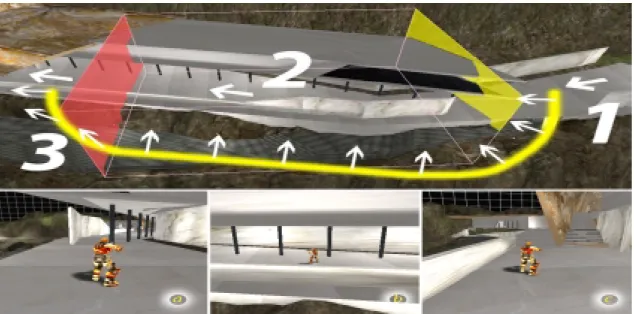
When running the environment and the user approaches the colonnade, upon entering, an event is triggered in the VE which is recognised by the system and the camera module (tracking shot) takes over. Figure 3 demonstrates this graphically from the user’s standpoint. As the user approaches position 1 in Figure 3 the act of the user entering the volume (the wire frame box in Figure 3) is recognised by the system as an event. Window (a) in Figure 3 depicts the user’s approaching the colonnade from a “standard” camera view: a third person point of view. Once the event has been identified, the camera moves into the tracking position shot (yellow line in Figure 3 indicates the camera path and window (b) what the user sees once the camera is in position) whilst the
user remains within the volume boundaries (see position 2 in Figure 3). Finally, the user’s action of leaving the
volume (see position3 in Figure 3) is recognised by the system as an event and the system, in turn, responds by returning the camera to a third person point of view (window (c)).
4.2 Example
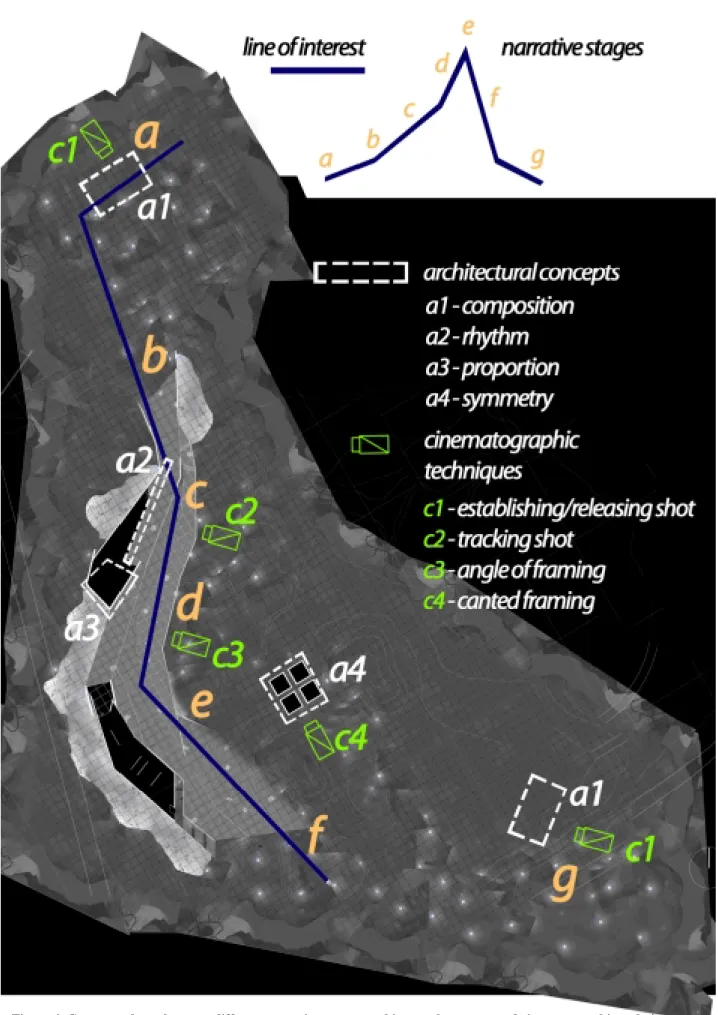
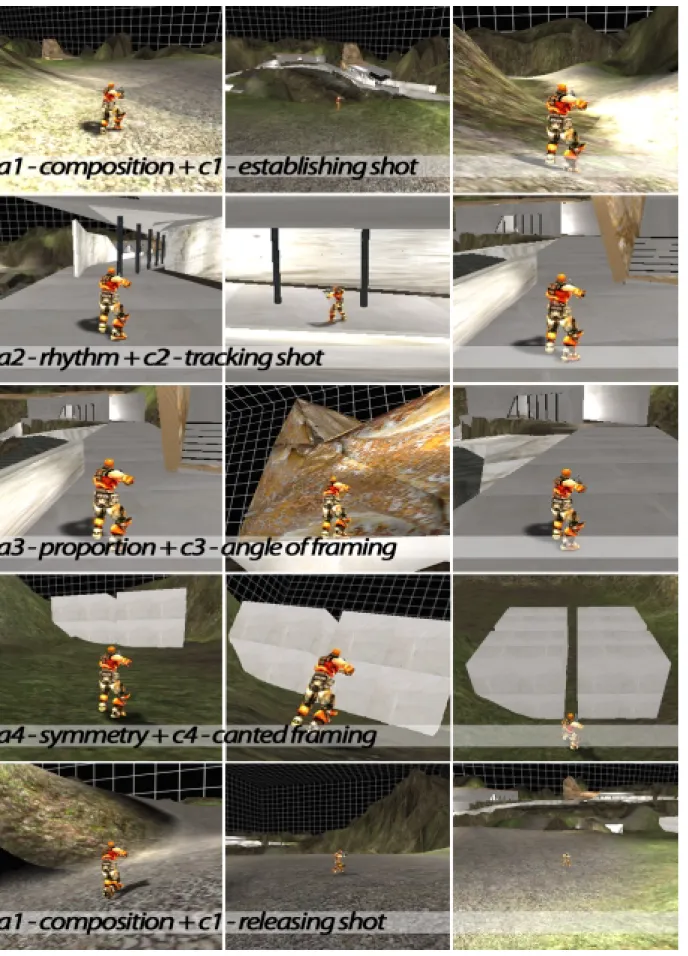
The narrative model used in the example follows the principles laid by Laurel and it can be found in [Laurel93] (see figure 4 narrative stages). Point (a) on the narrative scale introduces the first architectural concept (composition) through the use of the ‘establishing shot’ (cinematographic technique). The user remains relatively calm while progressing through the environment and gets a sense of the composition of the architecture at hand. As he nears the built form (b), his experience heightens as he is introduced to more concepts at more of a regular pace. As he reaches (c), (d), and (e) he experiences rhythm, scale, and symmetry – this area is where the experience of the environment is most enveloping. Reaching points (f) and towards (g) the user is given a slow release from the environment, finally to look back over the architecture once again, taking in the architectural composition from another perspective.. The correspondence between different narrative stages; architectural concepts and cinematographic techniques used is shown in figure 4. Figure 5 shows a series of film strips detailing each architectural concept with its partnered cinematographic technique as it used in the architectural walkthrough. The sequential nature of the camera positions exists as a vehicle for providing the structured, experiential narrative. Deviating from this ‘path’ finds the user out-of-narrative but able to experience the environment, and thus the architecture,
along an undetermined path.
Figure 3. User approaches the colonnade, upon entering an event is triggered in the VE which is recognised by the system and the camera module takes over
5. CONCLUSIONS
In this paper we have presented an initial prototype of a real-time cinematic control camera engine which enables the creation of architectural walkthroughs with a narrative structure. Basically, our prototype can be seen as a method of encapsulating camera tasks, which follow the rules the cinematography (i.e. tracking shot), into well defined units called “camera modules” (i.e. tracking shot module) which are then combined to create walkthroughs with narrative structure. We therefore have presented the initial steps for a camera mode which we believe could give the viewer a better understanding of the architectural design concepts in a virtual environment.
6. REFERENCES
[Alexander77] Alexander, C., Ishikawa, S., and Silverstein, M. 1977. A Pattern Language. Oxford University Press.
[Alvarado03] Alvarado, Rodrigo García. and Castillo, Gino Alvarez. 2003. Técnicas cinematográficas para las animaciones arquitectónicas. In proceedings of SIGraDi 2003.
[Arijon76] Arijon, D. 1976. “Grammar of the Film Language”. Communication Arts Books, hasting house, Publishers, New York
[Calderon00] Calderon, C., van Schaik, P., and Hobbs, B. 2000. Is VR an effective communication medium for building design?. Proceedings. Virtual Reality International Conferences 2000, Laval, France 18-21 May 2000 (pp 46-55)
[Christianson96] Christianson, D. B., Anderson, S. E., He, L., Cohen, M.F., Salesin, D.H., and Weld, D.S. 1996. Declarative Camera Control For Automatic Cinematography”. In proceedings of AAAI ’96, 148-155.
[Drucker95] Drucker, S. and Zeltzer, D. 1995.
CamDroid: A system for implementing intelligent
camera control. In proceedings of the 1995 Symposium on Interactive 3D Graphics, 139-144.
[He96] He, L. Cohen, M. and Salesin, D. 1996. The virtual cinematographer: A paradigm for automatic real-time camera control and directing. In
Proceedings of the ACM SIGGRAPH’96, 217-224. 1996
[Karp90] Karp, P. and S.K. Feiner. 1990. Issues in the automated generation of animated presentations. Graphics Interface ’90.
[Laurel93] Laurel, B. 1993. Computers as theatre. Addison Wesley Longman.
[Rasmussen92] Rasmussen, S.E. 1962. Experiencing Architecture, MIT Press
[Stappers01] Stappers, Pieter Jan., Saakes, Daniel,. and Addriaanse, Jorrit. 2001. On the narrative structure of Virtual Reality walkthroughs. CAAD futures 2001. [Temkin03] Temkin, A. 2003. Seeing Architecture with a
Filmaker’s Eyes. In proceedings of ACADIA 2003: connecting-crossroads of digital discourse.
[UnrealEngine04] UnrealEngine2. 2004. Internet. Avail-able from http://udn.epicgames.com/Two/WebHome; accessed 17th of August 2004.
[Ware90] Ware, C. and Osborne, S. 1990. Exploration and Virtual Camera Control in Virtual Three Dimensional Environments. Proceedings of the 1990 Symposium on Interactive 3D Graphics (Snowbird, Utah)1990
[Wilenski27] Wilenski, Reginal Howard. 1927. The Modern Movement in Art. London: Faber and Faber. [Yale04] Yale, 2004. Film Analysis Guide. Internet.
Available from http://classes.yale.edu/film-analysis; accessed 28th November 2004.
Figure 5. Architectural concepts with its partnered cinematographic techniques as it used in the architectural walkthrough.
![Table 1. List of camera shots and camera movements. A complete description of camera shots can be found in [Yale04]](https://thumb-us.123doks.com/thumbv2/123dok_us/905641.2616704/3.892.82.453.542.683/table-list-camera-camera-movements-complete-description-camera.webp)