Secure Protocols for Key
Pre-distribution, Network Discovery,
and Aggregation in Wireless Sensor
Networks
byKevin J. Henry
A thesis
presented to the University of Waterloo in fulfillment of the
thesis requirement for the degree of Doctor of Philosophy
in
Computer Science
Waterloo, Ontario, Canada, 2015
c
This thesis consists of material all of which I authored or co-authored: see Statement of Contributions included in the thesis. This is a true copy of the thesis, including any required final revisions, as accepted by my examiners.
Statement of Contributions
The content presented in Chapter3was co-authored with Maura Paterson. All chapters of this thesis were authored under the supervision of Douglas Stinson.
Abstract
The term sensor network is used to refer to a broad class of networks where several small devices, called sensors, are deployed in order to gather data and report back to one or more base stations. Traditionally, sensors are assumed to be small, low-cost, battery-powered, wireless, computationally constrained, and memory constrained devices equipped with some sort of specialized sensing equipment. In many settings, these sensors must be resilient to individual node failure and malicious attacks by an adversary, despite their constrained nature.
This thesis is concerned with security during all phases of a sensor network’s life-time: pre-deployment, deployment, operation, and maintenance. This is accomplished by pre-loading nodes with symmetric keys according to a new family of combinatorial key pre-distribution schemes to facilitate secure communication between nodes using minimal storage overhead, and without requiring expensive public-key operations. This key pre-distribution technique is then utilized to construct a secure network discovery protocol, which allows a node to correctly learn the local network topology, even in the presence of active malicious nodes. Finally, a family of secure aggregation protocols are presented that allow for data to be efficiently collected from the entire network at a much lower cost than collecting readings individually, even if an active adversary is present.
The key pre-distribution schemes are built from a family of combinatorial designs that allow for a concise mathematical analysis of their performance, but unlike previous ap-proaches, do not suffer from strict constraints on the network size or number of keys per node. The network discovery protocol is focused on providing nodes with an accurate view of the complete topology so that multiple node-disjoint paths can be established to a des-tination, even if an adversary is present at the time of deployment. This property allows for the use of many existing multi-path protocols that rely on the existence of such node-disjoint paths. The aggregation protocols are the first designed for simple linear networks, but generalize naturally to other classes of networks. Proofs of security are provided for all protocols.
Acknowledgements
I would like to thank all members, past and present, of the Cryptography, Security, and Privacy (CrySP) research lab for inspiring and shaping my work over the years.
Dedication
Table of Contents
List of Tables xi
List of Figures xii
1 Introduction to Sensor Network Research 1
1.1 Introduction to Sensor Networks . . . 2
1.1.1 Example Applications . . . 4
1.2 Security Issues in Wireless Sensor Networks . . . 7
1.2.1 Pre-deployment . . . 10
1.2.2 Deployment/Setup . . . 11
1.2.3 Operation . . . 15
1.2.4 Management/Maintenance . . . 16
1.3 Organization and Contributions . . . 18
1.3.1 Pre-deployment . . . 18
1.3.2 Deployment/Setup . . . 19
1.3.3 Operation . . . 20
1.3.4 Maintenance. . . 20
2 An Overview of Combinatorial Key Pre-distribution 22 2.1 Key Pre-distribution . . . 23
2.1.2 Randomized Schemes . . . 26
2.1.3 But Why Rely on Randomness? . . . 29
2.2 Combinatorial Design Theory . . . 30
2.2.1 Set Systems . . . 30
2.2.2 Configurations. . . 31
2.2.3 Balanced Incomplete Block Designs . . . 33
2.2.4 Transversal Designs . . . 34
2.2.5 Other Designs . . . 35
2.3 Set Systems as KPSs . . . 35
2.4 The Linear Scheme . . . 37
2.4.1 A More Thorough Analysis . . . 41
2.5 The Quadratic and Higher Degree Schemes . . . 43
2.5.1 Higher Degree Constructions . . . 45
2.6 A Useful Generalization . . . 46
2.7 Multiple Space Schemes . . . 51
2.8 Summary and Remarks . . . 53
3 Flexible Parameters for Combinatorial KPSs 55 3.1 Problems with Parameter Choice . . . 56
3.2 Approaches to Varying Network Size . . . 57
3.2.1 Randomized Subset Schemes . . . 58
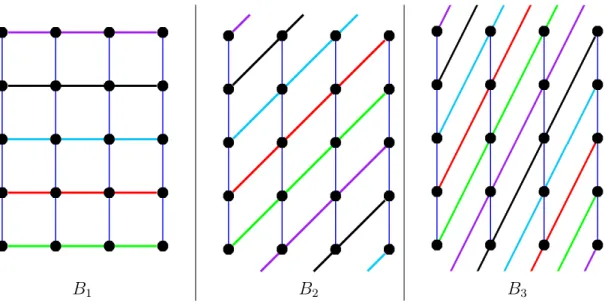
3.2.2 Resolvable and Decomposable Designs . . . 59
3.2.3 Decomposable Schemes . . . 60
3.2.4 Finer Control Over Network Size . . . 63
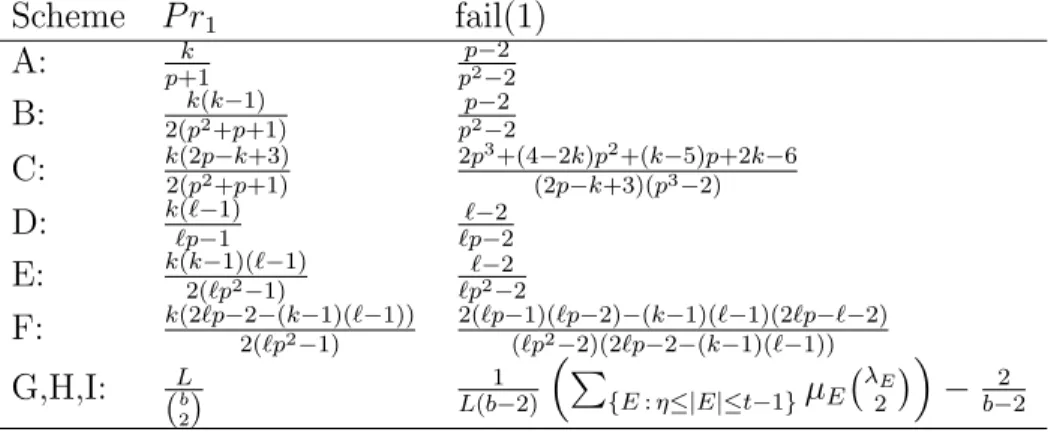
3.3 Deriving Performance Metrics . . . 63
3.3.1 Analysis of the Decomposable Linear KPS . . . 64
3.3.2 Analysis of the Decomposable Quadratic KPS . . . 65
3.3.3 Computing Performance Metrics for Arbitrary Set Systems . . . 68
3.4 Comparison of Decomposable and Randomized Approaches . . . 75
4 Secure Network Discovery 83
4.1 Introduction . . . 83
4.1.1 Related Work . . . 84
4.2 Problem Setting . . . 85
4.3 Tools and Assumptions . . . 87
4.3.1 Authentication . . . 87
4.3.2 Key Pre-distribution . . . 90
4.3.3 Localization and Directional Antennas . . . 91
4.4 Proposed Solution . . . 92
4.4.1 Phase 1: Identifying Neighbors . . . 92
4.4.2 Phase 2: Identifying 2-Hop Paths . . . 98
4.4.3 Phase 3: Beyond 2-Hop Paths . . . 102
4.4.4 Adding New Nodes . . . 103
4.5 Performance Analysis . . . 103
4.6 Summary and Remarks . . . 106
5 Resilient Aggregation in Sensor Networks 110 5.1 The Aggregation Problem . . . 111
5.1.1 Secure Aggregation . . . 113
5.1.2 Problem Statement . . . 116
5.1.3 Naive Solutions . . . 118
5.1.4 Comparison to Existing Approaches . . . 119
5.2 Linear Networks . . . 124
5.2.1 Key Pre-distribution for Linear Networks . . . 128
5.3 Secure Aggregation using the Optimal KPS . . . 128
5.3.1 Aggregation when k = 1 . . . 129
5.3.2 Analysis . . . 133
5.4 Aggregation Using the Pairwise KPS . . . 136
5.4.1 Analysis . . . 141
5.5 Aggregation Using the Group-Based KPS . . . 144
5.5.1 Reacting to Node Spoofing Attacks . . . 148
5.6 Comparing Linear Approaches . . . 149
5.7 Moving Beyond Linear Networks . . . 150
5.7.1 Merging Two Paths Into One . . . 151
5.7.2 Merging Multiple Paths . . . 152
5.8 Linear Sub-Networks in Random Topologies . . . 156
5.9 Comparison to Previous Approaches . . . 160
5.10 Grid-Based Networks and Load Balancing . . . 164
5.11 Group-Based Aggregation for Grid Networks . . . 166
5.12 Summary and Remarks . . . 168
6 Conclusion 169
APPENDICES 172
A Summary of Notation 173
B Data Tables 175
List of Tables
2.1 The effect of node compromise on resilience in the linear scheme. . . 42
2.2 The effect of node compromise on resilience in the quadratic scheme. . . . 45
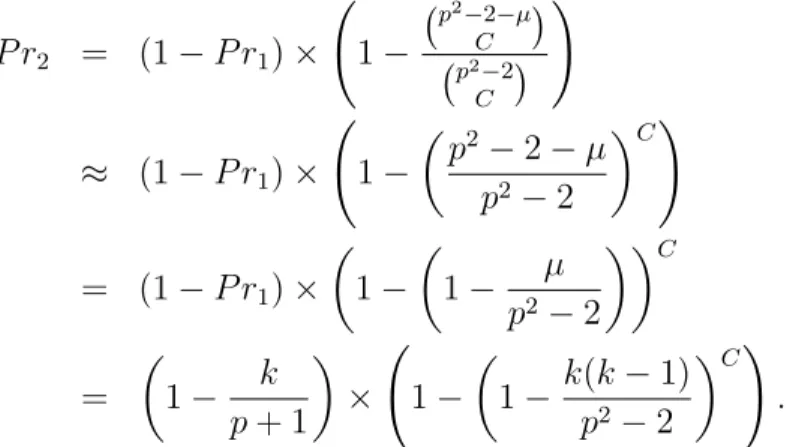
2.3 The two-hop connectivity (P r2) and resilience of the linear LS-KPS and MS-KPS. . . 53
3.1 Sample values for L for several small intersection thresholds. . . 71
3.2 Comparison of performance metrics for transversal design-based schemes. . 76
5.1 Summary of communication costs for the optimal, pairwise, and group-based linear aggregation protocols. . . 151
B.1 Resilience of random KPSs derived from a TD(2,15,71). This data was used to generate Figure 3.2. . . 175
B.2 Connectivity of random KPSs derived from a TD(2,15,71). This data was used to generate Figure 3.2. . . 177
List of Figures
1.1 The Mica2 and Mica2Dot sensor nodes. . . 3
1.2 An example of a millimeter-scale smart dust node. . . 4
2.1 Example of the Eschenauer-Gligor KPS. . . 27
2.2 A (7,7,3,3)-configuration, also known as the Fano plane. . . 32
2.3 Example blocks in a TD(2,4,5). . . 35
2.4 Some sample blocks in the linear LS-KPS. . . 38
3.1 A partial resolution of a TD(2,5,5). . . 60
3.2 Comparison of linear schemes based on a TD(2,15,17) with maximal net-work size N ≈5000. . . 77
3.3 Comparison of quadratic schemes with intersection threshold η = 1 based on a TD(3,15,17) with maximal network size N ≈5000. . . 78
3.4 Comparison of quadratic schemes with intersection threshold η = 2 based on a TD(3,15,17) with maximal network size N ≈5000. . . 79
3.5 Comparison of linear schemes based on a TD(2,25,157) with maximal net-work size N ≈24000. . . 80
3.6 Comparison of quadratic schemes with intersection threshold η = 1 based on a TD(3,25,29) with maximal network size N ≈24000.. . . 80
3.7 Comparison of quadratic schemes with intersection threshold η = 2 based on a TD(3,25,29) with maximal network size N ≈24000 . . . 81
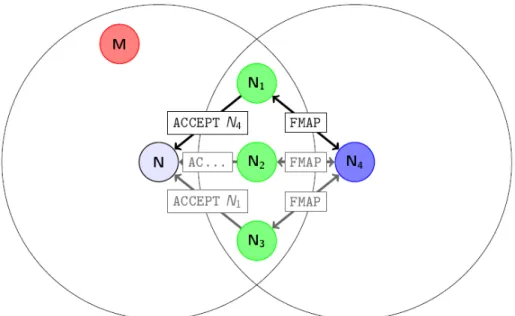
4.2 A pictorial demonstration of neighbor discovery. . . 94
4.3 A pictorial demonstration of neighbor discovery (cont.) . . . 95
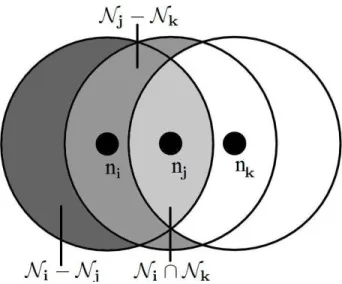
4.4 The intersecting neighborhoods of two-hop neighbors. . . 99
4.5 An example of two-hop neighbor discovery . . . 101
4.6 The probability that the LHM assumption is satisfied for a random network. 104 4.7 The probability 2HM assumption is satisfied for a random network. . . 105
4.8 The probability that the LHM assumption is satisfied for a variety of differ-ent parameter with fixed density. . . 107
4.9 The probability that the 2HM assumptions are satisfied for a variety of different parameter sets with fixed density. . . 108
5.1 A simple aggregation tree within a network. . . 112
5.2 Commitment tree generation in the CPS aggregation protocol. . . 122
5.3 An (8,2)-linear sensor network. . . 125
5.4 Examples of subsets of a thick linear network, and thick two-level linear network. . . 126
5.5 A minimal Euclidean spanning tree on a geometric graph of 100 nodes. . . 127
5.6 Optimal and pairwise KPS for a (10,3)-linear network, and group-based KPS for a (10,2)-linear network.. . . 129
5.7 A resilient data aggregation protocol for (N,1)-linear networks wherek = 1 using the optimal KPS . . . 131
5.8 A flawed data aggregation protocol for (N,1)-linear networks wherek = 2 . 134 5.9 A resilient data aggregation protocol for k = 2.. . . 137
5.10 A resilient data aggregation protocol fork = 2 (cont.) . . . 138
5.11 A (16,3)-linear network partitioned into groups and subgroups . . . 144
5.12 In-group aggregation for subgroup si. . . 145
5.13 A group-based aggregation protocol . . . 146
5.14 A network that consists of two simple linear networks converging into a single linear network. . . 151
5.15 Breakdown of a tree into overlapping linear networks. . . 153
5.16 The “optimalk = 1” tree-based aggregation protocol. . . 154
5.17 A comparison of a Euclidean minimum spanning tree and a breadth-first spanning tree. . . 157
5.18 A balance between the MST and the shortest path tree in a Euclidean network.160
5.19 A minimum directed spanning tree. . . 161
5.20 A simple grid-based sensor network and a trivial linear spanning tree. The square node denotes the base station. . . 164
5.21 A pair of spanning trees for a grid network with communication ranged= 1, where each merge node in one tree is a leaf node in the other. . . 165
5.22 A pair of spanning trees for a grid network with communication range d = 1.5, where each merge node in one tree is a leaf node in the other. . . 166
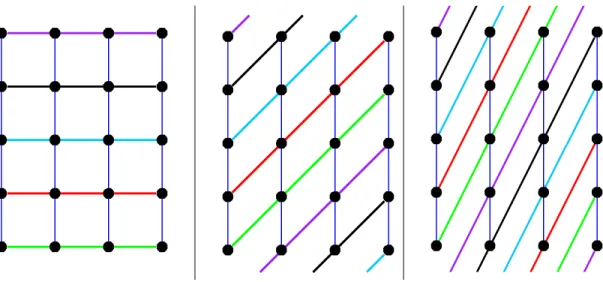
5.23 A grid network partitioned into groups of size 4×4, and subgroups of size 2×2. . . 167
Chapter 1
Introduction to Sensor Network
Research
The termsensor network is used to refer to a broad class of networks where several small devices, called sensors, are deployed in order to gather data and report it back to one or more base stations. Traditionally, sensors are assumed to be small, low-cost, battery-powered, wireless, computationally constrained, and memory constrained devices equipped with some sort of specialized sensing equipment. These descriptors are not precise, which makes formalizing a problem statement using sensors difficult in most cases. In practice, the term sensor can be applied to any communication-enabled sensing device whose processing power lies somewhere in the domain between a smart card and a cell phone. A sensor network is a collection of such sensors, ad-hoc or otherwise, which collectively coordinate their actions in order to sense data about their environment and forward it to a central location.
This thesis is concerned with a subset of the sensor network problem domain where nodes have extremely limited computational and memory constraints. In particular, we present a suite of protocols that allow resource-constrained sensor nodes to operate dur-ing all phases of a network’s lifetime in the presence of an active malicious adversary. The severe limitations of sensors in this setting make many common cryptographic tech-niques, such as public-key cryptography, too expensive to consider. In general, we rely on symmetric-key cryptography and design protocols from the ground up, beginning with a minimal set of assumptions, to identify precisely what capabilities are necessary in order provide a provably secure solution. We provide complete proofs of security and simulation results where applicable.
The protocols presented in this thesis span the main phases of the lifetime of a sensor network. First, we present a flexible variant of an existing key pre-distribution scheme that allows for combinatorial key pre-distribution to be used in networks of arbitrary size, rather than just networks where the number of nodes is a prime or prime power. We then demonstrate how this scheme can be used to perform secure network discovery in the presence of an active malicious adversary, by using a consensus-based voting protocol.
The main operational goal of a sensor network is to collect and report data to a base station. We present a suite of aggregation protocols that makes this process more efficient, and ensures that damaged or compromised nodes cannot maliciously alter the network-wide aggregate without detection. These protocols are based on a family of linear networks; how-ever, we demonstrate that such networks arise naturally in many common sensor network settings. The generalization of our approach can be applied to many other topologies while incurring only small overhead at each point two or more paths merge in a spanning tree.
1.1
Introduction to Sensor Networks
The most general interpretation of the term “sensor network” refers to any network in which low-cost, low-power nodes are deployed to collect and forward sensor readings, and as such, they encompass a wide variety of node capabilities and applications. Definitions in the literature are often vague, as there is no standard accepted definition of a sensor network. For example, according to Jawhar and Mohamed [53],
“a sensor network can be described as a collection of sensor nodes which co-ordinate to perform some specific action.”
and according to Martin and Paterson [74],
“There is no single, precise, definition of a wireless sensor network. As a result this term is applied to a wide family of networking environments that support a range of applications.”
The lack of a precise definition makes sensor networks a wide open space of research, with many different assumptions about the individual capabilities of sensor nodes and the set-tings where they will be deployed. One common platform for sensor network development is TinyOS [63], an operating system built specifically for sensor networks. TinyOS is often used in conjunction with Mica sensor hardware. Figure 1.1 shows a typical Mica2 sensor node alongside a Mica2Dot node, with the following specifications:
Figure 1.1: The Mica2 and Mica2Dot sensor nodes. The full sized Mica2 node is powered by 2 AA batteries, while the Mica2Dot is powered by a 1 inch coin cell. Images taken from the Mica2 [29] and Mica2Dot [30] data sheets
• Processor: ATmega 128L (8-bit, 16 MHz) • Program Flash Memory: 128K bytes • Measurement Flash Memory: 512K bytes • Communication Range: 500–1000m
• Size: 58 x 32 x 7mm (Mica2), 25 x 6mm (Mica2Dot) • Weight: 18g (Mica2), 3g (Mica2Dot)
• Power: 2x AA batteries (Mica2), 3V coin cell (Mica2Dot)
The Mica sensor platform was first released in 2002, and provided researchers with a low-cost, standardized platform upon which sensor network protocols could be implemented and tested. Mica nodes are physically large, allowing them to be powered with off-the-shelf hardware, and to be equipped with standard connectors for attaching different sensing equipment. In the decade following the release of TinyOS and the Mica platform, several other similar nodes have been released.
A different branch of hardware-related sensor research has been pushing the limits on the physical size of sensor nodes, typically at the expense of communication range, memory,
Figure 1.2: An example of a millimeter-scale smart dust node, based on the node presented by Lee et al. [62]. Photograph by Martin Vloet, Michigan Photography [102].
and computational ability. The goal of such work is to make the nodes as small and cheap as possible, while still retaining a useful amount of functionality. For example, the node presented by Warneke et al. [107], around the same time the Mica platform was released, has a total volume of 16 mm3, and the node presented a decade later by Lee et al. [62] is less than 2 mm3 in volume. Nodes on this scale are sometimes referred to assmart dust.
The contrast between Mica-like nodes and smart dust nodes exemplify the wide scope of sensor network research. Solutions for one class of node may make assumptions that are not relevant for a different class of nodes. In particular, the trend of reducing the size and cost of individual nodes in smart dust networks, potentially at the expense of speed and storage, suggests that there will always be a demand for protocols that make a minimal set of assumptions about the capability of each node.
1.1.1
Example Applications
Akyildiz et al. [2] provide a survey of potential sensor network applications, partially sum-marizing earlier proposals [38]. They identify several types of measurements that a sensor
node may be deployed to measure. These include: • Temperature • Humidity • Vehicular movement • Light levels • Pressure • Soil conditions • Noise levels
• The presence or absence of certain objects • Mechanical stresses
• Motion characteristics (velocity, orientation, etc.).
In addition to specific sensor types, they also enumerate many deployment environments where sensor networks could be used. These include:
1. Military applications
• Battlefield surveillance
• Reconnaissance of opposing forces and terrain • Targeting
• Damage assessment
• Nuclear, biological, and chemical attack detection and reconnaissance. 2. Environmental applications
• Forest fire detection • Biocomplexity mapping • Flood detections
3. Health applications
• Physiological data monitoring • Patient tracking/monitoring • Drug administration. 4. Home applications • Home automation • Smart environment. 5. Other applications
• Climate control in office buildings • Vehicle monitoring
• Inventory control.
Alongside their survey of applications, Akyildiz et al. also survey pre-deployment, de-ployment, post-dede-ployment, and environmental issues that affect sensors throughout their lifetime. These phases roughly match the same phases considered in this thesis, which are discussed in detail in the next section. Yick et al. [112] provide another survey that iden-tifies many of the same deployment scenarios, but they consider the requirements of each deployment scenario in more detail, and relate them to existing sensor network technologies that have emerged since their initial exploration.
Commercial hardware is now available that addresses most of the sensing applications discussed above. A notable example is the Libelium Waspmote [66], which provides an updated Mica-like platform with several types of swappable sensors. These include:
• Gas sensors
• Event sensors (pressure, impact, vibration, etc.) • Water sensors (pH, temperature, dissolved gases, etc.) • City monitoring (noise, dust, luminosity, humidity, etc.) • Parking monitor (car detection)
• Video (cameras, IR, etc.) • Radiation (Geiger counter) • Smart meter (water, power, etc.)
Each of these sensors sits on top of a node that is of similar size to the Mica2 node in Figure1.1, which has a physical footprint slightly larger than two AA batteries.
1.2
Security Issues in Wireless Sensor Networks
Sensor networks have been proposed for a variety of applications. In many of these ap-plications, an active adversary or a global eavesdropper may be present, but even in the general case, there are several security considerations to be made. Sensor networks may be deployed in an unknown or hostile environment and are subject to physical damage upon deployment, or during operation, as a result. Nodes are battery-operated and expected to fail over time. Sensing equipment, or the nodes themselves, may also malfunction and behave in an unpredictable manner.
A common example that demonstrates several key security issues is the use of sensors to survey hostile or adversary-controlled territory. An airplane is loaded with several sensor nodes and flies over the area to be surveyed, dropping sensors as it goes (and potentially damaging some of them). The goal of these sensors is to self-organize and establish a communication network, collect data about their surroundings, and forward it back to a base station. The adversary wishes to prevent data collection, and is expected to capture and disable nodes, re-program nodes, insert fake nodes, and alter or block communication between nodes. Even if nodes can be made tamper-proof, the adversary may have control over the environment and can feed false information to nodes. Durisic et al. [36] provide a survey of military applications of wireless sensor networks.
Shi and Perrig [98], and Wang et al. [105] identify the following general security re-quirements:
• Availability — Ability to remain accessible in the presence of DoS attacks.
• Authorization — Ability to prevent unauthorized nodes from joining the network. • Authentication — Ability to verify that a given message originated from a given
• Confidentiality — Ability to ensure that only the intended recipients can read mes-sages.
• Integrity — Ability to ensure that messages have not been altered during transit. • Fault Tolerance — Ability to continue operation in the presence of failure.
• Self Healing — Ability to recover from and adapt to changes in the network.
• Non-Repudiation — Ability to prevent a node from denying it sent a signed message. • Repudiation — Ability to deny having sent a signed message.
• Freshness — Ability to detect if old messages are replayed. • Reliability — Ability to guarantee a message is delivered.
• Accountability — Ability to detect and punish malicious or malfunctioning nodes. • Forward Secrecy — Ability to prevent a node from reading messages once it is
re-moved from the network.
• Backward Secrecy — Ability to prevent a new node that joins the network from reading any previous messages.
• Scalability — Ability to accommodate both very small and very large networks. • Flexibility — Ability to accommodate different deployment methods and
environ-ments.
• Resiliency — Ability to continue operation in the presence of compromised nodes. Not all applications will require all security considerations. In general, these security requirements are not specific to sensor networks, and apply to virtually any networking application.
Karlof and Wagner [54] provide an intuitive approach to sensor network security for routing protocols by considering network assumptions, trust requirements, threat mod-els, and security goals before considering specific routing attacks in detail. The attacks considered are:
• Selective forwarding/dropping — Selectively dropping some messages but not others. • Sinkhole attacks — Attempting to route as much traffic through a single malicious
node as possible.
• Sybil attack — One node pretending to be multiple nodes.
• Wormhole attacks — Using a high-power transmitter to connect one or more mali-cious nodes, thus creating more attractive but adversarial-controlled links.
• HELLO flood — Spoofing or re-broadcastingHELLOmessages to falsely convince nodes they are within communication range.
• Acknowledgment spoofing — Spoofing of link-level protocol communication messages to falsely convince a node its messages were or were not delivered.
In general, attacks against sensor networks can also be categorized with respect to the Open Systems Interconnection (OSI) model, with attacks occurring at one of the physical, data link, network, transport, or application layers.
Karlof and Wagner’s threat model distinguishes between a node-class attacker, which is subject to the same constraints as a regular sensor node, and a laptop-class attacker, which has capabilities similar to a base station. Distinctions are also made betweeninsider attacks, performed by a malfunctioning or compromised node, and outsider attacks, per-formed by an attacker adding unauthorized nodes to the network. As a final consideration, bothactive and passive adversaries are considered, with the former able to actively inject or alter messages into the network. Active adversaries are often considered to be local, able to communicate with only a small portion of the network, while passive adversaries are often considered to be global, and are able to eavesdrop on all messages sent over the network. In many applications, the base station is considered to be tamper-proof and is treated as a trusted third party. Cardenas et al. [17] provide a similar taxonomy of sen-sor network threat models based on a study of Supervisen-sory Control and Data Acquisition (SCADA) networks.
When considering security issues, it is useful to approach sensor network operation as occurring in a set of discrete phases which can be analyzed independently. The lifetime of a sensor network can be broken down into four distinct phases:
1. Pre-deployment 2. Deployment/Setup
3. Operation
4. Management/Maintenance.
Each of these phases has its own set of security considerations, which will be discussed briefly in the next section. These phases are similar to the phases discussed by Carmen et al. [18]. In their model, the lifetime of a sensor network was broken into manufacture, storage, pre-deployment, deployment, mission, and mission completion. These parallel the four phases presented above, with the addition of the physical security of the nodes prior to deployment. Physical security during manufacture and storage is beyond the scope of this thesis.
The protocols presented in this thesis each use slightly different adversarial models, which are presented alongside each protocol in the subsequent chapters. In all cases we assume an adversary compromises and assumes control over a subset of nodes in the net-work. The key pre-distribution scheme in Chapter 3 is analyzed with respect to random node compromise across the entire network. The later chapters require constraints on the number of compromised nodes within certain subsets of the network. In some cases, a majority of honest nodes are required locally to prevent malicious nodes from injecting false information. In the case of linear topologies, considered in Chapter 5, we require that honest nodes occur with sufficient frequency that the adversary cannot segment the network by taking control of sufficiently many consecutive nodes.
1.2.1
Pre-deployment
This phase is concerned with all aspects of sensor node security before the network is deployed.
Node Capability
The physical characteristics of each node must be established before any security consid-erations can be made. In particular, the basic capabilities, such as memory, CPU, and battery power all determine the types of cryptographic techniques that can be utilized. While symmetric-key cryptography is often used in sensor networks, much research has been done to make public-key cryptography practical for resource-constrained nodes. Rel-evant works include the first elliptic curve cryptography (ECC) implementation for sensor networks [70], RSA and additional ECC implementations [104], and the TinyPBC [80] and TinyECC [68] libraries.
The communication medium in sensor networks is also an important consideration. Although most sensor network protocols assume omnidirectional wireless broadcasts as the communication medium, many [6,13,58,79] have begun investigating the use of directional antennas in sensor networks. In particular, Ash and Potter [6] and Kumar and Varma [58], utilize directional antennas in order to perform localization, which allows a sensor node to determine its approximate physical location after deployment. The communication medium also determines whether or not known methods for distance bounding [14,92], or fingerprinting [31,91], are available.
Additionally, special hardware, such as a GPS receiver or synchronized clocks, may be available in some settings.
Key Management
Because symmetric-key cryptography is usually preferred in sensor networks, the problem of pre-distributing keys to each sensor node is an important area of research. Eschenauer and Gligor [37] proposed a simple key pre-distribution scheme where each node is issued a random subset of keys from a larger key pool. This idea has been extended by others [24] as well. More recently, combinatorial designs have been utilized for key pre-distribution to increase efficiency or add additional useful properties. Examples include early proposals by C¸ amtepe and Yener [21], who utilize balanced incomplete block designs (BIBDs) and generalized quadrangles to manage keys. Martin explores the design space of sensor net-works [73] and draws parallels between several design requirements and existing designs. Combinatorial approaches have also been used in specialized settings, such as for grid topologies [9], and settings where nodes are deployed in separate groups [76]. Transversal design-based systems [61] are used extensively in this thesis.
In systems where public-key cryptography is utilized, the key management step would also include issuing keys and certificates to each node before deployment.
1.2.2
Deployment/Setup
The deployment phase is concerned with the physical characteristics of the network after it is deployed, along with protocols that run once, such as network discovery, when the network comes online.
Topology
Because sensor networks are used in a variety of applications, there are a variety of topolo-gies that arise naturally depending on how nodes are deployed and how keys are issued. More efficient protocols are possible when additional assumptions can be made about the structure of the network.
In many applications, nodes are assumed to be distributed completely at random, thus giving rise to arandom topology. A common assumption is that nodes are distributed by airplane over a region. In this setting, nodes are still considered to be randomly distributed, however additional assumptions arise due to the nature of deployment. In particular, a node dropped from a specific point will likely land within an expected radius, and nodes dropped shortly before or after will have a higher probability of being nearby than nodes dropped much earlier or later. Such networks have apartially random topology.
Sensor networks that contain nodes of differing capabilities often give rise to a natural hierarchical topology. Nodes with greater communication range, computational ability, and larger batteries can aid in routing or aggregating messages for lower-power nodes in their neighborhood. In settings where there is complete control over the deployment location of nodes, the most natural topology is often agrid, as it provides a high level of coverage using a small amount of nodes. Some protocols have been designed specifically for grid-based sensor networks [9]; however, in general the area is not well studied.
Martin and Paterson [74] observe that the network topology has a tremendous impact on the design of sensor network protocols, and provide a simple, but comprehensive framework for categorizing networks based on the expected topology and key requirements. Their framework considers three categories:
1. Homogeneity
• Homogeneous — All nodes have identical capability.
• Hierarchical — Nodes have a natural hierarchy based on capability. 2. Control Over Deployment/Topology
• Fixed, no control — Sensors are distributed randomly.
• Fixed, partial control — Sensors are distributed with some control over general location, but with some randomness on exact location. For example, nodes distributed from a plane will likely land within an expected area and near other nodes dropped at the same time.
• Fixed, full control — Network topology is predefined.
• Locally mobile — A node is mobile within a well-defined subset of the network. • Fully mobile — Nodes are mobile throughout the entire network.
3. Communication structure
• t-complete — All subsets of size t should be capable of secure communication. • locally t-complete — All local subsets of size t should be capable of secure
communication, where “local” refers to nodes that are neighbors in some sense, such as those that are within each other’s communication range.
• regionallyt-complete — All subsets of sizet in a given geographic region should be capable of secure communication.
The distinction between locally complete and regionally complete can be used, for example, to distinguish between cases where nodes deployed in a fixed topology should share keys with other nearby nodes in their communication range, while mobile nodes should share keys with other nodes deployed in the same general region, even if this region is significantly larger than any node’s communication range. In the context of the above framework, the protocols presented in this thesis are mainly designed for homogeneous, fixed networks, with regionally or locally t-complete communication structure.
Jawhar and Mohamad [53] have observed that sensor networks have found several applications in settings where the network topology is inherently linear. For example, monitoring of pipelines, railways, subway tunnels, power lines, and border control have all been proposed using sensor networks. Very little work exists in the literature that specifically targets linear topologies. This thesis presents a new family of protocols designed for linear topologies, which generalizes naturally to grid- and tree-based topologies. Network/Neighbor Authentication
Before messages can be routed in a sensor network, each node must determine its neighbors and the local network topology. This process is the first step for routing protocols, such as ARAN [97], S-AODV [114], and DV-SRP [83]. Poturalski, et al. [88] study the problem of neighbor discovery in sensor networks and demonstrated that approaches that rely on either message transmission time or distance between nodes cannot be secure in many settings; however, protocols that rely on both transmission time and location can be secure. Their model assumes nodes cannot collaborate with one another to determine the network
topology. Distance alone is not sufficient, as an adversary utilizing a wormhole attack, where a message is recorded in one location of the network, and then replayed at a different point in the network, can falsely convince two nodes they are close together. If an adversary is able to quickly forward a message, or relay messages between two nodes it controls at a high enough speed, then time alone is not sufficient in some cases. This thesis presents a collaborative approach to network discovery in the presence of active malicious nodes. Key Establishment
Cryptographic keys allow nodes to encrypt messages or compute message authentication codes (MACs), thus providing confidentiality against a passive adversary, and authenticity and integrity against an active adversary. Even when keys are pre-distributed to nodes, it is possible that many pairs of nodes wishing to communicate do not have a key in common, or may wish to establish a new unique pairwise key. In these situations, common neighbors between the two nodes can be used in order to establish a new shared key known only to these two nodes. Such approaches include those of Chan, Perrig, and Song [24], Ling and Znati [67] and Wu and Stinson [108], each of which utilize multiple node-disjoint paths in order to securely establish a key between two nodes. The key establishment problem is not considered in this thesis; however, the existence of multi-path protocols for key establishment provides motivation for the network discovery protocol presented in Chapter 4.
Localization
Some sensor network applications require that sensors are able to estimate their physical location in the network. This ability allows sensor readings to be tied to a physical lo-cation, as well as allowing the detection of certain types of attackers within the network. Localization protocols allow a node to determine either its absolute position, or its position relative to other nodes in the network. Ash and Potter [6], and Kumar and Varma [58] provide two different approaches utilizing wireless antennas to perform localization. Cheng et al. [27] provide a comprehensive survey on localization in sensor networks. An attacker may wish to inject false location information into the network in order to accomplish a wormhole attack, or a Sybil attack, which could both be detected if precise locations of each node were known. If a node relies on special “anchor” nodes, or infers its location from the location of other nodes, it must be able to determine its location even if some of its neighbors are malicious. This problem has been considered by Alfaro et al. [4], who
provide a protocol that allows a node to determine its location using neighbor-supplied data, as long as the number of malicious neighbors is below a certain threshold.
Localization protocols are utilized in Chapter 4 as a tool to perform collaborative network discovery. Including location information in route discovery messages allows for the detection of malicious nodes claiming to have the ability to communicate with nodes outside of their communication range.
1.2.3
Operation
The operation phase is where a sensor network spends most of its lifetime. During this phase nodes are actively collecting sensor readings and forwarding them to the base station. Routing
Routing messages within a sensor network is dependent on knowledge gained during the network discovery phase. ARAN [97], S-AODV [114], and DV-SRP [83] are examples of general routing protocols for sensor networks, and they generally focus on determining the shortest path from a node to its destination. The limited availability of battery power to send messages must be taken into consideration when routing messages, so that no single node receives a significantly higher load than others while routing messages. A more complete survey of sensor network routing protocols is given by Al-Karaki and Kamal [3] and Akkaya and Younis [1], and a survey of multi-path routing protocols is given by Stavrou and Pistillides [99].
Network discovery and routing are closely related. The above protocols provide meth-ods for discovering a route from a source to a destination, while the network discovery problem considered in this thesis is concerned with learning the complete topology within a subset of the network. With complete knowledge of the topology, determining a route to a destination is made much easier.
Aggregation
Because broadcasting a message is usually the most draining operation a sensor node per-forms, it is desirable to minimize the total number of messages sent when collecting sensor readings. For this reason, sensor readings may be aggregated hop-by-hop rather than having each node send its individual reading back to the base station. Rajagopalan and
Varshney [90] survey several techniques for data aggregation in wireless sensor networks. In an adversarial setting, a malicious node may be in charge of forwarding a single mes-sage that contains readings from many other nodes in the network. Various approaches to enforcing correct behavior or detecting malicious behavior include hash tree-based ap-proaches [25,40], directed diffusion-based approaches [96], concealed aggregation using ho-momorphic encryption [81,93], and homomorphic signatures [64]. In general, aggregation techniques are closely related to the underlying network topology and the communication model of the sensor network. In homogeneous networks, push and pull diffusion techniques are common. In the former, nodes initiate the propagation of sensor readings toward the base station, while in the latter the base station itself initiates the protocol by advertis-ing the type of information it is seekadvertis-ing. In hierarchical and group-based networks, the underlying topology provides natural points for aggregating data, such as a clusterhead aggregating readings for all nodes it is coordinating. The aggregation problem is considered in much greater detail in Chapter5.
Perfectly Secure Message Transmission
Perfectly Secure Message Transmission (PSMT) [32,106] allows a message to be transmit-ted from a source to a destination in such a way that the sender is guaranteed that the message is delivered and is unaltered as long as the assumptions of the protocol are met. The message is split across multiple node-disjoint paths and is reliably delivered if fewer than a third of the paths contain an adversarial node. Interactive variants of PSMT can also be constructed as long as fewer than one half of the paths contain an adversarial node. Perfectly secure message transmission has been used as a building block for key estab-lishment schemes [108], and can be used as a tool for building secure reliable aggregation protocols.
This thesis does not improve any prior results in perfectly secure message transmissions, but solves the related problem of determining multiple node-disjoint paths within the network so that multi-path protocols, such as PSMT, can be utilized. The discovery of such paths is not considered in the above proposals.
1.2.4
Management/Maintenance
During the lifetime of the network, non-sensing tasks, such as key refreshing or the addition of new nodes, may be required.
Adding/Removing Nodes
Due to the limited lifetime of sensor nodes, it may be desirable in some settings for new nodes to be periodically added to the network to replace nodes that have failed. Networks operating in this setting require that protocols used for network discovery, routing, and key pre-distribution be flexible enough to accommodate the addition of nodes post-deployment. Additionally, nodes deployed in a hostile environment may be compromised or become damaged. Honest nodes should possess the ability to detect and inform others of malicious nodes when possible, in an effort to limit their ability to interfere with normal network operation.
The flexible key pre-distribution schemes presented in Chapter 3 allow for future net-work growth with deterministic performance with respect to both connectivity and re-silience.
Key Refreshing
When compared to the problems of key pre-distribution and key establishment, the problem of key refreshing in sensor networks has seen relatively little attention. As an adversary captures deployed nodes, more keys are leaked and the overall security of the network is diminished. By periodically refreshing keys in the network, forward secrecy can be achieved, eliminating the ability of the adversary to decrypt messages that have been recorded prior to a node’s compromise. This problem has been considered by Blackburn et al. [10], as well as Guo and Leung [42], for example. A broader survey is given by He et al. [45].
Adversary Detection
The problem of detecting malicious nodes in sensor networks has been well studied. A wireless intrusion detection system was proposed by Chen et al. [26], while the problem of detecting Sybil attacks/cloned nodes has been considered by Li and Gong [64,65], among others. The problem of wormhole detection is also well studied, with results by Hu et al. [50], Bose et al. [15], and Dong et al. [33]. Detecting a passive adversary is difficult, which is why many secure sensor network protocols require that two nodes only exchange sensitive information if they have some sort of cryptographic key in common. Key pre-distribution schemes, like the family presented in Chapter3, facilitate initial secure communication the network, and the network discovery protocol presented in Chapter4allows nodes to learn
the local network topology so that multi-path key establishment can be used to establish a key with a neighbor, even if an active adversary is present. The aggregation protocols in Chapter 5actively detect malicious behavior and alert the base station when it occurs.
1.3
Organization and Contributions
This thesis presents a suite of secure protocols that touch on all phases of a sensor network’s lifetime, thereby allowing nodes to self-organize and operate in the presence of an active malicious adversary. Moreover, the protocols presented here do not utilize computationally expensive primitives, such as public-key cryptography, making them suitable for use on virtually any class of sensor hardware. The specific contributions, as they relate to each phase, are summarized here. For reference, a summary of notation used in this thesis is provided in Appendix A.
1.3.1
Pre-deployment
The pre-deployment phase is concerned with all aspects of a node prior to deployment. Our goal is to begin with a minimal set of assumptions about node capability, and add specific requirements as needed. For this reason, we rely only on the use of symmetric keys, and assume no public-key infrastructure is available. This approach provides functionality that targets the widest possible range of applications. The availability of protocols that make minimal assumptions about node capability allows resources to be spent on minimizing the size and cost of nodes, rather than on increasing their capability to accommodate secure protocols.
The main contribution in pre-deployment is given in Chapters 2and 3, where a family of flexible key pre-distribution schemes is presented. Chapter2explains the theory behind combinatorial designs and demonstrates how they can be used for key pre-distribution. These combinatorial designs are highly structured and well-studied, with a wide body of results to draw from, and allow for precise mathematical analysis. Unfortunately, their highly structured nature comes at the cost of rigid parameter choices.
Chapter3presents two new families of combinatorial key pre-distribution schemes that directly address the problem of inflexible parameter choice. The first family decomposes the underlying combinatorial design into several smaller designs, allowing for a precise perfor-mance analysis of numerous fixed-size subsets of the complete design. This decomposition
greatly expands the range of network sizes that the scheme can be applied to, without sacri-ficing the ability to precisely analyze the expected performance of the scheme. The second family considers the use of random subsets of arbitrary size, thus allowing the construction of networks of any size with predictable performance. The trade-off for complete flexibility in network size is a loss of precise mathematical analysis of performance. We compensate for this by providing several simulations that confirm the expected performance of our approach.
Chapter 3 contains joint work published with Maura Paterson [47].
1.3.2
Deployment/Setup
Chapter 4 presents a collaborative approach to secure network discovery in the presence of an active adversary. We assume that nodes have been distributed in a random topology with no prior knowledge of their expected neighbors in the network. The only pre-loaded information that each node possesses is a set of keys issued according to the “linear” key pre-distribution scheme presented in Chapter3.
The protocol in Chapter4is partly motivated by the existence of multi-path protocols, such as multi-path key establishment and perfectly secure message transmission. These protocols assume that an adversary has compromised some subset of the network, and utilize multiple node-disjoint paths to allow nodes to securely establish keys or send mes-sages. These approaches assume the existence of multiple node-disjoint paths, and leave the problem of actually establishing said paths as an open problem.
We present a protocol for establishing the local network topology to an arbitrary depth even when an active adversary is present from the very beginning. This adversarial as-sumption is stronger than asas-sumptions many other protocols use, where it is assumed that the adversary is not present until some time after deployment. The protocol is consensus-based, and only accepts the existence of a node and its neighbors if a majority of the received information is consistent. This property prevents an adversary from injecting false information as long as adversarial nodes do not form a majority in any portion of the network. Simulated results are included to demonstrate the effect of random node compromise on the assumption that the majority of nodes in a given neighborhood are honest.
The network discovery protocol presented here ensures that each node can present only one identity to the network, and that its identity must be consistent with the keys it was issued. This property ensures that a malicious node cannot present multiple identities or convince an honest node that it lies on more than one specific path between two nodes.
Therefore, paths produced by our protocol are suitable for use in protocols like perfectly secure message transmission and multi-path key establishment.
This protocol was presented previously [48].
1.3.3
Operation
The main goal of a sensor network is to capture and forward data to a central location. A common technique for saving energy during this process is to aggregate data hop-by-hop as it flows towards the base station, which allows for a single flow of information to capture the state of the network, rather than having each node report its readings individually.
Chapter 5 presents a family of aggregation protocols designed to aggregate over linear networks. Although linear networks are simple, they are a naturally arising topology in sensor networks. Many of the existing aggregation techniques assume a tree-based struc-ture, which, while applicable to a linear network, tend to provide worst-case performance when used with them. Our protocols exploit the linear topology of the network to pro-vide data aggregation with real-time adversary detection, which we accomplish by utilizing multiple natural key pre-distribution schemes for linear networks.
Although our aggregation protocols are based on a linear topology, we demonstrate that linear networks arise naturally in many general settings and demonstrate a method for utilizing our protocols over arbitrary topologies.
1.3.4
Maintenance
The main contributions in this thesis are three families of secure protocols for combinatorial key pre-distribution, network discovery, and data aggregation, which directly targets the pre-deployment, deployment, and operation phases, respectively. While none of these directly target the maintenance phase of a sensor network, all three protocols have an impact on it.
The flexible key pre-distribution schemes presented in Chapter3allow for a high degree of flexibility over parameter choice. This flexibility allows us to choose parameters for a larger than necessary number of nodes, while retaining predictable performance when only a subset of these nodes are deployed. Thus, parameters can be chosen to allow for new nodes to be added to the network without any significant change in the performance of the underlying key pre-distribution scheme, and without having to issue additional keys to already deployed nodes.
Chapter 4 describes a network discovery protocol that is secure in the presence of an active adversary. While this protocol is intended to be run by all nodes concurrently, the same approach can be repeated when new nodes are added into the network, thus allowing them to discover the local network topology.
Aggregation techniques prolong the lifetime of a sensor network by reducing the total energy expenditure when collecting data from all nodes. The aggregation protocols in Chapter 5 are designed to allow for runtime detection of malicious behavior so that the protocol can be aborted early and the malicious nodes can be dealt with. Depending on the deployment scenario, nodes could update the topology to route around potentially malicious nodes, or the network administrator could be alerted to replace said nodes.
Chapter 2
An Overview of Combinatorial Key
Pre-distribution
The previous chapter provided a brief introduction to sensor network research. Although sensor nodes are understood to be computationally limited, memory limited, and power limited, they encompass such a wide variety of applications that it is difficult to provide specific details. Several libraries exist that provide public key and elliptic curve cryptog-raphy on sensor nodes, and there are multiple platforms which are powerful enough to utilize them. At the same time, researchers continue to push for smaller nodes, often at the expense of computational ability or available storage.
The continual shrinking of sensor nodes suggests that there will always a class of sensors for which public key cryptography is simply too expensive to implement. In these settings, it makes sense to pre-load sensors with a small set of symmetric keys that will enable secure communication after deployment. These keys are issued according to akey pre-distribution scheme (KPS), with each node possessing some smallkeyring from a larger master keylist. This chapter is concerned with the pre-deployment phase of a sensor network, and is intended to establish the necessary background theory to derive a new family of flexible key pre-distribution schemes for sensor networks. In particular, we are concerned with combi-natorial key pre-distribution schemes, which utilize well-studied combinatorial designs to determine which keys are issued to which nodes.
We begin with a brief introduction to the key pre-distribution problem and establish some useful metrics in evaluating the performance of a KPS. This is followed by an overview of several families of combinatorial designs and a demonstration of how they can be nat-urally mapped to key pre-distribution schemes. Two of these schemes, the “linear” and
“quadratic” schemes, are presented and analyzed in detail, as they form the basis for a new family of KPSs in the next chapter.
2.1
Key Pre-distribution
In 2002, Eschenauer and Gligor [37] identified three fundamental problems with respect to the use of symmetric key cryptography in WSNs:
1. Key Pre-distribution:
• How do we assign keys to individual sensor nodes? 2. Shared-Key Discovery:
• Two nodes can only communicate if they are within each other’s communication range, and they have a common shared key.
• How do two nodes determine if they share a common key? 3. Path-Key Establishment:
• Nodes that cannot communicate directly should be able to communicate via one or moremulti-hop paths.
• How can we efficiently determine secure multi-hop paths? • Ideally, a two-hop path is preferred.
By multi-hop path, we mean a path of the form n1 → n2 → . . . → nk where k ≥ 3. A
two-hop path is a path of the form n1 → n2 →n3. A solution to the key pre-distribution problem can be evaluated with respect to several metrics, the most important of which are described below.
Storage Requirements
Because sensor nodes are typically constrained with respect to storage, the total number of keys, denoted by k, should be kept “small”. Although the total amount of space that can be dedicated to key storage may vary between different models of sensors, it is common to aim for a system that can achieve acceptable performance with k < 100. In general, the smaller the value ofk, the more difficult it becomes to balance connectivity and resilience.
Network Connectivity
In the most general network settings, no information about the network topology is known prior to deployment. Therefore, it is desirable that any random pair of nodes in the network have a reasonably high probability of sharing a key with each other. The probability that two randomly chosen nodes share at least one key is denoted byP r1.
Network Resilience
In an adversarial setting, it is assumed that one or more nodes will eventually be compro-mised, and all keys possessed by a compromised node will be revealed to the adversary. Therefore, the impact of an adversary learning a subset of the keys must be understood. If
snodes are compromised at random and have their keys revealed, then fail(s) denotes the probability that a random link between two honest nodes in the network is compromised as a result. The metric fail(1) is often used, as it demonstrates the impact of a single random node becoming compromised. Note that asmaller value of fail(1) corresponds to ahigher degree of resilience in the network.
In general, computing a precise value for fail(1) is straightforward, but computing a general formula for fail(s) is not. Lee and Stinson [60] provide a more accurate estimate for fail(s) for two of the KPSs considered later in this chapter, with results summarized in Tables 2.1 and 2.2.
Computational and Communication Requirements
Intuitively, increasing the number of keys per node, k, leads to a greater degree of connec-tivity, as the probability that two nodes share a key,P r1, increases. However, this comes at the cost of increasing fail(1) as result, as a larger number of keys are leaked when a single node is compromised. It is preferable if a KPS can optimize the trade off between connec-tivity and resilience without incurring high storage cost, and that it be flexible enough that parameters can be chosen to suit a wide range of network requirements. Because sensor nodes are computationally limited and energy limited, any scheme attempting to address these problems must do so without incurring a high computation or communication cost. Additional Considerations
While most key pre-distribution schemes are concerned with striking a balance between storage, connectivity, and resilience, it is also important that a KPS be flexible enough to
apply to a broad class of networks. For example, it may be desirable for a KPS to allow for one parameter, such as storage, to be fixed, while still allowing the balance between resilience and connectivity to be tweaked. Some applications may require support for nodes to be added or removed from the network. Others approaches may rely on information about the network, such as topology, being known in advance.
2.1.1
Naive Schemes
The main metrics considered in the previous section are easily demonstrated through the following naive solutions to the key pre-distribution problem.
Scheme 1. The Trivial KPS. Given a network N, choose a single master key K. For each n∈ N, give key K to node n.
The trivial KPS simply assigns the same master key to each node in the network. This scheme achieves optimal storage (k = 1), only a single key per node, as well as perfect connectivity (P r1 = 1), as any pair of nodes possess the shared key K. The trade-off for perfect connectivity and storage in this case is worst-case performance with respect to resilience. In the trivial KPS, fail(1) = 1, meaning every link in the network is no longer secure once a single node is compromised. This scheme demonstrates the theoretical lower bound for storage and connectivity, and an upper bound for resilience and connectivity. Scheme 2. The Pairwise KPS. Given a network of N of N nodes, for each pair of distinct nodes ni, nj ∈ N, give nodes ni and nj the distinct pairwise key Ki,j.
The pairwise scheme assigns a unique key to every distinct pair of nodes in the network, thus achieving perfect connectivity (P r1 = 1), as well as perfect resilience (fail(1) = 0). These properties come at the cost of worst-case storage, with k = N −1. The pairwise scheme demonstrates an upper bound on necessary storage, as well as a theoretical lower bound on resilience.
Scheme 3. The Unique Key KPS. For a network N, give each node n ∈ N a unique key.
The unique scheme assigns each node in the network a unique key. This scheme achieves optimal storage (k = 1), as well as perfect resilience (as there are no links to compromise), but at the cost of worst-case connectivity (P r1 = 0). Note that the performance in this case is identical to issuing no keys at all. We assume that at least one key will be issued to each node in a KPS.
2.1.2
Randomized Schemes
The Eschenauer-Gligor Randomized KPS
Along with identifying the main key pre-distribution problems outlined in this chapter, Eschenauer and Gligor [37] also proposed a simple solution that achieves a better balance between resilience and storage than the naive schemes.
Scheme 4. The Randomized KPS. [37] Given a network N, choose a master key list Kof v distinct keys. For each node n∈ N, give a random subset of size k from K to node
n.
Figure 2.1 contains a simple example with a master key list K of size v = 100 where K={1, . . . ,100}, and each node is issued ten keys.
In the Eschenauer-Gligor Randomized KPS, each node is issued a random k-subset from a master key list Kof sizev. Two nodes perform shared-key discovery by exchanging a list of key identifiers and simply checking their own keyring against the received list. Path-key establishment is performed by comparing the key lists of neighbors for common keys to determine a secure path to any nearby node with which a key is not shared. A variant of this approach is to generate the identifiers in each node’s keyring using a keyed pseudo-random function. This approach shifts a majority of the communication cost to computational cost, as nodes simply exchange seeds rather than entire lists of keys. Therefore, the computational and communication costs are:
• Exchanging key lists: O(k) communication and O(k) computation
• Exchanging seeds: O(1) communication and O(klogk) computation (if the key list must be sorted; more efficient approaches may be possible).
The connectivity of the scheme is given by
P r1 = 1− v−k k v k = 1− ((v −k)!) 2 v!(v−2k)! ≈ k 2 v (whenv k).
N1 = {17,21,31,41,47,73,75,85,93,97} Shared keys with N1 N2 = {19,54,59,66,67,72,72,80,91,92} N3 = {28,42,44,45,51,63,65,73,80,97} {97} N4 = {2,8,19,21,22,42,66,71,97,100} {97} N5 = {3,12,13,60,77,90,92,94,98,99} ∅ N6 = {39,42,45,46,51,52,61,69,82,89} ∅ N7 = {14,23,31,33,34,55,57,74,81,87} {31} N8 = {14,18,40,54,58,68,71,85,87,93} {85} N9 = {11,18,20,42,49,64,76,81,89,99} ∅ N10 = {6,18,26,37,39,57,66,81,84,93} {93}
Figure 2.1: Example of the Eschenauer-Gligor KPS with a master key list K = {1, . . ., 100}, where each node is assignedk = 10 keys. NodeN1 shares a common key with nodes
N3, N4, N7, N8, and N10. The link between uncompromised nodes N1 and N3 is only compromised if node N4 becomes compromised.
The resilience of the scheme is given by fail(1) ≈ v−1 k−1 v k = k v.
This approximation holds when each pair of nodes are using a single key to communicate. In practice, nodes sharing more than one common key could derive a new key from their entire set of shared keys. If v k2, then it is expected that most links in the network will be secured using only a single key. A general formula for fail(s) is given by Kendall et al. [55].
Using the above formulas, it can be shown that relatively high levels of connectivity can be achieved with a small number of keys per node. For example, let v = 10000 and
k= 75. Then we have P r1 ≈ 752 10000 = 0.5625 fail(1) ≈ 75 10000 = 0.0075.
Therefore, each node in the network has a greater than 50% chance of sharing a key with a random neighbor, but a smaller than 1% chance that a given link with a neighbor will be insecure if the adversary captures a random node.
Because the keyring for each node is selected independently, the randomized KPS allows additional nodes to be added to the network by simply choosing a new random keyring for each new node. Depending on the application, the randomized KPS may require additional bookkeeping by a network administrator to keep track of which keys are assigned to which nodes.
The q-composite KPS
In the previous section it was noted that in the randomized KPS, two nodes may share more than one key. Chan at al. [24] have advocated choosing parameters such that two nodes communicate if and only if they have at least q keys in common. From these q
keys, a key derivation function can be used to derive a new pairwise key between nodes. The goal is to provide a higher degree of resilience, as a larger numbers of nodes must be compromised before the adversary is expected to learn a specific set of q keys.
Scheme 5. The q-composite KPS.[24] Given a network N, choose a master key listK of v distinct keys. For each node n∈ N, give a random subset of keys from K of size k to node n. Two nodes must have at least q keys in common to establish a secure connection. Two nodes that share at leastq0 ≥q keys{k1, . . . , kq0}can derive a new shared key by
computing
k0 = HASH(k1||k2||. . .||kq0),
where HASH is a suitable hash function, and the keys are sorted in some agreed upon order. Analysis of theq-composite scheme is more complicated than the randomized scheme. The probability that two nodes share exactlyi keys is given by
P r(i) = v i v−i 2(k−i) 2(k−i) k−i v k 2 .
Therefore, we can compute the probability that two nodes have at leastqkeys in common by
P r1 = 1−(P r(0) +P r(1) +. . .+P r(q−1)). The resilience of the scheme is given by
fail(s) = k X i=q 1− 1−k v si P r(i) P r1 .
Using the above formulas we can demonstrate how changing the valueqaffects performance. Letv = 5000 and k = 75. q P r1 fail(1) 1 0.6808 0.008223 2 0.3108 0.000152 3 0.1019 0.000002
For each additional key two nodes use to communicate, the probability than an adversary can compromise the link drops dramatically. However, this is accompanied by a significant drop inP r1 as well.
The computation and communication costs of the q-composite scheme are identical to the randomized scheme, with the small additional cost of the key derivation function. Similarly, it is trivial to add nodes to the network, and the same bookkeeping must be done to track which keys have issued to which nodes.
2.1.3
But Why Rely on Randomness?
Randomized approaches to key pre-distribution provide a simple and straightforward so-lution to the key pre-distribution problem, but a consequence of assigning keys randomly is the inability to make precise statements about the performance of the KPS. Although the expected connectivity of the randomized and q-composite schemes is quite high with the appropriate choice of parameters, there is still a small chance that the key graph of the KPS may be disconnected. It also possible that certain keys will be held by a larger than expected number of nodes, leading to a loss of resilience, or that some keys may be held by a very small number of nodes, leading to unnecessary storage. Because keys are assigned randomly, a network administrator requires a large amount of randomness to assign keys, and must also keep track of which keys are issued to which nodes if they wish to perform simple tasks such as computing network statistics or assessing the impact of a specific node compromise.
In the previous sections it was established that when using a randomized KPS, nodes must have a mechanism by which they can determine which keys are shared with their neighbors. One option is use O(k) communication and O(k) computation to search the key list. An alternative is to use O(1) communication to transmit a seed for a pseudo-random function, and O(klogk) computation to compute, sort, and search the key list. Due to the fact that communication tends to be orders of magnitude more expensive than
computation, the latter case is generally preferable for any practical set of parameters. In memory-limited settings, another benefit of generating key identifiers from a seed is the ability to store another node’s list of keys simply by storing the seed.
The benefits of using a random seed to generate a node’s list of keys exemplifies why deterministic approaches may be a better option for key pre-distribution. A fully deter-ministic key pre-distribution scheme does not rely on any randomness to distribute keys, allows for precise analysis, and does not require and additional bookkeeping by a network administrator. If keys are distributed according to a more structured object than a simple ordered list, then it is also possible to achieve computational costs that are lower than the approaches described in this section.
A natural approach to deterministically distributing keys is to use some sort of struc-tured, symmetric pattern. Because entire branches of mathematics and combinatorics are concerned with the study of repeating and overlapping structures, there is a rich body of already-established results that can be naturally applied to the key pre-distribution prob-lem. Furthermore, these structures may have additional properties that are useful in the context of sensor networks. The remainder of this chapter is dedicated to evaluating a subset of these approaches.
2.2
Combinatorial Design Theory
Combinatorial design theory is concerned with arranging elements of a finite set in such a way that certain “nice” or “balanced” properties are achieved. The notion of a “nice” or “balanced” property is vague, but may, for example, refer to the separation of elements into different subsets such that certain numerical properties hold. The question of whether or not such an arrangement exists, and, if so, how many exist and how they can be efficiently constructed, all fall under the umbrella of design theory. More specifically, this section is concerned with a subset of designs known asblock designs, which lend themselves naturally to the key pre-distribution problem.
A full description of the relationship between a design and a key pre-distribution scheme is given in Section2.3, but the relevant parallels are also described alongside the definitions and examples of designs in this section.
2.2.1
Set Systems
Definition 1. A set system, or design, is a pair (X,A), where 1. X is a set of elements, called points, and
2. A is a collection of non-empty subsets of X, called blocks. As an example, consider the following:
X = {1,2,3,4,5,6,7}
A = {{1,2,3},{1,4,5},{1,6,7},{2,4,7},{2,5,6},{3,4,6},{3,5,7}}.
This set system also has some additional structure not required by the definition of a set system. For example, choose any point x ∈ X. The degree of x is the number of blocks inA that contain x. In this example, every point has degree 3. Such a system is said to beregular, of degree 3. Similarly, choose any block b ∈ A. The rank of b is the number of points in the block. In this example, each block has rank 3. Such a system is said to be uniform of rank 3.
If the points in X are cryptographic keys, then blocks can be thought of as keyrings. A uniform design is one where each keyring is the same size, and a regular design is one where each key appears in the same number of keyrings. These properties provide the foundation for building a KPS from a combinatorial design.
2.2.2
Configurations
A set system that is both regular and uniform suggests a strong notion of sy

![Figure 4.1: The Fingerprinted Mutual Authentication Protocol (FMAP) [91]. Here f p sig denotes the fingerprint of the received message, f p A and f p B the fingerprints of Alice and Bob respectively, and K is a key shared by Alice and Bob.](https://thumb-us.123doks.com/thumbv2/123dok_us/911417.2617573/102.918.209.722.184.418/figure-fingerprinted-authentication-protocol-fingerprint-received-fingerprints-respectively.webp)