Enhanced Cost Optimized VPN Provisioning Algorithm
1R.Ravi, 2Dr. S.RadhaKrishnan,TIFAC-CORE, Arulmigu Kalasalingam College of Engineering1Assistant Professor in Department of CSE, 2HOD and Senior Professor in Department of CSE,
Arulmigu Kalasalingam College of Engineering, Anand Nagar, Krishnankovil, 626 190 Virudhunagar Distri t, Tamil Nadu, India.
Summary
A Virtual Private Network (VPN) aims to emulate the services provided by a private network over the shared Internet. The endpoints of VPN are connected using abstractions such as Virtual Channels (VCs). Reliability of an end-to-end VPN connection depends on the reliability of the links and nodes. VPN service providers provide new services with Quality of Service (QoS), guarantees are also resilient to failures. Supporting QoS connections requires the existence of routing mechanisms that computes the QoS paths, where these paths satisfy the QoS constraints. Resilience to failures, on the other hand, is achieved by providing, each primary QoS path, a set of alternative QoS paths, upon a failure of either a link or a node. We aim at to minimize the total bandwidth reserved on the backup edges. The above objectives, coupled with the need to minimize the global use of network resources, imply that the cost of both the primary path and the restoration topology should be a major consideration of the routing process. It turns out that the widely used approach of disjoint primary, restoration paths is not an optimal strategy. Hence, the proposed approximation restoration algorithms construct a restoration topology, and this topology protects a portion of the primary QoS path. This approach guarantees to find a restoration topology with optimal cost which satisfies the QoS constraints.
Keywords
Restoration Schemes, QoS Models, QoS Constraints, Restricted Shortest path, Primary path and Restoration Topology.
1. Introduction
A virtual private network (VPN) is a private data network that makes use of the public Internet [1] to maintain privacy through the use of IP tunneling technology and network security protocols. VPNs can be regarded as a replacement of the expensive private leased lines. The
main purpose of a VPN is to provide a company secure communication among multiple sites through the shared Internet. More detailed descriptions of VPNs can be found in [2]. To support a VPN, a service provider has to allocate predetermined paths to connect among customer sites. As customers may want to have bandwidth guaranteed, enough bandwidth has to be reserved on these paths. Therefore, finding appropriate paths and appropriate bandwidth reservation while minimizing the total bandwidth used becomes an important problem to service providers. Two popular models for specifying customer bandwidth requirements have been proposed. They are known as the pipe model and the hose model. In the pipe model, customers are required to specify the bandwidth they need among each pair of VPN endpoints. In other words, a customer has to know the traffic between each pair of sites in advance and inform the service provider. This model is not very flexible since a customer may not be able to predict the communication patterns between VPN endpoints. Another disadvantage of this model is that the resources reserved for a pair of VPN endpoints cannot be allocated to other traffic flows. Thus, the utilization of Internet resources becomes very inefficient. The hose model was proposed by Duffield et al. to solve the problems of the pipe model. In the hose model, VPN customers just need to specify the incoming and outgoing traffic volume of each VPN endpoint (known as ingress
bandwidth and egress bandwidth) instead of between
every pair of VPN endpoints. The ingress bandwidth of an endpoint is the capacity required for aggregating the incoming traffic to the endpoint from other endpoints. The egress bandwidth is the capacity required for aggregating the outgoing traffic from the endpoint into the network. In other words, ingress bandwidth specifies the maximum amount of traffic an endpoint would receive per time unit while egress bandwidth specifies the maximum amount of traffic an endpoint would send out per time unit. Detailed examples showing the differences between the pipe model and the hose model can be found in [3].
Present paper describes a new hose-model VPN provisioning algorithm called “Cost Optimized VPN
Provisioning Algorithm –COVPA” to address this issue.
2. Cost Optimized VPN Provisioning Algorithm –COVPA
INPUT:A Network graph G=(N,L),VPN access routers AR=(ar1,ar2,….,arp) ∑ N residual bandwidth constraints B
on L and a VPN setup request Vr=(r1,r2,…,rp)
OUTPUT: A minimum cost VPN tree VTMC for Vri on
which all leaf nodes are VPN access routers ari with ri>0.
Diagram of Algorithmic approach
PHASE-I: The network backbone managed by service providers is modeled
The network backbone is modeled by an undirected graph G= (N, L), where N and L are the set of routers and the set of links, respectively. Let n and m
denote the cardinality of N and L, respectively. Let B be the residual bandwidth of links on L and the amount of residual bandwidth on link l (lЄL) is denoted by B(l). A subset AR = {ar1, ar2…arp} of N (AR N) is the set of
VPN access routers. Each endpoint ei of a VPN gains
access to VPN service by connecting to a specific VPN access router ariin AR. In other words, for each endpoint
of a VPN, there is a corresponding VPN access router in
AR.
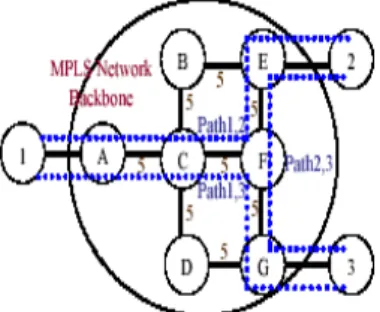
The elliptic region in figure 1 is an example of network backbone G. The round regions (A to G) inside G
are routers in N. The solid lines between two routers are links in L. The number beside each link is the amount of
residual bandwidth on it (B (l) =5 for all lЄL in this figure). The VPN access routers set AR = {A, E, G}. The round regions (1, 2 and 3) outside G are endpoints (e1, e2 and e3, respectively, in our notation) of a VPN, which gain access to VPN service via routers in AR. The dotted lines labeled as path i, j is the transmission path for VPN traffic between ei and ej.
PHASE-II: VPN Setup Request Modeling
The demands for VPN service of customers is described by VPN setup requests. In this paper consider that the bandwidth requirement of each endpoint ej is symmetric. Let b(ej) denotes the bandwidth requirement of endpoint ej, and Maxr denote the maximum bandwidth guarantee provided by service providers. The ith VPN setup request, denoted by vri , describes a VPN that
customer’s request service provider to establish. Each vriis
represented by a p-tuple vector (r1, r2,…, rp), where p is
the cardinality of access routers AR. The number of nonzero elements in vri represents the number of endpoints
contained in the corresponding VPN. The value of jth element rj of vri represents the bandwidth requirement of
endpoint ej.
PHASE III: Cost Optimized Hose- model VPNs Establishment Problem
The COVPA defined in this paper which mainly
considers on-line establishment of bandwidth guaranteed point-to-point tunnels. However, in the context of VPN provisioning, the basic unit concerned is a VPN consisting of numerous point-to-point tunnels, rather than a point-to-point tunnel, that makes the problem more challenging. In COVPN, service providers manage a network backbone G (as described in subsection PHASE-I) on which VPNs are established. The VPN setup requests of customers are sent to VRS (VPN Request Server) by service provider.
In this paper consider the situation where (a) VPN setup requests arrive one by one independently and (b) information about future VPN setup requests is
The network backbone managed by service providers is modeled
The
Cost optimized
Hose-model VPNs
establishment
Problem
The VPN setup request describing the VPN service requested by customers is modeled
unknown. This information includes the number of future VPN setup requests, the number of endpoints contained in each VPN setup request, and the bandwidth requirement of each endpoint. The service provider must process each VPN setup request in an on-line manner, the off-line model in not suitable. Upon receiving a VPN setup request
vri, the service provider triggers the provisioning algorithm
to establish a corresponding VPN. The provisioning algorithm performs this task by first choosing a path between each endpoint pair and then allocating bandwidth on each link on the paths. If there is not enough residual bandwidth on the link when the bandwidth is being allocated, vri will be rejected. In this paper the rejection
ratio is taken as the performance metric to compare
different hose-model VPN provisioning algorithms. The
rejection ratio is defined as:
Number of requests rejected
Rejection ratio=
Total number of request received The optimization goal of provisioning algorithms is to minimize the rejection ratio, which in turn will maximize the number of requests successfully established on the network backbone. Although the main performance metric here focus on rejection ratio.
Other important performance metrics (eg: link utilization and bandwidth allocation efficiency) are also investigate in the experimental simulations. In this paper, assume that service provider uses a server-based strategy for processing VPN setup requests. In server-based strategy, the VPN provisioning algorithm is run on a single entity called VPN request server (VRS). The VRS also keeps the complete link state topology database and is responsible for finding an explicit path for each endpoint pair of a VPN. Then the explicit paths can be setup using a signaling protocol such as RSVP . For computing the explicit paths, the VRS needs to know the current network topology and link residual bandwidth. We assume that there exists a link state routing protocol for information acquisition.
3. The Factors Influencing Rejection Ratio
In this case, the links of the network backbone have a finite amount of bandwidth and the service provider needs to establish multiple VPNs on the network backbone on-line. The two most important factors influencing the rejection ratio achieved by provisioning algorithms are: (1)
Bandwidth allocation efficiency (2) Load balance
mechanism that considers the amount of residual bandwidth on links. Provisioning algorithms must take the residual bandwidth of links into account, and avoid using links that are thinly spread. This will balance the load on links of G and reduce rejection ratio.
4. COVPA
To address the problems described above we propose a new provisioning algorithm called the Cost Optimized
Hose-Model VPN Provisioning Algorithm (COVPA). Both
of COVPA and tree routing are tree-based.COVPA also adopts VPN tree for establishing each VPN. The cost function of COVPA for VPN tree selection is defined as following:
RS( lx )
CostCOVPA(T)=∑1≤x≤k
B( lx )
Where RS(lx) and B(lx) represent the amount of
bandwidth needed and the amount of residual bandwidth on link lx, respectively. The cost function of COVPA is inspired by the cost function defined in the routing algorithms for route selection.
When processing a request, COVPA tries to find a
VPN tree that minimizes the cost function defined above. It is clear that the additional cost for using a link lx in building a VPN tree is proportional to the value of RS(lx) and is reciprocal to the value of B(lx). Therefore, COVPA
tries to finds a VPN tree that has abundant residual bandwidth and only requires a small amount of bandwidth to be allocated to the tree links. As a result, COVPA can look after both bandwidth allocation efficiency and load balancing. The pseudo code of COVPA is described below Input: Tree Storage
Output: Cost of COVPA.
1. Two bandwidths are Link Bandwidth and Residual Bandwidth are used.
2. Calculate the normal tree for all VPN routers are connected, which is calculated using BFS using pruning
cost in Tv to get normal VPN tree, where all paths are satisfied for the VPN request.
3. Compute RS to find the minimum path in PTv (several VPN) select one.
4. Find the cost of COVPA using the formula CostCOVPA(T)
conne
Figure2: Pseudocode for COVPA
Assume a network graph G consisting of n nodes. To process a VPN setup request vri, COVPA iterates totally n
times, once for each vЄN. In each iteration, COVPA first finds a candidate VPN tree PTvrooted at v for vri, and then
computes the amount of bandwidth needed to be allocated to each link lx of PTv. Finally the cost value associated
with PTvcan be computed. After finding all PTv(vЄN), if
there do not exist any PTv (vЄN) on which all links have
enough residual bandwidth for allocation, COVPA will reject vri. In the case of accepting vri, COVPA will return
the VPN tree with the minimum cost value among all PTv
(vЄN) for vri which is denoted by VTMC. In addition,
COVPA then allocates bandwidth to each link lx of VTMC
by performing B(lx) = B(lx)-RS(lx). To find a candidate VPN tree PTv rooted at v, COVPA first find a BFS tree
(breadth first search tree ) Tv rooted at v (by calling Function BFS_Tree). Tv contains all nodes in G and in addition, Tv may contain nodes which are not VPN access routers used in vrias leaf nodes. Therefore, COVPA prunes Tv and obtained a candidate VPN tree PTv, on which all leave nodes are VPN access routers used in vri(by calling
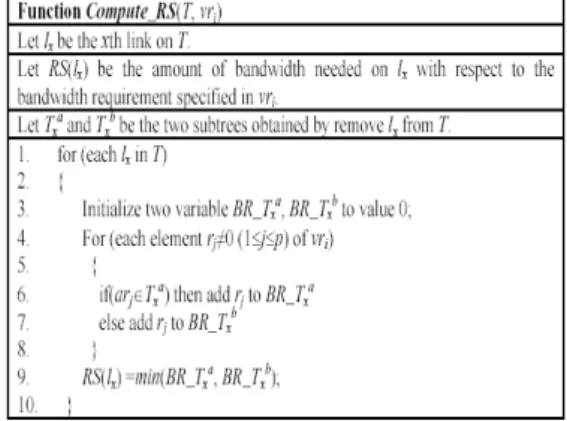
Function Prune_Tree). COVPA computes the amount of bandwidth needed for each link lx of a VPN tree T
according to the bandwidth requirement information in vri
(by calling Function Compute_RS in figure 3). To compute the value of RS(lx) (lxЄT), we first remove lx from T and this will partition the VPN tree into two sub trees Txaand Txb. Let BR_ Txa and BR_Txb denote the accumulated
bandwidth requirement of the VPN access routers (endpoints) on Txa and Txb, respectively. Then RS(lx) is
determined by the minimum value of BR_ Txaand BR_Txb.
Given a VPN tree T, in a normal case, the function Cost of
COVPA returns the cost value computed by the cost
function defined previously. However, where T is null (Ø), or there are links on T which do not have enough bandwidth for allocation, the function Cost will return
Figure3: Pseudo code for compute_RS 5. COMPARIION AND ANALYSIS:
We conducted an study to measure the performance of our COVPA and BFS primal–dual algorithms, and compared them with the approach of using a Steiner tree to connect
VPN endpoints. The major findings of our study can be summarized as follows.
• The primal–dual algorithm generates VPN trees with the smallest cost for a wide range of ingress/egress bandwidth ratios. It outperforms both the BFS and the Steiner tree algorithms for medium-to-large bandwidth ratios.
• For low ingress/egress bandwidth ratios, the primal–dual algorithms slightly outperform the COVPA algorithm. In many cases, they construct VPN trees that reserve half the bandwidth reserved by Steiner trees.
5.1 Experimental Results
(Designed and developed COVPA Vs BFS and Steiner Tree Routing)
We compared the provisioning cost (that is, the total bandwidth reserved on links of the VPN tree) and the running times of the algorithms for the symmetric as well as the asymmetric bandwidth models. In the study, we examined the effect of varying the following two parameters on provisioning cost: 1) network size 2) number of VPN nodes. Most of the plots in the following subsections were generated by running each experiment five times (with different random networks) and using the average of the cost/execution times for the five repetitions as the final result.
Simulation 1: (Network Size)
Figure.4 depicts the provisioning cost of the BFS and Steiner tree algorithms as the number of network nodes is increased from 10 to 100. VPN endpoints are assigned equal ingress/egress bandwidths and the number of VPN endpoints is set to 10% of the network size. The COVPA algorithm is provably optimal for the symmetric case. Further, unlike the Steiner tree and BFS algorithm which is oblivious to the bandwidths of endpoints, the BFS algorithm does take into account the bandwidth requirements for VPN endpoints. As a result, it outperforms Steiner tree algorithm by almost a factor of 2 for a wide range of node values.
Figure 4 Effect of number of network nodes on performance of algorithms(symmetric) 0 2000 4000 6000 8000 10000 12000 10 30 50 70 100 Total-Nodes Co s t BFS-Cost Steiner-Cost COVPA
Table1 Parameter configuration of Simulation 1 Simulation 2 (Number of VPN Nodes)
Similar results are obtained for the COVPA, BFS and Steiner tree approaches for a wide range of VPN node values (see Figure 5). In the experiment, the number of nodes in the network were fixed at 100 and VPN endpoints were assigned symmetric bandwidths.
Figure 5 Effect of number of VPN nodes
Table 2 : Parameter configuration of Simulation 2 Simulation 3: (Rejection Ratio)
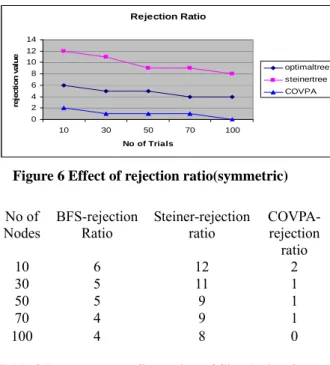
We conduct 15 runs with various number of topology, in each of which, 100 requests are randomly generated. The rejection ratios achieved by the three provisioning algorithms are (see Figure 6). The x-axis represents the run no. and the y-axis represents the rejection ratio and average link utilization achieved by each provisioning algorithm in each run. We can see that the rejection ratio achieved by COVPA is much less than that achieved by
BFS and optimal tree routing.
Figure 6 Effect of rejection ratio(symmetric)
Table 3 Parameter configuration of Simulation 3 6. CONCLUSIONS
In this research work, the designed novel algorithms for provisioning VPNs in the hose model. COVPA connected VPN endpoints using a tree structure and attempted to optimize the total bandwidth reserved on edges of the VPN tree. The algorithm showed that even for the simple scenario in which network links are assumed to have infinite capacity, the general problem of computing the optimal VPN tree is NP-hard. However, for the special case when the ingress and egress bandwidths for each VPN endpoint are equal, COVPA proposed a breadth-first search algorithm for computing the optimal tree. According the simulation results COVPA can indeed reduce the rejection ratio effectively.
Acknowledgement
First of all we thank the almighty for giving us the knowledge and courage to complete the research work successfully. We express our gratitude to our respected Vice Chancellor Dr. Chelliah Thangaraj M.Tech., Ph.D for allowing us to do the research work internally. Also we acknowledge the support provided by TIFAC-CORE Network Engineering. (Department of Science and Technology, Government of India).
References
[1] H. Liang, O. Kabranov, D. Makrakis, and L. Orozco-Barbosa,(2002) “Minimal Cost Design of Virtual Private Networks,” in IEEE Proceedings of the CCECE ’02, 2002, vol.3, pp. 1610 – 1615.
No of Nodes
BFS-Cost Steiner-Cost COVPA-Cost 10 1413 1437 1114 30 3859 3985 3242 50 5997 6207 4876 70 8522 8810 6895 100 11370 11370 8345
Nodes BFS-Cost Steiner-Cost COVPA-Cost 10 6550 6961 6345 30 7710 8070 6950 50 9398 9689 8450 70 9858 10122 9010 100 10920 11145 9910 No of
Nodes BFS-rejectionRatio Steiner-rejection ratio COVPA-rejection ratio 10 6 12 2 30 5 11 1 50 5 9 1 70 4 9 1 100 4 8 0 0 2000 4000 6000 8000 10000 12000 5 10 20 25 34 VPN_Nodes Co s t BFS-Cost Steiner-Cost COVPA Rejection Ratio 0 2 4 6 8 10 12 14 10 30 50 70 100 No of Trials re ject io n va lu e optimaltree steinertree COVPA
[2] T. Erlebach, M. Ruegg (2004), “Optimal Bandwidth Reservation in Hose-Model VPNs with Multi-Path
Routing”, INFOCOM 2004., vol.4,pp.2275-2282
[3] A. Kumar, R. Rastogi, A. Silberschatz, and B. Yener (2002), “Algorithms for Provisioning Virtual Private
Networks in the Hose Model”, IEEE/ACM Trans. on
Networking, vol.10, issue 4, August 2002. pp. 565-578.
[4] A. Juttner, I. Szabo, and A. Szentesi (2003), “On Bandwidth Efficiency of the Hose Resource
Management Model in Virtual Private Networks”, In
Proc. INFOCOM 2003.vol 1, pp.386-395
[5] P. P. Mishra, H. Saran(2000), “Capacity Management and Routing Policies for Voice over IP Traffic”, IEEE Network, vol. 14, no. 2, pp. 20-27, March/April 2000. pp. 20-27.
[6] B. M. Waxman (1988), “Routing of Multipoint
Connection”, IEEE Journal on Selected Areas in
Communications, vol. 6, issue 9, December 1988. pp. 1617-1622.
[7] X. Yuan (1999), “On the Extended Bellman-Ford Algorithm to Solve Two-constrained Quality of Service Routing Problems”, in ICCN'99, pp.304-310
[8] Zhanfeng Jia and Pravin Varaiya (2006), “Heuristic Methods for Delay Constrained Least Cost Routing Using K-Shortest-Paths”, IEEE TRANSACTIONS On Automatic control, vol. 51, no. 4, April 2006, pp.707-712
The Authors
Mr.R.Ravi is presently working as Assistant Professor & M.E (CSE) coordinator in department of Computer Science and Engineering at A.K.College of Engineering, Krishnankoil, Tamilnadu. He has completed his B.E Computer Science and Engineering from Thiagarajar College of Engineering, Madurai and M.E Computer Science and Engineering from Jadavpur University, Kolkata. Now he is a research scholar in Anna University. He has guided more than 25 M.E./B.E. projects. His field of interests are Network Engineering, Artificial Intelligent, Natural Language Processing, Network Security and Micro processors. E-mailid:[email protected], [email protected] Phone:(College) 04563 – 289042- Extension Mobile: 94424 18917. Dr.S.Radhakrishnan is presently working as a Senior Professor and Head, Department of Computer Science and Engineering at
A.K.College of Engineering, Krishnankoil,
Tamilnadu. He has completed his M.Tech. and Ph.D. in Biomedical Engineering from Institute of Technology, Banaras Hindu University. He has guided more than 50 M.E./M.Tech. projects and 10 M.Phil. Thesis. Currently five candidates are working for Ph.D. under his guidance. His field of interests are Network Engineering, Computer Applications in medicine and evolutionary computing. He is also serving as Project Director(Network technologies) in TIFAC CORE in Network Engineering at A.K.College of Engineering. He has more than 10 publications to his credit.