Date labelling in the Nordic countries
Practice of legislation
Ved Stranden 18 DK-1061 Copenhagen K www.norden.org
The report addresses how date labels are determined and applied with focus on reducing food waste in the Nordic countries. This was assessed through a survey and selected interviews with Nordic food manufacturers about their considerations when deciding the date label. Another objective has been to distinguish if there are differences in the way food safety authorities interpret legislation. The results from the study indicate that there are differences between the countries in terms of both the practice of guidelines and the shelf life of food.
The report is part of the Nordic Prime Ministers’ overall green growth initiative: “The Nordic Region – leading in green growth” – read more in the web magazine “Green Growth the Nordic Way” at www.nordicway.org or at www.norden.org/greengrowth
Date labelling in the Nordic countries
Tem aNor d 2015:504 TemaNord 2015:504 ISBN 978-92-893-3913-1 (PRINT) ISBN 978-92-893-3915-5 (PDF) ISBN 978-92-893-3914-8 (EPUB) ISSN 0908-6692 Tem aNor d 2015:504 TN2015504 omslag.indd 1 18-02-2015 10:39:34
Date labelling
in the Nordic countries
Practice of legislation
Hanne Møller, Nina Lødrup, Pernille Lundquist Madsen,
Åsa Rosengren and Annika Nurttila
Date labelling in the Nordic countries Practice of legislation
Hanne Møller, Nina Lødrup, Pernille Lundquist Madsen, Åsa Rosengren and Annika Nurttila ISBN 978-92-893-3913-1 (PRINT) ISBN 978-92-893-3915-5 (PDF) ISBN 978-92-893-3914-8 (EPUB) http://dx.doi.org/10.6027/TN2015-504 TemaNord 2015:504 ISSN 0908-6692
© Nordic Council of Ministers 2014 Layout: Hanne Lebech
Cover photo: Formetc
Print: Rosendahls-Schultz Grafisk Printed in Denmark
This publication has been published with financial support by the Nordic Council of Ministers. However, the contents of this publication do not necessarily reflect the views, policies or recom-mendations of the Nordic Council of Ministers.
www.norden.org/en/publications
Nordic co-operation
Nordic co-operation is one of the world’s most extensive forms of regional collaboration, involv-ing Denmark, Finland, Iceland, Norway, Sweden, and the Faroe Islands, Greenland, and Åland. Nordic co-operation has firm traditions in politics, the economy, and culture. It plays an im-portant role in European and international collaboration, and aims at creating a strong Nordic community in a strong Europe.
Nordic co-operation seeks to safeguard Nordic and regional interests and principles in the global community. Common Nordic values help the region solidify its position as one of the world’s most innovative and competitive.
Nordic Council of Ministers Ved Stranden 18
DK-1061 Copenhagen K Phone (+45) 3396 0200
Content
Content ... 5 Summary... 7 Foreword ...11 1. Introduction ...13 1.1 Background ...131.2 Goal and scope ...14
2. Legislation ...15
2.1 EU legislation of date labelling...15
2.2 On-going work ...17
2.3 Legislation and guidelines in the Nordic countries ...18
2.4 Denmark ...18
2.5 Finland ...19
2.6 Norway ...20
2.7 Sweden ...21
3. Survey ...23
3.1 Purpose and approach ...23
3.2 Description of participating companies ...23
3.3 Dairy products ...24
3.4 Fish products ...25
3.5 Meat products ...26
3.6 Ready-to-eat foods and ready meals ...27
3.7 Summary of results from survey ...28
4. In-depth interviews ...31
4.1 Purpose and approach ...31
4.2 Results of the interviews ...32
4.3 Main findings and comments from the in-depth interviews ...40
5. Discussion ...43
5.1 Nordic differences in practice of the food legislation ...43
5.2 Experiences from other studies ...45
5.3 What are the impacts of date labelling for the amount of food waste? ...45
6. Conclusion ...47
7. Further work ...49
8. References ...51
9. Glossary ...53
10.Sammendrag ...55
11.Appendix Country specific results from survey ...59
11.1 Results of the Danish companies ...59
11.2 Results of the Norwegian companies ...61
11.3 Results of the Finnish companies ...63
Summary
As part of the Nordic Prime Ministers' green growth initiative, The Nor-dic Region - leading in green growth, the NorNor-dic Council of Ministers has initiated a project focusing on reducing food waste in the entire food supply chain. The overall aim was to reduce food waste without endan-gering food safety. The project consisted of three sub projects: 1) Defini-tions and surveys of food waste from primary production, 2) Date label-ling, and 3) Redistribution of food. This report summarizes results from a Nordic project on date labelling and practice of legislations in the Nor-dic countries, phase 1.
The project group consisted of representatives from Danish Veteri-nary and Food Administration, National Food Agency in Sweden, Finn-ish Food Safety Authority Evira, Norwegian Food Safety Authority, No-fima and Ostfold Research. The project had a project leader from Evira (Finnish Food Safety Authority) from the start in august 2013 until April 2014 and then taken over by a Norwegian project leader from Ostfold Research.
The goal of the project was to identify how current food labelling leg-islation is practiced in four Nordic countries, find out if there are any differences in how the food safety authorities interpret the legislations, and give guidelines to the food business operators. To study the above raised issues, the following activities were conducted:
Compilation of current legislation and guidelines.
Survey on how the industry determines the date labelling and the
shelf life.
In depth-interviews with follow-up questions of selected food
companies.
The same labelling legislation applies throughout the EU and the coun-tries that have an agreement on the European Economic Area (Norway, Iceland and Liechtenstein). The legislation on general labelling and nu-trition labelling is merged to a common regulation on food information to consumers (Regulation (EC) No 1169/2011). The FIC-regulation will enter force in all member states in December 2014.
The survey has shown that there are differences in guidelines and how it is practiced. The survey was web-based and 64 companies re-sponded to the survey, representing 87 products (the survey was de-signed so that the companies could add response for more than one product). One of the main questions was how the shelf life is deter-mined. Most of the companies answered that the shelf life of the prod-ucts is determined by “Storage experiments in combination with micro-biological and sensory analysis” (58%). Some companies also answered that “Experience from other products” (20%) and “Product characteris-tics” (16%) are important
After analysing the results from the survey, more questions were raised and interviews of selected companies were conducted to obtain more in-depth answers to these questions. The interviews focused on the usage of product date labels “best before” or “use by”. The “use by” label refers to both product safety and quality (microbiological), while the “best before” label refers only to product quality. The interviews were conducted for the following product types:
Fresh milk, pasteurised.
Cold smoked sliced salmon, vacuum packed.
Minced beef without water and salt, MAP-packed.
Cooked ham, MAP-packed.
Warm smoked ham, MAP-packed.
Ready-to-eat salad, containing heat-treated chicken.
Ready-to-eat sandwich, containing chicken (not N).
For each product type, 2–3 interviews were conducted in each country. A total of 67 interviews were conducted. The completed interviews were compiled and documented in separate reports for each country. The interviews focused on the applications of the legislation, type of labelling “best before” or “use by” and shelf life.
Type of data label (best before or use by)?
Why is this date label chosen?
How long is the durability time (days) and how is it established?
Processing and packaging technique?
Other concerns regarding the date labelling
(durability/quality/preservatives)?
Date labelling in the Nordic countries 9 Fresh milk, cold smoked salmon, cooked ham and warm smoked ham had a doubling of the shelf life in days from the shortest to the longest.
Minced beef had a threefold increase from the shortest to the longest shelf life. The ready-to-eat salads and sandwiches had even larger differ-ence, but it must be emphasized that different packing methods were used for the ready-to-eat products. Therefore, the shelf life is not compa-rable for these products.
When it comes to the type of labelling, the interviews revealed
differ-ent use of labelling forsmoked salmon, cooked ham, smoked ham and
ready-to-eat products. Swedish food manufactures use the “best before” label much more often than manufacturers in the other countries. This is probably because there has been an established practise of the Swedish manufactures to only use the label “use by” if the product is included in the guidance document to Swedish labelling legislation (LIVSFS 2004:27). Both the survey and the in-depth interviews have shown that there are different ways to interpret legislation, for the choice of the date labelling. Results indicate that there is a need for a better understanding and guidance on food labelling terms, since the companies has interpret-ed the legislation differently.
The project will be continued and the results from Phase 1 shows the following points that may be relevant to further research.
Identify underlying causes to different labelling and shelf-life
between the food companies in the four Nordic countries.
There is a lack of empirical data where food waste is directly linked
to date labelling.
How much does the length of the shelf life affect the amount of food
waste?
Do manufacturers want to shorten the shelf life of the product to
make it seem fresher?
Do consumers prefer products with shorter shelf life?
Why do companies in Norway generally set a longer shelf life of their
products?
Would it be possible to harmonize of date labelling and storage
temperature in the Nordic countries?
Durability of a product after opening of the packaging.
The findings presented in this report are part of the Nordic Prime Minis-ters' overall green growth initiative: “The Nordic Region – leading in green growth” - read more in the web magazine “Green Growth the Nor-dic Way” at www.norNor-dicway.org or at www.norden.org/greengrowth
Foreword
This report focuses on the labelling of the date of minimum durability on prepacked food, one of the reasons identified by researchers for food waste from production to consumer. It presents the results of a Nordic project carried out by researchers in collaboration with national author-ities and industry. The project is financed by the Nordic Council of Minis-ters through the Nordic Green Growth Programme.
In recent years, great attention is paid to food waste and what can be done to reduce the amount of food waste. There have been a number of projects on national, European and global level. A joint Nordic project will strengthen the ability of the Nordic countries to influence this work. The project provides the opportunity to give common Nordic viewpoints in future work on food waste reduction, both in the EU and other inter-national arenas.
The world’s population is increasing while natural resources are lim-ited. A large proportion of the population is malnourished or undernour-ished. At the same time, we discard about 1/3 of the food produced globally. Reduction of food waste is a three-in-one gain. It increases the amount of available food, reduces the pressure on productive land and reduces the environmental impacts. In addition, it saves money for the consumers. Clear and well founded rules on date labelling and good practices in the entire food chain are of crucial importance to ensure food safety for the consumers while avoiding that food of good microbio-logical quality is discarded only due to the date labelling.
The project group in the Nordic date labelling project consisted of representatives from Danish Veterinary and Food Administration, Swe-dish Food Agency, Finnish Food Safety Authority Evira, Norwegian Food Safety Authority and Ostfold Research. Thanks to participants in the project group, the steering group and contributions from others who have provided inputs during the project.
Oslo 10. December 2014
Bent Høie
1.
Introduction
The Nordic Council of Ministers has initiated a Nordic project focusing on reducing food waste in the entire food supply chain. The overall aim was to reduce food waste without endangering food safety. The project consisted of three sub projects: 1) Definitions and surveys of food waste from primary production, 2) Date labelling, and 3) Redistribution of food. Organisations involved in the project are food safety and agricul-tural authorities and research institutes in Norway, Sweden, Denmark and Finland.
This report documents the work and results concerning date label-ling in subproject 2. The project addressed how the date label is deter-mined and practiced with focus on reducing food waste. This was as-sessed by conducting a survey and selected interviews on what consid-erations Nordic food manufactures make when deciding the date mark.
The Nordic Prime Ministers' initiative, The Nordic Region - leading in green growth, defines eight priorities aimed at greening the Nordic economies, one of which is to develop technologies and methods for better waste treatment. Food waste is among the categories identified as particularly interesting in the context of green growth and environmen-tal impact.
1.1
Background
According to current EU legislation, food business operators e.g. manu-facturers and packers must carry out date mark labelling on almost all packed foods ready for delivery to the final consumer. The aim is to help consumers to use food in a safe and optimized way. The date mark is an indication that states the length of time a food product can be stored under specified storage conditions.
There are two types of date labellings, “best before” and “use by”. The “best before” is appropriate for most foods and indicates the length of time a food item can be expected to retain its original condition, and so relates to the food quality. Foods which have passed their “best before” date should be safe to eat, but may not have the best quality. If a product is labelled with a “use by” date, it can neither be sold nor be used after
that day. Hence, the date labelling should be chosen with care. Other-wise, fully edible and safe food may possibly be discarded and with un-necessary food waste as the result.
Food waste is an important issue not only in the Nordic countries, but also within the entire EU. In 2011, the EU Commission launched a long-term framework for actions for a resource-efficient Europe (flagship initiative). One of the goals is to half the amount of waste of edible foods by 2020. In addition, 2014 is the European year against food waste to create awareness for European citizens and to focus national govern-ments’ attention on this important topic.
1.2
Goal and scope
The overall scope of the project was to identify how current practice in the regulations is generating unnecessary food waste and how this prac-tice can be modified to reduce the amount of food waste.
The goal of the project was to identify how food labelling legislations are practiced in the four Nordic countries (Denmark, Finland, Norway and Sweden) and find out if there are any differences in how the food safety authorities interpret the legislations and give guidelines to the food business operators. This was done by conducting a survey on how the industry determines the date label and the shelf life and follow-up questions in interviews with selected companies.
Data labelling is important for food waste. Measured in term of quanti-ty, it is the food without date label (fruit, vegetables and bread) that gen-erates the most of food waste. However, in terms of climate impact meat and meat products are important and these products have date label. Con-sumer survey in the ForMat-project shows that food is discarded because the product’s shelf life has expired (Hanssen & Møller, 2013). Much of the wasted food is unnecessary and is probably due to the consumer’s lack of understanding of the date label; although consumers in surveys say they have good knowledge of what the date labels means.
2.
Legislation
The background for this chapter is that although the same legislation for food labelling applies in the Nordic countries, there may be differences between the understanding, interpretations and practice of it. In particu-lar, this applies how companies implement legislation.
2.1
EU legislation of date labelling
2.1.1
Until 2014
The same labelling legislation applies throughout the EU and also other countries such as Norway, Iceland and Liechtenstein that have an agreement on the European Economic Area (EEA).
The first EU legislation on labelling came 1978 (79/112 / EEC) and was updated in the labelling directive 2000 (2000/13 / EC). Articles 9–10 in this directive cover date labelling with “best before” (minimum durabil-ity) and “use by”. Foods shall be labelled with expiration date “use by” instead of “best before” if they from a microbiological point of view are considered highly perishable and are likely to constitute immediate dan-ger to human health after a short period of time.
There are some exemptions from the requirement of the date of min-imum durability. These exemptions are for example fresh fruit, vegeta-bles, bakers’ wares, wines, salt, sugar, vinegar and chewing gums. This will also apply when FIC enters into force.
2.1.2
Regulation on Food Information to Consumers (FIC)
In 2011, the labelling legislation was merged with several directives including the legislation on nutrition labelling for food to one regulation
on Food Information to Consumers (FIC).1 The FIC-regulation will be
applicable from December 2014.
The new regulation maintains the rules regarding date labelling as follows:
Article 2
Article 2(2)(r) defines the “the date of minimum durability” as the date until which the food retains its specific properties when properly stored.
Article 9
In article 9 (1)(f) it is stated that the date of minimum durability or the “use by” date is one of the required mandatory particulars on food.
Article 24
In the case of foods which, from a microbiological point of view, are highly perishable and are therefore likely after a short period to consti-tute an immediate danger to human health, the date of minimum dura-bility shall be replaced by the “use by” date. After the “use by” date, a food shall be deemed unsafe in accordance with Article 14(2)–(5) of Regulation (EC) No 178/2002 (General Food Law).
Article 24 explicitly states that after the “use by” date a food shall be deemed unsafe in accordance with Article 14(2) to (5) of Regulation (EC) No 178/2002. The aim of this provision is to clarify that when the “use by” date of a given food product has expired, it should not be con-sumed and, logically, should not be offered for sale to consumers.
Article 25
Article 25 (1) states that when foods require special storage conditions this shall be indicated on labelling.
Guidelines
The are no EU guidelines on durability labelling. In some EU-countries, there are guidelines on how to set durability and specifying if / when to use the “best before” or the “use by” mark.
──────────────────────────
1 Regulation (EU) No 1169/2011 of the European Parliament and of the Council of 25 October 2011 on the provision of food information to consumers.
Date labelling in the Nordic countries 17
2.2
On-going work
Codex Alimentarius – Codex Committee on Food Labelling (CCFL) The Codex Alimentarius Commission, established by Food and Agri-cutural organization of the United Nations (FAO) and World Health Or-ganization (WHO) in 1963, develops harmonised international food standards, guidelines and codes of practice to protect the health of the consumers and ensure fair practices in the food trade. The CCFL shall draft provisions on labelling applicable to all foods.
Most national and regional competent authorities use the Codex Gen-eral Standard for the Labelling of Prepackaged Foods (GSLPF) to guide national/regional labelling requirements, including requirements for date marking of foods. Despite this, globally there are a number of dif-ferent systems for date labelling and difdif-ferent terminologies are used on the package. This creates confusion for consumers, industry and regutors particularly in countries that lack national regulations for date la-belling and where food import is significant. In 2013, it was agreed that the CCFL should review the GSLPF to address the issue on date labelling. Food labelling legislation must control the clarity, format, meaning and application of date labelling information to contribute to effective use of food business operators, consumers and regulators, towards en-suring food safety and quality, as well as contributing to food security.
There is a need to review and clarify the definitions in the GSLPF re-lated to date labelling and to establish clarity of expression and presen-tation. If there is confusion around these parameters, it increases the risk of unsafe food consumption and may increase the risk of food waste. This confusion can occur with both consumers and food business operators. Lack of clarity of also contributes to the complexity in regula-tory monitoring of safety and quality.
The importance of reducing food waste caused by the incorrect use of and enforcement of date marking is highlighted as a critical issue.
ON- going work within EU
In cooperation with stakeholders, experts and Member States, the EU Commission is currently analysing how to reduce food waste without compromising food safety. This will hopefully lead to future EU actions for reducing food waste. A wide number of topics are addressed such as donation of surplus food to food banks, date labelling, feed, short food
supply chains, bio-energy, etc. More information may be found on the
webpage of the EU Commission.2 The Health and Consumers Directorate
General of the European Commission (DG SANCO) wants to establish a working group with food waste experts from the Member States. The task of the group would be to support the identification and prioritiza-tion of acprioritiza-tions to be taken at EU level to prevent and reduce food waste without losing food and feed safety and protection of animal health.
2.3
Legislation and guidelines in the Nordic countries
When FIC is applicable from December 2014, the same legislation applies in all EU- and EEA-countries. The following sections explain for each coun-try the legislation up to 2014. This is relevant since it forms basis for dif-ferent interpretations and national guidelines between countries.
2.4
Denmark
Legislation
BEK No. 1308 of 14/12/2005 – Regulations of labelling of food (now repealed as FIC is applicable). In Denmark, the Danish Veterinary and Food Administration give following advice: “Use by” is used on perisha-ble foods, such as meat and fish, which can pose a risk to human health after that date.
“Best before” is used on non-perishable foods, e.g. bread, grains and pasta etc. The date indicates that until that date, the food is guaranteed to keep quality, but it still may be edible after this date.
Before the implementation of FIC in December 2014, it has not been permitted neither to sell food products after the expiry of the “best be-fore” date nor the “use by” date.
────────────────────────── 2 http://ec.europa.eu/food/food/sustainability/index_en.htm
Date labelling in the Nordic countries 19 Guidelines
Denmark has national guidance on durability labelling in guidance on
general labelling section 12.3 Further, Denmark has launched a
consum-er information campaign on durability labelling.4
2.5
Finland
Legislation
The Trade and Industry Ministry’s regulation on labelling of food (1084/2004). Will be repealed as FIC enters into force.
Guidelines
The Finnish Food Safety Authority Evira has published guidelines on the labelling of foodstuffs, including date labelling. The guidelines are in-tended for both food control personnel and food business operators. The
guidelines are being revised to correspond with the FIC regulation.5 The
revision will be completed by the end of 2014.
It is the responsibility of the food business operator to establish the durability of the product and on the basis of this information decide which date label “best before” or “use by” to use on the product.
“Use by” date should be used on microbiologically easily perishable foods. According to the legislation on the labelling of food, a food product is highly perishable when it is easily spoiled and poses a health risk after short-term storage. Examples of such food, unless they are made durable for example by means of heat treatment and / or conservatives are:
Fresh cheese, i.e. unripened cheese (fresh cheese is usually easy
perishable, however, pasteurized fresh cheese is not
microbiologically easily perishable and instead of the “use by” labelling, “best before” labelling can be used)
egg products
fresh meat, intestines, blood and fresh plasma
minced beef and other meat products not prepared
────────────────────────── 3 http://www.foedevarestyrelsen.dk/SiteCollectionDocuments/25_PDF_word_filer%20til%20download/ 06kontor/Maerkning/Faerdigpakkede_foedevarer/Mærkningsvejledning%20juli%202014%20-%20gældende%20fra%2013.%20december%202014.pdf 4 http://www.tjekdatoen.dk 5 http://www.evira.fi/files/products/1405331465406_elintarviketieto-opas_eviran_ohje_17068_1_fi.pdf
fresh fish, fish eggs and shellfish
salted fish and smoked and grilled fish
ready to eat foods, desserts and bakery products, which have not
been heat-treated.
In addition, other than those mentioned in the list can be easily perisha-ble and thus require labelling with “use by”. The manufacturer should always assess from case by case whether a product shall be considered microbiologically easy perishable. Food may not be sold after “use by” date, nor used in the preparation of a food to be sold or served.
In addition, it should be mentioned that Evira has issued a guideline on foodstuffs donated to charity. In this guideline some exceptions on use of products that have passed their use by date are given. The given conditions are very specific and restricted only to the specific context of foods donated for charity. Charity organisations that prepare food using fresh foodstuffs that have been donated can use products on the day after the “use by” date. The condition is that the quality of the product is sensorial evaluated and the products are heated to at least 70 °C during preparation.
Food information guidance. Evira guide 17068/1.6 The revision will
be completed by the end of 2014.
Labelling control guidance. Evira guide 17055/1/sv.7
Foodstuffs that are donated to charity. Evira guide 16035/1/se.8
2.6
Norway
Legislation
The current Regulations on the labelling of food products is based on directive 2000/13/EC on labelling, presentation and advertising of
foodstuffs.9 ────────────────────────── 6 http://www.evira.fi/files/products/1405331465406_elintarviketieto-opas_eviran_ohje_17068_1_fi.pdf 7 http://www.evira.fi/files/attachments/se/evira/blanketter_och_anvisningar/livsmedel/paskrifter_ forpackningar/pakkausmerkintojen_valvontaohje_versio_4_1_se.pdf 8 http://www.evira.fi/files/attachments/se/evira/blanketter_och_anvisningar/livsmedel/livsmedelslokaler/ ruoka-apuohje_16035_2013_se.pdf 9 http://www. lovdata.no/forskrift/1993-12-21-1385
Date labelling in the Nordic countries 21 Guidelines
On the web site of the Norwegian Food Safety Authority, some guidance
is given on the labelling of durability.10 This guidance is related to the
legislation before December 2014. Below follows a shortened version. Prepacked foods shall be labeled with a use-by or best before date. The labelling requirement takes health and quality into account. The date should be the date the food product keeps its specific properties, quality etc. based on the given storage conditions in unopened packaging.
For foods that are highly perishable and therefore after a short period is likely to constitute an immediate danger to human health, the date of minimum durability shall be replaced by the “use by” followed by the date. Such foods can not be sold after the expiry date. The wording “use by” can not be replaced by other terms.
Highly perishable foods should always be labelled with specified storage conditions. For meat and meat products there are the specific hygiene rules, including temperature requirements.
After the expiry of the “best before” – date, the products may still be offered for sale. The business is responsible for the quality or other spe-cific features of the product.
2.7
Sweden
Legislation
Livsmedelsverkets föreskrifter om märking och presentation av Livsme-del; LIVFS 2004:27.
From December 2014: Livsmedelsverkets föreskrifter om livsmedels-information; LIVSFS 2014:4.
Guidelines
Livsmedelsverket is currently revising “Vägledning till Livsmedelsver-kets föreskrifter (LIVSFS 2004:27) om märkning och presentation om livsmedelˮ. A new version should be updated according to the
FIC-regulation.11
──────────────────────────
10 http://www.mattilsynet.no/mat_og_vann/merking_av_mat/generelle_krav_til_merking_av_mat/ holdbarhetsmerking_paa_matvarer.2711
According to the current guidance, the use-by date is the last day a food, that from a microbiological point of view is very perishable, last is expected to be consumed without being unfit.
The guidance also states that a food should be considered as very per-ishable if there is danger that the food may pose a risk to human health,
and that this occurs in a short time i.e. within a few days. Such foods
should be labelled with the “use by” date instead of “best before” date. Foods labelled with “use by” date on the time of packaging is assessed to be unfit or harmful after a certain date. These foods should be
consid-ered to be unsafe and must not be sold.12 Food should be regarded as
unfit for use even if it in a particular case cannot be shown that the food really is harmful to health.
Foods that are labelled “best before” are allowed to be sold after ex-piry date, but the seller and not the manufacturer is responsible for the
quality of the product.13
Foods are generally regarded as very perishable if the durability is less than five days at a storage temperature of +4 °C or lower. Even among food with slightly longer durability, they may be regarded as highly perishable. Based on the above criteria, the person responsible for the labelling should consider whether the product is considered highly perishable or not.
──────────────────────────
12 Article 14 of Regulation (EC) No. 178/2002 laying down the general principles relevant to requirements of food law, establishing the European Food Safety Authority and laying down procedures in matters of food and feed safety.
3.
Survey
3.1
Purpose and approach
The purpose of the survey was to map and to gain increased knowledge about how the date labelling (“use by” or “best before” date) is set by Nordic food industry and retail trade today.
A web-based survey was send by e-mail to Nordic food companies during April and May 2014. In Denmark and Finland, the survey was sent out through the industries’ own organizations, and therefore, the total number of companies is unknown. In Norway and Sweden, the sur-vey was sent directly from the Finnish Food Safety Authority Evira to companies based on a list of companies producing relevant product groups. The survey was translated into each country’s own language and the dispatch included an introduction to the survey.
3.2
Description of participating companies
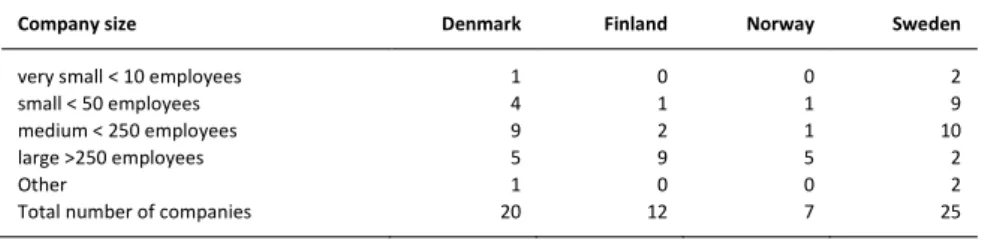
In total, 64 companies responded to the survey. The response was low, especially for Norway and Finland (Table 1). However, the companies that responded, represented a large percentage of food products on the market.
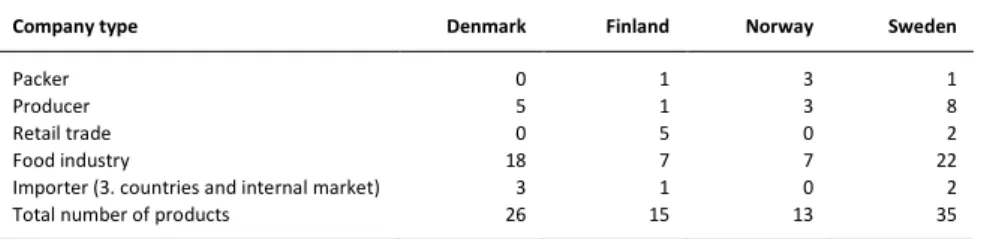
Most of the companies were medium or large. Only a few very small and small companies responded the survey. In addition, most of the countries represented the food industry, (Table 2). Since the responding companies had a multiple choice, some responders were also marked as packers and producers.
The survey was designed so that the companies could add response for more than one product. In total, there were responses for 87 prod-ucts. Table 3 shows which categories the products were representing.
Table 1. Company size
Company size Denmark Finland Norway Sweden
very small < 10 employees 1 0 0 2
small < 50 employees 4 1 1 9
medium < 250 employees 9 2 1 10
large >250 employees 5 9 5 2
Other 1 0 0 2
0 1 2 3 4 5 6
Denmark Finland Norway Sweden
n umb er of pr oduc ts Fresh milk Fermented milk Cheese
Table 2. Type of company
Company type Denmark Finland Norway Sweden
Packer 0 1 3 1
Producer 5 1 3 8
Retail trade 0 5 0 2
Food industry 18 7 7 22
Importer (3. countries and internal market) 3 1 0 2
Total number of products 26 15 13 35
Table 3. Food categories of the products represented in the survey
Food category Denmark Finland Norway Sweden
Dairy product 0 2 4 13
Fish product 1 1 1 5
Meat product 5 6 5 12
Ready-to-eat foods and ready meals 20 8 1 3
Total number of products 26 17 11 33
3.3
Dairy products
The survey included 19 dairy products. One product was removed from the analysis due to unclear answers. Figure 1 shows the types of dairy products. No Danish dairy products were included. Two Finnish fresh milk products were included, one labelled “use by” and one “best be-fore”. Two Norwegian fresh milk products were labelled “best bebe-fore”. One fermented milk product and one cheese were labelled “best before”. Three Swedish fresh milk products were labelled “best before” and one “use by”. Three Swedish fermented milk products and five cheese prod-ucts were also included, all labelled “best before”.
Date labelling in the Nordic countries 25 0 1 2 3 4 5
Denmark Finland Norway Sweden
n u m b er o f p ro d u cts Fresh
Cold smoked or warm smoked
Raw pickled
The shelf life is determined mainly by storage experiments and microbio-logical analyses/sensory analysis (Norway and Sweden) and recommen-dations by the manufacturer and microbiological analysis (Finland) see table 4.
Table 4. How is the shelf life determined for dairy products? This question had multiple choices and the number of products does not add up to the number of answers here
Denmark Finland Norway Sweden
Storage experiment, microbiological/ sensory analysis 0 0 4 12
Experience from other products 0 0 1 4
Product characteristics 0 0 0 2
Market profile 0 0 0 0
Other 0 2 0 0
Total products 0 2 5 18
3.4
Fish products
The survey included 10 fish products, fresh, cold or smoked fish and raw pickled (Figure 2). From Denmark, one cold smoked fish product was labelled “use by”, from Finland, one raw pickled product was labelled “best before”. From Norway, one fresh fish product was labelled “use by”. From Sweden, seven fish products were included in the survey, but two products were removed from the analysis due to unclear answers. Of the four fresh fish products, two were labelled “use by” and two “best before”. The cold smoked fish product was labelled “best before”.
The results show that shelf life is mainly determined by storage experi-ments in combination with microbiological analyses/sensory analysis. However, for the Finnish raw pickled product, shelf life was also deter-mined by experiences from other products. For the Swedish fresh fish products, the shelf life was additionally determined by products charac-teristics/experiences from other products (Table 5).
Table 5. How is the shelf life determined for fish products? The companies had multiple choices, therefore the number of products does not add up to the number of answers
Denmark Finland Norway Sweden
Storage experiment microbiological/sensory analysis 1 1 1 4
Experience from other products 0 1 0 1
Product characteris. 0 0 0 3
Market profile 0 0 0 0
Other 0 0 0 0
Total products 1 2 1 8
3.5
Meat products
The survey included 27 meat products consisting of fresh untreated meat, minced meat of beef, pork, lamb, chicken, sliced and unsliced meat products, raw meat preparations, meat products and sausages (Figure 3). From Denmark, the four meat products were marked “best before”. From Finland, one minced meat, meat product sliced, raw meat prepara-tion, were marked “use by”, one meat product was marked “best before”. One of two sausage products was marked “use by” and one marked “best before”. From Norway, one fresh, untreated red meat product was marked “best before”, two sliced meat product were marked “use by” and one meat products was marked “use by «and one “best before”. From Sweden, three fresh, untreated red meat products were marked best before. Three minced meat products had different date labelling, one product was labelled “use by” and two products “best before” (one of these was a frozen product). One raw meat preparation was labelled “best before”. Two meat products were included, one labelled “use by” and one “best before”. One raw sausage product was labelled “use by” and two smoked or heat-treated sausage products “best before”.
Date labelling in the Nordic countries 27 0 1 2 3 4 5
Denmark Finland Norway Sweden
n umb er of pr oduc ts
Fresh, untreated red meat Minced meat of beef, pork, lamb or chicken
Meat product sliced Meat product unsliced Raw meat preparation Meat product Sausage
Figure 3 Type of meat product
The shelf life was determined mainly by storage experiments and mi-crobiological analyses/sensory analysis (Table 6). Since the companies had multiple choices here, the number of products does not add up to the number of answers here.
Table 6. How is the shelf life determined for meat products? The companies had multiple choices, therefore the number of products does not add up to the number of answers
Denmark Finland Norway Sweden
Storage experiments and microbiological analyses/Sensory analysis 5 6 5 10
Experience from other products 0 0 3 6
Product Characteristics 0 2 3 2
Market profile 0 0 0 3
Other 0 0 0 0
Total number of products 5 8 11 21
3.6
Ready-to-eat foods and ready meals
The survey included 33 ready-to-eat foods and ready meals (Figure 4). From Denmark, 16 ready-to-eat foods and 5 ready meals were labelled “best before”. From Finland, 4 ready-to-eat foods and four ready meals were all labelled “use by”. From Norway, one ready-to-eat product was labelled “use by”. Three Swedish ready meals were marked “best before”.
0 2 4 6 8 10 12 14 16 18
Denmark Finland Norway Sweden
nu mbe r of produ cts ready meals ready-to-eat (sandwiches and ready salads)
Figure 4. Type of ready-to-eat food and ready meals
The results show that shelf life mainly is determined by storage experi-ments and microbiological analyses/sensory analysis, but also experienc-es from other product and product characteristics were used (Table 7).
Table 7. How is the shelf life determined for ready to eat food and ready meals? The companies had multiple choices, therefore the number of products does not add up to the number of answers
Denmark Finland Norway Sweden
Storage experiments and microbiological analyses/Sensory analysis 17 8 1 2
Experience from other products 8 1 0 1
Product characteristics 8 1 0 0
Market profile 0 0 0 0
Other 0 3 0 0
Total number of products 33 13 1 3
3.7
Summary of results from survey
The results from the survey are summarised in table 8. The table shows that most companies answered that the shelf life of the products are determined by “Storage experiments in combination with microbiologi-cal and sensory analysis” (58%). Some companies also answered that “Experience from other products” (20%) and “Product characteristics” (16%) are important.
Date labelling in the Nordic countries 29 Table 8. How is the shelf life determined? Answers for all product categories in % of total answers
Denmark Finland Norway Sweden Total
Storage experiments, microbiological/Sensory analysis 59% 60% 61% 56% 58%
Experience from other products 21% 8% 22% 24% 20%
Product characteristics 21% 12% 17% 14% 16%
Market profile 0% 0% 0% 6% 2%
Other 0% 20% 0% 0% 4%
4.
In-depth interviews
4.1
Purpose and approach
In-depth interviews of selected companies were conducted to investi-gate how Nordic food companies relate to labelling legislation and de-termine the date labelling / shelf life of their products. The purpose was to determine if there are any differences between companies and coun-tries regarding practice of legislation and to clarify determination fac-tors for durability. Another aim was to investigate if differences in the use of date labelling were based on different product characteristics and storage conditions or if it was due to different legal interpretation and national guidelines.
The interviews focused on food processing and packaging companies and their usage of product date labels “best before” or “use by”, for fol-lowing product types:
Pasteurised fresh milk.
Cold smoked sliced salmon, vacuum packed.
Minced beef, without water and salt, MAP (Modified Atmosphere
Packaging).
Cooked ham, MAP.
Warm smoked ham, MAP.
Ready-to-eat salad, containing heat-treated chicken.
Ready-to-eat sandwich, containing chicken (not Norway).
The interviews were done through personal interviews, phone interviews and some questions were asked by email. For each product type, 2–3 in-terviews were conducted in each country. The completed inin-terviews were compiled and documented in separate reports for each country, including responses for specific questions and relevant additional information com-ing up durcom-ing the interview. The interviews were conducted from June to October 2014 and performed by DTU in Denmark (Andersen, 2014), MTT in Finland (Reinikainen & Pinolehto, 2014), Nofima in Norway (Hagtvedt, 2014) and SIK in Sweden (Ba th, 2014).
Questions asked were:
Type of data label (best before or use by)?
Why is this date label chosen?
How long is the durability time (days) and how is it established?
Processing and packaging technique?
Other concerns regarding the date labelling
(durability/quality/preservatives)?
The results from the interviews reproduce what the companies have expressed in the interviews, but it is not necessarily the same as facts about the current regulations. The names of the food companies were anonymized.
4.2
Results of the interviews
4.2.1
Pasteurised fresh milk
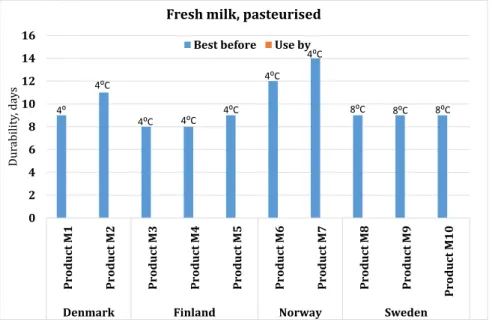
Figure 5 shows shelf life for fresh pasteurised milk for the Nordic coun-tries. All the fresh milk products (M1–M10) used the date label “best before”. The shelf life varied from 8 days (Finland) to 14 days (Norway). The legislation does not state explicit rules how to test the durability, it is up to the companies to decide. Hazard Analysis and Critical Control Point (HACCP) is a tool for the companies to control the quality and safe-ty of pasteurised milk. Storage temperature has the greatest influence on durability but packaging and processing technique also have an influ-ence. Therefore, improvements in the process techniques will influence durability and allow extending the “best before” dates. All companies test durability by microbiology and sensory analysis.
Date labelling in the Nordic countries 33 0 2 4 6 8 10 12 14 16
Product M1 Product M2 Product M3 Product M4 Product M5 Product M6 Product M7 Prod
uct M8
Product M9 Product M1
0
Denmark Finland Norway Sweden
Dur
abili
ty
, da
ys
Fresh milk, pasteurised
Best before Use by
4⁰ 8⁰C 4⁰C 4⁰C 4⁰C 4⁰C 4⁰C 4⁰C 8⁰C 8⁰C
Figure 5. Durability in days and type of date marking for pasteurised fresh milk. Marked storage temperature for each product is shown above each bar
A few years ago, the date labelling on pasteurised fresh milk in Norway was changed from “use by” to “best before”. The reason was that pas-teurized fresh milk is not considered highly perishable.
In general, all products were equal in terms of product characteristics, processing and packaging. The Swedish milk products had a storage
tem-perature of 8 °C or lower, which was higher than in the other Nordic
coun-tries that have 4 °C. Common Nordic storage temperature limits were
dis-cussed about 15 years ago, but nothing has happened at that point up to now. Swedish companies estimated that the durability date has a margin of 1–3 days. That means that the products may last 1–3 days longer than the date labelling. Furthermore, some companies claim that the labelling “minimum durable until” would be clearer than “best before” and hence, avoiding unnecessary food wastage.
4.2.2
Cold smoked sliced salmon, vacuum packed
Figure 6 shows date labeling for cold smoked salmon (products S1–S9). Denmark, Finland and Norway used “use by” and Sweden used “best before”. The interviews cover two or three products in each country, but even with a limited number of products, the results show different in-terpretations of the legislation. Shelf life ranged from 14 to 30 days.
0 5 10 15 20 25 30 35
Product S1 Product S2 Product S3 Prod
uct S4
Product S5 Product S6 Product S7 Product S8 Prod
uct S9
Denmark Finland Norway Sweden
Dur
abili
ty
, da
ys
Cold smoked sliced salmon, vacuum packed
Best before Use by
4⁰C 4⁰C 4⁰C 4⁰C 4⁰C 4⁰C 4⁰C 4⁰C 4⁰C
Figure 6. Durability in days and type of date marking for vacuum packed cold smoked salmon. Marked storage temperature for each product is shown above each bar
Vacuum packed fish always poses a risk of listeriosis, which is caused by facultative anaerobic Listeria monocytogenes capable of growing in the presence or absence of oxygen. In addition, despite rare cases, there is a risk for botulism associated for fish products improperly prepared and or if the product is stored in too warm conditions. The durability date is established based on durability tests that measure microbiological quali-ties and for example levels of L. monocytogenes.
One of the Danish companies preserved the products by using organ-ic acids. In all the other countries only salt are added for preservation.
Statements from companies went in opposite directions; one be-lieved that it should be possible to use the “best before” label and anoth-er believed that only “use by” label can be used, since these products are considered perishable. It was also stated that it could be complicated to understand the regulations regarding date labelling, because it is re-ferred to terms defined in other regulations, such as “perishable”. It would be easier for the companies if the Food Safety Authorities would give more clear guidance on the labelling of these products.
One company reported that when launching new products, the shelf life is calculated as part of the product development. During develop-ment, shelf life is proposed to be based on sensory analyses followed by microbiological analyses to confirm the correctness of the suggested
Date labelling in the Nordic countries 35 0 2 4 6 8 10 12 14 16 18 20 Product B 1 Product B 2 Product B 3 Pr od uct B4 Product B 5 Product B 6 Product B 7 Product B 8 Product B 9 Product B 10
Denmark Finland Norway Sweden
Dur abi li ty , da ys
Minced beef, without water and salt, MAP packed
Best before Use by 4⁰C 4⁰C 4⁰C 4⁰C 4⁰C 4⁰C 4⁰C 4⁰C 4⁰C 4⁰C
shelf life. New analyses and assessment of durability are conducted eve-ry third year or if there are changes in the production process.
4.2.3
Minced beef, without water and salt, MAP
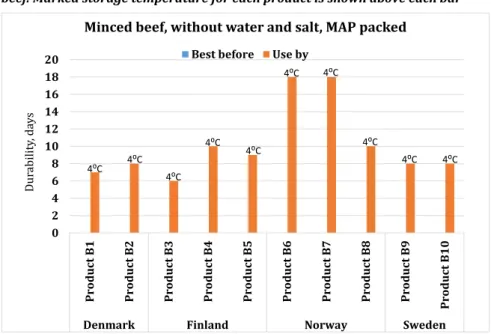
For minced beef, the companies used “use by” label due to legislation concerning food products that are considered highly perishable. The shelf life varied from 6 to 18 days (products B1–B10), (Figure 7). All companies used MAP-technique, which can have shorter or longer shelf life than vacuum packing, depending on the type of gas mixture used.
Figure 7. Durability in days and type of date marking for MAP packed minced beef. Marked storage temperature for each product is shown above each bar
The “use by” label was chosen since the product has short durability because of fast quality impairment. The interviewed companies assumed that the consumers can not really distinguish between “best before” and “use by” labels. They also believed knowledge of different food products and their durability is about to disappear. It was also pointed out that reduced food waste is an important issue. When using vacuum packag-ing, the shelf life may double and one of the Danish companies uses the “Best before” label on vacuum packed minced meat.
The packaging gas used is of importance for the durability of the product. In the interviews, it was not asked specifically about which packaging gas that was used for the selected products. In Norway, a gas
mixture of 60% CO2 and 40% N2 is used for most types of raw, fresh
meat, i.e. minced meat, hamburgers, pork, lamb, poultry and certain
types of beef. This CO2/N2 mixture gives long microbiological shelf life.
In Sweden and Denmark, it is common to use so-called high-oxygen,
which is 70% O2 and 30% CO2, for most types of raw, fresh meat. High
oxygen is mainly used to give the meat a bright red colour, which is
at-tractive to consumers (Kim et al., 2010). However, it also gives a shorter
shelf life compared to the CO2/N2 mixture, i.e. 8–9 days for minced meat.
Further, high oxygen is known to provide several unwanted properties like rancidity, inhibition of tenderization of the meat, and early brown-ing in the inner portion of the meat at heat treatment. Some pathogenic bacteria grow faster in meat in high oxygen gas mix compared to the
60% CO2/40% N2 gas mix (Sørheim, 2014).
The Norwegian companies thought it is strange that the Food Safety
Authority imposes requirements for 2 °C for minced meat in production
and processing, when the storage temperature during the remaining
supply chain is at 4 °C. The processing time is relatively short for the
minced meat compared to the rest of the shelf life.
4.2.4
Cooked ham, MAP
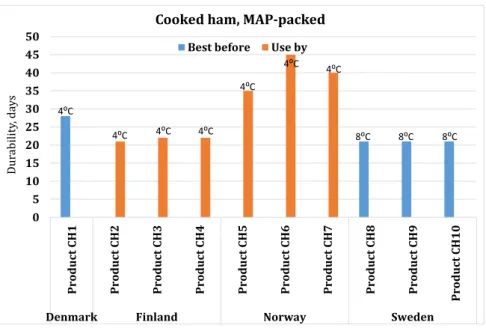
The “use by” label was utilised in MAP-packed cooked ham products in Finland and Norway (CH2–CH7), and “best before” labelling was used in Denmark and Sweden (CH1, CH8–CH10), (Figure 8). Microbiological safety, sensory tests and risk management are considered when estab-lishing the shelf life. Durability of MAP-packed cooked ham varied from
21–45 days. Storage temperature was 4 °C for products from Denmark,
Date labelling in the Nordic countries 37 0 5 10 15 20 25 30 35 40 45 50
Product CH1 Product CH2 Product CH3 Product CH4 Product CH5 Product CH6 Product CH7 Product CH8 Product CH9 Product CH10
Denmark Finland Norway Sweden
Dur
abili
ty
, da
ys
Cooked ham, MAP-packed
Best before Use by
4⁰C 8⁰C 8⁰C 8⁰C 4⁰C 4⁰C 4⁰C 4⁰C 4⁰C 4⁰C
Figure 8. Durability in days and type of date marking for MAP-packed cooked ham. Marked storage temperature for each product is shown above each bar
The durability was established by experience and verified through regu-lar tests. When choosing the “use by” label the justification was that the product was ready to eat and was not intended to be heat treated before being eaten. The reliability of cold chain is very important for the
dura-bility. It is desirable to have as long shelf life as possible since it is
im-portant for the consumers, but also for wholesalers and retail for logisti-cal reasons.
The Swedish companies made both pressed and whole muscle ham. The ham is salted, tumbled, shaped and heat-treated. Durability tests were based on microbiological and sensory analysis. The companies assessed that the shelf life has margin of 1–3 days.
One of the Norwegian companies stated that the “use by” label is cho-sen because of the risk of L. monocytogenes. There is a risk for the bac-terium although much has been done to minimize both prevalence and its ability to grow in the product. The product has a long shelf life and there might be temperature fluctuations in the consumer refrigerator and when the product is kept at room temperature during meals. To ensure that consumers do not eat the product after the expiry date has passed, the “use by” label is chosen.
0 5 10 15 20 25 30 35 40 45
Product SH1 Product SH2 Product SH3 Product SH4 Product SH5 Product SH6 Product SH7 Product SH8 Product SH9 Product SH10
Denmark Finland Norway Sweden
Dur
abili
ty
, da
ys
Warm smoked ham, MAP-packed
Best before Use by
8⁰C 8⁰C 8⁰C 4⁰C 4⁰C 4⁰C 4⁰C 4⁰C 4⁰C 4⁰C
4.2.5
Warm smoked ham, MAP
The “use by” label was utilised for MAP-packed warm smoked ham products in Finland and Norway (SH2–SH7), and the “best before” label was used in Denmark and Sweden (SH1, SH8–SH10), the same as for cocked ham (Figure 9). The durability varied from 21 to 40 days. The
storage temperature was 4 °C for Danish, Finnish and Norwegian
prod-ucts from Denmark, Finland and Norway whereas prodprod-ucts from
Swe-den had a storage temperature of 8 °C. The analysis and viewpoints for
warm smoked ham is the same as for cooked ham.
Figure 9. Durability in days and type of date marking for MAP-packed smoked ham. Marked storage temperature for each product is shown above each bar
4.2.6
Ready-to-eat salad, containing heat-treated chicken
For ready-to-eat salads, the “use by” label is being utilised in all coun-tries (R1, R3–R10), but “best before” is also used in Denmark and Swe-den (R2, R11), (Figure 10). The durability varied from 2 to 14 days. The
storage temperature was 4 °C for products from Denmark, Finland and
Norway, and 8 °C for Swedish products.
The two companies that used “best before” label stated that the product does not spoil after a certain date, but it loses quality due to wilted vegetables. Even though Food safety authorities’ guidelines do not point out this type of product of being highly perishable, companies used “use by”. Either they had been advised by the National Food Agency
Date labelling in the Nordic countries 39 0 2 4 6 8 10 12 14 16
Product R1 Product R2 Product R3 Prod
uct R4
Product R5 Product R6 Product R7 Product R8 Product R9 Product R10 Product R11
Denmark Finland Norway Sweden
Dur
abili
ty
, da
ys
Ready-to-eat salad, containing heat-treated chicken
Best before Use by
4⁰C 4⁰C 4⁰C 4⁰C 4⁰C 4⁰C 4⁰C 4⁰C 4⁰C 8⁰C 8⁰C
to use this label or that the reason was that the vegetables have lost quality after expiration date.
Figure 10. Durability in days and type of date marking for ready-to-eat salad. Marked storage temperature for each product is shown above each bar
The packaging method is important for the shelf life. Not all companies have specified what type of packaging they use. The products with short shelf life used a simple container with lid and no MAP, but some of the products with longer shelf life used MAP. Another important factor for the shelf life was the quality of raw materials. This can vary and makes it difficult to determine the shelf life.
4.2.7
Ready-to-eat sandwich, containing chicken
Norway was not included when compiling data for this product type since the product is not available in the retail in Norway. The “use by” labelling is being utilised for ready-to-eat sandwich containing chicken in all countries (RS1, RS2, RS4–RS6), but also “best before” is used in Denmark and Sweden (RS3, RS7), see (Figure 11). The durability varied
from 2 to 14 days. The storage temperature was 4 °C for Danish, Finish
0 2 4 6 8 10 12 14 16 Product RS1 Prod uct RS 2
Product RS3 Product RS4 Product RS5 Product RS6 Product RS7
Denmark Finland Norway Sweden
Dur ab il it y, da ys
Ready-to-eat sandwich, containing chicken
Best before Use by
8⁰C 8⁰C 4⁰C 4⁰C 4⁰C 4⁰C 4⁰C
Figure 11. Durability in days and type of date marking for ready-to-eat sand-wich. Norway does not have this type of product. Marked storage temperature for each product is shown above each bar
Product safety is the reason for the choice of “use by” label. Shelf life was determined by microbiological analyses and sensory analyses are used to evaluate taste.
As for the ready-to-eat salad, the packaging method is important for the shelf life. The products with short shelf life did not use MAP. In addi-tion, the quality of incoming raw materials is a very important factor for the shelf life and variations can make it difficult to determine the length of the shelf life.
4.3
Main findings and comments from the in-depth
interviews
For all the products, there was a major difference in the shelf life. Fresh milk, cold smoked salmon, cooked ham and warm smoked ham had a doubling of the shelf life in days from the shortest to the longest and minced beef had a threefold increase. The ready-to-eat salad and sand-wich had even larger difference, but it must be emphasized that different packing methods were used for the ready-to-eat products. Therefore, the shelf life is not completely comparable for these products. The other product groups had the same type of processing and packaging methods and hence, they provide a good basis for comparison. The only
differ-Date labelling in the Nordic countries 41 ence is a higher storage temperature for the Swedish milk and ham. However, Swedish products did not generally have a shorter shelf life compared to products in the other countries. Norway had the longest shelf life for all product groups, with the exception of ready-to-eat prod-ucts, which are not comparable.
Regarding the type of labelling, there was also a difference for some
of the products, i.e. smoked salmon, cooked ham, smoked ham and
ready-to-eat products. Swedish food manufactures use the “best before” label much more often than manufacturers in the other countries. One reason for this may be that the manufactures only use “use by” if the product is included in the current guidance document of the National
Food Agency, i.e. minced meat, fresh fish, fresh poultry, organs, raw
sau-sages, and bakery products with cream.
The interviews covered only some selected product groups repre-sented by a few manufacturers. It may also be of interest to obtain cor-responding information on other product groups.
For some of meat products, food companies in Norway have conducted a thorough assessment concerning which date label should be used. Steaks and fillets of a certain brand, which earlier were labelled “use by” are now labelled “best before”. Traditionally, the assessment of perishability has been done according to criteria as pH and water activity. Packaging and storage has not been highly emphasized. Vacuum packed filets of meat are stored for maturation for a relatively long period, and are considered to keep for additional days/weeks. Due to this, it may seem illogical that such a product is not edible from one day to another, such as “use by” marking implies. New techniques for production and packaging are developed and the Norwegian Food Safety Authority takes this into consideration regard-ing the labellregard-ing of durability. On this background, many Norwegian food businesses have reconsidered the use of “use by” and “best before” label-ling. However, it is emphasized that it is the companies themselves who are responsiblefor the quality of their products.
5.
Discussion
5.1
Nordic differences in practice of the food
legislation
The aim of this project was to identify how food labelling legislations are practiced in four of the Nordic countries and to find out if there are any differences in how the food safety authorities practice the legislations and give guidelines to the food producing companies. This may contrib-ute to identify how current practice of the food legislation is generating unnecessary food waste and how this practice can be modified to reduce the amount of food waste.
Both the survey and the in-depth interviews have shown that there are different ways to interpret legislation regarding choosing the date labelling and there are major differences in the assessment of shelf life for similar food products. In essence, the question is why there is such a difference in shelf life between different manufacturers of similar prod-ucts and between countries. Are there real differences in for example legislation, processing, packaging and refrigeration or is the difference only based on different interpretation of the food legislation? Further studies should focus on underlying causes of the different shelf lives of similar food products.
5.1.1
Differences in using date label
The practical interpretation of the legislation is decided by the manufac-tures. The “use by” label clearly identifies the durability of the product and is to be used on highly perishable products that also constitute danger to human health. However, it can be difficult to define clearly, when a product is highly perishable, and the manufacturer will ensure that consumers receive products that are of high quality and are safe to eat. The “use by” label refers to both product safety and quality (microbiological), but the “best before” label refers only to product quality. Results indicate that there is a need for a better understanding and guidance on food labelling terms, since the companies has interpreted the legislation differently.
One clear difference in legislation between the countries was found. Until now, it has not been allowed to sell the “best before” products after