How Do We Improve It?
Margaret J Neff MD MSc
Introduction: Regulations Pertaining to Informed Consent Elements of Consent
Types of Consent
Who Can Provide Consent? Obtaining Consent
Consent Examples
Quality of Informed Consent Improving Informed Consent Summary
The freedom to choose is integral to our daily lives, directs our interactions with patients, and is a key component of our conduct of human-subjects research. Most of the historical errors and atrocities in human experimentation had at their core a failure of consent. In response to those events, national and international law developed to direct researchers to a process of informed consent to participate in research. The application of this process, though, can be challenging. What does this process look like? Does it require written documentation, and if so what type? Who can give informed consent? Though researchers worldwide would agree on the concept of informed consent, the nuts and bolts of applying this ideal can create obstacles to researchers, confusion to subjects, and increasing regulations that may or may not help achieve the goal. I will review the current regulatory guidelines, summarize the types of consent, and consider options for improving the informed-consent process. Key words: informed consent, waiver of consent, surrogate decision maker. [Respir Care 2008;53(10):1337–1341. © 2008 Daedalus Enterprises]
Introduction: Regulations Pertaining to Informed Consent
The Nuremberg Code (1947), the Declaration of
Hel-sinki (1964), and the Belmont Report (1979)1all provide
general guidance for the conduct of research with human subjects, and they all highlight the importance of auton-omy. The Belmont Report lays out specific ethical princi-ples: respect for persons (subject autonomy and informed consent), beneficence (assessment of risks vs benefits), and justice (equitable application of research and selection of subjects). These represent the guiding principles that
Margaret J Neff MD MSc is affiliated with the Division of Pulmonary and Critical Care Medicine, Department of Medicine, and with Univer-sity of Washington Human Subjects Committee D (Biomedical), Uni-versity of Washington, Seattle, Washington.
Dr Neff presented a version of this paper at the RESPIRATORYCARE
Journal Symposium at the 53rd International Respiratory Congress of the American Association for Respiratory Care, held December 1-4, 2007, in Orlando, Florida.
The author reports no conflict of interest related to the content of this paper.
Correspondence: Margaret J Neff MD MSc, Division of Pulmonary and Critical Care Medicine, Harborview Medical Center, 325 9th Avenue, Box 359762, Seattle WA 98104. E-mail: [email protected].
have shaped federal and state law regarding research con-duct. For researchers conducting studies in the United States, most research is governed by the United States Code of Federal Regulations Title 45, Part 46, known as
the Common Rule.2 Drug studies are governed by the
Food and Drug Administration’s regulations in Code of Federal Regulations Title 21, Part 50.3 Additional
influ-ences on the conduct of studies and the application of informed consent include state law, institutional policies, and in some situations, the study sponsor. I will discuss common themes, but the specifics depend on each insti-tution’s interpretation of the regulatory guidelines.
Elements of Consent
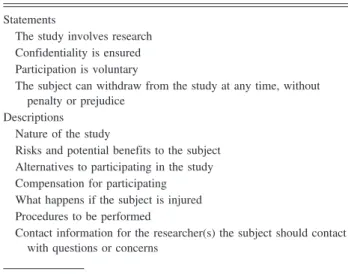
The Common Rule specifies many criteria for informed consent. Table 1 shows the primary elements of the con-sent form. However, concon-sent is about much more than just the form. Despite the large amount of time spent devel-oping and fine-tuning the form, in reality consent is about a process that includes a non-coercive interaction between subject and investigator.
Types of Consent
Many types of consent are possible for clinical purposes that may or may not be acceptable for research studies. Types of consent include written, verbal, telephone, and faxed. In most institutions, verbal consent, such as may be sought for certain clinical procedures, is not allowed for research. As an example, calling a subject or legally au-thorized representative, discussing the study, and then hav-ing him/her consent over the telephone with another “wit-ness” on the telephone call, may be acceptable in clinical
emergencies but rarely if ever for research. On the other hand, that conversation could occur over the telephone and the subject (or legally authorized representative) could then sign a consent form and fax it to the researcher. The dif-ference is that the subject has time to review the entire form, and the fax provides printed documentation of the consent. Regulations have not yet caught up with modern technology to provide consistent guidance regarding elec-tronic signatures, e-mail consent, or video conferencing.
Depending on the study, the risk profile, and the cir-cumstances surrounding consent, an institutional review board (IRB) may grant a waiver of documentation of con-sent or a waiver of concon-sent itself. Both are relatively un-common. The latter is more common in situations such as screening medical records for inclusion criteria for a study or retrospective review of records for epidemiology pur-poses. A distinct category of research that sometimes qual-ifies for waiver of consent is emergency research. Studies that might qualify for this accommodation include those where immediate intervention is required to obtain benefit (eg, studies on pre-hospital treatment of myocardial in-farction, stroke, or resuscitation). The criteria for waived consent include: no more than minimal risk, or the risk from the condition/illness is high; the intervention will not adversely affect the subject’s rights; the research is not practical without the waiver; and information will be pro-vided to and consent obtained from the subjects at a later date, if feasible. For emergency research, community no-tification might be required. Emergency research conducted under waiver of consent is closely monitored by regulatory authorities to ensure the welfare of subjects who, by de-sign, and as a consequence of their illness or injury, do not have the option to say yes or no.
Who Can Provide Consent?
Ideally, informed consent is always provided by the subject, under optimal conditions, without any sense of time or other pressure. This is not always possible, though, and in many cases the consent process is impacted by the illness or injury that makes the patient eligible for the study. When the subject is not competent to consent, in-vestigators look to a surrogate for consent. Note that “com-petent to consent” may be more rigorously interpreted for mental competency than defined for research. A subject who has been deemed legally incompetent cannot consent to participate in research; a guardian may have been as-signed, and the guardian could stand in for the subject for research consent. In most medical situations, though, the issue of competence is decided clinically based on the extent of injury, illness, pain, sedation, et cetera, and how those might affect the subject’s ability to understand and freely consent. This assessment is often left to the clinical discretion of the investigator, although some regulatory
Table 1. Elements of an Informed Consent Form* Statements
The study involves research Confidentiality is ensured Participation is voluntary
The subject can withdraw from the study at any time, without penalty or prejudice
Descriptions Nature of the study
Risks and potential benefits to the subject Alternatives to participating in the study Compensation for participating What happens if the subject is injured Procedures to be performed
Contact information for the researcher(s) the subject should contact with questions or concerns
* The entire informed consent form must be in a language and at a readability level appropriate for the intended subjects.
authorities, depending on the anticipated study population, may require a plan to assess competency be included with the research design.
Surrogate consent means consent from someone other than the subject (the legally authorized representative, sometimes casually termed the “legal next of kin”). The types of research that are eligible for surrogate consent differ state to state. Some states (eg, New York) are more restrictive and require minimal risk and the potential for benefit to allow surrogate consent. In different states the criteria for who can act as the legally authorized represen-tative and under what conditions differ greatly. Many states borrow from the state’s statutes regarding clinical consent, although in many settings consent for procedures might be obtained from a much wider pool of relatives than is al-lowed for research consent. A relatively common order of consent authority is: guardian, subject, the person who has durable power of attorney for health care, spouse, adult children, parents, and adult siblings. Though anyone on that list can consent, the person highest on the list always has the final say and must be approached about new or ongoing consent when available.
Obtaining Consent
Presentation of a study to a subject or legally authorized representative is about much more than just getting a sig-nature on the consent form. Though regulations are more specific about the elements included in a consent form, the consent process is in fact probably more important than the form itself. This process starts with the approach to the subject or legally authorized representative. Ideally the topic of research can be introduced by someone known to the subject, so the subject has the ability to say no without having to directly refuse the research team. Similarly, if the research involves a telephone survey, the research should be “announced” first in the form of a letter or flyer so the subject doesn’t suffer the “telemarketing” experi-ence of a cold call from an unknown entity. When possi-ble, it’s best if the person who contacts the subject in the consent process is separate from the clinical team, so that there is no risk of the subject feeling coerced because of concern that his or her clinical care depends on study participation.
Once the consent process is underway, it is best con-ducted in a quiet location and under conditions that allow time for the subject or legally authorized representative to consider the pros and cons and review the materials. Some research, though, such as research in emergency and crit-ical-care situations, makes that difficult, given the abrupt onset of illness/injury and the short period of time avail-able in which care/interventions could be useful. These situations require even more sensitivity on the part of re-searchers, to minimize the risk of coercion or adding stress
on the subject or legally authorized representative. Addi-tionally, often the clinician conducting the consent process is involved in the research because they hope the inter-vention will work. It’s very important to maintain balance in the presentation of risks and benefits and avoid thera-peutic misconception—the perception by the subject that
being in the studywillimprove the outcome. If that were
known, there would be no study and the intervention would simply be offered. Though the research may benefit soci-ety in the long run, in all cases the benefits are at best possible and certainly unknown at the level of the indi-vidual.
Different institutions, depending on location, referral pattern, and population, may have additional challenges to incorporate into the consent process. For instance, a high illiteracy rate in the study region may require a special approach to consent. Enrolling only subjects who can read and write would unfairly limit access to research and vi-olate the tenet of justice. The investigator would need to work with the local IRB(s) to devise a consent process that incorporates the required elements of consent but also re-sponds to the unique issues of the study’s subjects. A possible solution could be a subject advocate who is present during consent and could attest to comprehension and con-sent, rather than using a written document, which would be meaningless if the subject were illiterate.
Another factor that requires sensitivity is cultural
dif-ferences. A study inThe Archives of Internal Medicinein
2002 documented an increased distrust of whites among
African-Americans with regard to research.4
African-Americans were more likely to think they might be used as “guinea pigs,” that the investigator wouldn’t explain things fully, or that the investigator was giving medications just to experiment on them. Clearly we have a long way to go to repair the effects of past research tragedies.
Consent Examples
• “I’m just going to look at the medical records of patients with chronic obstructive pulmonary disease to report our experience with bi-level positive airway pressure.”
IRB approval is required because the investigator will be accessing medical records. However, it is likely that there will be a waiver of consent, because it is a retro-spective chart review, there is no intervention, the risk to subjects is minimal (privacy and confidentiality concerns only), and there is no practical way to do the study oth-erwise.
• “I described the study, but I’m not sure the husband really understood. He just signed the form.”
Remember that the consent process means trying to en-sure the subject or legally authorized representative un-derstands what’s being asked. One strategy is to ask the
subject or legally authorized representative a couple ques-tions about the study: “What disease are we studying?” “What’s one risk of the study?” Most importantly, ensure that the person is aware that participation is voluntary and won’t otherwise affect the care. Particularly in emergency or intensive-care research, families are overwrought and grasp for any possible benefit. It’s our job to make sure they have the best opportunity to freely accept or decline enrollment.
• “I talked with the family and they seemed interested, but then they just left after being here all night. Should I call them back in?”
Be sensitive to the family’s needs. If permitted by the IRB, it may be an option to call them at home and fax them a copy of the consent, which they could sign and fax to you. When calling a family at home, always be sure to mention up front that the call is not about a problem with their loved one (those are the calls they fear when they go home), but just about a research study. If the investigator hasn’t talked with the family yet, do not call them directly. Ask a member of the clinical team to call and introduce the researcher.
• “The niece is here and willing to sign the consent form. Is that OK?”
The answer depends on the state and local regulations that define the list of legally authorized representatives. In many states, nieces, aunts, cousins, et cetera are not on that list.
Quality of Informed Consent
Despite our best efforts, many subjects or legally au-thorized representatives may not be fully “informed” when providing consent for research. In addition, was it an added burden or did they feel like it helped them contribute? Several studies, which involved both adults and children, have looked at these issues. A survey of Phase I-III cancer clinical trials used the Quality of Informed Consent tool.5
In a survey of 207 (72%) of the patients, 92% were sat-isfied with the consent process, 74% did not realize the treatment was non-standard, 63% didn’t realize there was a potential for risk, and only 26% realized that trials mainly benefit the future. Interestingly, only 46% of the providers realized the latter.
Another study evaluated understanding of the concept of randomization. The researchers recorded 137 consent conferences in childhood leukemia studies.6In 83% of the
recordings, randomization was discussed, but after the con-ference only half of the parents understood the concept. Discussion of trial details and the presence of a nurse acting as subject advocate during the consent conference were associated with better understanding.
Improving Informed Consent
Given the above examples of less-than-thorough under-standing of what has been consented to, how can this process be improved for subjects? One way may be to simplify the consent form by removing information and risk language that’s not specific to the research study it-self. Using topic sentences as headings may help get across key concepts, if such a format is allowed by the IRB. Though not yet widely required, asking the subject a ques-tion or two at the end of the consent process may help to assess understanding. A review of 42 trials that studied consent methods found that multimedia approaches and enhanced consent forms had little effect.5In other words,
expansive brochures or writing more in the consent form did not help subjects understand what they were being told or asked. However, certain other strategies, such as pro-viding additional time by a study member or including a neutral educator, made more of a difference in the sub-ject’s understanding. This highlights the simple fact that, though there is a lot of effort spent on the consent form, the process and the communication between human beings plays a large role in a subject’s understanding. More re-search is needed. For example, how do different locations of consent (bedside vs private room vs busy area) affect comprehension? Also, how does the severity of illness/ injury impact understanding? Do subjects who were en-rolled by a legally authorized representative ultimately con-cur with that decision? We need to be able to tailor the consent process to the person being asked for consent and to begin to apply learning theory and communication tools used in education to improve our consent process. Though the consent form is important, the consentprocessis key.
Summary
The ability to accept or decline access to private infor-mation is a core right that we hold dear. This extends to consent for clinical research. There are federal, state, and institutional regulations that dictate this process, including what must be included in the consent form and who can consent. However, the process of informed consent is less regulated and there are few, if any, requirements that there be an assessment of whether the process is actually work-ing to provide a truly informed consent. More research is needed to identify the types of processes that can help with this comprehension. In the meantime, providing adequate time and, when possible, having a neutral person involved with the consent conference may help comprehension. Most importantly, remember that research is a privilege, not a right, and the goal isn’t just to get the person to sign the consent form but, rather, to present the study in a clear way and then let the subject decide. That will truly lead to
a partnership that will help further research while main-taining the integrity of the process.
REFERENCES
1. National Institutes of Health. The National Commission for the Pro-tection of Human Subjects of Biomedical and Behavioral Research. Belmont report: ethical principles and guidelines for the protection of human subjects of research. April 18, 1979. http://ohsr.od.nih.gov/ guidelines/belmont.html.Accessed August 25, 2008.
2. National Institutes of Health. Office of Human Subjects Research. Code of Federal Regulations, Title 45, Part 46. Protection of human
subjects. http://ohsr.od.nih.gov/guidelines/45cfr46.html. Accessed August 25, 2008.
3. United States Food and Drug Administration, Department of Health and Human Services. Part 50. Protection of human subjects. http:// www.cfsan.fda.gov/⬃lrd/cfr50.html.Accessed August 25, 2008.
4. Corbie-Smith G, Thomas SB, St George DM. Distrust, race, and research. Arch Intern Med 2002;162(21):2458-2463.
5. Joffe S, Cook EF, Cleary PD, Clark JW, Weeks JC. Quality of informed consent in cancer clinical trials: a cross-sectional survey. Lancet 2001;358(9295):1772-1777.
6. Kodish E, Eder M, Noll RB, Ruccione K, Lange B, Angiolillo A, et al. Communication of randomization in childhood leukemia trials. JAMA 2004;291(4):470-475.