Archetypes for Managing ERP Systems
Pernille Kræmmergaard1 and Michael Fiil Hansen2 Department of Business Studies, Aarhus Business School, Denmark1
[email protected]; 2 [email protected]
Abstract
The ERP journey has taken us beyond implementation, into the second wave of ERP. One interesting question in this second wave is how the ERP system is managed and what role the ERP system plays in the organization after some years of implementation. These questions are addressed in this paper. In our research of 20 case-studies we found certain similarities and differences in the patterns which coalesced around three alternatives in the way organizations approach the managing of ERP in the second wave. We describe these archetypes, which we call the Calculators, the Co-players and the Drivers, and we present illustrative cases of each of the archetypes. The archetypes are believed to play an important role in conveying the essential differences existing in alternative ways in which organizations manage their ERP system during the second wave.
Keywords: ERP, archetypes, managing, architecture, alignment.
1. Introduction
Few IT innovations have had as much impact on organizations the past years as Enterprise Resource Planning (ERP) systems. An ERP system is a standardized software package designed to integrate the data used throughout the entire organization (Davenport, 1998). Today, virtually every major private organization has implemented one or more ERP systems. It is estimated that during recent years organizations worldwide have annually spent around US$18.3 billion on ERP (Shanks et al., 2003). A recent Danish study revealed that around 90% of the 500 largest enterprises in Denmark have implemented an ERP system (Møller et al. 2003).
Many organizations are now taking the next step on their ERP journey. This journey is often described in terms of waves (Shank et al. 2003; Willis and Willis-Brown, 2002). The first ERP wave includes the acquisition, configuration and implementation of the ERP system, along with changes inflicted on the organization after going live with the ERP system for the first time. The second wave includes making continuous improvements and maximising the benefits from ERP. In the last decade research into the first wave has been intensive, and we now know how to implement the systems, what critical success factors we have to be aware of, and how the ERP change the organization right after going live. Research into the second wave and how to manage these systems have however been scarce. Research into ERP has a clear message (Ross and Vitale, 2000; Marcus and Tannis, 2000; Pui et al., 2002; Rikhardsson and Kræmmergaard, 2006) these systems have to be managed,
beyond the traditional bounds of the go-live and stabilization phase to reap the true value of the system.
However, the question remains, how this is done. In the research reported in this paper we set out to gain an understanding of how ERP systems are managed during the second wave. To do this we adopted a multiple case study approach. During the last ten years one of the authors have conducted more than 20 in-depth case studies (which are used in this paper) about the implementation and use of ERP systems in organizations, and further we have during the last year conducted 7 in-depth case studies in 7 different organizations. During the analysis of our data we found out, not surprisingly, that organizations managed their ERP systems quite differently. However, at the same time we found certain similarities and differences in the patterns concerning the way in which organizations manage their ERP systems during the second wave. We describe these three alternative approaches in terms of archetypes, discussing each one through an individual case study (as done by Hirschheim and Lacity, 2000). It should be noted that the archetypes are neither as clear nor as animated as they seem. There is overlap and their differences are overstated for the purpose of effect. They are highly simplified but powerful conceptions of an ideal type. The archetypes are believed to play an important role in conveying the essential differences that exist in the alternative ways in which organizations manage their ERP systems.
After this introduction the theoretical background is presented and discussed in relation to managing ERP systems during the second wave. Furthermore, for the understanding of the archetypes, theory from the Information Systems field (IS) is presented with the aim of providing the reader with conceptual understanding of the description of the archetypes. In the third section the three archetypes are presented, whereas the next section discusses the implication of the different archetypes and finally a conclusion is drawn and a suggestion for further research is outlined.
2. Background
Organizations' experience with ERP systems has been studied quite extensively during the last decade. Ross and Vitale (2001) describe organization’s experience with ERP systems as moving through different phases. They argue that after the stabilization phase, the organization will add new functionalities and new modules or bolt-ons to the ERP system from third part vendors in the continuous improvement phase, whereafter the organization will transform itself. Marcus and Tanis (2000) also describe the organization’s experience with ERP systems as moving through several (rather similar) phases; chartering, the project, shake-down (identical with Ross and Vitale's stabilizing phase) and On-ward and Up-ward. Unlike Ross and Vitale (2001) who assume that the organization will transform itself, Markus and Tanis (2000) regard their stage model as iterative. Organizations may recycle through the phases when they undertake major upgrades and/or replacements of their ERP systems. Other researchers who talk about different phases in ERP systems are Willis and Willis-Brown (2002). The first phase is the period before the ERP systems go live, the second phase begins with stabilizing the ERP system, followed by adding functionalities and re-engineering, and finally extending and integrating. They all agree on the existence and importance of the stages after stabilization, and research into the first and second wave has a clear message: these systems cause extensive organizational changes and have the ability to transform a business, but only if the organization is able to integrate the activities (Markus et al., 2003; Ross et al., 2003;
Davenport et al., 2004a; Davenport et al., 2004b; Dillard et al., 2005; Rikhardsson et al., 2006).
Table 1. Characteristics of the Rationalized Architecture Stage
Rationalized Data Architecture
IT Capability IT focused on wiring core processes
Key Management Innovation
Recognizing the essence of the business
Business Case for IT Improved business performance; integration
Locus of control Senior Management, IT, and process leadership
Key Governance Issues Determine core processes and funding priorities
Business, process and data integration and standardization of business processes are often mentioned as the main organizational changes in relation to ERP implementations (Rikhardsson and Kræmmergaard, 2006). The standardization and integration of data and processes are the characteristics in what Ross (2004) call the “Rationalized Data Architecture Stage”1. The characteristics of this stage are outlined in Table 1.
Ross (2003) argues that organizations move through different stages of IT architecture and describe four such phases; The Application Silo, Standardized Technology, Rationalized Data and Modular Architecture. In the application silo the architecture consists of individual applications for the individual needs of the different business unit’s. In the standardized technology architecture the architecture becomes enterprise-wide and provides efficiencies through technology standardization and, in most cases, centralization. In the rationalized data architecture the organization has an enterprise-wide IT architecture, which is now expanded to include standardization of data and processes as well. In the last stages, the modular architecture, the architecture builds onto enterprise-wide global standards with loosely coupled applications, data and technology components, to preserve the global standards while enabling local differences. Today there are still some technical difficulties in
1
IT architecture is defined by Ross (2004, p.2) as “the organizing logic for applications, data and infrastructure technologies, as captured in a set of policies and technical choices, intended to enable the firm’s business strategy”
obtaining a total modular platform, but the increase in web services and other similar technologies are helping organizations to near the modular stage. The stages differ in the logical design of their applications, the data, the infrastructure, and IT capabilities they need. Ross claims that firms can generate significant business values at each stage, when they capitalize on the architecture’s benefits, and that companies that skip or rush through stages will often experience the benefits being delayed or back-pedalling to acquire the missing competencies.
ERP systems are said to integrate data and standardize business processes, which are identical to the primary objective of the “Rationalized Data Architecture” stage. The integration and standardization of processes create a strong platform since the business processes are homogeneous across the organization. At the same time some companies and business leaders had expressed discontent with the rigid structure the integration and standardization have resulted in, and discontent with the difficulties in making changes and local customatization. Expressions like, “it is like cement” are often heard.
The benefits from implementing an ERP system and the “Rationalized Data Architecture” stage seem obvious to the organization, but we question rather the characteristics from this stage and whether the implementation becomes institutionalized in organizations just by implementing an ERP system. We know from earlier studies about implementation of ERP systems that they are not to be viewed as deterministic technologies (Boudreau and Robey, 1999) and that ERP systems can be understood as an actor (Kræmmergaard, 2000; Hanseth and Braa, 1998). Therefore it can be expected that other characteristics than the ones Ross (2004) presents as characterizing the “rationalized architecture stages” can be expected in organizations using ERP systems.
To be able to get the full potential out of the ERP system, the system must constantly be aligned with the business strategy (Kræmmergaard and Kock, 2002) but how is this done, and the next question then becomes, what should “drive” the business development, the ERP system or the business strategy.
Strategic alignment means “applying IT in an appropriated and timely way, in harmony with business strategies, goals and needs“ (Luftman and McLean, 2004, p. 90) and is not to be seen as an event but should be understood as a journey (Henderson and Vankatraman, 1999; Hirschheim and Sabherwal, 2001). Strategic alignment is believed to improve performance and has been the number one concern for CIO for many years (Sabherwal and Chan 2001; Bergeron et al., 2004; Luftman and McLean, 2004).
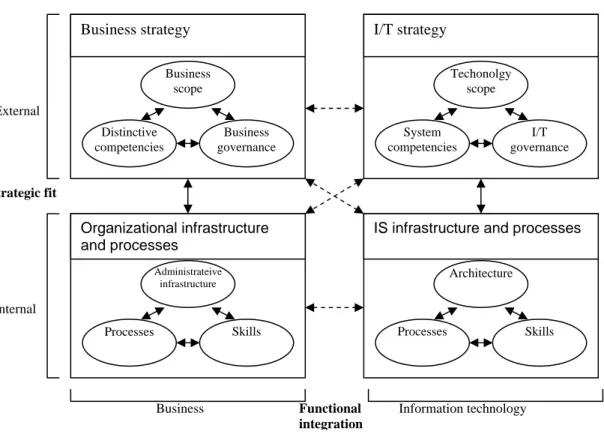
There are several studies concerned with the alignment of business and IT (Henderson and Venkatraman 1999, Reich and Benbasat 2000; Hirschheim and Sabherwal 2001, Sabherwal et al., 2001, Sabherwal and Chan 2001). This paper uses the model presented by Henderson and Venkatraman (1999) called the Strategic Alignment Model (SAM). Although it is an old model and the article has been reprinted and is still one of the most referred articles in the alignment literature. The model consists of four domains: Business strategy, IT strategy, organizational infrastructure and processes, and IS infrastructure and processes. The two first domains (shown in the upper part of figure 1) have an external focus, and the last two (the bottom of Figure 1) are focused on the internal part of the organization. In each of the external domains there are three components; scope, competencies and governance. In the internal domains, the components are; architecture, processes and skills.
Figure 1. Strategic alignment model (Henderson and Venkatraman, 1999)
Henderson and Venkatraman (1999) acknowledge that alignment cannot be achieved only by looking at the internal or the external domains. A change in one domain will affect a least two of the others. They present four different perspectives of alignment (Table 2). The changing domain is called the Anchor or Driver domain. The change affects one of the domains next to it, called the Pivot domain, and finally the change has implication for an opposite domain called the Impact domain.
Table 2. Perspectives of alignment (Henderson and Venkatraman, 1999)
Strategy execution Technology transformation Competitive potential Service level Anchor eller Driver
Business strategy Business strategy IT strategy IT strategy
Pivot Organizational
infrastructure and processes
IT strategy Business strategy IS infrastructure and processes Impact IS infrastructure and processes IS infrastructure and processes Organizational infrastructure and processes Organizational infrastructure and processes Business strategy Business scope Distinctive competencies Business governance Organizational infrastructure and processes Administrateive infrastructure Processes Skills I/T strategy Techonolgy scope System competencies I/T governance
IS infrastructure and processes
Architecture Processes Skills External Internal Strategic fit Functional integration Information technology Business
Henderson and Venkatraman (1999) stress that an organisation does not choose one and only one perspective, but follows one perspective while being aware of the others. Since a change in e.g. the IS processes caused by the ERP might effect some of the business processes, it will not automatically make the business processes the impact domain.
A large part of the choice of alignment perspective is based on strategies, business as well as IS. Miles and Snow (1978) identified three different business strategies; defenders, prospectors, and analyzers. Sabherwal and Chan (2001) and Hirschheim and Sabherwal (2001) described the alignment between these strategies and IS strategies. The defenders are the most stable; they offer high quality products or services at low prices. They seek operational efficiency and economies of scale. The investments are highly cost efficient but with few core technologies. The defenders do not search outside their domain for new opportunities, and rarely make adjustments in structure and technology. According to Sabherwal and Chan (2001) the defenders should follow an IS for efficiency strategy, where the IS is used to support the business. The prospectors constantly seek new products/market opportunities. They invest heavily in product R&D to emphasize innovation. The prospectors have an IS for flexibility strategy that seeks flexible technology and uses an organic organization structure, but it often lacks control and low operational efficiency. The analyzers combine the strengths of the two other types. They seek to minimize risk while maximizing opportunities for growth. The analyzers have a stable product core, but like the prospectors they seek new products and markets. They usually have a matrix organization structure, and a dual technological core, with stable and flexible components. Therefore analyzers have an IS for comprehensiveness strategy.
After this theoretical background the reader should have the conceptual understanding necessary to understand the characteristics of the three archetypes presented in the following section.
3. Three archetypes for managing ERP systems
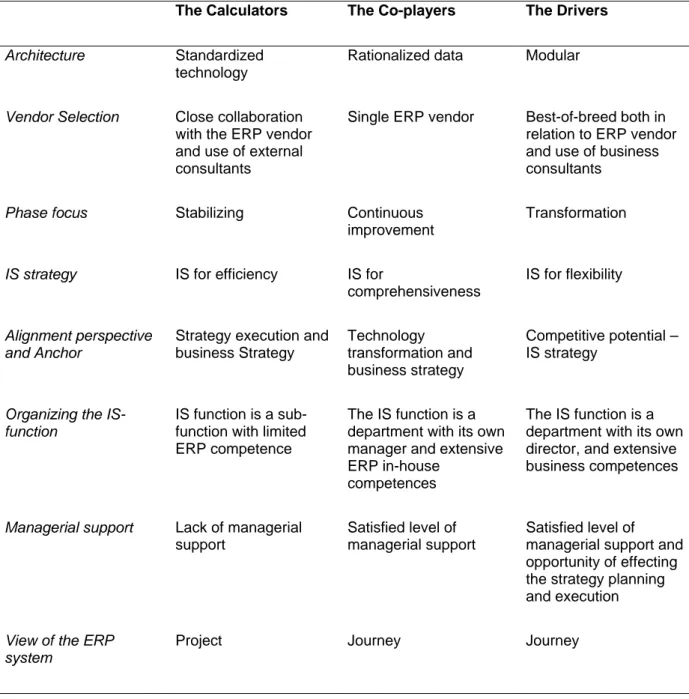
Through our research we identified three archetypes for managing ERP, which we have named: The Calculators, the Co-players and the Drivers. The names of the archetypes are as neutral as possible, since the purpose of this paper is “only” to present them and not to evaluate if one of them is superior. The archetypes are presented in table 3 and below the characteristic of each of the archetypes are described, followed by an illustrative case.
3.1 The Calculators
The calculators are in the standardised technology phase; they have technology standards which reduce the number of management systems and are thereby reducing the cost of IT. This is in harmony with their IS strategy. They have one ERP vendor, and some other legacy systems. Their main problem is that data are embedded in the individual applications and therefore not integrated between all of the systems. Further it helps the calculators to make decisions regarding new technology.
The calculators are in the stabilizing phase, they have finished the implementation of the ERP, but it is not embedded in the organization yet.
Table 3. Archetypes for ERP management
The Calculators The Co-players The Drivers
Architecture Standardized
technology
Rationalized data Modular
Vendor Selection Close collaboration
with the ERP vendor and use of external consultants
Single ERP vendor Best-of-breed both in relation to ERP vendor and use of business consultants
Phase focus Stabilizing Continuous
improvement
Transformation
IS strategy IS for efficiency IS for
comprehensiveness
IS for flexibility
Alignment perspective and Anchor
Strategy execution and business Strategy Technology transformation and business strategy Competitive potential – IS strategy
Organizing the IS-function
IS function is a sub-function with limited ERP competence
The IS function is a department with its own manager and extensive ERP in-house
competences
The IS function is a department with its own director, and extensive business competences
Managerial support Lack of managerial
support
Satisfied level of managerial support
Satisfied level of managerial support and opportunity of effecting the strategy planning and execution
View of the ERP system
Project Journey Journey
The calculators are typically a bit conservative or in financial trouble and follow the defender strategy. They use their ERP to improve efficiency, but do not seek a competitive advantage from the ERP. Their alignment perspective follows the strategy execution, which means that the ERP is to support the business. The Business strategy has been articulated and is the anchor domain and thereby the driver of the organizational design (pivot) and the IS processes (Impact). A change in the business strategy will therefore result in changes in the organizational design, forcing the ERP to adapt to these changes.
There is little involvement from the leaders in order to ensure that the ERP is fully embedded in the organization. They see the IT as an extra cost of doing business, a cost that has to be reduced as much a possible. The employees have only got little responsibility towards the systems as well, they feel that it is the job of the IS function
to make sure that data are in order and systems are aligned with business processes.
The IS function is most likely a subfunction to another department, and because of the view of the use of ERP as a project, that ends after the implementation, the calculators use external ERP consultants, since they do not want to spend resources on keeping the ERP competencies in-house.
3.1.1 Case: Alpha
Alpha is a Danish manufacturing organization with both domestic and foreign production plants in addition to sales subsidiaries abroad. From the early 1980s until 1995 the organization experienced a tremendous growth both in turnover and number of employees. During the summer of 1995, Alpha received increasing numbers of customer complaints about products, so they started an ERP project in 1995 to improve the information flow. The system went live in January 1997.
Alpha chose one ERP vendor in order to create one platform for the entire organization. However, they did not achieve full data integration, since some employees in the production were using the old systems, and others were keying in the data wrong.
After going live Alpha suffered some financial problems, which forced them to adopt the defender strategy. They needed to cut cost and this affected their use of ERP. This led them to an IS for efficiency strategy where there were only resources for the IS investments, that were necessary to support the business strategy and processes. In Alpha the IT department is placed below the economy CIO, and no direct connection exists between the IT manager and the CEO. The IT manager does not feel that he has any influence on the business strategy. At Alpha the attention to the ERP shifted after a normal operation were reached, and the people involved in the implementation project group, who had gained a superior knowledge about the ERP system and business processes, went back to their ordinary functions within the organization. The implementation of the ERP system had been organized as a project, and after the stabilization the project organization was disbanded. Later on many of the people with the superior ERP knowledge left the company, resulting in a loss of ERP competencies.
3.2 The Co-players
The co-players use the ERP as an information management system to rationalize data into shared databases, and to integrate the core processes. The co-players have one ERP vendor and use that system to support all business processes. This helps the decision-making about future investments and also improves the infrastructure of the organization. By doing this they shift to the rationalized data stage. The co-players have finished the implementation of ERP and are now in the stage of extending and integration, adding new modules and functions to the system. Co-players' business is based on core products, but they still seek new markets and products, making them analysers. In order to follow their business strategy, they adapt the IS strategy, IS for comprehensiveness, where the ERP supports the existing business operations, and helps identify and utilize opportunities in the market.
Although the business strategy is still in focus, the IS strategy is having more effect. The Business strategy (anchor) is the driver, but the IS processes (impact) are now changed through the IS strategy (Pivot). The effect of this is a close collaboration
between the IS manager and the CEO. The IS function follows the ERP vendor and looks for opportunities in new processes and modules.
The co-players realise the business potential in IS, therefore the ERP has full support from the CIO. In order to realise the full benefits of the ERP, the co-players focus on maintaining the knowledge that are generated during and after the implementation, within the organization, this is done by building in-house ERP competencies.
The co-players see the ERP as a new player in the organization, instead of one ending after the implementation. It needs actor status and its own management.
3.2.1 Case Beta
The company of Beta was founded in the late 19th century, today they are represented in more than 60 countries and all their divisions are working with development and production of semi-raw materials, which are used in several larger companies. Their strategy is to develop their core business by exploiting the full potential of the current business segment; this is done through innovation and value creation.
During 1999 Beta realised that their current IT systems had an apparent shortage compared to the development in the digital market, so they decided to implement a new ERP system. They use one system for everything, as they say, “it is in the ERP all of it”. This is a strategic choice, where Beta benefit from all the extra technology provided by the vendor.
“There is a lot of benefit by choosing a standard system; you are constantly given new technology you can add to the system“
Today the system is well integrated in Beta, and all data have to be registered in the ERP in order to be validated. The successful implementation and use, have caused that all implementation goals have been achieved and have created a fast ROI. The ERP has a large influence on their overall business, as they say,
“We are in a situation today, where IT and ERP is part of setting the business strategy and the opportunities in it“
This shows the close alignment between IT and business strategy.
In Beta they focused on maintaining the knowledge, which was generated during and after the implementation, therefore almost only internal consultants were working on the ERP. The CEO sees the importance of the ERP and that ERP is not a project ending with the implementation.
3.3 The Drivers
The drivers are trying to reach the modular architecture stage, which allows them to choose several different ERP vendors, because of a wired business core. This further allows the drivers to choose new ERP modules and functionalities that fit best with that part of the organization, regardless of vendor - the best-of-breed - while still maintaining a solid core. So the drivers do not have a single ERP vendor, instead they look for the potential ones for the different solutions on the market.
The drivers are still adding modules to the ERP but are also using the system to transform the organization. This is done by creating closer links to customers and suppliers, through the use of ERP.
The drivers are searching for new products and new markets as a part of the prospector strategy. In order to do this they need a flexible IS strategy. The drivers see the IS as a potential competitive advantage. And the IS strategy is a large part of the business and it is therefore possible to talk about IS strategy as the anchor
domain which is affecting the business strategy (pivot) and through this, the processes of the organization (impact). This means that opportunities in the ERP, like new modules, could affect the business strategy and thereby the organizational processes in the organization.
The IS function is a department with its own director, with a close collaboration with the CEO; this ensures the influence on the business strategy. The department has extensive ERP and business competences, since it needs knowledge about the system as well as the business. But even though trying to keep competencies in-house, this is not done at any cost. A selective sourcing is used, meaning that if something is valued not to be a core competence, then it is outsourced.
The drivers see the use of ERP as a journey and is constantly looking for new opportunities from the software vendors, not only the ones that they are already using, but all potential vendors in the market.
3.3.1 Case Gamma
The Gamma company was founded in the middle of the 1920s. They expanded during the 1950, and today they are a worldwide competitor. They develop, produce, and promote electronic products. Their strategy is to increase turnover by delivering the products the market demands, and with their unique quality.
In order to realise the strategy, they need flexible IT systems. The IS is to support the business strategy, by collaborating with the entire value chain, internally and externally. Doing this Gamma see IS as giving a competitive advantage, as they say, “You won’t get ahead of the others by running after them, so you get beyond just by using a standard system.“
Gamma started their ERP journey in 1996, and the first module of the ERP went live at the beginning of 1998, but because of the complexity of the production module this was not implemented until the fall of 1999.
In order to fulfil their strategy Gamma chose one core ERP system, however, if the primary ERP systems cannot support the needs, they just use something else, a so-called best-of-breed choice. They can do this because of their flexible strategy and wired architecture. They use one ERP core but with a lot of extended features which allows them to call web services and other processes.
Gamma run all of the ERP projects in-house, in order to keep the knowledge. Sometimes they use consultants with core competencies, but by getting them to work with their own people, they obtain new knowledge. If they do not see a business potential in a competence, then they outsource it, as they have done with the operation of their mainframe system.
The entire organization is very informal, which also reflects on the relationship with the CEO and the IT manager. The IT manager is a part of a senior management group, which refers to the board of directors.
5. Discussion
The presentation of the three archetypes shows that there is not a single way of managing an ERP system. How organizations choose to do this depends on their competencies in working with IS, also called IT maturity (Galliers and Sutherland, 2003) and they are getting different benefits from this. All organizations do not need to be drivers; it all depends on their strategy with the ERP. Organizations need to be aware of the competencies needed and their own level of maturity before they start
the ERP journey, and then utilize this knowledge in order to plan their use of ERP and the expected benefits and disadvantages.
The organizations also need to be aware of the different attributes and thereby the benefits and disadvantages of the archetypes. This helps them to figure out what problems they might have, and what possible solutions there could be. Further it helps them to realize what is important if they wish to make changes in their attributes or even try to change towards a different archetype.
This paper questions if the implementation and use of an ERP alone can make organizations reach higher stages of architecture. The calculators' goal is to use the ERP to integrate data and processes, and thereby move to the rationalized data stage. But since they are not fully aware of the competencies required to reach this stage, they find themselves back-pedalling. So a lack in competencies might result in an organization not reaching the wanted architecture stage.
We find it important to stress that in this paper there is no evaluation of the archetypes, in terms of one being better than the other, this could however be an interesting subject for further study. Even though there is no evaluation of the archetypes, there are benefits and disadvantages of all of them.
6. Conclusion
This paper has identified and presented three different archetypes of managing ERP systems during the second wave of ERP - the Calculators, the Co-players and the Drivers. Each of these was defined through the attributes: architecture, vendor selection, phase focus, IS strategy, alignment perspective, IS function, managerial support and view of the ERP system. The study showed that each of the archetypes has a different way of managing their ERP, depending on their way of doing business and their IS competencies.
The definition of the archetypes constitutes a context in which we can discuss ERP management. They provide a foundation, which can be used to study different aspects of managing ERP. We consider the following areas as the most interesting regarding further research:
• The governance structure in the different archetypes. Who has the decision and input rights, and should the governance structure be different depending on the archetype?
• The process of transforming from one archetype to another. How does an organization change from a co-player to a driver?
• The transformation into the driver – or the modular stage – would it be fair to call that the third wave of ERP?
• The implementation process of the driver with a focus on how to reach the modular stage - what are the critical success factors in this transformation?
• Management of the relations involved in the different archetypes, including sourcing issues. Is the relationship with the ERP vendor different when you have a single system strategy and a best-of-breed?
References
Bergeron, F., Raymonch, L. and Rivard, S. (2004), “Ideal patterns of strategic alignment and business performance”, Information management, Vol. 41, pp. 1003-1020.
Boudreau, M. C. and Robey, D. (1999), "Organizational Transition to Enterprise Resource Planning Systems: Theoretical Choices for Process Research", International Conference on Information Systems, pp. 291-299.
Davenport, T. H. (1998), “Putting the enterprise into the enterprise system”, Harvard business review. July-August 1998.
Davenport, T. H., Harris, J. G. and Cantrell, S. (2004a), "Enterprise systems and ongoing process change", Business Process Management Journal, Vol 10, No.1, pp. 16-27. Davenport, T. H., and Brooks, J. D. (2004b), “Enterprise systems and the supply chain”,
Journal of Enterprise Information Management, Vol. 17, No.1, pp.8-19.
Dilland, D.F.; Ruchala, L. and Yuthas, K. (2005), “Enterprise resource planning: A physical manifestations of administrative evil”, International Journal of Accounting Information Systems, Vol.6, pp.107–127.
Galliers, R.D. and Sutherland, A.R. (2003), “Information systems management and strategy formulation: applying and extending the ‘stages of growth’ concept.”, in Galliers, R. D. and Leidner, D. E. (Eds.), Strategic Information Management – challenges and strategies in Managing Information Systems, 3rd edition. Elsevier Butterworth Heinemann, Oxford, England, pp. 33-64.
Hanseth, O. and Braa, K. (1998), "Techonology as Traitor: Emergent SAP Infrastructure in a Global Organization", In Hirscheim, R., Newmann M., and DeGross J. I. (Eds.), The Nineteenth International conference on Information Systems, ICIS' 98, Helsinki, pp. 188-197.
Henderson, J.C. and Venkatraman, N. (1999), “Strategic alignment: Leveraging information technology for transforming organizations”, IBM systems journal, Vol 38, No. 2 & 3. Hirschheim, R and Lacity, M. (2000), “The myths and realities of Information Technology
Sourcing”, Communication of the ACM, vol. 43, No. 2, pp. 99-107.
Hirschheim, R. and Sabherwal, R. (2001), “Detours in the Path toward strategic information systems alignment”, California management reviews, Vol. 44, No.1.
Luftman, J. and McLean, E.R. (2004), “Key issues for IT executives”, MiS Quaterly Executive. Vol. 3, No. 2, pp. 89-104.
Kraemmergaard, P. (2000), "ERP implementation - ERP as an actor", In proceedings of 16th World Computer Congress 2000. August 21-25 2000, Beijing, China.
Kræmmergaard, P. and Koch, C. (2002), “Managing ERP after going-live”, Proceedings of the 9th International Conference, European Operations Management Association, Copenhagen.
Markus, M. L., Petrie, D., and Axline, S. (2003). “Continuity versus discontinuity: Weighing the future for ERP packages”, in Shanks G., Seddon P. and Willcocks L. (Eds.),
Secondwave enterprise resource planning systems - implementing for effectiveness, Cambridge University Press.
Markus L. and Tanis C. (2000), “The Enterprise System Experience - From Adoption to Success”, in Zmud R. (Ed.), Framing the Domains of IT Management, Pinnaflex, pp. 173-207.
Milies, E.E. and Snow, C.C. (1978), Organizational strategy, structure and process, Mcgraw-Hill.
Møller, C., Kræmmergaard, P. and Rotbøl, M. (2003), “Virksomhedssystemer i Danmark 2003 -en analyse af de 500 største danske virksomheders ERP systemer”, IFI working paper series no. 126 ISSN no. 1398-067X. Aarhus: Department of Information Science.
Pui Ng, C. S., Gable, G. G. and Chan, T. (2002), ”An ERP-client benefit-oriented maintenance taxonomy”, The Journal of Systems and Software, Vol. 64, pp. 87–109. Reich, B. H. and Benbasat, I. (2000), “Factors that influence the social dimension of
alignment between business and information technology objectives”, MIS quarterly,
Vol. 24. No.1, pp. 81-113.
Rikhardsson, P. and Kræmmergaard, P. (2006 – in press), “Identifying the impacts of enterprise system implementation and use: Examples from Denmark”, International Journal of Accounting Information Systems, online Elsevier Science Direct, 2006. Ross, J. W. (2003), “Creating a strategic IT architecture competency: Learning in stages”,
CISR WP No.335 and Sloan WP No. 4313-03.
Ross, J. W. and Vitale, M. R. (2000), “The ERP revolution: surviving vs. thriving”, Information systems frontiers, Vol. 2, No. 2, pp.233-241.
Sabherwal, R. and Chan, Y. E. (2001), “Alignment between business and IS strategies: A study of prospectors, analyzers, and defenders”, Information system research, Vol. 12, No. 1, pp. 11-33.
Sabherwal, R.; Hirschheim, R. and Goles, T. (2001), “The dynamics of alignment: Insights from a punctuated equilibrium model”, Organization Science, Vol. 12, No. 2 March-April 2001, pp. 179-197.
Shanks, G.; Seddon, P. B., and Willcocks, L. P. (Eds.). (2003), Second-wave enterprise resource planning systems: Implementing for effectiveness, Cambridge University Press.
Willis, T H. and Willis-Brown, A. H. (2002), “Extending the value of ERP”, Industrial management and data systems, Vol. 102, No. 1-2, pp. 35-39.