Academic Journal Quality Guide
Version 4
Copyright © Charles Harvey, Aidan Kelly, Huw Morris and Michael Rowlinson, 2010
Published by
The Association of Business Schools, 137 Euston Road, London, NW1 2AA,
United Kingdom
ISBN
i
Contents
Advisory Panel Members ... ii
Contact at ABS: ... ii
Introduction ... 1
1.
What Purposes do Academic Journals Serve?...1
2.
What are the Functions of Journal Quality Lists? ...2
3.
Types of Journal Quality List ...2
4.
Commonly Perceived Problems of Journal Quality Lists ...3
5.
Compilation and Quality Assessment Procedures ...4
6.
Contents of the ABS 2010 Guide ...7
7.
Why does it all matter? ... 11
Conclusion ... 11
References ... 12
Appendix 1: Data on Sub-Fields of Business and Management Studies... 14
ii
Editors
Professor Charles Harvey
Pro-Vice-Chancellor for Humanities and Social Sciences,
University of Newcastle (advisor: Business History)
Aidan Kelly
Senior Lecturer in Social Research Methods, Department of
Sociology, Goldsmiths University of London
Professor Huw Morris
Pro-Vice-Chancellor (Academic) University of Salford
Professor Michael
Rowlinson
Professor, School of Business and Management, Queen Mary
University of London
Advisory Panel Members
Professor David Blackaby
Economics
University of Swansea School of
Business and Economics
Professor Robert Blackburn
Enterprise and Small
Business
Kingston Business School
Professor Chris Cooper
Tourism and Hospitality
Management
Oxford Brookes University
Business School
Professor Christine Ennew
Marketing
Nottingham University Business
School
Professor Ewan Ferlie
Organization Studies
and Public Management
Kings College, University of London,
Department of Management
Professor Gerard
Hodgkinson
Psychology,
Organizations and
General Management
University of Leeds Business School
Professor Margaret Hogg
Marketing
Lancaster University Management
School
Professor Roland Kaye
Accounting
Norwich Business School, University
of East Anglia
Professor Colin Mason
Enterprise and
Innovation
Strathclyde Business School
Professor Philip Molyneux
Finance
Bangor Business School
Professor Huw Morris
Human Resource
Management
Pro-Vice-Chancellor (Academic)
University of Salford
Professor Bob O’Keefe
Information Management University of Surrey School of
Management
Professor Howard Thomas
Strategy
Warwick Business School
Professor Chris Voss
Operations, Technology
and Management
Science
London Business School
Contact at ABS:
Julie Davies
Head of Research and
Development,
Association of Business
Schools
tel. +44(0)20 7388 0007
1
Introduction
Welcome to version 4 of the Association of Business School (ABS) Academic Journal Quality Guide.
The ABS Academic Journal Quality Guide is a hybrid based partly upon peer review, partly upon
statistical information relating to citation, and partly upon editorial judgements following from the
detailed evaluation of many hundreds of publications over a long period. It provides a guide to the
range, subject matter and relative quality of journals in which business and management academics
might publish the results of their research.
The brief agreed between the editorial team and the chair of the ABS Research Committee can be
summarised as follows:
I.
The Guide should be designed primarily to serve the needs of the UK business and management
research community.
II.
The Guide should classify journals into four categories (grades 1 to 4) plus a new category of 4*
which recognises the quality of those journals ranked as a ‘top’ class journal in at least seven of
ten international listings consulted.
III.
The classification process should be stringent and methodical in all cases, embracing five
sources of evidence:
a. the assessments of leading UK researchers in each of the main sub-fields covered
b. the mean citation impact scores for the most recent five year period
c. evaluation by the editors of the quality standards, track records, contents and processes
of each journal included in the Guide
d. the number of times the journal was cited as a top journal in ten lists taken to be
representative of the ‘world’ rating business and management journals
e. the number of times a journal was cited in the submissions to the 2008 RAE
IV.
The Guide should be comprehensive in the coverage of research conducted in Business Schools
in the UK and internationally covering a wide range of disciplines, fields and sub-fields within the
social sciences and taking an inclusive approach to what constitutes business and management
research.
V.
The editors should accept responsibility for the final classification of all journals included in
Version 4 of the Guide, following full consideration of feedback on Version 3 of the Guide and the
recommendations made by a panel of experts representing the main sub-disciplines within the
field.
VI.
The editors should publish and justify their working methods and their approach to the problems
of classification.
This introduction provides important background information which will help you to get more from the
ABS Guide. In particular it provides answers to seven frequently asked questions. First, what
purposes do academic journals serve? Second, what are the functions of journal quality lists? Third,
how do journal quality lists vary? Fourth, what are the problems associated with journal quality lists.
Fifth, how have the ABS journal quality rankings been made? Sixth, how do the ABS quality
rankings compare with those of others? Finally, why does it all matter?
1.
What Purposes do Academic Journals Serve?
Academic journals are one of the most important means of publishing and disseminating the results
of academic research and scholarship. In doing so, they serve the following purposes:
2
I.
A stamp of quality. Publication in a journal should indicate that an article can be read and is worth
reading. The editorial review processes of all journals in the ABS Guide involve blind peer review
of articles submitted by two or more researchers active in the field. These reviewers provide
feedback to the authors about the quality and standing of their work. This review process is
generally designed to be both developmental and judgemental in nature. Thus authors are
advised about whether their articles are publishable in their current form, how they should be
revised, whether they should be submitted to another publication, or whether they should not be
published at all.
II.
To inform and debate. Most journals are produced by members of the research community in
partnership with academic publishers and/or professional associations. The papers selected for
publications are intended to disseminate research findings, both empirical and theoretical, and to
stimulate debate about particular topics and issues. Improved access to journals by electronic
means has meant that debates more frequently take place across journals rather than within the
pages of a single journal.
III.
An official record of knowledge and information. The editorial and publishing process produces
definitive paper and electronic records which can be indexed and catalogued for a wide range of
users – researchers, government, public bodies, corporate bodies, charities, tutors, students,
practitioners and members of the public.
IV.
A means of managing intellectual property rights and permissions. The final submission of an
article approved for publication is normally accompanied by the signing over of some elements of
the author’s rights to the article. Once these rights have been assigned, the publisher, the
author’s agent or in a few cases the author(s) themselves are responsible for granting
permissions to reproduce sections of the paper and for the collection of copyright and licence
fees.
2.
What are the Functions of Journal Quality Lists?
Journal quality lists can fulfil one or more of the following four functions.
I.
Provide an indication of where best to publish. This is particularly important for early career
researchers or for researchers transferring between disciplines/sub-fields or embarking on cross-
or inter-disciplinary research. A list of journals and their relative quality can help potential authors
to decide what to read and where to publish.
II.
Inform staffing decisions. In the USA, journal quality lists often inform the decision making
processes of tenure, promotion and reward committees. In the UK, they are increasingly used by
appointment, promotion and reward committees.
III.
Inform library purchasing decisions. A growing number of higher education institutions and their
purchasing consortia are using journal quality lists to determine which journals and aggregation
services to buy.
IV.
Application in reviews and audits. Lists are frequently used in the UK and other countries to aid
internal and external reviews of research activity and the evaluation of research outputs.
3.
Types of Journal Quality List
Journal quality lists come in five basic forms:
I.
Institutional lists. These are the most common form of list and are typically drawn up on the basis
of the views of members of research groups within a department (e.g. Aston 2008 and Cranfield
2009).
II.
Derived lists.
These lists extrapolate journal rankings from the ratings awarded in assessment or
audit activities such as the UK RAE (e.g. Easton and Easton, 2003; Geary, Marriot and
Rowlinson, 2004; Mingers, Watson and Scaparra, 2009).
3
III.
Peer surveys. Assessments are made on the basis of the assessments of peers within a
particular field or sub-field (e.g.; Jones, Bran and Pendlebury, 1996; Jarley, Chandler and Faulk,
1998; Van Fleet, McWilliams and Seigel, 2000; Peters, Daniels, Hodgkinson and Haslam, 2009).
IV.
Citation studies. In these lists, judgments are made on the basis of the number of times in which
an average article in a journal is cited by the authors of articles in related journals (e.g.; Johnson
and Podsakoff, 1994; Tahai and Meyer, 1999; Starbuck, 2002 and Institute of Scientific
Information, 2004; Madhi, D’Este and Neely, 2009).
V.
Hybrid lists. These lists rank journals by a combination of two or more of the methods listed
above (c.f. Wil-Harzing, 2008; Harvey-Morris, 2005).
4.
Commonly Perceived Problems of Journal Quality Lists
The most commonly perceived problems of compiling journal quality lists are:
I.
Wheat and chaff
.
One of the most commonly voiced criticisms of journal quality lists is that highly
rated journals occasionally publish poor pieces of work and that high quality research sometimes
finds its way into lesser ranked journals. There may be some truth in this, but neither situation is
commonplace, and journals that consistently publish high quality research invariably rise up the
quality rankings; equally, when editorial standards lapse, journals move downward in terms of
both citation and quality rankings.
II.
Special issues.
It has been suggested that the normal editorial standards of otherwise highly
ranked journals may be reduced through the publication of special issues. Practice varies
between journals, but all the evidence points to the higher rated journals (3 and 4 in the ABS
Guide) maintaining editorial standards across all editions, including special issues.
III.
New journals.
Lists tend to give the highest rankings to journals with an established readership
and as a consequence tend to rank newer journals, whatever their aspirations or intrinsic quality,
lower down the scale. This may be the case, but the process of new journals proving themselves
is a necessary one that leads ultimately to quality improvements across the board. Reputation
ultimately can only be established though the quality of the articles published.
IV.
Citation Impact Factors are sufficient to measure journal quality. Citation Impact Factors do
provide a standardised measure of the extent to which the articles published in a journal are
referenced elsewhere, but as a standalone proxy measure of relative journal quality or
performance in research (Mahdi et al., 2008) citation impact factors are problematical, as
demonstrated in Table 1 below.
Table 1: Limitations of Citation Impact Factors as a Measure of Journal Quality
Limitation
Explanation and Consequences
Incomplete
coverage
Some 459 journals out of 821 in the 2010 ABS Guide have a citation impact
factor for 2008 (the year for which the most recent data is available) and only
429 have a five year mean citation factor. However, journals without a citation
impact factor are regularly cited and some are heavily cited. When, for
example, established journals with high peer esteem first enter the scheme they
tend to be listed straight away near top of the rankings for their respective field.
Examples include the award of an impact factor of 1.537 to
Entrepreneurship
Theory and Practice
on its first appearance in the citation listings in 2005, placing it
on a par with titles such as the
Journal of Management
(1.535) and ahead of the
Harvard Business Review
(1.404). Even more emphatically, the
Journal of
Economic Geography
came top of the geography list on its first appearance in 2004
with an impact factor of 3.139.
Non-recognition of
differences in
epistemological
traditions
High citation impact factors result from the repeated inclusion of articles in
referential chains
. A referential chain is a list of references to a series of
studies of a similar type that grows ever longer as more studies of that type are
conducted. In the experimental sciences, for example, it is commonplace to report
on experiments that are variants of earlier studies, and for these earlier studies to be
4
included in a referential chain. It is for this reason that psychology journals
typically have much higher citation impact factors than journals in other fields
included in the ABS Guide. Other disciplines, however, proceed to generate new
knowledge though very different practices and procedures. In business and
economic history, for example, where most articles are founded on archival
data, very few studies are conducted that lead naturally to referential
chaining. Hence lengthy chains are rarely formed, and citation impact factors are
typically much lower than in the medical, engineering and scientific fields. The long
established and highly esteemed
Journal of Economic History
, for example, known
for the originality, rigour and academic quality of its content, recorded a five year
average citation impact factor of just 0.73 2008. It follows that citation impact
factors should not be used to make comparisons between fields without the
application of standardization for differences in centrality and dispersion (as
detailed, for example, in Figure 1 below).
Herding
Herding is a consequence of symbolic association. It stems from the tendency of
academics to associate their own research through citation to what are
perceived to be the best journals and most influential authors. When referential
chains are cross-referenced, referential networks are formed such that similar
sets of highly cited journals regularly feature in lists of references. This, in effect,
places journals already at the top at a big advantage to those seeking to rise
through the citation ranks, reinforcing the perception that research published
in more highly cited journals invariably is superior to work published in less
heavily cited journals. Herding works to mask the fact that top quality
research can from time to time be published in less heavily cited journals.
Content bias
Journals devoted to survey articles, literature reviews, methodology and
conceptual development tend to be more heavily cited than journals dedicated
to publishing the results of original research. Prominent examples in the ABS
Guide include the
Annual Review of Psychology
, with a five year average impact
factor of 16.26 in 2008, and the
Journal of Economic Literature
which in 2008 had
an impact factor of 7.842. Journal rankings based purely on citation impact factors
cannot distinguish between journals of different types with different academic
objectives.
Game playing
and
differences in
levels of
maturity
between fields
Some academic fields, like economics, have developed more mature and
sophisticated academic practices than others. A higher proportion of journals in
the field carry citation impact factors when compared to less mature fields like
tourism and hospitality management. In mature fields, the rules of the citation
game are well known, and there is a well established pecking order of journals, with
numerous referential networks in existence. Citation impact factors are a better
proxy for journal quality in mature rather than immature fields. In less mature fields,
referential networks are far less dense; citation impact factors are fewer and of a
lesser order, and consequently a less valuable guide to the reach and influence of
journals in the field.
5.
Compilation and Quality Assessment Procedures
The ABS Guide provides an expert assessment of the quality of the empirical and theoretical
research articles typically published within the pages of an academic journal. The editors take the
view that although high quality research may on occasion be published in lesser ranked journals and
vice versa
, these exceptions to the rule do not invalidate the overall assessment of the quality of
research published in a journal. The ABS Guide is intended primarily to serve the needs of the UK
business and management academic community. However, we know from feedback that the Guide
has currency and is used extensively in many countries across the world.
The ABS Guide is essentially a consensus list and its authority rests upon general acceptance of the
fair and balanced view of relative quality taken by the editors and advisory panel members. The ABS
Guide is not comprehensive. It does not include all the journals in which business and management
academics might be drawn to publish their research. Rather, the Guide seeks to include all core
5
journals, broadly defined, and for established journals evidenced by threshold level inclusion at the
latest (2008) comprehensive UK research assessment exercise.
The rankings made in the ABS Guide are not fixed, but have been reviewed annually, and from 2010
onwards biennially in light of available evidence. The ABS Guide is informed by citation statistics but
individual journal assessments are not dictated by them. It is observed that citation impact factors
vary depending on the scholarly practices prevailing in different fields, the size and nature of the
audience for the journal, the types of article published, and the size of the academic community
within a field. This means that citation impact factors alone cannot be taken as indicative of the
quality of the articles published in a journal. A more sensitive and multi-faceted approach to ranking
is required.
Bearing in mind that the overall quality of a journal and the quality of an individual article published
therein may vary, upwards or downwards, the journals included in the ABS Guide have been ranked
as specified in the following table. This ranking scale is not the same as the RAE scale as it is used
to rank journals and not to rate the quality of individual researchers or research outputs. It should be
noted that no reference is made to ‘national’ and ‘international’ standards, which are seen by the
editors as problematic and potentially misleading. In a world of easy communication, research of
modest quality is regularly published in journals laying claim to be ‘international’, and such claims
can frequently be supported through reference to the domicile of contributors, readers and
members of editorial boards. In the ABS Guide, journals are ranked by the quality and impact of the
research typically published without reference to any claims made relating to geographic reach or
importance.
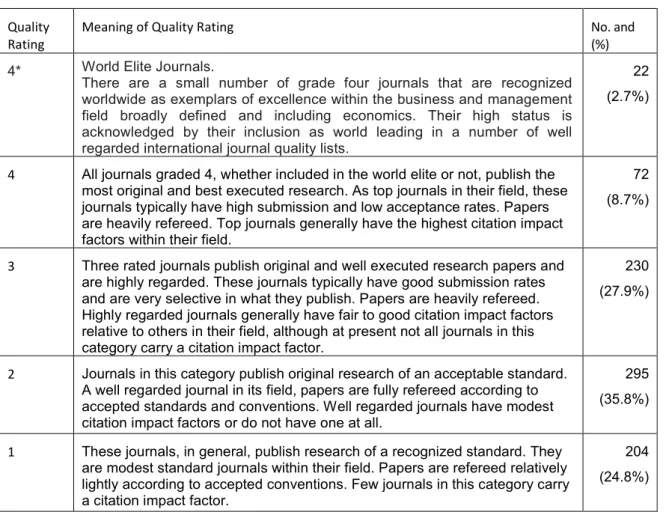
Table 2: Specification of Journal Quality Standards
Quality
Rating
Meaning of Quality Rating
No. and
(%)
4*
World Elite Journals.
There are a small number of grade four journals that are recognized
worldwide as exemplars of excellence within the business and management
field broadly defined and including economics. Their high status is
acknowledged by their inclusion as world leading in a number of well
regarded international journal quality lists.
22
(2.7%)
4
All journals graded 4, whether included in the world elite or not, publish the
most original and best executed research. As top journals in their field, these
journals typically have high submission and low acceptance rates. Papers
are heavily refereed. Top journals generally have the highest citation impact
factors within their field.
72
(8.7%)
3
Three rated journals publish original and well executed research papers and
are highly regarded. These journals typically have good submission rates
and are very selective in what they publish. Papers are heavily refereed.
Highly regarded journals generally have fair to good citation impact factors
relative to others in their field, although at present not all journals in this
category carry a citation impact factor.
230
(27.9%)
2
Journals in this category publish original research of an acceptable standard.
A well regarded journal in its field, papers are fully refereed according to
accepted standards and conventions. Well regarded journals have modest
citation impact factors or do not have one at all.
295
(35.8%)
1
These journals, in general, publish research of a recognized standard. They
are modest standard journals within their field. Papers are refereed relatively
lightly according to accepted conventions. Few journals in this category carry
a citation impact factor.
204
(24.8%)
6
In compiling version 4 of the ABS Guide (2010), using the quality classification system outlined
above, version 3 of the ABS Guide (2009) served as the starting point. Extensive feedback on
version 3 of the Guide was presented to a specially convened advisory panel meeting. The panel
met on 5 November 2009 at Warwick Business School and made various general recommendations
and many specific recommendations relating to individual titles. The recommendations were then
considered by the editors in light of the most recent data including recently published listings and the
most recent citation impact data. At this point the editors decided to formulate a more explicit set of
principles that would guide decisions to include, exclude and grade journals in version 4 of the
Guide. These were agreed as principles at the second meeting of the panel on 5 March 2010 at
Manchester Metropolitan Business School. The principles are described below:
1. The ABS Guide 2010 edition includes all journals with 2 or more submissions in the UK Research
Exercise 2008 plus a limited number of new journals with the prospect of emerging as a core
journal, and in addition selected others with consistently high citation statistics.
2. The journals qualifying for inclusion in the ABS Guide 2010, as detailed in 1 above, were next
divided into two sets: those carrying a citation impact factor and those that do not. Each of these
sets of journals was then classified according to different procedures.
3. With few exceptions, journals not carrying a citation impact factor were graded at 2 or lower. The
exceptions to this rule are journals with an established reputation and previously graded 3 in the
Guide. The majority retained this grade in recognition that in particular sub-fields citation impact
factors have not been seen as important to journal editors and contributing authors. Examples
include the sub-fields of accounting, entrepreneurship and small business, hospitality and
tourism; and marketing. (The editors will keep this matter under review as they believe in
principle that all higher graded journals – 3 and 4 – should carry a citation impact factor.)
4. Agreed exceptions apart, journals not carrying a citation impact factor were next divided into
ranks 1 and 2 on the basis of an individual assessment of (a) evidence relating to the academic
standards prevailing at the journal; and (b) the originality and quality of the research articles
typically published in the journal. The journals graded as in the 2 category provided convincing
evidence of high editorial standards and a thorough refereeing process at the double-blind
standard or higher. The journals graded 1 displayed lower standards and a less rigorous
refereeing process. Many of the 2 graded journals have editors and members of editorial boards
who are respected international authorities within their field.
5. For journals carrying a citation impact factor, the minimum grade awarded is 2.
6. All journals carrying a citation impact factor provisionally were classified as falling within ranks 2,
3 and 4 according to its standardised
citation impact factor class. To eliminate known variation in
citation practices across the sub-fields of Business and Management, the raw JCR data are
measured in terms of field-specific standard deviations from the mean of each field’s journal
scores. It is computed as follows:
a. The field means and standard deviations for each JCR citation impact factor are
determined.
b. The mean field factor is subtracted from each journal’s score and this is divided by the
standard deviation for that score for the field. For all journals the standard score
measures the number of standard deviations it departs from the mean for the field.
c. The scores for all journals were then ranked and divided into quartiles of all journals with
an impact factor.
7. The final grade for each journal included in the ABS Guide for 2010 was determined by the
editors, under advice from the members of the editorial advisory panel, in two stages.
7
a. In the first stage, the provisional classification was either confirmed or moved upwards or
downwards based on an individual assessment of (a) evidence relating to the academic
standards prevailing at the journal; and (b) the originality and quality of the research
articles typically published in the journal. In making these qualitative judgements, editors
and advisory panel members, in addition to their first-hand knowledge as subject
experts, consulted a specially constructed data set, enabling them to compensate for
biases relating to the types of article published within particular journals.
b. In the second stage, the very highest ranking journals within the 4 category were
identified through inclusion of a *superscript. These journals are those ranked in the
highest category in at least 7 of 10 business and management journal lists selected to
produce an ‘international’ ranking scale. The 'world elite' rating for each journal counts
the number of times a journal is the highest possible rating in each of the following
journal quality listings:
Financial Times list (2009)
University of Queensland (2007)
Australian Business Deans Council (2008)
Monash University, Melbourne (2007)
ESSEC Business School Paris (2005)
Centre National de la Recherche Scientifique (2008)
Wirtschaftsuniversität Wien (2008)
Dutch Business Administration academics (1999)
University of Groningen School of Management (undated)
University of Texas Dallas (undated)
6.
Contents of the ABS 2010 Guide
In this section we introduce the reader to the
contents of each of the columns contained in the
ABS 2010 guide. Following the ISSN and Journal
Title columns are those listing the ABS quality
ratings awarded to each journal in the previous
2009 edition and in the current 2010 edition. As
Table 3 shows the 2010 edition has seen a large
number of journals removed from the Guide
because they failed to meet the criterion of having
at least two submissions in the RAE 2008 BMS unit
of assessment. A small number of other journals
were also removed because of their marginality to
the core academic concerns of the BMS subject area. As would be expected the reduction of the
number of journals to 823 has seen some changes to the proportions of journals represented in
each of the four grades of quality, but these differences are not taken to be significant as they are a
consequence of the removal of grade 1 journals not meeting the new criteria for inclusion.
Table 4: The Definition of RAE Variables used in the ABS 2010 Guide
Total cites
The total number of citations to be found in RAE 2008
submissions to the Business and Management Studies,
Accounting and Finance and Library and Information Studies
submissions to RAE 2008.
Table 3: Proportion of Journals at each
ABS grade
Grade
ABS
2008
ABS
2009
ABS
2010
4
10.3
10.5
11.4
3
24.9
24.4
27.9
2
37.8
37.4
35.9
1
27.0
27.8
24.8
Total
1017
1033
825
8
GPA for outputs
The GPA score for outputs is a summary measure of the RAE
2008 assessment of the quality of an institution’s published
outputs. GPA is an addition of the weighted proportions of
quality as assessed by the RAE BMS panel for 2008. The
weights applied to the proportions of output in each quality
category were: 4,3,2,1. The mean score for a journal is the
mean GPA for outputs awarded to the institutions citing the
journal in RAE 2008.
Overall GPA
The GPA score for outputs is a summary measure of the RAE
assessment of the quality of an institution’s research including
scores for published outputs, research environment and
esteem. GPA is an addition of the weighted proportions of
quality as assessed by the RAE BMS panel for 2008. The
weights applied to the proportions of output in each quality
category were: 4,3,2,1. The mean score for a journal is the
mean GPA for overall quality awarded to the institutions citing
the journal in RAE 2008.
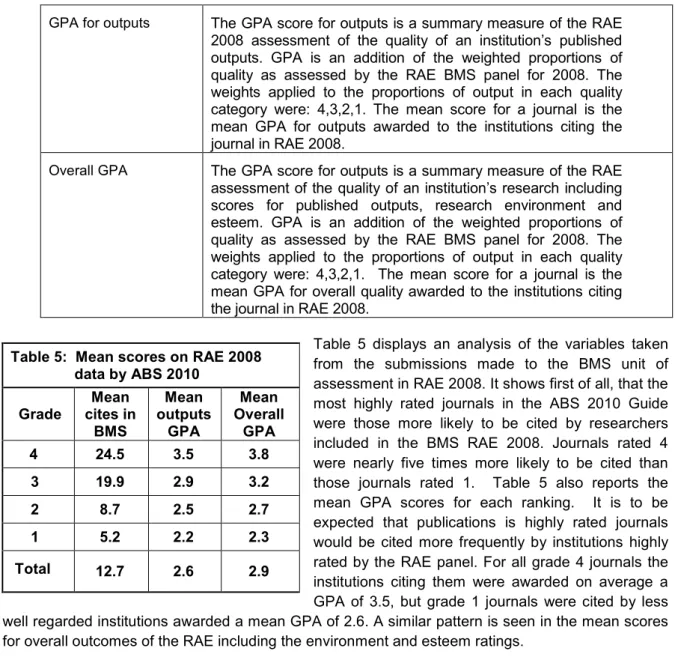
Table 5 displays an analysis of the variables taken
from the submissions made to the BMS unit of
assessment in RAE 2008. It shows first of all, that the
most highly rated journals in the ABS 2010 Guide
were those more likely to be cited by researchers
included in the BMS RAE 2008. Journals rated 4
were nearly five times more likely to be cited than
those journals rated 1. Table 5 also reports the
mean GPA scores for each ranking. It is to be
expected that publications is highly rated journals
would be cited more frequently by institutions highly
rated by the RAE panel. For all grade 4 journals the
institutions citing them were awarded on average a
GPA of 3.5, but grade 1 journals were cited by less
well regarded institutions awarded a mean GPA of 2.6. A similar pattern is seen in the mean scores
for overall outcomes of the RAE including the environment and esteem ratings.
The ISI/Thompson 2008 Journal Citation Reports provide report on 460 of the journals included in
this version of the guide. Version 4 of the ABS Guide incorporates a two citation impact factor
quartile rankings based on the. The two factors reported in the new version 4 of the Guide are: the
five year mean citation impact score; and the citation impact factor score for 2008. These are
defined in Table 6.
Table 5: Mean scores on RAE 2008
data by ABS 2010
Grade
Mean
cites in
BMS
Mean
outputs
GPA
Mean
Overall
GPA
4
24.5
3.5
3.8
3
19.9
2.9
3.2
2
8.7
2.5
2.7
1
5.2
2.2
2.3
Total
12.7
2.6
2.9
Table 6: The Definition of JCR Citation Impact Variables used in the ABS 2010 Guide
Citation Impact
Factor 2008
The citation impact factor of a journal is the number of current year
citations to the source items published in that journal during the previous
two years. As described in the text the quoted figures have been
standardised by field, and are measured in terms of standard deviations
from the mean for the field.
Five Year Mean
Citation Impact
Factor
The JCR reports 2009 include the five year mean impact factor using
data for the years 2004-8. As described in the text the quoted figures
have been standardised by field, and are measured in terms of standard
deviations from the mean for the field.
9
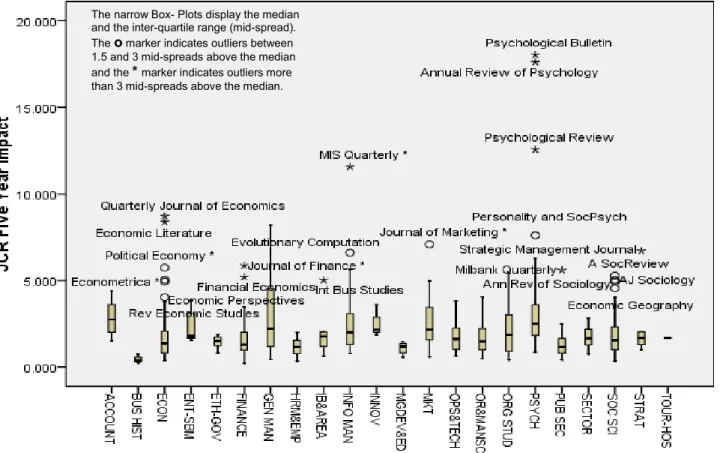
Figure 1: Box plots of the JCR Five Year Mean Citation Impact by Field.
As is clearly displayed in Figure 1 there are larger differences across sub-fields1 in the five-year
mean citation impact and in the inter-quartile range of this variable. Some extreme outliers are also
present. Organisational psychology has a high mean and some very high outliers, whereas
accountancy has a high mean citation score with no outliers.
Rather than use the raw scores found in the journal citation reports, the JCR data was standardised
by subject area and then these scores divided into quartiles. The latest (2008) citation impact figure
are thus expressed as a quartile ranking of journal impact factors standardized by subject-area.
Those journals with a score of four are in a class of the top twenty five percent of journals for the
citation impact factor reported.
While, at present, citation impact factors are not available
for all business and management journals, Table 7 shows
that those journals with the highest ABS 2009 ranking
invariably have the highest citation impact factors: ABS
grade 4 journals are typically just over one standard
deviation above the mean impact factor for their field
whereas those in the 3 category are between half and
nearly one standard deviation below the mean of their
fields.
One way of assessing the validity of the ABS scheme is to assess its consistency or reliability in
relation to other quality indicators. First, we can examine the schemes produced by other academic
British academic institutions. Table 8 displays the percentage of journals classified at each grade for
the ABS 2009 Guide and those for other quality indicators.
1
The field codes used are those listed in the RAE 2008 statement of criteria and working methods, with the addition of ethics and governance, sector studies, and tourism and hospitality. The Law sub-field has with withdrawn from the list and the law journals that meet the guide’s classification criteria have now been re-allocated to other sub-fields.
Table 7 Standardised Impact Factors
by ABS 2010 Grade
Grade
Impact 2008
Five Year
Mean
4
1.1
1.2
3
-0.6
-1.0
The narrow Box- Plots display the median and the inter-quartile range (mid-spread). The o marker indicates outliers between 1.5 and 3 mid-spreads above the median and the * marker indicates outliers more than 3 mid-spreads above the median.
10
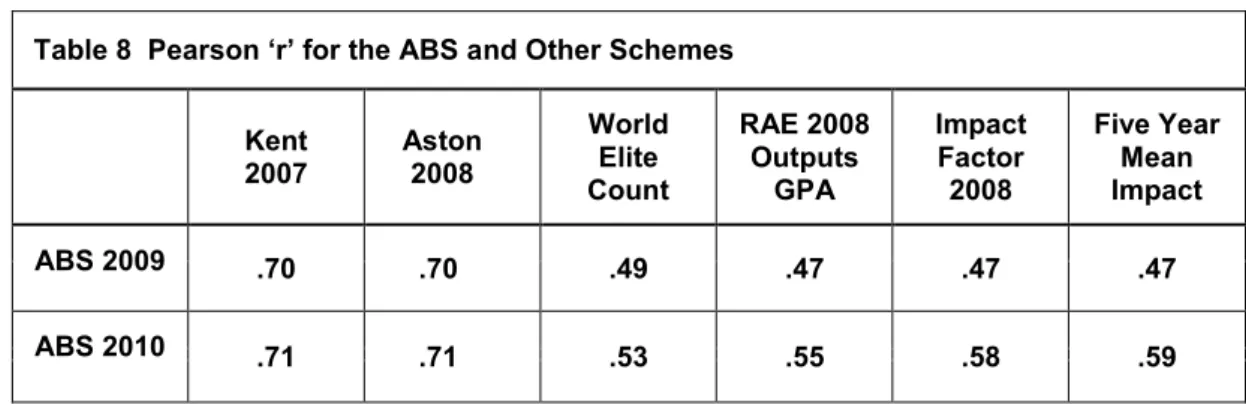
Table 8 Pearson ‘r’ for the ABS and Other Schemes
Kent
2007
Aston
2008
World
Elite
Count
RAE 2008
Outputs
GPA
Impact
Factor
2008
Five Year
Mean
Impact
ABS 2009
.70
.70
.49
.47
.47
.47
ABS 2010
.71
.71
.53
.55
.58
.59
Table 8 confirms that the ABS Guide has a highly consistent pattern of correlation other ranking
schemes, RAE 2008 outcomes and citation impact factors. The comparison of 2009 and 2010
journal ranks shows a stronger link between impact factors and journal quality ratings. The validity of
the ABS quality guide is also confirmed by a regression analysis where the mean ABS 2010 grade
of an institution's journals submitted in RAE 2008 were used to predict RAE 2008 GPA scores
(Kelly, Harvey and Morris, 2009).
Table 9 Key to Subject Fields in ABS Journal Quality Guide Tables
Subject Code
Subjects Covered
ACCOUNT
Accounting. This field includes auditing and taxation journals (See also
Finance).
BUS HIST
Business History. This field includes related specialist journals focusing
on management, firms, industries and employees.
ECON
Economics. This is a very broad field with many sub-specialisms. The
focus in the selection of journals has been on general economics journals
and those that publish articles dealing with business, management and
industrial economics and related fields.
ENT-SMBUS
Entrepreneurship and Small Business.
ETH-GOV
Ethics and Governance.
FINANCE
Finance. All general and specialist finance journals including insurance
and actuarial journals.
GEN MAN
General Management. This is a broad field containing many of the
"heartland" journals of business and management studies, which have a
broad coverage and inter-disciplinary content.
HRM&EMP
Human Resource Management and Employment Studies. This field
includes journals dealing with personnel, human resource management,
employee and industrial relations as well as those that apply sociological
perspectives to work and employment.
IB&AREA
International Business and Area Studies. This field brings together
international business and interdisciplinary area studies.
INNOV
Innovation and technology change management.
INFO MAN
Information Management. Studies of information systems and information
technology and information processes.
MGT&ED
Management and Education. This includes career, employee and
management development as well as publications focusing on education,
skills and training.
MKT
Marketing. The field covers advertising and marketing and related
specialisms such as communications and public relations.
11
PSYCH
Psychology. This is a small sub-set of the psychology journals that attract
contributions from business and management academics.
OR&MANSCI
Operations Research and Management Science. This field includes the
application of mathematical analysis, operations research,
OPS&TECH
Operations and Technology Management.
PUB SEC
Public sector policy, management and administration
SECTOR
Sector Studies. This covers health, education, arts, not-for-profit,
engineering and other fields of management practice. It extends beyond
issues of services management to include specialisms in manufacturing
and primary industries.
SOCIAL
SCIENCES
Social Sciences. These in the main are sociological, geographical,
economic historical, cultural and political journals that are attractive
publication outlets for business and management academics.
STRAT
Business Strategy.
TOUR-HOSP
Tourism and Hospitality Management.
7.
Why does it all matter?
Over the past two decades, academic journal publishing has risen from relative obscurity to become
a global industry dominated by big international publishing houses. In business and management
alone, the major publishers already have tens of academic journals in their “stables”. Academics
from many parts of the world have been willing collaborators in this explosion in academic journal
publishing. On the demand side, there is a genuine desire for more specialist content to support
academic developments in teaching and research. On the supply side, academic careers are
increasingly tied to success in publishing, meaning that more and more papers are being turned out
in search of a legitimate vehicle for dissemination. English has become the international academic
language, and the growth in both demand and supply seems set fair to continue as more academics
around the world are drawn into the game.
The fates of individual academics and publishers are intimately bound together. As the number of
journal titles has multiplied, the search for distinction and high status by way of citation impact
factors and quality rankings has intensified. Authors wish to publish in the “best” journals, such as
those in the 4 and 3 grades in the ABS Guide, as publication in these journals confers greater status
(and ultimately career) rewards than publication in journals lower down the pecking order. The
academic journals market is both hotly contested and highly stratified. The fact is that there are
many hundreds of business and management journals in the 2 and 1 grades of the ABS Guide. It
follows that for publishers status and reputation are keenly sought after. The more high ranking
journals in an “academic stable”, the greater the ultimate financial rewards are likely to be. Certainly,
there are other factors bearing upon profitability, but, ceteris paribus, it is much better in the long run
for publishers to be associated with journals that confer high status upon their contributors. In the
competitive struggle, it pays to attract academic editors, members of editorial boards, and
contributors of high academic distinction. The fate of the majority of journals may be to languish in
the reputational foothills, but a minority, blessed with strong credentials, clever strategies and broad
market appeal, will rise quickly though the ranks to become high status, high reputation publications.
Conclusion
The ABS Academic Journal Quality Guide is intended to benefit the ABS membership and the
academics who work in member schools. In order to make informed decisions, whether at the level
of the business school or at the level of the individual academic, a fair and reasonable guide to the
quality of academic journals is an indispensable tool for research strategy making. The data analysis
presented in this introduction gives support to those who trust the ABS Guide in making often
12
otherwise extremely difficult judgements about research quality across a disparate set of sub-fields
within the business school community. The ABS Guide, in recognizing the both peer evaluation and
citation impact factors as pertinent to any assessment of journal quality, meets the specific needs of
those making such decisions.
References
Aston (2008)
Journal league tables
, Aston Business School,
http://www.abs.aston.ac.uk/newweb/research/rankings/
(last accessed 17
thMarch 2009).
Bessant, J., Birley, S., Cooper, C., Dawson, S., Gennard, J., Gardiner, M., Gray, A., Jones, P., Mayer, C.,
McGee, J., Pidd, M. and Rowley, G. (2003) ‘The state of the field of business and management
research: reflections of the Research Assessment Exercise (RAE) panel’, British Journal of
Management, vol. 14-1 pp 51-68.
Cranfield (2009)
Journal recommendations for publication,
6
thEdition February 2009 Cranfield School of
Management, http://www.som.cranfield.ac.uk/som/p10597/Research/Journal-Rankings (last
accessed 17
thMarch 2009).
Easton, G. and Easton, D. (2003) `Marketing journals and the Research Assessment Exercise,’ Journal of
Marketing Management, vol. 19-1/2, pp 5-24.
Gar!ield, E. (1999) ‘Journal impact factor: a brief review.’ Canadian. Medical. Association. Journal. 161:979–
980.
Geary, J. Marriott, L. and Rowlinson, M. (2004) ‘Journal rankings in business and management and the
2001 Research Assessment Exercise in the UK’, British Journal of Management, vol. 15-5 pp
95-141.
Harvey, C. and Morris, H. (2005) ‘Harvey-Morris business journals listing’, Mimeo
Harzing, A.W.K. (2007), Google Scholar - a new data source for citation analysis,
http://www.harzing.com/pop_gs.htm (last accessed 17
thMarch 2009).
Harzing, Anne-Wil K and van der Wal, Ron (2008) ‘Google scholar as a new source for citation analysis’ in
Ethics in Science and Environmental Politics
Vol. 8: 2008
http://www.int-res.com/articles/esep2008/8/e008pp5.pdf
HERO (2004) ‘Higher Education and Research Opportunities in the UK’,
http://www.hero.ac.uk/sites/hero/rae/
(last accessed 17
thMarch 2009).
ISI/Thompson Reuters (2008) ‘Journal citation reports’
http://thomsonreuters.com/products_services/scientific/Journal_Citation_Reports
(last accessed 17
thMarch 2009).
Jarley, P. Chandler, T. and Faulk, L. (1998) ‘Are we playing the same game? Publishing task environments
and research productivity among management specialists’, Human Relations, Vol. 51 pp 799-824.
Jones, M., Brinn, T. and Pendlebury, M. (1996) ‘Judging the quality of research in business schools: a
comment from accounting’, Omega: International Journal of Management
Science, vol. 24-5 pp 597-602.
Kelly,A Morris, H and Harvey, C (2009) ‘Modelling the outcome of the UK business and management
studies RAE 2008 with reference to the ABS Journal Quality Guide’
[http://www.the-abs.org.uk/files//RAE2008_ABS2009_final.pdf]
Mahdi, S., D’Este, P. and Neely, A. (2008) ‘Citation counts: are they good predictors of RAE scores’,
Advanced Institute of Management Report from Cranfield University.
13
Mingers, J. (2007) ‘Ranking journals in business and management: a statistical analysis of the Harzing
dataset’, http://www.kent.ac.uk/KBS/images/assets/J_Mingers_cluster%20by%20title.pdf (last
accessed 17
thMarch 2009).
Madhi, S., D’Este, P. and Neely, A. (2008). ‘Citation counts: are they good predictors of RAE scores? A
bibliometric analysis of RAE 2001,’ The Advanced Institute of Management, Working Papers.
[Online]. Available at:
https://dspace.lib.cranfield.ac.uk/bitstream/1826/2248/3/Citation%20Counts%20Are%20They%20G
ood%20Predictors%20Of%20RAE%20Scores-2008.pdf. Last accessed 10
thMarch 2010.
Mingers, J., Watson, K. and Scaparra, P. (2009).
‘Estimating business and management journal quality
from the 2008 Research Assessment Exercise in the UK,’ Kent Working Paper No. 205
[Online].
Available at:
http://www.kent.ac.uk/kbs/documents/research/working-papers/2009/205-rae-papers.pdf . Last accessed 10th March 2010.
Peters,K.,. Daniels, K.,Hodgkinson, G. and Haslam,S. (2009). ‘Expert judgements of management journal
quality: the role of identity concerns in a contested domain,’ Academy of Management
Conference, Chicago, IL, August.
RAE (2006) ‘RAE 2008: Research Assessment Exercise’,
http://www.rae.ac.uk/
(last accessed 1
stDecember 2006).
Starbuck, W. (2002) ‘Journals ranked by citation per article’,
http://pages.stern.nyu.edu/~wstarbuc/cites.htm
(last accessed 25th November 2005).
Van Fleet, D. McWilliams, A. and Siegel, D. (2000) ‘A theoretical and empirical analysis of journal rankings:
the case of formal Guides’, Journal of Management, Vol. 26, pp 829-861.
Wil-Harzing, A. (2008) ‘Journal quality guide’, Twenty Fourth Edition,
http://bibliothek.fh-burgenland.at/typo3conf/ext/naw_securedl/secure.php?u=0&file=fileadmin/Download/bibliothek/D
ocs/jql_2008_32.pdf&t=1225509363&hash=f639505ed593f960541a6b79406fd3f5 (last accessed
17
thMarch 2009).
14
Appendix 1: Data on Sub-Fields of Business and Management Studies
Field
Number and Percentage
of Journals Distribution of Journals across grades Means and Standard Deviations
N 4 3 2 1 ABS 2009 ABS 2010 Impact Factor Five Year ACCOUNT 35 5 14 9 7 2.3 2.5 1.5 2.8 4% 14% 40% 26% 20% 1.2 1.0 0.8 1.1 BUS HIST 14 1 3 7 3 1.6 2.1 0.4 0.5 2% 7% 21% 50% 21% 1.3 0.9 0.3 0.3 ECON 134 17 48 49 20 2.4 2.5 1.1 1.7 16% 13% 36% 37% 15% 1.0 0.9 0.9 1.4 ENT-SBM 17 2 5 4 6 1.9 2.2 1.5 2.3 2% 12% 29% 24% 35% 1.2 1.1 0.4 1.0 ETH-GOV 16 0 4 3 9 1.4 1.7 1.0 1.4 2% 0% 25% 19% 56% 1.2 0.9 0.1 0.4 FINANCE 62 4 23 24 11 2.3 2.3 1.2 1.7 8% 7% 37% 39% 18% 1.0 0.8 0.9 1.4 GEN MAN 31 7 5 8 11 2.1 2.3 2.2 3.2 4% 23% 16% 26% 36% 1.4 1.2 1.8 2.6 HRM&EMP 35 4 10 14 7 2.1 2.3 0.8 1.2 4% 11% 29% 40% 20% 1.1 0.9 0.4 0.5 IB&AREA 24 1 4 8 11 1.8 1.8 1.5 2.1 3% 4% 17% 33% 46% 0.8 0.9 0.8 1.5 INFO MAN 53 2 18 19 14 2.0 2.2 1.8 2.6 7% 4% 34% 36% 26% 1.1 0.9 1.0 2.0 INNOV 10 1 2 3 4 1.8 2.0 2.2 2.5 1% 10% 20% 30% 40% 1.1 1.1 0.4 0.9 MGT&ED 29 0 4 13 12 1.6 1.7 1.0 1.1 4% 0% 14% 45% 41% 0.8 0.7 0.8 0.4 MKT 54 5 12 16 21 2.0 2.0 1.5 2.5 7% 9% 22% 30% 39% 1.1 1.0 1.0 1.6 OPS&TECH 40 1 10 17 12 1.8 2.0 1.2 1.7 5% 3% 25% 43% 30% 1.0 0.8 0.6 0.8 OR&MANSCI 35 4 12 14 5 2.1 2.4 1.2 1.7 4% 11% 34% 40% 14% 1.3 0.9 0.7 1.0 ORG STUD 28 4 5 10 9 2.0 2.1 1.4 2.1 3% 14% 18% 36% 32% 1.3 1.0 0.9 1.5 PSYCH 38 16 11 9 2 2.6 3.1 3.0 4.0 5% 42% 29% 24% 5% 1.5 0.9 3.5 4.2 PUB SEC 33 3 8 12 10 2.0 2.1 1.0 1.5 4% 9% 24% 36% 30% 1.1 1.0 0.7 1.2 SECTOR 37 1 7 17 12 1.4 1.9 1.3 1.7 5% 3% 19% 46% 32% 1.2 0.8 0.4 0.6 SOC SCI 60 12 20 24 4 2.6 2.7 1.3 1.9 7% 20% 33% 40% 7% 1.1 0.9 0.8 1.3 STRAT 12 1 4 4 3 2.3 2.3 1.7 2.4 2% 8% 33% 33% 25% 1.2 1.0 0.9 2.1 TOUR-HOSP 24 2 1 11 10 1.7 1.8 1.2 1.7 3% 8% 4% 46% 42% 1.0 0.9 0.1 0.0 Total 821 93 230 295 203 2.1 2.3 1.4 2.1 100 11% 28% 36% 25% 1.2 1.0 1.4 1.9
15
Appendix 2: Providing feedback to the editors and the advisory panel.
The Association recognizes that journal quality ranking exercise is not a precise science but a
process by which judgements are made on the basis of those sources of evidence that are
readily available to the editors. The Association of Business Schools therefore invites feedback
on version 4 of the ABS Academic Journal Quality Guide from relevant discipline based
professional and representative associations, and individual researchers. It is ABS policy that
the journal quality guide should be subject to regular review in order to reflect developments
in the field. In particular, the Association invites feedback with respect to the following:
I.
Journals that might usefully be included in or excluded from the Guide;
II.
Improvements and ways of adding value to the Guide;
III.
Classification of the journal’s field and grade;
IV.
Comments on the methodology of journal quality assessment.
For the previous versions of the Guide, the quality of feedback received has varied
enormously. Given the high volume of feedback received by the editors, those providing
feedback are strongly advised to take note of, and act in accordance with, the following:
1. Feedback submitted after 1st April 2010 will be taken into account when editors and
advisory panel meet in November 2011 to consider changes to the guide to be made for
Version 5 (2012).
2. The editors will not consider feedback submitted directly from journal publishers. Publishers
should provide editors and associated academic groups with the information relevant to
assessment of a journal’s quality as defined by the editors in the introduction to the guide.
3. Feedback from groups of academics representing a specialist field carries greater weight
than that from individual academics. Feedback will be welcomed from discipline-based
professional and representative associations. Individual academics are encouraged to
make their opinions felt through the relevant associations.
4. Those providing feedback should read the criteria of journal quality assessment listed in the
introduction to the guide. For example, those proposing that a journal be upgraded to a ‘3’
should be aware that this proposal is unlikely to be accepted if the journal does not have an
ISI/Thompson impact factor. Journals currently graded '3' that have still failed to secure an
impact factor will, in accordance with editorial policy, automatically be considered for
downgrading to '2' when Version 5 of the guide is in preparation.
5. Effective feedback will be in the form of evidence and arguments closely linked to the
criteria listed in the introduction to the guide.
Please read the introduction to the guide before making any feedback especially those
section related to the role of RAE 2008 submissions data and the use made of JCR citation
impact factors.
All feedback should be sent by email to Julie Davies, Head of Research and Executive
Development at the ABS: [email protected]
ABS 2010 ABS 2009 Total Cites Mean GPA for output Impact Factor 2008 Five Year Mean Impact Impact Factor 2008 Quartile Five Year Mean Quartile Grade Four
0021-8456 Journal of Accounting Research * 4 4 9 3.1 9 1.1 1.0 4 4
0165-4101 Journal of Accounting and Economics * 4 4 5 2.8 8 1.7 1.4 4 4
0001-4826 Accounting Review * 4 4 3 2.8 7 0.5 0.8 4 4
0361-3682 Accounting, Organizations and Society * 4 4 90 2.7 7 0.4 0.3 3 3
1380-6653 Review of Accounting Studies 4 4 9 2.8 2 0.0 0.2 3 3
Grade Three
0823-9150 Contemporary Accounting Research 3 3 7 2.7 2 -0.6 -0.4 2 2
0001-3072 Abacus 3 3 35 2.6 1 -1.1 -1.4 1 1
0001-4788 Accounting and Business Research 3 3 74 2.7 1
0155-9982 Accounting Forum 3 3 24 2.4 1
0737-4607 Journal of Accounting Literature 3 3 1 3.1 1
0963-8180 European Accounting Review 3 3 26 2.6 0 -1.1 -1.4 1 1
1045-2354 Critical Perspectives on Accounting 3 3 117 2.5 0
0951-3574 Accounting, Auditing and Accountability Journal 3 3 97 2.6 0
0890-8389 British Accounting Review 3 3 62 2.5 0
1044-5005 Management Accounting Research 3 3 41 2.6 0
0267-4424 Financial Accountability and Management 3 3 31 2.6 0
0278-4254 Journal of Accounting and Public Policy 3 3 18 2.7 0
0020-7063 International Journal of Accounting 3 3 9 2.4 0
0888-7993 Accounting Horizons 3 3 5 2.7 0
0148-558X Journal of Accounting, Auditing and Finance 3 3 3 3.0 0
1050-4753 Behavioral Research in Accounting 3 3 1 2.8 0
Grade Two
0278-0380 Auditing: A Journal of Practice and Theory 2 2 2 2.6 0 -0.9 -0.4 1 2
1090-6738 International Journal of Auditing 2 2 12 2.6 0
0967-5426 Journal of Applied Accounting Research 2 2 9 2.4 0
0007-1870 British Tax Review 2 2 5 2.2 0
0897-3660 Advances in International Accounting 2 2 4 2.4 0
1049-2127 Journal of Management Accounting Research (AAA) 2 2 3 2.7 0
1061-9518 Journal of International Accounting, Auditing and Taxation 2 2 7 2.7 0
0810-5391 Accounting and Finance 2 2 4 2.4 0
1542-6297 Journal of International Accounting Research 2 2 2 2.3 0
Grade One
0268-6902 Managerial Auditing Journal 1 1 15 2.1 0
1744-9480 Accounting in Europe 1 1 4 2.5 0
1832-5912 Journal of Accounting and Organizational Change 1 1 3 2.4 0
1467-0895 International Journal of Accounting Information Systems 1 1 2 2.5 0
1740-8008 International Journal of Accounting Auditing and Performance
Evaluation (IJAAPE) 1 0 3 1.8 0
ISSN Journal Title
Ratings RAE 2008
World 'Elite' Count
JCR data standardised by field
ACCOUNTANCY
ABS 2010 ABS 2009 Total Cites Mean GPA for output Impact Factor 2008 Five Year Mean Impact Impact Factor 2008 Quartile Five Year Mean Quartile
ISSN Journal Title
Ratings RAE 2008
World 'Elite' Count
JCR data standardised by field
Grade Four
0007-6791 Business History 4 4 39 2.5 0 -0.5 -0.1 2 3
Grade Three
0023-656X Labor History 3 2 2 2.5 0 1.7 1.5 4 4
1467-2227 Enterprise and Society 3 3 10 2.5 0 -0.1 -0.9 3 1
0007-6805 Business History Review 3 3 5 2.6 0 -0.5 0.4 2 3
Grade Two
0958-5206 Accounting, Business and Financial History 2 2 25 2.5 1
0148-4184 Accounting Historians Journal 2 2 11 2.6 1
0967-2567 European Journal of the History of Economic Thought 2 0 3 2.7 0 -0.6 -0.9 2 1
0968-5650 Financial History Review 2 2 5 2.5 0
1032-3732 Accounting History 2 2 10 2.6 0
0022-5266 Journal of Transport History 2 2 2 2.6 0
Grade One
1362-1572 Historical Studies in Industrial Relations 1 0 7 2.5 0
1744-9359 Management and Organizational History 1 1 5 2.5 0
1361-4916 European Review of Economic History 1 0 4 2.5 0
1355-252X Journal of Management History 1 0 1 2.7 0
BUSINESS HISTORY
ABS 2010 ABS 2009 Total Cites Mean GPA for output Impact Factor 2008 Five Year Mean Impact Impact Factor 2008 Quartile Five Year Mean Quartile
ISSN Journal Title
Ratings RAE 2008
World 'Elite' Count
JCR data standardised by field
Grade Four
0012-9682 Econometrica * 4 4 5 2.9 7 3.0 2.3 4 4
0022-3808 Journal of Political Economy * 4 4 3 2.8 7 2.8 2.8 4 4
0002-8282 American Economic Review * 4 4 17 2.9 7 1.2 1.5 4 4
0033-5533 Quarterly Journal of Economics 4 4 6 2.9 6 4.2 4.9 4 4
0034-6527 Review of Economic Studies 4 4 16 2.9 6 1.6 1.6 4 4
0022-0515 Journal of Economic Literature 4 4 4 2.8 5 4.0 4.7 4 4
0304-4076 Journal of Econometrics 4 4 27 2.9 5 0.7 0.7 4 4
0304-3932 Journal of Monetary Economics 4 4 7 2.8 5 0.3 0.7 3 4
0022-0531 Journal of Economic Theory 4 4 11 2.9 5 0.1 -0.1 3 3
0034-6535 Review of Economics and Statistics 4 4 8 2.8 4 1.2 1.4 4 4
0020-6598 International Economic Review 4 4 4 2.7 4 0.0 -0.1 3 3
0895-3309 Journal of Economic Perspectives 4 4 3 3.0 3 3.0 2.4 4 4
0013-0133 Economic Journal 4 4 39 2.6 3 0.7 0.8 4 4
0095-0696 Journal of Environmental Economics and Management 4 4 8 2.5 3 0.6 0.6 4 4
0899-8256 Games and Economic Behavior 4 4 7 2.9 3 0.2 0.0 3 3
0895-5646 Journal of Risk and Uncertainty 4 4 7 2.6 1 -0.1 0.3 3 3
1542-4766 Journal of the European Economic Association 4 3 8 2.8 0 0.2 -1.1 3 1
Grade Three
0741-6261 RAND Journal of Economics 3 3 5 2.9 5 0.2 0.4 3 4
0734-306X Journal of Labor Economics 3 3 2 2.4 3 1.2 0.7 4 4
8756-6222 Journal of Law, Economics and Organization 3 3 2 2.7 3 0.6 0.2 4 3
0022-1996 Journal of International Economics 3 3 13 2.8 3 0.6 0.8 4 4
0094-1190 Journal of Urban Economics 3 3 1 2.8 3 0.3 0.1 3 3
0304-3878 Journal of Development Economics 3 3 8 2.6 3 0.2 0.1 3 3
0014-2921 European Economic Review 3 3 20 2.7 3 -0.1 0.1 3 3
0167-6296 Journal of Health Economics 3 3 9 2.8 2 1.1 1.3 4 4
0735-0015 Journal of Business and Economic Statistics 3 4 8 2.7 2 0.8 0.3 4 3
0022-166X Journal of Human Resources 3 3 1 2.5 2 0.2 0.4 3 3
0047-2727 Journal of Public Economics 3 3 11 2.7 2 0.1 0.3 3 3
0022-1821 Journal of Industrial Economics 3 3 5 2.8 2 0.0 0.1 3 3
0002-9092 American Journal of Agricultural Economics 3 3 3 2.3 2 -0.2 -0.1 3 3
0938-2259 Economic Theory 3 3 14 2.7 2 -0.4 -0.6 2 2
0266-4666 Econometric Theory 3 3 7 2.7 2 -0.4 -0.2 2 3
0921-8009 Ecological Economics 3 3 13 2.5 1 0.8 0.5 4 4
0258-6770 World Bank Economic Review 3 3 2 2.6 1 0.7 0.4 4 3
0007-2303 Brookings Papers on Economic Activity 3 3 0 1 0.3 1.3 3 4
0883-7252 Journal of Applied Econometrics 3 3 13 2.7 1 0.1 0.2 3 3
0167-7187 International Journal of Industrial Organization 3 4 15 2.7 1 -0.1 0.0 3 3
0147-5967 Journal of Comparative Economics 3 3 11 2.5 1 -0.3 0.0 2 3
0927-5371 Labour Economics 3 3 10 2.6 1 -0.3 -0.3 2 2
0165-1889 Journal of Economic Dynamics and Control 3 3 22 2.7 1 -0.3 -0.3 2 2
0013-0079 Economic Development and Cultural Change 3 3 1 2.4 1 -0.3 -0.3 2 2
0048-5829 Public Choice 3 3 8 2.6 1 -0.5 -0.5 2 2
0304-4068 Journal of Mathematical Economics 3 3 7 2.7 1 -0.8 -0.8 1 1
0266-4658 Economic Policy 3 3 3 3.0 0 1.2 0.8 4 4
0021-857X Journal of Agricultural Economics 3 2 10 2.4 0 0.1 -0.3 3 2
0167-2681 Journal of Economic Behavior and Organization 3 3 15 2.6 0 0.0 0.0 3 3
0023-7639 Land Economics 3 3 4 2.1 0 -0.1 0.0 3 3
1094-2025 Review of Economic Dynamics 3 3 2 3.0 0 -0.2 -0.3 3 2
0023-5962 Kyklos 3 3 6 2.3 0 -0.4 -0.5 2 2
0034-6586 Review of Income and Wealth 3 3 1 2.6 0 -0.4 -0.6 2 2
0309-166X Cambridge Journal of Economics 3 3 53 2.6 0 -0.4 -0.5 2 2
0030-7653 Oxford Economics Papers 3 3 18 2.6 0 -0.4 -0.1 2 3
0095-2583 Economic Inquiry 3 3 13 2.5 0 -0.4 -0.4 2 2
1368-4221 Econometrics Journal 3 3 5 2.7 0 -0.4 -1.1 2 1
0933-1433 Journal of Population Economics 3 3 6 2.5 0 -0.5 -0.4 2 2
0013-0427 Economica 3 3 22 2.6 0 -0.5 -0.4 2 2
0347-0520 Scandinavian Journal of Economics 3 3 4 2.5 0 -0.5 -0.1 2 3
0305-9049 Oxford Bulletin of Economics and Statistics 3 3 18 2.7 0 -0.5 -0.1 2 3
0038-4038 Southern Economic Journal 3 3 9 2.5 0 -0.5 -0.7 2 1
ECONOMICS