ORIGINAL CONTRIBUTION
Hypertension and the Risk of Mild
Cognitive Impairment
Christiane Reitz, MD, PhD; Ming-Xin Tang, PhD; Jennifer Manly, PhD; Richard Mayeux, MD, MSc; Jose´ A. Luchsinger, MD, MPH
Objective:To explore whether hypertension is associ-ated with the risk of mild cognitive impairment (MCI), an intermediate stage of dementia, because there are con-flicting data relating hypertension to the risk of Alzhei-mer disease.
Design and Setting:Prospective community-based co-hort study conducted in northern Manhattan. Multivar-iate proportional hazards regression analyses were used, relating hypertension to incident all-cause MCI, amnes-tic MCI, and nonamnesamnes-tic MCI in 918 persons without prevalent MCI at baseline followed up for a mean of 4.7 years.
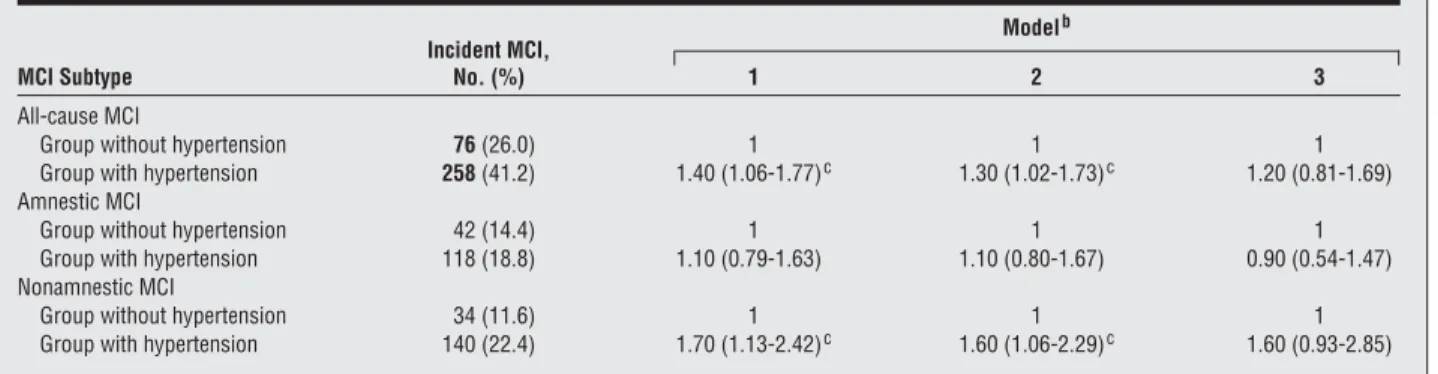
Results:There were 334 cases of incident MCI, 160 cases of amnestic MCI, and 174 cases of nonamnestic MCI dur-ing 4337 person-years of follow-up. Hypertension was associated with an increased risk of all-cause MCI (haz-ard ratio, 1.40; 95% confidence interval, 1.06-1.77;P=.02) and nonamnestic MCI (hazard ratio, 1.70; 95% confi-dence interval, 1.13-2.42;P=.009) after adjusting for age
and sex. Both associations were slightly attenuated in mod-els additionally adjusting for stroke and other vascular risk factors. There was no association between hyper-tension and the risk of amnestic MCI (hazard ratio, 1.10; 95% confidence interval, 0.79-1.63;P= .49). Consistent with this association, hypertension was related with the slope of change in an executive ability score, but not with memory or language score. There was no effect modification of the association between hypertension and MCI byAPOEε4genotype or use of antihyperten-sive medication.
Conclusions:A history of hypertension is related to a higher risk of MCI. The association seems to be stron-ger with the nonamnestic than the amnestic type of MCI in the elderly. These findings suggest that prevention and treatment of hypertension may have an important im-pact in lowering the risk of cognitive impairment.
Arch Neurol. 2007;64(12):1734-1740
M
ILD COGNITIVE IMPAIR-ment (MCI) has at-tracted increasing in-terest during the past years, particularly as a means of identifying the early stages of Alz-heimer disease (AD) as a target for treat-ment and prevention. Existing prevalence and incidence data are inconsistent be-cause of different operational criteria, sam-pling, and assessment procedures.1
Stud-ies using the criteria of Petersen et al2,3for
diagnosing MCI in clinical and epidemio-logical settings report an incidence rate of 9.9 per 1000 person-years for MCI among elderly persons without dementia4and an
annual conversion rate of 10% to 12% to AD in subjects with MCI, particularly amnes-tic MCI (AMCI), in contrast to a conver-sion rate of 1% to 2% in the healthy elderly population.5
There are inconclusive data relating hy-pertension, a modifiable vascular risk fac-tor, to cognitive impairment and demen-tia. While most longitudinal studies6,7
reported an increased blood pressure be-fore the onset of AD or vascular
demen-tia, most cross-sectional studies8,9or
stud-ies with a shorter follow-up10 observed
associations between low blood pressure and dementia or no association between hypertension and cognitive impairment. We previously reported relationships be-tween hypertension and vascular demen-tia but not AD. There are also conflicting data on the effect of antihypertensive treat-ment on cognition.11,12
The mechanisms underlying the asso-ciations between blood pressure and cog-nitive impairment or dementia remain un-clear. High blood pressure levels may lead to white matter hyperintensities on mag-netic resonance imaging or lacunar brain infarcts, which in turn may lead to cog-nitive impairment or dementia.13,14More
direct links between blood pressure and AD are suggested by autopsy studies15,16
reporting an increased frequency of neu-rofibrillary tangles and brain atrophy in hy-pertensive persons.
Our objective in the present longitu-dinal study was to determine whether hy-pertension is associated with the risk of in-cident MCI.
Author Affiliations: The Gertrude H. Sergievsky Center (Drs Reitz, Tang, Manly, Mayeux, and Luchsinger), the Taub Institute for Research on Alzheimer’s Disease and the Aging Brain (Drs Manly, Mayeux, and Luchsinger), Departments of Neurology and Psychiatry (Dr Mayeux) and Medicine (Dr Luchsinger), Columbia University College of Physicians and Surgeons, and Departments of Biostatistics (Dr Tang) and Epidemiology (Dr Mayeux), Mailman School of Public Health, Columbia University, New York, New York.
METHODS
SUBJECTS AND SETTING
Participants were enrolled in a longitudinal cohort study by a random sampling of Medicare recipients 65 years or older re-siding in northern Manhattan (Washington Heights, Hamil-ton Heights, and Inwood). The sampling procedures have been described elsewhere.17Each participant underwent an in-person interview of general health and function at study en-rollment, followed by a standard assessment, including medi-cal history, physimedi-cal and neurologimedi-cal examination, and neuropsychological battery.18Baseline data were collected from 1992 through 1994. Follow-up data were collected during evalu-ations at sequential intervals of approximately 18 months, per-formed from 1994 to 1996, 1996 to 1997, and 1997 to 1999. In this elderly population, some participants did not complete follow-up at all intervals because of refusal, relocation, or death. About half of participants were evaluated at the third fol-low-up visit. This study was approved by the institutional re-view board of Columbia-Presbyterian Medical Center.
The sample for this study comprised those participants who were without MCI or dementia at baseline, who had at least 1 follow-up interval, and who had complete information to as-certain MCI following the criteria of Petersen et al.2,5Of the 1772 participants in whom a full neuropsychological exami-nation was attempted, 339 (19.1%) were excluded because of prevalent dementia, 304 (17.2%) were excluded because of prevalent MCI, and 211 (11.9%) were excluded because of un-availability for follow-up. Thus, the final analytic sample in-cluded 918 individuals.
Compared with the original 1772 participants, the final sample without prevalent MCI and dementia and with pro-spective data was younger (mean [SD] age, 76.3 [6.1] vs 77.3 [6.8] years;P⬍.001) and had a similar distribution of women (69.4% for both) and African Americans (33.6% vs 32.6%), fewer Hispanics (43.9% vs 47.0%; P⬍.001), and more non-Hispanic whites (22.6% vs 20.4%;P= .008).
CLINICAL ASSESSMENTS
Data were available from medical, neurological, and neuropsy-chological evaluations.18,19All participants underwent a standard-ized neuropsychological test battery that examined multiple do-mains in either English or Spanish.18Orientation was evaluated using parts of the modified Mini-Mental State Examination.20 Lan-guage was assessed using the Boston Naming Test,21the Con-trolled Word Association Test,22category naming, and the com-plex ideational material and phrase repetition subtests from the Boston Diagnostic Aphasia Evaluation.23Abstract reasoning was evaluated using the Wechsler Adult Intelligence Scale–Revised similarities subtest24and the nonverbal identities and oddities sub-test of the Mattis Dementia Rating Scale.25Visuospatial ability was examined using the Rosen Drawing Test26and a matching ver-sion of the Benton Visual Retention Test.27Memory was evalu-ated using the multiple choice version of the Benton Visual Re-tention Test27and the 7 subtests of the Selective Reminding Test28: total recall, term recall, term storage, continuous long-term storage, words recalled on last trial, delayed recall, and de-layed recognition. Memory complaints were assessed using 11 items from the Disability and Functional Limitations Scale29,30and the Blessed Functional Activities Scale.31In addition, partici-pants were asked if they had difficulties in general and in spe-cific areas, such as names of persons or things. Participants were considered to have memory complaints if they indicated prob-lems on 1 or more of these items. This neuropsychological test battery has established norms for the same community.32
DIAGNOSIS OF DEMENTIA
Diagnosis of dementia and assignment of specific cause were done by consensus of neurologists, psychiatrists, and neuro-psychologists based on baseline and follow-up information. The diagnosis of dementia was based onDiagnostic and Statistical Manual of Mental Disorders(Fourth Edition) criteria33and re-quired evidence of cognitive deficits on the neuropsychologi-cal test battery and evidence of impairment in social or occu-pational function (Clinical Dementia Rating ofⱖ1).34Diagnosis of AD was based on the National Institute of Neurological and Communication Disorders and Stroke–Alzheimer’s Disease and Related Disorders Association criteria.35
DEFINITION OF MCI
The MCI criteria were retrospectively applied among individu-als without dementia after the consensus conference. Persons considered for MCI were required to have the following: (1) a memory complaint, assessed as previously described; (2) ob-jective impairment in at least 1 cognitive domain based on the average of the scores on the neuropsychological measures within that domain and a 1.5-SD cutoff using normative corrections for age, years of education, ethnicity, and sex; (3) essentially preserved activities of daily living (previously defined); and (4) no diagnosis of dementia at the consensus conference.
To cast the widest net to determine the prevalence of MCI and to determine which individuals were more likely to progress to dementia, the original criteria of Petersen et al,2which focus on memory impairment, were expanded to include mutually exclu-sive subtypes based on cognitive features. The first subtype, AMCI without involvement of other cognitive domains, corresponds most closely to the original definition used by Petersen and col-leagues. Memory impairment was defined as a score of less than 1.5 SDs below the demographically corrected mean on an aver-age composite measure comprising the following learning and memory measures: (1) total recall from the Selective Reminding Test, (2) delayed free recall from the Selective Reminding Test, and (3) recognition from the Benton Visual Retention Test. Per-formance on composite scores from all other cognitive domains (executive, language, and visuospatial) was required to be within normal limits (score must beⱖ1.5 SDs below the demographi-cally corrected mean). Other MCI subtypes were classified that allowed for impairment in a single nonmemory domain if per-formance on composite scores from all other cognitive domains was within normal limits. Executive function MCI was assigned if impairment was demonstrated on an average composite mea-sure comprising the following meamea-sures: (1) letter fluency, (2) category fluency, and (3) the Wechsler Adult Intelligence Scale– Revised similarities subtest. Language MCI was defined as iso-lated impairment on an average composite measure comprising (1) the Boston Naming Test, (2) the Boston Diagnostic Aphasia Examination repetition subtest, and (3) the Boston Diagnostic Aphasia Examination comprehension subtest. Visuospatial MCI was assigned if impairment was demonstrated on an average com-posite score comprising: (1) the Rosen Drawing Test and (2) the Benton Visual Retention Test matching subtest. Finally, we al-lowed for impairment in multiple cognitive domains in the ab-sence of dementia. Multiple-cognitive-domains-with-memory-impairment MCI (MCI-MCDM) was diagnosed if there was objective impairment on the memory domain composite score and if there was impairment on at least 1 other cognitive do-main. Multiple-cognitive-domains-without-memory-impairment MCI was assigned if there was Multiple-cognitive-domains-without-memory-impairment in 2 or more of the 3 nonmemory domains and if the memory domain composite score was within normal limits. Again, classification into the 6 subtypes was mutually exclusive. We used 3
out-comes for these analyses: (1) all-cause MCI; (2) AMCI (includ-ing AMCI without involvement of other cognitive domains and MCI-MCDM); and (3) nonamnestic MCI (NAMCI). The ratio-nale for this classification is that AMCI without involvement of other cognitive domains and MCI-MCDM equally predict the de-velopment of AD, and MCI-MCDM is thought to be a more ad-vanced form of AMCI involving other cognitive domains.
COGNITIVE SCORES
A factor analysis was performed using data from the baseline assessment of the entire cohort with the 15 neuropsychologi-cal measures using a principal component analysis with vari-max rotation and Kaiser normalization.36This analysis yielded 3 factors: (1) a memory factor, for which the 7 subtests of the Selective Reminding Test were the main contributors28; (2) a visuospatial reasoning/cognitive factor (executive factor), for which visuospatial tests of reasoning were the main contribu-tors (including the Rosen Drawing Test,26matching and rec-ognition components of the Benton Visual Retention Test,27and the identities and oddities subtests of the Mattis Dementia Rat-ing Scale25); and (3) a language factor, for which language mea-sures were the main contributors (Boston Naming Test,21 Con-trolled Oral Word Association Test,22and Wechsler Adult Intelligence Scale–Revised similarities subtest).24Component scores for each subject at each visit were calculated by adding the loading weighted scores of the measures that contributed to each factor. We used the factor weights of the baseline fac-tor scores and normalizing equations to calculate facfac-tor scores for the follow-up assessments.
DEFINITION OF HYPERTENSION AND OTHER COVARIATES
At baseline, all participants were asked whether they had a his-tory of hypertension any time during their life. If affirmative, they were asked whether they were under treatment and the specific type of treatment. Blood pressure was also recorded at each visit using a monitor (Dinamap Pro 100; Critikon Co, Tampa, Florida). The blood pressure cuff was placed on the right arm while the individual was seated, and a recording was obtained every 3 min-utes over 9 minmin-utes. The third measurement was recorded in the database. Values higher than 140 mm Hg (systolic) and 90 mm Hg (diastolic) were used as criteria for hypertension.
Stroke was defined according to the World Health Organi-zation criteria.37The presence of stroke was ascertained from an interview with participants and their informants. Persons with stroke were confirmed through their medical records, 85% of which included results of brain imaging. The remainder were confirmed by direct examination. Diabetes mellitus was de-fined as a history at any time during life. At baseline, all par-ticipants were asked whether they had a history of diabetes. If affirmed, they were asked whether they were under treatment and the specific type of medication. Heart disease was defined as a history of atrial fibrillation and other arrhythmias, myo-cardial infarction, congestive heart failure, or angina pectoris at any time during life. Assessment of all covariates was inde-pendent of cognitive assessment and diagnosis of cognitive im-pairment or dementia.
APOEGENOTYPING
APOEgenotypes were determined as described by Hixson and Vernier,38with slight modification. We classified persons as ho-mozygous or heterozygous for theAPOEε4allele or as not hav-ing anyAPOEε4allele.
STATISTICAL ANALYSES
Information on demographic characteristics and other potentially relevant factors was compared among individuals with and without a history of hypertension.2Tests were used for categorical data, and analysis of variance was used for continuous variables. Multivariate Cox proportional haz-ards models were used to estimate the association of hyper-tension to incident all-cause MCI, AMCI, and NAMCI. Because the period between the follow-up assessments in this cohort is relatively short, the time-to-event variable was age at onset of MCI (ie, the age at the assessment at which the research diagnosis was made). Among individuals who did not develop MCI, those who developed dementia were censored at the dementia diagnosis and those who did not develop dementia, who died, or who were lost to follow-up owing to relocation before development of MCI were cen-sored at their last evaluation. Information on covariates was obtained at baseline. We initially adjusted for sex and age, then we adjusted for sex, age, ethnic group, years of educa-tion, andAPOEε4genotype in a second model. In a third model, we adjusted for sex, age, ethnic group, years of edu-cation,APOEε4genotype, stroke, diabetes, heart disease, and plasma low-density lipoprotein cholesterol level. The addi-tional covariates in the third model are theoretically in the pathways linking hypertension and MCI. Thus, any attenua-tion of hazard ratios observed in this model should be inter-preted as evidence of mediation and not of confounding. We checked the proportional hazards assumption that the effect of variables of interest is constant in time, by creating time-dependent variables that we then added to the model. When the variable tested added significant information (eg, pro-portional hazard assumption not satisfied), the model was adjusted for this variable. To explore the association between blood pressure levels and risk of MCI, we finally repeated all analyses using the continuous measure of blood pressure as the independent variable. We estimated the risk of conversion to dementia among persons with MCI using logistic regression. Generalized estimating equations39were used to examine changes in neuropsychological domains over time, represented by cognitive scores, and compare them between persons with and without hypertension. The dependent variables were the cognitive scores, and the inde-pendent variables were hypertension and time (included as a continuous variable). Generalized estimating equation analy-ses yield coefficient values that represent associations between factor scores and variables included in the model. A significant coefficient for hypertension indicates a difference between 2 groups at baseline or at any subsequent interval. A positive value for the coefficient indicates that the group with a specific variable performed better than the group without that variable. A significant time coefficient would indicate a significant change in a score over the total dura-tion of follow-up. A significant interacdura-tion term would indi-cate a difference in the rate of change in cognitive score between persons with and without hypertension. Data analy-sis was performed using 2 commercially available software programs (SPSS, version 13.0 [SPSS Inc, Chicago, Illinois], and SAS statistical software, version 9.1 for Windows [SAS Institute Inc, Cary, North Carolina]).
RESULTS
There were 334 cases of incident MCI, 160 cases of AMCI, and 174 cases of NAMCI during 4337 person-years of follow-up (incidence densities, 7.7, 3.7, and 4.0 cases,
respectively, per 1000 person-years of observation). The mean ± SD age of the sample was 76.3 ± 6.1 years, and 69.4% were women; 22.6% were white, 33.6% were black, and 43.9% were Hispanic (percentages do not total 100 because of rounding). The mean (SD) years of educa-tion were 8.7 (4.6); 62.8% had hypertension, 21.3% had diabetes, and 30.4% had heart disease. Of the sample, 25.0% were homozygous or heterozygous for theAPOEε4 allele, and use of antihypertensive medication was re-ported by 394 subjects (42.9%). Persons with hyperten-sion were more often women, were less educated, and more often had a history of stroke, diabetes, or heart dis-ease than were persons without hypertension (Table 1). Compared with persons without MCI, persons with AMCI were 6 times more likely (odds ratio, 6.0; 95% confi-dence interval, 4.0-8.9) to convert to dementia after ad-justment for age, sex, years of education, ethnic group, andAPOEε4genotype. The odds ratio for persons with NAMCI was not statistically significant (odds ratio, 1.4; 95% confidence interval, 0.9-2.3).
RISK OF INCIDENT MCI
The mean (SD) age at onset of MCI was 80.7 (5.9) years. In multivariate analyses, hypertension was associated with an increased risk of all-cause MCI (P= .02) and NAMCI (P=.009) after adjusting for age and sex (Table 2). These associations remained stable in models additionally ad-justing for years of education, ethnic group, andAPOEε4
genotype, and were slightly attenuated in models addi-tionally adjusting for stroke and other vascular risk fac-tors, such as diabetes, low-density lipoprotein choles-terol level, smoking, or heart disease. The results did not change after adjusting for blood pressure measure-ments or use of antihypertensive medication. There was no relation between hypertension and the risk of AMCI (P= .49) in either model. There was no effect modifica-tion of the associamodifica-tion between hypertension and MCI
byAPOEε4 genotype. Using blood pressure
measure-ments instead of diagnosis of hypertension as the inde-pendent variable or restricting the analyses to persons with a longer follow-up (observation time is equal to the median follow-up of 3.9 years or longer) did not change the observed associations.
HYPERTENSION AND CHANGE IN COGNITIVE SCORES OVER TIME
We conducted generalized estimating equation analyses comparing slopes of cognitive score change between per-sons with and without hypertension (Table 3). All sub-jects had successive cognitive data in at least 2 intervals, 79% had at least 3 intervals, and 59% had 4 or more inter-vals. For the memory score, we found—after adjustment for age, sex, years of education, ethnic group, andAPOEε4
genotype (model 2)—that it was not related to differences in hypertension status at baseline and declined with time. However, this decline was not different by hypertension status, indicated by the lack of significance of the interac-tion term. For the executive score, we found that it was not related to baseline hypertension and increased over time (indicated by a positive coefficient for time). However, this
increase over time was lower for persons with hyperten-sion, indicated by the significant negative interaction term for hypertension and time. We also found after adjust-ment for other vascular risk factors and stroke that the sta-tistical significance for the interaction term was attenu-ated, which we interpret as evidence of mediation of vascular disease and stroke in the relation between hypertension and executive impairment. There was no relation between hy-pertension and changes in the language score.
COMMENT
In this longitudinal analysis of 918 persons, hyperten-sion was associated with an increased risk of all-cause MCI that was mostly driven by an association with an increased risk of NAMCI after adjusting for age and sex. There was no relation between hypertension history and the risk of incident AMCI and there was no effect modi-fication of the association between hypertension and any MCI subtype byAPOEε4genotype or use of antihyper-tensive medication. We also found that executive abili-ties increased over time, which we think was because of practice effects, but this increase was lower in persons with hypertension, consistent with the notion that hy-pertension increases the risk of impairment in execu-tive abilities. Hypertension was not related to the change over time in memory and language abilities.
The mechanisms by which blood pressure affects the risk of cognitive impairment or dementia remain
un-Table 1. Comparison of Characteristics Among Persons With and Without Hypertension in 918 Subjects Followed Up Prospectivelya Characteristic Group Without Hypertension (n = 292) Group With Hypertension (n = 626) Female sex 178 (61.0) 461 (73.6)b Age, mean (SD), y 76.9 (6.6) 75.6 (5.7) Education, mean (SD), y 9.8 (4.5) 8.4 (4.5)b Ethnic groupc Non-Hispanic White 84 (28.8) 116 (18.5) Black 101 (34.6) 207 (33.1) Hispanic 105 (36.0) 298 (47.6) APOEgenotype 4/− or 4/4 76 (26.0) 264 (42.2) Stroke 24 (8.2) 114 (18.2)b Diabetes mellitus 35 (12.0) 184 (29.4)b Heart disease 55 (18.8) 256 (40.9)b Current smoking 33 (11.3) 62 (9.9) LDL cholesterol level, mean (SD), mg/dL 121.1 (36.3) 120.1 (36.9) MCI 76 (26.0) 251 (40.1)b Abbreviations: LDL, low-density lipoprotein; MCI, mild cognitive impairment.
SI conversion factor: To convert LDL cholesterol to millimoles per liter, multiply by 0.0259.
aData are given as number (percentage) of each group unless otherwise indicated. Some percentages are based on an incomplete sample because of missing data.
bSignificant (P= .05) vs the group without hypertension. cClassified by self-report using the format of the 1991 US census.40
clear. Hypertension may cause cognitive impairment through cerebrovascular disease. Hypertension is a risk factor for subcortical white matter lesions found com-monly in AD.41 Hypertension may also contribute to a
blood-brain barrier dysfunction, which has been sug-gested to be involved in the cause of AD.41 Other
pos-sible explanations for the association are shared risk fac-tors, such as the formation of free oxygen radicals.41,42
Several studies have previously examined the rela-tion of hypertension with MCI. In the Cardiovascular Health Study,43persons with MCI had a higher
preva-lence of hypertension, but no distinction was made be-tween persons with AMCI and NAMCI. White matter dis-ease on magnetic resonance imaging, which could be considered an intermediary between hypertension and MCI, was also more prevalent in persons with MCI in this study. In the Italian Longitudinal Study of Aging, hy-pertension was related to a 44% higher risk of MCI that
was close to statistical significance,44but no distinction
was made between AMCI and NAMCI. A study in Fin-land also found that hypertension was related to a higher risk of MCI,45without distinction of MCI subtype. The
main contribution of our study is the examination of this association in a multiethnic cohort in New York City, and the distinction between MCI subtypes.
In our study, hypertension was associated with a higher risk of all-cause MCI and NAMCI. Mild cognitive impair-ment has been described as an intermediate stage between normal cognition and dementia.2,46There is evidence that
NAMCI is related in particular to cerebrovascular disease and vascular cognitive impairment. Because hypertension is associated with a higher risk of cerebrovascular disease and vascular dementia,47,48it seems reasonable that it is
re-lated to the risk of NAMCI in our study. Also, the relation of hypertension to NAMCI remained stable after adjust-ing for years of education, ethnic group, andAPOEε4
geno-Table 2. Data Relating Hypertension and the Risk of Incident MCIa
MCI Subtype Incident MCI, No. (%) Modelb 1 2 3 All-cause MCI
Group without hypertension 76(26.0) 1 1 1 Group with hypertension 258(41.2) 1.40 (1.06-1.77)c 1.30 (1.02-1.73)c 1.20 (0.81-1.69) Amnestic MCI
Group without hypertension 42 (14.4) 1 1 1 Group with hypertension 118 (18.8) 1.10 (0.79-1.63) 1.10 (0.80-1.67) 0.90 (0.54-1.47) Nonamnestic MCI
Group without hypertension 34 (11.6) 1 1 1 Group with hypertension 140 (22.4) 1.70 (1.13-2.42)c 1.60 (1.06-2.29)c 1.60 (0.93-2.85) Abbreviation: MCI, mild cognitive impairment.
aA Cox proportional hazards model was used, with age at onset as the time variable, as described in the “Statistical Analyses” subsection of the “Methods” section.
bData are given as hazards ratio (95% confidence interval). Model 1 was adjusted for sex and age; model 2, adjusted for age, sex, years of education, ethnic group, andAPOEgenotype; and model 3, adjusted for sex, age, ethnic group, years of education,APOEgenotype, stroke, diabetes mellitus, heart disease, current smoking, and low-density lipoprotein cholesterol level. In all models, the group without hypertension was the reference group.
cSignificant difference vs the group without hypertension.
Table 3. Data From General Estimating Equations Relating Hypertension to Change in Cognitive Scores With Time
Variablea
Model 1 Model 2 Model 3
Coefficient ± SD PValue Coefficient ± SD PValue Coefficient ± SD PValue Memory Score
Hypertension −9.5 ± 2.9 .001 −4.1 ± 2.9 .15 −1.8 ± 2.9 .54 Time −4.2 ± 0.8 ⬍.001 −4.2 ± 0.7 ⬍.001 −4.1 ± 0.7 ⬍.001 Hypertension⫻time interaction 0.7 ± 1.1 .46 0.3 ± 0.9 .72 0.3 ± 0.9 .69
Executive Score
Hypertension −0.9 ± 1.7 .59 2.5 ± 1.6 .13 1.1 ± 1.6 .50 Time 3.9 ± 0.4 ⬍.001 3.9 ± 0.4 ⬍.001 3.2 ± 0.4 ⬍.001 Hypertension⫻time interaction −1.0 ± 0.5 .03 −1.2 ± 0.5 .01 −0.7 ± 0.4 .09
Language Score
Hypertension −0.3 ± 0.3 .33 −0.0 ± 0.3 .87 −0.1 ± 0.3 .74 Time −0.2 ± 0.04 ⬍.001 −0.1 ± 0.06 .06 −0.2 ± 0.0 ⬍.001 Hypertension⫻time interaction 0.05 ± 0.04 .28 0.1 ± 0.1 .44 0.1 ± 0.0 .20 aA statistically significant result for the hypertension term indicates a difference in score at baseline between persons with and without hypertension. A statistically significant coefficient for time indicates a significant change in the cognitive score with time. A significant interaction term for hypertension⫻time indicates that the slopes of change in cognitive score between persons with and without hypertension were significant.
type, and was attenuated after adjustment for stroke and vascular risk factors, indirectly suggesting that cerebrovas-cular disease may be mediating the relation between hy-pertension and NAMCI. These results suggest that hyper-tension is mainly related to an increased risk of nonamnestic forms of cognitive impairment,49 such as
frontal-executive cognitive impairment.
There was no relation between hypertension and the risk of incident AMCI. Episodic memory deficits are a strong predictor of conversion to dementia, in particular AD.50
Consequently, the termamnestic MCIrepresents a sub-group with a high probability of conversion to dementia caused by AD.50The association between hypertension and
AD is unclear. A 15-year longitudinal study51reported
in-creased blood pressure 10 to 15 years before the onset of AD and vascular dementia. Others found it to be lower in older individuals with AD8or did not find an association
between hypertension and cognitive impairment.52
In the interpretation of these findings, it is of major importance to keep in mind that MCI is likely to be a clini-cally and pathologiclini-cally heterogeneous syndrome, and that definitions of MCI and MCI subtypes rather repre-sent diagnostic constructs than established diagnostic en-tities. The frequency of dementia in a group of individu-als with cognitive impairment is the result of the definition of the disorder and the underlying pathological fea-tures. Thus, it is possible that a different definition of MCI or MCI subtypes would have led to different results.
There are alternative explanations for our observa-tions. One is that hypertension is part of a preclinical syn-drome of NAMCI or that persons with preclinical NAMCI reported hypertension while subjects who would not de-velop MCI did not; we tried to eliminate these possibili-ties by excluding persons with baseline MCI from the analyses and by repeating the analyses restricted to per-sons with a longer follow-up. Another potential expla-nation for our findings is chance because of multiple com-parisons. However, the results are in line with the a priori hypothesis of an association of hypertension with NAMCI rather than AMCI when using the present MCI defini-tion, and are mechanistically plausible. These facts make chance because of multiple comparisons an unlikely ex-planation for our findings.53Another potential
explana-tion is confounding. For example, if less educaexplana-tion is re-lated to hypertension, and persons with less education are more likely to be diagnosed as having MCI, then it is possible that the relation between hypertension and all-cause or NAMCI could be beall-cause of confounding by so-cioeconomic factors. We adjusted for years of education and ethnicity as markers of socioeconomic status to ac-count for this possibility. However, it is possible that hy-pertension is related to other behaviors related to poor health that, in turn, may increase the risk of cognitive decline that we could not adjust for, and we cannot elimi-nate the possibility of lack of control for unknown con-founders as a potential explanation for our findings.
The main limitation of our study is the lack of subclini-cal markers of hypertension, such as left ventricular hy-pertrophy by electrocardiogram or echocardiogram, and the use of self-reported history as our main measurement of hypertension. As shown in our sample, most elderly people will develop hypertension in their lifetime.54
There-fore, elderly cohorts may be too homogeneous to show dif-ferences in outcomes related to a history of hypertension. Our measurement of hypertension did not take into ac-count severity or duration. Thus, it is possible that our re-sults tend to underestimate the association between hy-pertension and MCI, and could bias our results to the finding of no association with AMCI. It is possible that studies in younger age groups with measures of hypertension bur-den in midlife could find stronger associations with risk of MCI than we report, including an association with AMCI. Also, this study was conducted in an elderly multiethnic community in an urban setting with a high prevalence of risk factors for morbidity and mortality, such as diabetes and hypertension. Persons who dropped out of the study during follow-up were mainly Hispanic and, at baseline, were older, were less educated, and had a higher preva-lence of vascular risk factors than those who remained in the study. This could have resulted in an underestimation of the association between hypertension and MCI com-pared with the original cohort. Also, hypertension is re-lated to higher cardiovascular mortality, and it is possible that some hypertensive persons would have demon-strated cognitive decline had they not died before inclu-sion in this cohort. Thus, there are important biases re-lated to the sample of this study that should be taken into account in the interpretation and generalization of these findings. We did not have information on brain magnetic resonance imaging and measures of cerebrovascular dis-ease. Thus, our stroke variable is likely an underestima-tion of the prevalence of cerebrovascular disease. We ex-pected that the other vascular risk factor variables would be surrogate markers of cerebrovascular disease risk. Our ascertainment of MCI subtypes was based on neuropsy-chological criteria and would not have been affected by the availability of imaging data.
The main strength of our study is that it is a prospec-tive cohort study designed for the diagnosis of cogniprospec-tive impairment and dementia with standard criteria, and with complete clinical and neuropsychological evaluation at each interval, which permitted the ascertainment of dif-ferent types of incident MCI.
Our findings support the hypothesis that hypertension increases the risk of incident MCI, especially NAMCI. Pre-venting and treating hypertension may have an important impact in lowering the risk of cognitive impairment. Accepted for Publication:January 8, 2007.
Correspondence:Jose´ A. Luchsinger, MD, MPH, Divi-sion of General Medicine, Columbia University Medical Center, Presbyterian Hospital, 9 East-105, 630 W 168th St, New York, NY 10706 ([email protected]). Author Contributions:Study concept and design:Reitz, Mayeux, and Luchsinger.Acquisition of data:Manly, Mayeux, and Luchsinger.Analysis and interpretation of data:Reitz, Tang, Manly, Mayeux, and Luchsinger. Draft-ing of the manuscript:Reitz, Mayeux, and Luchsinger. Criti-cal revision of the manuscript for important intellectual con-tent:Tang, Manly, Mayeux, and Luchsinger.Statistical analysis:Reitz and Tang.Obtained funding:Manly, Mayeux, and Luchsinger.Administrative, technical, and material
sup-port:Manly and Mayeux.Study supervision:Manly and
Financial Disclosure:None reported.
Funding/Support:This study was supported by grants PO1 AG07232, 1K08AG20856-01, and RR00645 from the National Institutes of Health; the Charles S. Robert-son Memorial Gift for Research in Alzheimer’s Disease; and the Blanchette Hooker Rockefeller Foundation.
REFERENCES
1. Bischkopf J, Busse A, Angermeyer M. Mild cognitive impairment: a review of preva-lence, incidence, and outcome according to current approaches.Acta Psychiatr Scand. 2002;106(6):403-414.
2. Petersen RC, Doody R, Kurz A, et al. Current concepts in mild cognitive impairment.
Arch Neurol. 2001;58(12):1985-1992.
3. Petersen RC, Stevens JC, Ganguli M, Tangalos EG, Cummings JL, DeKosky ST. Practice parameter: early detection of dementia: mild cognitive impairment (an evidence-based review): report of the Quality Standards Subcommittee of the American Academy of Neurology.Neurology. 2001;56(9):1133-1142. 4. Larrieu S, Letenneur L, Orgogozo JM, et al. Incidence and outcome of mild
cog-nitive impairment in a population-based prospective cohort.Neurology. 2002; 59(10):1594-1599.
5. Petersen RC, Smith GE, Waring SC, Ivnik RJ, Tangalos EG, Kokmen E. Mild cog-nitive impairment: clinical characterization and outcome.Arch Neurol. 1999; 56(3):303-308.
6. Kivipelto M, Helkala EL, Laakso MP, et al. Midlife vascular risk factors and Alz-heimer’s disease in later life: longitudinal, population based study.BMJ. 2001; 322(7300):1447-1451.
7. Launer LJ, Ross GW, Petrovitch H, et al. Midlife blood pressure and dementia: the Honolulu-Asia aging study.Neurobiol Aging. 2000;21(1):49-55. 8. Guo Z, Viitanen M, Fratiglioni L, Winblad B. Low blood pressure and dementia in
elderly people: the Kungsholmen project.BMJ. 1996;312(7034):805-808. 9. Morris MC, Scherr PA, Hebert LE, et al. The cross-sectional association
be-tween blood pressure and Alzheimer’s disease in a biracial community popula-tion of older persons.J Gerontol A Biol Sci Med Sci. 2000;55(3):M130-M136. 10. Qiu C, von Strauss E, Fastbom J, Winblad B, Fratiglioni L. Low blood pressure
and risk of dementia in the Kungsholmen project: a 6-year follow-up study.Arch Neurol. 2003;60(2):223-228.
11. Di Bari M, Pahor M, Franse LV, et al. Dementia and disability outcomes in large hypertension trials: lessons learned from the Systolic Hypertension in the El-derly Program (SHEP) trial.Am J Epidemiol. 2001;153(1):72-78.
12. Forette F, Seux ML, Staessen JA, et al. Prevention of dementia in randomised double-blind placebo-controlled Systolic Hypertension in Europe (Syst-Eur) trial.
Lancet. 1998;352(9137):1347-1351.
13. Kalaria RN. The role of cerebral ischemia in Alzheimer’s disease.Neurobiol Aging. 2000;21(2):321-330.
14. Vermeer SE, Prins ND, den Heijer T, Hofman A, Koudstaal PJ, Breteler MM. Silent brain infarcts and the risk of dementia and cognitive decline.N Engl J Med. 2003;348(13):1215-1222.
15. Petrovitch H, White LR, Izmirilian G, et al. Midlife blood pressure and neuritic plaques, neurofibrillary tangles, and brain weight at death: the HAAS.Neurobiol Aging. 2000;21(1):57-62.
16. Sparks DL, Scheff SW, Liu H, et al. Increased density of senile plaques (SP), but not neurofibrillary tangles (NFT), in non-demented individuals with the apolipo-protein E4 allele: comparison to confirmed Alzheimer’s disease patients.J Neu-rol Sci. 1996;138(1-2):97-104.
17. Tang MX, Stern Y, Marder K, et al. TheAPOE-ε4allele and the risk of Alzheimer disease among African Americans, whites, and Hispanics.JAMA. 1998;279 (10):751-755.
18. Stern Y, Andrews H, Pittman J, et al. Diagnosis of dementia in a heterogeneous population: development of a neuropsychological paradigm-based diagnosis of dementia and quantified correction for the effects of education.Arch Neurol. 1992; 49(5):453-460.
19. Pittman J, Andrews H, Tatemichi T, et al. Diagnosis of dementia in a heteroge-neous population: a comparison of paradigm-based diagnosis and physician’s diagnosis.Arch Neurol. 1992;49(5):461-467.
20. Folstein MF, Folstein SE, McHugh PR. “Mini-Mental State”: a practical method for grading the cognitive state of patients for the clinician.J Psychiatr Res. 1975; 12(3):189-198.
21. Kaplan E, Goodglass H, Weintraub S.Boston Naming Test.Philadelphia, PA: Lea & Febiger; 1983.
22. Benton A.FAS Test. Victoria, BC: University of Victoria; 1967.
23. Goodglass H, Kaplan E.The Assessment of Aphasia and Related Disorders, 2.
Philadelphia, PA: Lea & Febiger; 1983.
24. Wechsler D.Wechsler Adult Intelligence Scale–Revised.New York, NY: Psycho-logical Corp; 1981.
25. Mattis S.Mental Status Examination for Organic Mental Syndrome in the Elderly Patient.New York, NY: Grune & Stratton; 1976.
26. Rosen W.The Rosen Drawing Test.Bronx, NY: Veterans Administration Medi-cal Center; 1981.
27. Benton A.The Benton Visual Retention Test.New York, NY: Psychological Corp; 1955. 28. Buschke H, Fuld PA. Evaluating storage, retention, and retrieval in disordered
memory and learning.Neurology. 1974;24(11):1019-1025.
29. Golden RR, Teresi JA, Gurland BJ. Development of indicator scales for the Com-prehensive Assessment and Referral Evaluation (CARE) interview schedule.
J Gerontol. 1984;39(2):138-146.
30. Gurland B, Golden RR, Teresi JA, Challop J. The SHORT-CARE: an efficient in-strument for the assessment of depression, dementia and disability.J Gerontol. 1984;39(2):166-169.
31. Blessed G, Tomlinson BE, Roth M. The association between quantitative mea-sures of dementia and of senile change in the cerebral grey matter of elderly subjects.Br J Psychiatry. 1968;114(512):797-811.
32. Stricks L, Pittman J, Jacobs DM, Sano M, Stern Y. Normative data for a brief neuropsychological battery administered to English- and Spanish-speaking com-munity-dwelling elders.J Int Neuropsychol Soc. 1998;4(4):311-318. 33. American Psychiatric Association.Diagnostic and Statistical Manual of Mental
Disorders. 4th ed. Washington, DC: American Psychiatric Association; 1994. 34. Hughes CP, Berg L, Danziger WL, Coben LA, Martin RL. A new clinical scale for
the staging of dementia.Br J Psychiatry. 1982;140:566-572.
35. McKhann G, Drachman D, Folstein M, Katzman R, Price D, Stadlan EM. Clinical diagnosis of Alzheimer’s disease: report of the NINCDS-ADRDA Work Group un-der the auspices of Department of Health and Human Services Task Force on Alzheimer’s Disease.Neurology. 1984;34(7):939-944.
36. Kleinbaum D, Klipper L, Muller K.Applied Regression Analysis and Other Mul-tivariable Methods.2nd ed. Boston, MA: PWS-Kent; 1988.
37. Hatano S. Experience from a multicentre stroke register: a preliminary report.
Bull World Health Organ. 1976;54(5):541-553.
38. Hixson JE, Vernier DT. Restriction isotyping of human apolipoprotein E by gene amplification and cleavage withHhaI.J Lipid Res. 1990;31(3):545-548. 39. Zeger SL, Liang KY, Albert PS. Models for longitudinal data: a generalized
esti-mating equation approach.Biometrics. 1988;44(4):1049-1060.
40. Census of Population and Housing.Summary Tape File 1: Technical Documen-tation[computer program].Washington, DC: Bureau of Census; 1991. 41. Skoog I. The relationship between blood pressure and dementia: a review.Biomed
Pharmacother. 1997;51(9):367-375.
42. Luchsinger JA, Reitz C, Honig LS, Tang MX, Shea S, Mayeux R. Aggregation of vascular risk factors and risk of incident Alzheimer disease.Neurology. 2005; 65(4):545-551.
43. Lopez OL, Jagust WJ, Dulberg C, et al. Risk factors for mild cognitive impair-ment in the Cardiovascular Health Study Cognition Study: part 2.Arch Neurol. 2003;60(10):1394-1399.
44. Solfrizzi V, Panza F, Colacicco AM, et al; Italian Longitudinal Study on Aging Work-ing Group. Vascular risk factors, incidence of MCI, and rates of progression to dementia.Neurology. 2004;63(10):1882-1891.
45. Tervo S, Kivipelto M, Hanninen T, et al. Incidence and risk factors for mild cog-nitive impairment: a population-based three-year follow-up study of cogcog-nitively healthy elderly subjects.Dement Geriatr Cogn Disord. 2004;17(3):196-203. 46. Petersen RC. Mild cognitive impairment as a diagnostic entity.J Intern Med. 2004;
256(3):183-194.
47. Hu G, Sarti C, Jousilahti P, et al. The impact of history of hypertension and type 2 diabetes at baseline on the incidence of stroke and stroke mortality.Stroke. 2005;36(12):2538-2543.
48. Posner HB, Tang MX, Luchsinger J, Lantigua R, Stern Y, Mayeux R. The rela-tionship of hypertension in the elderly to AD, vascular dementia, and cognitive function.Neurology. 2002;58(8):1175-1181.
49. DeCarli C. The role of cerebrovascular disease in dementia.Neurologist. 2003;9 (3):123-136.
50. Luis CA, Loewenstein DA, Acevedo A, Barker WW, Duara R. Mild cognitive im-pairment: directions for future research.Neurology. 2003;61(4):438-444. 51. Skoog I, Lernfelt B, Landahl S, et al. 15-Year longitudinal study of blood
pres-sure and dementia.Lancet. 1996;347(9009):1141-1145.
52. Farmer ME, Kittner SJ, Abbott RD, Wolz MM, Wolf PA, White LR. Longitudinally measured blood pressure, antihypertensive medication use, and cognitive per-formance: the Framingham Study.J Clin Epidemiol. 1990;43(5):475-480. 53. Rothman KJ. No adjustments are needed for multiple comparisons.Epidemiology.
1990;1(1):43-46.
54. Vasan RS, Beiser A, Seshadri S, et al. Residual lifetime risk for developing hy-pertension in middle-aged women and men: the Framingham Heart Study.JAMA. 2002;287(8):1003-1010.