Clauses in Chinese
Chien-Jer Charles Lin and Thomas G. Bever
University of Arizona
1. Introduction
A controversy in the sentence processing literature regarding relative-clause processing was raised by Hsiao and Gibson’s (2003) study of Chinese relative clauses. Their study suggested that, contrary to the patterns found in all other languages, Chinese relative clauses showed a processing preference for object extractions. This result posed a challenge to sentence processing theories that attempt to account for crosslinguistic patterns regarding relative-clause processing. In this article, we argue that Hsiao and Gibson’s claim of an object preference in Mandarin was invalid. It was not supported by the experimental data they provided, as their experiment was confounded by a crucial factor. We cite two sets of experimental evidence from Mandarin–the self-paced reading of regular relative clauses and that of possessor relative clauses. Both experiments showed a preference for subject extractions in Mandarin. As the controversy caused by Mandarin is removed, we discuss an incremental minimalist parsing theory that accounts for this universal parsing preference.
2. Resolving the Controversy
Much previous psycholinguistic research has investigated the differences between subject and object relative clauses in processing. In languages with head-initial relative clauses, subject-extracted relative clauses like (1) were easier to comprehend than object-extracted relative clauses like (2).
(1) The guy who followed the first lady was a spy. (2) The guy who the first lady followed was a spy.
This subject preference was found in Brazilian Portuguese (Gouvea, 2003), Dutch (Frazier, 1987; Mak, Vonk, & Schriefers, 2002), English (Ford, 1983; King & Just, 1991; Gibson, Desmet, Grodner, Watson, & Ko, 2005; Traxler, Morris, & Seely, 2002; King & Kutas, 1995), French (Frauenfelder, Segui, & Mehler, 1980; Cohen & Mehler, 1996; Holmes & O’Regan, 1981), and German (Schriefers, Friederici, & Kuhn, 1995; Mecklinger, Schriefers, Steinhauer, & Friederici, 1995).
In languages with head-final relative clauses, the processing preferences appeared to be more varied. In both Japanese and Korean, preferences for subject extractions were reported (Kwon, Polinsky, & Kluender, 2004; Miyamoto & Nakamura, 2003). In Mandarin, however, a preference for object extractions was reported by Hsiao and Gibson (2003). The varied results of head-final relative clauses challenged the possibility of a universal processing account. A theory that is based on the accessibility of structural positions predicts a universal subject preference since subject positions are universally higher in structure (and therefore more easily accessed) than object positions (e.g. Hawkins, 1999; Lin, 2006; O’Grady, 1997). A theory based on processing resources and locality predicts that shorter linear distances between the head noun and the relativized gap are preferred to longer linear distances (Gibson, 1998). Accordingly, subject extractions are preferred for head-initial relative clauses, while object extractions are preferred for head-final relative clauses. Experimental results from head-final relative clauses challenged either the structure-based theory or the locality-based theory. The structure-based theory is challenged by the Mandarin data, in which object extractions
© 2006 Chien-Jer Charles Lin and Thomas G. Bever. Proceedings of the 25th West Coast Conference on Formal Linguistics, ed. Donald Baumer, David Montero, and Michael Scanlon, 254-260. Somerville, MA: Cascadilla Proceedings Project.
were found to be preferred. The locality theory is challenged by the Japanese and Korean data, where subject gaps, though more distant from the post-nominal head nouns, produced processing advantages.
The first step to resolving such a controversy is to examine the validity of Hsiao and Gibson’s (2003) claims regarding processing preferences in Mandarin. We found the experiment reported by Hsiao and Gibson problematic in several aspects. They found shorter reading times for object relative clauses on the pre-relativizer regions of normal relative clauses and on several regions of doubly-embedded object relative clauses. For regular relative clauses, differences found prior to the relativizers were unlikely to reflect the differences in processing relative clauses, since these fragments appear like regular sentence fragments and are hardly indicative of relative clauses. Their reported preference for object relative clauses at most reflects longer reading of fragments with missing arguments like (3a).
(3) a. Subject relative clauses in Mandarin pro yaoqing fuhao de guanyuan pro invite tycoon DE official
‘The official who invited the tycoon ...’ b. Object relative clauses in Mandarin fuhao yaoqing de guanyuan
tycoon invite DE official
‘The official who the tycoon invited ...’
Furthermore, Hsiao and Gibson’s comparison between subject relative clauses embedded within subject relative clauses and object relative clauses embedded within object relative clauses in the double-embedding conditions was seriously confounded. Their comparison was invalid because in Mandarin, the former (i.e. double subject embeddings) involved center dependencies of the fillers and the gaps, while the latter (i.e. double object embeddings) involved serial dependencies. The latter condition was easier than the former condition—not because object relative clauses were intrinsically easier, but because serial dependencies made these doubly embedded object relative clauses easier to process. This point is illustrated by (4).
(4) a. Subject relative clauses embedded in subject relative clauses
[GAP1] invite [GAP2] conspire judge DE tycoon DE official have bad intentions
b. Object relative clauses embedded in object relative clauses
tycoon invite [GAP2] DE judge conspire [Gap1] DE official have bad intentions
A further problem concerns their materials. The verbs used in their experiment were not controlled for syntactic ambiguity. Among the forty verbs used in the twenty sets of sentences, 7 took sentential complements in addition to nominal objects; 13 took verbal complements. An experiment tacking the accessibility of subject and object positions in relative clauses should avoid verbs that are syntactically ambiguous. In sum, the preference for subject extractions that was argued by Hsiao and Gibson was not valid. In the following, we cite two pieces of evidence that, to the contrary, supported a subject preference in Mandarin.
3. New Processing Evidence from Mandarin
3.1. Processing Regular Relative Clauses (Lin & Bever, 2006)
To reevaluate the processing preferences regarding subject and object extractions in Mandarin, we conducted self-paced reading tasks of regular singly-embedded relative clauses in Mandarin, using verbs that took only nominal objects. In a 2x2 factorial design looking at the types of relative clauses (subject versus object extractions) and the targets of modification (relative clauses modifying the subject versus the object of the matrix clauses), we found a robust effect of subject preference.
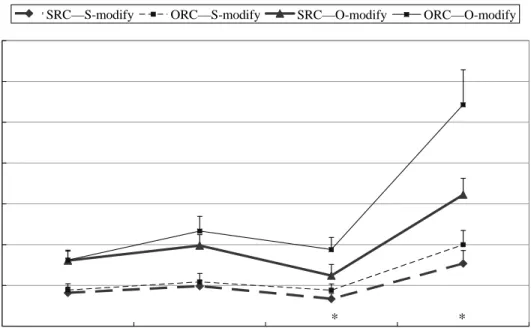
Sentences with subject relative clauses were significantly read more quickly on both the relativizer and the head noun, reflecting an effect of filler-gap integration. Figure 1 (cited from Lin, 2006: 131) shows that subject relative clauses were consistently read faster than object relative clauses whether they modified the subject or the object of the matrix clauses.
400 600 800 1000 1200 1400 1600 1800 V(src)/N(orc) N(src)/V(orc) DE N Re ad in g Ti me ( m s)
SRC—S-modify ORC—S-modify SRC—O-modify ORC—O-modify
Figure 1. Reading time of each region within regular relative clauses (Lin, 2006: 131) (SRC = subject-extracted relative clause, ORC = object-extracted relative clause)
With the materials better controlled than Hsiao and Gibson’s, we show that subject relative clauses were actually processed faster than object relative clauses in Mandarin. The results contradicted Hsiao and Gibson’s proposal and supported a structure-based theory of sentence comprehension.
3.2. Processing Possessor Relative Clauses (Lin, Fong, & Bever, 2005)
Another piece of evidence supporting the subject preference in relative-clause processing was observed on possessor relative clauses. In Lin, Fong, and Bever (2005), we conducted self-paced reading tasks, investigating the processing of gaps located at different syntactic structures within possessor relative clauses. The goal was to contrast between a structure-based theory and a locality-based theory.
We adopted “patient-dislocation” as a way to vary the location of a possessor gap within the relative clause. In Mandarin, a patient role can be marked by BA preverbally (the BA condition) or appear in the subject position as in a passive BEI construction in addition to the canonical condition, where the patient is located at the canonical object position. Examples are provided in (5).
(5) a. Chinese possessor relative clause with canonical order: huairen bangjia _ laopo de zongcai jueding baojing bad guys kidnap wife DE chairman decide call police
‘The chairman whose wife bad guys kidnapped decided to call the police.’ * *
b. Chinese possessor relative clause with BA (agent BA patient V): huairen ba _ laopo bangjia de zongcai jueding baojing
bad guys BA wife kidnap DE chairman decide call police
‘The chairman whose wife bad guys kidnapped decided to call the police.’ c. Chinese possessor relative clause with BEI in the passive construction:
_ laopo bei huairen bangjia de zongcai jueding baojing wife BEI bad guys kidnap DE chairman decide call police
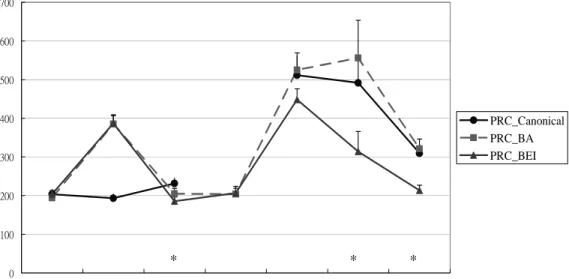
‘The chairman whose wife was kidnapped by bad guys decided to call the police.’ Noticeably, the distance between the head noun and the possessor gap is longest for passives, shorter for the BA condition, and shortest for the canonical condition. We conducted naturalness/grammaticality ratings as well as self-paced reading tasks. Both the naturalness ratings and the self-paced reading results suggested that the passive condition was most natural and read most quickly. In Figure 2 (cited from Lin, 2006: 172), significant differences were obtained on the head noun and the matrix verb—where filler-gap integration took place.
Figure 2. Reading time of each region of the sentences with possessor relative clauses (Lin, 2006: 172) The processing of possessor relative clauses also contradicted the predictions of a locality-based theory and supported a structure-based theory. Even though passive possessor relative clauses had the longest filler-gap distance, the fact that the possessor gap is located at the subject position makes it the easiest to access.
4. The Incremental Minimalist Parser
Putting together the new evidence of subject preferences in the processing of regular and possessor relative clauses in Mandarin, and the existing crosslinguistic evidence, which we summarize in Table 1, we conclude that a theory based on locality cannot account for the crosslinguistic preferences of relative-clause processing. A structure-based parsing theory, instead, makes correct predictions across languages.
RTs for Possessor RCs 0 100 200 300 400 500 600 700 N1 V1/BA/BEI N2 V1 DE N3 V2 Regions RT ( m s) PRC_Canonical PRC_BA PRC_BEI * * *
Table 1. Preferences for Relative-Clause Processing
Language RC position Preference Task References
Brazilian Portuguese
Postnominal SRC RSVP Gouvea (2003)
Dutch Postnominal SRC Self-paced reading Frazier (1987)
SRC Self-paced reading
Eye-movement monitoring
Mak, Vonk, & Schriefers (2002)
English Postnominal SRC Continuous Lexical Decision Task
Ford (1983)
SRC Self-paced reading King and Just (1991), Gibson, Desmet, Grodner, Watson, & Ko (2005)
SRC Eye-movement
monitoring
Traxler, Morris, & Seely (2002)
ERP King & Kutas, 1995
French Postnominal SRC phoneme-monitoring
task
Frauenfelder, Segui, & Mehler (1980)
SRC click-monitoring Cohen & Mehler (1996)
SRC Eye-movement
monitoring
Holmes and O’Regan (1981) German Postnominal SRC Self-paced reading Schriefers, Friederici, and
Kuhn (1995)
SRC ERP Mecklinger, Schriefers,
Steinhauer, & Friederici’s (1995)
Mandarin Prenominal ORC Self-paced reading Hsiao & Gibson (2003) SRC Self-paced reading Experiment 1 (Lin, 2006) Japanese Prenominal SRC Self-paced reading Miyamoto & Nakamura
(2003)
Korean Prenominal SRC Self-paced reading Kwon, Polinsky, & Kluender (2004)
In this section, we briefly sketch a structure-based parsing theory called Incremental Minimalist Parser (IMP) that is based on the Minimalist Program (Chomsky 1995, 2000, 2005) and left-to-right incremental parsing (e.g. Phillips, 1996). IMP predicts an advantage for subject positions in processing.
IMP assumes the incrementality hypothesis proposed by Phillips (1996, 2003: 42): “Sentence structures are built incrementally from left to right.” As a model of the human sentence parser, IMP aims at deriving the correct logical and semantic relations within a sentence and at providing the structural basis for processing preferences.
In realistic operation, IMP receives individual lexical items of a sentence (from left to right) as inputs and constructs syntactic structures incrementally in order to compute sentential meaning. IMP has two major components—a series of top-down functional templates, and lexico-syntactic features of each incoming word. The functional templates are top-down structures based on projections of the functional heads. IMP assumes the top-node of the input sentence to be a CP. The input items occupy various structural positions within this CP, from left to right. The selectional relations between functional projections produce the schematic structure for each sentence. A C selects for a T, which selects for a v, and so on. These functional heads are elements that exist in the lexical array of every sentence, given that the parser expects every utterance to express a proposition, i.e. to be part of a sentence. They are valued as the sentence is incrementally built.
Meanwhile, based on the syntactic features of individual words, IMP considers the possibility of merging the input word with previous local structure and attaching the word to the top-down templatic
structure. An input is always considered in terms of its relation to the head in the structure. It can either be the head itself, or it can be selected for by the head. This is depicted as the probe-goal relationship. If the input is part of an adjunct, it can be taken to adjoin to the phrase projected by the head, as in a modificational adjunct like an adverbial. Case features are checked at the linearized position by the head. Thematic relations are not assigned until the verb-associated projections (i.e. v and V) are reached. When a constituent functions as an adjunct, it adjoins to an XP, and projects as an XP. Each incoming word is first recognized in terms of its part of speech. This incoming word projects maximally with the specifier and complement positions created in the projected structure. For example, a preposition would project as a PP with the preposition as the head and a DP as the complement. It first attempts to merge externally with the structure of the previous word. If it can be the complement of the previous head, it merges with the previous head as a complement. If the previous head is already argument-complete, it seeks the possibility of merging with the previous maximal projection (i.e. an XP). If no such option is available, it merges as an adjunct. Merging is driven by feature checking.
Using such a model to parse English relative clauses, the parser recognizes the relativizer who as a wh-operator located at Spec-CP, checking the [wh] feature of C. The parser analyzes the preceding NP as containing a relative clause (i.e. an embedded CP). A series of top-down functional projections is constructed within this embedded CP. A relative pronoun such as who carries the feature [IDENT(X, Y)], which is valued by relating the head noun with a c-commanded trace. Who gets copied to the embedded Spec-TP (which is higher than the object position) to value the case feature [nom]. This produces a parsing preference for subject extractions as it takes longer to reach the embedded object position for feature valuing than the subject position.
In parsing Mandarin relative clauses, which are head-final, the parser does not recognize the first incoming words as part of a relative clause until reaching the relativizer de—a C-head within a head-final CP. Upon receiving the relativizer, a trace is created at the embedded missing DP position. The relativizer de also carries the feature [IDENT (X, Y)], a two-place function that relates a trace DP (X) to a head noun NP (Y). It probes at the DP trace in the embedded IP, valuing one of the arguments. DP traces at the subject positions are easier to probe at because they are structurally higher and more easily accessed by the relativizer than the object trace. The head noun then enters Spec-CP, satiating the other argument of [IDENT]. For a detailed discussion of the processes of incremental minimalist parsing, refer to Chapter 2 of Lin (2006).
5. Concluding Remarks
After all, the processing preference for subject-extracted relative clauses in Mandarin Chinese is in line with the universal processing preferences for gaps at subject positions. We showed that the seeming controversy caused by Hsiao and Gibson’s (2003) experimental results in Mandarin Chinese actually did not exist. Crosslinguistic experimental data support a theory based on structural parsing (such as the Incremental Minimalist Parser), not a processing theory that focuses only on linear locality.
References
CHOMSKY,NOAM. 1995. The Minimalist Program. Cambridge, MA: MIT Press.
—. 2000. Minimalist Inquiries: The Framework. Step by Step: Essays on Minimalist Syntax in Honor of Howard Lasnik, ed. by Roger Martin, David Michaels and Juan Uriagereka, 89-156. Cambridge, MA: MIT Press. —. 2005. On Phases. Cambridge, MA
COHEN,LAURENT and MEHLER,JACQUES. 1996. Click Monitoring Revisited: An On-Line Study of Sentence
Comprehension Memory and Cognition, 24.94-102.
FORD,MARILYN. 1983. A Method for Obtaining Measures of Local Parsing Complexity throughout Sentences.
Journal of Verbal Learning and Verbal Behavior, 22.203-18.
FRAUENFELDER,U., SEGUI,J. and MEHLER,J. 1980. Monitoring around the Relative Clause. Journal of Verbal
Learning and Verbal Behavior, 19.328-37.
FRAZIER, LYN. 1987. Syntactic Processing: Evidence from Dutch. Natural Language and Linguistic Theory,
GIBSON,EDWARD. 1998. Linguistic Complexity: Locality of Syntactic Dependencies. Cognition, 68.1-76.
GIBSON, EDWARD, DESMET, TIMOTHY, GRODNER, DANIEL, WATSON, DUANE and KO, KARA. 2005. Reading
Relative Clauses in English. Cognitive Linguistics, 16.313-53.
GOUVEA, ANA C. 2003. Processing Syntactic Complexity: Cross-Linguistic Differences and ERP Evidence,
University of Maryland, College Park.
HAWKINS,JOHN A. 1999. Processing Complexity and Filler-Gap Dependencies Across Grammars. Language,
75.244-85.
HOLMES,V.M. and O'REGAN,J.K. 1981. Eye Fixation Patterns during the Reading of Relative-Clause Sentences.
Journal of Verbal Learning and Verbal Behavior, 20.417-30.
HSIAO,FRANNY and GIBSON,EDWARD. 2003. Processing Relative Clauses in Chinese. Cognition, 90.3-27.
KING,JONATHAN and JUST,MARCEL ADAM. 1991. Individual Differences in Syntactic Processing: The Role of
Working Memory. Journal of Memory and Language, 30.580-602.
KING,JONATHAN W. and KUTAS,MARTA. 1995. Who Did What and When? Using Word- and Clause-Level ERPs
to Monitor Working Memory Usage in Reading. Journal of Cognitive Neuroscience, 7.376-95.
KWON,NAYOUNG, POLINSKY,MARIA and KLUENDER,ROBERT. 2004. Processing of Relative Clause Sentences in
Korean. Poster presented at Architectures and Mechanisms for Language Processing (AMLaP) 2004
LIN,CHIEN-JER CHARLES. 2006. Grammar and Parsing: A Typological Investigation of Relative-Clause Processing,
Departments of Linguistics and Anthropology, The University of Arizona: Ph.D. Dissertation.
LIN,CHIEN-JER CHARLES and BEVER,THOMAS G. 2006. Chinese is no exception: Universal subject preference of
relative clause processing. Paper presented at The 19th Annual CUNY Conference on Human Sentence Processing, CUNY Graduate Center, New York, NY.
LIN,CHIEN-JER CHARLES, FONG,SANDIWAY and BEVER,THOMAS G. 2005. Left-Edge Advantage of Gap Searching
in Chinese Possessor Relativization. Poster presented at the 2005 Conference on Architectures and Mechanisms for Language Processing (AMLaP-2005), Ghent University, Ghent, Belgium.
MAK,WILLEM M., VONK,WIETSKE and SCHRIEFERS,HERBERT. 2002. The Influence of Animacy on Relative
Clause Processing. Journal of Memory and Language, 47.50-68.
MECKLINGER,A., SCHRIEFERS,H., STEINHAUER,K. and FRIEDERICI,A.D.. 1995. Processing Relative Clauses
Varying on Syntactic and Semantic Dimensions: An Analysis with Event-Related Potentials. Memory and Cognition, 23.477-94.
MIYAMOTO,EDSON T. and NAKAMURA,MICHIKO. 2003. Subject/Object Asymmetries in the Processing of Relative
Clauses in Japanese. WCCFL 22 Proceedings, ed. by G. Garding and M. Tsujimura, 342-55. Somerville, MA: Cascadilla Press.
O'GRADY,WILLIAM. 1997. Syntactic Development. Chicago: The University of Chicago Press.
PHILLIPS,COLIN. 1996. Order and Structure, Linguistics, MIT: Ph.D. Dissertation.
—. 2003. Linear Order and Constituency. Linguistic Inquiry 34.37-90.
SCHRIEFERS,H., FRIEDERICI,A.D. and KUHN,K. 1995. The Processing of Locally Ambiguous Relative Clauses in
German. Journal of Memory and Language, 34.499-520.
TRAXLER,MATTHEW J., MORRIS,ROBIN K. and SEELY,RACHEL E. 2002. Processing Subject and Object Relative
Conference on Formal Linguistics
edited by Donald Baumer,
David Montero, and Michael Scanlon
Cascadilla Proceedings Project Somerville, MA 2006
Copyright information
Proceedings of the 25th West Coast Conference on Formal Linguistics © 2006 Cascadilla Proceedings Project, Somerville, MA. All rights reserved
ISBN 1-57473-415-6 library binding
A copyright notice for each paper is located at the bottom of the first page of the paper. Reprints for course packs can be authorized by Cascadilla Proceedings Project.
Ordering information
Orders for the library binding edition are handled by Cascadilla Press. To place an order, go to www.lingref.com or contact:
Cascadilla Press, P.O. Box 440355, Somerville, MA 02144, USA
phone: 1-617-776-2370, fax: 1-617-776-2271, e-mail: [email protected]
Web access and citation information
This entire proceedings can also be viewed on the web at www.lingref.com. Each paper has a unique document # which can be added to citations to facilitate access. The document # should not replace the full citation.
This paper can be cited as:
Lin, Chien-Jer Charles and Thomas G. Bever. 2006. Subject Preference in the Processing of Relative Clauses in Chinese. In Proceedings of the 25th West Coast Conference on Formal Linguistics, ed. Donald Baumer, David Montero, and Michael Scanlon, 254-260. Somerville, MA: Cascadilla Proceedings Project.
or:
Lin, Chien-Jer Charles and Thomas G. Bever. 2006. Subject Preference in the Processing of Relative Clauses in Chinese. In Proceedings of the 25th West Coast Conference on Formal Linguistics, ed. Donald Baumer, David Montero, and Michael Scanlon, 254-260. Somerville, MA: Cascadilla Proceedings Project. www.lingref.com, document #1456.