Keywords—Big Data, Cloud computig, E-Health, IoT, M2M. Abstract—In this paper we study the way how to process big data gathered by a decentralized cloud system, based on general systems and Remote Telemetry Units (RTUs), for tele-monitoring of E-Health environmental parameters. Also, we analyze a proposed cloud M2M system, where each RTU communicates by radio with a telemetry data gateway connected to a cloud computing infrastructure equipped with appropriate software that delivers processed data.
Furthermore, we present how we use a search based application built on Exalead CloudView to search for weak signals in big data. In particular, given the E-Health application, we propose to leverage trivial and non-trivial connections between different sensor signals and data from other online environmental wireless sensor networks, in order to find patterns that are likely to provide innovative solutions to existing problems. The aggregation of such weak signals will provide evidence of connections between renewable energies and environmental related issues faster and better than trivial mining of sensor data. As a consequence, the software has a significant potential for matching environmental applications and challenges that are related in non-obvious ways in Internet of Things (IoT) scenarios. Finally, we discuss the applicability for other information sources and use case scenarios.
I. INTRODUCTION
LOUD computing and Internet of Things (IoT) are nowadays two of the most prominent and popular ICT paradigms that are expected to shape the next era of computing.
The IoT paradigm relies on the identification and use of a large number of heterogeneous physical and virtual objects (i.e. both physical and virtual representations), which are connected to the internet [1]. IoT enables the communication between different objects, as well as the in-context invocation of their capabilities (services) towards added-value
This work was supported in part by the eWALL project and has been funded by the Sectoral Operational Programme Human Resources Development 2007-2013 of the Ministry of European Funds through the Financial Agreement POSDRU/159/1.5/S/134398.
G. Suciu is with the Faculty of Electronics, Telecommunications and IT, Telecommunication Department, University POLITEHNICA of Bucharest, Romania (phone: +40213323006; fax: +40213323005; e-mail: [email protected]).
V. Suciu is with the Faculty of Electronics, Telecommunications and IT, Telecommunication Department, University POLITEHNICA of Bucharest, Romania (e-mail: [email protected]).
O. Fratu is with the Faculty of Electronics, Telecommunications and IT, Telecommunication Department, University POLITEHNICA of Bucharest, Romania (e-mail: [email protected]).
applications. Early IoT applications are based on RFID (Radio Frequency Identification) and Wireless Sensor Network (WSN) technologies and deliver tangible benefits in several areas including manufacturing, logistics, trade, retail, green/sustainable applications, as well as other sectors. Furthermore, the European Commission has already co-funded a number of FP7 projects (e.g., IOT-A, iCore, BUTLER) [2], which have researched the main building blocks of IoT systems (including reference architectures) and have built innovative added-value applications.
At the same time, the cloud computing paradigm [3] realizes and promotes the delivery of hardware and software resources over the Internet and according to an on-demand utility based model. Depending on the type of computing resources delivered via the cloud, cloud services take different forms such as Network as a Service (NaaS), Infrastructure as a service (IaaS), Platform as a service (PaaS), Software as a service (SaaS), Storage as a service (STaaS) and more. These services hold to promise to deliver increased reliability, security, high availability and improved QoS at an overall lower total cost of ownership (TCO). Similarly to the case of cloud computing, the EC has already co-funded a number of projects (e.g., RESERVOIR, VISION- CLOUD, OPTIMIS, CONTRAIL) [2], which have developed pan-European prototypical cloud infrastructures, while they have also built relevant cloud technologies (e.g., resource management, security) and applications.
Another common aspect of IoT applications is that many of them of practical interest involve control and monitoring functions, where human-in-the-loop actions are not required. As a matter of fact, the only reason for having many of these applications is to remove human intervention for improved efficiency, security, and safety. We focus specifically on these applications, which we call Ma-chine-to-Machine (M2M), which will create a bridge between the real world (made of sensors, actuators, tags that are pervasive in our lives) and the virtual world (the Internet and its associated services).
In the case of M2M, important research initiatives are proposing new reference models, defining standards and new communication architectures, with different approaches for solving security, reliability and energy-efficiency problems. How-ever, many efforts are focused on largely distributed critical infrastructures and just a few initiatives are dedicated to the definition of platforms for deployment and execution of new M2M applications, based on new generations of WSN
Big Data Processing for E-Health Applications
using a Decentralized Cloud M2M System
George Suciu, Victor Suciu and Octavian Fratu
and innovative sensor mining methods that can be deployed according to a cloud computing model.
Indeed, M2M applications are envisioned to be hosted within cloud computing systems and contribute to the converge of interactions between the real and virtual world, thus accomplishing improvements in industrial productivity and quality of life for citizens, based on secure and dependable automation of sensing and actuating tasks.
However, we argue that this kind of approach is sub-optimal for M2M because of its inherent paradigms: M2M applications are highly autonomous, implement simple and repetitive interactions in highly constrained environments, with limited scope in time and space, and must respond in a reliable manner to mission critical QoS needs, whereas usual cloud applications require that big volumes of data are redundantly stored and provided through content delivery networks, to be avail-able for very long periods and accessible as ubiquitously as possible for the use by human begins.
The paper is organized as follows. Section 2 presents an overview of the state of the art in Cloud computing, IoT and M2M. Section 3 presents a Cloud computing architecture for E-Health applications, while Section 4 presents Big Data processing involved in the previously mentioned architecture. Finally, Section 5 draws the conclusions.
II. RELATED WORK
A. Convergence between Cloud computing and IoT Since the early instantiations/implementations of both technologies, it has be-come apparent that their convergence could lead to a range of multiplicative benefits. Most IoT applications entail a large number of heterogeneous geographically distributed sensors. As a result, they need to handle many hundreds (sometimes thousands) of sensor streams, and could directly benefit from the immense distributed storage capacities of cloud computing infrastructures. Furthermore, cloud infrastructures could boost the computational capacities of IoT applications, given that several multi-sensor applications need to perform complex processing that is subject to timing (and other QoS constraints). Also, several IoT services (e.g., large scale sensing experiments, smart city applications) could benefit from a utility-based delivery paradigm, which emphasizes the on-demand establishment and delivery of IoT applications over a cloud-based infrastructure.
The proclaimed benefits of the IoT/cloud convergence have (early on) given rise to research efforts that attempted to integrate multi-sensory services into cloud computing infrastructures [4]. The most prominent of these efforts are the so-called sensor-clouds, which blend sensors into the data centre of the cloud and accordingly provide service oriented access to sensor data and resources [5]. Several recent research initiatives are focusing on real-life implementation of sensor clouds, including open source implementations [6]. Note that such initiatives are in progress both in the US and in the EU [7], aiming at developing middleware infrastructures for
sensor-clouds, which will enable the on-demand delivery of IoT services.
In addition to research efforts towards open source sensor-clouds, there are also a large number of commercial on-line cloud-like infrastructures, which enable end-users to attach their devices on the cloud, while also enabling the development of applications that use those devices and the relevant sensor streams. Such commercial systems include COSM [8], ThingsSpeak [9], and Sensor-Cloud [10]. These systems provide tools for application development, but they offer very poor semantics and no readily available capabilities for utility based delivery. There is also a number of other projects which have been using cloud infrastructures as a medium for Machine-to-Machine (M2M) interactions (e.g., [11]), without however adapting the cloud infrastructure to the needs of the IoT delivery.
In the area of IoT applications (e.g., for smart cities), we are also witnessing cases of IoT/cloud convergence. For example, in the scope of ICT-PSP project RADICAL [12], the partners will be deploying sensor streams over the BONFIRE cloud infrastructure, as means to benefitting from the cloud’s storage capacity and applications hosting capabilities. A similar approach is followed in the scope of the FP7 SmartSantander project [13]. We note that smart cities is a privileged domain for exploring and realizing the IoT/cloud convergence, given that such applications need to manage and exploit a large number of distributed heterogeneous sensor streams and actuating devices.
B. Big Data
The European Union has declared Big Data as a priority for Horizon 2020, the EU’s next European research framework. This is confirmed by the theme and budget of the last FP7 ICT call for projects to be started in 2014 [14,15].
The plethora of data types and formats (structured, unstructured, semistructured or multistructured) as well as the diversity of generating sources (sensors, devices, social networks, web content, mobile phones, etc.) generates a large variety of data. According to Tech Target [16], multistructured data already represents 80% of the volume of data that is available in an organization.
The economic potential of Big Data represents the greatest challenge and it consists of finding value in the large volume of unstructured data in (near) real time. The tendency to use this information for business analytics is becoming a worldwide management practice.
Fruitful sources of data, recently come to attention (IoT, sensor networks, social networks) have given an unprecedented growth rate of the volume of available microeconomic and macroeconomic data. It is estimated that in the year 2012 alone, 2.5 ExaBytes of data have been generated daily [17].
Big Data and their management (generating, storing, indexing, and searching) is a worldwide challenge because multiple factors, of which we mention:
[18] from 2012 estimates the creation of 4.4 million new jobs globally in relation to Big Data.
• Environment problem monitoring: warping dams, proactive maintenance and repair, using satellite imaging to monitor changes in the Earth’s crust (earthquakes, erosion, floods, and landslides).
• Smart City management: this is based on gathering, managing and analysing large volumes of data regarding car and passenger traffic, the evolution of environmental factors, energy consumption dynamics, high risk situation monitoring etc. [2].
Variable prices and rising costs of production are forcing energy producers to optimize production costs. Therefore "precision energy production", the optimized use of natural energy resources such as water, sun or wind is now indispensable. The growing environmental awareness of consumers further accelerates this process and promotes the usage of remote automatic monitoring system for field in-formation such as the one we propose. By running the M2M software over virtual machines it is possible to optimize the network performance and improve the energy consumption for the devices that are powered by batteries [19].
In previous approaches RTUs (Remote Telemetry Units) were implemented in most cases on a local server and no company could aggregate enough sensor data to consider automating the production process and providing the required resilience [20]. Furthermore, by using low power sensors and data aggregation the energy consumption of the M2M network can be optimized [21].
Some studies show that Cloud computing can actually make traditional data-centres more energy efficient by using technologies such as resource virtualization and workload consolidation [22]. Contrary to the above opinion, other studies, for example Greenpeace [23], observe that the Cloud phenomenon may aggravate the problem of carbon emissions and global warming.
C. M2M Communications in Wireless Networks
M2M communications (or Machine Type Communications - MTC) can use either wireless or fixed networks, gaining in recent years a considerable interest among mobile network operators. M2M communication solutions that use mobile networks can prove to be easier to deploy and can support a large number of de-vices, most importantly those with mobility features. The ubiquitous connectivity nature of mobile networks (especially from 3GPP Rel. 8 onwards) will enable M2M services that require reliable and immediate data delivery to distant M2M servers.
The different behaviour of M2M devices, compared to plain mobile network terminals poses a need for optimizing networking solutions, in order to specifically tailor them for M2M communications in mobile networks. Therefore, 3GPP, the Open Mobile Alliance (OMA), IEEE, ETSI and a number of other standardization bodies have launched standardization activities on M2M communications [24].
Regarding 3GPP, the focus is on system optimizations that
prevent M2M signalling congestion and network overload. These are the main important issues that prevent the mass-market adoption of M2M services.
Different models are foreseen by 3GPP for M2M traffic in regards to communication between the M2M Application and the 3GPP network. In a so called Direct Model, the M2M Application communicates with the UE directly as an over-the-top application on 3GPP network. This is shown as Fig. 1.
, MTC Device MTC Device UE M2M Application 3GPP Boundary 3GPP Network Direct Model DeviceMTC DeviceMTC M2M Application 3GPP Boundary 3GPP Network M2M Server MTC Device MTC Device Indirect Model M2M Server 3GPP Network b) Service Provider controlled communication c) 3GPP operator controlled communication Indirect Model M2M Application UE UE a) Direct communication, under 3GPP operator control
Fig. 1 M2M Application to UE for M2M Communication Models [24]
In short, the communication between the M2M server and 3GPP network is, within the scope of 3GPP, including when that communication becomes internal to the network. The communication between the M2M Application and the M2M Server is out of the scope of 3GPP.
III. COMPONENTS OF THE CLOUD E-HEALTH ARCHITECTURE
To illustrate the need for interconnecting extremely heterogeneous sensors and gateways we consider the following example scenarios, which show short-term realistic applications of smart things enabled by M2M communication:
• Continuous care: Citizens affected by chronic diseases can be provided with sensors continuously monitoring relevant health parameters, which produce data that are conveyed through a smart phone to a remote centre for real-time analysis. In case a potentially dangerous situation is detected an alarm can be fed back to the smart phone.
• Ambient assisted living: Activity detection sensors installed in houses where senior or disabled citizens live send data to a remote centre, so as to generate alarms in case anomalies are detected with respect to a typical pattern (e.g., prolonged lack of movement during daytime).
• Smart grid: The Distribution System Operator (DSO) provides the smart meter of a house with information on the next-house cost of electricity. Based on this piece of information, possibly combined with other sources (e.g., power currently generated by solar panels), a remote control system can switch on/off smart electric appliances.
• Traffic management: Road-side units (RSU) are placed along roadways to monitor the flow of vehicles. Based on the information collected from a given area, a remote centre can identify congestions and provider drivers with real-time feedback to reduce travel times, hence CO2 emissions.
transportation infrastructures with information on their location and health status, by allowing a remote control system to optimize logistics or track dangerous goods, for commercial vehicles only, and provide all drivers with improved safety or advanced ser-vices (e.g., pay-as-you-go insurance).
A. Cloud Architecture
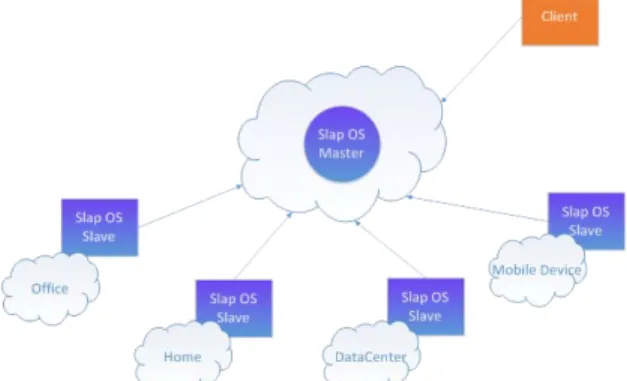
We will introduce SlapOS [20], a decentralized cloud system based on a Master and Slave design, as shown in Fig. 2. In this section we are going to provide an overview of SlapOS architecture and are going in particular to explain the role of Master node and Slave nodes, as well as the soft-ware components which they rely on to operate a distributed cloud for E-Health applications. Slave nodes request to Master nodes which software they should in-stall, which software they show run and report to Master node how much re-sources each running software has been using for a certain period of time. Master nodes keep track of available slave node capacity and available software. Master node also act as Web portals and Web service so that end users and software bots can request software instances which are instantiated and run on Slave nodes.
Fig. 2 SlapOS Master – Slave Cloud Architecture
Master nodes are stateful. Slave nodes are stateless. More precisely, all information required to rebuild a Slave node is stored in the Master node. This may include the URL of a backup service which keeps an online copy of data so that in case of failure of a Slave node, a replacement Slave node can be rebuilt with the same data.
It is thus very important to make sure that the state data present in Master node is well protected. This could be implemented by hosting Master node on a trusted IaaS infrastructure with redundant resource. Or - better - by hosting multiple Master nodes on many Slave nodes located in different regions of the world thanks to appropriate data redundancy heuristic. We are touching here the first reflexive nature of SlapOS. A SlapOS master is normally a running instance of SlapOS Master software instantiated on a collection of Slave nodes which, together, form a trusted hosting infrastructure. In other terms, SlapOS is self-hosted.
SlapOS Slave nodes are relatively simple compared to the Master node. Every slave node needs to run software requested by the Master node. It is thus on the Slave nodes that software is installed. To save disk space, Slave nodes only install the
software which they really need.
Each slave node is divided into a certain number of so-called computer partitions. One may view a computer partition as a lightweight secure container, based on UNIX users and directories rather than on virtualization. A typical barebone PC can easily provide 100 computer partitions and can thus run 100 RTU web portals or 100 sensors monitoring sites, each of which with its own independent database. A larger server can contain 200 to 500 computer partitions.
B. M2M Architecture for E-Health
In Fig. 3 we present the general structure of the system that we propose for the tele-monitoring of installation sites in hydro power stations.
At each of the monitored installation sites a system is set up composed mainly from distant RTUs, sensors and actuators. RTUs capable to communicate with the Gateway through GSM-GPRS and Internet will be used in standard configura-tions. For the installation sites which are situated in no GSM coverage areas, RTUs in the UHF band of 430-440 MHz will be used. These will communicate with the date concentrator through a bridge station (bridge) which will ensure the UHF-GPRS and UHF-GPRS-UHF conversion.
In the relatively few instances when this will be possible, the RTU-Gateway communication will be held by radio exclusively in the UHF band of 430-440 MHz. The system’s key elements are:
• Gateway, which ensures the communication with the RTUs and available re-source management;
• Presentation Server (PS) which is hosted on a computer with server features (for example, unattended operation 24/7), equipped with a software package focused mainly on data presentation in various forms, entirely available to us-ers.
• Application Server (AS), focused on special tasks, which PS cannot perform.
Fig. 3 General structure of the E-Health system
Practically, all system communication is done through the Internet and this gives the system investment and mostly operational advantages. It is mentioned that the users can access the processed data, offered by the PS and AS anywhere and anytime, from any terminal with Internet access (PC, tablet, mobile phone etc) [20].
The system’s central elements are configured and scaled so that they would al-low a system takeover of 100 RTUs.
IV. BIG DATA PROCESSING CHARACTERISTICS AND
DISCUSSIONS
Currently there are many solutions on the market for search and analysis of large volumes of information. These solutions are focused on semantic technologies for aggregating and collating data, both structured and unstructured.
Since the well-known Google, which is used by all users, we have developed and are developing solutions for Enterprise Business Applications such as CRM (Customer Relationship Management), ERP (Enterprise Resource Planning) and BI (Business Intelligence) and web applications, such as applications B2B (Business to Business), B2C (Business to Customer), using data from various sources (databases, web content, user generated content, etc.).
In our approach we use CloudView Exalead [25], a search platform which offers wide access to in-formation on infrastructure level and is used for both SBA (Search Business Application) for online and enterprise level. This application combines semantic technologies for developing applications such as drag-and-drop, as well as qualitative and quantitative analysis to provide information to the user.
Located at the intersection between search and Business Intelligence, Cloud-View is also a platform for the Exalead search engine, which was designed to implement semantic processing and selective navigation data volumes that are on the Web, making it easy for users searching and analysing information and enabling organizations to improve their knowledge and resources exploitation.
With the advent of cloud computing, the convergence of the cloud computing with WSN has been attempted, as an extension of the sensor grid concept in the scope of on-demand elastic cloud based environments. In particular, the convergence of cloud computing with WSN aims at compromising the radically differences and conflicting properties of the two technologies. In particular, sensor networks are location specific, resource constrained, expensive (in terms of development/deployment cost) and generally inflexible in terms of resource access and availability. On the contrary, cloud based infrastructures are location independent provide a wealth of inexpensive resources, as well as rapid elasticity
Fine-grained (raw) data have to be conveyed in a centralized manner over the Internet from sensors up to the remote centre, so as to give the latter the high-resolution information it needs to take decisions. Therefore, the things and gate-ways are effectively separated from the back-end, which has storage and computation functions, both physically, through the Internet, and logically via a set of abstraction layers. Such an approach has worked well in the past for similar technologies, like the Web, from which the initial IoT attempts inherit most of their design and characteristics. However, we argue that full and sustainable exploitation of M2M applications needs a tighter
integration between the real and virtual world. The following issues of what we can call “the current approach” can be identified: scalability, security, reliability, QoS, resource/energy efficiency and multi-domain implementation.
To overcome the limitations of the current systems for M2M applications, we propose a novel approach based on the following principles:
1. Storage and processing of data are as close as possible, in space and time, to where they are generated and consumed.
2. Important non-functional requirements, namely security, reliability and QoS, are supported by means of a tight integration of the high-level services pro-vided with the physical resources of the peripheral devices, i.e., things and gateways.
3. Energy efficiency and scalability of the systems are achieved through the dis-tribution of on-the-spot inferred content, rather than raw data.
4. Cross-domain applications using real-time data from multiple sources can be seamlessly implemented.
The current state of art of M2M platforms is quite fragmented and there isn’t a single view toward an interoperable smart object world. The M2M commercial platforms are vertically focused on solving specific sector issues and are tightly in-tegrated with applications. This approach, taken from the telemetry legacy appli-cations, has created a bunch of sensor devices not interoperable one each other, with high boundaries and integration possible only at database or presentation layers.
For many years, M2M deployments were based on proprietary/custom applications and networking infrastructures, which were typically expensive to build, manage and maintain. Today’s market for sensor devices is a hotbed of idea generation, as the prospect of embedding intelligence in the form of M2M (machine-to-machine) technology into mobile devices has everyone excited about the possibilities. The current market is already filled up with devices that can track everything from blood-glucose levels to traffic patterns.
In making the case for open-platform development in M2M, the sensor and communication device manufacturing community is only one part of the model, where the application and service side is pushing for enablers to seamlessly access to widely distributed, real-time data from the environment. Throughout the recent past years, the concept of open-platform development, management and monitoring has emerged, basically solving again problems mainly from the technological point only in specific sectors. For example, the medical device world faces regulatory and sensitive data issues when development is concerned. Embedded and mobile software provider emphasize this idea through the delivery of commercial off-the-shelf software solution. The emphasis with such a platform is to ensure companies optimize their software across the entire lifecycle of a product, starting with design, all the way through support of the deployed devices. This is merely one example in one specific market that demonstrates
how a technology platform can provide a jumpstart to the development process that, until now, has been lacking in the market.
The convergence between Telco, Media and Consumer Electronics leads ever more to the need to interpret as “network devices” items very different in themselves and detached from any form of connectivity. The Internet of Things is destined to become a fundamental sector for the distribution of new technologies, both within companies and in daily life.
V. CONCLUSION
The paper discussed a number of popular ICT paradigms, including Cloud computing, IoT and Big Data. It provided an extensive state of the art review of them and the convergence between them. Next, we proposed a M2M system based on a decentralized cloud architecture, general systems and Remote Telemetry Units (RTUs) for E-Health applications. The system was built for Big Data processing of sensors in-formation in the way that data can be aggregated to generate “virtual” sensors, and some measurement results were presented.
With the advent of smart mobile devices, the Internet access has become ubiquitous, and has opened the way for new applications that use M2M communications. Indeed, the Internet of Things paradigm is an evolution of the traditional Internet for seamlessly integrating most things around us and collecting big data from sensors that track everything happening in our environment. IoT is already a reality and is growing, while the way we apply this new concept will drive new applications and may revolutionize life. Future research includes concepts such as flexible, open, and standardized service interfaces - Internet of Services (IoS), people becoming part of ubiquitous intelligent networks having the potential to seamlessly exchange information – Internet of People (IoP), and, finally, the ability to interconnect any web enabled device and provide natural Human-2-Machine (H2M) interaction interfaces - Internet of Everything (IoE).
REFERENCES
[1] O. Vermesan, P. Friess, P. Guillemi, and S. Gusmeroli, “Internet of Things Strategic Research Agenda,” in Internet of Things – Global
Technological and Societal Trends, River Publishers, 2011.
[2] G. Suciu, S. Halunga, O. Fratu, A. Vasilescu, and V. Suciu, “Study for Renewable Energy Telemetry using a Decentralized Cloud M2M System,” in Wireless Personal Multimedia Communications (WPMC),
IEEE 15th International Symposium on, 24-28 Jun. 2013, pp. 1-5.
[3] P. McFedries, “The cloud is the computer”, IEEE Spectrum. Available:
http://spectrum.ieee.org/computing/hardware/the-cloud-is-the-computer. [4] A. Basu, J. Vaidya, H. Kikuchi, and T. Dimitrakos, "Privacy-Preserving Collaborative Filtering on the Cloud and Practical Implementation
Experiences," Cloud Computing (CLOUD), 2013 IEEE Sixth
International Conference on, 2013, pp.406-413.
[5] M. M. Hassan, B. Song, and E. N. Huh, “A framework of sensor-cloud integration opportunities and challenges,” in Proceedings of International Conference Ubiquitous Information Management
Communication, 2009, pp. 618-626.
[6] Open Source IoT Cloud. Available:
https://sites.google.com/site/opensourceiotcloud.
[7] Open Source Solution for the Internet of Things into the Cloud. Available: http://www.openiot.eu.
[8] Xively – Public Cloud for the Internet of Things. Available: https://www.xively.com.
[9] Internet of Things – ThingSpeak. Available:
https://www.thingspeak.com.
[10] Sensor Cloud. Available: http://www.sensor-cloud.com.
[11] M. Kranz, P. Holleis, and A. Schmidt, “Embedded Interaction: Interacting with the Internet of Things” in IEEE Internet Computing,
vol. 14, no. 2, 2010, pp. 46-53.
[12] RADICAL: RApid Deployment and adoption of sustainable socially-aware and intelligent sensing services for emerging smart cities.
ICT-PSP project. Available:
http://ec.europa.eu/information_society/apps/projects/factsheet/index.cf m?project_ref=325138.
[13] SmartSantander. FP7 project. Available: http://www.smartsantander.eu. [14] FP7 Work Programme 2013. Cooperation Theme 3: ICT (2012).
Available:
http://ec.europa.eu/research/participants/portalplus/static/docs/calls/fp7/ common/32767-annex_6_to_the_decision_ict_for_cap_en.pdf. [15] FP7 Work Programme 2013. Cooperation Theme 5: Energy (2012)
Available:
http://ec.europa.eu/research/participants/portalplus/static/docs/calls/fp7/ common/32765-annex_8_to_the_decision_energy_for_cap_en.pdf. [16] Exploiting Big Data: Strategies for Integrating with Hadoop to Deliver
Business Insights (2012). Available:
http://media.techtarget.com/digitalguide/images/Misc/EA-Marketing/E-Zine/BAA%20assets/BigDataReport_final.pdf
[17] A. McAfee, and E. Brynjolfsson, “Big Data: The Management Revolution”, Available: http://hbr.org/2012/10/big-data-the-management-revolution.
[18] Gartner Says Worldwide Cloud Services Market to Surpass $109 Billion in 2012, Available: http://www.gartner.com/newsroom/id/2163616. [19] S. H. Hung, C.H. Chen, and C.H. Tu, “Performance evaluation of
machine-to-machine (M2M) systems with virtual machines.” In
International Symposium Wireless Personal Multimedia
Communications, IEEE, 2012, pp. 159-163.
[20] G. Suciu, C. Cernat G. Todoran, V. Poenaru, T. Militaru, and S. Halunga, “A solution for implementing resilience in open source Cloud platforms,” in International Conference on Communications, IEEE,
2012, pp. 335-338.
[21] S.Y. Tsai, S.I. Sou, and M.H Tsai, “Effect of data aggregation in M2M net-works," in International Symposium Wireless Personal Multimedia
Communications, 2012, pp. 95-99.
[22] S.G. Kumar, and R. Buyya “Green Cloud computing and Environmental Sus-tainability,” in Harnessing Green IT: Principles and Practices,
2014, pp. 315-340.
[23] Greenpeace International, “Make IT Green: Cloud computing and its
contribution to climate change,” Available:
http://www.greenpeace.org/international/en/publications/reports/make-it-green-Cloudcomputing.
[24] 3GPP, TS 23.888 “System improvements for Machine-Type Communications (MTC),” Version 11.0.0 (Release 11), Sept. 2012 [25] R. Eckstein, “Interactive search processes in complex work situations: a
retrieval framework,” Vol. 10. University of Bamberg Press, 2011, pp. 62-67.