Chapter
4
Access to Finance
March 2014
This chapter should be cited as
ERIA and OECD (2014), ‘Access to Finance’ in ERIA SME Research Working Group (ed.), ASEAN SME Policy Index 2014-Towards Competitive and Innovative ASEAN SMEs, ERIA Research Project Report 2012-8, pp.57-80. Jakarta: ERIA and OECD.
57
Chapter 4
Access to Finance
1.
Introduction and Assessment Framework
The opportunity to access small amounts of finance can be an important catalyst for small businesses to get access to the resources they need to gain a foothold in the market. This is particularly critical for micro enterprises. Many SMEs lack awareness of financing resources and programs available from commercial banks and other private sector and government sources, and have difficulty defining and articulating their financing needs. In this regard, financial institutions need to be more responsive to their needs.
Based on an ERIA research (Harvie, et al., 2010), a significant number of SMEs still rely on their internal resources for start-up and business expansion. However, for aspiring smaller and domestically owned companies in less developed economies (Cambodia, Lao PDR, and Viet Nam), such internal resources are scarce because they make lower profits and have insufficient access to funds. Moreover, the size of these firms and the stage of the country's development (reflecting the financial market conditions) affect the diversity of choices of financial institutions and financial products available which these SMEs can get access to. In view of this, the availability of and access to external finance is very important.
There is potential for credit rationing or high risk premiums exercised by the financial institutions for SMEs. But firm size and the stage of a country’s development (financial market development), as mentioned, do affect the conditions of external finance offered to SMEs, and so larger SMEs in more developed economies (Indonesia, Malaysia, the Philippines, and Thailand) tend to get bigger loans with longer terms and with lower interest rates than smaller SMEs in the less developed AMSs.
The owners’ net worth, collateral, business plan, financial statement, and cash flow are critical for financial institutions in devising the financial conditions they extend to
58
SMEs. In other words, financial institutions seem to assign higher risk premium on opaque SMEs by offering less favorable financial conditions.
On SME performance, financial access has a significant impact on SMEs’ innovation capability and participation in the export market. Bigger SMEs with access to larger loans with longer terms and at lower interest rates are more capable of conducting innovation and exporting activity in as much as these external finances with favorable conditions provide them with enough time and resources to innovate and enter foreign markets.
Policy measures are therefore needed to deepen and broaden financial markets with the aim of encouraging greater competition among financial resource providers (more non-bank instruments such as venture capitals, equity funds), reducing the cost of borrowing, and stimulating greater provision of finance that will enhance the development of diversified products and services more suitable in meeting the needs of the SMEs.
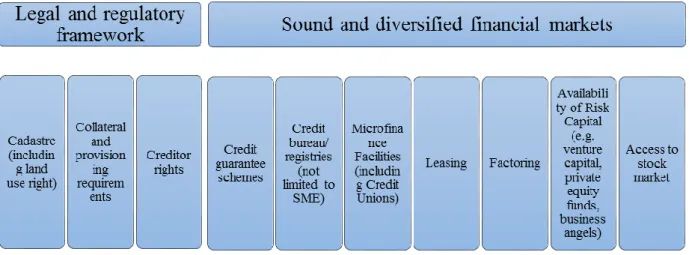
There are two policy sub-dimensions to serve these ends as outlined in Figure 11.
Figure 11: Assessment Framework for Access to Finance
(i) Development of regulatory framework to deepen the financial sector
This would refer to, among others, concerns regarding the development of the cadastre system and the provision of creditors’ rights by introducing a suitable set of
59
laws that protect lenders from non-payment. At the same time, this should look into alternative sources of risk capital finance for innovative SMEs. The establishment of a capital market will complement traditional sources of funding for SMEs. Innovative financing instruments should be introduced for knowledge-intensive as well as technology-intensive start-up enterprises, using intangible collaterals such as ideas, knowledge and expertise as their principal assets to source funds from the capital market.
(ii) Sound and diversified financial products/markets
Less collateral-based lending system must be promoted by introducing credit guarantee schemes, credit ratings, credit information, and collateral registry systems. These mechanisms are important to broaden the base of collaterals such as account receivables, movable assets (machinery and automobiles) and others since very often, SMEs have limited assets to be used as collaterals required by most commercial banks. The more developed systems would gradually build confidence towards a collateral-free lending practice.
SMEs should be encouraged to utilize alternative sources of financing, including equity financing and venture capital as well as other financial instruments (leasing, factoring). Therefore, the creation of more angel investors, venture capitals and equity funds should be encouraged. Moreover, collaboration between research institutes, business incubators, entrepreneurs and venture capitalists should be strengthened to create wider networking and funding opportunities.
Capacity building for financial institutions and financial literacy for SMEs must also be provided. Normally, banks tend to charge SMEs higher interest rates and demand collateral due to the lack of transparency and creditworthiness of SMEs. SMEs should therefore be encouraged to seek BDS providers, including various business associations such as chambers of commerce and federations of industries, and to work with banks to build SMEs’ capacity in basic financial management and book keeping and to encourage more financial institutions to develop innovative financial products suitable to SMEs such as mobile finance.
In the absence of credit ratings and credit information system, BDS providers can be a reference point for financial institutions to identify potential clients, ascertaining
60
their creditworthiness, imparting professional financial and accounting techniques and other services. This complementary nature between BDS providers and financial services helps to minimize both the risk and transaction costs to creditors and investors, and makes access to credit and equity less costly and cumbersome for SMEs.
2.
Assessment Results
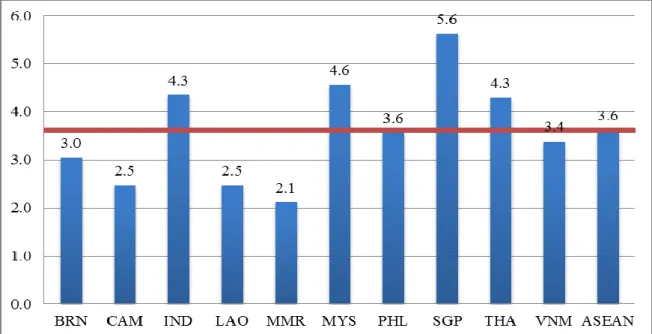
There is a big gap in the access to finance of the less advanced AMSs as compared with Singapore, Malaysia, Thailand, Indonesia, and the Philippines. It is exacerbated by the poor functioning of the cadastre system, stringent collateral requirements, and inadequate protection of creditor rights. Credit risk guarantee schemes and central bureaus for credit information, which are essential to promote collateral-free finance, are not well established nor functioning in these less advanced AMSs. There is likewise a lack of legal framework/policy to promote alternative finances and diversified financial markets, ranging from microfinance, leasing, factoring, venture capitals, equity funds, business angels, to stock markets in these economies as can be gleaned in the scores in Figure 12 and Table 5.
61 Singapore
SMEs in Singapore have several avenues to finance their investment activities. There are sufficient and flexible provisions for collaterals to be placed for loan activities, including properties, machines and equipment, and vehicles. The banks require around 70 to 80 percent collateral as part of their loan amount, healthy credit history and minimum of two years business track record. However, there is no central collateral registry in Singapore. The creditors have strong institutional rights to secure their loans.
In terms of debt financing for SMEs, the Government works with participating financial institutions to provide access to credit. More than 4,000 SME loans amounting to S$1.5 billion were co-guaranteed by the Government in 2012. These range from providing micro loans of up to S$100,000 to providing loans of up to S$ 15 million for the purchase of equipment and assets. It has also been observed that the financial industry has an increased focus on catering to SMEs, with many setting up an SME banking office. An SME Credit Bureau owned and operated by the private sector is also available to address the credit risk of SMEs in Singapore.
For equity financing, there is a sufficient range of risk capital (venture capital, private equity funds) available in the economy with exit options such as direct sales and stock market IPOs. A Business Angels Network South-East Asia (BANSEA) was set up in 2001 to facilitate deals between business angels and entrepreneurs, which include financing, mentoring and networks. There are leasing and factoring financial activities in the economy which are monitored and regulated by the Monetary Authority of Singapore (MAS). For SMEs looking to raise capital through public listing, the Singapore stock exchange consists of two sets of listing: SGX Mainboard and the SGX SESDAQ. The listing at the Mainboard requires companies to meet certain requirements, including market capitalization, pre-tax profits, and operating track record as set by the Singapore Stock Exchange. There are no quantitative requirements for listing in the SESDAQ and newer companies tend to list in the smaller stock exchange.
62 Malaysia
Malaysia has a fully functioning cadastre system (available online ) that allows SMEs to use real estate as collateral in their efforts to access bank finance, flexible collateral provisioning requirements and well established regulations for secured transactions in the country. Malaysia has adopted a flexible system of collateral requirements for SMEs. Regulations involving secured transactions are documented in Malaysia to ensure that creditor rights are protected and the time required for creditors to recover their credit from a default debtor is less than a year and at relatively low cost.
The guarantee schemes offered by the Credit Guarantee Corporation Malaysia Berhad (CGC) are available to all viable SMEs nationwide. The objective of the schemes under the CGC is to bridge the gap between the needs of SMEs and the concerns of lenders by providing a commercially viable guarantee system that is adequately backed financially, thereby giving credence to its ability to fulfil the guarantee commitments. At present, there are 13 CGC branches across the nation. As of end-2012, a total of 420,217 SMEs have been guaranteed by the CGC with loans outstanding amounting to RM51.4 billion. Although the CGC has performed well in relation to matching incomes and expenses, problems of reach to all segments of SMEs still require improvements in its implementation.
The Credit Bureau of Malaysia, which is owned and operated by the private sector, is a leading provider of comprehensive and credible credit information and ratings on SMEs in Malaysia. The Bureau is essentially a platform for SMEs to build, maintain and enhance their credit ratings and ultimately, facilitate wider and easier access to financing. The Bureau also assists SMEs by providing them with an avenue for recourse and ensures accurate and up-to-date information in their reports and ratings.
Microfinance facilities exist in Malaysia, which refer to financing up to RM 50,000 to micro entrepreneurs for business purpose only. Microfinance Institutions (MFIs) in Malaysia offer only microcredit loans and no other microfinance services such as micro-savings or micro-insurance. This limited financial service is due to the restrictions imposed by the Banking and Financial Institutions Act (BAFIA) that allows banking institutions to provide only loan services.
63
The leasing activities in Malaysia are regulated by the Banking and Financial Institutions Act. Leasing companies constitute a relatively small portion of the financial sector in Malaysia, with the number registering 227 companies in 2011. Although leasing has been an important source of financial support for SMEs, there are some problems with its accessibility in the country. Similar to leasing activities, despite its early introduction, factoring remains a relatively untapped alternative source of financing for businesses in Malaysia.
The Securities Commission (SC) of Malaysia is the regulator for risk capital to incorporate the new tax incentives for the venture capital industry. Venture Capital Corporations (VCCs) registered with the SC are eligible for tax exemptions for five years of assessment, subject to their investment of at least 30 percent of invested funds in the form of seed capital, start-ups and/or early stage financing in approved investee companies. Divestments were mainly through share redemptions and sales trade. The Malaysian stock market, Bursa Malaysia, restructured its business units in 2009 to unify the lower capitalised firms of the Second Board with the Main Market. The Malaysian Exchange of Securities Dealing and Automated Quotation (MESDAQ) was renamed as Access, Certainty, Efficiency under a new regulatory framework for listing and equity fundraising. The Access, Certainty, Efficiency Market accepts SMEs from all sectors of the economy for listing.
Thailand
Thailand has made notable progress in improving the efficiency of the cadastre and land registration. Land ownership has been fully documented by the cadastre which is operated fully nationwide. All transfers and dealing of land titles can be carried out in the provincial land office. Some services are also available online.
At present, Thailand does not have a centralized collateral registry office in operation. The collateral requirement for bank loan to SMEs varies with banks and types of collateral provided. The average collateral requirement could be inferred from the
loan-64
to-value ratio. The average of this ratio is about 80 percent, implying that collateral requirement is less than 150 percent of loan. SME firms can apply for an uncollateralized loan. The Small Business Credit Guarantee Corporation (SBCGC), the state-owned bank, provides credit guarantees to viable SMEs which do not have sufficient collateral.
Thailand provides a legal framework on secured transactions although it does not ensure all four rights of creditors. Secured creditors are paid first when a debtor defaults outside an insolvency procedure or when a business is liquidated. They are not subject to an automatic payment when a debtor enters a reorganization procedure. As for the length of legal procedure for a creditor to recover their credit, it takes about 440 days for commercial cases on average. Cost as a percentage of claim is about 15 percent. In case of insolvency, it takes 2.7 years on average and costs 36 percent of the debtor’s estates to be able to recover the credit in Thailand.
The Credit Guarantee Scheme for Thai SMEs is administered by the Small Business Credit Guaranteed Corporation (SBCGC). This state-owned corporation was capitalized by 4.4 billion THB in 2010. More than 90 percent of the fund comes from the Ministry of Finance and the balance from Thai banks. The rest are from private banks and state banks.
Thailand has the National Credit Bureau established in May 2005 through merger. Its shareholders include the shareholders of Thai Credit Bureau Company Limited, and banks as well as government financial institutes. The National Credit Bureau is responsible for keeping both firm and individual credit information (both positive and negative). The system of processing and reporting the credit data is updated monthly.
Microfinance activities include financial services, savings, loans, money transfers and insurance in a small amount for low income individuals or micro enterprises. Many microfinance activities to assist the poor have been provided by Thai specialized financial institutions (such as Government Saving Bank, Bank for Agriculture and
65
Agriculture Cooperatives, SME bank) and other community-based funding services like the Village Fund Scheme. Other commercial banks also provide such small loans.
There are many leasing and factoring companies in Thailand which are regulated by the Bank of Thailand. Most commercial banks and non-bank personnel loan businesses provide leasing and factoring for Thai SMEs. Information on overall activities for both leasing and factoring to SMEs are not available and it is believed that the factoring activities are under traded.
The venture capital and private equity fund businesses have been relatively small in Thailand. The Venture Capital or Private Equity Business purpose is to invest in Thai SMEs which have strong growth potential and high expected return. In 2013, there were only 19 members of the Thai Venture Capital Association. In 2012, the Thai government approved Bt5 billion for the venture capital program, which will also get additional funding from several banks such as Krungthai, SME Bank and the Government Savings Bank. This program aims to provide support and opportunities to students and young graduates who have the potential to become new-generation entrepreneurs. The Thailand Stock Exchange has been operated since 2011 with market capitalization of around 77.7 percent of GDP. The market for alternative investments (MAI) was established in 1999 and provides alternatives for smaller firms, of which some are SME, to listing on the main board of the Thailand Stock Exchange market. It thus provides an exit point for venture capital investors.
Indonesia
Legal and regulatory framework on credit has been quite advanced. For the debtor, on one hand, the ownership of land has been documented, with fully functioning cadastre allowing firms to use real estate as collateral in their efforts to access bank finance. Moreover, there is also flexible collateral definition (movable assets) and/or flexible provisioning requirements for loans under certain amounts. On the other hand, there is also regulation that ensures creditor rights and legal procedures for litigations take less than 2 years and cost less than 20 percent.
66
In Indonesia, the cadastre system is in place but the land ownership of the country has not yet been entirely documented. The cadastre system is under the responsibility of the National Land Agency (Badan Pertanahan Nasional (BPN) which operates fully nationwide. The agency has also provided online cadastre services. This online service provides complete information on the cadastre system but it does not provide online registration services.
The percentage of collateral requirement varies, depending on the type of loan and the financial institution that provide the loan. As for banks, principally, the central bank’s regulation states that the collateral is the business itself. Banks will ask for additional collateral to ensure that the loan would be repaid or returned. In practice, the collateral requirement may vary, ranging from 0 percent to more than 100 percent.
There is no rigid definition on collateral in Indonesia. While the collateral theoretically requires fixed assets, in practice, moveable assets and/or flexible provisioning requirements for loans under certain amount or certain types of loan can also be used by firms. Firms can also apply for an uncollateralized loan if the business prospect is very good and strictly monitored, although this is very rare. Some government programs for SMEs such as PKBL and LPDB do not also require any collateral. Meanwhile, there is no centralized collateral registry office in Indonesia.
According to the law, legal procedure for a creditor to recover his/her credit from a default debtor takes two months at a maximum. However, in reality, the process usually takes 3-4 years. The legal cost for the procedure is 2 percent of all assets owned by the debtor (not limited only to the collateral).
The financial sector in Indonesia is quite sound and well diversified, with access to finance for SMEs having been widened in the country. The credit guarantee facilities are already in place although the coverage is still limited to certain geographic locations and type of business. A bureau that records all individual and private firm credit information is already in place, yet it is still limited to only credit information in the
67
banking sector. The law and regulation to govern microfinance are also already in place, with many microfinance institutions providing a wide range of microfinance products and having extensive coverage in the country.
Moreover, the regulations and supervisions of the leasing, factoring, and risk capital sector are already enacted. There are already significant leasing activities in place in the country but the activity of factoring and venture capital is still limited. Furthermore, the Indonesian stock market has medium capitalization (≥ 20% GDP) and liquidity.
The credit guarantee scheme in Indonesia is managed by Jamkrindo (Indonesia’s Credit Guarantee) which has several schemes. Aside from Jamkrindo, the Central Bank (Bank Indonesia) also plans to establish credit guarantee schemes for agriculture, farming, and fishery which accounted for a large share in inflation calculations. But the credit guarantee facility is still limited in number and volume. Only 30 percent of SME loans are guaranteed by the government. Indonesia has a bureau that records private firm credit information in the country but it is not a specialized credit bureau for SMEs. Bank Indonesia, the central bank, records all individual and private firm credit information in the banking sector. The credit information from Bank Indonesia is available only for banks, as it is constrained by bank secrecy regulation.
There are many institutions providing microfinance facilities in Indonesia. These microfinance institutions, which are mostly privately managed, are present and operate throughout the country. In general, these institutions can be grouped into two major groups. The first group is banks. The second group is cooperatives and other micro-finance institutions, including those established by private entities. In 2012, according to data from Indonesia’s Financing Companies Association (APPI), there were about 197 companies whose activities are in leasing, factoring, consumer finance and credit card.
In Indonesia, most of the venture capital firms do not utilize venture capital from the capital market to be invested in the SMEs. Their source of finance is borrowing from banks. Furthermore, many others use their own funds. In this case, they are more
68
suitable to be called business angels. In addition, the capital market also provides funds to SMEs. The fund is called discretionary funds (or one may call it as private equity funds). Despite the shortcoming of this discretionary fund, its availability has helped some Indonesian SMEs. The Indonesian stock market has medium market capitalization, accounting for about 46.07 percent of the country’s GDP in 2011 and the liquidity is about US$ 594.12 million. Hitherto, there is no special board for SMEs in Indonesia’s stock market.
Philippines
The cadastre on land ownership is fragmented and not updated in the Philippines because of the overlapping functions of several government agencies that are responsible for carrying out surveying/titling activities. There is very little information sharing among the agencies. About 54.6 percent of land ownership is documented. There is a pipeline project to come up with a single system cadastre, update and harmonize the existing cadastre system as well as to develop a common working base map.
Based on the Manual of Regulations for Banks, loans can be secured by real estate mortgages, chattels and intangible properties. There is no collateral registry in operation that is unified geographically and by asset type. The value or amount of collateral required by financial institutions depends on the latter’s credit policy. In practice, the average percentage of collateral requirement ranges from 125 to 140 percent of the loan amount. Firms can apply for uncollateralized loans. These are approved on a case-to-case basis depending on the financial condition of the firm, whether it has enough equity, sufficient assets to cover its liabilities, and track record of the firm (i.e., no previous defaults).
The Financial Rehabilitation & Insolvency Act (FRIA) was adopted in 2010 to ensure a timely, fair, transparent, effective, and efficient rehabilitation or liquidation of debtors. The law provides secured creditors with grounds for relief from an automatic stay and sets a time limit to it.
69
There are three major institutions providing credit guarantee facilities: the Credit Guarantee Program which aims to help financial institutions consider the granting of loans to MSMEs; the Wholesale Guarantee for existing loan portfolios and shorter loans to direct and indirect SME exporters; and guarantee institutions for the agriculture and fishery sectors whose mission is to provide better and accessible credit and guarantee to agricultural stakeholders. However, the credit guarantee facility covers limited geographical locations and type of business.
Private credit bureaus have been in existence but a centralized credit information system is absent. To address the fragmented and unorganized credit information system, the Credit Information System Act was enacted in 2008. The Credit Information System (CIS) is under the Central Credit Information Corporation. Its implementation has been limited due to lack of regulatory and funding support. Credit information services are in place but access is limited to financial institutions.
The National Credit Council approved a Regulatory Framework for Microfinance in 2002. Even with the variety of institutions providing microfinance and a clear regulatory framework for the practice of microfinance, much remains to be done to increase the reach of microfinance institutions. According to industry estimates, the supply of microfinance is reaching only between 10-20 percent of the potential market. As of 2010, there were 202 banks with microfinance operations and with 932,622 clients being served.
Leasing and factoring are regulated by the Securities and Exchange Commission and the Bangko Sentral ng Pilipinas (for their quasi-banking functions). Leasing and finance companies are affiliated with banks and other financing institutions. Leasing/factoring is still a growing market in the country. Leasing products include auto, heavy equipment, office equipment, medical equipment, and other specialized types of manufacturing and production equipment. It will still take time for the financial leasing industry to become mature.
70
Risk capital is available with several venture capital/private equity funds. Exit is possible through IPO but very few firms are listed in the SME Board of the Philippine Stock Exchange. Venture capitalism has remained limited due to the shortage of experienced technology entrepreneurs and managers, shortage of scientists and engineers, and accessibility to a global network of experts that may provide the necessary knowledge and even financial capital to build a community of venture capitalists. Another concern is the lack of business-minded technology entrepreneurs, with many engineers and scientists tending to think of becoming employees rather than pursuing their own ventures.
The SME Board was officially launched in July 2001. To date, there are only two companies listed on the Board. The unattractiveness of SME Boards was attributed to the absence of incentives for underwriters to promote the SME Board. The requirements for listing on the First and Second Boards are almost the same as for the SME Board and it is easier to borrow from banks and other financial institutions than to comply with the SME Board listing rules. Moreover, there are concerns among potential investors on SME’s financial viability and lack of track record as well as on compliance due to the strict and expensive pre-and post-listing requirements (continuous disclosure requirements).
Brunei Darussalam
The Cadastral System in Brunei Darussalam was designed for the purpose of registration and transfer of ownership. The cadastral system in Brunei Darussalam is based on the Torrens Systems and uses lot number as the identifier. These are mainly privately owned lots and a number of lots occupied by government departments. These plots are completely digitized and supported by field notes and Survey Plans.
In Brunei Darussalam, land and properties can only be registered in the name of an individual and not in a company’s name. Hence, charging a property to a financial institution will not be permissible. Hence, collaterals will generally be in the form of a
71
personal or corporate guarantee or placement of fixed deposits as security for banking facilities.
Creditors can petition for a Creditors liquidation and appoint a Liquidator to manage the liquidation of a company for the recovery of amounts owing to them. Secured creditors would have priority in a distribution and any balance remaining will be distributed to the unsecured creditors.
There are no credit guarantee schemes yet in place. The Credit Bureau was established in 2012. Its aim is to help the financial industry to significantly improve credit risk management, reduce information gaps and make more informed decisions efficiently. The aim is also to instil greater financial discipline amongst borrowers so that they maintain good credit history. Only members can have access to information from the Credit Bureau.
Microfinance facilities are administered by both the Ministry of Industry and Primary Resources and the Brunei Economic Development Board. Some of the loan schemes are Microcredit Finance Scheme (MFS) administered by the Ministry of Industry and Primary Resources to assist local entrepreneurs to start and expand small scale business activities; Enterprise Expansion Program (EEP) Financing by the Brunei Economic Development Board to help SMEs expand their businesses through increasing their productivity and to groom future promising local enterprises to export and expand overseas; and Enterprise Facilitation Scheme (EFS) under the Ministry of Industry and Primary Resources to assist SMEs to expand and develop their business activities and build capacity to export.
There are no factoring facilities in Brunei Darussalam. Leasing is also not widely used. The more common types of financing would be under a hire purchase which is mainly for the purchase of motor vehicles. There are no specialized leasing companies for SMEs.
72
Risk capital financing and ventures are still in an infancy stage in Brunei Darussalam. There are three types of Investment Fund Schemes: (i) Promising Local Enterprise Development Scheme (PLEDS) Investment Fund, administered by the Brunei Economic Development Board. This is an investment fund for investing in and transforming promising local enterprises so that they can compete internationally either through increased exports or overseas expansion; (ii) The Future Fund, administered by Future ventures SDN BHD to bridge the initial funding gap for potential innovative ICT entrepreneurs who are promising and have good business ideas; and (iii) Accel-X Investment Fund, administered by the Brunei Economic Development Board to provide funding support for early stage companies in hi-tech growth areas such as ICT and engineering. There is currently no stock market in Brunei Darussalam nor are there any plans for the establishment of a stock market.
Viet Nam
In Viet Nam, land ownership belongs to the entire people represented by the state; thus, this right does not appear on the cadastre. Cadastre indicates the land use right. Information in the cadastre includes name, location/address, and area of land. The cadastre operates fully nationwide and enterprises can use land use right as collateral to access bank credit. In some local authorities, cadastre services are available online. However, the land use right has not been fully documented, with the coverage of about 70-75 percent of land ownership.
Collateral required by financial institutions values from 125 percent to 143 percent of loan amount. Not only real estate but also non-estate collateral (movable), valuable papers, and assets being formed in the future are also used as collateral. However, in Viet Nam, there is no centralized collateral registry office.
Enterprises can also borrow from credit institutions without collateral. Commercial banks can provide uncollateralized loan for traditional, large and trusted enterprises with an annual revenue of more than VND 400 billion (equivalent to US$ 20,000). Credit institutions usually set their own criteria in the case of lending without secured assets.
73
They mainly base on the customers’ prestige when providing loans without requirement of secured assets.
A legal framework for secured transactions has been in existence for quite some time in Viet Nam. Under the existing legal regulations, creditor rights are basically ensured and the legal procedure for the creditors to recover their credit from default debtors takes two months at maximum. However, in practice, many cases take much longer like one year. In terms of legal cost for procedures, on average, it is around 2.8 to 5 percent of the collateral’s value.
There are Credit Guarantee Schemes for SMEs applied nationwide via 13 credit guarantee funds at the provincial level and a guarantee program by the Viet Nam Development Bank (VDB) when SMEs borrow from commercial banks. In 2013, the Fund for SME Development was established to support SMEs to conduct feasible business plan or project in priority sectors.
The State Bank of Viet Nam (SBV) established the Credit Information Center (CIC) with the function of collecting, processing, storing, analyzing and forecasting credit information. The database of the CIC has been created by collecting information from all credit institutions operating under the Law on Credit Institutions. This database also allows applying credit rating for internal borrowers of credit institutions. Most of the financial institutions subscribed to the bureau. However, the access to this information is limited to the public. The Private Credit Bureau was also established for the improvement of the retail market, supporting SMEs and individuals in accessing credit.
Understanding the important role of microfinance as a useful tool for economic development, many regulations on the organization and operation of microfinance institutions were issued. The fund for microfinance institutions comes from public, donor and private sources. The private source accounted for 82.5 percent of total amount of funds. Most of the microfinance institutions lend their money to individuals and households who are mainly farmers or doing business in rural areas.
74
In terms of the legal framework, both leasing and factoring activities have been regulated in different legal documents. Financial leasing company is one of popular types of medium and long-term credit institutions. However, there are no specialized leasing companies for SMEs and factoring is a less common facility offered to SMEs.
The law and regulation of risk capital have been approved and institutional responsibilities clearly assigned to the Ministry of Finance. The Government has also offered incentives (including taxes, organizing trade fairs and investment forums) for venture capital or private equity or business angels to promote networking with SMEs. As of this date, several venture capital funds have been established. Direct sales, initial public offering (IPO) and lending are available options of risk capital sources. The Viet Nam stock market initially opened on 11 July 1998. Its market capitalization as a share of GDP fluctuates from 20 to 40 percent. Up to now, Vietnam does not have a board of SMEs in the stock market; however, most of the listed companies in the Hanoi Securities Trading Center (HASTC) are SMEs with the total number of around 250 and the market liquidity ranging from VND 200-300 billion.
Lao PDR
The Lao government has ranked access to finance as one of its most important priorities (SMEPDO, 2010). The task of access to finance includes: (1) Enhancing efficiency in the field of enforcement of business relevant laws; (2) Strengthening of banks and financial institutions including microfinance institutions; (3) Developing a diversity of financial products and services for SMEs; (4) Enabling business people to formulate realistic business plans, stimulate bookkeeping and financial reporting of economic activities; (5) Providing access to finance to banks in order to create conditions for the extension of their credit networks and for solving their liquidity situation; and (6) Strengthening of SME Promotion and Development Fund. Government has also decreed a SMEs Promotion Fund in order to support SMEs for financial accession.
There is a fully functioning cadastre system allowing firms to use real estate as collateral in their efforts to access bank finance. Collateral requirement ranges from
75
100-150 percent of the loan amount. Restrictive collateral definition and rigid provisioning requirement are imposed for uncollateralized loans. Credit rights are protected but it will take 2 to 4 years to recover their credit from default debtors and will cost about 20-30 percent of the collateral value.
Credit guarantee facilities are in place as well as credit information services but access is limited to financial institutions. There are microfinance facilities present and operating throughout the country. The facilities are mainly state- or donor-funded and offer a limited range of microfinance products. There is the presence of leasing law, regulators active in monitoring market, and some leasing activity. Factoring law is under preparation while a stock exchange market is in place with low market capitalization and low liquidity.
Myanmar
For land registration and documentation (cadastre), all the land areas and ownership, particularly of residential areas, are well documented in Myanmar. At present, government has taken measures to encourage farmers to register ownership of their farmland to be able to use them as collaterals at the banks to get loans with relatively cheaper interest rate than those available from informal money lenders.
The major problem for lands to be qualified as collaterals in Myanmar is the name of ownership since in the permit or lease contract, it is frequently registered not in the same name as the real owner who holds the estate. It is a general tendency in Myanmar that the owners of land do not want to change title of the land due to a 30 percent tax on the sale value. It is estimated that 80 to 90 percent of the people who buy land do not change land ownership formally. This makes them automatically ineligible for getting bank loans. There is no online cadastre service available so far for these purposes. The loan amount ranges from 35 to 50 percent on the forced sales value of the collateralized property depending on the case. Up to now, none of the movable properties can be collateralized.
76
Concerning creditor rights, it is common in Myanmar that if the borrower is unable to pay regularly, either the principal or interest on the loan, the bank officer firstly negotiates with the borrower to recover the loans and if it does not succeed, brings the case to the court. There are no other separate regulations for secured transaction. Neither reorganization plan nor bankruptcy proceeding is provided in Myanmar. The court interprets on the case and if it is found that the borrower defaults on his/her part of the contract, it gives the bank approval or the right to seize the collateralized property. After that, the liquidation officer of the bank tenders that property covered in the loan covenant. The time taken to finish the legal procedure may range from 3 to 6 months depending on the number of court cases and efficiency of the concerned court. The legal cost formally required is less than US$100 but if the attorney’s fees, transportation and other expenses are included, the cost may reach up to US$2000 per case from the beginning to the end.
There is no credit guarantee scheme either in government or the private sector in Myanmar until now although it is now included as one of the activities to be prioritized in the SME development policy framework that is being drafted. Currently, the SME Development Centre is conducting a credit screening scheme that screens the eligibility of local SME for loan with a discounted interest rate (i.e., 8.5 percent per annum).
There is no specialized bureau for the preparation and distribution of credit information either in government or private up to now. Under the leadership of the Republic of Union of Myanmar Federation of Commerce and Industry (RUMFCCI), an information bureau is currently being established with the help of a foreign agency. At present, the private banks maintain their own databases on the borrowers of their bank. However, there is no consolidated national database until now.
A microfinance law was enacted in Myanmar in 2012. At present, a number of microfinance providers including international non-governmental organizations (INGOs) and NGOs are actively operating. They provide small loans to the poor people who mainly rely on informal money lenders for their daily livelihood and are mainly located in rural areas and poor parts of the cities. Since the main principle of
77
microfinance is targeted to the informal sector, it can be said that the availability of such loans from SMEs is limited.
There are no leasing and factoring arrangements in the country, so there is no specialized leasing or factoring company at present. About five years ago, one or two private banks were granted licenses to open a leasing department by the Central Bank, but these licenses were later suspended by the Central Bank.
There is also no legal provision for operating venture capital as well as other forms of risk capital. Such forms of capital arrangements are not available nor are known by the owners of SMEs.
There are no financial markets including stock market in Myanmar up to now. Therefore, the SMEs in Myanmar cannot get finance from the stock market. Although measures are being taken in collaboration with some foreign institutions, with the target to open the Myanmar Stock Market in 2015, financing from this source may nonetheless not be available in the foreseeable future.
Cambodia
The legal and regulatory framework for access to finance might be undermined by war legacy and history of the country which left the cadastre system underdeveloped. The Cadastre Department under the Ministry of Land Management is mandated to record land titles and ownership and land use right across the country. In addition, transfers and dealing of land titles can be carried out with provincial cadastre offices. At present, around 32 percent of land ownership has been documented by the cadastre system. In addition, the new initiative “Old Policy, New Action”, massive land reform programme is speeding up land reform and land titling. In most cases, property is used as collateral to access bank credit. In rare circumstances, movable assets such as goods and products can be counted as collateral for credits in the amount of less than US$ 5000.
78
Meanwhile, Cambodia does not have a centralized collateral registry office in operation. The average percentage of collateral required by financial institutions remains high at between 125 percent and 200 percent of the total loan amount.
In special cases, SME firms can apply for an uncollateralized loan. Cambodian commercial banks such as the ANZ Royale Bank provide their customers’ uncollateralized loans based on their financial statements and cash flows, with the amount ranging from US$ 2 to 5 million. Nevertheless, the demand side also matters. The lack of capacity on the part of the borrowers to prepare proper financial statements and business plans are usually the complaints of the financial institutions. The legal framework on secured transaction is in place. The secured party may take possession or control of the collateral without legal proceedings if the debtor has agreed in writing after default. In addition, the secured party has the right to request an expedited judicial order from the court which authorizes the secured party to take possession or control of the collateral. However, if the collateral is sold at an execution sale, the secured party may buy the collateral during the sale.
Cambodia’s financial market is rudimentary, providing only basic functions on mobilizing savings and providing credit. For the last 5 years, real estate boom and rapid urbanization, especially in Phnom Penh, have allowed house mortgage financing to take shape at a fast pace. Furthermore, the financial market becomes more diversified by the piloting of credit guarantee schemes and entry of private equity funds seeking investment opportunities in frontier markets like Cambodia.
There have been experiments of credit guarantee schemes but these have barely succeeded. Currently, there are 2 guarantee schemes under operation. However, the success remains uncertain.
The Credit Bureau Cambodia is a joint venture between a private firm, banking association, microfinance association and few commercial banks. The board directors, chaired by a senior official from the National Bank of Cambodia and represented by top executives from the respective shareholders. The system of processing and reporting the credit data is on voluntarily basis.
79
Microfinance institutions have been growing steadily both in scope and scale. By the end of 2012, total assets of microfinance sector increased from US$ 749 million to US$ 1,073 million, an increase of 43 percent compared to 2011. Total loan, with an average interest rate of 24 percent, increased from US$ 642 million by the end of 2011 to US$ 886 million by the end of 2012, an increase of 38 percent. The operation of microfinance had expanded throughout the country, with 1,919 facilities at the district level, 12,974 at the commune level, and 72,001 at the village level. In 2012, the number of borrowers increased from 1,141,913 to 1,297,151 with 80 percent of borrowers being women.
Cambodia has a regulation on financial leasing. The National Bank of Cambodia officially issues a certification to a financial leasing company. However, there is no business factoring activity in Cambodia.
Cambodia has not yet had legal frameworks to regulate venture capital and private equity fund. Only a few of them are active such as Devenco and Leopard. While Devenco’s strategy is to invest in potential underdeveloped SMEs, Leopard tends to invest in well-established business.
The operation of the Cambodia Stock Exchange was launched in April 2012, with only one firm, the state-owned enterprise Phnom Penh Water Supply, listed for trading.
80 Table 5: Access to Finance
BRN CAM IND LAO MMR MYS PHL SGP THA VNM ASEAN
4.1 Legal and regulatory framework 3.7 2.7 4.8 2.7 2.7 4.3 3.3 5.7 4.0 3.3 3.7
4.1.1 Cadastre (including land use right) 4.0 3.0 5.5 3.0 4.0 5.0 3.5 6.0 4.5 3.0 4.2
4.1.2 Collateral and provisioning requirements 4.0 2.0 3.5 2.0 1.0 3.0 3.5 5.0 3.5 3.5 3.1
4.1.3 Creditor rights 3.0 3.0 5.5 3.0 3.0 5.0 3.0 6.0 4.0 3.5 3.9
4.2 Sound and diversified financial markets 2.4 2.3 3.9 2.3 1.6 4.8 3.8 5.6 4.6 3.4 3.5
4.2.1 Credit guarantee schemes 2.0 3.0 4.0 2.5 2.0 5.0 4.0 5.0 4.5 3.5 3.6
4.2.2 Credit bureau/ registries (not limited to SME) 2.0 2.0 2.0 2.0 1.0 6.0 1.5 6.0 6.0 4.5 3.3
4.2.3 Microfinance Facilities (including Credit Unions) 4.0 4.0 5.0 3.0 4.0 4.0 4.0 5.0 4.0 3.5 4.1
4.2.4 Leasing 4.0 3.0 5.0 3.0 1.0 3.5 4.0 6.0 5.0 3.5 3.8
4.2.5 Factoring 1.0 1.0 4.0 2.0 1.0 4.0 4.0 6.0 4.0 2.5 3.0
4.2.6 Availability of Risk Capital (e.g. venture capital, private equity funds, business angels)
3.0 1.0 4.0 1.5 1.0 6.0 4.0 6.0 3.5 3.5 3.4
4.2.7 Access to stock market 1.0 2.0 3.0 2.0 1.0 5.0 5.0 5.0 5.0 3.0 3.2