Understanding the determinants
of cloud computing adoption
Chinyao Low and Yahsueh Chen
Department of Industrial Engineering and Management,
National Yunlin University of Science & Technology, Douliou,
Taiwan, Republic of China, and
Mingchang Wu
Graduate School of Technological & Vocational Education,
National Yunlin University of Science & Technology, Douliou,
Taiwan, Republic of China
Abstract
Purpose– The purpose of this paper is to investigate the factors that affect the adoption of cloud computing by firms belonging to the high-tech industry. The eight factors examined in this study are relative advantage, complexity, compatibility, top management support, firm size, technology readiness, competitive pressure, and trading partner pressure.
Design/methodology/approach– A questionnaire-based survey was used to collect data from 111 firms belonging to the high-tech industry in Taiwan. Relevant hypotheses were derived and tested by logistic regression analysis.
Findings– The findings revealed that relative advantage, top management support, firm size, competitive pressure, and trading partner pressure characteristics have a significant effect on the adoption of cloud computing.
Research limitations/implications– The research was conducted in the high-tech industry, which may limit the generalisability of the findings.
Practical implications– The findings offer cloud computing service providers with a better understanding of what affects cloud computing adoption characteristics, with relevant insight on current promotions.
Originality/value– The research contributes to the application of new technology cloud computing adoption in the high-tech industry through the use of a wide range of variables. The findings also help firms consider their information technologies investments when implementing cloud computing.
KeywordsCloud computing, Technology-organisation-environment, Technology adoption, Taiwan, Republic of China, Information technology operations
Paper typeResearch paper
1. Introduction
According to severe market competition and a dramatically changing business environment, firms have still prompted to adopt various state-of-the-art information technologies (IT) to improve their business operations (Pan and Jang, 2008; Sultan, 2010). In recent years, the term “cloud computing” has been critical in the world of IT. Cloud computing, or the use of internet-based technologies to conduct business, is recognised as an important area for IT innovation and investment (Armbrustet al., 2010; Goscinski and Brock, 2010; Tuncay, 2010). Cloud computing has spread out through the main areas related to information systems (IS) and technologies, such as operating systems, application software, and technological solutions for firms (Armbrust et al., 2010).
The current issue and full text archive of this journal is available at www.emeraldinsight.com/0263-5577.htm
IMDS
111,7
1006
Received 11 March 2011 Revised 4 May 2011 Accepted 4 May 2011Industrial Management & Data Systems
Vol. 111 No. 7, 2011 pp. 1006-1023
qEmerald Group Publishing Limited 0263-5577
In other words, cloud computing is a kind of computing application service that is like e-mail, office software, and enterprise resource planning (ERP) and uses ubiquitous resources that can be shared by the business employee or trading partners. Thus, a user on the internet can communicate with many servers at the same time, and these servers exchange information among themselves (Hayes, 2008). Moreover, telecommunication and network technology have been progressing fast; they contain 3G, FTTH, and WiMAX, so the high-speed infrastructures are integrated strongly. Cloud computing services can provide the user seamlessly, the convenience, and the quality-stable technological support that can develop the enormous potential demand (Buyyaet al., 2009; Pyke, 2009). Thus, cloud computing provides the opportunity of flexibility and adaptability to attract the market on demand.
From a business point of view, firms are increasingly attempting to integrate business processes into their existing IS applications and build internet-based technologies for transacting business with trading partners (Tuncay, 2010). In high-tech industries, ubiquitous data transformation practices have become one of the key aspects for improving operation efficiency. To enhance competitive advantage, developing cloud computing capability is an important undertaking because it is not only rapidly changing the way that enterprises buy, sell, and deal with customers, but it is also becoming a more integral part of enterprises’ business tactics (Pyke, 2009). Cloud computing diffusion becomes a significant research topic because it enables firms to execute data transactions along value chain activities (e.g. including manufacturing, finance, distribution, sales, customer service, information sharing and collaboration with trading partners) (Gartner, 2009; Pyke, 2009).
While cloud computing has been discussed as a new technology develop that can provide several advantages, both strategic and operational, to its adopters, the cloud computing adoption rate is not growing as fast as expected (Banerjee, 2009; Buyyaet al., 2009; Goscinski and Brock, 2010). In fact, Sclater (2009) surveyed different companies from different industries that have built custom applications in the cloud and analysed how cloud computing affected the companies’ operations in security integration areas. The future of computing lies in cloud computing, whose major goal is reducing the cost of IT services while increasing processing throughput, reliability, availability, and flexibility and decreasing processing time (Hayes, 2008). Owing to the lack of exploratory studies that explain the diffusion and adoption of cloud computing, our research is to understand the process of adoption of the technology and to identify factors affecting the cloud computing adoption decision with high-tech industry in Taiwan.
2. Theories and literature review
2.1 The concept of cloud computing
Several computing paradigms have promised to deliver a utility computing vision, and these include cluster computing, grid computing, and more recently, cloud computing (Armbrustet al., 2010; Buyyaet al., 2009). Cloud computing is a new paradigm shift in which including computing resource services, soft applications of distributed systems and data storage. Thus, the computing world is quickly transforming toward a system of deriving relative applications for millions to extend as a service rather than to run on their personal computers. Gartner (2009) defined a style of computing in which massively scalable IT-related capabilities are provided as a service to external
Determinants of
cloud computing
adoption
customers using internet technologies. Erdogmus (2009) considered cloud computing a pool of highly scalable, abstracted infrastructure is capable of hosting end-customer applications that are billed by consumption. Sultan (2010) defined IT capabilities that are requested, provisioned, delivered, and consumed in real time over the internet.
Cloud computing will be adopted by firms that are likely to use a more hybrid process of on-premise, “public” cloud and “private” cloud services when appropriate (Goscinski and Brock, 2010). The concept of private cloud computing involves firms deploying key enabling technologies, such as virtualisation and multi-tenant applications, to create their own private cloud database. Individual business units then pay the IT department for using industrialised or standardised services in line with agreed chargeback mechanisms. For many firms, this approach is less threatening than an overall move to the public cloud and should make it easier to hand individual services over to trade partner providers in future (Tuncay, 2010). Moreover, cloud computing is a new business model wrapped around new technologies, such as virtualisation, applications (Software as a Service (SaaS)), platform (Platform as a Service (PaaS)), and hardware (Infrastructure as a Service (IaaS)) (Goscinski and Brock, 2010).
In the SaaS category, there is a process by which different software applications are provided by the application service provider as a rental over the internet, leveraging cloud infrastructure and services released by Salesforce.com customer resource management (CRM), Google Apps, Oracle Siebel on Demand and Microsoft BPOS. The PaaS category represents clouds that access a range of computer, database, and storage functions within a virtualised platform provided over the internet and services released by Salesforce.com, Microsoft Azure, and Google App Engine. Finally, the IaaS category is the delivery of computer infrastructure as a service. It is a provision model in which an organisation outsources the equipment used to support operations, including storage, hardware, servers, and networking components. The service provider owns the equipment and is responsible for housing, running, and maintaining it. The client typically pays on a per-use basis and services are presented by AMAZON.COM AWS, SUN NETWORK.COM, IBM Blue Cloud, and Verizon CaaS. As we could expect, the term “cloud” is derived from the idea of businesses and users being able to access applications from anywhere in the world on demand. In this paper, cloud computing is defined as a collection of disembodied services accessible from anywhere using any mobile device with an internet-based connection (Erdogmus, 2009; Gartner, 2009; Misra and Mondal, 2010; Sultan, 2010). Surveys were completed in 2009 by Gartner analysts on IT trends (especially cloud computing) to show that cloud computing is being used more in the areas of business when compared to other fields (Gartner, 2009). In fact, Pyke (2009) described the following benefits of cloud computing: scalability, ease of implementation, is using the skilled practitioners, freeing up of internal resources, and quality of service. There is no doubt about the paramount potential of cloud computing; according to a recent Merrill Lynch research note, cloud computing is expected to be a “$160-billion addressable market opportunity, including $95 billion in acquired business and productivity applications, and another $65 billion in online advertising” (Hamilton, 2008). Cloud computing service providers are incentivised by the profits to be made from charging consumers for access to these services. Firms are attracted by the opportunity for reducing or eliminating costs associated with “in-house” provision of these services (Buyyaet al., 2009).
IMDS
111,7
2.2 Prior research on cloud computing adoption
Considering the way in which adoption of cloud computing can revolutionise the business scenario in different technological innovations, its facilities and resources could be accessed on demand (Tuncay, 2010). Many previous studies in the field of cloud computing have addressed the areas of new technologies, security requirement and the future expectations in these emerging environments. From the financial point of view, Misra and Mondal (2010) built two types of business models that can be drawn for companies (cloud users) willing to adopt cloud computing services. There are business models for companies with an existing IT infrastructure and business models for startup companies. A contemporary survey found that the current charging pattern and other factors of the cloud make it highly suitable for small- and medium-sized firms (Misra and Mondal, 2010). However, firm size was found to have an effect on perceived strategic importance of cloud computing in innovative technological development. Pyke (2009) has stated that firm applications typically would be in charge of their localised sets of processes, with the connection of applications to these processes.
Prior studies have proposed a trade-off equation that indicates which technology can lead to higher profits. Misra and Mondal (2010) tried to broaden this outlook with a model that not only helps identify the suitability of a company for cloud computing by clearly tracing all the factors but also tries to give a certain profitability valuation of the benefits associated with cloud computing. Banerjee (2009) provides an overview of technological research studies that were performed in HP labs and that adopted cloud-scale smart environments, such as utility computing and the smart data centre. Buyyaet al.(2009) have also dealt with market-oriented resource allocation of cloud computing by leveraging third-generation Aneka enterprise grid technology. Grossman et al. (2009) developed a cloud-based infrastructure that had been optimised for performance networks and supported necessary data mining applications. In summary, we conclude that the above-mentioned cloud computing adoption research is twofold:
(1) Although various factors affect cloud computing adoption among prior researchers’ findings, all these factors can be classified in technological, organisational, or environmental contexts. Thus, it is feasible to apply the technology-organisation-environment (TOE) framework to explore the cloud computing adoption issue.
(2) Most studies have explored the importance of the technological factors affecting cloud computing adoption. However, the influences of environmental and organisational factors on cloud computing adoption vary across different industry contexts. Therefore, there is a need to analyse the determinants of cloud computing adoption in different industries to acquire a better understanding of cloud computing adoption.
2.3 TOE framework
A theoretical model for cloud computing diffusion needs to consider the weaknesses in the adoption and diffusion technological innovation, which are caused by the specific technological, organisational, and environmental contexts of the firm. Several studies (Chau and Tam, 1997; Chong and Ooi, 2008; Kuan and Chau, 2001; Lin and Lin, 2008; Oliveira and Martins, 2010; Pan and Jang, 2008; Shirish and Teo, 2010; Zhuet al., 2004) have been credited with proposing the TOE framework, developed
Determinants of
cloud computing
adoption
by Tornatzky and Fleischer (1990), to analyse IT adoption by firms. The TOE framework identifies three context groups: technological, organisational, and environmental. The technological context refers to internal and external technologies applicable to the firm. Organisational context refers to several indexes regarding the origination, such as firm size and scope, centralisation, formalisation, and complexity of managerial structure and the quality of human resources. Environmental context refers to a firm’s industry, competitors and government policy or intention. The TOE framework is consistent with Rogers’ (1983) theory of innovation diffusion (Pan and Jang, 2008; Shirish and Teo, 2010; Wanget al., 2010), which recognises the following five technological characteristics as precedents for any adoption decision: relative advantage, complexity, compatibility, observability, and trialability. Therefore, the TOE framework explains the adoption of innovation and a considerable number of empirical studies have focused on various IS domains.
Swanson (1995) contended that adoption of complex IT innovations requires an advantageous technology portfolio, organisational structure, and environmental strategy. Chau and Tam (1997) adopted the TOE framework and explained three factors that affect the adoption of open systems. These factors are the characteristics of the innovation, organisational technology, and external environment. Kuan and Chau (2001) confirmed the utility of the TOE framework adopting complex IS innovations. Several studies are grounded in the TOE framework for assessing the value of e-business at the firm level (Lin and Lin, 2008; Oliveira and Martins, 2010; Zhu et al., 2004). They found that technological readiness (the significant factor), financial resources, global scope, and regulatory environment contribute strongly to e-business value. Hong and Zhu (2006) considered the TOE framework in the adoption of e-commerce and the identification of new factors that fit the characteristics of type III innovation. Shirish and Teo (2010) demonstrated the impact of information and communication technology (ICT) on the TOE framework and suggested that policy makers should consider measures to enhance development of e-government and e-business collectively. Pan and Jang (2008) examined the factors within the TOE framework that affect the decision to adopt ERP in Taiwan’s communications industry. Chong and Ooi (2008) utilised the TOE model empirically to examine the factors that affect the adoption of the RosettaNet standard.
However, the challenge comes when making a decision about whether cloud computing would be appropriate for firms with already existing and functional technology. The organisation must decide to either develop and invest in its own recourses or to make changes based on consideration of the environmental situation. Based on the literatures that supported the TOE framework for the examination of IT and IS innovations, including open systems, e-business, e-commerce, ICT, ERP, and RosettaNet standard technology adoption and performance (Swanson, 1995; Chau and Tam, 1997; Kuan and Chau, 2001; Zhuet al., 2004; Shirish and Teo, 2010). The current study stipulated that the following three features influence cloud computing adoption: technological context (relative advantage, complexity, and compatibility), organisational context (top management support, firm size, and technology readiness), and environmental context (competitive and trading partner pressures).
As TOE framework includes the environment context, it becomes better able to demonstrate intra-firm innovation technology adoption; therefore, we consider this model to be more exhaustive (Zhu et al., 2004). The TOE framework also has a clearly
IMDS
111,7
theoretical basis, consistent empirical support, and the likely of application to IS/IT adoption (Kuan and Chau, 2001; Zhuet al., 2004; Shirish and Teo, 2010). This study refers the TOE framework to develop and validate an adoption model for cloud computing technology in the high-tech industry in Taiwan. The rest of the paper is organised as follows: in Section 3, we present the research model and hypotheses. In Sections 4, we describe the research methods and analysis of the data. Finally, we conclude the paper in Section 5.
3. Research model and hypotheses
In this study, the research model incorporates technological, organisational, and environmental contexts as important determinants of cloud computing adoption. As shown in Figure 1, this incorporation of the three contexts posited eight predictors for cloud computing adoption, and adoption was considered as a binary variable, with non-adopter firms assigned the value of 1 and adopter firms assigned the value of 2. We used logistic regression analysis to test the hypotheses, and these factors are hypothesised to have a direct effect on firm adoption of cloud computing technology; the relationships among the eight factors were outside the scope of our research.
3.1 Technology context
3.1.1 Relative advantage and complexity. Rogers (1983) defined relative advantage as the degree to which a technological factor is perceived as providing greater benefit for firms. It is reasonable that firms take into consideration the advantages that stem from adopting innovations (To and Ngai, 2006). Cloud computing services, which allow
Figure 1.
Conceptual model for the adoption of cloud computing Technology Organization Environment Cloud computing adoption H1 (+) : Relative advantage H2 (–) : Complexity H3 (+) : Compatibility
H4 (+) : Top management support
H5 (+) : Firm size
H6 (+) : Technology readiness
H7 (+) : Competitive pressure
H8 (+) : Trading partner pressure
Determinants of
cloud computing
adoption
operations to be generalised and mobilised through internet transactions, can substitute for or complement ERP software. The expected benefits of embedded cloud computing services include the following: speed of business communications, efficient coordination among firms, better customer communications, and access to market information mobilisation (Armbrustet al., 2010; Hayes, 2008). However, firms may not have confidence in a cloud computing system because it is relatively new to them (Buyyaet al., 2009). It may take users a long time to understand and implement the new system. Thus, complexity of an innovation can act as a barrier to implementation of new technology; complexity factor is usually negatively affected (Premkumaret al., 1994). The diffusion of the innovation model is inclined toward investigating the adoption of new technology (Rogers, 1983). The five properties of innovation are: relative advantage, compatibility, complexity, trialability, and observability. Therefore, we propose two hypotheses for the adoption of cloud computing:
H1. Relative advantage will be positively associated with the adoption of cloud computing.
H2. Complexity will be negatively correlated with the adoption of cloud computing.
3.1.2 Compatibility. Compatibility refers to the degree to which innovation fits with the potential adopter’s existing values, previous practices and current needs (Rogers, 1983). Compatibility has been considered an essential factor for innovation adoption (Cooper and Zmud, 1990; Wanget al., 2010). When technology is recognised as compatible with work application systems, firms are usually likely to consider the adoption of new technology. When technology is viewed as significantly incompatible, major adjustments in processes that involve considerable learning are required. Thus, the following hypothesis is proposed:
H3. Compatibility will be positively correlated with the adoption of cloud computing.
3.2 Organisational context
3.2.1 Top management support and firm size. The organisational context includes attributes such as size, quality of human resources, and complexity of the firm’s managerial structure (Hong and Zhu, 2006; Oliveira and Martins, 2010). Top management support is critical for creating a supportive climate and for providing adequate resources for the adoption of new technologies (Lin and Lee, 2005; Wanget al., 2010). As the complexity and sophistication of technologies increase, top management can provide a vision and commitment to create a positive environment for innovation (Lee and Kim, 2007; Pyke, 2009). Top management plays an important role because cloud computing implementation may involve integration of resources and reengineering of processes. Moreover, previous research has found that the size of a firm is one of the major determinants of IT innovation (Dholakia and Kshetri, 2004; Hong and Zhu, 2006; Pan and Jang, 2008). Some empirical studies have indicated that there is a positive relationship between top management support and adoption of new technology (Pan and Jang, 2008; Zhuet al., 2004). It is often reported that large firms tend to adopt more innovations, largely due to their greater flexibility and ability to take risk (Pan and Jang, 2008; Zhuet al., 2004). Consequently, firm size is an important factor
IMDS
111,7
that affects the perceived strategic importance of cloud computing in innovative technological development. Thus, the following hypotheses are proposed:
H4. Top management support will be positively correlated with the adoption of cloud computing.
H5. Firm size will be positively correlated with the adoption of cloud computing.
3.2.2 Technological readiness. The technological readiness of organisations, meaning technological infrastructure and IT human resources, influences the adoption of new technology (Kuan and Chau, 2001; To and Ngai, 2006; Oliveira and Martins, 2010; Pan and Jang, 2008; Wang et al., 2010; Zhu et al., 2006). Technological infrastructure refers to installed network technologies and enterprise systems, which provide a platform on which the cloud computing applications can be built. IT human resources provide the knowledge and skills to implement cloud-computing-related IT applications (Wang et al., 2010). Cloud computing services can become part of value chain activities only if firms have the required infrastructure and technical competence. Therefore, firms that have technological readiness are more prepared for the adoption of cloud computing. These considerations lead to the following hypothesis:
H6. Technology readiness will be positively correlated with the adoption of cloud computing.
3.3 Environmental context
3.3.1 Competitive and trading partner pressure. Competitive pressure refers to the level of pressure felt by the firm from competitors within the industry (To and Ngai, 2006; Oliveira and Martins, 2010). They have been suggested that the experience of intense competition is an important determinant of IT adoption (Kuan and Chau, 2001; Zhuet al., 2004). As high-tech industry has the characteristics of rapid changes, firms face pressure and become increasingly aware of and follow their competitors’ adoption of new technologies. By adopting cloud computing, firms benefit greatly from better understanding of market visibility, greater operation efficiency, and more accurate data collection (Misra and Mondal, 2010). Additionally, many firms rely on trading partners for their IT design and implementation tasks (Pan and Jang, 2008). Some empirical research studies have suggested that trading partner pressure is an important determinant for IT adoption and use (Chong and Ooi, 2008; Laiet al., 2007; Lin and Lin, 2008; Pan and Jang, 2008; Zhuet al., 2004). Thus, we expect the following two hypotheses for the adoption of cloud computing:
H7. Competitive pressure will be positively correlated with the adoption of cloud computing.
H8. Trading partner pressure will be positively correlated with the adoption of cloud computing.
4. Method
4.1 Sampling and instrument
Data for our study were collected using a questionnaire, and a sample was selected from the top 500 firms in the high-tech industry in Taiwan. In this study, 34 survey items for
Determinants of
cloud computing
adoption
eight constructs in the questionnaire actually came from prior literature reviews and are modified to fit the context of cloud computing. The questionnaire had two parts:
(1) demographic characteristics as shown in Table I, including company age, number of employees, capital, annual sales, and adoption status of cloud computing services; and
(2) evaluation of the eight predictors.
Out of 500 questionnaires that were mailed to Hsinchu, Central, and Southern Taiwan Science Park were randomly selected. Only IT staff or managers of the high-tech firms were targeted as respondents in this study because they are in a better position to understand the current IT operations and future trends of the firms.
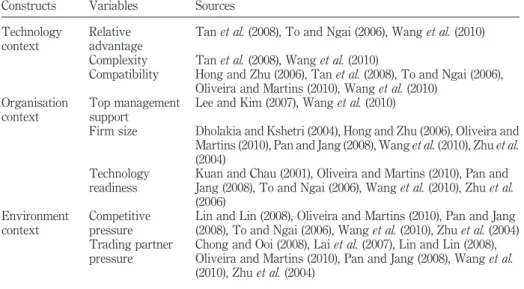
We received responses from 128 firms, including 17 responses that were rejected because they contained errors or missing data. There were a total of 111 usable responses, yielding an overall response rate of 22.22 per cent. The principal construct measures were based on existing instruments. Items were modified to fit the cloud computing context. Table II shows the sources from which the items were adapted. Consequently, non-response is a potential source of bias in survey studies that needs to be properly addressed (Fowler, 1993). The tests for early and late respondents’ homogeneity considered the firm’s number of employees and the annual sales of firm. No significant differences were detected between the early and late respondent groups, suggesting that there was not a significant response bias.
4.2 Scale reliability and factor analysis
The constructs testing for reliability were achieved by calculating the Cronbach’s alpha. All the constructs were found to have an adequate alpha value (.0.7) (Hairet al., 1998). A total of 34 items were developed to capture the eight factors under investigation.
Characteristic Sample composition
Company age (years)
Less than 5 16 (14.4) 5-10 33 (29.7) 10-20 34 (30.6) 20-30 12 (10.8) Over 30 16 (14.4) Number of employees Less than 1,000 63 (56.8) 1,000-2,000 15 (13.5) More than 2,000 33 (29.7) Capital (NT$ million) Less than 1,000 21 (18.9) 1,000-5,000 31 (27.9) More than 5,000 59 (53.2)
Annual sales (NT$ million)
Less than 10,000 46 (41.4)
10,000-30,000 26 (23.4)
More than 30,000 39 (35.1)
Note:The percentage values are given in parenthesis
Table I.
Sample characteristics
IMDS
111,7
Each item was measured using the five-point Likert scale. The factor analysis with principal-component factoring methods was conducted to evaluate the construct validity of the measures. In assessing fit between the items and their constructs, all of the primary factor loadings should have been greater than 0.5 and had no cross-loadings (Hairet al., 1998). Three items were eliminated because of cross-loadings. The factor analysis was run again, and eight factors were identified as explaining the phenomena under consideration in the current study (having eigenvalues greater than 1). The results explained 75.69 per cent of the independent variables, implying a satisfactory degree of construct validity. The Kaiser-Meyer-Olkin (KMO) measures the adequacy of the sample; in this analysis, the KMO was 0.853 (KMO$0.8 is excellent (Kaiser, 1974)), which reveals that the matrix of correlation was adequate for the factor analysis. The KMO for individual variables was also adequate. The eight factors are as follows: relative advantage (RA), complexity (CX), compatibility (CM), top management support (TS), firm size (FS), technology readiness (TR), competitive pressure (CP), and trading partner pressure (PA). The results of reliability analysis and factor analysis are shown in Table III.
4.3 Data analysis
The composite scores of the eight factors were calculated and the mean and standard deviation (SD) scores are shown in Table IV. To test the research model, the logistic regression technique was run with all eight independent variables because it is sensitive to multicollinearity.
Multicollinearity for the regression technique was assessed in the following two ways:
(1) the variance inflation factor (VIF) was calculated, and it ranged from a low of 1.04 to a high of 3.01 in which the values were below the threshold of 10; and (2) all condition indices (C.I.) above the 30 threshold were identified.
Constructs Variables Sources Technology
context
Relative advantage
Tanet al.(2008), To and Ngai (2006), Wanget al.(2010)
Complexity Tanet al.(2008), Wanget al.(2010)
Compatibility Hong and Zhu (2006), Tanet al.(2008), To and Ngai (2006), Oliveira and Martins (2010), Wanget al.(2010)
Organisation context
Top management support
Lee and Kim (2007), Wanget al.(2010)
Firm size Dholakia and Kshetri (2004), Hong and Zhu (2006), Oliveira and Martins (2010), Pan and Jang (2008), Wanget al.(2010), Zhuet al.
(2004) Technology
readiness
Kuan and Chau (2001), Oliveira and Martins (2010), Pan and Jang (2008), To and Ngai (2006), Wanget al.(2010), Zhuet al.
(2006) Environment
context
Competitive pressure
Lin and Lin (2008), Oliveira and Martins (2010), Pan and Jang (2008), To and Ngai (2006), Wanget al.(2010), Zhuet al.(2004) Trading partner
pressure
Chong and Ooi (2008), Laiet al.(2007), Lin and Lin (2008), Oliveira and Martins (2010), Pan and Jang (2008), Wanget al.
(2010), Zhuet al.(2004)
Table II.
Constructs and their resources
Determinants of
cloud computing
adoption
RA CX CM TS FS TR CP PA RA1 0.645 RA2 0.769 RA3 0.740 RA4 0.651 RA5 0.706 RA6 0.540 CX1 0.830 CX2 0.881 CX3 0.866 CM1 0.583 CM2 0.513 CM3 0.512 CM4 0.775 CM5 0.800 CM6 0.829 CM7 0.834 CM8 0.630 TS1 0.795 TS2 0.775 TS3 0.729 TS4 0.679 FS1 0.706 FS2 0.693 FS3 0.686 FS4 0.727 TR1 0.510 TR2 0.718 CP1 0.841 CP2 0.842 PA1 0.875 PA2 0.876 Eigenvalue 2.700 2.143 11.862 2.167 1.752 1.009 1.180 1.408 Variance 11.725 21.146 38.942 50.427 59.175 63.036 69.232 75.693 acoefficient 0.847 0.897 0.924 0.915 0.843 0.734 0.707 0.879 Table III. Factor analysis Mean (SD) Diagnosing multicollinearity Independent variables All Adopter Non-adopter VIF C.I.
RA 3.63 (0.60) 3.91 (0.52) 3.58 (0.61) 1.68 1.01 CX 3.48 (0.82) 3.72 (0.70) 3.43 (0.83) 1.35 6.79 CM 3.26 (0.87) 3.35 (1.03) 3.24 (0.84) 2.63 8.74 TS 3.19 (0.81) 3.18 (0.99) 3.16 (0.78) 2.2 14.06 FS 3.17 (0.80) 3.17 (0.91) 3.17 (0.78) 1.92 15.85 TR 3.29 (0.75) 3.46 (0.89) 3.26 (0.72) 3.01 18.58 CP 2.38 (0.94) 1.94 (0.91) 2.46 (0.93) 1.04 22.17 PA 2.86 (0.94) 2.36 (0.98) 2.96 (0.91) 1.32 26.8 Table IV.
Means and diagnosing multicollinearity of all independent variables
IMDS
111,7
Therefore, as also shown in Table IV, the results strongly indicated that there was no serious problem of multicollinearity among the independent variables (Hairet al., 1998). The result of the logistic regression in this study is shown in Table V. The calculated likelihood ratio (LR¼98.4) implies a strong relationship between the dependent and the independent variables for each regression. The Hosmer and Lemeshow goodness-of-fit test (x2¼3.78, p¼0.876) revealed that there are no differences between the fitted values of the model and the actual values. Thep-value here indicated that the research model was not significantly different from a perfect one that can correctly classify all respondents into their respective groups (Hosmer and Lemeshow, 1980). The NagelkerkeR2showed that about 37 per cent of the data variation was explained by the logistic model.
The significance of the regression coefficients of the hypothesised predictors was examined using the Wald statistics. As shown in Table V, the coefficients of relative advantage (p,0.05), top management support (p,0.05), firm size (p,0.05), competitive pressure (p,0.05), and trading partner power (p,0.01) were significant at the 0.05 level. Thus, supporting evidence was found for H1, H4-H7. All other variables were not significant. However, the sign of the regression coefficient (b) represents the positive or negative effect on the adoption of cloud computing. Therefore, we may state that:
. top management support, firm size, competitive pressure, and trading partner
pressure were positively related to organisational likelihood to adopt cloud computing; and
. relative advantage was negatively related to organisational adoption of cloud
computing.
With respect to overall discriminating power, the results shown in Table V also indicate a prediction accuracy of 86.5 per cent based on the logistic regression model. As there are 18 adopters and 93 non-adopters in this study, computing adoption by random choice would result in (18/111)2þ(93/111)2¼72.83 per cent, which was less
Predictor bcoefficient SE Wald statistics Sig.
Relative advantage 21.408* 0.693 4.124 0.042
Complexity 20.185 0.439 0.177 0.674 Compatibility 0.200 0.517 0.149 0.699 Top management support 1.270* 0.643 3.902 0.048
Firm size 1.370* 0.634 4.679 0.031
Technology readiness 21.099 0.716 2.353 0.125 Competitive pressure 0.842* 0.378 4.971 0.026
Trading partner power 1.834* * 0.599 9.380 0.002
Constant 24.333 3.307 1.717 0.190
Observed total Non-adopter firms Adopter firms Correct (percent)
Non-adopter firms 93 90 3 96.8
Adopter firms 18 12 6 33.3
Overall 86.5
Notes: *p,0.05; * *p,0.01; * * *p,0.001; 22 log likelihood: x2¼71.39 (df¼8), p,0.001;
goodness of fit:x2¼3.78 (df¼8),p¼0.876
Table V.
Results of the logistic regression analysis
Determinants of
cloud computing
adoption
than in the case of our regressions. Thus, we concluded that the logistic regression has a higher discriminating power than the random choice model.
4.4 Discussion
The nature of the cloud computing technology that we studied was more closely related to core business processes. Therefore, cloud computing adoption enables the firm to perform critical tasks along value chain activities. The goal of this study was to extend our understanding of cloud computing adoption in the high-tech industry in Taiwan by identifying factors that distinguish adopters from non-adopters. We found that there are five drivers for cloud computing adoption. They are: relative advantage, top management support, firm size, competitive pressure, and trading partner power.
4.4.1 Technological context. As Wang et al. (2010) noted, expected benefits can provide motivation for innovation technology adoption and expansion because employee appreciation of the relative advantages of the new system to raise work efficiency. The relative advantage of cloud computing services implementation could improve speed of business communications, efficiency of coordination among firms, customer communications, and access to market information mobilisation (Armbrust et al., 2010). Relative advantage was observed to have a significantly negative influence on cloud computing adoption in the high-tech industry. This finding is inconsistent with previous studies (Tanet al., 2008; To and Ngai, 2006; Wanget al., 2010). This finding implies that firms realise the relative advantage of applying cloud computing with IS applications, but that they may have a lower level of cloud computing know-how. One possible reason is cloud computing is a new technology that has complex charging mechanisms, and the firms may consider trading off the relative advantage and charging service costs. In addition to the cost of implementing such IT systems, the cost of the systems themselves can be comparatively high and often represent a major barrier to their adoption (Teo et al., 2009). Thus, relative advantage has a significantly negative effect.
Unexpectedly, complexity and compatibility were not found to be the significant discriminators. This finding is inconsistent with previous studies (Oliveira and Martins, 2010; Wanget al., 2010). Nevertheless, this inconsistency does not mean that the firms think cloud computing adoptions do not have technological complexity and compatibility. As shown in Table IV, the average of cloud computing adopters and non-adopters are both above 3.0 (natural assessment), but are slightly different. One possible explanation for this being insignificant is that the immaturity of cloud computing technology and unclear charging mechanism. If firms’ previous experiences with IS are compatible and match existing information infrastructure, then the changes introduced by cloud computing services will be consistent with existing practices. This correlation implies that the complexity and compatibility of cloud computing implementation can be part of a barrier to cloud computing adoption.
4.4.2 Organisational context. Prior research (Cho, 2006; Dholakia and Kshetri, 2004) has indicated that the characteristics of a firm should play an important role in the decision-making process. In this study, top management support and firm size were significant discriminators between cloud computing adopters and non-adopters. Furthermore, based on the positive effect in the logistic regression, it is clear that the adoption of new technology requires top management support and an adequate capability in technology integration (Cho, 2006). Larger firms have a higher probability
IMDS
111,7
of adopting cloud computing because they have more resources and may be better able to take on risk (Hayes, 2008).
Unexpectedly, technological readiness did not significantly impact cloud computing adoption. This finding is inconsistent with previous studies (Oliveira and Martins, 2010; Zhuet al., 2006). This result may stem from the fact that the firms were current cloud computing adopters, and thus, there is likely to be less variance in the current business processes. It also implies that organisational competence may help to leverage existing IS applications and data resources across key processes along the value chain when the firm embeds the cloud computing service. However, firms with sophisticated technological resources (hardware, software, and expertise) may not influence initial cloud computing adoption but the extent of implementation instead. That is, firms adopting cloud computing may have already made requisite organisational changes, reducing the influence of organisational technological competency in distinguishing different levels of cloud computing diffusion.
4.4.3 Environmental context. In the environmental context, competitive pressure and trading partner power were statistically significant for cloud computing adoption in the high-tech industry. This finding is inconsistent with previous studies (Lin and Lin, 2008). It implies firms are aware of respond more quickly in the competitive environment. Furthermore, trading partner power also has a positive effect on IT adoption decisions; this power can be either convincing or compulsory. This result is consistent with prior studies from Chong and Ooi (2008) and Oliveira and Martins (2010) and implies that, when firms face strong competition, they tend to implement changes more aggressively. Examples of firms that have administered compulsory power include Wal-Mart, which requires its partners to either adopt radio frequency identification or lose their business (Chong and Ooi, 2008). Firms adopt cloud computing depending on whether they have been influenced by convincing power, such as financial incentives for their trading partner, or through compulsory power, whereby the firm that has more bargaining power has requested that the firm with less bargaining power adopt cloud computing.
Finally, the results are consistent with those of Lin and Lin (2008), who observed that the internal integration and external diffusion of IS technologies create capabilities that enhance a firm’s ability to diffuse e-business. Thus, firms with a stronger TOE conceptual model of cloud computing are in a better position to facilitate easier diffusion of cloud computing services. However, by promoting cloud computing usage in a wider scope of value chain activities, the main implication of this finding is that increasing user awareness of the benefits of cloud computing positively affects the efficient use and diffusion of cloud computing.
5. Conclusion
To promote cloud computing adoption, it is necessary to clarify the factors that explain this adoption, and make a perspicacious analysis to understand if different industries have the same drivers for cloud computing adoption. Along with the potential benefits of cloud computing, through, come possible pitfalls that interrupt usefulness. One concern is the contemplation of failure downtime, which will vary by provider, and can happen as server maintenance is executed or as unforeseen outages occur. Another concern is the complexity and compatibility of cloud computing implementation can be a barrier to cloud computing adoption. While cloud computing has been regarded
Determinants of
cloud computing
adoption
as an important technology that can provide strategic and operational advantages, significant rates of implementation in the high-tech industry are yet to be seen. Hence, it is necessary to understand the impact of cloud computing adoption in the high-tech industry. Firms that would like to adopt cloud computing can start with gradual implantation, slowly increasing the number of processes by developing more internet infrastructure or portable electronic equipment. Firms can begin by implementing cloud computing services into business processes, such as ERP and CRM. These processes are of high value to the firms, and the benefits of adopting SaaS with their trading partners helps them to compete with their bigger rivals. The contributions of this study are fourfold.
First, this study presents several key findings and implications about the determinants of cloud computing adoption in the high-tech industry. These key findings are as follows:
. Whether a firm implements cloud computing in the high-tech industry depends
on the firm’s technological, organisational, and environmental contexts.
. Five variables (i.e. relative advantage, firm size, top management support,
competitive pressure, and trading partner pressure) were found to be significant determinants of cloud computing adoption, and three variables (i.e. complexity, compatibility, and technology readiness) were found to be insignificant determinants of cloud computing adoption.
. Among the determinants, trading partner pressure was observed to be the most
influential factor affecting a firm’s cloud computing adoption.
. Relative advantage was the barrier to cloud computing adoption.
One possible reason for this barrier was that the charging mechanisms of cloud computing services were not found to be friendly towards the firms’ adoption of the technology. In addition, to the best of our knowledge, this study is one of the first that examines adoption of cloud computing using an innovation diffusion model. Based on the TOE theoretical framework (Tornatzky and Fleischer, 1990), this study developed and validated a research model to examine the influence of eight contextual factors on cloud computing adoption in the high-tech industry.
As in most empirical studies, our work is limited in some ways. First, the TOE framework may not explicitly point out that what are the major constructs in the model and the variables in each context. To solve this limitation, future research should consider that for more complex new technology adoption it is leading to combine more than one theoretical model to express a better understanding of the IT adoption phenomenon. Second, this work uses the logistic regression technique to explain the predictors that define between adopters and non-adopters. The method only focuses on the single relationship between the independent and dependent variables (Hair et al., 1998). Therefore, the interrelationship among the independent variables, no use of control variables, and moderators were not analyzed in this study. Future studies can simultaneously examine a series of variable influences and relationships. Finally, our work investigates only high-tech industry, others studies with new samples of specific industry, such as manufacturing or service, should be congregate to further study the applicability of TOE framework.
IMDS
111,7
References
Armbrust, M., Fox, A., Griffith, R., Joseph, A.D., Katz, R., Konwinski, A., Lee, G., Patterson, D., Rabkin, A., Stoica, I. and Zaharia, M. (2010), “A view of cloud computing”,
Communications of the ACM, Vol. 53, pp. 50-8.
Banerjee, P. (2009), “An intelligent IT infrastructure for the future”, Proceedings of 15th International Symposium on High-performance Computer Architecture, HPCA, Raleigh, NC, USA.
Buyya, R., Yeo, C.S., Venugopa, S., Broberg, J. and Brandic, I. (2009), “Cloud computing and emerging it platforms: vision, hype, and reality for delivering computing as the 5th utility”,Future Generation Computer Systems, Vol. 25, pp. 599-616.
Chau, P.Y.K. and Tam, K.Y. (1997), “Factors affecting the adoption of open systems: an exploratory study”,MIS Quarterly, Vol. 21, pp. 1-24.
Cho, V. (2006), “Factors in the adoption of third-party B2B portals in the textile industry”,Journal of Computer Information Systems, Vol. 46, pp. 18-31.
Chong, A.Y.L. and Ooi, K.B. (2008), “Adoption of interorganizational system standards in supply chains: an empirical analysis of RosettaNet standards”,Industrial Management & Data Systems, Vol. 198, pp. 529-47.
Cooper, R.B. and Zmud, R.W. (1990), “Information technology implementation research: a technological diffusion approach”,Management Science, Vol. 36, pp. 123-39.
Dholakia, R.R. and Kshetri, N. (2004), “Factors impacting the adoption of the internet among SMEs”,Small Business Economics, Vol. 23, pp. 311-22.
Erdogmus, H. (2009), “Cloud computing: does Nirvana hide behind the nebula?”,IEEE Software, Vol. 26, pp. 4-6.
Fowler, F.J. (1993),Survey Research Methods, 2nd ed., Sage, Thousand Oaks, CA.
Gartner (2009), “Cloud computing inquiries at Gartner”, available at: http://blogs.gartner.com/ thomas_bittman/2009/10/29/cloud-computing-inquiries-at-gartner (accessed 16 September 2010).
Goscinski, A. and Brock, M. (2010), “Toward dynamic and attribute based publication, discovery and selection for cloud computing”, Future Generation Computer Systems, Vol. 26, pp. 947-70.
Grossman, R.L., Gu, Y.H., Sabala, M. and Zhang, W.Z. (2009), “Compute and storage clouds using wide area high performance networks”,Future Generation Computer Systems, Vol. 25, pp. 179-83.
Hair, J.F., Anderson, R.E., Tatham, R.L. and Black, W.C. (1998),Multivariate Data Analysis, Prentice-Hall, Upper Saddle River, NJ.
Hamilton, D. (2008), “Cloud computing seen as next wave for technology investors”, available at: http://bx.businessweek.com/facebook/cloud-computing-seen-as-next-wave-for-technology-investors/2282630717759769/ (accessed 4 June 2008).
Hayes, B. (2008), “Cloud computing”,Communications of the ACM, Vol. 51, pp. 9-11.
Hong, W. and Zhu, K. (2006), “Migrating to internet-based e-commerce: factors affecting e-commerce adoption and migration at the firm level”, Information & Management, Vol. 43, pp. 204-21.
Hosmer, D.W. and Lemeshow, S. (1980), “A goodness-of-fit test for the multiple logistic regression model”,Communications in Statistics, No. 10, pp. 1043-69.
Kaiser, H.F. (1974), “An index of factorial simplicity”,Psychometrika, Vol. 38, pp. 31-6.
Determinants of
cloud computing
adoption
Kuan, K.K.Y. and Chau, P.Y.K. (2001), “A perception based model for EDI adoption in small business using a technology-organization-environment framework”, Information & Management, Vol. 38, pp. 507-12.
Lai, F., Wang, J., Hsieh, C.T. and Chen, J.C. (2007), “On network externalities, e-business adoption and information asymmetry”, Industrial Management & Data Systems, Vol. 107, pp. 728-46.
Lee, S. and Kim, K. (2007), “Factors affecting the implementation success of internet-based information systems”,Computers in Human Behavior, Vol. 23, pp. 1853-80.
Lin, H.F. and Lee, G.G. (2005), “Impact of organizational learning and knowledge management factors on e-business adoption”,Management Decision, Vol. 43, pp. 171-88.
Lin, H.F. and Lin, S.M. (2008), “Determinants of e-business diffusion: a test of the technology diffusion perspective”,Technovation, Vol. 28, pp. 135-45.
Misra, S.C. and Mondal, A. (2010), “Identification of a company’s suitability for the adoption of cloud computing and modelling its corresponding return on investment”,Mathematical and Computer Modelling, Vol. 53, pp. 504-21.
Oliveira, T. and Martins, M.F. (2010), “Understanding e-business adoption across industries in European countries”,Industrial Management & Data Systems, Vol. 110, pp. 1337-54. Pan, M.J. and Jang, W.Y. (2008), “Determinants of the adoption of enterprise resource planning
within the technology-organization-environment framework: Taiwan’s communications industry”,Journal of Computer Information Systems, Vol. 48, pp. 94-102.
Premkumar, G., Ramamurthy, K. and Sree, N. (1994), “Implementation of electronic data interchange: an innovation diffusion perspective”,Journal of Management Information Systems, Vol. 11, pp. 157-86.
Pyke, J. (2009), “Now is the time to take the cloud seriously”, White Paper, available at: www. cordys.com/cordyscms_sites/objects/bb1a0bd7f47b1c91ddf36ba7db88241d/time_to_ take_the_cloud_seroiusly_online_1_.pdf (accessed 9 November 2010).
Rogers, E.M. (1983),Diffusion of Innovation, The Free Press, New York, NY.
Sclater, N. (2009), “Cloudworks: eLearning in the cloud”, available at: http://cloudworks.ac.uk/ cloud/view/2430/ (accessed 7 October 2009).
Shirish, C.S. and Teo, T.S.H. (2010), “E-government, e-business, and national economic performance”, Communications of the Association for Information Systems, Vol. 26, pp. 267-86.
Sultan, N. (2010), “Cloud computing for education: a new dawn?”, International Journal of Information Management, Vol. 30, pp. 109-16.
Swanson, E.B. (1995), “Information systems management among organizations”,Management Science, Vol. 40, pp. 1069-92.
Tan, S.K., Chong, S.C., Lin, B. and Eze, U.C. (2008), “Internet-based ICT adoption: evidence from Malaysian SMEs”,Industrial Management & Data Systems, Vol. 109, pp. 224-44. Teo, T.S.H., Srivastava, S.C. and Jiang, L. (2009), “Trust and electronic government success:
an empirical study”,Journal of Management Information Systems, Vol. 25, pp. 103-37. To, M.L. and Ngai, E.W.T. (2006), “Predicting the organizational adoption of B2C e-commerce:
an empirical study”,Industrial Management & Data Systems, Vol. 106, pp. 1133-47. Tornatzky, L.G. and Fleischer, M. (1990),The Processes of Technological Innovation, Lexington
Books, Lexington, MA.
Tuncay, E. (2010), “Effective use of cloud computing in educational institutions”,Proscenia Social and Behavioral Sciences, Vol. 2, pp. 938-42.
IMDS
111,7
Wang, Y.M., Wang, Y.S. and Yang, Y.F. (2010), “Understanding the determinants of RFID adoption in the manufacturing industry”,Technological Forecasting & Social Change, Vol. 77, pp. 803-15.
Zhu, K., Dong, S., Xu, S.X. and Kraemer, K.L. (2006), “Innovation diffusion in global contexts: determinants of post-adoption digital transformation of European companies”,European Journal of Information Systems, Vol. 15, pp. 601-16.
Zhu, K., Kraemer, K.L., Xu, S. and Dedrick, J. (2004), “Information technology payoff in e-business environments: an international perspective on value creation of e-business in the financial services industry”,Journal of Management Information Systems, Vol. 21, pp. 17-54.
About the authors
Chinyao Low is a Professor in the Department of Industrial Engineering and Management at National Yunlin University of Science and Technology, Taiwan. He received his PhD in Industrial Engineering from Cleveland University, USA in 1993. His research interests are mainly in scheduling theory, quality engineering, and some related fields.
Yahsueh Chen has over four years work experience in manufacturing industry. She is a PhD student in the Department of Industrial Engineering and Management. Her current research interests are in the areas of statistical computing, system dynamics decision analysis, supply chain management and quality engineering. Yahsueh Chen is the corresponding author and can be contacted at: [email protected]
Mingchang Wu is a Professor in the Graduate School of Technological & Vocational Education at National Yunlin University of Science and Technology, Taiwan. He received his PhD in Vocational and Science Education from Purde University in 1995. His research interests are mainly in cooperation research collaboration relationship and communication and some related fields.
Determinants of
cloud computing
adoption
1023
To purchase reprints of this article please e-mail:[email protected]