A
N
A
NALYSIS OF
F
USING
A
DVANCED
M
ALWARE
E
P
ROTECTION
LOGS,
M
ALWARE
I
NTELLIGENCE AND
A
CTIVE
D
IRECTORY
A
TTRIBUTES AS AN
I
NSTRUMENT
FOR
T
HREAT
I
NTELLIGENCE
Submitted in partial fulfilment
of the requirements of the degree of
M
ASTER OFS
CIENCEof Rhodes University
Japie Vermeulen
Grahamstown, South Africa
Abstract
After more than four decades email is still the most widely used electronic commu-nication medium today. This electronic commucommu-nication medium has evolved into an electronic weapon of choice for cyber criminals ranging from the novice to the elite. As cyber criminals evolve with tools, tactics and procedures, so too are technology vendors coming forward with a variety of advanced malware protection systems. However, even if an organization adopts such a system, there is still the daily chal-lenge of interpreting the log data and understanding the type of malicious email attack, including who the target was and what the payload was.
This research examines a six month data set obtained from an advanced malware email protection system from a bank in South Africa. Extensive data fusion tech-niques are used to provide deeper insight into the data by blending these with malware intelligence and business context. The primary data set is fused with malware intelligence to identify the different malware families associated with the samples. Active Directory attributes such as the business cluster, department and job title of users targeted by malware are also fused into the combined data.
This study provides insight into malware attacks experienced in the South African financial services sector. For example, most of the malware samples identified be-longed to different types of ransomware families distributed by known botnets. However, indicators of targeted attacks were observed based on particular employ-ees targeted with exploit code and specific strains of malware. Furthermore, a short time span between newly discovered vulnerabilities and the use of mali-cious code to exploit such vulnerabilities through email were observed in this study. The fused data set provided the context to answer the “who”, “what”, “where” and “when”. The proposed methodology can be applied to any organization to provide insight into the malware threats identified by advanced malware email protection systems. In addition, the fused data set provides threat intelligence that could be used to strengthen the cyber defences of an organization against cyber threats.
Acknowledgements
First and foremost, I would like to thank my amazing family for their love, support and understanding of the family time sacrificed during the past two years to com-plete my studies. I would also like to thank Prof. Karen Bradshaw my supervisor for all the proof reading, guidance and correcting my mistakes. I also would like to extend a sincere thanks to Prof. Barry Irwin for the first year of guidance and support. Finally, I would like to thank my employer for granting me the time off, often in very short notice to work on my thesis and all the assignments.
ACM Computing Classification System Classification
Thesis classification under the ACM Computing Classification System1 (2012
ver-sion valid through 2017):
•Security and privacy~Malware and its mitigation
•Mathematics of computing~Exploratory data analysis
Contents
1 Introduction 1
1.1 Context of Research . . . 1
1.2 Motivation for this Research . . . 2
1.3 Research Questions . . . 2
1.4 Research Objectives . . . 3
1.5 Expected Contributions of the Research . . . 3
1.6 Approach . . . 4
1.7 Limitations of the Research . . . 5
1.8 Thesis Structure . . . 5
2 Background Concepts and Related Work 7 2.1 Malware . . . 7 2.1.1 Identification of malware . . . 8 2.1.2 Malware categories . . . 8 2.1.3 Malware families . . . 9 2.1.4 Malware attribution . . . 10 2.2 Phishing . . . 11 i
CONTENTS ii
2.2.1 Impact of targeted phishing . . . 12
2.2.2 Impact of malicious spam . . . 13
2.3 Defence against Phishing . . . 16
2.3.1 Advanced malware protection systems . . . 16
2.3.2 Phishing awareness . . . 17
2.4 Log Data Analysis . . . 17
2.4.1 Fused log data as a source of intelligent data . . . 18
2.4.2 Fused log data as a source of threat intelligence . . . 19
2.5 Active Directory . . . 20
2.5.1 Overview of Active Directory . . . 20
2.5.2 Active Directory in a security context . . . 20
2.6 Threat Intelligence . . . 21
2.6.1 Use of threat intelligence . . . 21
2.6.2 Threat intelligence cycle . . . 22
2.6.3 Sub areas of threat intelligence . . . 24
2.7 Related Research . . . 25 2.8 Summary . . . 26 3 Experimental Methodology 28 3.1 Experimental Approach . . . 29 3.2 Experimental Setup . . . 29 3.3 Data Collection . . . 30
CONTENTS iii
3.3.2 Data set 2 – Malware intelligence . . . 31
3.3.3 Data set 3 – Active Directory business context . . . 32
3.4 Data Pre-processing . . . 33
3.4.1 Data set quality validation . . . 33
3.4.2 Data set cleaning – Data set 2 – Malware intelligence . . . 34
3.4.3 Data set cleaning – Data set 3 – Active Directory business context . . . 34
3.4.4 Data anonymization . . . 35
3.5 Data Fusion . . . 36
3.6 Hardware and Software Configuration . . . 38
3.7 Summary . . . 38
4 Results of Individual Data Set Analyses 39 4.1 Analysis of data set 1 – AMEPS log data . . . 40
4.1.1 Monthly malicious email analysis . . . 40
4.1.2 Situational awareness . . . 42
4.1.3 Subject line key word analysis . . . 45
4.1.4 Summary of information from data set 1 . . . 47
4.2 Analysis of data set 2 – Malware intelligence . . . 47
4.2.1 Top 10 malware families identified . . . 48
4.2.2 Remainder of the malware families . . . 49
4.2.3 Summary of information from data set 2 . . . 54
4.3 Analysis of data set 3 – Active Directory . . . 54
CONTENTS iv
4.3.2 Top 10 targeted departments in the bank . . . 56
4.3.3 Top 20 targeted job titles . . . 57
4.3.4 Summary of information from data set 3 . . . 58
4.4 Summary . . . 58
5 Results of Fused Data Set Analysis 59 5.1 Threat scenario 1 . . . 60 5.2 Threat scenario 2 . . . 61 5.3 Threat scenario 3 . . . 62 5.4 Threat scenario 4 . . . 64 5.5 Threat scenario 5 . . . 65 5.6 Threat scenario 6 . . . 66 5.7 Threat scenario 7 . . . 67 5.8 Summary . . . 68
6 Relevance of Information from the Fused Data Set 69 6.1 Limitations of each data set . . . 69
6.1.1 Limitations of data set 1 . . . 70
6.1.2 Limitations of data set 2 . . . 70
6.1.3 Limitations of data set 3 . . . 71
6.2 Fused data set . . . 71
6.3 Relevance of the fused data set information . . . 72
6.3.1 Technical threat intelligence . . . 72
6.3.2 Tactical threat intelligence . . . 72
6.3.3 Operational threat intelligence . . . 72
6.3.4 Strategic threat intelligence . . . 73
CONTENTS v
7 Conclusion and Future Work 75
7.1 Summary of Research . . . 75 7.2 Contributions of Research . . . 76 7.3 Future Research and Recommendations . . . 77
References
79
List of Figures
3.1 Overview of experimental approach . . . 29
3.2 Data set 2 inner join operation . . . 37
3.3 Data set 3 inner join operation . . . 37
3.4 Fused data set . . . 37
4.1 Monthly malware volume trend . . . 40
4.2 Daily malware volume Dec 2016 - Feb 2017 . . . 41
4.3 Daily malware volume Mar 2017 - May 2017 . . . 42
4.4 Most targeted days of the week . . . 43
4.5 Time of day . . . 44
4.6 Top 10 geographic malicious email sources . . . 45
4.7 Top 20 subject lines . . . 46
4.8 Distribution of the top 20 monthly subject lines . . . 47
4.9 Top 10 malware families identified . . . 48
4.10 Remainder of the malware families identified . . . 50
4.11 Business clusters targeted by malware . . . 55
4.12 Top 20 job titles targeted in retail . . . 56
LIST OF FIGURES vii
4.13 Top 10 targeted departments in the bank . . . 57
4.14 Executive leadership positions targeted . . . 57
4.15 Top 20 targeted job titles . . . 58
5.1 Business clusters targeted with malware originating from within South Africa . . . 61
5.2 Subject line analysis of Lockyransomware from the top 5 countries . 62 5.3 Distribution analysis of exploit code “CVE-2017-0199” . . . 63
5.4 Distribution analysis of exploit code “CVE-2014-1761 – Luminos-ityLink” . . . 64
5.5 Distribution analysis of exploit code “RTF OLE Exploit –NanoCoreRat” 65 5.6 Malware distribution analysis of C-level targets in the bank . . . 66
5.7 Malware distribution analysis of the most targeted job title . . . 67
6.1 Information available from data set 2 . . . 71
6.2 Information available from data set 3 . . . 71
List of Tables
2.1 The different malware categories . . . 9
3.1 AMEPS CSV fields . . . 31
3.2 Malicious emails detected by month . . . 31
3.3 Malware intelligence fields . . . 32
3.4 Active Directory business context fields . . . 33
3.5 Data set 3 cleaning tasks . . . 35
3.6 Data anonymization tasks . . . 36
3.7 Research data set information . . . 36
3.8 Data processing hardware . . . 38
6.1 Information available from data set 1 . . . 70
A.1 Appendix SHA256 filename checksums . . . 91
List of Code Listings
1 Query used to obtain email log data from the AMEPS data set . . . . 31 2 AutoLenz syntax used to extract malware attribute . . . 32 3 SQL query used to extract AD business context data . . . 33
Chapter 1
Introduction
“An amazing thing, the human brain. Capable of understanding incredibly complex and intricate concepts. Yet at times unable to recognize the obvious and simple.” – Jay Abraham
1.1
Context of Research
Employees with an inadequate understanding of the dangers associated with the Internet, pose a significant information security risk to the organizations they are employed in. Furthermore, with email being the most widely used medium for malware distribution, organizations face a constant threat of unsuspecting employees opening malicious emails (Dhamija & Hearst, 2006). To mitigate this risk, an organization can deploy an Advanced Malware Protection (AMP) solution to prevent malicious emails from entering the organization’s network as part of a layered defense architecture (Cisco, 2015).
However, for an organization to be aware of any malicious email campaigns targeting them, correlation and analysis of the required logs generated by such a solution are required (Lumeta, 2015). Furthermore, by fusing additional contextual data log sources together, an organization can derive intelligent information from the combined output of different data log sources (Informatica, 2013). For example, the use of Active Directory (AD) data in conjunction with the AMP log data can provide more context such as the business unit in which a user
1.2. MOTIVATION FOR THIS RESEARCH 2 resides or the job role of a particular user (Microsoft, 2016). Therefore, the use of security analytics (Informatica, 2013) together with Business Intelligence (BI) methods for the analysis of such fused logs, can help identify hidden patterns of malicious activity never seen before in an organization (Hoppeet al., 2009) as well as aid in the decision making progress within an organization (Chen & Storey, 2012).
Such data analysis techniques can also be applied to real-time monitoring as part of continuous cyber situational awareness monitoring (Lumeta, 2015). Should any information security risks be uncovered based on previously unseen malicious activity patterns being identified by such analysis methods, an organization could respond in a timely manner to address any risk identified (Hoppeet al., 2009).
1.2
Motivation for this Research
While in full-time employment at a South African financial institution, the researcher often overheard questions regarding the benefits of an AMP solution such as:
• “What exactly does our expensive advanced malware email protection solution protect us against?”
• “Who is being targeted in our organization?”
This research set out to gain insight into malware driven email attacks on the financial industry in South Africa as part of the “Knowledge Discovery of Digital Data” (KDD) to identify the level of threat intelligence that can be obtained from the data. Knowledge discovery is the process of uncovering intelligent information that is of value and usable to an organization (Fayyadet al., 1996). In addition, we hypothesize that fusing data from a variety of sources can provide more meaningful knowledge discovery.
1.3
Research Questions
In the process of proving our hypothesis, the following research questions were posed:
1.4. RESEARCH OBJECTIVES 3 • To what extent can the fusion of AMP logs, malware intelligence and AD user
attributes be used as an instrument for threat intelligence?
• To what extent can the fusion of AMP logs, malware intelligence and AD user attributes be used in a cyber security awareness program?
• What type of threat intelligence can be derived by the fusion of AMP logs with AD user attributes in an organization?
• Can the information derived from the above research questions be factored into a cyber security dashboard for executive management?
1.4
Research Objectives
The primary objective of this research project is to create a fused log system that can be used to provide actionable threat intelligence to an organization. To achieve this primary objective, the following secondary objectives are defined:
1. Analyse a variety of types of individual log data to ascertain what information is available from each.
2. Utilize a suite of tools that can be used to combine various types of log data into a fused data set.
3. Analyse the fused log data to ascertain the kind of information available. 4. Determine the usefulness of the information obtained for threat intelligence.
1.5
Expected Contributions of the Research
In Ponemon’s research report “Big data analytics in Cyber Defense” (Ponemon Institute LLC, 2013) the researchers found that the analysis of large data sets obtained from security technologies provided organizations deeper insight to combat cyber threats. In addition, eighty-two percent of the respondents wanted the analysis of large security data sets combined with malware data. Teymourlouei & Jackson (2017) found that the analyses of large security data sets provided a quick solution to identify anomalies and advanced attack vectors. Hutchins
1.6. APPROACH 4
et al. (2011) emphasized the importance of advanced malware data analysis as an instrument for intelligent network defense.
However, Fanet al.(2014) discussed some of the challenges posed in the processing and analysis of large data sets. For example, large data sets require significantly more computational processing power than normal data sets. In addition, large data sets tend to have a higher noise factor to work through before deriving intelligent data that is of value to the business.
This research provides a methodology that could be applied in organizations as required to derive threat intelligence from internal log data sources. Chismon & Ruks (2015) discussed the importance of determining the data requirements that would produce an intelligent data set that could be used as a source of threat intelligence.
1.6
Approach
A script was required to extract the required data from the different data log sources and write the output to file. The extracted data was fused with malware intelligence and AD attributes, thereby adding two layers of context to the data for further analysis and finally BI analysis methods were applied to the fused data to perform a knowledge discovery on the fused data set. Our approach consisted of six steps as set out below.
1. Obtain primary data set from the bank based on time frame provided.
2. Create scripts to extract the required malware intelligence and business context.
3. Check data consistency and clean data. 4. Anonomize data.
5. Fuse the primary data set by joining the extracted malware intelligence and business context data.
1.7. LIMITATIONS OF THE RESEARCH 5
1.7
Limitations of the Research
The researcher is aware of research studies that have been done on the effectiveness of advanced malware protection systems. However, a large portion of this research focuses on public and open-source based sandboxes. The data set used was obtained from a commercial sandbox that ranked as a leader in the Gartner1
quadrant.
A further limitation of the study, is that only email attacks utilizing malicious attachments identified by the advanced malware protection system were studied. Furthermore, the data utilized for this study were specific to one of the five largest banks in South Africa.
1.8
Thesis Structure
The remainder of the thesis is arranged as follows:
• Chapter 2 provides essential background information on malware, phishing, log analysis, data fusion, threat intelligence and related research.
• Chapter 3 describes the research methodology, the collection and processing of the data sets and the data fusion process.
• Chapter 4 presents the results of the individual data set analyses. A comparison of the results from a South African perspective and an international data set is also provided and discussed.
• Chapter 5 presents the results of the fused data set analysis. The results in this chapter are discussed in the context of seven threat scenarios.
• Chapter 6 discusses the usefulness of the fused data set results by first contextualizing the limitation of each individual data set. This is followed by a discussion of how the results of the fused data set feeds into the four sub areas of threat intelligence discussed in Chapter 2.
• Chapter 7 concludes the research and suggests possible future research. 1https://www.gartner.com
1.8. THESIS STRUCTURE 6 Appendix A provides additional information about this research project in the form of a link to a Github2repository containing the unique list of SHA256 cryptographic
identifiers obtained from the malware samples used in this research.
Chapter 2
Background Concepts and Related
Work
“Reading is equivalent to thinking with someone else’s head instead of with one’s own.” –Arthur Schopenhauer
In order to satisfy our research goal and the body of knowledge to which this research will contribute, some essential background knowledge is required. This chapter covers an overview of malware and phishing in particular, including defences against phishing. This is followed by a discussion on log data analysis and the fusion of a variety of log types. Different types of threat intelligence and the threat intelligence life cycle are presented next. Finally, related research is discussed.
2.1
Malware
“People’s computers are not getting more secure. They’re getting more infected with viruses. They’re getting more under the control of malware.” –Avi Rubin
Today malware is an umbrella term associated with almost any type of malicious software code used by cyber criminals (Rieck et al., 2008). Over the last 10 years, malware has evolved from the pestilent auto-run1 malware to 1
http://www.howtogeek.com/203522/how-autorun-malware-became-a-problem-on-windows-and-how-it-was-mostly-xed/
2.1. MALWARE 8 sophisticated malicious code used in attacks on nation states (Bencsáth et al., 2012). Furthermore, malware has been attributed to the destruction of data on tens of thousands of machines, as well as halting operations at multi-billion dollar corporations (Bronk & Tikk-Ringas, 2013). In the same way, cyber criminals have developed different strains of sophisticated financial malware targeting banks and retailers globally with reported losses netting millions in local currency (Kaspersky Lab, 2015a; Symantec, 2014).
The analysis of malware therefore, forms an important part of understanding the type of malicious code being dealt with and the potential impact to an organization (Solutionary, 2005). In the following sections we discuss the identification of malware and the different malware categories and malware families.
2.1.1
Identification of malware
The first step in the identification of malware is to assign a cryptographic label to the malware sample that can be used as a cryptographic identifier (Kendall & McMillan, 2007). Such a label can be used to obtain more information about the malware without wasting countless hours of searching. The cryptographic identifier can be used to check online repositories for any known information about the particular malware and can also be used as an integrity check point during the analysis of malware. For example, if the original software code of the malware were to change, the cryptographic identifier would change as well (Kendall & McMillan, 2007).
2.1.2
Malware categories
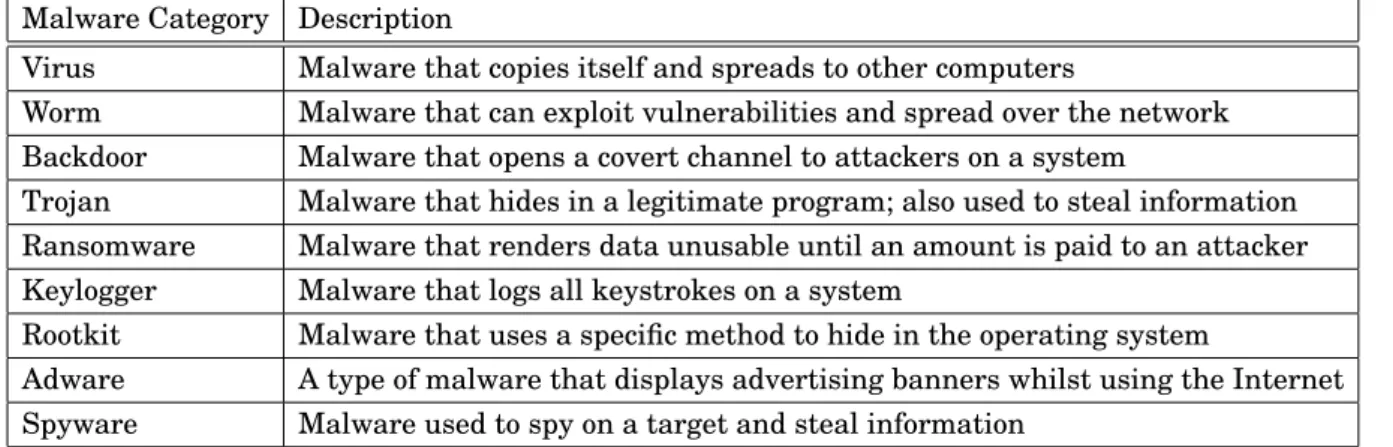
Often when malware is discovered in an organization, it is important to understand to which category the malware belongs (Solutionary, 2005). For example, a piece of malware could belong to the “Worm” category, thereby containing malicious code that could spread through the network exploiting network vulnerabilities (DuPaul, 2012). Malware could also contain “Backdoor” functionality that would allow an attacker remote access into a network through a covert channel (Hardikar, 2008). This type of malware could be used to deploy additional malware, maintain persistence or steal information from an organization (Hardikar, 2008).
2.1. MALWARE 9 Nevertheless, many different types of malware categories exist providing different functionality as shown in Table 2.1 (Hardikar, 2008; DuPaul, 2012).
Table 2.1: The different malware categories
Malware Category Description
Virus Malware that copies itself and spreads to other computers
Worm Malware that can exploit vulnerabilities and spread over the network Backdoor Malware that opens a covert channel to attackers on a system
Trojan Malware that hides in a legitimate program; also used to steal information Ransomware Malware that renders data unusable until an amount is paid to an attacker Keylogger Malware that logs all keystrokes on a system
Rootkit Malware that uses a specific method to hide in the operating system
Adware A type of malware that displays advertising banners whilst using the Internet Spyware Malware used to spy on a target and steal information
2.1.3
Malware families
Although the different malware categories offer a glimpse of the functionality provided by a particular piece of malware (Hardikar, 2008), the behavioural patterns and code similarities of malware can be used to attribute the code to a particular malware family (Riecket al., 2008). For example, malware can behave in a specific way to interact with a system in a particular programmatic order. Furthermore, malware could contain static code similarities. Therefore, dynamic and/or static analysis of malicious code is used in the classification of malware and its attribution to a particular malware family (Riecket al., 2008).
The identification of a particular malware family could sometimes be attributed to a particular malware distribution network or cyber criminals known to make use of a particular type of malware (Symantec, 2015, 2017; Bartholomew & Guerrero-Saade, 2016). In July 2010, Stuxnet Lee (2012), the first of a kind of malware that was designed to cause physical damage to critical infrastructure, was discovered by security researchers from Belarus. However, security researchers from Symantec traced Stuxnet back to November 2005 (McDonaldet al., 2013). The Stuxnet worm was specifically designed to alter the code on Programmable Logic Controllers found in Siemens Supervisory Control and Data Acquisition Systems. These systems are used to monitor and control critical infrastructure like power grids,
2.1. MALWARE 10 reservoirs and nuclear power stations. The majority of Stuxnet infections were discovered in Iran, targeting nuclear centrifuges (Karnouskos, 2011).
Shortly, after the discovery of Stuxnet, a new sophisticated piece of malware named Duqu was discovered by security researchers in Hungary (Bencsáth et al., 2012). This malware shared programmatic similarities to Stuxnet, but was designed for a different purpose, that is to capture passwords, documents and end user behaviour on a computer system and transmit these back to the adversary. Duqu was traced back to targets in Iran and Sudan. In both cases, security researchers discovered that these two pieces of malware used previously undiscovered vulnerabilities in the Microsoft Windows operating system to exploit targeted computer systems (Bencsáthet al., 2012).
That said, two years later a more advanced version of Duqu was discovered by the security firm Kaspersky Lab, named Duqu 2.0 (Kaspersky Lab, 2015b). However, this time the target was different, being the security firm Kaspersky itself. Kaspersky, a security service provider and malware research firm that discovered the Stuxnet worm, became the target of sophisticated malware sharing the same similarities in design as its predecessors. Kaspersky reported that Duqu 2.0 also utilized previously undiscovered vulnerabilities in the Microsoft operating system to exploit computer systems on its internal network (Kaspersky Lab, 2015b). With reference to this, in a recent news article,2 use of the Duqu 2.0
malware in the Kaspersky network breach was attributed to Israeli intelligence (Perlroth & Shane, 2017).
2.1.4
Malware attribution
Although malware can easily be attributed to a particular malware family and/or category, it is important to note that the attribution of malware to a particular criminal group and/or entity is a difficult task (Bartholomew & Guerrero-Saade, 2016). For example, malware authors could purposefully add programmatic elements to malicious software code that mimics code similarities of different cyber criminal groups, thereby implicating the wrong cyber criminal group in an attack (Bartholomew & Guerrero-Saade, 2016).
2.2. PHISHING 11
2.2
Phishing
“A Good Phishing Attack is Worth a Million Zero-Days” –Thomas Fischer
What started as a systematic plan by defiant juveniles to steal passwords by email, advanced into one of the top cyber threats affecting individuals, organizations and governments today (Rekouche, 2011). Email forms a vital part of business and personal day-to-day digital communication with billions of emails sent daily over the Internet. However, this vital digital communication platform also introduced an ever changing threat to businesses and social users. Owing to its ease of use and the lack of security awareness amongst its users, this digital communication platform is also leveraged by cyber criminals for malicious operations (Meidam, 2015).
Phishing is the process whereby a cyber criminal crafts a special email message to entice an individual to disclose sensitive information that would not normally be disclosed. For example, a cyber criminal could spoof an email from a bank to an individual to obtain personal bank account information (Elledge, 2004).
Over time phishing has evolved into different types of phishing attacks tailored to specific cyber criminal objectives. For example, targeted phishing is a more personalized phishing attack whereby cyber criminals target a specific user or department in an organization. In this case, cyber criminals prepare an email attachment containing malicious software to compromise their target (Meidam, 2015). High volumes of malware driven email, known as malicious spam, is another type of phishing attack seen almost daily in organizations. Often, the malicious software employed in these types of attacks can be used to capture sensitive user or corporate data (Symantec, 2016b). In addition, an attacker could also leverage such malicious software to establish a covert channel out of a corporate network, allowing cyber criminals direct internal access to corporate assets (Elledge, 2004).
In the following subsections we discuss the financial impact of malware used in targeted phishing and malicious spam attacks, defending against phishing and related research in this field.
2.2. PHISHING 12
2.2.1
Impact of targeted phishing
One could easily argue that one of the biggest threats to an organization is targeted phishing. Cyber criminal syndicates carefully select a target organization with a particular goal in mind (Villeneuve, 2011). In recent targeted phishing attacks against global banks we have seen cyber criminals target the Society for Worldwide Interbank Financial Telecommunication (SWIFT) system (Nettitude, 2016). In February 2016, the central bank of Bangladesh confirmed that their SWIFT systems were compromised through a targeted phishing attack (Nettitude, 2016).
It was reported that in this attack cyber criminals crafted a malicious curriculum vitae document that was used to target the Human Resource department to establish an initial foothold in the network (Cheng, 2017). Cyber criminals then attempted to transfer $1 billion. However, they only managed to transfer $81 million. In December 2015 an attack following the same modus operandi was reported from a Vietnamese bank. However, the attackers did not manage to transfer any funds. In January 2015 another similar SWIFT attack was reported by the bank of Ecuador. This time, cyber criminals managed to transfer $12 million (Nettitude, 2016). In June 2016 an unnamed Ukrainian bank also reported that they had been compromised and cyber criminals managed to transfer $10 million through their SWIFT system (Nettitude, 2016).
Between August 2015 and February 2016 a cyber criminal group known as “Buhtrap” were responsible for targeting Russian and Ukrainian banking clients with malicious spam designed to compromise sensitive client banking information (Group IB, 2016). Later, moving away from malicious spam, the same cyber criminal group targeted specific Russian banks using the same malicious software seen in the malicious spam attacks. It was reported that the “Buhtrap” group managed to transfer a total of $27.5 million during these targeted phishing campaigns. Thus, as demonstrated by the “Buhtrap” group, malicious software used in mass malware attacks could also be leveraged in more targeted phishing (Group IB, 2016).
In 2014, JP Morgan, one of the largest US investment banks, reported one of the most significant data breaches resulting from a staff member having opened a targeted phishing email containing a malicious attachment (Vanier, 2016). Furthermore, the cyber criminals managed to obtain a foothold in the internal
2.2. PHISHING 13 network of the bank. However, instead of compromising financial systems to transfer funds, the cyber criminals ex-filtrated the records of 83 million clients over a period of 7 months. The compromised data were used to set up an elegant fraud scheme, which lead to losses amounting to $100 million before it was terminated (Vanier, 2016).
In late 2013, “The Great Bank Robbery” was discovered by security firm Kaspersky (Kaspersky Lab, 2015a). It was reported that 100 banks globally had been targeted by a sophisticated cyber criminal group referred to as Carbanak. The criminal group used a targeted phishing attack to deploy malicious software known as
Carbanak to provide them backdoor access to the targeted banks globally. In addition, the malware was designed to allow the criminal group to perform video surveillance on their targets by using the built-in video capability of the systems targeted. Through this surveillance, the criminal group could ascertain intricate business knowledge of internal banking operations, enabling them to gain access to the targeted banks’ automatic teller machine (ATM) networks and to dispense cash at will. It is estimated that the criminal group stole up to $1 billion during their campaign targeting banks globally (Kaspersky Lab, 2015a). In a recent report by Symantec, security researchers discovered common attributes between the malicious software used by the Carbanak group and some of the attacks on SWIFT systems discussed earlier (Symantec Security Response, 2016).
2.2.2
Impact of malicious spam
Over the last 10 years, security companies have reported a downward trend in spam mail (Symantec, 2015; Robinson, 2015; Kaspersky Lab, 2016). However, spam has been replaced by a more dangerous attack vector known as malicious spam (Symantec, 2015; Robinson, 2015; Kaspersky Lab, 2016). Although malicious spam is not a novel attack vector, it allows an attacker to craft a malicious email attachment in the form of a legitimate business file that can bypass traditional anti-malware controls and ultimately compromise a user’s system (Robinson, 2015).
Stone-Grosset al. (2011) discuss an underground economy related to a malicious managed email distribution network known as the Cutwail botnet. The cyber criminals managing this network provide the required infrastructure to orchestrate automated malicious spam attacks against organizations. In addition,
2.2. PHISHING 14 these malicious spam services can be acquired on underground cyber crime forums by willing buyers. Therefore, cyber criminals lacking the skill level to perform targeted phishing attacks themselves can make use of such services to orchestrate attacks against organizations. Given the availability of such services it is obvious that malicious spam is a rapidly growing threat to organizations.
Currently, one of the largest active malicious managed email distribution networks on the Internet is known as theNecursbotnet (Baird et al., 2017). This particular botnet is well known for distributing high volumes of malicious spam. Two particular malware families associated with this botnet are known as Locky and
Dridex. The former malware family is a malicious piece of software known as ransomware (Baird et al., 2017). However, Locky is only one particular strain of the malware part of the ransomware category. Ransomware has recently been wreaking havoc across different industries globally (Symantec, 2016a). The purpose of a ransomware email driven attack is to compromise a system of an organization and render specific data on the system unusable until a spesific amount of money has been paid as a ransom to the cyber criminals targeting the organization (Symantec, 2016a).
In a press release by the Federal Bureau of Investigation (FBI), it was reported that between 2014 and 2015, US companies suffered combined financial losses of up to $47 million based on malicious ransomware spam attacks (Anderson, 2016). At the time of writing, figures for direct financial losses suffered by companies in South Africa were unfortunately not available. One reason for this may be that South African companies are reluctant to report these types of attacks. This makes it very difficult to get a comprehensive view on malicious ransomware spam attacks in South Africa (Alfreds, 2016a). However, based on reports in the media, companies and users suffered undisclosed financial losses due to ransomware email attacks (Alfreds, 2016b). Furthermore, the researcher is aware of 13 confirmed ransomware incidents in his own organization during 2016. However, no direct financial losses were reported based on these 13 ransomware incidents.
It comes as no surprise that cyber criminals have gone one step further to build a business model around Ransomware-as-a-Service (RaaS) (McAfee Labs, 2016). While our discussion on the Cutwail and Necurs botnets focused on the infrastructure available in the underground to orchestrate malicious spam attacks on organizations, the RaaS business model provides an end-to-end ransomware crime service. For example, any person connected to the Internet can leverage
2.2. PHISHING 15 such a service to orchestrate an attack on any organization of choice with little or no skill. The cyber criminal syndicates running these operations perform all the advanced functions in the background, whilst claiming a percentage of the ransom money acquired from the compromised victim (McAfee Labs, 2016). Therefore, one can see how any organization can become a target today and the serious threat these managed crime services pose to an organization.
In the 2014 “State of Financial Trojans report” by Wueest (2015), it was reported that almost every type of financial institution had been targeted by financial malware like the Dridex malware used in malicious spam attacks. In addition, cyber criminals create malicious document files embedded with the malware and mask them as legitimate documents before being distributed to the target organization.
However, not only is this malware used in high volume malicious spam attacks, but cyber criminals have also used it in targeted phishing attacks. For example, in 2015 a Swiss based organization suffered such an attack during which cyber criminals managed to transfer more than $1 million from a high value corporate account (Wueest, 2015). It was further reported that in 2015 financial organizations in the UK suffered $30 million in losses due to the Dridex financial malware used in malicious spam attacks. It is estimated that financial organizations across the globe suffered up to $100 million in losses due to the Dridex financial malware (Kharpal, 2015).
It is important to note that, although malicious spam attacks are seen as a nuisance for cyber defenders to deal with (McAfee Labs, 2016), once such an attack is successful, the information of the organization where the malware is active can be sold on underground markets. Advanced cyber criminals can buy this information on these underground markets to structure more advanced attacks on the particular organization (Wueest, 2016). For example, traditional cyber criminals would be interested in obtaining credentials to compromise bank accounts. However, advanced cyber criminals are likely to compromise additional hosts in the target network to obtain sensitive trade information or compromise financial processing systems (Wueest, 2016).
The security firm Symantec reported that similar methods were used in attacks on banks in 2016 (Symantec Security Response, 2016). Moreover, sophisticated malware was used to compromise bank machines that were initially compromised
2.3. DEFENCE AGAINST PHISHING 16 by malicious spam attacks (Symantec Security Response, 2016). In a report by Group IB & Fox-IT (2014), it was reported that in 2014 an advanced cyber criminal group known as “Anunak” purchased high value target information from cyber criminals performing malicious spam attacks on organizations. It was further stated that this particular advanced cyber criminal group transferred more than $25 million from Eastern European financial organizations in 2014.
2.3
Defence against Phishing
“You could spend a fortune purchasing technology and services, and your network infrastructure could still remain vulnerable to old-fashioned manipulation.” –Kevin Mitnick
2.3.1
Advanced malware protection systems
Malware driven email attacks have evolved at such a rate that traditional detection methods have struggled to keep up (Frost & Sullivan, 2016). For example, as discussed in the RaaS model in Section 2.2.2, cyber criminals automate the creation of new malware strains to bypass traditional malware detection systems with ease (McAfee Labs, 2016). Therefore, an organization should look at adopting an Advanced Malware Protection System (AMPS), which can provide an organization with behaviour based analysis of suspicious files entering the organization. Instead of just traditionally looking at static values of suspicious files to generate a verdict, the AMPS can execute a file in an isolated environment to monitor the programmatic behaviour of such a suspicious file (Frost & Sullivan, 2016).
It is worth mentioning that in the Carbanak attack discussed in Section 2.2.1, it was reported that the AMPS from Trend Micro could identify malicious elements within the particular malware used during the attack by dynamically analysing the programmatic behaviour of the malicious file (Irinco, 2015). Furthermore, in a recent report by Kaspersky Lab the security research team were notified of two separate sophisticated malware based attacks on banks based in Poland and South East Asia through their AMPS (Kaspersky Lab, 2017a). An AMPS can further protect an organization against malicious spam attacks like ransomware (Trend Micro, 2017).
2.4. LOG DATA ANALYSIS 17
2.3.2
Phishing awareness
An organization can have a multitude of technical defensive layers to combat cyber attacks (Shaw et al., 2009). However, an unsuspecting employee opening a malicious attachment could result in financial losses of millions to an organization as was the case in the SWIFT (Nettitude, 2016) security breaches and Carbanak
(Kaspersky Lab, 2015a).
In a study by Dhamija & Hearst (2006) the researchers found that a high quality phishing attack could still fool the majority of test subjects. Therefore, it is imperative that employees are educated in cyber security awareness to form part of the human cyber defensive layer in an organization (Shawet al., 2009). Employees that are trained and aware of cyber threats understand their role in protecting an organization’s information. The awareness of cyber threats in an organization should promote a cyber cautious culture, whereby employees would think before opening a suspicious attachment or web link (Shawet al., 2009).
2.4
Log Data Analysis
“The ability to take data, to be able to understand it, to process it, to extract value from it, to visualize it, to communicate it, that’s going to be a hugely important skill in the next decades.” –Hal Varian
Operating systems, network devices and software applications typically provide some functionality to generate computerized data messages known as “logs” when certain events occur in a system, device or application. Logs or log files are often used to identify system resource or application performance issues and provide a sequential track record of events that have taken place on a system (PCI Security Standards Council LLC, 2016).
Networking, system, security and technical logs are critical when performing cyber security monitoring and/or doing cyber security investigations. These logs provide a layer of valuable data that forms part of such monitoring and investigative activities (Crest, 2015). For example, a firewall provides information of communication between a source and destination IP. In addition, an application log could provide information about the user account used in conjunction with the
2.4. LOG DATA ANALYSIS 18 source IP. Therefore, fusion of these different layers of log data can provide an intelligent log data layer that can be used in such monitoring and/or investigative activities (Crest, 2015).
Another example of valuable logs that could be used for monitoring and/or investigative activities originates from PowerShell (Symantec, 2016c). PowerShell is an interactive command line and scripting framework that forms part of modern Microsoft Windows systems used for system administration and automation. However, this framework has also been used as a tool of choice for cyber criminals to orchestrate attacks on organizations. PowerShell code is often used by cyber criminals in document files to download malware and infect a system. However, such activity can easily be detected by monitoring PowerShell logs (Symantec, 2016c).
2.4.1
Fused log data as a source of intelligent data
The fusion of multiple data sets is a popular technique in big data analytics to derive intelligent data in today’s financial markets (Chen & Storey, 2012). Moreover, deep analysis of complex data sets has also been used to determine the impact of business decisions.
Fayyadet al.(1996) applied various data analysis techniques to discover intelligent data in business areas like finance, marketing, manufacturing and fraud. For example, the intelligent data discovered in the fraud business area could be directly applied in the detection of money laundering in the US Treasury Financial Crimes Enforcement Network (Fayyad et al., 1996). Intelligent data can therefore be defined as data that can be used in the decision making process to determine the impact of a business decision (Chen & Storey, 2012).
In a survey by Goebel & Gruenwald (1999) a multitude of data analysis techniques are discussed. The authors also explain that the application of different data analysis techniques to data sets can produce different levels of intelligent information for an organization. Intelligent data can also be used in an organization to understand and mitigate the cyber threats to the organization (Hutchins et al., 2011). Therefore, intelligent data can provide valuable information to an organization about its modern day adversaries and how to defend against these (Hutchinset al., 2011).
2.4. LOG DATA ANALYSIS 19
2.4.2
Fused log data as a source of threat intelligence
One of the key pillars of threat intelligence is data fusion and analysis (Informatica, 2013). Data fusion can be defined as the combination of multiple data log sources to create a new threat intelligence data set (Informatica, 2013). Hawthorne (2016) discussed the importance of fusing segregated cyber data sets to provide a comprehensive view of the cyber threats targeting an organization. With reference to this, Hoppe et al. (2009) discovered hidden patterns between the propagation of malware and internal computer systems. The researchers fused anti-malware solution log data with the data of internal computer system attributes to produce a new threat intelligent data set that formed part of the data analysis that uncovered a previously unseen data pattern.
Tarala (2011) discussed the importance of fusing log data as part of continuous cyber security monitoring in an organization, thereby providing cyber situational awareness of threats targeting the organization. In addition, cyber security analysts are provided with greater context within which to analyse such threats, increasing the overall efficiency of the analysts.
Opreaet al. (2015) fused the log data of domain name system (DNS), web proxies and firewalls to produce a threat intelligence layer to aid in the detection of malicious network traffic during the early stages of a malware infection within a corporate network.
Abraham & Nair (2015) proposed a predictive cyber security framework that uses a data analysis technique known as an attack graph. The framework combined the data of vulnerabilities usually found within network services on single network hosts with vulnerability security attributes to identify the shortest attack path to the most vulnerable information system on the network.
Arnaoet al. (2015) developed the “Laika BOSS” intrusion detection and malware analysis platform. This platform can collect data from multiple different data log sources and fuse the data sets together with additional meta-data about potential threat actors. In addition, this platform allows security analysts to respond to new threats in a timely manner based on the different levels of analysis routines that can be performed on disparate data sets. As a result, data analysed through the “Laika BOSS” platform, can provide a security analyst with a threat intelligence
2.5. ACTIVE DIRECTORY 20 layer that reduces the manual analysis time and increases the overall efficiency of the analyst (Arnaoet al., 2015).
2.5
Active Directory
“My message for companies that think they haven’t been attacked is: “You’re not looking hard enough” –James Snook
2.5.1
Overview of Active Directory
In 2000, Microsoft released Windows Server 2000 introducing a new component known as Active Directory (Microsoft, 2000). Ten years later, it was reported that AD was being used in 95% of Fortune 1000 companies (Gohstand, 2010). AD provides an organization with an active database to store, authenticate and administer organizational resources on a network. Such resources, known as
objects, contain different data fields to identify each object uniquely (Microsoft, 2000). For example, a userobjectcan contain business context information, like the department, job title or office location where the user resides. In addition,objects
also contain permissions that allow the user object to access network resources across the network (Microsoft, 2000).
2.5.2
Active Directory in a security context
The context of cyber security related information has become an important element in cyber security monitoring and incident investigations (Crest, 2015). “There is a reason LDAP monitoring is being used by some of the most successful information security teams. It is a powerful addition to any information security program that is able to harness its true potential and resolve complex attack scenarios” (Gumbs, 2017).
As adversaries attempt to obtain an entry point into an organization by using techniques like targeted phishing to compromise high value users in an organization (Splunk, 2017), the monitoring of high valueobjectsin AD has become critical for cyber security monitoring teams. For example, the domain admin
2.6. THREAT INTELLIGENCE 21
objectin AD contains privileged userobjectswith full control over an organization’s internal network resources. Therefore, one can see the security attributes of these defined privileged userobjectsand the security context that AD provides (Splunk, 2017).
Furthermore, the security context could also highlight the significance of an attack should it have been successful. For example, if an adversary targeted a high value user account or system and the attack was prevented, the security context around this could highlight the potential business impact if such a user account or system had been breached (Hewlett Packard Enterprise, 2016).
2.6
Threat Intelligence
“If you know the enemy and know yourself you need not fear the results of a hundred battles.” –Sun Tzu
Gartner defines threat intelligence as “evidence-based knowledge, including context, mechanisms, indicators, implications and actionable advice, about an existing or emerging menace or hazard to assets that can be used to inform decisions regarding the subject’s response to that menace or hazard” (Webroot, 2013). However, threat intelligence is often associated with static data points provided by vendors, for example, file reputation values or command and control server information of threat actors collected by the vendors. These static data points also provide a level of actionable threat intelligence collected from cyber attacks observed across different organizations (Securosis, 2015).
2.6.1
Use of threat intelligence
Although static data points provide specific information about a particular threat, this does not necessarily provide intelligence. Threat information should be used in context and correlated with the operational environment in which it is assessed. In addition, intelligence should provide answers to drive business decisions in an organization (Walker, 2016). In the 2014 “SANS Intelligence and Analytics” survey (Shackleford, 2014), it was reported that the adoption and use of threat intelligence was still slow compared with the 2013 survey. However, it was also reported that
2.6. THREAT INTELLIGENCE 22 those organizations that had implemented threat intelligence into their security program had benefited from the visibility it provided of known threat indicators. In the 2015 “SANS Who’s using Cyber Threat Intelligence and How” survey (Shackleford, 2015), it was reported that more organizations had adopted threat intelligence to the extent of having a dedicated team looking after this function in the cyber security team. However, these teams still relied on the threat intelligence data feeds provided by vendors and security communities.
In the 2016 “SANS The state of Cyber Threat Intelligence” survey (Shackleford, 2016), it was reported that organizations had implemented threat intelligence more holistically into their cyber security program. In addition, the value of threat intelligence in a cyber security program could be quantified as it matured.
In the 2017 “SANS Cyber Threat Intelligence” survey (Shackleford, 2017), a radical shift was revealed in that almost half the organizations had a dedicated threat intelligence team. Furthermore, another shift from the consumption of threat intelligence to the production of threat intelligence among internal threat intelligence teams was reported. For example, threat intelligence teams would utilize internal systems of interest to analyse and produce threat intelligence reports, thereby not only relying on vendor feeds, but adopting a hybrid model of producing and consuming threat intelligence (Shackleford, 2017).
Although we have seen a shift in the adoption of threat intelligence in organizations over the last four years, it is important to understand the value of the threat intelligence cycle (Chismon & Ruks, 2015). In the following subsections, the threat intelligence cycle as well as four important types of threat intelligence namely, technical, tactical, operational and strategic threat intelligence (Chismon & Ruks, 2015) are discussed.
2.6.2
Threat intelligence cycle
Although threat intelligence can be used to reduce cyber risk and aid threat hunters in an organization (Walker, 2016), “Doing threat intelligence is important – but doing it right is critical” (Chismon & Ruks, 2015, p.4). The five important phases of the threat intelligence cycle are the following: requirements, collection, analysis, production and evaluation. The threat intelligence cycle evaluates the
2.6. THREAT INTELLIGENCE 23 quality of the data input into the first three phases and allows the input of each of these phases to be altered until it passes the evaluation phases to produce a quality data set that can be used in an organization (Chismon & Ruks, 2015). Below we briefly discuss the five phases of the threat intelligence cycle.
Phase 1 – Requirements
Requirements are imperative to determine “what” needs to be achieved by using threat intelligence and the value this will provide.
Phase 2 – Collection
The correct data points need to be identified to collect the relevant information to achieve the requirements from phase 1.
Phase 3 – Analysis
During the analysis phase, the data from phase 2 are processed and analysed. In addition, during this phase the processed data could also be fused with different data sets to produce an intelligent data set.
Phase 4 – Production
In this phase, the processed data from phase 3 are in an acceptable state to be presented to senior management or utilized in the operational environment.
Phase 5 – Evaluation
In the last phase, the output of phase 4 is evaluated against the requirements of phase 1. If all requirements have been met, deeper analysis can commence on the data set from phase 4. If the requirements have not been met, the process returns to phase 1 to establish whether the requirements set out were realistic and/or mistakes were made during phase 2 or 3.
2.6. THREAT INTELLIGENCE 24
2.6.3
Sub areas of threat intelligence
Technical threat intelligence
Technical threat intelligence is usually associated with static data points provided by threat feeds. Moreover, this type of threat intelligence provides cyber defenders short time span indicators of compromise, such as malicious IP addresses, domains and/or hashes (Chismon & Ruks, 2015). For example, one popular community driven threat intelligence feed is the Alien Vault Open Threat Exchange (OTX)3
feed.
Tactical Threat Intelligence
Tactical threat intelligence is usually derived from industry research around advanced persistent threats (APTs). The tools, techniques, and procedures (TTPs) used by APTs are used to enhance security monitoring. TTPs can also be used to ensure that incident response teams are aware and prepared to respond to the latest cyber threats. For example, the popular tool Mimikatz4 is used to dump
credentials and can be used in conjunction with legitimate tools likePStools5in an
organization (Chismon & Ruks, 2015).
Operational Threat Intelligence
Operational threat intelligence provides a level of situational awareness to management of cyber attacks that the organization has experienced (Chismon & Ruks, 2015). This level of threat intelligence can be used by upper management to drive the improvement of cyber security controls, for example, understanding cyber threats better and strengthening cyber preventative controls (Rattray, 2014).
Strategic Threat Intelligence
Strategic threat intelligence provides high level information to executives and Board members. Examples of the information include the financial impact of cyber
3https://otx.alienvault.com/
4https://github.com/gentilkiwi/mimikatz
2.7. RELATED RESEARCH 25 attacks or use of a vendor supply chain that has suffered numerous data breaches (Chismon & Ruks, 2015).
2.7
Related Research
Over the years there have been a variety of studies looking at some form of email data in one way or another. One of the most popular research topics in the late 90s was email “SPAM”. Although email spam was not classified as malicious, it was seen more as a nuisance and responsible for high loads of unsolicited mail traffic across the globe. Therefore, at that time a fair amount of research focused on the prevention and/or reduction of overall spam mail (Goodmanet al., 2007).
A plethora of research has also been done on the detection of phishing (Khonji
et al., 2013). The author did an extensive literature survey on phishing detection techniques and found that machine learning yielded the best results at the time. However, they also highlighted the importance of educating users in the detection of phishing email as well as the use of technology in the detection and prevention thereof.
Today the term phishing goes hand in hand with cyber crime and still plagues organizations globally. Much research has been done in this particular field of email data. In 2006, Dhamija & Hearst (2006) presented the first empirical research on why phishing attacks are so successful focusing on the lack of phishing awareness of users. In their study, the researchers fused data points like age, sex, educational level and the amount of time subjects used computers.
Jagatic et al. (2007) conducted a social phishing experiment between groups of university students. The researchers harvested social information of the subjects to target them in a phishing attack. Subjects were selected based on the amount of quality information available online to determine how reliably a social media context could be used to succeed with a phishing attack.
They also fused data points like age, class and major subject which provided valuable information. For example, the success rate of the phishing attacks between freshman and final year students provided similar results. In addition, the phishing attack had the highest success rate with science majors. Ferguson
2.8. SUMMARY 26 (2005) reported similar results. However, he found that junior students were highly susceptible to phishing mails with a university grade theme.
Lee & Lewis (2011) clustered disparate advanced malware data from different types of industries to identify patterns in targeted phishing attacks. They also identified specific targeted attacks against organizations in their research. However, they noted that further research would be necessary to identify commonalities across the recipients targeted, for example, if specific recipients were targeted to compromise a particular target.
Le Blond et al. (2014) analysed targeted malware data from a non-governmental organization (NGO) with dealings in China. The researchers enriched the data set by fusing the recipient target email address with social media information to add more context to the data and understand the job level of users targeted at the NGO. These researchers identified all four sub areas of threat intelligence, thereby showing the value of analysing targeted malware data. However, it is important to note that this study was limited to only one NGO.
The research of Grazianoet al.(2015) showed the level of malware intelligence that can be derived by clustering a public sandbox malware data set. The researchers found that advanced malware used in targeted attacks was submitted months before making the headlines.
Various vendor based research papers (Symantec, 2015), (Phishlabs, 2016), (Kaspersky Lab, 2016), (Symantec, 2016b) and (Kaspersky Lab, 2017b) are released annually focusing on a general breakdown of malware activity seen across different organizations around the globe. In addition, certain vendor based research focuses on specific strains of malware families as seen in (Bencsáthet al., 2012), (Bronk & Tikk-Ringas, 2013), (Group IB & Fox-IT, 2014), (Kaspersky Lab, 2015a), (Symantec, 2016a), (McAfee Labs, 2016), (Group IB, 2016) and (Kaspersky Lab, 2017a).
2.8
Summary
In this chapter we discussed the background concepts relevant to the research presented in the remainder of this thesis. First, we presented an overview of malware identification, its categories and families. Next, we provided background
2.8. SUMMARY 27 information on the financial impact of malware used in phishing attacks ranging from the advanced to the novice cyber criminal, followed by methods for defending against phishing and the importance of user education. The analysis and fusion of log data to create intelligent data was discussed as well as the usefulness of AD data in cyber security. The concept of threat intelligence was introduced including the different sub areas thereof. Finally, research directly related to this project was presented.
Chapter 3
Experimental Methodology
“Design is not just what it looks like and feels like. Design is how it works.” - Steve Jobs
Our research goal is to complement the work discussed earlier by focusing our analysis on advanced malware data from one of the big five banks in South Africa. To the best of our knowledge no similar research has been done in South Africa at this time. As discussed earlier, Lee & Lewis (2011) raised the need to contextualize advanced malware data to determine if specific recipients were targeted in an advanced malware attack. This research looks at this component by fusing AD attributes with advanced malware log data, thereby providing the required context without using social media as an data enrichment source as was done by Le Blond
et al. (2014). Le Blond et al. (2014) further managed to use advanced malware mail data as a source of threat intelligence. In the latest “SANS 2017 Threat Intelligence” survey (Shackleford, 2017), it was reported that more organizations are producing threat intelligence from internal systems. Therefore, our research is intended as a contribution to what has been reported in one of the latest Threat Intelligence surveys.
This chapter details the approach and methodology used in this study. In the first sections we give an overview of the experimental approach followed as well as the data analysis process. The data collection process is discussed next, followed by the data cleaning and anonymization process and finally the data fusion process.
3.1. EXPERIMENTAL APPROACH 29
3.1
Experimental Approach
The exploratory data analysis (EDA) philosophy relies on the visual presentation of the underlying data instead of using data analysis and/or mathematical models, to uncover hidden patterns in the data (NIST, 2017). One of the main reasons for selecting the EDA method is the nature of this method to explore data and generate a hypothesis to investigate and explore further, rather than proofing a hypothesis or evaluating the data against a particular data model (Cox & Jones, 1981).
3.2
Experimental Setup
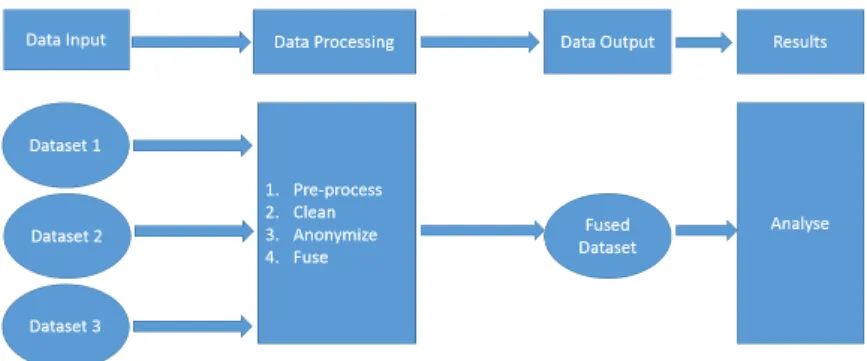
A high-level overview of the experimental process to gain insight into the malware driven email attacks on a financial organization in South Africa is shown in Figure 3.1. Data collection starts with the collection of three data set inputs. Once collected the data sets are pre-processed, cleaned and anonymized. Finally, the three data sets are joined and the analysis is performed.
Figure 3.1: Overview of experimental approach
The primary data set used in this research has been provided by a local South African bank with the required permission for its use on condition that no personal identifiable information (PII) is published. The specific technology vendor used by the bank for the purpose of advanced email malware protection is anonymized and simply referred to as the advanced malware email protection system (AMEPS). We fused the primary data set with malware intelligence meta-data and business context to produce the intelligent data set that was explored as a source of threat
3.3. DATA COLLECTION 30 intelligence. However, to gain a deeper understanding of the individual data sets, the researcher first performed EDA on each data set individually. This was followed by the fusion of all three data sets into a new intelligent data set which was again explored using the EDA method.
The approach outlined above allowed us to explore the value that can be obtained by performing EDA on each data set individually followed by the combined value of all three data sets fused into a single data set. With the knowledge that the use of an AMEPS is not a silver bullet against the daily battle against email driven malware attacks, this research aims to contribute to a working methodology that any organization can adopt as a starting point to produce threat intelligence using advanced malware log data. As such, the research provides the first important input into the requirements phase discussed in Section 2.6.2.
3.3
Data Collection
In the following sections we explain the three data sets used in our research, including how the data were obtained and the structure of the data sets.
3.3.1
Data set 1 – AMEPS log data
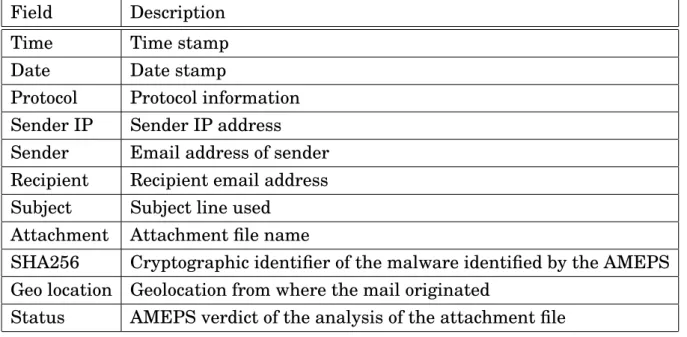
The primary data set used in this research was obtained from the bank’s AMEPS over a period of 6 months from December 2016 to March 2017. Our research criteria stipulated that we required all SMTP traffic logs that were flagged with malicious attachments by the bank’s AMEPS during that period. The researcher was provided with a comma separated value (CSV) file export of the AMEPS data requested, containing the fields described in Table 3.1.
3.3. DATA COLLECTION 31 Table 3.1: AMEPS CSV fields
Field Description
Time Time stamp
Date Date stamp
Protocol Protocol information Sender IP Sender IP address Sender Email address of sender Recipient Recipient email address Subject Subject line used
Attachment Attachment file name
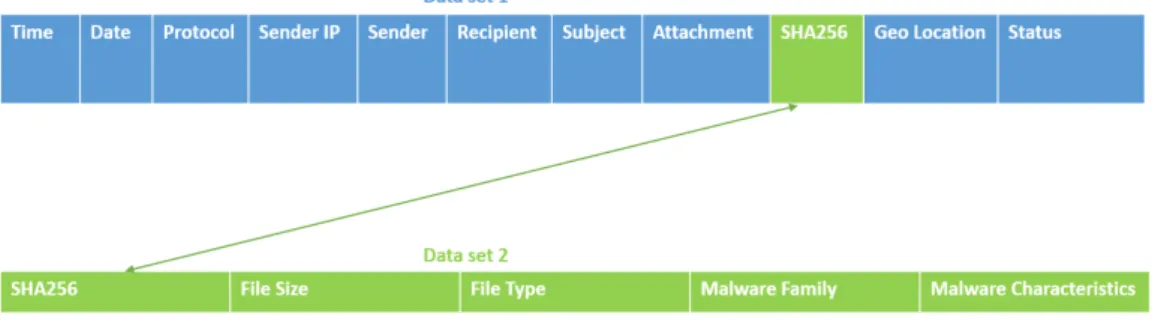
SHA256 Cryptographic identifier of the malware identified by the AMEPS Geo location Geolocation from where the mail originated
Status AMEPS verdict of the analysis of the attachment file
The query shown in Listing 1 was used to extract the information described in Table 3.1.
Listing 1Query used to obtain email log data from the AMEPS data set
{"operator":"all","children":[{"field":"sample.malware","operator":"is","value":1}, {"field":"alias.email","operator":"contains","value":"@bankdomain.co.za"},
{"field":"session.tstamp","operator":"is in the range","value":["2016-12-01T00:00:00","2017-05-31T23:59:59"]}]}
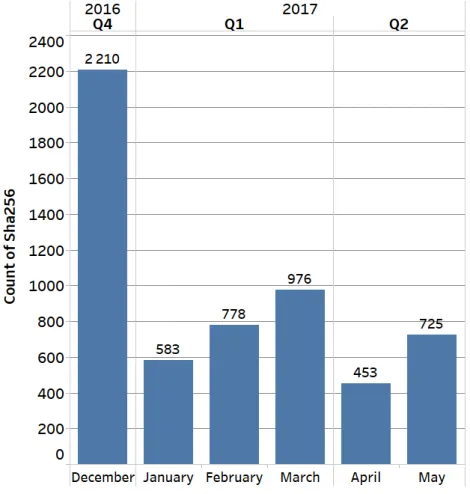
Our primary data set consisted of a total of 5275 malicious emails, broken down by month as shown in Table 3.2.
Table 3.2: Malicious emails detected by month
Month Dec 2016 Jan 2017 Feb 2017 Mar 2017 Apr 2017 May 2017
Malicious emails detected 2210 583 778 976 453 725
3.3.2
Data set 2 – Malware intelligence
For the second data set, the SHA256 cryptographic identifiers associated with the malware identified in the primary data set were used. Although the SHA256
3.3. DATA COLLECTION 32 cryptographic identifier provides a unique label assigned to a particular piece of malware, the SHA256 field on its own in the primary data set does not provide sufficient information about the malware detected on the AMEPS. For this reason, a total of 2061 unique SHA256 cryptographic identifiers were extracted from the primary data set for further enhancement.
TheAutoLenz1script was used to extract more contextual malware attributes from
the 2061 SHA256 cryptographic identifiers. This script provides the functionality to extract different layers of meta-data about malware, for example, a user friendly name and behavioural characteristics of the malware. However, for the purpose of our malware intelligence data set we extracted only the malware attributes given in Table 3.3.
Table 3.3: Malware intelligence fields
Field Description
SHA256 Cryptographic identifier of the malware
File Size Reported file-size based on the cryptographic identifier File Type The file type associated with the cryptographic identifier
Malware Family The malware user friendly name based on the cryptographic identifier Malware Characteristics Characteristics of the malware based on the cryptographic identifier
The Python script given in Listing 2 was used to extract the fields in Table 3.3.
Listing 2AutoLenz syntax used to extract malware attribute
python af_lenz.py -i UniqueSHA256listfile -q "APIKey" -r meta_scrape -l 0 > UniqueSHA256output
3.3.3
Data set 3 – Active Directory business context
The recipient email addresses obtained from our primary data set provided the particular target destination of the malware. However, this particular piece of information on its own does not provide the required business context. For example, an email recipient could have a specific job title and work in a particular business cluster and/or department. Alternatively, an email recipient could be a distribution list used in a particular business cluster and/or department.
3.4. DATA PRE-PROCESSING 33 Therefore, to obtain more business context around targeted mail recipients, a total of 4288 unique email recipients were extracted from the primary data set. The extracted list of email recipients was given to the bank’s information security database administrator to extract the respective business context fields from AD as given in Table 3.4.
Table 3.4: Active Directory business context fields
Active Directory Field Description
Mail This field maps to the recipient email address targeted
Company This field maps to the relevant business cluster in which the recipient resides Department This field maps to the relevant department in which the recipient resides Title This field maps to the relevant job title associated with the mail recipient
All recipient AD business context data were available in an SQL database managed by the bank’s information security team. The query given in Listing 3 was used to extract the required data as given in Table 3.4.
Listing 3SQL query used to extract AD business context data
select mail,Company,department,title from [Domain_ActiveDirectory]..Bankdomain where mail in (select f1 from [SQL_Repository_Reporting].[dbo].[Acheckanddelete])
3.4
Data Pre-processing
In the real world, data sets are prone to errors and incompleteness. For exampl