WHAT ABOUT ICT FOR STUDENTS WITH READING AND WRITING
DIFFICULTIES?
T. Mølster
Hedmark University College (NORWAY)
Abstract
The question we ask in this paper is what role digital tools play for students who struggle with reading and writing difficulties. Being able to read and write are basic skills. Therefore, it is important that the school and the teachers do what they can to help these students. We know that Information and Communication Technology (ICT) can be a valuable tool for learners with various kinds of disabilities. This is especially true for students who struggle with reading and writing. However, it seems that digital technology used to compensate for different learning impairments has not reached the classroom to a full extent. This paper is based on findings in the Norwegian research project The Function of Special Education (the SPEED project). The project has collected a broad range of empirical data from students, teachers and parents on level 5 to 9, including data on the use of computers in both the ordinary teaching and special education. A key finding is that ICT seems to play a modest role in everyday schoolwork for students with reading and writing difficulties. On the other hand, we find that both teachers and students report that ICT is very useful as a compensatory or alternative tool for this group of students. The paper will attempt to explain this apparent contradiction. Keywords: Special Education, Reading and Writing Difficulties, ICT, Inclusive Education, Assistive Technology.
1 RESEARCH QUESTIONS, OBJECTIVES AND THEORETICAL FRAMEWORK
Research on the relationship between use of Information and Communication Technology (ICT) and students’ learning shows contradictory findings. Despite huge investments in technology, we lack clear indications that ICT actually promotes learning in school. When it comes to special education, the situation is more or less the same as for students in general, despite the existence of useful tools and software for students with various learning difficulties ([2]). However, there is evidence from Norway and elsewhere that students who use such tools can improve their learning outcome, for instance, when dyslectic students overcome some of the barriers they experience ([10]).For persons with an impairment various digital devices can facilitate learning and compensate for their loss to some extent, if they have access and competent support, for instance as put by the World Health Organization ([34]). They also argue that ICT has the potential to increase opportunities to participate in society.
Although digital technology has opened new opportunities for participation and inclusion, it seems that school has not been able to exploit digital technology to achieve inclusive education ([2], [19]). However, teachers think favourably about ICT. The majority of Norwegian teachers in the 7th and 9th grade agree that the use of ICT promotes reading, writing and collaboration ([7]).
There is evidence that ICT is a valuable tool for learners with various kinds of disabilities ([3]). We also know that ICT can be useful for students who struggle with reading and writing difficulties ([6]). In the eighties special education teachers realized that the computer could be used to effectively train students with different kinds of learning difficulties. Special education teachers started to use ICT as an assistive device to compensate for reading and writing difficulties. Nevertheless, digital technology used to compensate for different difficulties has not reached the classroom fully ([26]).
Already from the 1960s and onward it has been claimed that technology helps to increase participation and inclusion for learners with disabilities, in and out of school ([2], [3], [9]). However, some learners receiving special education may feel stigmatised when using technical aids designed for disabled people ([21], [25]). According to Söderström ([29]), these learners therefore prefer using the same technology as the rest of the class.
1.1 Research question
The focus in this paper is the function of ICT for students having reading and writing difficulties. The research question is twofold:
• To what extent do students with reading and writing difficulties use ICT in school?
• What attitudes have students and teachers to ICT as a tool for reading and writing?
2 COMPUTER-ASSISTANCE FOR STUDENTS WITH READING AND WRITING
DIFFICULTIES
There seems to be a general perception among teachers and special educators that students having reading and writing difficulties (RWD, my abbreviation) may benefit from digital tools such as compensatory aids or alternative tools ([1]), [8], [18], [32]). Scholars claim that digital tools have a potential to support students’ performance in reading and writing ([4], [14]). Students gain access to texts and teaching materials on an equal footing with the rest of the class ([32]). By using synthesized speech, the student can listen to the text instead of reading it. Speech recognition can transform speech to written text. Students who have writing difficulties can find support in extended spell checking and text prediction tools. The “writing to read”-method ([31]) has proven to be useful for many students in the first reading education. Mona Wiklander further develops the method by adopting speaking keyboard ([33]). Speech synthesis makes the method particularly useful, not least for students with a minority background. Tone Finne claims that audio support is crucial for students to become more self-reliant in learning the basic skills of reading and writing ([11]).
In other words, there is evidence suggesting that digital tools can be helpful for students with reading and writing difficulties. However, we lack of recent research that confirms this. A Norwegian study from 2008 reveals that ICT-supported reading can stimulate students' development of basic reading skills and motivation for reading and writing activities ([10]). A Swedish longitudinal study with control groups show greater progress in reading skills for the group using digital means ([14]). Einar Landmark has shown that spelling with sound synthesis has positive effect on the spelling of students with writing difficulties ([20]). A US study ([4]) supports this. However, a meta-analysis of 85 individual studies in the period 1984-2010 concludes that we cannot say anything specific about the effect of technology support in writing ([26]). An Australian meta-study analyzing 15 selected articles in the period from 2004 to 2009 is more positive in its conclusion ([22]). Note that most of these studies have studied technology that is now outdated. Peterson-Karlan points out that as technology develops rapidly, we need more updated research in this field ([26]).
Research shows that students using special aids, such as computers, can feel stigmatized ([5], [29], [30]). As ICT becomes more common in school, there is reason to believe that students with reading and writing difficulties can increasingly use digital tools in the ordinary teaching without feeling stigmatized ([8]).
There are different causes of reading and writing difficulties. Students therefore need different forms of facilitation. Many students with dyslexia can perform at the same level as other pupils if they receive the assistance they need It is challenging for schools and teachers to find out how each child can learn most effectively. The question is whether schools and the teachers have the skills necessary to help these students. There are several surveys that suggest that the answer to this question is no ([5], [13], [17], [30]).
3 RESEARCH METHODOLOGY
This paper is a result of the research project the Function of Special Education - the SPEED project1. The project is looking into a range of aspects concerning the quality of special education in primary and lower secondary education in Norway. It is a mixed method project using surveys, interviews, classroom observations and document analysis. Our informants are students aging between 10 and 16 years, class teachers, special education teachers and parents in 2 municipalities in Norway. The number of invited students was 2780. The response rate was 97%. The interviews and classroom observations concerned students receiving special education, 158 students in all.
The class teacher survey and the special education teacher survey relate to one particular student. The class teacher has the main responsibility for the student. The class teacher reported if the student had any of the following categories of learning difficulties: hearing impairment, visual impairment, behavioral problems, reading and/or writing difficulties, learning difficulties in mathematics, other learning difficulties, general learning difficulties, other difficulties or no difficulties. The paper is focusing on the 107 students reported to have reading and/or writing difficulties. Forty-seven of these students were taking part in some kind of special education.
For the classroom observations, an instrument based on the “Time-Sample Measures of Behavior” approach was developed ([16], [27]). We observed students taking part in special education in or out of their regular class. Every 5 minutes the observer ticked off the actual activity the target student was displaying or the situation (s) he was in. The categories were predefined. One of the categories was if the selected student was using a computer at the observation time. The number of observations is 7673 and the number of observed students is 158.
The student survey contained a variety of questions about life in school. To shed light on the extent of ICT-use, students answered the following seven questions about how often they use ICT in different contexts (based on the Norwegian national survey Monitor Skole ([7]) :
1 How often do you use computers in the subject Norwegian? 2 How often do you use computers in the subject Mathematics? 3 How often do you use computers when presenting for the class? 4 How often do you use computers to write assignments?
5 How often do you use computers to take notes? 6 How often do you use computers for collaboration?
7 How often do you use computers to communicate with the teacher?
It was made clear for the informants that the notion ’computer’ includes artefacts like PC, mac, tablet, iPad, mobile phone etc. All variables have a nominal scale ranging from 1 indicating the lowest level of ICT-use to 5 indicating the highest level (1=Never, 2=Several times a month, 3=Once a week, 4=Several times a week, 5=Daily). By using the principal component analysis in SPSS, we found that we could reduce the seven questions on ICT-use to one factor representing students' total use of ICT in school. The factor, Total Use of ICT, is the sum of scores on each of the underlying questions. Total Use of ICT ranges from seven (if the student has scored 1 in all seven questions) to 35 (if the student has scored 5 in all of the questions). In order to study possible differences between high and low usage of ICT, we have constructed two groups of pupils: the high frequency users and the low frequency users. According to our definition, pupils scoring 21, the median value, or higher on the Total Use of ICT belong to the group of high frequency users, while pupils scoring less than 21 belong to the group of low frequency users.
In the survey, teachers assessed the academic achievement of the student on a scale from 1 (very low) to 6 (very high) in the subjects Norwegian, Mathematics and English. We use the factor Total Academic Achievement as the sum of scores in each subject to indicate the students total learning outcomes.
The research design allows for combining survey data with observation data on an individual level.
4 RESULTS
To shed light on the research questions findings are organized the around five issues: the extent of ICT use among students, how students feel about using ICT, teacher’s attitudes, inclusion and academic achievements.
4.1 The extent to which ICT is used
Fig. 1 compares total use of ICT for two groups of students: students reported to have reading and writing difficulties and students reported to have no learning difficulties. In the comparison of groups, I use the PISA scale where the overall average is set at 500 points, and one standard deviation (SD) equals 100 points. Differences (effect size) of 0.4 SD or more are regarded as substantial differences ([15]).
Fig. 1. Total use of ICT
According to fig 1, students reported to have reading and writing difficulties report that they use ICT more often than students who are reported to have no difficulties, do. The difference is substantial (0.65 SD). An independent-samples t-test reveals that the difference is significant. Based on the assumption that ICT is particularly useful for students with reading and writing difficulties, we can interpret this as a positive result. However, our data says nothing about how ICT is used and for what purposes.
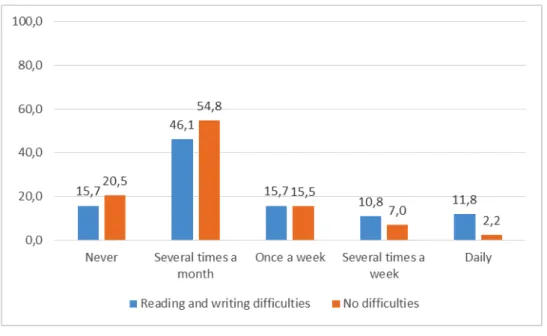
Let us look at the frequency of ICT-use in one specific subject: Norwegian. Naturally, fig. 2 confirms the previous finding. However, according to this analysis the use of ICT is not very widespread in either group. Only 11.8% of students with literacy difficulties report that they use ICT on a daily basis. What is perhaps more surprising, is that more than half of the students report that they use ICT only several times a month or less.
Fig. 2. Use of ICT in the subject Norwegian. Percent.
If we assume that students with reading and writing disabilities may benefit from digital tools for both reading and writing, one would expect a more frequent use.
Classroom observations give more or less the same impression. Only in 364 cases out of a total of 7673 observations, the selected student was observed using a computer, which is 4.7% of the observations. The number of observed students having reading and writing difficulties is 34, 22 male and 12 female students. This group of students is observed using computers in 5.6% of the observations, slightly but not significantly higher than the whole group. However, the observed ICT-use is unevenly distributed. The number of students actually observed using a computer was only 10 out of 34, 8 male and 2 female. This group used computers in 18.9% of the observations. Male students accounts for 91% of these observations.
The six RWD student observed most often with computer, all boys, also scored highest when they self-report on how often they use computers at school. Five of the six students say they use computer daily in the subject Norwegian. Therefore, there is good correlation between the observed use and self-reported use of computer for this group of students. This shows that among students with reading and writing difficulties there exists a group, mainly boys, which uses computer significantly more than the others. Unfortunately, we know little about the extent to which the use of computer promotes learning for this group.
4.2 How students experience the use of ICT
We asked the students the following questions about how they perceive the use of ICT in their schoolwork:
Table 1. How students perceive using ICT at school (no. students)
Yes No Don’t know
Do you learn more, when using a computer? 14 7 10
Do you concentrate better, when using a computer? 13 11 7
Do you find it embarrassing to use a computer when the rest of the class do not?
5 18 4
Almost half of the students report that they learn better when using ICT at school. Many of them also claim that they concentrate better. However, a significant portion of the students claims the opposite. Two out of three students do not think it is embarrassing using a computer when the rest of the class is not. Five students (18%) answers yes to this question.
4.3 Teacher’s attitudes to ICT
We asked teachers and special education teachers to consider four statements about student’s benefits from using a computer:
1 Tasks are more adapted to the needs of the student 2 The student experience a greater degree of mastery 3 The student is more motivated
4 Student becomes more independent
The statements had five response categories from one (totally disagree) to five (totally agree). Fig. 3 shows the percentage of teachers and special educators who fully or partially agree with the statements. Note that the statements relate to a particular student reported to have reading or writing difficulties.
Fig. 3. Percentage of teachers and special educators who fully or partially agree with the statements. In general, both teachers and special education teachers signal a positive attitude towards the use of ICT for students with reading and writing difficulties. It is interesting to observe that special education teachers are more positive than regular teachers are, particularly when it comes to adapting tasks to the needs of the student. This strengthens the positive impression if we assume that special educators have more knowledge about students' special needs than regular teachers do.
4.4 ICT and inclusion
We also asked teachers and special education teachers to consider to what extent computer usage may constitute an obstacle to a more inclusive education.
Fig. 4. To what extent do teacher think that use of ICT can be an obstacle to inclusion?
Clearly, teachers in general do not consider ICT to be a hindrance to inclusion. However, special education teacher are not as certain about this as regular teachers are. In addition, according to table 1, some students do feel embarrassed using a computer when the rest of the class is not. Although neither teachers nor students experience using ICT as a problem in relation to inclusion, teachers should be aware that for some students using a computer in class might be challenging.
4.5 What is the relationship between ICT use and learning?
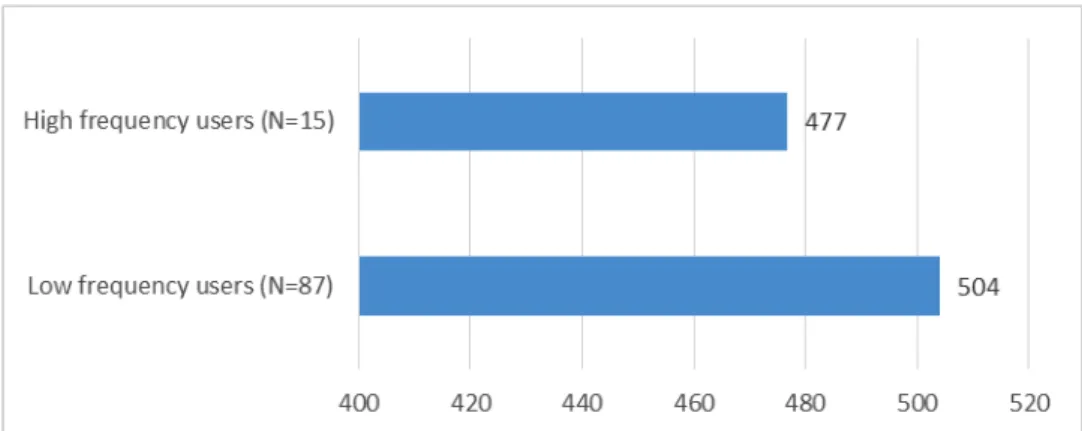
To shed some light on this issue we have compared the mean score on academic achievement for the group of pupils using ICT most frequently (the high frequency group) with the group using ICT less frequently (the low frequency group).
Note that 500 is the mean score for all RWD students and 100 points represents one standard deviation. Students using ICT frequently have lower score on academic achievement than students using ICT less frequently. The effect size is 0.27, which is between small and medium ([15]). A T-test shows that the difference is not significant. If we do this analysis for students reported to have no learning difficulties (N=1672), we find the same relationship. However, the effect size is 0.55, which is medium and significant according to a T-test. This finding corresponds with previous research ([23], [25]). The immediate conclusion may be that ICT use does not promote learning for any of these two groups. However, we have to be careful since we do not know how this small group of RWD students using ICT frequently would achieve with less ICT. Moreover, students with the most substantial problems are more likely to ICT in their programs.
5 DISCUSSION AND CONCLUSION
The main outcome of this investigation is threefold. Firstly, using ICT at school is not widespread among students having reading or writing difficulties. Secondly, teachers and students think favorably about using ICT for learning. Thirdly, we find that the relationship between ICT and learning seems not to be in favor if using ICT frequently.
Very few students with literacy problems are using ICT daily. However, there is a small group, mainly male students, reporting that they are using ICT more often than the rest. Classroom observations verify this finding. Unfortunately, we do not know how and for what purpose they use ICT. Likewise, we do not know why boys are overrepresented in the group of frequent ICT users. This asks for more research into the learning activity for these students.
The fact that ICT plays such a small role in schoolwork for students with reading or writing difficulties contrasts with the positive attitudes towards ICT expressed by both students and teachers. Nearly half of students with reading and writing disabilities say they concentrate better and learn more when they are using ICT. Class teachers and special education teachers confirm this finding. Special education teachers are even more positive to ICT than class teachers are.
On the other hand, in our material we find a negative relationship between frequent use of ICT and academic achievement. The difference is not significant, and it is considerably smaller than it is for students reported to have no learning difficulties. This might indicate that students reported to have reading and writing difficulties, in some way benefit from using ICT. However, we need more research to understand the function of ICT for this group of learners. The fact that ICT plays such a modest role in schoolwork gives us a poor basis for studying the learning impact of technology.
The question we have to ask is the following: what is the reason why ICT is not used more. In the SPEED-project, we do not have information that may shed light on this issue. According to an English study, middle school special education teachers perceive assistive technology to be an effective tool for literacy, but they use it minimally ([13]). Teachers reported barriers to using assistive technology in literacy including cost, usability, and lack of training and experience.
This study raises some questions about the technology's role in learning for students with reading or writing difficulties. Do students have access to relevant tools and are they trained to use them? How is ICT used in this part of special education? Do teachers have the skills they need to facilitate ICT support for these students? Technology in this area is developing fast. Therefore, we need more research. Several scholars call new controlled trials to find out more about what newer technology may mean for students with reading or writing difficulties.
REFERENCES
[1] Borkamo, R. (2013). IKT-baserte verktøy som hjelpemiddel for dyslektikere i grunnskolen [2] Brodin, J. (2010). Can ICT give children with disabilities equal opportunities in school?
Improving Schools, 13(1), 99-112. doi:10.1177/1365480209353483
[3] Brøyn, T., & Schultz, J.-H. (2005). IKT og tilpasset opplæring. Oslo: Universitetsforl.
[4] Cullen, J., Richards, S. B., & Frank, C. L. (2008). Using software to enhance the writing skills of students with special needs. Journal of Special Education Technology, 23(2), 33.
[5] Dale, L. A. (2012). Dysleksi og mestring : Hvordan virker bruken av kompenserende hjelpemidler inn på elever med dysleksi som går på videregående skoler?
[6] Diraä, N., Engelen, J., Ghesquière, P., & Neyens, K. (2009). The Use of ICT to Support Students with Dyslexia. In A. Holzinger & K. Miesenberger (Eds.), HCI and Usability for e-Inclusion: 5th Symposium of the Workgroup Human-Computer Interaction and Usability
Engineering of the Austrian Computer Society, USAB 2009, Linz, Austria, November 9-10, 2009 Proceedings (pp. 457-462). Berlin, Heidelberg: Springer Berlin Heidelberg.
[7] Egeberg, G., Björk Gudmundsdottir, G., Hatlevik, O. E., Ottestad, G., Skaug, J. H., & Tømte, K. (2012). Monitor 2011 – The Digital State of Affairs in Norwegian Schools. Nordic Journal of Digital Literacy, 7(01). Retrieved from http://www.idunn.no/ts/dk/2012/01/art04
[8] Engenes, E. M. (2011). Vedvarende lese-og skrivevansker. Bedre Skole, 4, 66-72. [9] European Agency for Development in Special Needs Education. (2013). Information and
Communication Tecgnology for Inclusion: Developments and Opportunities for European Countries Retrieved from
http://www.european-agency.org/sites/default/files/ICT%20for%20Inclusion-EN.pdf
[10] Fasting, R. B. (2008). IKT-basert læringsstøtte for elever med lese- og skrivevansker. Spesialpedagogikk, 73(7), 61-75.
[11] Finne, T., Roås, S. E., & Kjølholdt, A.-K. (2014). Den første skrive- og leselæringen [12] Bruk av PC med lydstøtte. Bedre Skole, 2(2014), 31-37. Retrieved from
https://www.utdanningsforbundet.no/upload/Tidsskrifter/Bedre%20Skole/BS_2_2014/UTD-BedreSkole-0214-WEB_Finne_mfl.pdf
[13] Flanagan, S., Bouck, E. C., & Richardson, J. (2013). Middle School Special Education Teachers’ Perceptions and Use of Assistive Technology in Literacy Instruction. Assistive Technology, 25(1), 24-30. doi:10.1080/10400435.2012.682697
[14] Fälth, L., Gustafson, S., Tjus, T., Heimann, M., & Svensson, I. (2013). Computer-assisted Interventions Targeting Reading Skills of Children with Reading Disabilities – A Longitudinal Study. Dyslexia, 19(1), 37-53. doi:10.1002/dys.1450
[15] Hattie, J. (2009). Visible learning : A synthesis of over 800 meta-analyses relating to achievement. London: Routledge.
[16] Haug P. (2014). Spesialundervisning i praksis. Paideia - Tidsskrift for profesjonell pedagogisk praksis 2014;8
[17] Horne, P.-L. (2012). Bruk av datahjelpemidler for elever med dysleksi
[18] Høigaard, B., Svestad, P. J., & Landmark, E. (2010). Pedagogisk bruk av IKT: Har skolene og lærerne den nødvendige kompetansen? Utdanning, 17, 44-45.
[19] Krumsvik, R. J. (2007). Skulen og den digitale læringsrevolusjonen. Oslo: Universitetsforl. [20] Landmark, E. (2009). Viktige hensyn å ta ved valg av dataprogrammer. Dyslektikeren, 1, 16-18. [21] Lupton, D., & Seymour, W. (2000). Technology, selfhood an physical disability. Social Science
& Medicine, 50(12), 1851-1862.
[22] Maor, D., Currie, J., & Drewry, R. (2011). The effectiveness of assistive technologies for children with special needs: a review of research-based studies. European Journal of Special Needs Education, 26(3), 283-298.
[23] Mølster, T., & Nes, K. (2015). Information and Communication Technology in Special
Education: To what extent does ICT support learning and participation for pupils seen to have special educational needs?Transitions in teacher education and professional identities : ATEE annual conference 2014: Proceedings (pp. 225-234). Brussel: Association for Teacher
Education. Retrieved from
http://repositorium.sdum.uminho.pt/bitstream/1822/36281/1/Proceedings_ATEE_Conference_2 014.pdf .
[24] OECD. (2015). Students, Computers and Learning: making the connection. Pisa, OECD Publishing Retrieved from http://dx.doi.org/10.1787/9789264239555-en.
[25] Pape, T. L.-B., Kim, J., & Weiner, B. (2002). The shaping of individual meanings assigned to assistive technology: a review of personal factors. Disability and rehabilitation, 24(1-3), 5-20.
[26] Peterson-Karlan, G. R. (2011). Technology to Support Writing by Students with Learning and Academic Disabilities: Recent Research Trends and Findings. Assistive Technology Outcomes and Benefits, 7(1), 39-62.
[27] Powell J, Martindale A, Kulp S. (1975). EVALUATION OF TIME-SAMPLE MEASURES OF BEHAVIOR. Journal of Applied Behavior Analysis. 1975;8(4):463-9.
[28] Svensson, I., & Jacobson, C. (2006). How persistent are phonological difficulties? A longitudinal study of reading retarded children. Dyslexia, 12(1), 3-20.
[29] Söderström, S. (2010). Teknologibruk i den digitale enhetsskolen: en pilotstudie av bruk av informasjons- og kommunikasjonsteknologi (IKT) i skolehverdagen for grunnskoleelever med nedsatt funksjonsevne. Trondheim: NTNU samfunnsforskning, Avdeling for mangfold og inkludering.
[30] Tallay, E., & Romnes, G. (2007). IKT for dyslektikere: hvordan blir datamaskiner som formidles gjennom Hjelpemiddelsentral brukt i skolen?
[31] Trageton, A. (2009). Skriv på pc - lær å lese! Oslo: Pedlex norsk skoleinformasjon. [32] Utgård, T., & Høigaard, B. (2008). IKT som lære- og hjelpemiddel. Retrieved from
http://innsikt.org/index.asp?id=27396
[33] Wiklander, M., Sjødin, L., & Braut, T. (2016). STL + håndbok : å skrive seg til lesing med lydstøtte : Sandvikenmodellen. Bryne: Infovest forl.
[34] World Health Organization. (2014). Disabilities and rehabilitation Retrieved from http://www.who.int/disabilities/technology/en/