by
GLORIA NOZIPHO MTHIYANE
submitted in accordance with the requirements for the degree of
MASTER OF ARTS
in the subject
HEALTH STUDIES
at the
UNIVERSITY OF SOUTH AFRICA
SUPERVISOR: DR DSK HABEDI
ACKNOWLEDGEMENTS
To God be the glory for giving me the strength and for empowering me to persevere and complete the study. I also wish to express my sincere gratitude and appreciation to the following people for their tremendous assistance and contribution towards this dissertation.
To my supervisor, Dr D.S.K. Habedi, for continued support, direction, and encouragement throughout the study, especially for her timeous responses: everything was appreciated.
To my children, Minenhle, my son, for your curiosity on my progress, which gave me courage to press on. To Talent, my daughter, for conveying your love and encouragement always; and to my niece, Nolwandle, for your patience and understanding about missing out on family time.
To the participants, for their time, for sharing their experiences, for contributions towards the study, and for entrusting me with the information provided.
To the Department of Health, KwaZulu-Natal College of Nursing, for granting permission to conduct the study at their institutions.
To the principal of Edendale, Mrs N.C. Majola, and on Grey’s campus, Mrs B. Shezi, for the support in gaining access to the participants. A special thank you to Mrs M. Subhan, for excellent coordination during the data-collection process at Grey’s Campus.
To my research assistant, Miss S. Malinga: thank you for dedicating your time during data collection, and may God bless you.
To my fellow church members, for their prayers, and for relief from church duties to allow me time to concentrate on the study. To my family and friends, for the space you provided.
To my fellow colleagues, especially the lecturers from both campuses, for their consistent support and guidance throughout the study. Mrs H. Mngomezulu: you are one of the kind. Thank you!
To the University of South Africa, for the proper direction and financial assistance provided throughout the study which made it easy for me to progress. Your cooperation
is greatly appreciated. The availability of library services on Pietermaritzburg campus was very helpful.
Dedication
To my late father: it was always your wish for your children to be successful through
education.
To my mother: your courage and perseverance while raising six children as a single parent was
a great example, as was your reliance on God throughout your life.
I also dedicate this to my siblings, for the success that they have attained in their lives, despite
all the challenges that they have faced.
THE EXPERIENCES OF NURSE EDUCATORS IN IMPLEMENTING THE EVIDENCE-BASED PRACTICE IN TEACHING AND LEARNING
STUDENT NUMBER: 33504636
STUDENT: Gloria Nozipho Mthiyane DEGREE: M A Nursing Science DEPARTMENT: Health Studies
SUPERVISOR: Dr DSK Habedi
ABSTRACT
The purpose of this study was to determine the nurse educators’ experiences in implementing the evidence-based practice (EBP) in teaching and learning, and to describe the importance and benefits of EBP teaching and learning to the nursing profession, especially for nurse educators and student nurses. A qualitative research design and methods were followed in conducting the study. A non-probability purposive sampling technique was used to access the sample of twelve nurse educators from two nursing campuses under KwaZulu-Natal College of Nursing within Umgungundlovu Health District. Data were collected using semi-structured interviews, the interview guide, and the digital voice recorder. Data were analysed manually, following a content thematic data analysis approach. Two themes emerged as follows:
Challenges experienced by nurse educators with the implementation of EBP in teaching and learning.
Benefits/value of EBP in teaching and learning.
Findings revealed that, although most of the nurse educators are supportive and displayed a positive attitude towards implementing EBP in teaching and learning, the level of knowledge and skills was questionable. This was coupled with a lack of motivation and commitment towards research. Therefore, recommendations for nursing education, nursing practice, and future research were suggested, for successful implementation of EBP in teaching and learning.
Key concepts: Evidence-based practice, experiences, implementation, nurse educators, teaching, learning, research, student/learner
i
TABLE OF CONTENTS
CHAPTER 1………..1
OVERVIEW OF THE STUDY………1
1.1 INTRODUCTION………...1
1.2 BACKGROUND TO THE PROBLEM………...1
1.3 STATEMENT OF THE RESEARCH PROBLEM……….3
1.4 RESEARCH AIM/PURPOSE………..3
1.5 RESEARCH OBJECTIVES……….3
1.6 RESEARCH QUESTIONS………..4
1.7 SIGNIFICANCE OF THE STUDY…..………4
1.8 DEFINITION OF KEY CONCEPTS………4
1.9 RESEARCH DESIGN AND METHODS………5
1.9.1 SETTING………6
1.9.2 POPULATION………...6
1.9.3 PARTICIPANT SAMPLING………...6
1.9.4 DATA COLLECTION………...6
1.9.5 DATA ANALYSIS……….6
1.9.6 SCOPE AND LIMITATIONS………...7
1.9.7 TRUSTWORTHINESS………7
1.10 ETHICAL CONSIDERATIONS………..7
1.11 STRUCTURE OF DISSERTATION………..8
ii
CHAPTER 2……….9
LITERATURE REVIEW……….9
2.1 INTRODUCTION………9
2.2 NURSING EDUCATION AND RESEARCH………...11
2.3 NURSE EDUCATOR………..13
2.4 EVIDENCE-BASED PRACTICE………...16
2.5 CONCEPTUAL FRAMEWORK/MODEL……….18
2.5.1 PARIHS framework………18
2.5.1.1 Nature of evidence………18
2.5.1.2 Quality context of implementation………..19
2.5.1.3 Appropriate facilitation...………..19
2.5.2 ARCC model……….19
2.5.3 Iowa model of EBP………..20
2.6 BARRIERS AND FACILITATORS TO IMPLEMENTATION OF EBP……….20
2.7 EBP IN TEACHING AND LEARNING………..22
2.8 STRATEGIES /METHODS SUPPORTING IMPLEMENTATION OF EBP IN TEACHING AND LEARNING………25
2.8.1 Problem-based teaching and learning method………..25
2.8.2 Experiential learning………...25
2.8.3 Projects………..26
iii
2.8.5 A case study /Case-based learning………..27
2.8.6 Cookie experiment teaching strategy………28
2.9 CONCLUSION……….29
CHAPTER 3………30
RESEARCH DESIGN AND METHODS………...30
3.1 INTRODUCTION………..30
3.2 RESEARCH DESIGN……….30
3.2.1 Qualitative research design………30
3.3 RESEARCH METHODOLOGY………...31 3.3.1 Sampling procedures………..31 3.3.1.1 Population……….31 3.3.1.2 Sampling technique……….32 3.3.1.3 Research setting………..33 3.3.1.4 Sample………...33 3.3.2 Data collection………33
3.3.2.1 Data collection approach and method………..33
3.3.2.2 Developing and testing of the data collection instrument………..34
3.3.2.3 Characteristics of the data collection instruments………..36
3.3.2.4 Data collection process………...38
3.4 DATA ANALYSIS………..40
iv 3.5.1 Credibility……….41 3.5.2 Transferability……….42 3.5.3 Dependability………..42 3.5.4 Confirmability………..42 3.6 ETHICAL CONSIDERATIONS………43 3.6.1 Permission………..43
3.6.2 Respect of individual autonomy………..43
3.6.3 Justice………..43
3.6.4 Compensation………44
3.6.5 Informed consent………44
3.6.6 Confidentiality and autonomy………..44
3.6.7 Beneficence and non-maleficence……….45
3.6.8 Scientific integrity of the research………45
3.7 CONCLUSION………...46
CHAPTER 4………47
DATA ANALYSIS, INTERPRETATION AND DESCRIPTION OF RESEARCH FINDINGS………...47
4.1 INTRODUCTION……….47
4.2 SAMPLE CHARACTERISTICS………...47
4.3 DATA MANAGEMENT AND ANALYSIS PROCESS………...49
4.4 INTERPRETATION AND DESCRIPTION OF RESEARCH FINDINGS………...53
v
4.4.1.1 Time constraints………...53
4.4.1.2 Lack and poor access to relevant resources………56
4.4.1.3 Current teaching approaches……….66
4.4.1.4 Lack of knowledge and skills by nurse educators………..73
4.4.1.5 Student character………... ….78
4.4.2 Theme 2: Benefits/value of EBP in teaching and learning………..84
4.4.2.1 Keeping up to date with current information……….. ….84
4.4.2.2 Preparing student nurses to engage in EBP………87
4.4.2.3 Improvement to quality patient care………..89
4.4.2.4 Reducing health care delivery costs………...89
4.5 CONCLUSIONS………..91
CHAPTER 5………92
CONCLUSIONS AND RECOMMENDATIONS ………..……….92
5.1 INTRODUCTION………..92
5.2 SUMMARY OF THE STUDY………...92
5.3 CONCLUSIONS………..93
5.3.1 Theme 1……….93
5.3.2 Theme 2……….93
5.4 RECOMMENDATIONS………..93
5.4.1 Recommendations for nursing education………94
vi
5.4.1.2 Resources………..94
5.4.1.3 Teaching strategies………..95
5.4.2 Recommendations for nursing practice………...96
5.4.2.1 EBP competencies………...96
5.4.3 Recommendations for future research……….98
5.5 CONTRIBUTIONS OF THE STUDY………99
5.6 LIMITATIONS TO THE STUDY………99
5.7 CONCLUDING REMARKS………99
vii
LIST OF TABLES
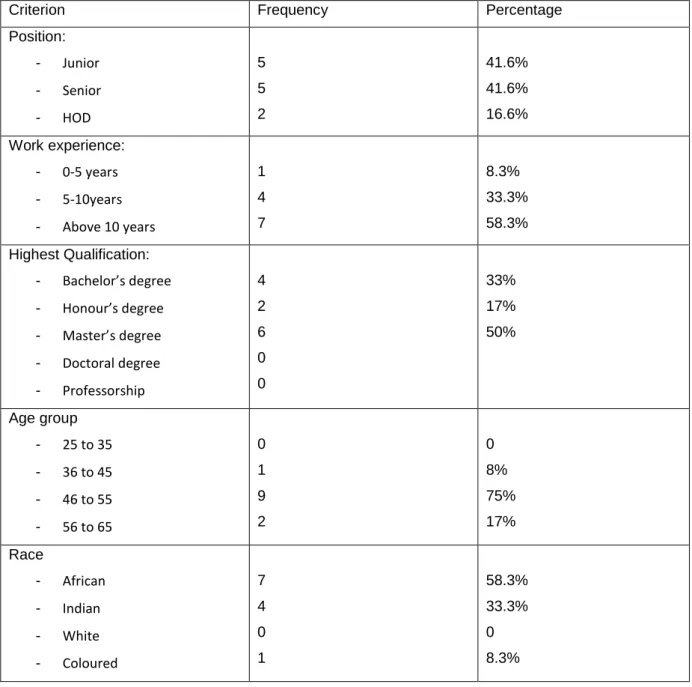
Table 2.1 SANC Nursing Education Training Standards………..13 Table 4.1 Samples’ demographic information……….49 Table 4.2 Nurse Educators’ experiences of EBP implementation in teaching and
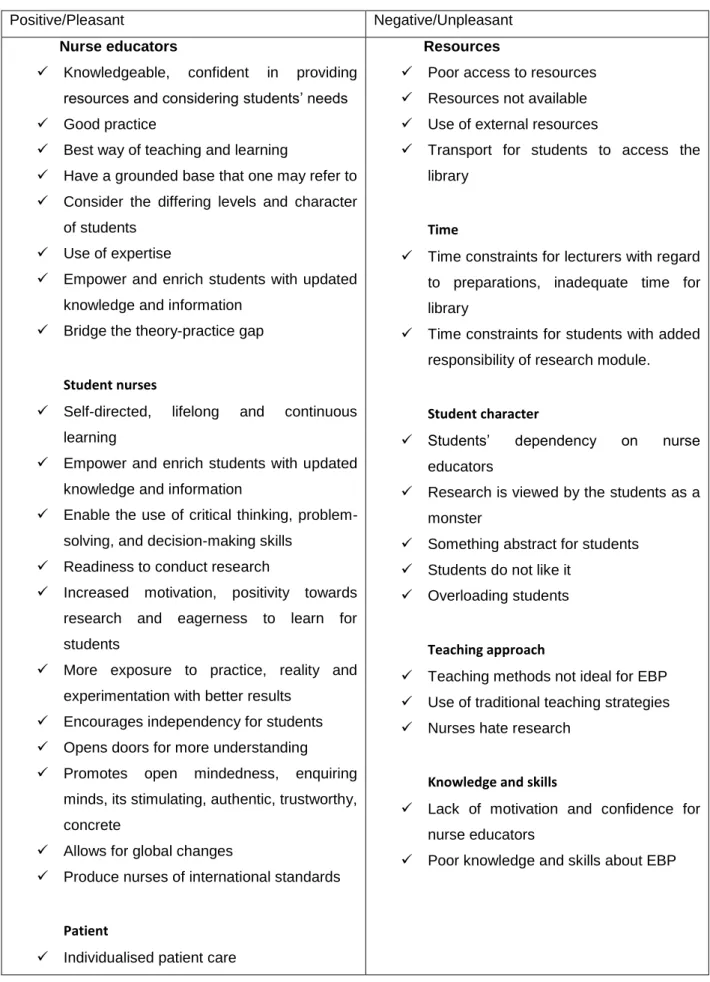
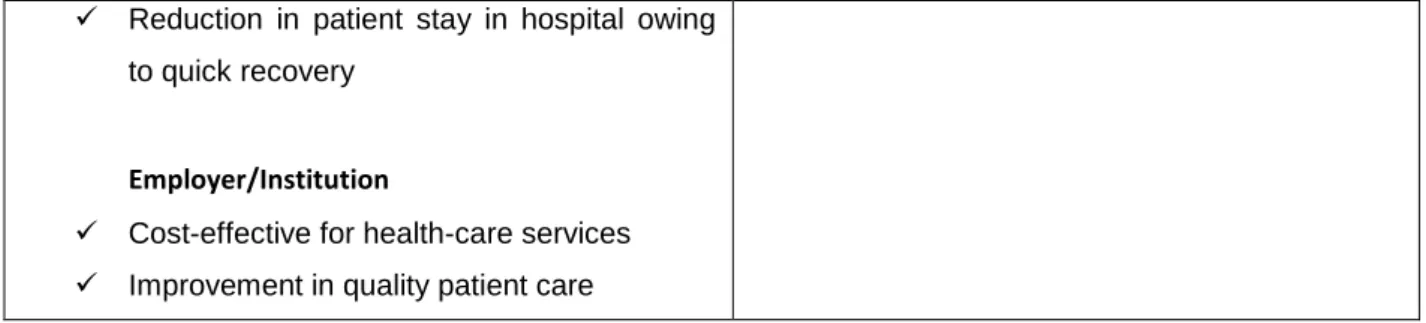
learning.……….…..51 Table 4.3 Themes and categories……….52
viii
ANNEXURES………...108
ANNEXURE A Unisa ethical clearance letter………..108
ANNEXURE B Request for permission letter – KZNCN………...110
ANNEXURE C Approval letter – KZNCN……….112
ANNEXURE D Request for permission letter – DoH………..113
ANNEXURE E Approval letter – DoH………115
ANNEXURE F Request for permission letter – Greys Campus………116
ANNEXURE G Approval letter – Greys Campus………...118
ANNEXURE H Request for permission letter – Edendale Campus……….119
ANNEXURE I Approval letter – Edendale Campus………..121
ANNEXURE J Participants’ information letter……….122
ANNEXURE K Consent form………..124
ANNEXURE L Interview guide………...125
ix
LIST OF ABBREVIATION A&P Anatomy and Physiology
AACN American Association of Colleges of Nursing ANE Academic Nurse Educators
APN Advanced Practice Nurse
ARCC Advanced Research and Clinical practice through close Collaboration ATR Attitudes towards Research
DoH Department of Health
EBHC Evidence-Based Health Care EBM Evidence-Based Medicine EBN Evidence-Based Nursing EBP Evidence-Based Practice HOD Head of Department HPS Human Patient Simulators IT Information Technology KZN KwaZulu-Natal
KZNCN KwaZulu-Natal College of Nursing NEI Nursing Education Institution
PARIHS Promoting Action on Research Implementation in Health Services PDA Personal Digital Assistants
RN-BSN Registered Nurses-Bachelor of Science in Nursing RSA Republic of South Africa
x SA South Africa
SANC South African Nursing Council
SAQA South African Qualifications Authority UNISA University of South Africa
US United States
1 CHAPTER 1
OVERVIEW OF THE STUDY 1.1 INTRODUCTION
Evidence-based practice (EBP) is described by Melnyk, Fineout-Overholt, Gallagher-Ford and Kaplan (2012:410) as a problem-solving approach to clinical decision-making in health care. EBP integrates the best evidence from well-designed studies with the clinicians’ expertise, including internal evidence from patients’ assessments, practice data, patients’ preferences and values. Melnyk et al (2012:410) further revealed that implementation of EBP leads to a higher quality of care, improved patient outcomes, and decreased health-care costs.
EBP teaching and learning has become an important function for nursing education. Research is used as an instrument in developing new teaching and learning strategies. Nurse educators base their EBP in teaching and on research reports. EBP in learning is also based on research, meaning that students learn by using research findings. Research-based teaching and learning encourages and stimulates critical thinking for students (Felicilda-Reynaldo & Utley 2015:91).
Although EBP is known to improve health-care quality, decreasing costs and empowering nurses, the challenge is which way ensures that EBP is implemented successfully by the nurses (Levin, Fineout-Overholt, Melnyk, Barnes & Vetter 2011:21). The implementation of successful EBP education serves the function of developing practitioners who value EBP and have the knowledge and skills to implement such practice (Lehane, Warren, O’Riodan, Savage, Drennan, O’Tauthaigh, O’Connor, Corrigan, Burke, Hayes, Lynch, Sahm, Heffernan, O’Keefe, Blake, Horgan & Hegarty 2017:8).
1.2 BACKGROUND TO THE RESEARCH PROBLEM
Nurse educators have a vital role to mentor student nurses in relation to developing EBP skills, accessing research products and participating in research projects. South African Nursing Education is undergoing transformational changes with the introduction of new nursing qualifications for the South African Nursing Council (SANC) in conjunction with Department of Health (DoH) of the Republic of South Africa (RSA) (Nursing Strategy 2008:8). This requires more innovative teaching approaches that
2
promote active participation, creativity and critical thinking in students, for example, online teaching and learning, accessing electronic resources, video conferencing, and research-based teaching and learning.
EBP teaching and learning functioning seem to be difficult to implement for both the nursing practice and education. Technological skills for accessing information, adequate resources, for example, libraries and good knowledge about research, are needed by nurse educators and student nurses for successful implementation of EBP in teaching and learning. Some barriers to the implementation of EBP are identified in literature as politics and organizational culture that avoid change (Nurses Struggle 2012:410-417). Nurses cannot implement EBP consistently even when they believe in evidence-based care; some barriers remain prevalent, for instance, resistance from colleagues, nurse leaders and managers (Nurses Struggle 2012:410-417). Therefore, the responsibility remains with nursing education to ensure that EBP in teaching and learning is implemented, and that it is properly delivered or taught to student nurses. However, it remains a challenge for those providing nurse education.
Nurse educators play a key role in creation of opportunities for implementing EBP and in facilitating the implementation process. The question now is how to foster implementation of EBP. The most important factor that is likely to help nurses and nurse educators to adopt EBP is the provision of adequate training in EBP (Hikkila, Hopia, Hasselberg, Tiittanen & Baighorzina 2017:3).The importance of embedding EBP in nurse education programmes cannot be underestimated if EBP and its positive patient outcomes are to be realised in health-care settings. Again, in the findings of the study conducted by Felicilda-Reynaldo & Utley (2015:93), one nurse educator noted that “nurse graduates will be prepared to facilitate a transformation of the health care system culture by implementing practice review and revision consistent with evidence-based nursing (EBN) research”. The above-mentioned statement highlights the importance of incorporating EBP throughout the curriculum to prepare students for future success in using EBP in their professional nursing practice (Felicilda-Reynaldo & Utley 2015:93). According to Massey & Bassendowski (2017:54), utilizing nursing best practice guidelines, reviewing and implementing applicable research evidence, and taking advantage of technological advances are all ways in which nursing can move forward as a well-informed discipline.
3
Findings from the study conducted by Malik, McKenna and Griffiths (2015:158) in Australia indicated that integrating EBP into undergraduate nursing education and preparing future nurses to embrace EBP into clinical practice becomes crucial in todays’ complex and evolving health-care environment. The study further implies that the role that EBP plays in the practical lives of student nurses will depend on the degree to which it is promoted by academics, the extent to which it is incorporated in course objectives, content, assessments, and its application within the clinical setting (Malik et al 2015:158). In this way, nurses’ willingness to carry out research projects, as well as to utilise the research findings effectively in practice is enhanced.
1.3 STATEMENT OF THE RESEARCH PROBLEM
Traditional teaching methods and learning styles still dominate in nursing education and these strategies do not encourage critical thinking amongst the student nurses, therefore, these methods will not prepare student nurses to make sound clinical judgements in practice (Subhan 2014:35). With the nursing profession experiencing many changes on contemporary issues, student nurses need to be prepared for these challenges. Using EBP as one of the teaching and learning strategies will qualify student nurses to become excellent critical thinkers, able to solve problems in the clinical area. However, EBP remains a relatively new concept to nursing, and there is limited literature available addressing the incorporation of EBP into nursing curricula, especially at the undergraduate level (Malik et al 2015:158). In South Africa, there is a dearth of literature in the implementation of EBP in education.
1.4 RESEARCH AIM/PURPOSE
The purpose of the study is to determine the experiences of nurse educators in implementing the EBP in teaching and learning, and to describe the importance and benefits of EBP in teaching and learning in the nursing profession, especially for nurse educators and student nurses.
1.5 RESEARCH OBJECTIVES
To explore and describe the experiences of nurse educators regarding the implementation of EBP in teaching and learning.
To make recommendations for nurse educators on implementing the EBP in teaching and learning.
4 1.6 RESEARCH QUESTIONS
What are the experiences of nurse educators regarding implementation of EBP in teaching and learning?
What recommendations may be made for nurse educators to implement the EBP in teaching and learning?
1.7 SIGNIFICANCE OF THE STUDY
Significance refers to the relevance of the research to some aspect of a profession, its contribution towards improving the knowledge base of the profession, and its contributions towards EBP (Polit & Beck 2012:708).
The findings of the study will also be used by nursing education institutions (NEIs) for the development of the curriculum, and in the reviewing of the curriculum. On completion of training, student nurses will be expected to be critical thinkers and problem solvers, advocates for patients in the clinical area.
1.8 DEFINITIONS OF KEY CONCEPTS Evidence-based practice
This is defined as the clinical problem-solving strategy that emphasises the integration of best available evidence from disciplined research with clinical expertise and patient preferences (Polit & Beck 2012:727). In the context of this study, this refers to the integration or the use of best available evidence of research into teaching and learning. Experiences
Experience relates to the knowledge that comes from being personally involved in an event, situation, or circumstances. The amount of experience affects the complexity of knowledge for the individual (Burns, Gray & Grove 2013:10). It may also refer to an incident which actively involved the person (individual or in a group context) at an emotional, physical, or social level. In this study, experience refers to feelings, perceptions and observations encountered by nurse educators regarding implementation of EBP in teaching and learning.
Implementation
This is defined as putting a decision or planned change into effect (Oxford English Dictionary 2012:363). In the context of this study, implementation is about using or incorporating research literature and findings into teaching and learning.
5 Learning
Learning is defined as the knowledge or skills gained through study or by being taught (Oxford English Dictionary 2012:413). In the context of this study, learning refers to knowledge and skills gained by student nurses through studying and through being taught.
Nurse educator
This is defined as a professional nurse with an additional qualification in Nursing Education, registered with the SANC. The nurse educator functions as lecturer, clinical educator, education management, researcher, and specialist (Competencies-Nurse Educator 2014:1). In the context of this study, nurse educators are the ones involved in classroom teaching.
Research
This is defined as a systematic inquiry that uses disciplined methods to answer questions or solve problems (Polit & Beck 2012:3). In the context of this study, research refers to an enquiry that seeks to gain understanding of the experiences of nurse educators in the implementation of EBP in teaching and learning.
Student/Learner nurse
This is defined as the person who is following a programme of study in a nursing education and training institution (Nursing Act 2005:30). In the context of this study, this refers to a person undergoing basic nursing training on a four-year R425 programme. In terms of section 45(1) of Nursing Act 50 of 1978, regulation R425 is set out as the regulation relating to the Approval of and Minimum Requirements for the Education and Training of a Nurse (General, Psychiatric and Community) and Midwife leading to the Registration. The duration of the study course is four academic year.
Teaching
Teaching is an act by a teacher which gives a student knowledge or skill or training (Oxford English Dictionary 2008:465). In the context of this study, this refers to the guidance provided by nurse educators to nursing students.
1.9 RESEARCH DESIGN AND METHODS
Research design is the action plan or blueprint of the research which provides a logical sequence of activities allowing the readers of the projects to see the connection between the research question that was posed in the introductory phase of the project,
6
the approach that was adopted to address the questions, the assumptions underlying the approach, ways in which to collect and analyse data, as well as the findings and conclusions (Kuada 2012:57). This study followed a qualitative research approach which is discussed in detail in Chapter 3.
1.9.1 SETTING
Setting is the overall location in which a study is undertaken (Polit & Beck 2012:742). For this study, the setting was at Edendale and Greys nursing campuses under the KwaZulu-Natal College of Nursing (KZNCN) within Umgungundlovu Health District. 1.9.2 POPULATION
A population is the entire population in which a researcher is interested and to which he or she wishes to generalise the study results (Polit & Beck 2012:744). For this study, all nurse educators comprised the population, drawn from the two selected nursing campuses involved in classroom teaching of the four-year R425 programme. Eligibility criteria are further explained in Chapter 3.
1.9.3 PARTICIPANT SAMPLING
Participant sampling is the process of selecting a portion of the population to represent the entire population so that inferences about the population may be made (Polit & Beck 2012: 290). Through the principals of both campuses, all nurse educators who met the inclusion criteria were requested to volunteer for participation in the study. The sampling process followed the non-probability method using a purposive sampling technique to select the participants. More details were provided in Chapter 3.
1.9.4 DATA COLLECTION
A semi-structured interview was the approach and method chosen for data collection. The researcher used an interview guide with pre-selected questions as the data-collection instrument. All interviews were captured on the digital voice recorder with the help of the research assistant. All the data-collection procedures are discussed further in Chapter 3.
1.9.5 DATA ANALYSIS
Data analysis entails techniques used to reduce, organise, and give meaning to data (Burns & Grove 2011:535). The researcher used a content thematic manual analysis to organise data. All recorded data were transcribed into written format. Transcriptions
7
were read thoroughly and repeatedly; common themes and categories of information were identified and grouped together. Files for each theme were created and labelled. Discussion and interpretation of the findings commenced thereafter. More details in Chapter 4.
1.9.6 SCOPE OF THE STUDY
The study was conducted at two nursing campuses of KZNCN within Umgungundlovu Health District. As such, its findings will have limited generizability outside of similar colleges within similar settings in KwaZulu-Natal (KZN) province. The study has the potential to be replicated in other settings; it could serve as a blueprint model for others in the field. The scope of the study was limited to nurse educators involved in classroom teaching at the two campuses that provide the four-year R425 programme under KZNCN.
1.9.7 TRUSTWORTHINESS
Standards of trustworthiness of qualitative research are parallel with the standards of reliability and validity in quantitative research. Trustworthiness is the degree of confidence qualitative researchers have in their data. The researcher assessed trustworthiness using credibility, transferability, dependability, and confirmability as suggested by Lincoln and Gubas’ framework (Polit & Beck 2012:584).
1.10 ETHICAL CONSIDERATIONS
Ethics approval was obtained from the Research Ethics Committee of the Department of Health Studies, University of South Africa (Unisa). Permission was granted by the DoH KZN, KZNCN, and both principals of Edendale and Greys Nursing Campus (see annexures A to I). Participants were informed about the study and requested to sign the informed consent forms. Principles of autonomy, justice beneficence, privacy, confidentiality, and anonymity were adhered to; and scientific integrity of the research was maintained throughout the study.
8 1.11 STRUCTURE OF THE DISSERTATION
Chapter 1 Gives overview and orientation to the study Chapter 2 Focuses on literature related to the topic
Chapter 3 Explains the research designs and methods used to conduct the study
Chapter 4 Presents data analysis, interpretation and description of research findings
Chapter 5 Includes conclusions and recommendations
1.12 CONCLUSION
The chapter provided the orientation and an overview of the study. The background, nature of problem under study, and significance of the study are explained, together with the study aim. Key terms were defined and the structure and layout of the report provided.
9 CHAPTER 2 LITERATURE REVIEW 2.1 INTRODUCTION
The topic under study is “The experiences of nurse educators in implementing the EBP in teaching and learning.” The purpose of the study is to determine the experiences of nurse educators in implementing the EBP in teaching and learning, and to describe the importance and benefits of research into EBP in teaching and learning for the nursing profession, especially for nurse educators and student nurses.
Experience relates to the knowledge that comes from being personally involved in an event, situation, or circumstances. The amount of experience affects the complexity of knowledge for the individual (Burns et al 2013:10). The researchers’ understanding is that experience may be good or bad, and may include opportunities or challenges for the individual. In this context, experience relates to knowledge that nurse educators have about EBP implementation in teaching and learning.
Literature on experiences of nurse educators in implementing the EBP in teaching and learning has not been clearly defined over the past ten years from the African and South African perspectives. This is supported by Schoonees, Rohwer and Young (2017:1-18) in the study conducted in a sub-Saharan academic institution to evaluate evidence-based health-care (EBHC) teaching and learning in the allied health-care undergraduate students. The study revealed lack of evidence relevant to the South African context as one of the challenges experienced by the lecturers when teaching and practising EBHC (Schoonees et al 2017:13-14).
Available international studies show more literature related to perceptions, attitudes, skills and knowledge of nurse educators on EBP implementation. The researcher had difficulty in locating literature that related to nurse educators’ experiences apropos of implementation of EBP in teaching and learning. A descriptive survey conducted in the United States (US) to assess the perceptions of EBP among nurses revealed that, even though the nurses (nurse educators formed 25% of the respondents in the survey) believe in evidence-based care, such care is not routinely implemented by nurses and other clinicians in health-care systems across the US (Melnyk et al 2012:411). Nurse educators are expected to be role-models for EBP implementation. However, findings
10
from the study show that nurse educators continue to teach research methods, instead of teaching how to use research in an EBP approach to care. This leads to graduate students completing their educational experience with negative attitudes towards research (Melnyk et al 2012:415).
Students undertake research purely to obtain a qualification; they believe that research has no value for the future. In addition, nurse educators cannot be expected to teach what is not known to them, therefore they must be equipped with knowledge and skills so that they can teach EBP to produce professional nurses competent in evidence-based care (Melnyk et al 2012:416).
McIntosh-Scott, Mason, Mason-Whitehead & Coyle (2014:197) define literature review as a summary of all relevant evidence available on a topic which is determined by the research question, parts of it being for inclusion in a literature review report.
The overall purpose of the literature review in a research study is to present a strong knowledge base for conducting the study. Literature review is essential to all steps of research process. This helps the researcher to choose the appropriate design and methods, and to accurately interpret and discuss the results (LoBiondo-Wood & Haber 2014:51).
The researcher focuses on the literature related to nursing education and research, nurse educators, the use of EBP in nursing education and practice, ways in which other related fields (e.g. medicine and social work) use EBP in their education, barriers and facilitators to the implementation of EBP, conceptual framework/models, and teaching/learning strategies to enhance the use of EBP in nursing education.
A search for relevant literature was undertaken with the assistance of the allocated librarian from the Unisa Library, and by means of the Internet. To guide the search for relevant literature, the researcher selected keywords relevant to the research topic. Search sites used were EBSCOHOST, CINAHL, and Curationis. Google scholar, NEXUS, and ProQuest were used for databases. South African Journal Articles, International Journal Articles, South African Research Projects were extracted from these search sites.
11 2.2 NURSING EDUCATION AND RESEARCH
Nursing research is defined as a scientific process that validates and refines existing knowledge, and generates new knowledge that directly and indirectly influences the delivery of EBP nursing (Burns, Gray & Grove 2015:3). Research is essential in any discipline and should form the foundation of all aspects of staff development. It is also important to create in practice a research-based culture by:
Making research a fundamental part of a practice so it becomes an everyday aspect of practice.
Ensuring that practice is built on research and informed by research so that health-care practitioners may consider research when making decisions about practice.
Supporting research-based cultures by practice development, staff development, and by developing research relationships (McIntosh-Scott et al 2014:9).
A similar culture should be created for nursing education. The ultimate goal of nursing education is the production of a highly competent and professional practitioner, which is that of a registered professional nurse. Through nursing education, students are facilitated, guided, assisted, and given the means to learn the art and science of nursing, so that they may be placed into nursing practice (Bruce, Klopper & Mellish 2013:14).
It is a fact that research is an integral part of nursing practice, education, and management; therefore, it is critical for nurse educators to foster research-mindedness in student nurses right from the beginning of their education and training programme. A nursing education system cannot advance without research (Bruce et al 2013:373). It is the responsibility of the health-education institutions to encourage student nurses to promote and deliver EBP from the onset of training. The principles of EBP must be introduced to students as part of pre-registration education (Emanuel, Day, Diegnan & Pryce-Miller 2011:21). Findings from the study conducted by Malik, McKenna & Plummer (2015:46) in a tertiary health-care facility in Victoria, Australia, investigating the perceptions of nurse educators on factors promoting EBP and perceived barriers to facilitating EBP in clinical settings before developing educational programmes, revealed that (1) nurse educators relied heavily on personal experience, and organisational policies and protocols as formal sources of knowledge, (2) nurse educators, clinical
12
coaches and nurse specialists had positive attitudes towards EBP implementation; however, they demonstrated a lack of knowledge and skills in appraising and putting evidence into practice, (3) these senior nurses indicated a desire for educational opportunities to upskill themselves in the process of EBP (Malik et al 2015:46).
The goal of nursing is to provide evidence-based care that promotes quality outcomes for patients, families, health-care providers and the health-care system (Burns et al 2015:3). Nursing education is constantly changing and evolving; however, the nurses’ role remains important in creating a body of knowledge, using it to inform their practice (Parahoo 2014:12).
Nursing education has a vital role to play in emphasising and intensifying the training of professional nurses to utilise research findings in their practice; there is a need for change in the nursing education system so that utilisation of research by professional nurses is enhanced or improved (Mngomezulu 2015:91). Findings from the quantitative study by Mngomezulu (2015:3) on the utilisation of research findings by professional nurses at two public hospitals in Umgungundlovu Health District KZN showed that there was a lack of research knowledge (73.3%). Even though other participants recommended the use of research (74.3%), 8.5% were unsure. Others (9%), however, had no idea of whether or not research should be used. The study also revealed that utilisation of research by professional nurses is still rated very low and lagging.
Currently, the South African Nursing Council (SANC) is in the process of phasing out the four-year programme (R425) and introducing the new qualification: a Bachelor’s Degree in Nursing and Midwifery (R174). On completion of the programme, the graduate must be able to utilise research in nursing and health-related problems to improve health-care outcomes (SANC circular 3/2009: 1-8).
SANC, as a regulator for nurses and midwives in RSA, sets and maintains standards of education, training and practice (Nursing Act 33 of 2005). NEIs must abide by these standards, to ensure that students are able to meet patients’ needs by being up to date with practice. EBP is the way of ensuring that practice remains current (Emanuel et al 2011:22).
The researcher cited the following standards and their criteria as relevant to teaching and learning nursing research (www.sanc.co.za/education_and_training.htm).
13
Table 2.1 Standards and criteria
(www.sanc.co.za/education_and_training.htm)
2.3 NURSE EDUCATOR
SANC (SANC-Competencies Nurse Educator July 2014:1-6) published nurse educators’ competencies, one of the functions of nurse educators being a researcher. These competencies consist of seven domains. The researcher has highlighted two of these domains and their criteria, as they relate to nursing research.
Domain 1 - Scholarship of teaching and learning In facilitating learning, the nurse educator must:
Utilise educational theories and principles, including EBP in facilitation of learning.
Use information technologies skilfully to support the teaching-learning process. Create opportunities for students to develop their critical and reasoning thinking
skills (SANC-Competencies Nurse Educator July 2014:2).
Standard Criterion
1. NEIs must prepare graduates who demonstrate the following:
- Sound scientific knowledge
- Clinical competence and graduates who can make sound scientific, clinical judgements
- Use evidence in practice
- Critical, analytical, and reflective thinking
- Research and use of EBP
2. NEIs provide classroom and clinical learning based on established, competencies, and grounded in the most current reliable evidence.
- Evidence-based research used in determining the required competencies, competency level, and context.
- Facilitators of programme have adequate skills and expertise.
- Use of field experts incorporated into programmes
14 Domain 6 - Research and Knowledge Creation To engage in scholarship, the nurse educator must:
Competently utilise relevant and current literature in all academic activities. Exhibit a spirit of enquiry in all academic activities.
Engage in scholarly activities in an established area of expertise.
Demonstrate skill in critical thinking, writing, and development of arguments. Demonstrate integrity and other qualities of scholarship (SANC-Competencies
Nurse Educator- July 2014:6).
The nurse educator, as one of the stakeholders in the promotion of EBP, has the following responsibilities towards the student:
To educate student nurses to think critically and question what they and others do.
To help the students develop the skill of asking relevant questions.
To educate students on acquiring EBP skills (e.g. searching, appraising, implementing, and evaluating).
To educate students to resist the pressure to conform to traditional non-EBP. To provide students with the skills to work as autonomous practitioners with
multidisciplinary teams.
To place less emphasis on teaching undergraduates how to do research and more on how to use research and implement change (Parahoo 2014:400). According to Bruce et al (2013:388-391) the role of the nurse educator is about:
Engaging students in scholarships by involving them in research projects.
Teaching research-mindedness in nursing by including research as an integral part of every teaching/learning session. Support every topic taught with research findings and evidence.
Teaching understanding and evaluation of research reports. This may be done by selecting the articles that are relevant to the student’s study or clinical practice, and let them examine these carefully, while providing guidelines.
Engaging in research as an ongoing part of teaching and learning.
Keeping abreast of research developments by attending conferences and seminars on research, not only in the nursing field but also in related fields.
15
Nurse educators should provide the following inputs: Model their own thinking processes.
Have learners work together.
Ensure various practice opportunities. Collaborate with colleagues.
Use different educational strategies.
Demonstrate to learners how to use general principles in nursing (Meyer & Niekerk 2011:84).
An online survey was conducted by Felicilda-Reynaldo and Utley (2015:89) from diverse institutions and geographic areas in the US on the reflections of EBP in nurse educators teaching philosophy statements with the purpose of (1) examining the characteristics of academic nurse educators (ANEs) and their teaching philosophies, and (2) exploring ways in which ANEs conceptualise EBP within their teaching philosophy statements. The aim was to focus on the nature and importance of EBP as elaborated in the teaching philosophy statements of ANEs. Teaching philosophy statements are described by Ratnapradipa and Abrams (2012:37) as a road map for one’s teaching career, helping educators to identify their strengths and weaknesses in the use of pedagogy. This includes the educator’s values, beliefs, and actions in the educational process. Findings revealed the EBP themes that were students’ success with EBP and EBP as a teaching approach. Felicilda-Reynaldo and Utley (2015:91) concluded by mentioning that the incorporation of EBP and its components was not widely acknowledged by ANEs, because only 16% of respondents specifically mentioned EBP as part of their personal teaching philosophy. EBP components in this study were identified as critical thinking, lifelong learning, and quality of care. The researcher is of the understanding that nurse educators are still lagging in using the EBP as a teaching and learning approach.
2.4 EVIDENCE-BASED PRACTICE
Firstly, it is important to note the connection or difference between research utilisation (RU) and EBP. Parahoo (2014:394) explains that research is a systematic and rigorous collection and analysis of data for describing and/or explaining phenomena. Its aim is to contribute to the advancement of knowledge, often in the form of theories. Although research can answer questions directly related to clinical practice, its scope is wider
16
than that of EBP. Researchers can make recommendations and formulate guidelines from research, but these may or may not be implemented by practitioners. RU involves analysis and critiques of published research. Efforts are made to apply some portion of findings to nursing practice (Polit & Beck 2012:25). EBP means the direct use of research in practice. EBP starts with questioning the practice and ends with using the evidence in practice. EBP is more rigorous, using the body of evidence as compared with individual studies for a particular clinical question (Mngomezulu 2015:16).
The term EBP is derived from the definition of evidence-based medicine (EBM). According to Masic, Miokovic & Muhamedagic (2008:219), EBM is defined as the conscientious, explicit, judicious, and reasonable use of modern, best evidence in making decisions on the care of individual patients. EBP is defined by Burns et al (2015:415) as the conscientious integration of best research evidence with clinical expertise, patient values, and needs in the delivery of quality and cost-effective health care. Parahoo (2014:392) gives a further description of EBP as all decisions and actions that are based on the best available evidence, considering clinical expertise and patient’s wishes. Nurses make numerous clinical decisions each day that affect the health outcomes of patients and their families. By choosing the best research evidence available, nurses can make quality clinical decisions that will improve the health outcomes for patients, families and communities (Burns et al 2015:22).
The reasons behind EBP (Parahoo 2014:390-391) included (1) increasing cost of health care. It is believed that a more efficient use of resources can help to reduce the cost of health services’ spending. (2) The glut or overabundance of research. More research has been conducted since the early 1990s which has led to more publications, raising a question of how to control and make use of this immense amount of knowledge in order to better peoples’ lives. (3) The variation in health care and unnecessary interventions. Unintended variations and unnecessary practices can cause harm and cost money, therefore justifying practice on evidence and conforming to evidence-based guidelines are better ways in which these unintended variations may be reduced. In view of the above reasons, EBP is currently the framework recommended to practitioners and policymakers to achieve objectives such as:
Increasing awareness of the effectiveness of the decisions and actions taken by practitioners, educators, and policymakers.
17
Reducing waste, and eliminating unnecessary practices.
Reducing variations in the provision of service, and in patients’ outcomes. Reducing the reliance on expert knowledge.
Increasing transparency of decision-making (Parahoo 2014:393-394).
Emanuel et al (2011:21) describe EBP as integral to health care, being a challenge to those providing nurse education. EBP is a means of developing and supporting patient-centred care using the most current evidence, nurses being able to identify and evaluate evidence. EBP is central to professional development. EBP is a goal for the profession of nursing and for each practising nurse. The following are identified as EBP benefits (Burns et al 2015:416):
Improved outcomes for the patients, providers, and health-care agencies.
Development of evidence-based guidelines for practice, leading to best treatment plans thus promoting quality health care.
Assisting students, educators, registered nurses, and advanced-practice nurses to provide the best possible care.
EBP may also be discussed as evidence-based nursing (EBN). According to Melnyk, Fineout-Overholt, Stilwel and Williamson (2010:51-53), EBN involves the following steps:
Asking a clinical question.
Searching for the best evidence. Critically appraising the evidence.
Integrating the evidence with one’s clinical expertise, and patient preferences and values.
Evaluating the outcomes of practice decisions or changes based on evidence.
Parahoo (2014: 393) has also identified the main steps in EBP involving the formulation of a clear question related to policy or practice, a search for relevant research studies, appraisal of related studies (based on quality), analysis and synthesis of the findings of these studies, dissemination of results, and implementation of evidence. Similar steps should be followed in nursing education during teaching and learning of EBP.
18
Nurse educators critically appraise research to expand their knowledge base and to develop and refine the educational process. Current nursing studies provide a basis, updating curriculum content for use in clinical and classroom settings. Educators act as role models for their students by examining new studies, evaluating the information obtained from research, and indicating the research evidence to be used in practice. Educators also collaborate in the conducting of studies, which requires a critical appraisal of previous relevant research (Burns et al 2015:363).
For students, critical appraisal of a study is often seen as the first step in learning the research process. Although it is not a basic skill, but it is acquired early in nursing education. This helps the students to expand their analysis skills, strengthen their knowledge base, and increase their use of research evidence in practice (Burns et al 2015:363). According to Emanuel et al (2011:23), support and guidance must be given to facilitate and develop student nurses so that they are able to critique literature, thereby recognising the best available evidence.
2.5 CONCEPTUAL FRAMEWORK/MODELS GUIDING IMPLEMENTATION OF
EVIDENCE IN PRACTICE AND FOR DEVELOPMENT OF EBP GUIDELINES 2.5.1 Promoting Action on Research Implementation in Health Services (PARIHS)
framework
McIntosh et al (2014:3-8) explain the Promoting Action on Research Implementation in Health Services (PARIHS) framework which was developed in 1998. This framework was shaped and refined in 2004 by a team of experts led by Jo Rycroft-Malone from the Royal College of Nursing in the US. The PARIHS framework was developed in an attempt to represent the complexity of the change processes involved in implementing researched-based practice, and to reflect interdependence and interplay of the many factors that appear to play a role in the successful implementation of evidence in practice. The PARIHS framework includes the following factors:
2.5.1.1 Nature of evidence
Knowledge derived from a variety of sources that has been tested and found to be credible, such as research, clinical experience, patients’ and carers’ experiences, and local data or information.
19 2.5.1.2 Quality context of implementation
Refers to the environment or setting in which the proposed change is to be implemented, including culture, leadership, and evaluation as a form of feedback. 2.5.1.3 Appropriate facilitation
This refers to the process of enabling or making the implementation of evidence in practice easier. Facilitation is achieved by individual carrying out of a specific role such as that of being a facilitator with the appropriate skills and knowledge to help individuals, teams, and organisations to use evidence in practice. Facilitators have a key role in developing contexts that are conducive to the use of evidence, working with practitioners to make sense of the evidence. The purposes, roles, skills, and attributes of facilitators are absolutely critical to implementation of EBP (McIntosh et al 2014:3-8). 2.5.2 Advanced Research and Clinical practice through close Collaboration (ARCC) model
This model is more useful in academic settings with formal linkages between nursing education and practice in which advanced practice nurses (APNs) are abundant. It is considered a mentorship model. The ARCC model focuses on establishing relationships across systems to bring experienced researchers together with clinicians, integrating research and clinical practice, for the purpose of implementing EBP. This model relies heavily on EBP mentors, ideally ANPs with in-depth knowledge of EBP, and expert clinical and group facilitation skills (Gawlinski & Rutledge 2008:298).
Gawlinski and Rutledge (2008:297) further identify the steps under the ARCC model that must be followed by the organisation:
Assess and organise culture for EBP readiness.
Identify strengths and major barriers to EBP implementation. Implement EBP strategies.
Develop and use EBP mentors.
Organise interactive EBP skill-building workshops. Make EBP rounds and form journal clubs.
Implement EBP.
20 2.5.3 Iowa model of evidence-based practice
This provides direction for the development of EBP in a clinical agency (Burns et al 2015:450). The Iowa model starts with a trigger/problem. Such triggers may be either knowledge focused or problem focused. Should the trigger/problem be a priority for the organisation, a team is formed. The team is composed of key stakeholders, clinicians, nurses, and other champions of EBP. The next step is synthesising the evidence. A pilot of the practice occurs if there is sufficient evidence to support the change. Evaluation of outcomes and dissemination of findings would follow (LoBiondo-Wood & Haber 2014:420).
If outcomes are favourable, change will be effected on the larger scale, and monitored to see whether such change was beneficial for patients, staff, and cost outcomes (Burns et al 2015:450; LoBiondo-Wood & Haber 2014:420). If there is not enough research to guide practice, and conducting the study is not feasible, other types of evidence are used, such as case reports, expert opinions, scientific principles, and theory combined with available research, to guide practice (LoBiondo-Wood & Haber 2014:420).
The researcher related this model to nursing education, in which nurse educators will experience triggers from knowledge which may question the current teaching/learning approaches and available information. Recommendations for teaching and learning strategies may be developed based on evidence synthesis. Recommendations could then be compared with current teaching and learning; and a decision may then be made on the need for a change in nursing education.
2.6 BARRIERS AND FACILITATORS TO IMPLEMENTATION OF EVIDENCE-BASED PRACTICE
Findings thus far suggest that barriers to nursing education relate to educators’ knowledge and skills, inadequate resources, students’ perceptions and learning styles, and structure of the nursing curriculum/programme. A qualitative study conducted by Bhembe (2014:4) explored and described the challenges faced by nurse educators in teaching research methodology; also in supervising undergraduate student nurses at the Southern Africa Nazarene University in Swaziland. This was in order to make recommendations to support nurse educators. Challenges revealed are related to human resources (research experience, competencies, and guidelines); physical
21
resources; and lack of support from the institutions. Recommendations were made to address the lack of specific competencies, research guidelines, a student/educator ratio, physical resources, and technology issues (Bhembe 2014:64).
Adamu and Naidoo (2015:34) conducted a quantitative study in Nigeria to explore and describe the perceptions of registered nurses towards EBP. Firstly, this study revealed that 97.1% of the respondents perceive themselves as being knowledgeable on the usefulness of evidence to inform practice. However, there was poor correlation between their knowledge and practice of EBN in informing their nursing care. Barriers to EBP were perceived by the respondents as inability to understand statistical terms used in research articles (61.7%), difficulty in judging the quality of research papers and reports (55.6%), difficulty in determining their applicability (44.4%), and finding time to engage in reading and searching for research articles of research findings. This latter factor was rated as the highest perceived barrier.
Organisational barriers (lack of time and lack of nursing autonomy) are perceived as top barriers internationally; while learning opportunities, culture building, and availability and simplicity of resources are regarded as facilitators of EBP. Educators, in practice, need to work with managers to address organisational barriers and proactively support EBP (Brown, Wickline, Ecoff & Glaser 2009:371-381).
A cross-sectional study conducted at a specialist hospital in Norway (Stokke, Olsen, Espehaug & Nortvedt 2014:1) investigated whether there was a positive correlation between EBP beliefs and EBP implementation. Results showed that nurses were positive on EBP, only, they practised it less. This was shown by a positive correlation between beliefs on EBP and implementation of EBP (r=0.59, p=0.001). Beliefs related to knowledge appear to have greatest effect on implementation of EBP; therefore, having knowledge and taking part in EBP working groups is important.
Aitken, Hachwood, Crouch, Clayton, West, Carney and Jack (2011:246) conducted a study at a tertiary teaching hospital in Brisbane, Australia. The study dealt with creating an environment to implement and sustain EBP: a developmental process.
Implementation strategies identified from the study were: Use of EBP mentors.
22
Provision of sufficient resources (time and money). Creation of culture and expectations related to EBP.
Practical EBP strategies (workshops, journal clubs & EBP rounds). Access to expertise (Aitken et al 2011:246).
2.7 EVIDENCE-BASED PRACTICE IN TEACHING/LEARNING
The research module has always been part of the nursing curriculum; however, the level of knowledge was limited to research process and principles for traditional NEIs. Currently, the KZNCN R425 programme requires that research be taught at the third-year level, compared with universities where it is introduced early in the programme. Research projects were never part of the programme; only as recently as 2016 the college required that third-year level students conduct a mini study. This was communicated in a letter (dated 24/06/2016) from the KZNCN principal to all campuses, instructing the campuses about the College Senate approval that all learners undergoing R425 programme have to conduct a complete research project with effect from 1 July 2016.
Nursing education output is manifested in a clinical practice or setting. Nurse practitioners are not effectively involved in research activities either as research developers or consumers. This is supported by the recent quantitative study which revealed that utilisation of research by professional nurses is still lagging (Mngomezulu 2015:78).
The majority of nurse educators from NEIs lack confidence in teaching and supervision of students in research expected of them. Nurse educators continue to use traditional teaching strategies which do not stimulate or encourage critical thinking to students. This is supported by Bhembe (2014:58) in a study conducted at the University of Swaziland on challenges faced by nurse educators in teaching research to undergraduate nursing students. The study revealed challenges related to human resources, physical resources, research skills and competencies, policies, students’ perceptions of research, and university management (Bhembe 2014:58).
One of the innovative teaching strategies for nurse educators in the present nursing education and practice is the use of research-based information. EBP may be used as a teaching medium in which learners use research articles instead of text books.
23
Teaching EBP to student nurses does not require a different approach; however, it requires:
That students should be lifelong learners.
Teaching what is currently known and not known about the topic or phenomenon under investigation.
Teaching students to be knowledgeable, competent and skilful.
Teaching students, graduates, and practitioners’ new knowledge and skills through continuing evidence-based education programmes (Bruce et al 2011:393).
Meyer and Niekerk (2011: 53) discuss facilitation of learning by nurse educators as the provision of guidelines on the required information: how and where learners should obtain and use information to attain outcomes. Meyer and Niekerk (2011:53) encourage the nurse educators to use the expertise of the registered nurse, nursing unit manager, clinical preceptor, or tutor in the clinical setting, as a useful learning resource. Nurse educators should create learning opportunities for learners; nothing should happen by chance; everything must be purposive and planned.
Rosser (2016:1) identified a problem with students having difficulty in applying research findings during clinical practice experiences that occur prior to completing the nursing research course. A pilot study was conducted with 34 senior students for 5 weeks at Baylor University Louise Herrington School of Nursing. These students were about to qualify and the aim was to close the gap before their professional practice. Students were given a chance to review relevant data, evaluate research, and consider client and nursing care outcomes, policies and procedures. Students used a clinical enquiry as the basis for incorporating EBP into nursing care. The study led to high student enthusiasm in clinical areas, suggesting that early incorporation of EBP as a research thread throughout the baccalaureate pedagogy was recommended. Findings from the study conducted by Schoonees et al (2017:2) on undergraduate allied health-care students at sub-Saharan University also indicate that students feel that EBHC learning should be integrated throughout the four-year study period to allow repetition, consolidation, and application of knowledge and skills.
Related health faculties (medicine and social work) are experiencing challenges in teaching and learning of EBP. In a study conducted by Young, Rower, Volmink, and
24
Clarke (2015:354) assessing perspectives of undergraduate module convenors in a South African academic institution on medical students’ training in EBHC, module convenors believed that EBHC teaching and learning were not optimal. They also indicated their varying support for enhancing EBHC. Aspects for consideration in teaching were identified as contextual factors within the faculty (for example, recognition for teaching), health sector issues (for example, workload), access to research, lecturer factors (for example, competing priorities), and learner motivation. Young et al (2015:354) concluded that the perspectives of module convenors are key to informing strategies for enhancing EBHC teaching and learning. Such perspectives emphasised the key roles of lecturers as role models, planning together to identify opportunities for integrating teaching and assessments, ensuring coherence, clear, explicit outcomes, and promoting faculty development.
In an article from United States of America (USA) University of Louisville discussing challenges of implementing EBP, social work faculties seem to have similar challenges of limited resources, workload requirements, time constraints, and increased expenses in pursuit of information to implement EBP in practice and education. Some of the challenges facing social-work practitioners are owed to the lack of formal training in skills and processing of EBP. This can lead to misinterpretation or overstatement of actual meanings of research findings. The majority of licensed social work practitioners did not have formal instruction in skills and processing of EBP from basic training: this was not included in the former social-work training curriculum (Farley, Feaster, Schapmire, D’Ambroise, Bruce, Oak & Sar 2015:4). Social-work educators also experience ethically-based challenges in relation to EBP, having to promote and teach EBP methods to comply with ethical standards established by the profession. In view of published research failing to provide evidence relevant to the population, practitioners have turned to the practice wisdom of colleagues advanced in the field, and who possessed experience specific to the population and topic of interest (Farley et al 2015:4). Allocation of sufficient resources for practitioners to fully implement all phases of the EBP process is encouraged. EBP may then be fully embraced, thus minimising challenges to implementation of EBP (Farley et al 2015:11).
25
2.8 STRATEGIES/METHODS SUPPORTING IMPLEMENTATION OF EVIDENCE-BASED PRACTICE IN TEACHING AND LEARNING
A teaching method is a particular technique a teacher uses to help learners gain the knowledge which they need, achieving a desired outcome. Strategies used in this context should promote critical thinking to student nurses because critical thinking skills are needed in implementing EBP. Critical thinking is a process in which various information is gathered, sifted, synthesised and evaluated, in order to understand a subject or issue. It enables a nurse to function as a knowledgeable worker who selects, combines, judges, and uses information, in order to proceed in a professional manner (Price & Harrington 2010:8). The researcher discusses the following teaching/learning methods or strategies to enhance the use of EBP in nursing education:
2.8.1 Problem-based teaching and learning method
Problem solving is defined as any activity in which the representation of prior experience and the components of a current problem to be solved are recognised to achieve a designated objective (Meyer & Niekerk 2011:133).
This is a process of applying existing knowledge to a new and unfamiliar situation. It is a way in which a teacher facilitates students’ understanding of a concept. Problem solving is a means of helping the student to learn new information; the student should know the basic operations of solving a problem to successfully use it as a teaching strategy (Bruce et al 2013:215-216).
Problem-based learning is also discussed by Hughes and Quinn (2013:230) as a teaching strategy within the context of enquiry, based on learning that involves confronting students with real-life problems providing stimulus for critical thinking and self-taught content. The researcher agrees with the above citation, in that problem identification is usually the first step to a research process. Therefore, this method may be effective in EBP teaching and learning.
2.8.2 Experiential learning
Experiential learning implies learning through experiencing or doing. This is a learner-centred approach. It is valuable because it enhances learners’ professional development: learners are actively involved in solving real problems and finding solutions. Experiential learning begins with experience, followed by reflection on the