2351-9789 © 2015 Published by Elsevier B.V. This is an open access article under the CC BY-NC-ND license (http://creativecommons.org/licenses/by-nc-nd/4.0/).
Peer-review under responsibility of AHFE Conference doi: 10.1016/j.promfg.2015.07.580
Procedia Manufacturing 3 ( 2015 ) 5192 – 5198
ScienceDirect
6th International Conference on Applied Human Factors and Ergonomics (AHFE 2015) and the
Affiliated Conferences, AHFE 2015
Development of a scale for quantifying a system’s human factors
readiness
Katherine Del Giudice
a,*, Kelly Hale
a, Matthew Johnston
aa
Design Interactive, Inc., 3504 Lake Lynda Drive Suite 400, Orlando FL 32817, USA
Abstract
Failure to fully consider human factors issues at all stages of system development can increase costs and delay system deployment. The System for Human Factors Assessment and Readiness Evaluation (SHARE) is a conceptual framework that includes a method for standardizing human factors readiness assessment. SHARE utilizes a Human Factors Readiness Level (HFRLs) scale, which includes human-factors specific level descriptions and evaluation requirements. HFRLs address a fundamental need in the human factors community to quantitatively measure system readiness from an end-user standpoint, providing a standardized way to communicate this information during system development. Human factors decision makers can use HFRLs in conjunction with Technological Readiness Levels (TRLs) to determine system field-readiness. SHARE was developed to demonstrate the utility of HFRLs to the system development process. SHARE uses human factors evaluation outcome data to calculate an HFRL score for each issue category, an overall HFRL for the system undergoing evaluation, and a prioritized list of issues associated with the system. This paper will provide a walk-through of the HFRL scale, examining how its use can assist in the system development lifecycle. It will also describe SHARE as an example implementation platform. © 2015 The Authors. Published by Elsevier B.V.
Peer-review under responsibility of AHFE Conference.
Keywords: System readiness; System evaluation; Human factors measurement; Risk assessment
* Corresponding author. Tel.: +0-000-000-0000 ; fax: +0-000-000-0000 . E-mail address: [email protected]
© 2015 Published by Elsevier B.V. This is an open access article under the CC BY-NC-ND license (http://creativecommons.org/licenses/by-nc-nd/4.0/).
Introduction
Human Factors is “a multidisciplinary effort to generate, compile, and apply information about human
capabilities and limitations [to system design]” [1]. By implementing human factors engineering early and often within a system’s development cycle, risks to operator and public safety, operator acceptance, and maintenance and training costs can be reduced. If human factors issues are identified later in the system’s operational phase,
deployment of “quick fixes” or additional training to overcome design shortfalls may occur, resulting in a non-optimal overall design. Further, if human factors issues remain unresolved, users often eventually reject the system and a replacement must be sought. Identifying and correcting a non-optimal human-system interface implementation during design can save up to ten times the cost compared to during development and up to 100 times the cost of repairing after release [2]. For example, design issues can be appropriately addressed, saving on back end training time to properly train system use [3]. Failing to identify, track, and resolve such human factors design issues can threaten the success of a system.
In the most commonly used system development workflows, system engineers are responsible for identifying technical issues related to system safety and functionality. To support this task, Technology Readiness Levels (TRLs) have been developed to quantify and communicate system technical readiness [4,5]. Although TRLs were initially developed to assess maturity of technology developed for space, the TRL scale relates very well to other capability assessment scales, and many organizations have since chosen to adapt the same approach for maturity assessment of their specific domain with just minor changes in definitions or terms (e.g., Software Readiness Levels, Manufacturing Readiness Levels). TRLs are an established assessment method that has proven useful in providing significant insights into potential program problems and risks with technology maturity. The TRL scale, however, does not provide explicit means for assessing potential human factors issues and risks. Further, system engineers may lack the knowledge and skills needed to evaluate a system for human factors readiness.
Human System Integration (HSI) applies the science of human factors to system design and has been integrated into systems acquisition decision-making across all branches of government [6]. HSI practitioners focus on optimizing the human part of system interaction by considering personnel, training, human factors, safety, occupational health, and personnel survivability requirements during the systems acquisition process [6]. Current Defense Department system acquisition policy requires that total system performance be optimized and total ownership costs be minimized when considering systems to acquire or develop [6]. There are several limitations that currently make this hard to achieve, including: (1) decision makers who are not formally trained in low-level HSI practices, (2) lack of agreed upon definitions of performance metrics to use for comparing the impact of HSI decisions on systems acquisition, and (3) difficulty in quantifying the impact of HSI decisions. In addition, different levels of experience in HSI knowledge and principles among the groups that support HSI activities, including disciplines as diverse as engineering, psychology, physiology, and systems safety, often leads to communication and collaboration failures.
While there are numerous tools available to track technical issues in a system, such as software bug trackers, there are currently no tools available that are specifically designed to measure the human factors readiness of a system using data from the outcome of human factors evaluations on the system. There is a need for a tool that allows both novice and expert HSI decision makers to model the human factors maturity and readiness of operational systems. Such a decision support system should:
x include specific criteria that can define a system’s readiness for operation from a human factors standpoint to assist with the transition from research concept to operable system,
x include the ability to track and quantify those issues that pose the greatest risk to the success of the system,
x align with the commonly used TRL scale for measuring system development progress, and
x simplify the detection of human factors gaps when sharing technologies within and between different groups or agencies.
A tool including these components will allow human factors to be an explicit component of system evaluations during both research and acquisition activities, and can provide a foundation for standardized human factors readiness assessment for system benchmarking and competitive analysis.
1.Human factors readiness assessment
Human factors readiness assessment begins with the evaluations under taken by HSI practitioners during system development. One or more evaluations are conducted over the development lifecycle, typically at least once in the conceptual or design stage, once after some development has been completed, and once following the development of a fully functional proof of concept or prototype. Human factors issue categories are those system design elements for which human-system capabilities and limitations should be carefully assessed, although not all issue categories are necessarily relevant to every system. HSI practitioners can utilize existing issue categories to organize the outcome of an evaluation, such as the Federal Aviation Administration’s (FAA) twenty-four Human Factors Study Areas [1,7]. Evaluations also often result in a list of recommendations to address each identified issue, with programs typically selecting to implement a subset of the recommendations with or without follow-up testing to validate whether the recommendation was effective at mitigating the identified issue.
Current system evaluation criteria are also closely tied to the identification of risk, in this case the risk of the issue to overall system operational effectiveness. Most government agencies and commercial companies have internal definitions of risk to be used during system development. For example, the FAA has established a safety risk management policy and prescribed procedures for implementing safety risk management [8, 9]. Table 1 provides the risk assessment criteria currently used by the FAA, which combines the risk’s potential severity and likelihood of occurrence to generate a risk score and category [9]. Table 2 provides definitions for each level of severity and probability [9].
Table 1. Risk Assessment Table
Likelihood
Severity A- Probably B - Remote C – Extremely Remote D – Extremely Improbable 1- Catastrophic 4- Extreme Risk 4- Extreme Risk 3- High Risk 3- High Risk
2- Hazardous 4- Extreme Risk 3- High Risk 3- High Risk 2- Medium Risk 3- Major 3- High Risk 2- Medium Risk 2- Medium Risk 1- Low Risk 4- Minor 2- Medium Risk 1- Low Risk 1- Low Risk 1- Low Risk 5- No Safety Effect 0- Acceptable 0- Acceptable 0- Acceptable 0- Acceptable
Since each human factors issue identified during an evaluation can be characterized using the concept of risk to either overall system effectiveness or the safety of the human operator, a risk assessment approach was determined to be appropriate for identifying and prioritizing identified human factors issues. Feedback from human factors practitioners validated this approach and also identified a number of other considerations needed to assess human factors readiness, including: (1) the need for an issue tracking capability, (2) consideration of available and proposed recommended solutions for identified issues, and (3) the degree to which recommendations are expected to minimize or eliminate the issue [10].
Table 2. Severity and Probability Rating Criteria
Severity Probability
Code Definition Code Definition
1- Catastrophic Death, system loss, permanent total
disability A – Probable Likely to occur
2- Hazardous Severe injury or major system damage B – Remote Possible 3- Major Minor injury or minor system damage C – Extremely Remote Unlikely
4- Minor Less than minor injury or system damage D – Extremely Improbable Extremely improbable 5- No Safety Effect No safety effect
3.1 Human Factors Readiness Levels (HFRLs)
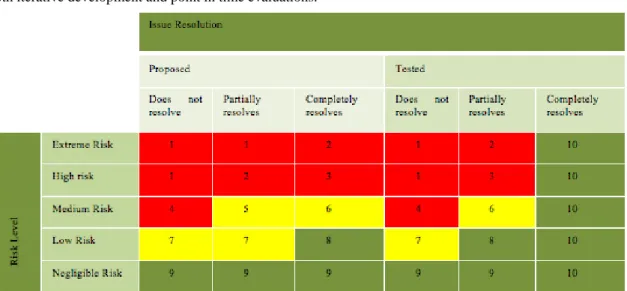
The Human Factors Readiness Level (HFRL) Scale was developed to prioritize each human factors issue identified during an evaluation based on its risk level and the status of any resolution recommended to address the issue. The overall scoring method utilizes a scale from 1 to 10, with a higher score indicating a higher level of human factors readiness. In addition, HFRL ranges were developed to facilitate a quick understanding of readiness, ranging from low (red), moderate (yellow), and high (green). While concerns such as cost and schedule impacts can influence decisions regarding system selection, interviews with practitioners revealed that such factors are not reflective of readiness [10]. A recommended solution that costs more or takes more time to implement does not
make a system’s current state more ready from a human factors standpoint than one that costs less and takes less time.
As shown in Figure 1, the left of the HFRL scoring matrix is the risk level that maps to FAA’s current risk matrix (see Table 1) that includes probability and severity of issues. At the top of the scoring matrix is Resolution Status. Issue resolutions are divided into two categories, those that have been tested and those that have been proposed, following conventions being used in product development [10]. An issue resolution recommendation can be determined to not resolve the issue, partially resolve the issue, or resolve the issue completely. The more a resolution addresses an issue, the higher the HFRL score becomes. In this way, the HFRL scoring matrix supports both iterative development and point in time evaluations.
3.2 System for Human Factors Readiness Evaluation (SHARE)
To facilitate ease of use and issue tracking over time, the HFRL scoring matrix has been integrated into a software assessment tool, the System for Human Factors Readiness Evaluation (SHARE). SHARE enables HFRL tracking over time by calculating an HFRL for (1) each issue identified, (2) each issue’s category of relevance, and (3) the system as a whole based on practitioner input.
Human factors issues are typically identified during evaluations of varying fidelity (e.g., paper and pencil heuristic evaluation through high fidelity user testing). SHARE enables tracking of these issues by allowing for
storage and manipulation of the following data surrounding each issue: data about the issue itself, the issue’s level of
risk, associated issue category(s), and resolution recommendations. SHARE guides users through entering information about the issues found in the system following an evaluation with respect to twenty-four human factors issue categories (see Table 3).
Table 3. SHARE Issue Categories
SHARE Issue Categories
Allocation of Function Documentation Input/Output Devices Special Skills and Tools Anthropometrics and Biomechanics Environment Knowledge, Skills, and Abilities Staffing
CHI Functional Design Operational Suitability Training
Communications and Teamwork Human Error Procedures Visual/Auditory Alerts Culture Information Presentation Safety and Health Workload
Displays and Controls Information Requirements Situational Awareness Work Space
SHARE captures information about each issue’s risk and any proposed changes that may have a potential or demonstrated impact on risk reduction. Dependent upon the available validation techniques or the fidelity of the system, a practitioner may empirically test the recommendation and validate it did indeed resolve the issue. Examples of these types of tests might be usability evaluations with relevant end users, measurements taken with CAD data, or other means of empirical validation. The extent to which the issue is resolved based on this measurement or test generates an updated HFRL score. As seen in Figure 1, empirical testing that demonstrates that the issue has been completely resolved progresses the HFRL score toward 10, which allows issue closure.
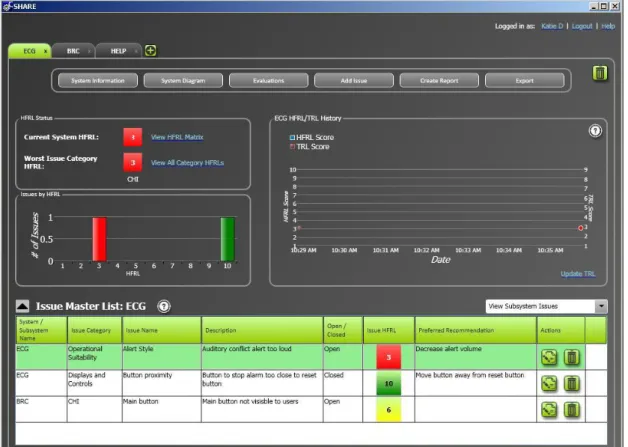
Following issue information entry, SHARE computes an HFRL for each issue based on practitioner input concerning the risk and resolution level of the issue. SHARE also computes an HFRL score for each relevant issue category based on the worst issue-level HFRL score among the issues in that category, and for the overall system based on the worst issue-level HFRL score among the issues present in the system. As issue information is updated, SHARE automatically re-calculates HFRL’s, providing a real-time indication of system human factors readiness.
SHARE’s database provides a repository for storing information about the issues identified in a system, including an issue description, its associated issue category(s), and the use case(s) under which the issue is identified. SHARE also allows cost, timing, and other information to be associated with each resolution recommendation to support the practitioner in the decision-making process. SHARE uses both the practitioner’s risk assessment for the issue and status of the chosen resolution recommendation to automatically compute an HFRL for the issue.
SHARE also provides tools to support management of a system with respect to HFRLs. In particular, SHARE provides a System Dashboard (Figure 2) that provides a summary of the status of a system with respect to HFRLs. A user can quickly view the current HFRL status of a system, the HFRL status of each issue category, and a graph representing the recent history of the system with respect to both HFRLs and TRLs. In addition, the System Dashboard also provides a master list of all the issues currently in the system, including their current HFRL.
2.Use Case
The following is an example of how a human factors practitioner might utilize HFRLs embedded in a tool such as SHARE to assist them during the system development process.
David is a system engineer with the FAA. His manager has tasked him with conducting a usability assessment for the new touchscreen radar display that is designed to support NextGen flight tracking. First, David sets up a system profile in SHARE detailing the display he is evaluating. He enters in details about the display and begins to set up his evaluations, including information about the participants he will be using to examine the display and the procedure he will walk them through. Next, he begins his evaluations, running each user through the evaluation protocol he already entered into SHARE. He uses his laptop to record issues he identifies into SHARE as he guides users through the protocol. For example, he notices that several participants accidentally hit the button to turn on the
display’s backlight when he asks them to get details about a particular flight. He creates a new issue in SHARE capturing details about this problem.
Fig. 2. SHARE System Dashboard
After the evaluation is over, David uses SHARE to examine the list of issues he identified. He makes notes in SHARE about potential ways the issues he found might be fixed. For the backlight issue, he makes a recommendation that the backlight button be moved off the display as a physical switch on the side. He notes that this resolution would most likely completely resolve the issue and would be very low cost to implement in contrast to other potential resolution methods. His initial assessment generates a system HFRL of 5. He then sends his SHARE file to his manager for review.
David's manager loads the SHARE file and sees that the display design got an overall HFRL of 5. The worst issue identified appeared unlikely to cause any major problems and did not pose any safety hazards. David's manager looks at the issue resolution recommendations David suggested and is happy to see that none of them have a high cost associated with them. David's manager uses SHARE to create a report about the display, including the issues identified, their severity, and David's suggested recommendations to share with higher-level FAA management.
David’s manager gives him feedback to test his proposed resolution recommendations in another evaluation.
David plans his evaluation and enters in its details into SHARE. During the evaluation he notes that the
recommendation seems to have worked, and that no users inadvertently activated the backlight switch during the
tasks. David updates the Issue’s HFRL to “tested” and “completely resolves”, which gives the issue an HFRL of 10. David notifies his manager that the worst outstanding issue in the system is now a concern with the sensitivity of
buttons on the touchscreen, which has an HFRL of 7. David’s manager is happy to see the HFRL of the System
improve from a 5 to a 7, and reports this progress to upper-level management.
3.Conclusions
The increasing importance of incorporating sound HSI methods in systems development and acquisition decision making is borne out of the observed impact human factors engineering can have on both safety risks to the end user or consumer of a product and the potential return on investment. Existing technical and manufacturing readiness levels and tracking systems to do adequately address human factors nor appreciate the financial impact human factors can have in the development or acquisition process. This impact calls for a quantification of human factors readiness within development and acquisition that adequately captures the risks of outstanding human factors related issues and the status of their proposed countermeasures. The Human Factors Readiness Level (HFRL) scale
developed in this project provides both risk and countermeasure status information. The HFRL scoring system has been incorporated into the SHARE issue tracking software. By utilizing HFRLs, SHARE is able to quantify each
issue’s status throughout the design or acquisition lifecycle in an effort to realize return on investment through early identification, prioritization, and rectification of issues and avoiding expensive, late-stage design changes.
Acknowledgements
The work described in this paper was supported by a small business innovation grant from the Federal Aviation Administration (FAA) (Contract DTRT57-10-C-10028).
References
[1] Federal Aviation Administration, Human Factors Acquisition Job Aid, Washington DC, 2003. [2] T. Gilb, Principles of Software Engineering Management, Addison-Wesley, 1988.
[3] RG Bias, DJ Mayhew, Cost-justifying Usability: An Update for the Internet Age, Morgan Kaufmann Publishers, San Francisco, 2005. [4] ST Sadin, FP Povinelli, R Rosen, NASA Technology Push Towards Future Space Mission Systems, Space and Humanity Conference
Bangalore India, Acta Astronautica, 20 (1989), 73-77.
[5] JC Mankins, Technology Readiness Levels, NASA: Office of Space Access and Technology, Advanced Concepts Office, 1995. [6] Department of Defense, Defense Acquisition Guidebook, Washington DC, 2010.
[7] P. Krois, J. Rehmann, Assessing Human Factors Risks in Air Traffic Management Research, Atlantic City, NJ, 2005.
[8] Federal Aviation Administration, FAA System Safety Handbook, Chapter 7: Integrated System Hazard Analysis, Washington DC, 2000. [9] Federal Aviation Administration, FAA System Safety Handbook: Appendix B: Comparative Risk Assessment Form, Washington DC, 2000. [10] Design Interactive, Inc., SHARE: System for Human Factors Readiness Evaluation Final Report, Orlando, FL, 2011.