European Online Journal of Natural and Social Sciences 2019; www.european-science.com Vol.8, No 1 (s) Special Issue on Advancement of Business and Management Science
ISSN 1805-3602
Openly accessible at http://www.european-science.com 25
Impact of Training and Supervisor Support on Organizational Commitment
with mediating role of Job Satisfaction
Muhammad Usman Ahmad1, Rizwan Qaiser Danish2, Hafiz Fawad Ali1, Rabia Shahid2, Muhammad Ahsan khan2, Kashif Nadeem3
1
Institute of Business Administration, University of the Punjab, Lahore; 2Hailey College of Com-merce, Punjab University, Lahore, Pakistan; 3National University of Modern Languages, Pakistan
E-mail: [email protected]
Abstract
Training and Supervisor support shows a very important role in growing organizational commitment. The purpose of this research is to give a hypothetical justification of: a) impact of su-pervisor support on organizational commitment, mediating part of job satisfaction for the positive connection between supervisor support and organizational commitment, b) direct impact of training on organizational commitment and job satisfaction for the positive association among training, or-ganizational commitment too. Self-administered questionnaires were distributed. The population which is targeted for this study was employees of the textile firms in Lahore. Data were collected from 320 employees. The study uses the SPSS and Structural Equation Modelling to test the hypo-theses among 320 respondents. The results indicate that there is a significant relationship between training and organizational commitment, supervisor support and organizational commitment, train-ing and job satisfaction. Supervisor support is significantly related with job satisfaction and there is a significant relationship between job satisfaction and organizational commitment.
Keywords: Job satisfaction, Supervisor Support, organizational commitment. Introduction
Organizational commitment, attitudes and job satisfaction and their association have been very important in past few decades. There are some polices of Human Resource management like polices of work-life which purpose to enhance engagement of employees, their well-beings and health such as organizational commitment do not influence their proposed effects (Henry & Beaure-gard, 2009). According to Ahmed et al., (2014) organizational commitment has significant impact on job satisfaction. Moreover, it is important that trainee are proficient of emerging unique learning developed which is from training programs in their daily work (Wenzel & Cordery, 2014). Accord-ing to (Hutchins et al., 2013; Pham et al., 2013) stated that much not trainees apply their skills effec-tively on new learning jobs. Although several aspects of job satisfaction have been examined widely in the experimental writing, regardless of whether there exist overflow externalities in work fulfillment – i.e., whether singular level occupation fulfillment is influenced by the total occupation fulfillment in a specific work advertise condition – or not stays as an unanswered inquiry. This is an important inquiry since work fulfillment is frequently connected with work environment states of mind, for example, contribution in the association, relatedness with col-leagues/clients/administrators, connection, inspiration, avoiding, propensity to back off work, truancy, and so on. These states of mind frame a work environment "air" and mutually add to the arrangement of laborer fulfillment and execution. Consequently, the total employment ful-fillment level in a specific workplace can be viewed as a "social" variable and may, thus, influ-ence singular level occupation fulfillment
Muhammad Usman Ahmad, Rizwan Qaiser Danish, Hafiz Fawad Ali,Rabia Shahid, Muhammad Ahsan khan, Kashif Nadeem
Openly accessible at http://www.european-science.com 26 Literature review
The literature review shows the Impact of variables on each other. It shows that whether they have a positive impact on each other or negative impact and what is the intensity of impact on other variables.
Training
The present business circumstance appears, apparently, to be described by high strength among affiliations, exhibit globalization and imaginative movement. To make due in such trouble-some conditions, affiliations need to search for the possible ways to deal with make viable high grounds. In this particular circumstance, the learning and capacities of delegates in an affiliation's have logically ended up being extremely principal to its execution, overall force, moreover, relent-less headway (Elnaga and Imran, 2013). One way to deal with make and upgrade the idea of agents is to outfit them with supportive planning and change programs. This is in light of the fact that the limits, data, and aptitudes of the gifted laborers were ended up being the key determinants high ground in overall business focuses (Becker, Bose, and Freeman, 2006). To suitably develop such learning, capacities and limits of Workers with a particular ultimate objective to perform well at work, planning programs are indispensable in supporting every single legitimate Individual (Peter-sen, Kruss, Gastrow & Nalivata, 2018). Hafeez and Akbar (2015) point by point that that the more the laborers get setting up, the more beneficial their level of execution would be and more their re-sponsibility will be towards the association. . Preparing has been found to associate with improving occupation fulfillment and representative expectation to remain. The inspirations driving this inves-tigation were to look at the wants and impression of getting ready quality between hotel directors and specialists, and to propose recommendations for improving planning quality and growing plan-ning satisfaction, work satisfaction, and objective to stay among delegates in the motel business. The connected model of this examination was made subject to SERVQUAL and the Service Profit Chain show. T-test exhibited that delegates saw low planning quality, which suggested specialists were not content with getting ready quality and that readiness quality required change. Eventual outcomes of backslide examination showed that arrangement was positively related to getting ready satisfaction and occupation satisfaction. Occupation satisfaction drove unequivocally to objective to remain (Lucrezi, Milanese, Danovaro & Cerrano, 2018). The underhanded effect of planning quality on ex-pect to remain was interceded by business satisfaction. This examination proposes simply more cognizance of the criticalness of getting ready quality and its results, and to give watchful thought to laborer planning.
Organizational commitment
In the event that organizations need to hold these surviving employees, they have to discover approaches to persuade surviving representatives to stay after downsizings. Unfortunately, next to no exploration advises how associations can hold survivors. This examination, thusly, has the larger goal of attempting to enable associations to persuade survivors to stay following a cutting back by expanding their authoritative responsibility. Expanded hierarchical responsibility results in dimi-nished turnover expectations, and, at last, bring down wearing down (Lasch, 2018). Powerful ad-ministrative correspondence and convincing help can reduce a portion of the negative impacts of downsizings. Nonetheless, persuading survivors to stay in an association requires a comprehension of the reasons why representatives leave their association following cutting back and a comprehen-sion of worker bolster offered by the association. The examination of the connection between orga-nizational commitment and training is still in its beginning periods. In spite of the fact that there have been a few investigations provided details regarding preparing and hierarchical duty in West-ern nations, almost no has been done in regard of the neighborhood experts in Malaysia. This ex-amination explores the relationship between five preparing factors (accessibility of preparing,
Special Issue on Advancement of Business and Management Science
Openly accessible at http://www.european-science.com 27
ster for preparing, inspiration to get the hang of, preparing condition and saw advantages of prepar-ing), and different parts of hierarchical duty (full of feeling responsibility, regularizing responsibili-ty, continuation duty and generally authoritative responsibility). The accessibility of preparing, bol-ster for preparing, inspiration to pick up, preparing condition, saw advantages of preparing were all essentially related with full of feeling responsibility, regularizing duty and generally hierarchical duty. The preparation condition and saw benefits were additionally essentially connected with dura-tion responsibility. Anyway the accessibility of preparing, bolster for preparing and inspiradura-tion to learn were not altogether corresponded with duration duty. This proposes notwithstanding different types of duty, Malaysian laborers don't feel that they have to stay in an association that has made accessible the preparation, given help for the preparation and were inspired to learn. Something else, results recommend that in general, preparing seems to have an effect on hierarchical responsibility. The commonsense ramifications of this is directors, who are so burning of improving hierarchical responsibility among their subordinates, should give careful consideration to preparing.
Job Satisfaction
Researchers in classified examinations have for quite some time been keen on why certain individuals are happier with their occupations than others (Ellickson, 2002). Occupation fulfillment indicates to a representative's general evaluation of his or her work and work related encounters, which is affected by a person's qualities, standards and convictions (Baron, 1976; Chan et al., 2004). The estimation of occupation fulfillment is critical as "associations with fulfilled workers prompt fulfilled clients" (Rust et al., 1996, p. 63). In spite of the across the board enthusiasm for work ful-fillment among specialists and experts, there has been until now restricted consideration dedicated to clarifying variety in work fulfillment among diversified store representatives. Research concerning the association between work satisfaction and occupation design has, all things considered, been set-tled through an instrument called the Job Diagnostic Survey. The Job Diagnostic Survey, made by Hackman and Oldman in 1975, assessed laborers' perspective of five occupation estimations includ-ing capacity arrangement, errand character, freedom, info and task centrality (Pierce et al., 1986). An examination by Marchese (1998) found a strong association between work worth and occupation layout, with pay immovably influenced by capacity and obligation. Occupation fulfillment has been turned out to be a standout amongst the most unmistakable element an association cares for with the end goal to support its execution. The reasons for this figured paper is to give a theoretical method for thinking about: a) snappy effect of crucial lift on occupation satisfaction; and b) the planning ac-tion of sensibility observaac-tion. for instance, laborer commitment, obligaac-tion, diverse leveled citizen-ship organize, information sharing, etc. Business fulfillment of a man can be assessed worried in everything thought about fulfillment or fulfillment with segments of the work (Gupta 2014). With a general technique, in any case, can't tell what parts of an occupation the authorities like or agitation. Satisfaction by points of view can show a progressively broad picture of occupation satisfaction with respect to the general procedure.
Supervisor Support
Supervisor and coworker support are probably going to build workers' full of feeling and standardizing duty because of the enthusiastic bonds. Wang (2008) revealed in a few societies, en-thusiastic bonds created among workers prompt sentiments of feeling of commitment and obligation which expands inspiration to help each other. Such passionate securities lead representatives to par-ticipate with one another in finishing assignments which thusly enhances the workers' duties towards the association. In this manner in this unique circumstance, it tends to be recommended that the pos-itive connection between boss help or colleague bolster for preparing and representative authorita-tive duty is because of that sentiment of commitment and obligation (borne out of enthusiastic
Muhammad Usman Ahmad, Rizwan Qaiser Danish, Hafiz Fawad Ali,Rabia Shahid, Muhammad Ahsan khan, Kashif Nadeem
Openly accessible at http://www.european-science.com 28 bonds) between workers. Manager bolster assumes a considerable job in worker work fulfillment. The reasons for this figured paper is to give a hypothetical procedure for thinking about: a) prompt effect of manager strengthen on occupation fulfillment; for instance, specialist commitment, obliga-tion, diverse leveled citizenship arranges, information sharing, etc. Official fortify suggests as the head exhibition in helping their representative to layout the aptitudes, learning, and viewpoints hoard from the game plan program (Rhea-des and Eisen-Berger, 2002). According to Bhatti et al. (2013), chief recognize essential occupations in getting ready ampleness. aftereffect of info is in-conspicuously seen as a bit of overseer help whereby the chief see which region of their lords ought to be improved, asking for that they join the masterminding program, in addition, help them with applying as far as possible in the wake of completing their action. Other than that, Ismail et al., (2010) imparted that executive is besides in charge of scattering fiscal plan for their worker's forma-tive reason. This is on the grounds that, everybody has the rights to collect their understanding, apti-tudes, and limits, and likewise, this must be drilled when they experience the arranging program given by the connection. Further, Goleman (2000) alluded to that inconceivable official ought to be able to make reachable targets, spread inspirational points of view exhaustive out the connection, and also increment the representatives' consideration on why the status is on a to a great degree prin-cipal measurement fundamental for them. Dependably, these goals are reachable if the principle gives full help to their authorities.
Conceptual Framework
Figure: 1 Hypothesis:
H1: There is significant relationship among training and organizational commitment. H2: There is significant relationship among supervisor support and organizational commit-ment.
H3: There is significant association among training and job satisfaction.
H4: There is significant association among supervisor support and job satisfaction.
H5: There is significant association among job satisfaction and organizational commitment. H6: Job satisfaction will mediate the association among supervisor support and Organiza-tional commitment.
H7: Job satisfaction will mediate the relationship between supervisor support and Organiza-tional commitment.
Methodology
Survey method is used as a research design to avail the data in short period of time and for that self-administered questionnaires were used for the collection of data. Individual’s employee
uti- Organiza-tional Commitment
Job Satisfaction
Training
Supervisor sup-port
Special Issue on Advancement of Business and Management Science
Openly accessible at http://www.european-science.com 29
lized as unit of analysis. The time framework of this study was Cross-sectional due to data gathered only one time. The study setting was non-contrived due to the minimal interference of the research-er. The population which is targeted for this study was employees of the textile firms in Lahore, Pa-kistan. Total sample size of the study was 320 respondents. 350 Questionnaire distributed among employees of the firm in which 293 questionnaire were completely filled, 57 were excluded because they were incomplete. Sample size was selected through item response theory. Non-probability con-venience sampling was used due to unknown population. Primary data was collected through admi-nistered questionnaire.
Analysis
The value of mean, Cronbach alpha α, correlation and standard deviation is given in the table 1, showing their range and variation within the range.
Table 1: The value of mean, Cronbach alpha α, correlation and standard deviation.
Variables Mean S.D α SP OC JS T
SP 3.47 .933 .945 1 0.466** .240** .404**
OC 3.25 1.15 .962 .466** 1 .457** .695**
JS 3.32 1.14 .887 .240** .457** 1 .105
T 3.49 1.03 .892 .404** .695** .105* 1
Above table shows the relationship among variables. Supervisor support is significantly and positively related with organizational commitment at r= .466 with the level of 0.05. Moreover, su-pervisor support is positively and significantly related with job satisfaction at r= .240 with the level of 0.05. This also shows that supervisor support is significantly and positively related with training at r= .404 with the level of 0.05.
Further, organizational commitment is positively and significantly related with job satisfac-tion at r= .457 with the level of 0.05. Organizasatisfac-tional commitment is positively and significantly re-lated with training at r= .695 with the level of 0.05. So, job satisfaction is significantly and positive-ly related with training at r= .105 with the level of 0.01.
Confirmatory Factor Analysis
After checking the correlation analysis, the further step is to examine the measurement mod-el. In 1998, Kelloway stated that minimum two factors should be used as latent variable.
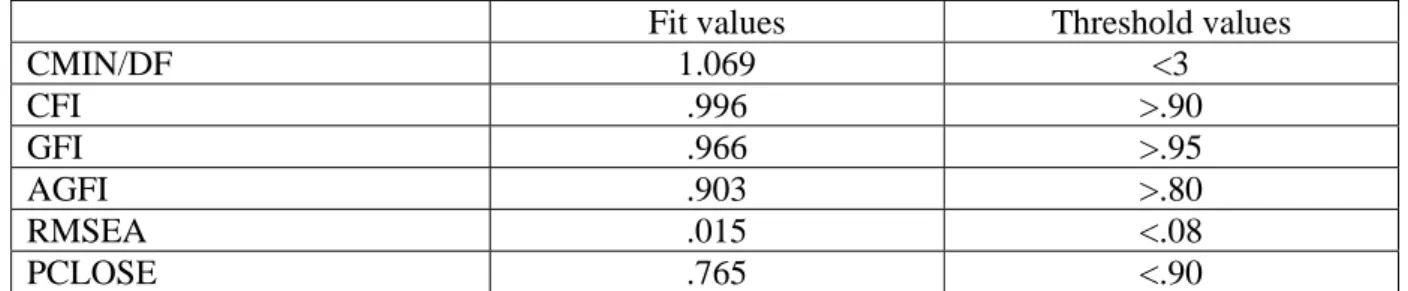
Table 2. Fit Summary.
Fit values Threshold values
CMIN/DF 1.069 <3 CFI .996 >.90 GFI .966 >.95 AGFI .903 >.80 RMSEA .015 <.08 PCLOSE .765 <.90
Model fit was tested through various statistics (Comparative fit index, Root mean square of errors, Goodness of fit, Average goodness of fit, chi square). These all values show the fitness of good of the model and these all are according to threshold values which is suggested by (Hu & Bentler, 1999).
Muhammad Usman Ahmad, Rizwan Qaiser Danish, Hafiz Fawad Ali,Rabia Shahid, Muhammad Ahsan khan, Kashif Nadeem
Openly accessible at http://www.european-science.com 30 Measurement Model
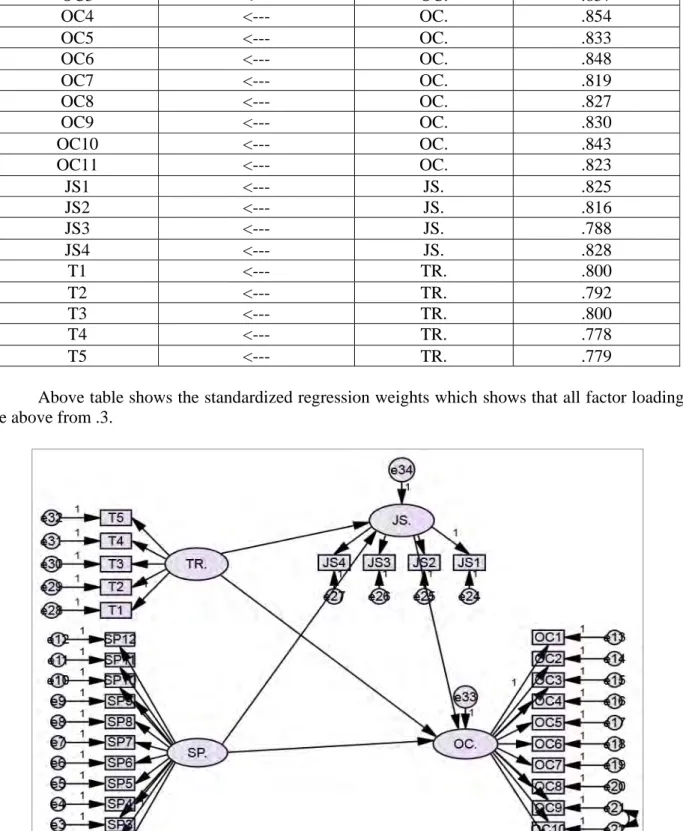
Figure 2: Measurement Model Table 3: The standardized regression weights
Estimate SP1 <--- SP. .805 SP2 <--- SP. .513 SP3 <--- SP. .798 SP4 <--- SP. .787 SP5 <--- SP. .793 SP6 <--- SP. .766 SP7 <--- SP. .781 SP8 <--- SP. .793 SP9 <--- SP. .797 SP10 <--- SP. .771 SP11 <--- SP. .783 SP12 <--- SP. .799 OC1 <--- OC. .839 OC2 <--- OC. .823
Special Issue on Advancement of Business and Management Science
Openly accessible at http://www.european-science.com 31
OC3 <--- OC. .837 OC4 <--- OC. .854 OC5 <--- OC. .833 OC6 <--- OC. .848 OC7 <--- OC. .819 OC8 <--- OC. .827 OC9 <--- OC. .830 OC10 <--- OC. .843 OC11 <--- OC. .823 JS1 <--- JS. .825 JS2 <--- JS. .816 JS3 <--- JS. .788 JS4 <--- JS. .828 T1 <--- TR. .800 T2 <--- TR. .792 T3 <--- TR. .800 T4 <--- TR. .778 T5 <--- TR. .779
Above table shows the standardized regression weights which shows that all factor loadings are above from .3.
Muhammad Usman Ahmad, Rizwan Qaiser Danish, Hafiz Fawad Ali,Rabia Shahid, Muhammad Ahsan khan, Kashif Nadeem
Openly accessible at http://www.european-science.com 32 Table: 4 Standardized Regression Weights
Table: 5 Mediation Table
Variables Direct Beta Without Mediation
Direct Beta with Mediation
Indirect Beta Results T---- JS--- OC .829*** .733*** .061*** Partial Media-tion SP--- JS---- OC .071*** .389*** .119*** Partial Media-tion Conclusion
This paper demonstrated that there is a significant relationship between training and organi-zational commitment, supervisor support and organiorgani-zational commitment, training and job satisfac-tion, supervisor support is significantly related with job satisfaction and there is a significant rela-tionship between job satisfaction and organizational commitment. Bootstrapping strategy was used for the mediation analysis. The results indicate that job satisfaction mediates the relationship be-tween training and organizational commitment (β= .733, 0.001). Job satisfaction also mediates the relationship between supervisor support and organizational commitment (β= .389, 0.001). Research such as that presented in the current paper provides further theoretical and practical knowledge to this important area.
Limitations and future directions of the study
The major limitation of this study is the generalizability of the results. In spite of the fact that sup-port was on a willful premise, bank administration impact may have reduced the generalizability of the examination (in spite of the fact that the members were totally educated before finishing the sur-vey). Beside this, the information was gathered at one point in time (i.e. cross-sectional), which leaves space for hypothesis and does not permit the researcher to decide causality among variables. Just longitudinal research can sufficiently unravel circumstances and end results. Accordingly, a longitudinal study is suggested for future researches.
References
Ahmad, M. B., Ali, H. F., Malik, M. S., Humayun, A. A., & Ahmad, S. (2019). Factors Affecting Impulsive Buying Behavior with mediating role of Positive Mood: An Empirical Study. Eu-ropean Online Journal of Natural and Social Sciences, 8(1), pp-17.
Allen, N.J. and Meyer, J.P. (1996). Affective, continuance, and normative commitment to the organization: an examination of construct validity, Journal of Vocational Behavior, 49(3), 252‐276
Baron, R.A. (1976). Behavior in Organizations, Allyn & Bacon, Boston, MA.[Google Scholar] Baldwin, T. T., & Ford, J. K. (1988). Transfer of training: A review and directions for future
re-search. Personnel Psychology, 41(1), 63-105.
Bluedorn, A.D. (1982). A unified model of turnover from organizations, Human Relations, 35(2), 135‐153. Estimate P JS. <--- TR. .012 .*** JS. <--- SP. .301 *** OC. <--- SP. .071 .*** OC. <--- TR. .829 *** OC. <--- JS. .473 ***
Special Issue on Advancement of Business and Management Science
Openly accessible at http://www.european-science.com 33
Bhatti, MA., Mohamed Battour, M., Pandiyan Kaliani Sundram, V., & Aini Othman, A. (2013). Chan, M.J., Pan, Z.D. and Lee, L.F.F. (2004), Professional aspirations and job satisfaction:
Chinese journalists at a time of change in the media, Journalism and Mass Communica-tion Quarterly, 81(2),
Chen, P., Sparrow, P., & Cooper, C. (2016). The relationship between person-organization fit and job satisfaction. Journal of Managerial Psychology, 31(5), 946-959.
Ellickson, M.C. (2002). Determinants of job satisfaction of municipal government em-ployees, Public Personnel Management, 31(3)
Elnaga, A., & Imran, A. (2013). The effect of training on employee performance. European Journal of Business and Management, 5(4), 137-147.
Goleman, D. (2000). Leadership that gets results. Harvard Business Review, 78(2), 4-17.
Gupta, M., Kumar, V., & Singh, M. (2014). Creating satisfied employees through workplace spiri-tuality: A study of the private insurance sector in Punjab (India). Journal of Business Ethics, 122(1), 79-88.
Hafeez, U., & Akbar, W. (2015). Impact of training on employee’s performance (Evidence from pharmaceutical companies in Karachi, Pakistan). Business Management and Strategy, 6(1), 49-64.
Ismail, A., Hasan, A. B. M., & Sulaiman, A. Z. (2010). Supervisor’s role as an antecedent of train-ing transfer and motivation to learn in traintrain-ing programs. Economica, 7(2), 18-37.
King, J. E., & Williamson, I. O. (2005). Workplace religious expression, religiosity and job satisfac-tion: Clarifying a relationship. Journal of Management, Spirituality & Religion, 2(2), 173-198.
Meyer, J. P., & Allen, N. J. (1997).Commitment in the workplace: Theory, research, and applica-tion. Thousand Oaks, CA: Sage
Millán, J. M., Hessels, J., Thurik, R., & Aguado, R. (2013). Determinants of job satisfaction: a Eu-ropean comparison of self-employed and paid employees. Small Business Economics, 40(3), 651-670.
Mowday, R., Steers, R. and Porter, L. (1982). Employee‐Organization Linkages: The Psychol-ogy of Commitment, Absenteeism, and Turnover, Academic Press, New York, NY. Putter, S. E. (2013). Making training stick : a close examination of how trainee readiness, supervisor
support, and practice foster transfer in a mobile technology based training, International Journal of Academic Research in Business and Social Sciences, 7(3)
Rhoades, L., & Eisenberger, R. (2002). Perceived organizational support: a review of the literature: American Psychological Association. 84(4), 698-714.
Rizwan Qaisar, Dr., Ali, Qazi. , Mahmood, Tayyaba. , Qaseem, Shumaila. , Ali, Hafiz Fawad & Ahmad, Muhammad Bilal. (2019). Paper (JOHMR). 10.30876/JOHR.4.4.2018.136-148. Somers, M.J. (1995), Organizational commitment, turnover and absenteeism: an examination of
direct and interaction effects, Journal of Organizational Behavior, 15(1), 49‐58.
Syed, Aleena. , Ahmad, Muhammad Bial., Ali, Hafiz Fawad. , Muhammad Arif, Mian & Gohar, Amna. (2018). Work-Family Conflict and Turnover Intentions: Moderated Mediation Model. Human Resource Research. 2. 95. 10.5296/hrr.v2i1.13925.
Wang, Y. (2008), Emotional bonds with supervisor and co-workers: relationship to organiza-tional commitment in China’s foreign-invested companies, The Internaorganiza-tional Journal of Human Resource Management, 19(5),
Van der Klink, J., Blonk, R., Schene, A. H., & Van Dijk, F. (2001). The benefits of interventions for work-related stress. American journal of public health, 91(2), 270-281.