UNVEILING THE EXPECTED LOSS MODEL IN IFRS 9 AND CIRCULAR 4/2017
Jorge Pallarés Sanchidrián and Carlos José Rodríguez García (*)
This article is the exclusive responsibility of the authors and does not necessarily reflect the opinion of the Banco de España or the Eurosystem.
(*) Both authors work at the Directorate General Banking Supervision at the Banco de España. We appreciate the help of Paco Manzano and the comments received from Pedro Comín.
UNVEILING THE EXPECTED LOSS MODEL IN IFRS 9 AND CIRCULAR 4/2017
As a result of the Great Financial Crisis, the G-20 requested that the accounting standard setters change the model for estimation of credit losses (or “provisions”). Following this mandate, the “expected loss” model replaced the “incurred loss” model in order to favor a more timely and adequate estimation of credit losses. We explain that, from a conceptual perspective, the expected loss model may help to achieve this goal because it requires credit losses to be recognized from the origination of the transaction and the level of provisions to be increased when the credit quality of the transaction worsens but it has not defaulted. The scant data available so far seem to confirm these conceptual insights. Some criticisms of the expected loss model allude to its pro-cyclicality, without considering that an efficient accounting standard should not repress volatility, by giving a false image of stability, as the incurred loss model did. The expected loss model allows for greater subjectivity in its application, but this subjectivity must be understood in a positive manner so as to anticipate more accurately future credit losses, not leaving room for earnings management practices. We campaign for an adequate implementation of the standard as an essential tool to achieve the objectives of all stakeholders (preparers, auditors, regulators and supervisors).
In the undertow of the global financial crisis in 2008, G-20 leaders asked for to change the “incurred loss model” in International Accounting Standard 39 (IAS 39), which they criticized as a “too little and too late” recognition of credit losses. To overcome this inefficiency, International Financial Reporting Standard 9 (IFRS 9) introduced a new accounting impairment framework based on an “expected loss” model.
Financial reports seek to provide useful information to a large number of users, investors being the primary users. In this regard, it is crucial to underpin the objective, usefulness and limitations of financial reporting gathered under the IFRS Conceptual Framework. For accounting standard setters, as commented by Hoogervorst (2017), their primary goal is to develop standards that bring transparency, accountability and efficiency to financial markets. In doing so, they encourage not only trust and growth, but they also support the long-term financial stability of the global economy. However, fostering financial stability is not the primary aim of accounting standards. It is primarily the remit of prudential regulators and supervisors, whose task is to safeguard the solvency of the financial system.
It could be argued that the incurred loss model led to adverse effects on the relevance of financial information and on financial stability. These adverse effects are a manifestation of “the great turkey problem” posed by Taleb (2012).1 A turkey is fed regularly by a butcher; every day that passes, the turkey confirms “with increased statistical confidence” that the grain is delivered by the butcher in due course; until a day before Christmas Eve2 when the butcher not only does not feed the turkey but dispatches it to the poultry store. The turkey uses evidence, ignores Christmas Eve, and makes future projections based on the past. “The great turkey problem” illustrates critical deficiencies in risk management practices, the most important deficiency is the fragility of the modelling of non-linear damaging
1 Nassin Nicholas Taleb is famous for developing the “Black Swan” Theory.
2 In Taleb’s (2012) example the crucial day is Thanksgiving. The authors have used Christmas Eve to make it easier to understand by readers outside the USA.
Abstract
1 Introduction
1.1 OBJECTIVE
OF THE ACCOUNTING INFORMATION
1.2 INCURRED LOSS MODEL DEFICIENCIES
phenomena relying only on historical information: volatility is smoothed to create the illusion of stability (not real stability) with devastating consequences when the repressed volatility is released. In short, the danger arises from the belief that the system is safe derived from an unbridled confidence in models based on historical data, which exclude events that have not occurred yet and compress volatility.
From the accounting point of view, it became clear that the incurred loss model gave too much leeway to banks to postpone recognizing inevitable loan losses for too long. Nevertheless, as Giner and Mora (2016) pointed out, some voices argued that during the recent financial crisis the “too little and too late” problem could have been avoided, at least partly, if the incurred loss model had been applied much more vigorously.
The principal standard setters – the International Accounting Standards Board (IASB) and the Financial Accounting Standards Board (FASB) – fulfilled the mandate from the G-20 and issued respectively: IFRS 9 in July 2014 and ASC 326 in June 2016. In the European context, IFRS 9 was incorporated into the European Union (EU) regulatory framework in November 2016 (“endorsed” in the EU jargon) and became mandatory from 1 January 2018 onwards. Whilst the American standard is expected to come into force on 15 December 2019 for “SEC filers” (institutions that are required to make regular submissions of financial information to the Securities and Exchange Commission) and on 15 December 2020 for other institutions.
IFRS 9 supersedes IAS 39 and amends it in two fundamental areas: the classification criteria for measurement purposes of financial assets and the introduction of an expected credit loss approach for the estimation of credit losses. In this context, following Hoogervorst (2018), IFRS 9 should have a preventative effect, because it will lead to a much quicker crystallization of loan losses and will contribute to an improvement of credit quality control systems in the banking industry. Besides, timely loan loss recognition will promote more prudent dividend distribution and remuneration policies.
According to Regulation (EC) 1606/2002, all issuers of listed securities, regardless of their sector of activity, must apply the IFRSs endorsed by the EU (IFRS-EU) in the preparation of their public consolidated accounts. This Regulation leaves it to the discretion of each Member State to choose from the following options for the preparation of the consolidated accounts of the unlisted entities and the individual accounts:
– require the application of IFRS-EU;
– develop a national accounting standard or National GAAP (Generally Accepted Accounting Principles); or
– allow entities to choose between the above two options consistently.
In Spain, under Article 43 bis of the Commercial Code, unlisted groups can choose between the two options (IFRS-EU or National GAAP) for the consolidated accounts; and, for the individual accounts, the sectoral accounting standard setter has developed a national accounting framework.
The Banco de España, in the exercise of its competences as a sectoral standard setter bestowed by Law 5/2014, issues mandatory accounting standards (“Circulars”) with the scope discussed above. Since 2004, given the adoption of IFRS by the EU, the Banco de
1.3 OVERCOMING DEFICIENCIES
España has followed a strategy based on aligning its accounting standards with the IFRS as adopted by the EU (IFRS-EU). Thus, by applying Spanish standards, international standards will also be applied.
Pursuant to the principle of effectiveness, by aligning Spanish GAAP for credit institutions with IFRS-EU, the Banco de España avoids the burden arising from the co-existence of two different accounting frameworks which are applicable to the same credit institution. Furthermore, the application of compatible accounting frameworks at both individual and consolidated level makes it easier for the users of financial reporting, including the Banco de España, as well as the European Central Bank (ECB) and the European Banking Authority (EBA), to analyze and understand credit institutions’ financial position and performance.
Finally, this strategy of alignment with IFRS-EU allows accounting developments at EU level to be incorporated promptly into Spanish GAAP for credit institutions. In this way, the quality of the Spanish GAAPs for credit institutions is comparable to that of the “benchmark” European Framework.
In the area of estimation of credit losses, the Circular, specifically Annex 9, incorporates additional guidance aimed at increasing the consistency of outcomes across Spanish institutions.
The next section includes a general scheme of the valuation of financial assets in IFRS 9 and Annex 9. Section 3 describes the classification of assets for the estimation of credit losses, debunking some critics with regard to the possible pro-cyclicality of the standard. Section 4 explains how to estimate expected credit losses and some principles for fostering proper implementation. Section 5 concludes and suggests areas of future research.
1.5 STRUCTURE OF THE ARTICLE
FIGURE 1
LISTED
Consolidated accounts Individual accounts
NON-LISTED
Mandatory IFRS Member State discretion:
— Mandatory IFRS — Option IFRS or National
GAAP
— Mandatory National Gaap Member State discretion:
— Mandatory IFRS — Option IFRS or National
Gaap
— Mandatory National Gaap
Member State discretion: — Mandatory IFRS — Option IFRS or National
Gaap
— Mandatory National Gaap Spanish option for individual accounts (listed and non-listed): Mandatory National GAAP.
Spanish option for consolidated accounts (non-listed): Voluntary IFRS or National GAAP. Comercial Code approved by Spanish Parliament.
EU ACCOUNTING ARCHITECTURE: REGULATION 1606/2002 (ART. 4 & 5)
IFRS 9 contains major changes to the classification for measurement of financial assets in comparison with IAS 39. In these new valuation requirements, the measurement basis depends on the institution’s business model for managing groups of financial assets and the contractual cash flow characteristics of the latter. The more principles-based approach of IFRS 9 requires the careful use of judgment in its application, which could lead to discretionary application.
Therefore, financial assets must be classified in the following “portfolios”:
– Amortised cost (AC) applies to “plain vanilla” debt instruments (e.g. loans and bonds) for which an entity has a business model to hold the financial asset to collect the contractual cash flows; to be eligible for classification in this portfolio, the contractual cash flows of the debt instrument must be Solely Payments of Principal and Interest (SPPI) on the principal amount outstanding consistent with a basic lending arrangement.
– Fair value through other comprehensive income (FVOCI) applies to “plain vanilla” (SPPI) debt instruments that are held within a business model whose objective is achieved by both collecting contractual cash flows and selling financial assets. – Fair value through profit or loss (FVPL) applies to financial instruments for which
the entity’s business model is different to those described above such as when the financial assets are held for trading or managed on a fair value basis.
Figure 2 shows the relationship between these different portfolios and their impairment model.
As reflected in the table above, impairment is recorded on traditional banking assets (loans and bonds) following an expected loss model according to IFRS 9 requirements. In general terms, the vast majority of banks’ financial assets will be subject to impairment [according to European Banking Authority (2018) about 80% of them are measured at amortised cost], to a greater or lesser extent depending on the institutions’ business model. This scheme is shared by the principal international standard setters (IASB and FASB), but with important dissimilarities that stem from the different business models of American and European banks. In Europe, the practice is for banks to keep originated loans on their books until maturity (originate-to-hold model), so their preference is for matching the cost of credit with the interest income over the expected life of the loan. By contrast American banks generally securitize and sell their originated loans in a short period of time (originate-to-distribute model), so the FASB’s main goal is to ensure that allowances are recorded immediately, as pointed out by Giner and Mora (2016).
The different business models affect the share of financial assets under the impairment framework. More than 80% of European banks’ financial assets are measured at amortised cost whereas American banks maintain 60% of their assets in this portfolio, according to Chae et al. (2018).
Before the standard came into force, there were warnings from some quarters that, on first-time application a system-wide sizable increase in provisions associated with expected credit losses could be anticipated [see, among others, Deloitte (2016), Autonomous (2016), Barclays (2017) and European Banking Authority (2016 and 2017)]. 2 Valuation of financial assets 2.1 CLASSIFICATION OF FINANCIAL ASSETS FOR VALUATION 2.2 FINANCIAL ASSETS SUBJECT TO IMPAIRMENT
This may have undesired pro-cyclical effects via banks’ profits and regulatory capital. It is pertinent to note that the first two impact assessments (IA) performed by the EBA (before IFRS 9 came into force) were based on estimates provided by the banks themselves, whilst the third IA [European Banking Authority (2018)]3 is based on 2018 data reported by banks to competent authorities (COREP and FINREP templates) and supplemented by public disclosures where possible.
The fear of a deep impact has proved wrong, especially, with regard to the increase in “provisions”, as indicated in Figure 3. According to the European Banking Authority (2018)
3 For European Banking Authority (2017) and European Banking AuthorityA (2018), we have taken into account the results shown by IRB entities in order to facilitate comparison with the rest of the surveys where the sample included mainly IRB banks.
SOURCE: Authors’ own elaboration.
FIGURE 2
Financial Assets at Amortised Cost (AC) (loans and bonds)
Impairment IFRS 9 expected loss model
Financial Assets at fair value through other comprehensive income (FVOCI) (loans and bonds)
Financial Assets at fair value through other comprehensive income (FVOCI) (equity)
Financial Assets at fair value through profit and loss (FVPL) (bonds, equity and derivates)
Without impairment CLASSIFICATION AND IMPAIRMENT
0 8.3 16.6 24.9 33.2 41.5 49.8 0% 5% 10% 15% 20% 25% 30%
Deloitte Autonomous EBA 1st IA Barclays EBA 2nd IA EBA 3rd IA
INCREASE IN “PROVISIONS” IMPACT ON CET-1 (right-hand scale)
IFRS 9 FIRST IMPACT FIGURE 3
the increase in “provisions” as at day-one (1 January 2018) was on simple average 11%.4 The reported negative day-one impact on CET-1 was on simple average 19 bps, in this case, lower than the EBA 2nd IA (2017) of 32 bps.5
Another argument that reinforces our message lies in the use of the transitional arrangements issued under Article 473 of Regulation (EU) 575/2013 on prudential requirements for credit institutions and investment firms (CRR). Many credit institutions have not resorted to using the CRR transitional arrangements concerning IFRS 9 impairment. Specifically, the majority of large institutions – in the EBA sample (57%) – are not using transitional arrangements [EBA 3rd IA (2018)].
As pointed out by Giner and Mora (2016), there were differences during the drafting period between the principal accounting regulators (IASB and FASB), in line with those discussed in Section 2.2. The IASB insisted on the importance of reflecting the relationship between pricing and expected credit losses, while the FASB focused on developing a high level of allowances for expected losses, which is more aligned with the objectives of prudential supervisors.
Figure 4 provides a brief explanation of impairment recognition under IFRS 9 for credit losses and interest revenue on financial assets depending on their credit risk.
For these purposes, financial assets are allocated to three credit risk categories that are widely known as “stages” (although this term is not used in the standard).6 Depending on the stage to which transactions are allocated, credit losses and interest income are calculated differently:
– “Stage 1”. At origination, institutions shall recognize – for all exposures – a loss allowance for an amount equal to 12-month expected credit losses (12-month ECL). This applies to financial assets without a significant increase in credit risk since initial recognition or that have low credit risk at the balance sheet date. The 12-month ECL are the estimated cash shortfalls during the life of the exposure derived from default events which may occur in the 12 months following the balance sheet date. That is, the 12-month ECL is the product resulting from multiplying the probability of default over a 12-month horizon by the severity of the loss in default. The 12-month ECL are defined as the future losses associated with the probability of default in the next 12 months (not the cash shortfalls expected in the next 12 months). Interest revenues are accrued over the gross carrying amount of the exposure.
– “Stage 2”. This is when there is a significant increase in the credit risk (SICR) of the exposure but default has not yet occurred. Examples of events that indicate a SICR could be significant are negative changes in: i) internal credit risk indicators (e.g. “scoring”), ii) external credit risk indicators (“rating”), iii) the probability of default; furthermore, the existence of amounts past-due shall be a backstop (rebuttable presumption) for classification under stage 2. In these cases, institutions recognize a loss allowance at an amount equal to lifetime 4 In European Banking Authority (2018) the simple average for all the banks in the sample was 9%, while the
negative impact on CET-1 for all the banks in the sample was 47 bps.
5 In European Banking Authority (2017), the negative impact on CET-1 for all the banks in the sample was 42 bps. 6 Together with this general approach that requires the allocation in “stages”, IFRS 9 also incorporates a specific
approach for Purchased or Originated Credit Impaired (POCIs) financial assets.
3 Classification of exposures for the estimation of credit losses
3.1 CLASSIFICATION OF EXPOSURES BY CREDIT RISK
expected credit losses. This amount should include the estimated cash shortfalls during the life of the exposure derived from default events which may occur over its residual life until maturity. That is, the Lifetime ECL is the product resulting from multiplying the probability of default over a horizon equal to the life of the exposure by the severity of the loss in default. Interest revenues are accrued over the gross carrying amount of the exposure.
– “Stage 3”. When a default event occurs, institutions shall recognize a loss allowance for the amount of the estimated cash shortfalls during the life of the exposure. That is, in these cases the Lifetime ECL is equal to the severity of the loss in default. Interest revenues are accrued over the (net) carrying amount (that is, the gross carrying amount minus the loss allowance) of the exposure.
As Bellini (2019) mentions, the definition of significant increase in credit risk since initial recognition plays a key role throughout the entire IFRS 9 process. SICR is the trigger on which the impairment recognition pivots and the event that allows a leap from the twelve-month expected credit loss to the lifetime expected credit loss. It is of vital importance that the institutions develop consistent policies in the recognition of the events, which give rise to both the significant increase of credit risk and the default. These events may include quantitative and qualitative indicators.
Meanwhile, generally in the context of Spanish individual financial statements, Annex 9 goes beyond IFRS 9 in the development of credit risk categorization and, under the umbrella of the international standard, includes more detailed factors for classification into and out of the different stages. Some of these factors have been developed with regard to the EBA definitions for supervisory reporting aims (forborne and non-performing exposures). These definitions are also used by the ECB and the EBA in their supervisory analysis.
To ensure that IFRS 9 is properly implemented, Annex 9 defines modifications under financial difficulties of the debtors and credit impaired financial assets based on the EBA definitions of forborne and non-performing exposures. The intention is to achieve a timely classification (e.g. forborne exposures must be classified under either stage 2 or stage 3, but never under stage 1). To apply Annex 9 correctly, it is necessary to respect the “cure”
3.2 IMPLEMENTATION IN SPAIN. ANNEX 9
FIGURE 4
STAGE 1 STAGE 2 STAGE 3
Impairment
recognition 12 month expected credit losses
Interest revenue
Lifetime expected
credit losses Lifetime expectedcredit losses
Effective interest rate on gross carrying
amount
Effective interest rate on gross carrying
amount
Effective interest rate on amortised cost IMPAIRMENT AND INTEREST ACCRUAL
Purchased or originated credit impaired financial assets: entities shall recognise as impairment cumulative charges in lifetime expected credit losses since initial recognition. Interest accrual with credit-adjusted effective interest rate to the amortised cost on gross carrying amount.
and “probation” periods established for forborne exposures (illustrated in the figure below), which specify the period of time required to confirm an improvement in the payment behavior of a borrower who has experienced financial difficulties.
With these definitions, Annex 9 seeks a consistent and uniform implementation within the expected loss model framework at all the institutions and an alignment with supervisory definitions that pursue simplification and a lower risk of material misstatements.
A frequent criticism of IFRS 9, among others by Sánchez Serrano (2018), is that this standard is not going to be applied with perfect foresight but, on the contrary, expected credit loss models would be able to anticipate downturns in the economic cycle only shortly before they occur. To clarify how IFRS 9 works, it is necessary to make clear that in order to move assets from stage 1 to stage 2 is not required to anticipate downturns but to identify assets whose credit risk premium is mispriced because their credit risk has significantly increased since origination.
3.3 IDENTIFICATION OF SIGNIFICANT INCREASES IN CREDIT RISK
FORBORNE EXPOSURES FIGURE 5
2nd Forbearance measures or past due >
Performing Performing forborne Performing forborne Non performing Performing forborne (“stage 2”) Non performing (“stage 3”)
— Cure period minimum 1 year — Regular payments in due time
reducing principal — Repayments of amounts
previously past due / written-off or alternative objective criteria — No other transaction same
debtor past due > 90 days 1st
forbearance measures
Rebuttable presumptions classification as non-performing
— Inadequate payment plan
— Contractual terms that delay payments blurring assessments (e.g. grace period > 2 years) — Amounts forgiven or written-off superior to
“provisions” similar exposures
Performing (“stage 1”) Performing forborne (“stage 2”)
— Probation perior minimun 2 years
— Regular payments in due time reducing principal — Repayments of amounts previously past-due /
written-off or alternative objective criteria — No other transactions same debtor past due
> 30 days
Forbearance measures From Non-performingto Performing forborne From Performing forborne to Performing
Thus, proper implementation of IFRS 9 does not require anticipating downturns, a task in which economists and macro-prudential supervisors have had few (dismal) successes. However, it does require measuring assets’ credit risk to identify those with currently mispriced credit risk premia. Credit institutions are in a better position to successfully complete this latter task. In practice, stage 2 assets are identified by using indicators of significant increases in credit risk and backstops (e.g. amount more than 30 days past due, forbearance granted), as discussed above.
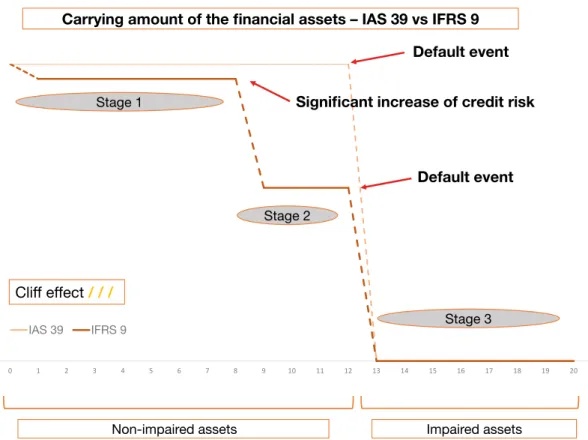
It should be acknowledged that the “cliff effect” when moving to stage 3 is much greater than when moving from stage 1 to stage 2. The “cliff effect” when moving to default status leads to “repressed” cyclicality under the IAS 39 incurred loss model (which was released during the financial crisis with devastating effects on the real economy).
In comparison with stage 2, the expected credit losses to be recognized in stage 3 would be larger because, in stage 3, accounting default has already occurred (risk of default equals 1) whereas, in stage 2, the transaction has not defaulted yet (risk of default lower than 1). Figure 6 shows how the gross carrying amount of the loan – used theoretically as an example – begins at the same level at origination and ends at the same level after the default event has arisen under both IAS 39 and IFRS 9. However, under IFRS 9, this movement is divided into several stages, depending on the credit quality of the transaction, which anticipates the impact of the credit losses on the statement and allows for a more accurate valuation. This would reduce the likelihood of recording an abrupt impact on profit or loss just when a downturn arises that further worsens the situation of the entity. SOURCE: Authors’ own elaboration.
FIGURE 6 CARRYING AMOUNT OF THE FINANCIAL ASSETS. IAS 39 VS IFRS 9
0 1 2 3 4 5 6 7 8 9 10 11 12 13 14 15 16 17 18 19 20
IAS 39 IFRS 9
Default event
Significant
increase
of
credit
risk
Carrying
amount of the
financial
assets
– IAS 39
vs
IFRS 9
Default event
Non-impaired assets Impaired assets
Stage 1
Stage 2
Stage 3
In accordance with the results shown in European Banking Authority (2018), the increase in provisions is mainly linked to performing financial assets (basically stage 1 and stage 2 assets) for which provisions increased by up to 94% (on simple average); on the other hand, the provisions of stage 3 assets showed an almost zero increase (on simple average). Furthermore, as illustrated in the figure below, the level of provisions for performing assets is higher under IFRS 9 than it was in previous years under IAS 39 and the institutions with lower provisioning levels have increased them. In general terms, institutions record more provisions, earlier and slightly more homogenously under IFRS 9 – as seen in Figure 77 – in comparison with IAS 39, under which the provisions for performing assets were very low at some institutions.
The three-stage approach of IFRS 9 seeks to balance, on the one hand, maintaining the link between the recognition of interest income and the level of credit losses (stage 1) and, on the other, the recognition of higher levels of credit losses when there is a signal that the credit risk premium has been significantly underestimated at origination (stage 2 and stage 3). For stage 1 assets, the interest income recognized in the statement of profit or loss is the product resulting from multiplying the gross carrying amount (before deducting accumulated credit losses) by the effective interest rate (that is calculated at origination taking into account the contractual cash flows of the transaction). As a result, during a given financial year, there is a certain correlation between the credit risk premium recognized as a part of the interest income calculated using the effective interest rate and credit losses (“12-month ECL”). For stage 2 assets, as they are mispriced (because credit risk has increased significantly since origination), the interest income recognized does not
7 The sample used for this figure comprises the 14 largest European banks with data reported in 2018 Q3. Even though the sample covers a large percentage of Total Assets in the European financial system, the results cannot be interpreted in a general way and should be taken with caution.
3.4 IMPAIRMENT RECOGNITION AND INTEREST ACCRUAL
SOURCE: Authors’ own elaboration.
FIGURE 7
IMPAIRMENT IN P&L FOR THE YEAR (EUR MILLION) OF THE PERFORMING ASSETS. IAS 39 VS IFRS 9
0 2,000 4,000 6,000 8,000 10,000 Impairment Performing 2016 2017 2018
change but the level of credit losses increases (“Lifetime ECL”). Stage 3 assets are not only mispriced but also defaulted and, consequently, they require bigger allowances and the interest income is reduced.
This link between the recognition of interest income and the level of credit losses is severed in the FASB standard, as discussed above.
For the estimation of expected credit losses, IFRS 9 requires credit institutions to reflect a broad range of relevant information, including historical, current and forward-looking information. It also requires that the outcome shall be neither an estimate of a worst-case scenario nor an estimate of the best-case scenario.
To implement the requirements, banks typically consider different macroeconomic scenarios, which are weighted in terms of the related probabilities. In any case, IASB staff have clarified graphically that IFRS 9 does not require either that you must use multiple scenarios or that you must use three scenarios; in fact, the “key message” from IASB staff is that you should “consider” multiple scenarios but may not always have to “use” them [IFRS Foundation (2016)].
Under IFRS 9, credit losses are assessed either individually or collectively. Annex 9 provides criteria to decide whether credit losses are to be determined by individual estimations (that require analytical information to be factored in) or by collective estimations (using statistical models). Individual estimations are performed using present value techniques in which the idiosyncratic cash flows of the transaction are discounted at its effective interest rate (EIR); whereas collective estimations are done using statistical parameters (often PD/LGD models) calculated using the cash flows of a homogenous group of transactions. In Annex 9, individual estimations are required where the transaction has unique characteristics; particularly, where there is an analytical signal of an increase in credit risk or a default event, as well as when there are not enough data for modelling statistical parameters.
In the application of the principle of proportionality, Annex 9 provides statistical risk parameters (so-called “alternative solutions”) that could be used for collective estimations of credit losses for transactions booked in Spain. “Alternative solutions” are used typically by smaller or less complex institutions to overcome the challenges associated with the implementation of IFRS 9. Both European Banking Authority (2017) and European Central Bank (2017) highlighted that smaller credit institutions found it more challenging to make progress in the implementation of IFRS 9; Annex 9 helps these institutions to overcome these challenges by providing a “ready-to-use” model for the collective estimation of credit losses. “Alternative solutions” could also serve as benchmarks for credit losses of transactions in Spain estimated collectively using internal methodologies.
Annex 9 provides collateral valuation criteria for the estimation of credit losses establishing the frequency with which the collateral should be re-valued and the techniques eligible for valuing it. For real estate collateral, the eligible techniques are full appraisals and Automated Valuation Methods (AVM) that consider the specific characteristics of the property. The guiding principle behind the Annex 9 criteria is that more full (and more frequent) appraisals are required for transactions with lower credit quality.
Furthermore, Annex 9 provides a framework for developing benchmarking (comparison of an institution’s own estimations with those of its peer group) and backtesting practices (comparison between estimated and actual losses).
4 Methodologies for the estimation of credit losses
4.1 MODELLING EXPECTED CREDIT LOSSES
Forward-looking information is a type of information to be considered in the estimation process. Naturally, it is neither the sole nor the most significant input. Rather, for the incorporation of forward-looking information, an approach should be followed in which historical information is adjusted using macroeconomic forecasts.
In collective estimations, the incorporation of forecasts of macroeconomic variables could contribute to mitigating the pro-cyclical effects observed in the risk parameters (e.g. PD/ LGD) calculated using statistical models (they are bigger in the worst part of the economic cycle) by taking into account the upswing in future periods.
Furthermore, it should be acknowledged that the estimation of credit losses under IFRS 9 is not only a statistical exercise but also an analytical one. In the individual estimations the assessment of the idiosyncratic characteristics of the transaction or the debtor is determinant for the outcome and decreases the degree of dependence on the evolution of the economy. For instance, the PD or the probability of cure in individual estimations could be calculated following a Bayesian approach in which the prior PD or probability of cure based on historical information is adjusted using current information (a new indicator of credit risk) that is not linked to changes in the economic cycle.
After analyzing the estimation of credit losses under both IFRS 9 and Annex 9, it is appropriate to state that the application of both standards requires the use of judgment in the expected loss assessment process. This could potentially affect its consistent application across institutions, which could result in a lack of comparability of their financial statements. Therefore, as the European Banking Authority (2017) noted, the existence of supervisory guidance emphasizes the importance of the high quality, robust and consistent application of IFRS 9, and may help to promote consistent policies and practices. In line with Barth and Landsman (2010), the extent to which loan loss provisioning is pro-cyclical, natural or amplified, and provides useful information will depend on how provisions are determined in practice, and not only on the content of the standard.
According to Bholat et al. (2018), it is poor lending, rather than accounting or reporting, that causes financial crises. They insist on the idea that the timely recognition of problem loans and credit losses in conjunction with proper transparency is critical to averting and mitigating crises. Therefore, the design of early warning systems in the shape of an adequate recognition of expected losses in good times is generally agreed by policymakers to contribute to greater bank resilience and to mitigate the impact of crises. For their part, Bushman and Williams (2012) report that discretionary provisioning in the form of earnings smoothing dampens disciplinary pressure on risk-taking, reduces bank transparency and inhibits monitoring by outsiders.
These authors comment that discretion over credit loss provisioning can have real beneficial or negative consequences for the discipline of bank risk-taking, depending specifically on how managers exploit available discretion to shape credit loss provisions. Once again, the term “discretion” per se does not necessary imply negative consequences. While discretionary smoothing via loan loss provisions (implicit forward-lookingness) dampens discipline over bank risk-taking, explicit forward-lookingness that captures the extent to which current provisions anticipate future deteriorations in the loan portfolio enhances discipline.
Proper implementation necessarily includes actions at different levels, as shown in Figure 8.
4.3 FORWARD-LOOKING INFORMATION
4.4 PROPER IMPLEMENTATION IS THE KEY
First, prior to the application of the standard, institutions will have had to enhance governance of the process, including comprehensive monitoring with the participation of the internal audit department. One of the keys to reducing future shocks when turbulence arises is to establish solid procedures and criteria for loan origination. A relaxation of credit standards during upswings leads to the recognition of greater losses during recessions [among others, Jiménez and Saurina (2005), Bouvatier and Lepetit (2008) and Porcuna (2018)]. It is also of capital importance to enhance data quality, as this is one of the biggest challenges in the implementation of IFRS 9 [Deloitte (2018)]. These procedures and criteria must be consistent with the institution’s risk appetite.
Second, once the standard has been applied, as we have commented throughout the article, it should be acknowledged that it is based on principles which have to be applied consistently. An adequate classification of the portfolios, according to the bank business model, shall contribute to a more accurate valuation. In this context, a timely categorization of the assets based on their credit risk (the so-called “staging”) and a robust valuation of the expected credit losses shall help to avoid undue abrupt impacts on the financial statements. It is also crucial to properly assess collateral value to avoid future surprises. Lastly, benchmarking exercises shall compare practices at different institutions across the whole market, in order to identify outlying practices, while the backtesting analysis helps boost confidence in the process and in the reliability of the estimates.
The third element is enforcement. We believe that the expected loss model shall be appropriately enforced within the banking industry. In this regard, further work is still needed to increase the consistency of outcomes through benchmarking exercises as well as to guide the institutions’ backtesting of estimated losses compared with actual losses.
The effectiveness of the new standards will depend not only on how banks implement them, but also on the contributions of enforcers and other stakeholders, as stated by Cohen and Edwards (2017).
SOURCE: Authors’ own elaboration.
IMPLEMENTATION FLOWCHART FIGURE 8
Standard application Integral governance Economic transactions Enforcement by Supervision & Auditing SUPRANATIONAL APPLICATION LEVEL PLAYING FIELD
Proper grant policy Comprehensive
monitoring Enhanced data quality
Reinforced staff integration
Timely classification Acurate valuation Collateral valuation
Benchmarking Backtesting
As for the auditors, Bouvatier, Lepetit, and Strober (2014) found a negative relationship between the quality of their work and the income smoothing practices on loan loss provisioning. This result suggests that auditors can avoid discretionary practices and reduce management bias in the estimations. In this regard, the international audit standard setter (International Auditing and Assurance Standards Board – IAASB –) has recently revised its standard on the audit of accounting estimates (ISA 540), principally induced by the change in the credit loss provisioning model.
The recent paper by Gebhardt and Novotny-Farkas (2018) which examines the role of supervisors in the financial reporting quality of banks is very interesting. They mention some previous studies [see Costello et al. (2016), Bischof et al. (2016) and Nicoletti (2017)], who describe the benefits of supervisory intervention for financial reporting transparency, and the association between regulatory leniency and the lower likelihood of income-decreasing restatements. Furthermore, most significantly, Nicoletti (2017) finds that supervisory scrutiny and external audits are positively associated with credit loss provision timeliness. The last finding bolsters our previous idea of the need for cooperation between auditors, enforcers and other stakeholders to strengthen the enforcement in respect of banks’ accounting practices.
Naturally, a homogeneous application of these measures across the different jurisdictions shall be essential to ensure a level playing field. Gebhardt and Novotny-Farkas (2018) highlight the importance of the recent efforts of supranational banking organizations (Basel Committee on Banking Supervision and EBA) to ensure consistent practices in the implementation of the newly introduced expected loss approach under IFRS 9.
The Great Financial Crisis changed the way credit institutions should estimate their provisions for financial assets. Thus, IFRS 9 supersedes IAS 39 by introducing some relevant changes which have made the headlines in financial sector regulation in recent years. A model based on incurred losses (IAS 39) has given way to a model based on expected losses (IFRS 9).
IFRS 9 requires a more timely and gradual recognition of credit losses, it promotes the early recognition of credit losses and contributes to improved credit quality control systems. It avoids the “false” stability and the negative effects of the constrained credit losses abruptly released under the IAS 39 incurred loss model when economic turmoil is acknowledged.
IFRS 9 reduces divergence in accounting practices in comparison with IAS 39, with regard to the methodologies for the estimation of credit losses in performing exposures. The more structured scheme with three “stages” allows more homogeneity and comparability in the standard application of IFRS 9 because it provides a clearer framework for the provisioning of exposures that are not in default (stage 3). IFRS 9 requires the recognition of 12-month expected credit losses from loan origination (stage 1 exposures) and introduces the need for lifetime expected credit losses when a significant increase in credit risk occurs before the default event (stage 2 exposures).
Classification of financial assets for the estimation of provisions pivots on the identification of significant increases in credit risk at the level of the exposure since its origination. Therefore, for a timely classification by stages is not necessary anticipating economic downturns. Contrary to the opinion of certain critics of IFRS 9, perfect foresight of future economic conditions can contribute positively to – but is not a prerequisite for – the proper 5 Conclusions and future
implementation of IFRS 9. What is required is an assessment of the credit risk at the level of the exposure, such as monitoring changes in PDs, credit ratings, credit scoring, days past due or whether forbearance has been granted. Credit institutions which function properly should be able to perform this kind of monitoring.
The timely identification of stage 2 assets (with significant increases in credit risk but not in accounting default) helps to avoid giving a false impression of stability which is then followed by the sudden recognition of credit losses in downturns that abruptly impacts the statement of profit or loss and complicates an already difficult situation.
The scarce data available confirm the conceptual insights mentioned above. Under IFRS 9, the overall level of provisions of large EU credit institutions has increased significantly (11% on average), the level of provisions for performing exposures (mainly stage 1 and 2 assets) has almost doubled on average and the institutions with lower levels of provisions for performing exposures have increased them.
To take advantage of the IFRS 9 expected loss model, and complying with this standard, Annex 9 of Circular 04/2017 of Banco de España includes: i) definitions of modifications under financial difficulties and credit-impaired exposures, following EBA definitions of forborne and non-performing exposures, to increase comparability and to contribute to a timely classification (e.g. forborne exposures shall be classified in stage 2 during the “probation” period); ii) in the application of the principle of proportionality, risk parameters (so-called “alternative solutions”) that could be used by typically small or less complex institutions for collective estimations to overcome the challenges of developing IFRS 9 models; iii) a framework for developing benchmarking and backtesting practices; as well as iv) collateral valuation criteria for the estimation of credit losses.
The merits of an accounting standard should be assessed in terms of proper implementation and whether such implementation is feasible for the institutions. In this regard, as a result of IFRS 9 and Annex 9, the estimation of credit losses is better integrated into management as now the involvement of different areas and levels within credit institutions’ structures is required.
Implementing IFRS 9 properly is essential and helps to avoid inefficiencies and undesired effects. The expected loss model allows greater subjectivity in its application but precisely this subjectivity may prevent credit loss estimations from being pro-cyclical without giving room for earning management. The expert judgment required in the individual estimations of provisions or in the consideration of forward-looking information may decrease the extent to which the estimations are dependent on changes in the economic cycle.
Further work is still needed from preparers, auditors, regulators and supervisors to increase the consistency of the outcomes of the IFRS 9 estimation of credit losses across institutions because significant steps of this iterative process depend on subjective assessments. The more stakeholders focus on the proper application of IFRS 9, the greater the benefit for the financial system in general. Possible avenues for achieving this are benchmarking exercises as well as guiding the institutions’ backtesting of estimated losses against actual losses. As more data become available, it will be very interesting to analyze further how institutions are implementing the standard. For this purpose, it will be essential to observe how the factors for the identification of significant increases in credit risk are used (stage 2 classification).
AUTONOMOUS (2016). Global Banks. IFRS 9 Looms Larger, Working Paper. BARCLAYS (2017). IFRS 9 Bigger than Basel IV. Available at
http://www.eifr.eu/document/file/download/1877/barclays-european-banks-ifrs9-bigger-than-basel-iv-jan-17-pdf. BARTH, E., and R. LANDSMAN (2010). “How did Financial Reporting Contribute to the Financial Crisis?”, European
Accounting Review, 19 (3), pp. 399-423.
BELLINI, T. (2019). IFRS 9 and CECL Credit Risk Modelling and Validation, Academic Press, p. 5.
BHOLAT, D., R. M. LASTRA, S. M. MARKOSE, A. MIGLIONICO and K. SEN (2018). “Non-Performing Loans at the Dawn of IFRS 9: Regulatory and Accounting Treatment of Asset Quality”, Journal of Banking Regulation, No. 19, pp. 33-54.
BISCHOF, J., H. DASKE, F. ELFERS and L. HAIL (2016). A Tale of Two Regulators: Risk Disclosures, Liquidity, and Enforcement in the Banking Sector, Working Paper, University of Mannheim.
BOUVATIER, V., and L. LEPETIT (2008). “Banks’ Procyclical Behavior: Does Provisioning Matter”, Journal of International Financial Markets, Institutions and Money, 18(5), pp. 513-526.
BOUVATIER, V., L. LEPETIT and F. STROBER (2014). “Bank Income Smoothing, Ownership Concentration and the Regulatory Environment”, Journal of Banking & Finance, No. 41, pp. 253-270.
BUSHMAN, R. M., and C. D. WILLIAMS (2012). “Accounting Discretion, Loan Loss Provisioning, and Discipline of Banks”, Journal of Accounting and Economics, No. 54, pp. 1-18.
CHAE, S., R. SARAMA, C. VOJTECH and J. WANG (2018). The Impact of the Current Expected Credit Loss Standard (CECL) on the Timing and Comparability of Reserves, Finance and Economics Discussion Series 2018-020, Washington, Board of Governors of the Federal Reserve System. Available at
https://doi.org/10.17016/FEDS.2018.020.
COHEN, B., and G. EDWARDS (2017). “The New Era of Expected Credit Loss Provisioning”, BIS Quarterly Review, March. Available at
https://www.researchgate.net/publication/323671882_The_Impact_of_the_Current_Expected_Credit_Loss_ Standard_CECL_on_the_Timing_and_Comparability_of_Reserves.
COSTELLO, A., J. GRANJA and J. WEBER (2016). Do Strict Regulators Increase the Transparency of the Banking System?, Working Paper, University of Michigan, University of Chicago, Massachusetts Institute of Technology. COUNCIL OF THE EU (2002). “Regulation (EC) No 1606/2002 of the European Parliament and of the Council of 19
July 2002 on the Application of International Accounting Standards”.
– (2017). “Regulation of the European Parliament and of the Council of Amending Regulation (EU) No. 575/2013 as Regards Transitional Arrangements for Mitigating the Impact of the Introduction of IFRS 9 on Own Funds and the Large Exposures Treatment of Certain Public Sector Exposures Denominated in Nondomestic Currencies of Member States”, confirmation of the final compromise text with a view to agreement, November.
DELOITTE (2016). Sixth Global IFRS Banking Survey. No Time Like the Present. Available at
https://www2.deloitte.com/content/dam/Deloitte/global/Documents/Financial-Services/gx-fsi-sixth-ifrs-banking-survey.pdf.
– (2018). The Post IFRS-9 Era for Lending Industry. Available at
https://www2.deloitte.com/content/dam/Deloitte/bg/Documents/risk/IFRS%209%20Sofia%20Event_20180604.pdf. EUROPEAN BANKING AUTHORITHY (2016). Report on Result from EBA Impact Assessment of IFRS 9,November
2016. Available at
https://www.eba.europa.eu/documents/10180/1360107/EBA+Report+on+impact+assessment+of+IFRS9. – (2017). Report on Result from the Second EBA Impact Assessment of IFRS 9, July 2017. Available at
https://www.eba.europa.eu/documents/10180/1720738/EBA+Report+on+results+from+the+2nd+EBA+IFRS9+IA.pdf. – (2018). First Observations on the Impact and Implementation of IFRS 9 by EU Institutions, December 2018.
Available at
https://eba.europa.eu/documents/10180/2087449/Report+on+IFRS+9+impact+and+implementation.pdf. EUROPEAN CENTRAL BANK (2017). SSM Thematic Review on IFRS 9. Assessment of Institutions’ Preparedness for
the Implementation of IFRS 9, Working Paper, November.
GEBHARDT, G, and Z. NOVOTNY-FARKAS (2018). Comparability and Predictive Ability of Loan Loss Allowances – The Role of Accounting Regulation versus Bank Supervision, CFS Working Paper, No. 591. Available at https://ssrn.com/abstract=3174016.
GINER, B., and A. MORA (2016). Bank Loan Loss Accounting: Research Implications for the Post-Crisis Debate, April 16. Available at
https://ssrn.com/abstract=2765667.
HOOGERVORST, H. (2017). IFRS 17 and its Contribution to Financial Stability, IFRS Foundation’s Annual European Conference, Amsterdam.
– (2018). Are We Ready for the Next Crisis?, speech at the IMF, Washington, DC.
IFRS FOUNDATION (2016). Forward-looking Information and Multiple Scenarios, presentation in PDF in May. Available at https://www.ifrs.org/-/media/project/financial-instruments/webcast-july-2016/ifrs9-webcast-july-2016-slides. pdf?la=en.
INTERNATIONAL ACCOUNTING STANDARDS BOARD (2014). IFRS 9: Financial Instruments, London, IASB. JIMÉNEZ, G., and J. SAURINA (2005). “Credit Cycles, Credit Risk, and Prudential Regulation”, International Journal
of Central Banking, Vol. 2, issue 2.
NICOLETTI, A. (2017). The Effects of Bank Regulators and External Auditors on Loan Loss Provisions, Working Paper, The Wharton School.
PORCUNA, L. (2018). “The Impact of the Recent Financial Crisis on the Pro-cyclical Behavior of European Banks: a Turning Point”, Spanish Journal of Finance and Accounting, Vol. 47 (4), pp. 533-578.
SÁNCHEZ SERRANO, A. (2018). “Financial Stability Consequences of the Expected Credit Loss Model in IFRS 9”, Revista de Estabilidad Financiera, No. 34, May, Banco de España, pp. 83-99.
SILVER, N. (2012). The Signal and the Noise: Why Most Predictions Fail – but Some Don’t, Penguin Group. TALEB, N. N. (2012). Antifragile: Things That Gain from Disorder, Random House.