What is a Code of Practice?
The term “code of practice” has a particular meaning under the Victorian Occupational Health and Safety Act 1985 (the Act). Other codes of practice, such as the advisory codes developed by the National Occupational Health and Safety Commission or Standards Australia, voluntary codes agreed in an industry, or codes adopted by other states or countries do not come within the meaning of the term used in the Act. The Act provides for codes of practice “for the purpose of providing practical guidance to employers, self-employed people, employees, occupiers, designers, manufacturers, importers, suppliers or any other persons who may be placed under an obligation by or under this Act. . .”[S.55(1)].
A code of practice approved by the Minister comes into effect when “notice of approval is published in the Government Gazette or on such later day as may be specified in the notice, . . .” [S.55(6)]. A code of practice does not have the same legal force as Regulations. Contravention of, or failure to comply with, Regulations made under the Act is an offence [S.47(1)]. Failure to observe a provision of an approved code of practice is not in itself a breach of the Act [S.55(8)].
A health and safety representative is able to cite an approved code of practice in a Provisional Improvement Notice as a means by which an alleged non-compliance with the Act or Regulations may be remedied [S.35(2)(a)]. Similarly, an Inspector may cite an approved code of practice as a means of remedying alleged non-compliance when issuing an Improvement Notice or Prohibition Notice [S.45(2)(a)].
The Act provides for codes to be used as evidence of contravention or failure to comply with a provision of the Act or regulations under the Act. The relevant section is section 56 and it is reprinted below.
Where in any proceedings under this Act it is alleged that a person contravened or failed to comply with a provision of this Act or the regulations in relation to which an approved code of practice was in effect at the time of the alleged contravention or
failure-(a) the approved code of practice shall be admissible in evidence in those proceedings; and
(b) if the court is satisfied in relation to any matter which it is necessary for the prosecution to prove in order to establish the alleged contravention or failure
that-(i) any provision of the approved code of practice is relevant to that matter; and
(ii) the person failed at any material time to observe that provision of the approved code of
practice-that matter shall be taken as proved unless the court is satisfied practice-that in respect of practice-that matter the person complied with practice-that provision of this Act or the regulations otherwise than by way of observance of that provision of the approved code of practice. The practical effect of this section is that provisions in the code constitute compliance with the provision of the Act or a regulation to which the code is giving practical guidance. The provisions in a code are, however, not mandatory. That is, a person may choose to comply with the relevant provision of the Act or regulation in some other way, provided that the alternative method used also fulfils the requirements of the Act or regulations.
This publication is copyright. No part may be reproduced by any process except in accordance with the provisions of the Copyright Act 1968. Copyright Victorian WorkCover Authority Melbourne Australia
First published 1995; Reprinted 1996. ISBN 0 7306 7366 9
What is the effect of incorporating standards in a code of practice?
Incorporation of a published technical standard in a code of practice has the effect of making that standard form part of the code. The standards listed in this code provide guidance to designers and manufacturers of plant which includes or is likely to include a confined space, and to employers on how to comply with their duties under the Occupational Health and Safety (Confined Spaces) Regulations 1996.
It is important to note that the standards themselves have not been written specifically as guidance on how to comply with the duties under the Regulations. As such, following the provisions of an incorporated standard may not constitute full compliance with the relevant duties. This is because the standard itself may not deal with all the matters relevant to hazard identification, risk assessment and risk control for the confined space in question. Appropriate judgement needs to be exercised in such circumstances.
To the extent that provisions of an incorporated standard are relevant to a duty under the Regulations, following those provisions (as is the case with any code provision) is deemed by the Victorian WorkCover Authority to be compliance with the relevant duty under the Regulations.
A designer or manufacturer of plant which includes or is likely to include a confined space or an employer or self-employed person may have followed the provisions of a relevant standard that is incorporated in this code prior to the Regulations coming into operation. In that case, they need to re-appraise the action they have already taken to comply with previous legislation covering hazards and risks associated with confined spaces, to assess whether or not they are in full compliance with the duties under these Regulations. However, as with other code provisions, provisions of an incorporated standard are not mandatory -alternative measures may be used in order to comply with the duties under the Regulations.
It should be noted that many of the published technical standards listed in this code contain provisions expressed in a mandatory manner, that is, they state that a person "shall" do some action. The mandatory provisions in the published technical standards are not mandatory for the purpose of the code. They should not be treated any differently to other provisions in those standards.
1.
Summary Purpose
This code of practice provides practical guidance on how people can meet the requirements of the Occupational Health and Safety (Plant) Regulations 1995. The aim of the Regulations is to protect people against the risks plant and associated systems of work can pose to their health or safety at work.
2. What is Plant?
Plant is defined in the Regulations to cover items such as lifts, cranes, pressure equipment, machinery, hoists, powered mobile plant, amusement structures, lasers, turbines, explosive-powered tools, scaffolds and temporary access equipment. The Regulations do not cover ships, boats, aircraft, road and rail vehicles, hand-held plant and plant which relies exclusively on manual power for its operation. This code of practice only deals with the types of plant covered by the Regulations.
3. Hazard Identification, Risk Assessment and Risk Control
The Regulations require the identification of hazards, assessment of risks and control of risks posed by plant and associated systems of work. The Regulations apply to designers, manufacturers, importers and suppliers of plant, employers and self-employed persons. The code explains what these processes mean and how they can be performed by designers and employers. Examples are also provided.
4. Duties of Designers
Proper attention to hazards and risks at the initial design stage can prevent or minimise many subsequent problems with plant. The code explains how designers can identify hazards, assess and control risks in the design process. A range of common hazards and risk control options are outlined, together with advice on issues such as the use of published technical standards in designs, appropriate record keeping practices and information provision.
5. Duties of Manufacturers, Importers and Suppliers
Manufacturers, importers and suppliers of plant can also play an important role in minimising risks by ensuring that hazard identification, risk assessment and risk control are done and that people supplied with the plant receive appropriate information on the use of the plant. The code explains the types of information that manufacturers, importers and suppliers need to give to people to whom the plant is supplied to ensure the plant is safely used.
6. Use of Plant
Positive and cooperative workplace arrangements are an important part of any injury and illness prevention strategy. The code offers employers advice not only on hazard identification, risk assessment and risk control measures, but also discusses issues such as consultation and employee training, information and instruction. A range of measures for controlling risks arising from the operation of plant are outlined. Examples are also provided of risk control measures for specific types of plant.
1. Authority
This code of practice is approved pursuant to section 55 of the Occupational Health and Safety Act 1985 (the Act). 2. Purpose
The purpose of this code of practice is to provide practical guidance to persons on how they can meet the requirements of the Occupational Health and Safety (Plant) Regulations 1995 (the Regulations), the objective of which is to protect people at work against risks to health or safety arising from plant and systems of work associated with plant.
3. Scope of This Code
This code of practice applies to all employers as defined under section 4 of the Act and to all designers, manufacturers, importers and suppliers of plant to workplaces. It also applies to self-employed persons who are required to comply with Part 7 of the Regulations as if they were an employer. Note 1
Note 1 (Note: a self employed person's duties under the Regulations only relates to people who may be exposed to a risk arising from the conduct of the undertaking of the self-employed person.)
The code applies to all the types of plant covered by the Regulations (as set down in regulation 106(1)). This includes pressure equipment, tractors, earthmoving machinery, lasers, scaffolds, temporary access equipment, explosive-powered tools, turbines and amusement structures. Note 2 It also includes plant that lifts or moves people and material, such as lifts, escalators, cranes, hoists and elevating work platforms.
Note 2 (See Appendix 1 for definitions of the types of plant covered by the Regulations.) The Regulations also apply to plant that processes material by way of a mechanical action which–
• cuts, drills, punches or grinds the material (for example, woodworking saws, drill presses, clicking presses, bench grinders);
• presses, forms, hammers, joins or moulds the material (for example, power presses, die casting machines, forging hammers, plastic injection moulding machines); and
• combines, mixes, sorts, packages, assembles, knits or weaves the material (for example, dough mixers, packaging machines, knitting machines).
Plant not covered by the Regulations and therefore this code of practice (as set down in regulations 106(1)(b) and 106(3)) are: • ships, boats, aircraft;
• vehicles designed to be used primarily as a means of transport on a public road or rail (for example, motor cars, locomotives Note 3);
• plant which relies exclusively on manual power for its operation (for example, block and tackle, hand or foot pumps, trolley vehicle jacks); and
• plant that is designed to be primarily supported by hand (for example, electric hand drills, hand-held spray guns, jack hammers).
by hand. That is, the release of the pedestrian control bar will not cause the pedestrian forklift to fall or topple over. Also, these are not manually powered plant.
Hydraulic, air or electrically powered hand tools suspended over a work station are not within the scope of the Regulations as they are primarily designed to be supported by hand for their operation. The prime purpose of suspending the tools over a work station is to provide the operators with ready access to the tools rather than as a means of providing support to the tools for their operation.
A hand-held spray gun is powered by a small compressor. Although the spray gun itself does not come under the scope of the Regulations, the compressor, if not designed to be supported by hand, comes under the scope of the Regulations as it is powered.
Plant that may be registrable for public road or rail travel, but which has not been primarily designed for this purpose, comes under the scope of the Regulations. Examples of such plant include forklift trucks, front end loaders, excavators and tractors. For example, a forklift truck is primarily designed to lift and carry loads around warehouses, storage areas and the workplace, not for travel on a public road.
4. Background and Objectives
Plant is associated with a significant proportion of accidents and consequent compensation claims in the Victorian workplace. Approximately 60% of the workplace fatalities investigated by the Health and Safety Organisation in Victoria between 1985 and 1994 were associated with unsafe plant or unsafe systems of work associated with plant. The most common types of plant-related fatalities include:
• falls from, crushing by, run-over and roll-over of tractors; • entrapment in manufacturing machinery;
• falls from, crushing by, and run-overs by forklift trucks; • crushing and run-overs by mobile cranes; and
• crushing by fixed cranes.
Plant-related death and injury incurs substantial costs to industry, government and the community. The 186,000 plant-related workers' compensation claims made in Victoria between 1985 and 1994 represent 28% of all compensation claims lodged over this period, with total payments to date of approximately $2 billion. Plant-related accidents can also incur other significant costs - costs that are not so easily quantified. These other costs can include human suffering, lost productivity and the costs of damage to plant and property.
Given the risk associated with the use of plant, Governments over the years have enacted a number of measures to reduce both the incidence and severity of workplace accidents. Until recently, plant safety in Victorian workplaces was regulated by 36 sets of Regulations. Plant is now regulated by only 3 sets of Regulations. These are:
• Occupational Health and Safety (Plant) Regulations 1995;
• Occupational Health and Safety (Certification of Plant Users and Operators) Regulations 1994; and • Equipment (Public Safety) (General) Regulations 1995.
The Occupational Health and Safety (Plant) Regulations 1995 are a set of broad performance-based regulations which place specific duties on persons to ensure that plant used in workplaces is designed, manufactured, installed, commissioned and used in ways that eliminate or, where this is not practicable, reduce risks to health or safety. The Regulations are intended to protect the health and safety of people at work from risks arising from plant, by ensuring the identification of hazards and the assessment and control of risks arising from exposure to the hazards.
This code of practice aims to assist persons achieve compliance with the Regulations. It is not possible to deal, in the code, with every or even most situations that may confront a designer or manufacturer or that may be found in the workplace. In using this code, discretion and judgement will be needed. Readers should always consider the appropriateness of the advice contained in this code or publications recommended by the code, having regard to the unique characteristics of the plant and the circumstances of the workplace where it is to be used.
5. Definitions
There are a number of key terms used throughout this code. Some of the terms are defined in Section 4 of the Act and others are in the Regulations. The terms are included here for the reader's convenience.
'AS/NZS' followed by a number and designation means the Australian Standard/New Zealand Standard to which that designation relates as published by Standards Australia and amended from time to time.
'Commissioning' means performing the necessary adjustments, tests and inspections to ensure plant is in full working order, in accordance with the requirements specified in the design of the plant, before the plant commences normal operation for the first time.
'Employee' means a person employed under a contract of employment or under a contract of training.
'Employer' means a person who employs one or more other persons under contracts of employment or under contracts of training.
'Engineering controls' means controls which use engineering measures to change the physical characteristics of plant to eliminate or reduce risk.
'Hazard' means the potential to cause injury or illness. 'Practicable' means practicable having regard to– (a) the severity of the hazard or risk in question;
(b) the state of knowledge about that hazard or risk and any ways of removing or mitigating that hazard or risk; (c) the availability and suitability of ways to remove or mitigate that hazard or risk; and
(d) the cost of removing or mitigating that hazard or risk..
'Published technical standard' means a document which gives technical information, guidance or advice on plant, that is published by–
(a) an Authority; Note 4 or (b) Standards Australia; or
(c) the British Standards Institute; or
(d) the International Organisation for Standardisation (ISO)–
or an organisation with substantially equivalent objectives in regards to the publication of technical information, guidance or advice on plant as any of the organisations mentioned.
Note 4 ('Authority means a person that has the power under the law of the commonwealth of Australia or the law of an Australian State or Territory to require design notification or registration of plant in a manner that is reasonably equivalent to the requirements under Part 10 of the Occupational Health and Safety (Plant) Regulations 1995.) 'Risk' means the likelihood of injury or illness arising from exposure to any hazard.
'Self-employed person' means a person who works for gain or reward otherwise than under a contract of employment or apprenticeship, whether or not that person employs one or more other persons.
'Use' when used in relation to plant, includes operate, maintain, service, repair, inspect and clean.
'Vicinity' means the area in or around the plant within which persons may be exposed to a risk arising from that plant. Any reference in the Regulations and this code to "designer", "'manufacturer", "importer" or "supplier" is a reference to a person who designs, manufactures, imports or supplies (as the case may be) plant for use in a workplace.
6. Systems of Work
The objective of the Regulations is to protect people at work against risks to health or safety arising from plant and systems of work associated with plant. "Systems of work" describes a wide range of activities which can contribute to safe work. Where relevant to the plant and associated work practice under review, systems of work may include:
• the company's policy and procedures for purchasing plant;
• the definition and allocation of roles, responsibility and accountability within the workplace;
• the arrangements or systems in place to ensure quality of instruction, competency assessment and supervision;
• systems of communication while performing a task or within the organisation generally; • the organisation of work including:
- the speed of the process line;
- traffic around the plant (people and vehicles); - time spent on monotonous or repetitive tasks; - the amount and type of manual handling required; - shift work arrangements;
- any production incentives that may affect health and safety;
• the arrangements or systems in place to ensure skill and experience of the employees allocated to particular tasks;
• work practices and procedures including maintenance and repair schedules; • and emergency procedures, for example, first aid and evacuation.
7. Generic Hazard Identification and Risk Assessment The Regulations provide (regulation 202):
If a person is required under these Regulations to carry out hazard identification or risk assessment procedures for plant, that person may carry out those procedures for a class of plant rather than for individual items of plant if-(a) all the plant in the class has similar functions and productive capacity; and
(b) the procedures carried out for the class of plant do not result in any person being subject to a different risk than if the procedures were carried out for each individual item of plant.
The Regulations impose duties on designers, manufacturers, importers, suppliers, employers and self-employed persons to carry out hazard identification and risk assessment in relation to plant and associated systems of work. Regulation 202 permits, in specific situations, a single hazard identification and risk assessment process to be carried out for a class of plant with similar functions and productive capacity.
Where multiple items of plant of the same design are used in circumstances (for example, systems of work and environment) which for all practical purposes are the same, a single hazard identification and risk assessment process in respect of one or a representative sample of items of plant in that class is sufficient, provided that the risk to a person is no different than if the processes were applied to each item of plant individually. This avoids the need to unnecessarily
Example 2
An employer has six power presses in a sheet metal factory. Each power press is to perform similar functions. The power presses are placed in a row. People may gain access to all sides of the two presses located at each end of the row. With the other four presses, people would only be able to gain access to the front part of the press.
Under the Regulations, the employer is able to undertake hazard identification and risk assessment for one of the end presses and apply the hazards identified, risk assessment and risk control measures to the other end press. Similarly the hazards identified, risk assessment and risk control measures for any one of the presses in the middle of the row may be used for the other three presses.
In choosing to carry out a generic process, the person with the duty to carry out this process must ensure that no person who may be affected by the plant or associated systems of work is subject to a different risk to their health or safety than if hazard identification and risk assessment were carried out for each individual item of plant. If a different risk would be posed to any person, a separate hazard identification and risk assessment process must be carried out for each relevant item of plant.
8. Relationship of the regulations to other hazard-specific regulations The Regulations provide (regulation 203):
If any regulation made under the Act (other than these Regulations)which deals with a specific hazard imposes on any person in relation to plant a requirement which is inconsistent with or equivalent to a requirement imposed by these Regulations, the person is only required to comply with the first regulation.
Regulation 203 recognises that a number of specific Regulations are in place and provides for other hazard-specific Regulations that may be developed in the future. To prevent overlap of regulatory duties, obligations and requirements under the Occupational Health and Safety Act 1985, regulation 203 establishes the precedence that should be given to hazard-specific Regulations.
If noise is identified as a hazard associated with plant, then in respect to that specific hazard and associated risk, the duties, obligations and requirements of the Occupational Health and Safety (Noise) Regulations 1992 prevail over any reasonably equivalent duty, obligation or requirement of the Occupational Health and Safety (Plant) Regulations 1995. That is, in relation to a noise hazard arising from plant, the Noise Regulations contain all the duties for employers, designers, manufacturers, importers and suppliers since the Noise Regulations prescribe duties for all of these individuals. The approved Code of Practice for Noise should be referred to for guidance in meeting the requirements of the Noise Regulations for the prevention, identification, assessment and control of risks arising from noise exposure in workplaces.
Similarly, in respect of manual handling hazards and associated risks arising from plant, the duties, obligations and requirements of the Occupational Health and Safety (Manual Handling) Regulations 1988 applying to employers, prevail over any related duties, obligations or requirements in the Occupational Health and Safety (Plant) Regulations. However, as the Manual Handling Regulations do not contain duties for designers, manufacturers, importers or suppliers, the duties prescribed in the Plant Regulations apply to these individuals in relation to manual handling hazards and associated risks. The approved codes of practice for Manual Handling should be referred to for guidance in meeting the requirements of the Manual Handling Regulations for the prevention, identification, assessment and control of risks arising from manual handling activity in workplaces.
9. Competency of people carrying out duties
Employers have a responsibility to ensure that people carrying out duties under the Regulations on their behalf have the appropriate competency to enable that person to correctly perform the tasks. The competency may be acquired through training, education or experience or through a combination of these.
The necessary training, education and experience will vary according to the type of plant and associated systems of work, and the complexity of the tasks to be undertaken.
10. Introduction
The design of an item of plant is critical to effective elimination or reduction of risk and therefore reduction of plant-related fatalities and injuries. An appropriate design process can avoid hazards and eliminate many of the risks from plant before it is introduced into the workplace. All phases of the life of plant, from design and use through to
demolition and disposal, should be considered when designing plant. It is also important that designers produce adequate information about the plant and its proper use in the workplace and that this information is provided and disseminated. This is important to ensure that risks that cannot be eliminated in the plant at the design stage are understood and that appropriate practices are followed when the plant is used.
The Regulations require designers of plant for use at a workplace to ensure that hazard identification, risk assessment and control of risk associated with the design of plant is carried out. The hazard identification, risk assessment and risk control process is summarised in the flow chart at Figure 1.
11. Hazard Identification 11.1 Hazard Identification Duty
The Regulations provide (regulation 302):
A designer of plant must ensure that all hazards associated with the use of plant are identified during the design of the plant, having regard to the state of knowledge of the hazards.
Hazard means the potential to cause injury or illness. Examples of the potential harm that plant or associated system of work may cause to people at workplaces include:
- Injury due to hair, loose clothing, gloves, neckties, jewellery, cleaning brushes or rags, or materials tangling with moving parts of plant or materials in motion;
- Crushing by falling or moving objects or plant tipping or rolling over; - Crushing due to people being thrown off and under plant;
- Crushing due to parts of a person's body being trapped between plant and any material or structure;
- Injury (cutting or piercing) due to a person striking a sharp object or being struck by sharp or flying objects; - Shearing of parts of a person's body between two machine parts or between a machine part and a workpiece or
between a machine part and a structure or object;
- Friction burns due to a person coming in contact with high speed rotating parts of plant or object, or rough surfaces of the plant or object;
Note 5 (Regulation 303(4) defines 'ergonomic considerations' as "considerations relating to the application of knowledge about human function, capabilities and requirements as it applies to the design of plant and systems of work associated with the plant".)
Note 6 (Refer to section 8 of this code of practice for guidance on the regulatory controls applying to noise hazards associated with plant. The approved Code of Practice for Noise should be referred to for guidance on the prevention, identification, assessment and control of risks arising from noise exposure).
Note 7 (Refer to the Department of Health and Community Services which administers legislation on radiation.) Designers are required to ensure all hazards associated with the use of plant are identified during the design of the plant. "Use" has a specific meaning in the Regulations – when used in relation to plant, "use" includes operate, maintain, service, repair, inspect and clean".
Thus, under the Regulations the designer is required to ensure that hazards associated with maintenance, service, repair, inspection and cleaning, as well as operation of the plant, are identified.
11.2 How to Identify Hazards.
'Hazard identification' is the process of identifying all situations or events that could give rise to the potential of injury or illness. Thus, it involves identifying all the sources arising from the use of the plant, that have the potential to cause injury or illness.
As an example, if the moving parts of an item of plant are identified as having a potential to cause injury through a person's clothing becoming entangled with the moving parts, then entanglement with the moving parts would need to be identified as a hazard associated with the use of the plant.
Appendix 3 outlines some of the hazards and sources of hazards that should be considered during hazard identification. Some or all of these may be relevant when undertaking hazard identification during the design of the plant, however, this is not intended to be an exhaustive list.
Designers should not limit themselves to situations that they have experienced. Rather they should try to anticipate all possible types of plant failure, systems failure, lack of consideration of ergonomic requirements and types of human error and how these could combine to create a situation that would cause harm to people.
Human error can be defined as any part of a set of human actions that exceeds a set limit of acceptability. Most errors are unintentional, unpremeditated actions that are inappropriate in the given situation. Some errors may be intentional. These occur when the person performs an action that is incorrect, but believes it to be correct or to be a better method of achieving the desired result. Thus, human error can also be defined as an inappropriate or missing action or response. (Deliberate behaviour, calculated to damage the system, is not considered to be human error.)
Missing or inappropriate actions or responses are more likely in work situations which place demands on people that are not compatible with their capabilities, experience and expectations. Such situations can occur when the design of plant and plant operating systems do not take account of ergonomic considerations.
The types of possible errors can be summarised as follows:
- error of omission (or missing response) - the person omits a specified action, a step in a sequence or a whole sequence; and
- error of commission (or inappropriate response) - the person does the task but does it incorrectly, for example, choosing the wrong action or object, doing it in the wrong sequence, taking too long or not long enough, or completing the particular action but not to the desired quality.
Appendix 4 lists some common human errors resulting from poor design through insufficient consideration of ergonomic requirements.
State of knowledge
Under the Regulations hazard identification is to be undertaken "having regard to the state of knowledge of the hazards". The phrase "state of knowledge" is taken from, and is one element of, the definition of "practicable" as set down in section 4 of the Act.
"State of knowledge" is to be interpreted objectively. It is not something which varies according to a duty-holder's own subjective or personal knowledge-base. It is an objective test of the general "state of knowledge" that a reasonable person in that position or situation is expected to have.
The state of knowledge in respect of hazards associated with the use of plant is a collective body of information sourced from experience and research in industry and government, and by professional bodies or specialist occupational health and safety practitioners.
Sources of information
There are a range of sources available that may assist the designer to ensure that the hazard identification process reflects the current state of knowledge on hazards which may arise. Examples include:
- discussions with other designers, manufacturers, suppliers or employers with similar types of plant; - advice obtained from specialist professionals including engineers;
- available faults, incidents, injury and accident reports or data from employers, users and manufacturers of similar types of plant;
- available accident or incident information, hazard alerts and other relevant reports from Health and Safety Organisation, Victoria and counterparts in other States or overseas, Worksafe Australia, unions and employer associations, and professional bodies; and
- relevant reports or articles from occupational health and safety journals, technical references or data bases from Australia and overseas, where available in Australia.
12 Risk Assessment
12.1 Risk Assessment Duty
The Regulations provide (regulation 303):
(1) If a hazard is identified under regulation 302, a designer must ensure that an assessment is made to determine whether there is any risk associated with the hazard.
(2) Without limiting subregulation (1), the designer must ensure that the risk assessment takes into account -(a) any risk factors associated with the use of the plant and, so far as is practicable, risk factors associated with the use of the plant which are specific to the workplace in which the plant is to be used; and
(b) the range of environmental and operational conditions in which the plant is intended to be used; and (c) any ergonomic considerations in relation to people who may use the plant.
(3) If the design of plant is required to be notified in accordance with regulation 1001 and a risk assessment has been conducted under sub-regulation (1), the designer of that plant must ensure
that-(a) the method used to undertake the risk assessment required under this regulation; and (b) the results of the risk
assessment-are recorded and retained, in a suitable state for examination for 10 years.
(4) For the purposes of this Regulation 'ergonomic considerations' means considerations relating to the application of knowledge about human function, capabilities and requirements as it applies to the design of plant and systems of work associated with the plant.
The Regulations require the designer to ensure that the risk assessment takes into account any risk factors associated with the use of the plant; the range of environmental and operational conditions in which the plant is intended to be used; and ergonomic considerations in relation to the people who may use the plant.
Use
Since "use" has a specific meaning in the Regulations when it is used in relation to plant, the designer is required to ensure that the risk assessment takes into account not only factors associated with the operation of the plant, but also factors associated with maintenance, service, repair, inspection and cleaning of the plant.
Ergonomic considerations in the design of plant
Most plant and associated systems of work involve some degree of human interaction. Ergonomics is concerned with the interaction between people, the plant and the other components of the system, and with the effects of these interactions on the performance of the system (see Figure 2).
A mismatch between human function, capabilities and requirements and the operational requirements for the plant will increase the risk to the operator and others in the vicinity of the plant. The application of ergonomics aims to maximise system performance while minimising the risks to people working with plant, as well as to others in the vicinity of the plant.
Ergonomics should be considered at every stage of the process of designing plant. All design decisions are likely to have some implication for operators or maintenance personnel. It is not sufficient to consider ergonomics in the final stage of developing operation procedures, when all major design decisions have been made.
Ergonomic factors are interrelated with design and performance factors. The risk assessment process that identifies and assesses ergonomic considerations is an integral part of the design process.
* The above figure is derived from Fig. 1.2 in Clark & Corlett - The Ergonomics of Workspaces and Machines. A Design Manual. (1995).
Methods of risk assessment
A person carrying out a risk assessment should determine a method of assessment that is appropriate for the plant and the hazards identified. Methods used to assess risks may be identified through discussions with professionals such as engineers and also from other designers, manufacturers, suppliers or employers in the industry, or by referring to relevant published technical standards, technical references and journals or publications issued by Health and Safety Organisation Victoria. Such methods usually involve a combination of some of the following procedures:
- technical or scientific evaluation;
- analysis of past experience of the workplace and the relevant industry, including analysis of injury and near-miss data; and
- instructions or methods recommended by professionals (engineers, safety officers), designers, manufacturers, suppliers, importers, employers, employees or any other relevant parties.
Visual inspection, auditing or testing of plant similar to that being designed, may assist in the assessment of risks. Examination of injury or incident data for the type of plant under design or for similar types of plant may assist in the determination of risks associated with identified hazards. However, the absence of an accident or incident history, a small number of accidents, or low severity of accidents cannot be taken as an automatic presumption of a low level of risk.
When assessing the risks associated with complex plant, a more systematic approach may be appropriate. A systematic approach may include quantitative analysis methods. For example, if plant is assessed by qualitative and semi-quantitative methods to result in a potentially catastrophic risk, this may need to be investigated further by the application of quantitative risk assessment.
12.3 Recording Risk Assessments.
The Regulations require the designer to record the risk assessment method used and the results of the assessment, if the design of the plant is required to be notified in accordance with regulation 1001. (The plant to which this notification requirement applies are listed in Item 1 of Schedule 2 of the Regulations.)
How the risk assessment is recorded depends on the types of hazards identified and the assessment method used. Whichever format chosen, the link between each hazard and the assessed risk should be clearly identified. The designer is required to retain the records in a suitable state for examination for 10 years.
Although the Regulations do not require the designer to record the risk assessment method and results for plant not requiring notification, it is suggested that this be done for all plant. This should assist compliance with regulation 308 which requires the designer to provide the manufacturer with information relating to the hazards and risks, identified and assessed in accordance with the Regulations, associated with use of the plant.
13 Risk Control
13.1 Risk Control Duty
The Regulations provide (regulation 304):
(1) A designer of plant must ensure that any risk associated with the use of the plant-(a) is eliminated; or
(b) if it is not practicable to eliminate the risk, is reduced so far as is practicable by altering the design of the plant. (2) A designer of plant must ensure
that-(a) the plant is designed so that the risk to the operators of the plant and people in the vicinity of the plant when the plant is used, is eliminated, or if it is not practicable to eliminate the risk, is reduced so far as is practicable; and
(b) if particular systems of work or the competency of operators are factors in the control of risk, they are specified in the information provided to the manufacturer under regulation 308; and
(c) if there is a likelihood of powered mobile plant colliding with pedestrians or other powered mobile plant, the design of the plant incorporates a warning device which will warn people who may be at risk from the movement of the plant.
(3) Nothing in this Part (except 301) limits the operation of this regulation. 13.2 Controlling Risk
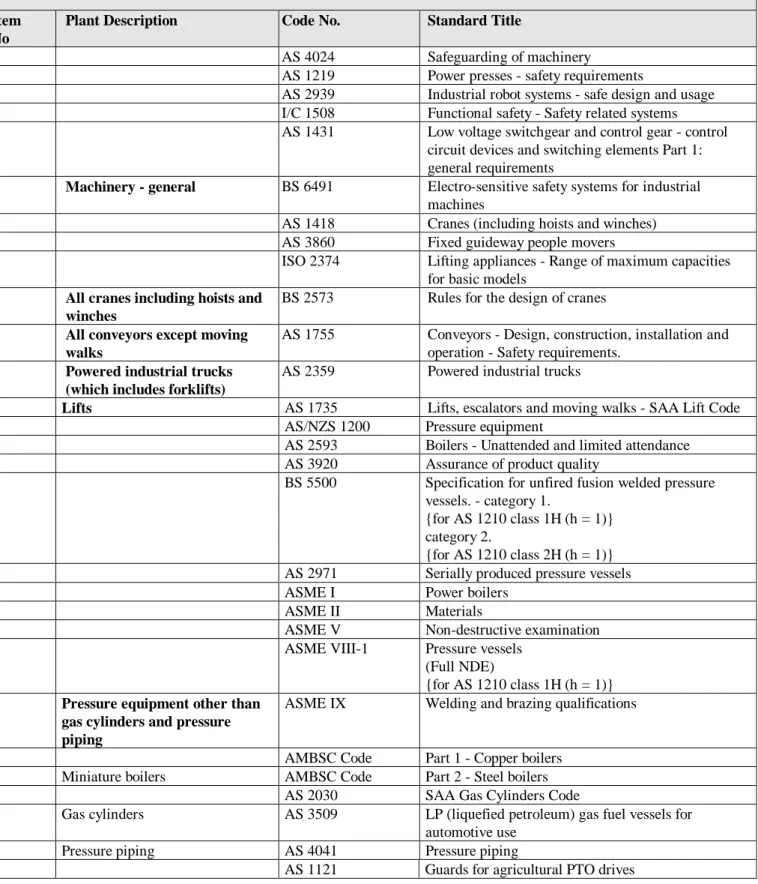
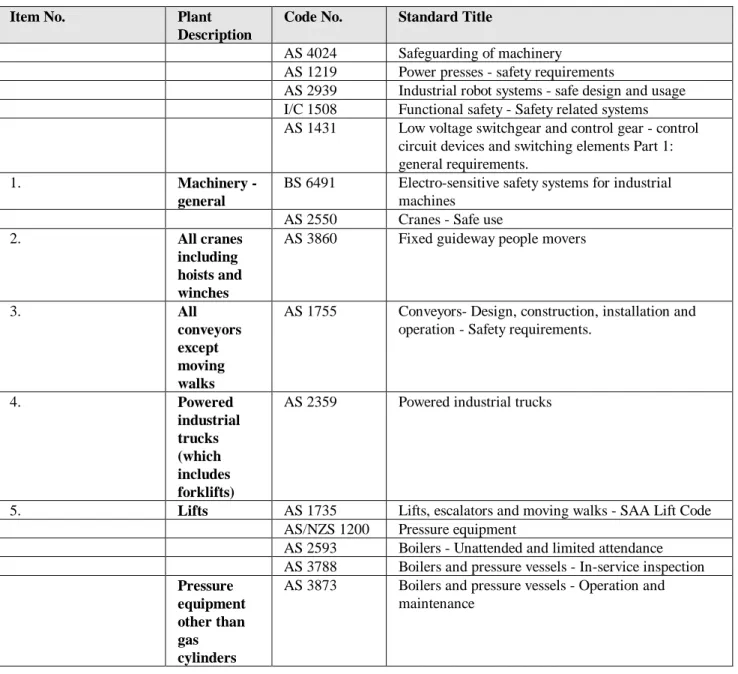
"Risk control" is the process of determining and implementing measures to control risks. The measures of control should address any risk identified in the risk assessment process. (The designer should have regard to the published technical standards listed in Table 1 in section 13.3 and in the consolidated tables in Appendix 2 when determining measures to control risk.)
The final decision on adoption of control measures should be appropriate to the specific characteristics of the plant and the knowledge available to the designer about the intended operating environment.
The Regulations clearly establish a priority order for the types of measures to control risk. The principal duty of the designer is to eliminate risk associated with the plant. If it is not practicable to do this, the Regulations require the designer to take action to reduce the risk so far as is practicable.
"Practicable" is defined in the Act as meaning: "practicable having regard to–
(a) the severity of the hazard or risk in question;
(b) the state of knowledge about that hazard or risk and any ways of removing or mitigating that hazard or risk; (c) the availability and suitability of ways to remove or mitigate that hazard or risk; and
In determining what measures are appropriate to ensure risk is controlled, each of the elements of practicable are required to be considered. This includes consideration of the severity of risks assessed. That is, consideration of the extent of the risk, including the seriousness of the potential injury or illness and the numbers of people who may be affected.
There are many ways for the designer to eliminate or reduce the risk to health and safety. Any action which removes the risk is the better control solution, provided it does not create another type of hazard and risk. When a control measure is selected, the designer should ensure that it does not create another risk or introduce new hazards. This could be done by carrying out a further hazard identification and risk assessment to evaluate the proposed design. The information gained should be compared to that obtained from the original hazard identification and risk assessment. If no single measure to control risk will achieve a satisfactory result, a combination of measures should be used.
For example, when designing a boiler the designer has identified the hazard of the boiler exploding due to over-pressure. The likelihood of this occurring in the absence of control measures would be high. While it is not practicable to eliminate the risk, the incorporation of a pressure release valve or other safety features reduces the risk associated with the hazard. However, if the pressure release valve or other safety features fail to operate, the risk of over-pressure and hence explosion of the boiler is again high. The safety valve reduces the risk but does not eliminate it.
Design to facilitate safe use
When designing plant to allow for safe use of that plant, factors the designer should take into consideration include: - the maximum number of tasks an operator can be expected to safely perform at any one time, and
complexity of those tasks;
- the layout of the workstation in which the plant may be used;
- the instrumentation for the plant, and the layout of the instrumentation. Instrumentation should provide the operator with clear, accurate information on how the plant is performing but not subject the operator to "information overload", which can cause error;
- the provision of devices, tools or controls appropriate to the pattern of work intended to be performed by the operator or other people using the plant;
- the provision of aids, guides, indicators, locks, interlocks, cover plates, guards, mounted instructions, signs, symbols and/or name plates, to facilitate correct actions and prevent operational errors;
- the need for quick recovery or maintaining the safety and integrity of the system in the event of operational error or plant failure;
- the need for ready access to the operator if assistance is required;
- the need to minimise the impairment of operator performance by eliminating or minimising the need for the operator to engage in physical or repetitive activity for inappropriate periods;
- the need to eliminate the risk of interference with, or inadvertent activation of, plant not in use.
Further guidance on the range of factors that should be considered when designing for the safe use of machinery is contained in AS 4024 Safeguarding of machinery. Other published technical standards listed in Table 1 in section 13.3 of this code also have applicable guidance on designing for the safe use of plant.
Ergonomic considerations
Technical references relating to ergonomic considerations can provide useful guidance on human functions, capabilities and requirements for designers of plant and plant operating systems.
Hazard identification, risk assessment and risk control example
Appendix 5 provides an example of the application of hazard identification, risk assessment and risk control processes to the design of a bench grinder.
13.3 Using Published Technical Standards
When determining measures to control risk, designers should have regard to the published technical standards listed in Table 1 (and in the consolidated tables in Appendix 2). It is acknowledged that there may be a large range of published technical standards other than those listed in Table 1, that address a given design project. Designers may choose to consider these when determining measures to control risk.
The technical standards listed in Table 1 (and in the consolidated tables in Appendix 2) provide guidance for the design projects listed. Note 8
Note 8 (The reader should refer to "What is a Code of Practice?" and "Incorporation of Standards" at the front of this code of practice for an explanation of the significance of the technical standards listed in this code.)
For example, in regard to designing a forklift truck, AS 2359 provides guidance relevant to hazard identification, risk assessment and control for a designer. This includes guidance on: calibrating and testing the stability of a forklift truck to ensure the stability of the truck is sufficient to prevent overturning; testing methods to ensure the proposed braking system is appropriate to the truck's speed and loading capacity; selection of tyres and rims, having regard to maximum rated loads; testing for fatigue stress on the fork arms; guarding of dangerous and moving parts; appropriate design of controls including steering wheels, brake pedals and load control levers and advice on the design of forklifts which are required to operate in a potentially explosive or toxic atmosphere, dusty environments and uneven terrain.
Table 1: Published technical standards relating to design of plant Item
No
Plant Description Code No. Standard Title
AS 4024 Safeguarding of machinery
AS 1219 Power presses - safety requirements
AS 2939 Industrial robot systems - safe design and usage I/C 1508 Functional safety - Safety related systems
AS 1431 Low voltage switchgear and control gear - control circuit devices and switching elements Part 1: general requirements
Machinery - general BS 6491 Electro-sensitive safety systems for industrial machines
AS 1418 Cranes (including hoists and winches) AS 3860 Fixed guideway people movers
ISO 2374 Lifting appliances - Range of maximum capacities for basic models
All cranes including hoists and winches
BS 2573 Rules for the design of cranes All conveyors except moving
walks
AS 1755 Conveyors - Design, construction, installation and operation - Safety requirements.
Powered industrial trucks (which includes forklifts)
AS 2359 Powered industrial trucks
Lifts AS 1735 Lifts, escalators and moving walks - SAA Lift Code
AS/NZS 1200 Pressure equipment
AS 2593 Boilers - Unattended and limited attendance AS 3920 Assurance of product quality
BS 5500 Specification for unfired fusion welded pressure vessels. - category 1.
{for AS 1210 class 1H (h = 1)} category 2.
{for AS 1210 class 2H (h = 1)} AS 2971 Serially produced pressure vessels
ASME I Power boilers
ASME II Materials
ASME V Non-destructive examination ASME VIII-1 Pressure vessels
(Full NDE)
{for AS 1210 class 1H (h = 1)} Pressure equipment other than
gas cylinders and pressure piping
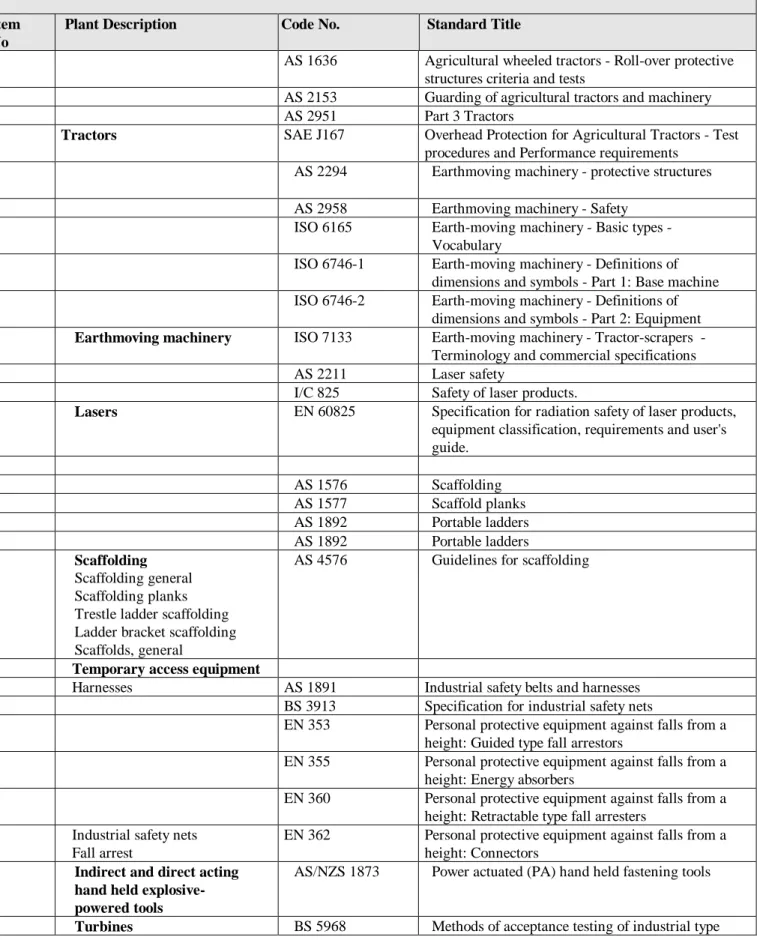
Table 1: Published technical standards relating to design of plant Item
No
Plant Description Code No. Standard Title
AS 1636 Agricultural wheeled tractors - Roll-over protective structures criteria and tests
AS 2153 Guarding of agricultural tractors and machinery
AS 2951 Part 3 Tractors
Tractors SAE J167 Overhead Protection for Agricultural Tractors - Test
procedures and Performance requirements AS 2294 Earthmoving machinery - protective structures AS 2958 Earthmoving machinery - Safety
ISO 6165 Earthmoving machinery Basic types -Vocabulary
ISO 6746-1 Earth-moving machinery - Definitions of dimensions and symbols - Part 1: Base machine ISO 6746-2 Earth-moving machinery - Definitions of
dimensions and symbols - Part 2: Equipment Earthmoving machinery ISO 7133 Earthmoving machinery Tractorscrapers
-Terminology and commercial specifications
AS 2211 Laser safety
I/C 825 Safety of laser products.
Lasers EN 60825 Specification for radiation safety of laser products,
equipment classification, requirements and user's guide. AS 1576 Scaffolding AS 1577 Scaffold planks AS 1892 Portable ladders AS 1892 Portable ladders Scaffolding Scaffolding general Scaffolding planks Trestle ladder scaffolding Ladder bracket scaffolding Scaffolds, general
AS 4576 Guidelines for scaffolding
Temporary access equipment
Harnesses AS 1891 Industrial safety belts and harnesses
BS 3913 Specification for industrial safety nets
EN 353 Personal protective equipment against falls from a height: Guided type fall arrestors
EN 355 Personal protective equipment against falls from a height: Energy absorbers
EN 360 Personal protective equipment against falls from a height: Retractable type fall arresters
Industrial safety nets Fall arrest
EN 362 Personal protective equipment against falls from a height: Connectors
Indirect and direct acting hand held explosive-powered tools
AS/NZS 1873 Power actuated (PA) hand held fastening tools
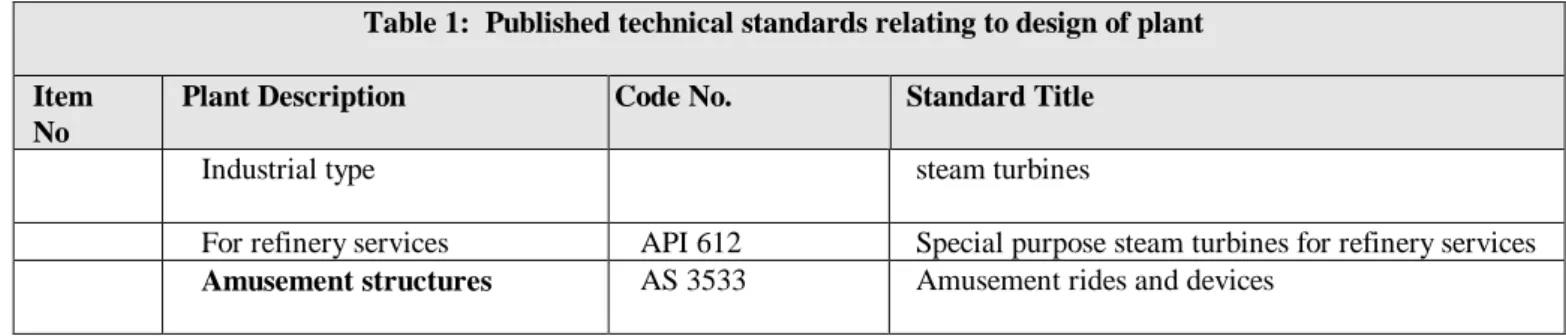
Table 1: Published technical standards relating to design of plant Item
No
Plant Description Code No. Standard Title
Industrial type steam turbines
For refinery services API 612 Special purpose steam turbines for refinery services
Published technical standards should be viewed only as a starting point in the control of risks. It should not be assumed that a design that meets the standard is without risk. This is because the standard itself may not deal with all the matters relevant to hazard identification, risk assessment and risk control for the plant in question. Appropriate judgement needs to be exercised in such circumstances.
Designers, when designing plant to specifications in published technical standard(s) such as those listed in Table 1, must determine whether the technical standard(s) fully deals with the risk to health or safety identified in the risk assessment process. This should involve a systematic assessment of whether the technical standard(s) apply to the whole plant or only certain parts of the plant and an assessment of the adequacy of the technical standard(s) in controlling a particular type of risk, having regard to the state of knowledge.
If designing the plant in accordance with the technical standard(s) listed in Table 1, or any other published technical standard, does not eliminate the risk to health or safety, the designer is required to reduce the risk so far as is practicable by altering the design of the plant. If the redesign still does not adequately control the risk, the designer is required to specify the risk control measures that require implementation when the plant is used.
13.4 Record Keeping.
The Regulations provide (regulation 307):
(1) A designer of plant must keep a record of all published technical standards, including parts of a published technical standard, used to design the plant and make the record available for inspection by the
Minister or a design verifier.
(2) If a designer does not use published technical standards to design the plant, he or she must keep a record of the engineering principles used to design the plant and make the record available for inspection by the Minister or a design verifier.
(3) The designer must ensure that the records referred to in this regulation are kept and maintained in a suitable state for inspection for 10 years.
Designers are required, where applicable, to record the published technical standards and/or engineering principles being used to design the plant. To minimise the level of recording, the designer may identify all major assemblies that, when combined, form the whole plant. The designer could then record that the major assemblies identified form the complete plant, and that their constituent parts have been designed to the identified published technical standards or specific engineering principles.
The requirement of regulations 307(1) and (2) could be met by maintaining a record of the following information, as appropriate:
• unique identification of the plant being designed;
• identification of all the major assemblies, and where required, identification of all the items that have been designed to the published technical standard or specific engineering principles;
• title of the published technical standard(s) used;
• where the entire published technical standard is not used, identification of the clauses that are used, or alternatively identification of the clauses that are not used, whichever is the easier; and
• where engineering principles are used instead of published technical standards, an outline of the engineering principles used.
Records outlining engineering principles should contain sufficient information to establish that the engineering principles have adequately addressed the issues of strength, stability, durability and safety features required to ensure the safe operation of the plant under normal and foreseeable emergency conditions.
13.5 Use of Guarding as a Measure to Control Risk . The Regulations provide (regulation 305):
(1) If a designer of plant uses guarding as a measure to control risk, the designer must ensure that guarding designed for that purpose will, so far
as is practicable, prevent access to the danger point or area of the plant.
(2) If a designer of plant uses guarding as a measure to control risk, the designer must ensure
that-(a) if access to the area of the plant requiring guarding is not necessary during operation, maintenance or cleaning of the plant, the guarding is a permanently fixed physical barrier; or
(b) if access to the area of the plant requiring guarding is necessary during operation, maintenance or cleaning of the plant, the guarding is an interlocked physical barrier which allows access to the area being guarded at times when that area does not present a risk and prevents access to that area at any other time; or
(c) if it is not practicable for the plant to use the type of guarding referred to in paragraph(a) or (b), the guarding is a physical barrier which can only be altered or removed by the use of tools; or
(d) if it is not practicable for the plant to use the type of guarding referred to in paragraphs (a), (b) or (c), the design includes a presence-sensing system that eliminates the risk arising from that area of the plant requiring guarding, while a person or any part of a person is in the area being guarded.
(3) If a designer of plant uses guarding as a measure to control risk the designer must ensure that the guarding is-(a) designed to make by-passing or disabling of the guarding, whether deliberately or by accident, as difficult as is reasonably possible; and
(b) designed so as not to cause a risk in itself. (4) If a designer of
plant-(a) uses guarding as a control measure; and
(b) the plant to be guarded contains moving parts and those parts may break or cause workpieces to be ejected from the
plant-the designer must ensure, so far as is practicable, that plant-the guarding will control any risk from those ejected parts and workpieces.
(5) Nothing in this regulation prevents a designer of plant from providing guarding which allows convenient repair, servicing and maintenance of plant when the plant is not in normal operation.
Types of guards
Numerous types of guarding systems are available to guard dangerous parts of machinery to prevent access by any person or body part. The Regulations establish a priority order for the types of guarding systems. Where guarding is used as a measure to control risk, the designer is required to ensure that the guard designed for the plant is:
• a permanently fixed physical barrier if access to the area requiring guarding is not necessary during operation, maintenance or cleaning of the plant; or
• an interlocked physical barrier if access to the area requiring guarding is necessary during operation, maintenance or cleaning of the plant. (Note: this type of guarding system must only allow access to the guarded area when that area does not presents a risk).
If guarding is to be used and it is not practicable to use either a permanently fixed physical barrier or an interlocked physical barrier, the designer is required to ensure that the guarding is a physical barrier that can only be altered or removed by the use of a tool. The physical barrier (that is, fixed guard) should be fixed in position by means of fasteners or other suitable devices, that cannot be altered or detached without the aid of a tool or a key. If it is not practicable to use a physical barrier, the designer is required to include a presence sensing system in the design. The following examples illustrate an application of each of the four types of guards.
Permanently fixed physical barrier - The risk associated with many hazards can be eliminated with a permanently fixed physical barrier. In Figure 3, the plant's power transmission is not required to be accessed during normal operation, maintenance or cleaning. It is therefore practicable to have the gear arrangements enclosed in a purpose designed gearbox housing to prevent access to moving gears. This has eliminated the risk associated with entanglement.
Fig 3
Cut – away view of a fixed physical barrier encasing the gear assembly and heavy duty electric motor
Interlocked physical barrier - An interlock guard is connected to the plant's operational controls so that the plant is prevented from operating until the guard is closed and either the guard remains locked closed until the risk from the hazard has passed or opening the guard causes the hazard to be eliminated before access is possible. In Figure 4, the hinged top guard on the dough mixer is provided with a positively operating insertion key which upon minimal movement, that is breaking contact when the lid is opened or removed, automatically cuts off the plant's power thereby allowing the dough blades to come to rest. In cases where the moving parts take a long period of time to come to rest, an
interlock locking arrangement preventing access is necessary to prevent access to the moving parts before they come to rest.
Physical barrier (or fixed guard) - The fixed guard by its design prevents access to the hazard associated with the moving parts of the plant. In Figure 5, the guillotine has a fixed guard secured to prevent access to the in-running nip points of the power transmission and the shear action of the guillotine blade.
Guard design
The mechanisms and controls forming part of a machine guard should be of a fail safe design. Guards should not in themselves create hazards. For example, the guarding should not weaken the structure of the plant, cause discomfort to the people using the plant or introduce new hazards such as pinch points, rough edges or sharp corners. Note: where some form of physical barrier is provided to prevent access to dangerous parts, the size and position of the barrier should take into account the range in height and build of people using the plant.
The design of the guard should be for a specific function, with design consideration being given, where appropriate, to: the placement, removal or ejection of work pieces; lubrication; inspection; adjustment; and repair of machine parts. Guarding should be designed for safe operation of the plant as well as to minimise interference to the plant.
The selection of a guard should take into consideration the environment in which it is to be used. Some examples of poor guard selection relative to the environment are: electrical charging of guards on high frequency welders; heating of guards in hot processes; and wire mesh guards on machines emitting splashes.
Physical barrier guarding should be constructed of material that is strong enough to resist normal wear and shock that may arise from failure of the parts or processes being guarded; and to withstand long use with a minimum of maintenance. If a guard is likely to be exposed to corrosion, corrosion-resistant materials or surface coatings should be used.
When an enclosure is used to prevent access to mechanical, chemical and electrical hazards, there may be an opportunity to control other risks. For example, risk associated with exposure to dust may be controlled by substituting a sheet metal guard for a mesh one.
Where there is a risk of jamming or blockage of moving parts, the designer should ensure that specific work procedures, devices and tools that will enable the plant to be cleared in a way that reduces the risk are documented.
If applicable, the designer should ensure that safe systems of work associated with the use and maintenance of the guarding and the maintenance of the components being guarded, are specified in the information provided to the manufacturer.
14. Providing information to the manufacturer The Regulations provide (regulation 308):
A designer of plant must ensure, when the design of the plant is made available to the manufacturer, that the manufacturer of the plant is provided with information to enable the plant to be manufactured in accordance with the design specifications and, if applicable, with information relating
to-(a) the purpose for which the plant is designed; and
(b) the hazards and any risk, identified and assessed in accordance with this Part, associated with use of the plant; and
(c) testing or inspections to be carried out on the plant; and
(d) installation, commissioning, de-commissioning, use, transport, storage and, if the plant is capable of being dismantled, dismantling of the plant; and
(e) systems of work and competency of operators necessary for the safe use of plant; and (f) emergency procedures (if any) required if there is a malfunction of the plant.
Purpose
When supplying information on the purpose for which the plant is designed, the information should be clear and precise. The information should contain all normal operational specifications and limitations.
As part of the documentation supplied to the manufacturer, if applicable, the designer is required to include details of the environment(s) for which the plant has been designed. Where appropriate, the designer should include a statement or warning on those circumstances where the use of the plant may result in an unsafe condition.
Hazards and risks
The designer is required to provide the manufacturer with information about hazards identified under regulation 302 and risks assessed under regulation 303, if applicable.
Other information
The Regulations also require the designer to provide the manufacturer with information on the following matters, if applicable:
• testing and inspection of plant;
• installation, commissioning, de-commissioning, operation, maintenance, cleaning, transport, storage and dismantling of plant;
• systems of work and competency of operators for safe use of plant; and • emergency procedures (if any) associated with a malfunction of the plant.
15. Hazard Identification, Risk Assessment and Risk Control 15.1 Manufacturers Duty to Control Risk
The Regulations provide (regulation 402):
(2) If the manufacturer of plant identifies a hazard and associated risk in relation to the construction and materials specified in the design of the plant and that hazard and risk have not been dealt with in the design, the manufacturer
must-(a) advise the designer, in writing, of the hazard and associated risk as soon as is reasonably possible; or
(b) if it is not possible to advise the designer of the hazard and risk in accordance with paragraph (a), ensure that-(i) the risk is eliminated; or
(ii) if it is not practicable to eliminate the risk, the risk is reduced so far as is practicable.
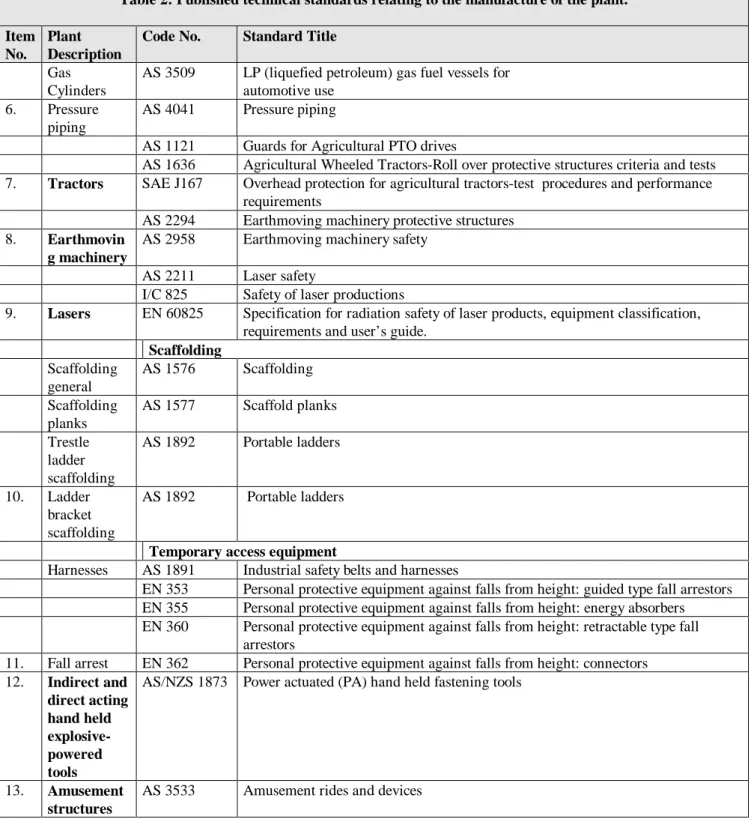
In determining whether there is a hazard and associated risk in relation to construction and materials specified in the design of the plant, the manufacturer should have regard to the published technical standards listed in Table 2. These standards also provide guidance on the inspection, testing and method of construction of plant. There may be published technical standards other than those listed in Table 2 that provide guidance on the materials used for the plant and the method of construction. The manufacturer may choose to consider these other published technical standards when identifying whether there is a hazard and associated risk in relation to the construction and materials specified in the design.
Where it is not possible for the manufacturer to advise the designer of an identified hazard and associated risk in relation to the construction and materials specified in the design, the manufacturer takes on the responsibility of the designer to ensure the risk is eliminated where practicable, or reduced so far as is practicable. Note 9
Note 9 (Where the manufacturer assumes the responsibilities of the designer under regulation 402, the manufacturer should have regard to the standards listed in Table l when determining measures to control risk)
Table 2: Published technical standards relating to the manufacture of the plant. Item
No.
Plant Description
Code No. Standard Title
AS 4024 Safeguarding of machinery
AS 1219 Power presses - safety requirements
AS 2939 Industrial robot systems - safe design and usage 1. Machinery
-general
I/C 1508 Functional safety - Safety related systems AS 1418 Cranes (including hoists and winches) AS 3860 Fixed guideway people movers 2. All cranes
including hoists and winches
ISO 2374 Lifting appliances - Range of maximum capacities for
3. All
conveyors except moving walks
AS 1755 Conveyors- Design, construction, installation and operation - Safety requirements.
4. Powered industrial trucks (which includes forklifts)
AS 2359 Powered industrial trucks
5. Lifts AS 1735 Lifts, escalators and moving walks - SAA Lift Code AS/NZS 1200 Pressure equipment
AS 3920 Assurance of product quality
BS 5500 Specification for unfired fusion welded pressure vessels - category l.
{for AS 1210 class 1H (n = 1)} - category 2.
{for AS 1210 class 2H (n = 1)} AS 2971 Serially produced pressure vessels ASME I Power boilers
ASME II Materials ASME VIII-1 Pressure vessels
(Full NDE)
{for AS 1210 class 1H (n = 1)) Pressure
equipment other than
Table 2: Published technical standards relating to the manufacture of the plant. Item
No.
Plant Description
Code No. Standard Title Gas
Cylinders
AS 3509 LP (liquefied petroleum) gas fuel vessels for automotive use
6. Pressure piping
AS 4041 Pressure piping
AS 1121 Guards for Agricultural PTO drives
AS 1636 Agricultural Wheeled Tractors-Roll over protective structures criteria and tests 7. Tractors SAE J167 Overhead protection for agricultural tractors-test procedures and performance
requirements
AS 2294 Earthmoving machinery protective structures 8. Earthmovin
g machinery
AS 2958 Earthmoving machinery safety AS 2211 Laser safety
I/C 825 Safety of laser productions
9. Lasers EN 60825 Specification for radiation safety of laser products, equipment classification, requirements and user’s guide.
Scaffolding Scaffolding general AS 1576 Scaffolding Scaffolding planks AS 1577 Scaffold planks Trestle ladder scaffolding AS 1892 Portable ladders 10. Ladder bracket scaffolding AS 1892 Portable ladders
Temporary access equipment
Harnesses AS 1891 Industrial safety belts and harnesses
EN 353 Personal protective equipment against falls from height: guided type fall arrestors EN 355 Personal protective equipment against falls from height: energy absorbers EN 360 Personal protective equipment against falls from height: retractable type fall
arrestors
11. Fall arrest EN 362 Personal protective equipment against falls from height: connectors 12. Indirect and direct acting hand held explosive-powered tools
AS/NZS 1873 Power actuated (PA) hand held fastening tools
13. Amusement structures
15.2 Manufacturer's Duty to Record Published Technical Standards Used in Manufacturing Plant The Regulations provide (regulation 404):
(1) A manufacturer of plant must keep a record of all published technical standards, including parts of a published technical standard, used to manufacture the plant and make the record available for inspection by the
Minister.
(2) The manufacturer must ensure that the records referred to in this regulation are kept and maintained in a suitable state for inspection10 years.
Manufacturers are required, where applicable, to record the published technical standards being used to manufacture the plant. To minimise the level of recording, the manufacturer may identify all major assemblies that, when combined, form the whole plant. The manufacturer could then record that the major assemblies identified form the complete plant, and that their constituent parts have been manufactured to the identified published technical standards.
The requirement of regulations 404(1) and (2) could be met by maintaining a record of the following information, as appropriate:
• unique identification of the plant being manufactured;
• identification of all the major assemblies, and where required, identification of all the items that have been manufactured to the published