MANAGERS’ USE OF MULTIPLE MANAGEMENT CONTROL SYSTEMS:
THE ROLE AND INTERPLA
Y OF MANAGEMENT CONTROL SYSTEMS AND COMPANY PERFORMANCE
COPENHAGEN BUSINESS SCHOOL SOLBJERG PLADS 3 DK-2000 FREDERIKSBERG DANMARK WWW.CBS.DK ISSN 0906-6934 Print ISBN: 978-87-93483-54-5 Online ISBN: 978-87-93483-55-2
Jeanette Willert
THE ROLE AND INTERPLAY OF
MANAGEMENT CONTROL SYSTEMS
AND COMPANY PERFORMANCE
MANAGERS’ USE OF
MULTIPLE MANAGEMENT
CONTROL SYSTEMS:
Managers’ use of multiple Management Control Systems:
The role and interplay of management control systems
and company performance
Jeanette Willert
Supervisors: Carsten Rohde and Teemu Malmi
Doctoral School of Business and Management
Jeanette Willert
Managers’ use of multiple Management Control Systems:
The role and interplay of management control systems and company performance 1st edition 2016 PhD Series 45.2016 © Jeanette Willert ISSN 0906-6934 Print ISBN: 978-87-93483-54-5 Online ISBN: 978-87-93483-55-2
Doctoral School of Business and Management is a cross disciplinary PhD School connected to research communities within the areas of Languages, Law, Informatics, Operations Management, Accounting, Communication and Cultural Studies.
English abstract
This dissertation addresses the topic Management Control Systems (MCS) as a Package. Many research studies investigate management and control systems individually, whereas fewer research studies take a holistic view and include a larger part of all the MCS managers use to guide and direct subordinates behaviour in the best interest of their companies. In the MCS literature, it is stressed that knowledge is particularly lacking about how managers design and use MCS as a package, and the effectiveness of using the MCS. This dissertation responds to this call by carrying out a large survey among executive managers in large companies, a survey that investigates the subject: Effective Management and Control Systems. The focus in the survey is to explore how executive management in large companies design and use their management control systems package. Further, this study is supplemented with archival data on the participating companies’ performance.
The dissertation presents three papers, each of which introduces knowledge within studying managers’ use of MCS as a package. The first paper presents executive managers’ use of management control systems as a package in large companies. With basis in a conceptual MCS framework the paper explores executive managers’ focus and emphasis on using the different parts of an MCS package to guide and direct their subordinates to ensure high organisational performance and further success for their companies. The second paper is a literature review including a comparative analysis of MCS frameworks. The paper discusses the fundamental purpose of MCS frameworks to clarify the usability of MCS frameworks in research and in practice. The paper draws attention to research gaps and missing variables within the frameworks, and provides a guideline of issues that researchers and practitioners may benefit from when using the frameworks.
some MCS and companies’ financial performance. The MCS investigated are: strategy, evaluation of subordinates, rules and procedures and executive managers’ focus on customer relations when guiding and directing their subordinates. The paper finds both some positive and some negative relations between the use of
MCS and companies’ development in financial performance. The findings in all
three papers can be used by both researchers and practitioners who wish to expand and advance their existing knowledge about MCS’ impact on company performance and success.
Danish abstract
Denne afhandling omhandler ledelses- og styringssystemer. Flere studier undersøger ledelses- og styringssystemer individuelt, mens færre studier vælger en holistisk tilgang, hvor der inkluderes en større del af alle de mange ledelses- og styringssystemer, som ledelser benytter, når de skal vejlede, styrer og kontrollerer underordnedes adfærd og arbejdsmønster for at opnå det bedste resultat for virksomheden. I litteraturen indenfor ledelses- og styringssystemer fremhæves det, at der især mangler viden om, hvordan ledere designer og bruger virksomhedens samlede pakke af ledelses- og styringssystemer, og hvor effektive disse systemer medvirker til øget indtjening. Denne afhandling responderer på litteraturen, ved at gennemføre en større spørgeskema- og interviewundersøgelse blandt top ledere i store virksomheder om dette emne: Effektive ledelses- og styringssystemer. Fokus i undersøgelsen er ud fra en holistisk tilgang, at kortligge de forskellige ledelses- og styringssystemer som direktionen i store virksomheder benytter til at lede deres organisationer med. For at kunne kvantificere effekten af ledelsernes afvendelse af styringssystemer, indeholder denne afhandling endvidere regnskabsdata fra de medvirkende virksomheder.
Afhandlingen består af tre artikler, som hver især præsenterer viden omkring toplederes brug af styrings- og ledelsessystemer som en samlet ledelsespakke. Den første artikel præsenterer resultaterne af interview- og spørgeskemaundersøgelsen. Med udgangspunkt i en konceptuel forskningsramme indenfor ledelses- og styringssystemer kortlægges toplederes fokus og prioriteringer mellem brugen af de forskellige dele af deres samlede pakke af ledelses- og styringssystemer, som de benytter til at sikre opnåelse af fastsatte mål for deres virksomheder. Anden artikel er en litteraturgennemgang, herunder en sammenlignende af anvendte konceptuelle forskningsrammer indenfor styrings- og ledelsessystemer. Artiklen
for at afklare anvendeligheden af disse i forskning og praksis. Artiklen fokuserer blandt andet på muligheder og mangler i forskningsrammerne og kortlægger information som forskere og praktikere kan have gavn af fremadrettet, ved anvendelse af de konceptuelle forskningsrammer. Den tredje artikel, undersøger relationer mellem lederes brug af ledelses- og styringssystemer, og virksomhedernes indtjeningsevne. Artiklen undersøger ledelses- og styringssystemer indenfor områderne strategi, præsentations evaluering, regler og procedurer samt leders fokus på kunderelationer, når de leder deres underordnede. Artiklen identificerer både positive og negative relationer mellem brugen af ledelses- og styringssystemerne, og udviklingen i virksomhedernes indtjeningsevne. Alle tre artikler præsentere resultater, som kan bruges af både forskere og praktikere, der ønsker at udvide og fremme deres viden om ledelses- og styringssystemers indvirkning på virksomheders økonomiske resultater.
Acknowledgements
This dissertation would not have been completed without the help of many people. I am deeply grateful to all of them.
I would like to thank my supervisor, Professor Carsten Rohde who invited me to write this dissertation. Carsten personally not only enriched my theoretical knowledge of the areas of accounting and management control, he also gave me the opportunity to be a member of the international research group ‘Management Control Systems as a Package’, which made me part of a network of twenty top researchers within the field of MCS. Thank you for always believing in my work.
I wish also to extend my gratitude to Professor David Otley, whom I meet at The Management Control Research Conference in September 2013. Since then, David has become a co-author of one of my papers. David and I have met several times to discuss Management control systems in general and development of our paper, including a presentation and discussion of the paper at a workshop organised by The Management Control Association. David has taught me much about ‘the
World of Research’ and has become a dear and true friend whom I highly value.
Executive managers from 120 of the largest companies in Denmark have provided data to this dissertation. I am very honoured and grateful that they were willing to spend some of their precious time to share their experience and knowledge on how they run organizations successfully. Thank you for taking time out of your busy schedules to explain how you design and use MCS as a package in your organizations.
Shifting from practice to research was not always an easy task for me. Thank you Jytte Larsen for forming a writing group with me and for persevering and motivating me when needed. Also thank you to Mark Simpson and Sara Haas for
would have been even longer. I also wish to express my gratitude to all the members in the international research group ‘Management Control Systems as a package’, with whom I have had regular meetings discussing the topic, working with data and writing an article. Thank you for all you have taught me. I hope our research group will continue.
Thanks to Professor Rolf Brüel and Senior Researcher Julia Mundy, who were discussants at my pre-defence. I thank you for taking part in improving previous editions of my research - your comments were very useful in my work with completing this dissertation. And thank you to all my colleagues at the Department of Accounting and Auditing at CBS, especially Jytte, Caroline and Thomas who have spent time reading my work and giving me useful feedback to continue the writing of my Ph.D. dissertation.
I also wish to thank FSR’s Studie- og Understøttelsesfond (the association of chartered auditors’ study and support fond) for providing financial support; without your funding it would not have been possible for me to write this dissertation.
Thanks to all my friends who have regularly asked interestedly about my research, and who have believed in my success with my Ph.D. from the start to the completion of this dissertation.
Finally, I wish to give special thanks to my family, my husband Kjeld and our three children Savannah, Maximilian and Athene, who have patiently followed my journey with my Ph.D. for the past four years.
Thank you!
Abbreviations
English word Danish word Abbreviation
Balanced Scorecard Balanced Scorecard BSC
Copenhagen Business School Copenhagen Business School CBS
Management Control Systems Ledelses-og styringssystemer MCS
Return on assets Aktivernes forrentning ROA
Strategic Business Unit Strategisk forretningsområde SBU
Table of contents
1 Introduction, motivation and objective... 1
2 Methodological position ... 5
2.1 Research methods and data... 9
2.1.1 Literature ... 10
2.1.2 Survey... 11
2.1.3 Survey instrument design... 13
2.1.4 Survey sample design... 14
2.1.5 Archival accounting data... 20
3 Theoretical position ... 20
3.1.1 Management control systems... 21
3.1.2 Management control systems’ frameworks ... 22
3.1.3 Contingency theory ... 44
4 Contribution to knowledge ... 51
5 Limitations and future research ... 54
6 References... 57
7 Articles... 65
7.1 Top managers’ use of management control systems in large companies in Denmark... 66
7.2 Management Control Systems and Performance Management Systems - A Comparative Analysis of Frameworks... 127
7.3 The Use of Management Control Systems: impact on companies’ performance... 186
Appendix A: Questionnaire...228 Appendix B: Respondents’ background information...246 Appendix C: Firm information on respondents’ companies...247
1
Introduction, motivation and objective
Management control systems (MCS) are a necessity for organizations, as MCS affect employee behaviour, secure and support goal fulfilment, set limitations, help to avoid or minimize risks, and give managers tools and systems to guide and direct their subordinates to the best interest of their companies (Berry et al, 2005; Merchant and Van der Stede, 2012; Simons 1995, 2005). Failures in managements’ design and use of MCS may lead to financial losses and reputation damage (Merchant and Van der Stede, 2012), which it may take years to recover from, or in the worst case cause organizational failure. As such the importance of MCS is accepted in both practice and research.
The aim of MCS is twofold – activities for planning and controlling, and activities
that encourage employees to be innovative by searching for opportunities and solving problems, including improving the existing business (Simons, 1995; Mundy, 2010). MCS consist of practices, controls and systems that management use to guide, direct and control their subordinates in the best interest of their organizations (Merchant and Otley, 2007; Malmi and Brown, 2008; Ferreira and Otley, 2009). Other important MCS elements include organizational structure and values, technology, culture, and other factors that may affect employee behaviour and subsequently organizational effectiveness, and hence performance (Otley 1980; Simons 1995). Previous research into MCS theory has had major focus on “how to design MCS in order to produce the desired outcome” (Malmi and Brown 2008, p.288). By including all controls of an MCS package within MCS studies, soled focusing on one or few accounting-based controls will be avoided, and the effects of informal and non-calculative controls such as organizational culture and administrative controls can be included (Malmi and Brown 2008), and hereby
recognize the informal control systems as MCS and not only as the context in which other controls operate. As organizations are unique and their environments are different, they need different MCS packages. As such, it is up to an
organization’s management to personalise their organization’s MCS package to
the best fit of their organization. In chapter three and in the three articles (chapter seven), MCS and the use of MCS will be described and discussed in detail.
An MCS Package is both cohesive and comprehensive, containing multiple controls that work simultaneously, some overlapping, depending on or influencing
each other, and all with the same overall goal –to fulfil a company’s objectives.
However, the MCS are designed for different purposes, by different people, at different times, each with different life-cycles, and can be used in part of an organization or as an omnibus MCS for an entire organization. Consequently, an organization’s MCS package cannot be seen as one holistic system, as some of the MCS would be able to function without the other controls, but rather as a package whose elements are related and independent (Malmi and Brown, 2008; Ferreira and Otley, 2009; Grabner and Moers, 2013, Strauss et al., 2013). Due to
uncertainty and dynamics in the organization’s environment, the construction of
an MCS package has to be flexible in order to be able to change and capture the volatility of the external environment. However, even though high volatility in the environment demands a more loosely coupled MCS package (Orton and Weick, 1990; Chenhall, 2006) that is quicker at adjusting to the changes, the package has to be comprehensive, and the controls must be coupled as tightly as they can or needed to ensure a high probability of success, and to ensure with reasonable confidence that no major unpleasant surprises will occur (Merchant and Van der Stede 2012). Thus management have to balance the need for innovation, adaptability and boundaries within the design of their organization’s MCS
package. Since many factors influence the controls and nothing is static, the perfect MCS may be difficult to maintain continuously, and consequently the fit of the multiple variables will likely be volatile over time (Melnyk et al., 2014).
Over the last 20 years, the general business environment has shown an increasing rate of change (Nixon and Burns 2005), opportunities and competition, both locally and globally, which has made a greater degree of uncertainty apparent. Increasing globalisation and economic fluctuations caused by the global financial crisis have resulted in dynamic and volatile markets, which demand organizations’ executive management to continuously ensure that their organizations provide the demanded goods and services as effectively and efficiently as possible. Therefore managers today need to follow their organizations’ development closely to ensure effectiveness and high levels of compliance, and to be able to react when their business environment changes. To do so, management need MCS.
This study addresses the topic ‘Management Control Systems as a Package’. An organization’s MCS package is like a puzzle. There are many different parts (systems and variables) that all have to be kept on track, and have to fit in with
each other to achieve a perfect ‘picture’. An organization’s overall performance
depends on how well management can foster collaboration and high performance at all levels, and on management’s success in taking advantage of the opportunities that arise. However, it can be difficult to see the total picture or perhaps find some misfit between parts, if only a few of them are observed. Still, most studies focus on the effects of a single MCS in isolation (e.g. Chong and Mahama, 2014; Ho et al, 2014), which means that these studies often exclude the effects of organizational context or the impact of using more MCS simultaneously (Chenhall, 2003; Malmi and Brown, 2008). Thus it is difficult or impossible to distinguish the result of using one control from the results of other controls that
are used at the same time, or from the context of the organization or the external environment. By separating the controls in research, controls with high influence may be omitted, and other controls may therefore show a stronger effect on performance than they actually have. Chenhall (2003) even claims that some findings are spurious, ambiguous or potentially conflicting with other results, due to the exclusion of controls in some studies.
Due to scarce research on addressing the use of multiple MCS and their interrelations, we know little about to what extent and how managers design such systems as a package (Malmi and Sandelin, 2010), how managers prioritize MCS, and to what extent managers are conscious about the interrelationship between systems and the possible effects that may, intended or unintended, emerge from such interrelations. For example, managers may be aware that organizational culture and values, and indeed their own behaviour, are important for the organization’s performance, but they may not recognize such more informal controls as controls that have a real impact as MCS themselves and as controls that may have a profound impact on the effectiveness of other MCS, as the administrative and more informal controls set ‘the tone at the top level’ and the pervasive tone for the organization’s operations as such. Which MCS are
recognized and which are not? How are interrelations between MCS factored in –
if at all? And what are the perceived consequences?
This dissertation includes a large dataset of empirical data containing information on how executive managements in 120 out of Denmark’s 318 largest organizations use MCS. The data will be used to explore the most common ways MCS are used in large Danish organizations today and to find general patterns that apply to a larger group of organizations than it would be able to verify in single case studies. The dataset is large in terms of both number of participants (120) and number of
questions asked (285). The study focuses on executive management’s perception of the relative importance of each control mechanism and the balance of different controls to guide and direct subordinate behaviour to enlarge performance and obtain company objectives. The main purpose of this study is to provide an overview of the design and use of MCS in Denmark.
The structure of this dissertation is as follows: The following chapter (2) contains descriptions of the methodology, methods and data used in this research. Chapter three includes a detailed description of the terms MCS, MCS frameworks and contingency theory. In Chapter four the contribution of this dissertation is summarized. In Chapter five a number of ideas for future research within the topic MCS as a package are suggested. Finally in Chapter seven, three articles are included. The first article is an empirical study that explores how executive management in large Danish organizations today use MCS to lead and guide their subordinates in the best interest of their organizations. The second article is a literature review of the development of conceptualized frameworks for studying the design and use of MCS as a package. The last article is an analytical article that looks for links between the use of MCS and organizational performance.
2
Methodological position
Researchers need different understanding or explaining factors to develop knowledge of situation, problems or phenomena, hence they need a methodology position for their research. The methodology position of this dissertation stems
from Arbnor and Bjerke’s (2009) ‘systems view’. With a foundation in a number
thinking, perspectivisation, understanding and explaining factors), Arbnor and Bjerke (2009) frame three methodological views of how to create knowledge: the analytical view, the systems view and the actors view. By mapping basic concepts, relations to paradigms, tools, techniques, methods, goals and ambitions for creating knowledge, Arbnor and Bjerke describe these three different ways of observing the world within methodological thinking.
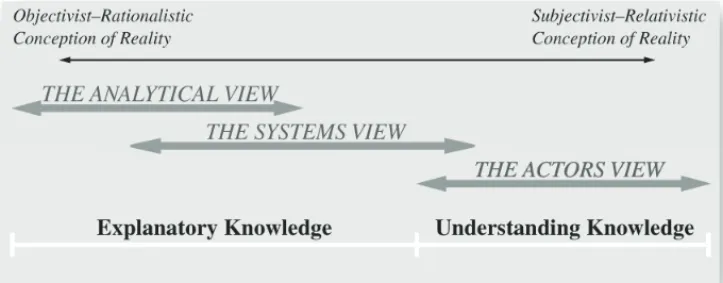
Figure 1: The Boundary between Explanatory and Understanding Knowledge
Source: Arbnor and Bjerke 2009, p 51.
“The analytical view presupposes that reality is filled with facts and independent
of individual perceivers” (Arbnor and Bjerke, 2009, p 36). Researchers use the analytical view when they study data to find patterns which can help them explore general facts of situations, problems or phenomena. In ‘the analytical view’, data are observed separately, and impacts from other variables or the environment are not incorporated. When working with ‘the analytical view’, quantitative data is often used. Such data most often stem from sources such as public statistics or other information gathered by authorities or other independent partners. Hence
‘the analytical view’ is known as “dataism” and determinism. However, interviews of professionals or people that have observed the phenomena can also be used, though ‘the analytical view’ does not incorporate individual perceivers; consequently, the interviewer has to pay attention to the objectivity of the participants when interviewing. The idea of creating knowledge according to ‘the analytical view’ is to catch the truth, as seeing reality as being the truth, and thereby to explore reality as objectively and closely as possible (Arbnor and Bjerke, 2009).
The idea of ‘the systems view’ is a holistic view, where all relevant variables and aspects must be seen as a whole (one system), in which the components (or aspects) of a system combined can bring synergy effects, which makes it possible to create situations where the whole of a system is more than the sum of its parts. “The systems view looks at reality as consisting of fact-filled systems structures in the objective reality and of subjective opinions of such structures, which are treated as facts as well” (Arbnor and Bjerke 2009, p 39). In ‘the systems view’, the world is considered as linked systems where all elements are dependent on other
elements. In ‘the systems view’, a company is seen not as a simple, isolated
organization, but as a system consisting of many components (products, resources, accounts, culture, management tools and style etc.) that are interdependent, which are in turn all influenced by and connected with other systems (e.g. customers, competitors, environment etc.) or components in other systems. Consequently, the result of a whole system is not only a result of it is own components and aspects and the fit between them, but it also depends on other systems and the match to these systems and their components. Thus, companies can have very different patterns and are influenced by many different systems; the idea of ‘the systems view’ is to find these different patterns and wholes as objective structures, and to
find new systems (or wholes) that are better than the previous ones. ‘The systems approach’ is based on the functionalist paradigm. This means that the focus is on
an explanatory approach that explains, describes and predicts. As ‘the systems
view’ includes both objective data and subjective opinions, the data collection will often be more substantial, and the dataset will include deeper and more comprehensive data than is the case in the ‘the analytical view’ (Arbnor and Bjerke 2009).
’The systems view’ acknowledges the dynamics found in organizations and their continuous interaction with the environment, as well as all the changes that constantly happen within and among such complex interdependent systems and
their environments. As a response, ‘the systems view’ uses feedback as a
stabilizing or reinforcing factor to continuously adapt or create new and better solutions for organizations. By focusing on processes and creating flexible systems that are open enough to react quickly to changes in order to ensure positive synergies, but are still tight enough to ensure goals fulfilment, as well as avoid or reduce risks, ‘the systems view’ seeks to catch and build better solutions for organizations. However, because system components, aspects, factors etc. change constantly, research within ’the systems view’ will often be a snapshot of the research object.
Researchers using ‘the actors view’ have to take part in the situation, problem or phenomena that they wish to study in order to obtain an understanding of individuals and their activities. If the researchers fail to participate, they will be
seen as strangers and miss opportunities to observe human micro-cosms1. The
1
A miniature representation of something, for example a unit, group, or place regarded as a copy of a larger one. The concept of human microcosm means a small group of individuals whose behaviour is typical of a larger social body encompassing it.
actors view “assumes that reality, as it exists for us, is a social construction, filled by chaos and uniqueness [for example] in the case of entrepreneurship, but also relatively stable structures, mentally anchored with those actors, who maintain the structures. It is a world, which to the largest extent is dependent on us human beings, where the creator of knowledge also participates as one of its constructors“ (Arbnor and Bjerke 2009, p 41). ‘The actors view’ uses three steps to process an interactive development of understanding: diagnostic pre-understanding, understanding and post-understanding. In the diagnostic pre-understanding process, the researcher works with background knowledge, and through dialogue and linguistic bridges he or she eliminates any differences in meanings that may exist between the researcher himself or herself and the individuals that participate in the study. The second step, ‘understanding’, uses the foundation created in the preunderstanding to achieve broader dialogue and action with the other actors in the study, as well as to analyse and find patterns in information. Step three, the post-understanding, is where the researcher has to conclude on the information
from the study and existing theory. (Arbnor and Bjerke, 2009 pp 140-141). As ‘the
actors view’ starts with subjective conceptualizations of individual actors, the results of these studies will also be subjective knowledge. Consequently, the results cannot be seen as general results and would have lesser value for common research on more complex problems. Finally, the results may be difficult to restore or verify.
2.1 Research methods and data
Methodology refers to the tools and techniques that can be used in the conduct of research. The focus in this dissertation is on ‘exploring practical use of MCS’. By gathering a large sample of information from practitioners within a broad scope of
their design and use of MCS, this study explores and analyses how practitioners today use MCS to ensure attainment of objectives and highest possible performance of their organizations. To achieve an open-minded approach when collecting data on how practitioners use MCS, data collection was done before specific research questions were formulated. However, the questionnaire that was used for collecting the data was based on a conceptual MCS framework (Malmi and Brown, 2008), and before the questionnaire was developed, a research agenda for the project was set, including three broad research questions, each with three
exploratory sub-questions (see more in the section below, ‘Survey’) (Malmi and
Sandelin 2010).
2.1.1 Literature
The aim of this PhD dissertation is to examine MCS as a package. Hence, the main literature review focuses on literature that looks broadly at the term MCS, consisting of research literature that includes more than one MCS. To make a structured review of the literature on MCS as a package, the method proposed by Webster and Watson (2002) was used. The structured approach constructs a body of literature on development of MCS frameworks and empirical studies of simultaneous use of multiple MCS. The structured review presented in this PhD dissertation identifies articles and books in the selected database that were related to MCS and which contained the words ‘management control’ in combination with the words 'framework' or 'package'.
The steps were as follows:
2) Keyword search (Management + Control*+ Framework or Package And Performance + Management + Framework or Package ) in,- and review of, relevant leading journals
3) Review of reference publications identified in step 2 (going backward)
4) Identification of publications citing key publications (going forward)
All abstracts in articles and books of the selected literature were read and studied in order to map research in MCS frameworks and identify the newest findings within the area of MCS as a package. All conceptual, empirical and analytical literature that was found relevant was included in the dissertation. The purpose of the first step was to identify the key literature for addressing MCS as a package. Following this, abstracts of literature from relevant references in the literature that was selected in the first step were read and studied to ensure better and more complete knowledge of the field. Finally, to ensure that all new research was covered, a ‘going forward’ process was done to ensure that literature on new MCS frameworks was found and included.
2.1.2 Survey
Survey methodology was selected for the empirical part of this dissertation. Survey methodology maximises and secures quality and generalizability in data, and seeks to explain why errors arise in surveys and afterwards in statistics. Hence the survey methodology seeks to minimise errors and ensure that the numbers and figures in the survey are as accurate as possible (Groves et al 2009).
“A “survey” is a systematic method for gathering information from (a sample of) entities for the purpose of constructing quantitative descriptors of the attributes of the larger population of which the entities are members” (Groves et al 2009, page 2).
The quantitative descriptors (statistics) are divided into two groups – descriptive statistics and analytic statistics. Descriptive statistics illustrate the size and distributions of various attributes in a population, e.g. as in article one where top managers’ use of MCS is explored to describe characteristics of how top managers today lead and control their organizations. Analytic statistics are used when measuring how two or more variables are related, e.g. as in article three where the relationship between the use of various MCS and organization performance is tested for interdependency. As surveys are designed to measure changes in the phenomena they study, surveys are on-going in nature. However, each survey provides a snapshot of how a given phenomenon is at the time the survey data are collected. This study is the Danish part of a large international study, which is the first large-scale attempt at examining how top managers in large companies design and use MCS as a package.
In 2010, Malmi and Sandelin instigated the international research project “Management Control Systems as a Package” (Malmi and Sandelin 2010). The aim was threefold, 1) to investigate how top management in large companies design and use MCS as a package, 2) to examine whether the design and use of MCS could be integral to an organization’s effectiveness and, 3) whether there is a correlation between what could look like independent parts of an MCS package. The purpose of Malmi and Sandelin’s international research project is to examine MCS as a package, by mapping how top management in large companies exercise their management control of middle managers at the highest levels of the companies’ hierarchies, and how effective these deployments are. With contributions from researchers from 20 universities in 11 different countries, the sample included 812 large companies, which were all investigated in relation to how they design, use and benefit from MCS.
2.1.3 Survey instrument design
The research project is designed as a quantitative survey. The tool used is a
comprehensive standardised questionnaire2 encompassing the areas: strategic
planning, short-term planning, performance measurement and evaluation, rewards and compensation, organizational structure and management processes, organizational culture and values, and organization and environment. Malmi and Brown’s (2008) conceptual MCS framework is used as basis for structuring the questionnaire, additionally, organizational design literature and strategic management literature on ambidextrous organizations contributes to the content and definition of the questions (Malmi and Sandelin 2010). Additionally to the MCS that are included in Malmi and Brown’s framework, the questionnaire has been extended by a section that includes questions regarding organizational factors, use of MCS, and the organisations’ environment. The questionnaire was provided in English by Malmi and Sandelin, following which each of the non-English-speaking participating countries translated the questionnaire into their native language, and re-translated back into English to ensure correct translations. A copy of the questionnaire is shown in appendix A. To ensure consistency and to achieve reliability of measurement instruments, a lexicon with comments and explanations to each question in the questionnaire was developed, as was as a sampling procedure to be used in the ORBIS database when selecting companies. Regular meetings were organised for project members to address research design and method. Coding procedures were applied uniformly, and finally a check of the data for consistency and missing values was conducted at the local level in each country.
2
The first version of the questionnaire was developed by Mikko Sandelin (Alto University), subsequently all participants in the international research group collaborated to modify, streamline and improve the final version of the questionnaire.
To ensure data quality and make sure that respondents understood the questions correctly, responses were gathered through personal interviews with CEOs, CFOs or other directors of 120 SBUs or stand-alone companies. The interviews lasted between two to three hours and were conducted by two researchers to ensure uniformity and objectivity. Further, the interviews were recorded to safeguard the validity of responses. The purpose of the interviews was to collect detailed information regarding the design and use of MCS in large companies. The questionnaire was formed as a classic survey: large sample size, random sampling, and statistics analyses of the data. Most responses were given as Likert scales of importance or frequency (1-7), and the remaining responses were selected from closed lists of categories (e.g. ownership type). There were no right or wrong responses, and “not applicable” (N/A) was provided as an option for some of the questions. However, although we used the same questionnaire in all companies, the face-to-face interviews move the survey in the direction of a cross-section field study. The interview method, the complexity of the phenomena studied, and the sampling rationale are typical of a cross-section field study approach (Lillis and Mundy 2005; Merchant and Manzoni 1989). In the interviews, top managers explained the business ecosystem of their organizations and were allowed time to explain their responses to the questions, and we had the opportunity to ask supplementary and clarifying questions. Data on the interviewees’ position, educational background and duration of employment in the companies they represented are shown in Appendix B.
2.1.4 Survey sample design
The ORBIS database was used in nine out of the eleven countries (including Denmark) to select the largest companies. The criterion used to define ‘large
companies’ was ‘active private companies with 250 or more employees3
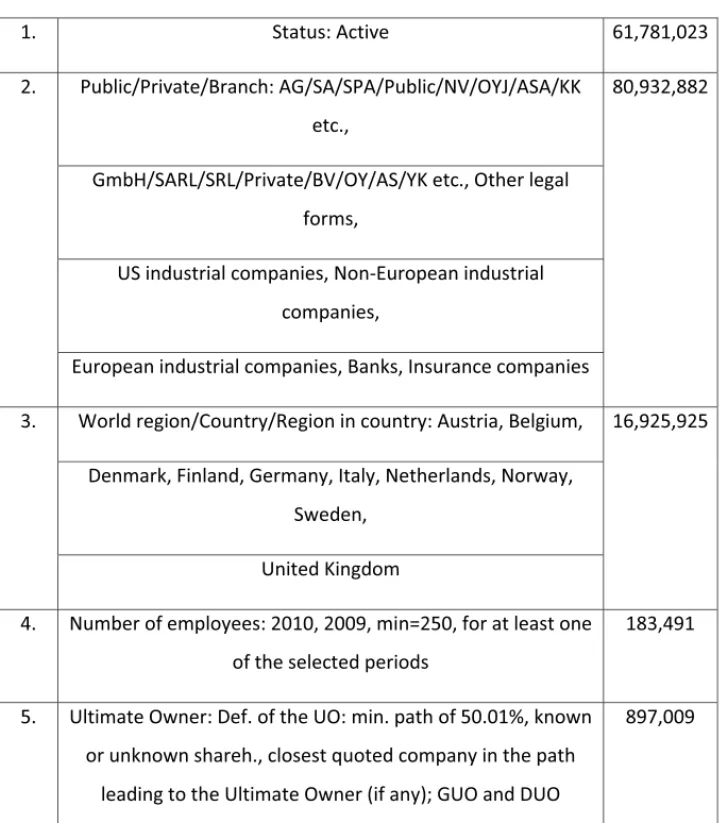
in 2009 or 2010’. Large companies were chosen as “size is an important contingency variable [within MCS research] as it has influence on other aspect of context” (Chenhall, 2006 page 98). Large companies tend to be more complex, have greater quantities of data and information, and have a structure where authority is more decentralized than in small companies. Consequently, large companies need rules, polices, systems and other MCS supporting and ensuring integration and coordination, and to guide and direct employees to fulfil company strategies and objectives (Chenhall, 2006; Flamholtz 1996). The five criteria used in the ORBIS database when selecting the target population are shown in table 1. Criterion number five was added to collate group companies into one company (e.g. a holding company). However, this criterion does not work perfectly in ORBIS, consequently this had to be checked manually in each country. The lists of large companies were categorised by country and into three industry sectors: manufacturing, trade and service. In Denmark, the lists of companies were then checked manually for duplicates and companies that had been closed down or
divided into smaller companies – all of which were deleted. Companies that had
been incorrectly categorised according to industry in the database were manually re-categorised. From this quality-checked total list of 318 companies, a random sample design was selected for interviewing (Groves et al 2009). The basis of
selection was ‘every third firm’ (Cochran 1977).
3
The European Union defines large enterprises as independent firms that employ more than 250 employees. http://www.oecd.org/regional/leed/1918307.pdf.
Table 1: Criteria used in ORBIS
1. Status: Active 61,781,023
2. Public/Private/Branch: AG/SA/SPA/Public/NV/OYJ/ASA/KK etc.,
80,932,882
GmbH/SARL/SRL/Private/BV/OY/AS/YK etc., Other legal forms,
US industrial companies, Non-European industrial companies,
European industrial companies, Banks, Insurance companies
3. World region/Country/Region in country: Austria, Belgium, 16,925,925
Denmark, Finland, Germany, Italy, Netherlands, Norway, Sweden,
United Kingdom
4. Number of employees: 2010, 2009, min=250, for at least one of the selected periods
183,491
5. Ultimate Owner: Def. of the UO: min. path of 50.01%, known or unknown shareh., closest quoted company in the path
leading to the Ultimate Owner (if any); GUO and DUO
In Denmark, data were collected in the period October 2011 to March 2013. To increase the response rate, five response-enhancing techniques that have shown positive effect on the response rate in surveys were used (Anseel et al, 2010). The first technique used was contacting the respondents personally. The top managers were contacted by phone by one of the four researchers in the Danish team, and even though top managers are not easy to get hold of, we continued to call until we had spoken personally to the top manager him- or herself. The second technique was to highlight the sponsorship by the universities (CBS and Aalborg University) to indicate the potential benefits and experience the respondents might gain by participating in a university research project. Third, the topic for the research ‘Management Control Systems as a package’ is very relevant for the population in the survey, and potential benefits of participating were introduced to the respondents. Fourth, all respondents were promised anonymity, to help participants feel comfortable when giving data and information to the research study. And finally, the fifth response-enhancing technique was to use personal interviews carried out by two researchers visiting the participants at their companies (Anseel et al, 2010).
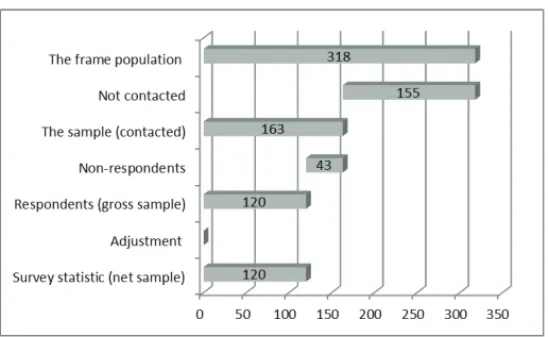
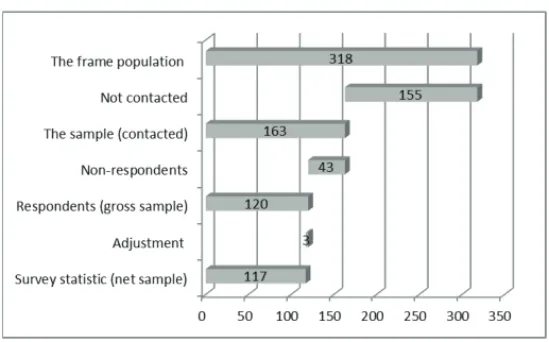
To obtain our target sample of 120 companies, we had to contact 163 companies. Personally, I called 74 companies, which resulted in a positive response rate of 85%, resulting in 63 interviews, which I organised and participated in. Seventy-two of the 120 companies had more than 1,000 employees, and 48 had less. In the data collection, the three industry sectors were represented by 56 manufacturing, 19 trade (retail and wholesale) and 45 service organizations. The percentage breakdown into the three sectors was the same percentage per sector in the data collection as in the quality-controlled total list of 318 companies. Below in figures
2 and 3 the process of selecting a sample of 120 companies from the frame population of 318 is shown.
Figure 2: Sample selection process for article #1
When adding a performance goal to the data sample, three of the companies became outliers. Two of the companies show extreme negative performance, and one positive. I have chosen to exclude these three observations in the third article, which is therefore based on 117 (97.5 %) out of the 120 companies in the sample.
Figure 3: Sample selection process for article #3
Despite all the precautions that may be taken when collecting such data, sample errors can occur. Respondents may have been too optimistic or pessimistic, or may not be sufficiently informed about their companies to be able to answer all the questions correctly. However, all the controls that are built into this research
project – e.g. the standardised questionnaire, coding procedures, the participation
of two researchers at the interviews, and the opportunity for respondents and
interviewers to ask for further explanation when filling in the questionnaire – help
to ensure a high quality in the sample.
This dissertation presents how the data collection was carried out in Denmark and the results of the Danish part of the international study. The researchers in the Danish part are: from CBS, Professor Carsten Rohde and PhD student Jeanette Willert, and from Aalborg University, Professor Poul Israelsen and PhD student Thomas Toldbod.
2.1.5 Archival accounting data
Due to the need for additional information in article 3, archival accounting data on the 120 companies who participated in the survey was collected for the years 2004 to 2013 from the ORBIS database to calculate ‘return on assets’ (ROA) per firm -year, in order to identify the development over time in each of the respondents’ organizational performance. The firms for which the ORBIS database could not provide the data for all ten years were contacted and asked for copies of their audited annual reports. The companies responded positively and provided all the missing accounts by sending their audited annual reports. One of the 120 companies, however, was founded in 2005, consequently they had no financial data for the year 2004.To eliminate the differences among industries, company context, market conditions and level of financial gearing of the participating
companies, this study focuses on the development in each of the companies’ ROA
(rather than the actual level of performance), to see if and how top managers’ different choices of use of MCS affect their company’s development in performance (article 3).
3
Theoretical position
The topic of this dissertation is MCS as a package with reference to theoretical and conceptual MCS frameworks which capture a holistic view of an organization’s MCS Package. The theoretical frame is contingency-based research. This chapter contains a description and discussion of some conceptual MCS frameworks, the purpose of an MCS package and the different MCS elements, and addresses some results of former MCS research within contingency-based research. As this dissertation is an explorative study, it will not test theory;
rather, conceptual frameworks will be used to give a more in-depth descriptive understanding of the design and use of MCS in large companies. This is done in the hope that such an appreciation would lead to further research in the design of more meaningful and appropriate normative MCS methods and systems that would be adapted and used in practice (Laughlin 1995).
3.1.1 Management control systems
Over the years, the scope of MCS has developed from simple and narrow
definitions excluding strategy and operational controls (Anthony 1965), to today’s
broader and more complex definitions (Collier, 2005). Today’s definitions of MCS include both periodical and rule-driven controls and more open and unstructured controls, as well as context variables that are not always fully controlled by the organization itself, but which rather originate from or are affected by the external environment in which the organization operates (Otley 1999; Chenhall 2003, 2006; Malmi and Brown 2008; Ferreira and Otley 2009; Merchant and Van der Stede 2012). Even though the scope of MCS has been broadened, the same three components presented by Anthony in 1965 still form the core of MCS: processes involving managers’ interaction with subordinates,
processes used for achieving the organization’s goals, and processes that ensure
effectiveness and efficiency (Anthony 1965, p.17). This focus on the original components of MCS in today’s broadened scope can be seen as a natural result of the development that has taken place in methods, systems, technologies and knowledge supporting MCS, which makes it possible today to design and use more complex controls with less use of resources (see more on the development of the term MCS in article three). A more detailed description of MCS follows below.
3.1.2 Management control systems’ frameworks
In 1965, Anthony (1965) introduced the term MCS and built an MCS framework that could be used when studying MCS. Since then, several researchers have developed new and more advanced MCS frameworks (Flamholtz et al, 1985; Flamholtz, 1996; Otley, 1980; Simons, 1995; Malmi and Brown, 2008; Ferreira and Otley 2009). The aim of the frameworks is to capture a holistic view of an organization’s MCS package. The MCS frameworks convey an overview of the components regarded as parts of the whole MCS package (Anthony 1965; Otley 1980; Fisher 1995, 1998; Simons 1995; Malmi and Brown 2008; Ferreria and Otley 2009). These frameworks are intended to support researchers in their empirical studies of organizations’ design and use of MCS as a package. The frameworks draw attention to the different controls used in an organization, including connections to contextual factors of the company, and stress the relationship and dependency in how the different controls are used in the different contextual settings. In addition, the frameworks encourage researchers to look at the effectiveness and efficiency of the MCS and the links between different designs and uses of MCS within an MCS package. The frameworks divide the controls into groups with different characteristics and uses (Simons 1995) or purposes (Otley, 1999; Malmi and Brown, 2008; Ferreira and Otley, 2009) in order to stress the importance of all the different areas of controls, both financial and non-financial. To capture all aspects at all levels of an organization, the frameworks must include both overall and broad MCS, such as mission and vision statements, and narrower controls such as personal reward systems.
Four of the most cited MCS frameworks are: Simons’ ‘Levers of control’ from 1995, Otley’s MCS framework composed of five key questions (1999), Malmi and Brown’s conceptual MCS from 2008, and finally Ferreira and Otley’s framework
from 2009 comprising twelve key questions. Below, the four frameworks are shown and followed by a description of the different MCS elements that are included in these frameworks. In addition, a discussion of the conditions and aims of these frameworks are included in paper 3. The four frameworks all have broad definitions of MCS, use contingency theory and incorporate the effect given by using MCS simultaneously.
Figure 3: Simons (1995): Levers of Control
Business Strategy Risks to Be Avoided Critical Performance Variables Strategic Uncertainties Core Values ELIEFS SYSTEMS BELIEFS SYSTEMS DIAGNOSTIC CONTROL SYSTEMS DIAGNOSTIC CONTROL SYSTEMS INTERACTIVE CONTROL SYSTEMS INTERACTIVE CONTROL SYSTEMS BOUNDARY SYSTEMS BOUNDARY SYSTEMS
Figure 4: Otley (1999): The performance management framework
1. What are the key objectives that are central to the organization’s overall
future success, and how does it go about evaluating its achievement for each of these objectives?
2. What strategies and plans has the organization adopted and what are the
processes and activities that it has decided will be required for it to successfully implement these? How does it assess and measure the performance of these activities?
3. What level of performance does the organization need to achieve in each of
the areas defined in the above two questions, and how does it go about setting appropriate performance targets for them?
4. What rewards will managers (and other employees) gain by achieving these
performance targets (or, conversely, what penalties will they suffer by failing to achieve them)?
5. What are the information flows (feedback and feed-forward loops) that are
necessary to enable the organization to learn from its experience, and to adapt its current behaviour in the light of that experience?
25 Figur e 5: M alm i an d Bro wn (2 008 ): Managem ent control system s pack age Cultural Controls Clans Values Symbols Planning Cybernetic Controls Rewa rd and Compen sation Long -range planning Action planning B udgets Fi nancial Measuremen t Systems Non-F inancial Measuremen t Systems Hybrid Measuremen t Systems Adm inistrative Contr ols Governance Struc ture Organisation Struc tur e Pol
icies and Pro
cedur
es
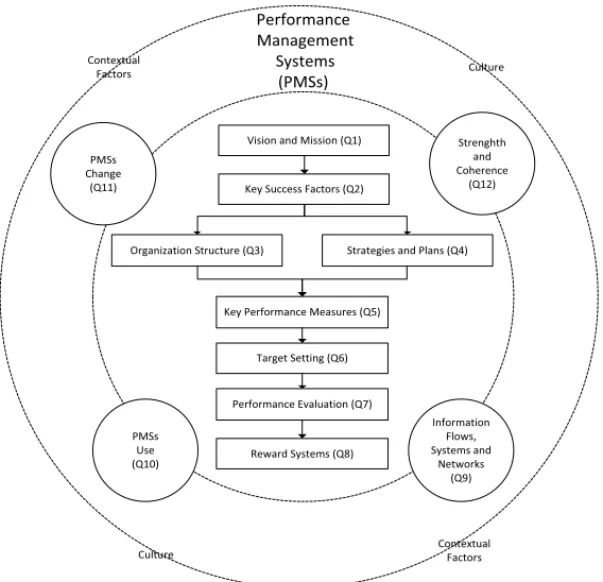
Figure 6: Ferreria and Otley (2009):
The performance management systems (PMSs) framework
Vision and Mission (Q1)
Key Success Factors (Q2)
Organization Structure (Q3) Strategies and Plans (Q4)
Key Performance Measures (Q5)
Target Setting (Q6) Reward Systems (Q8) Performance Evaluation (Q7) Strenghth and Coherence (Q12) Information Flows, Systems and Networks (Q9) PMSs Use (Q10) PMSs Change (Q11) Performance Management Systems (PMSs) Culture Culture Contextual Factors Contextual Factors
In table 2 the four frameworks developed by Simons (1995), Otley (1999), Malmi and Brown (2008) and Ferreira and Otley (2009) are compared. In table 2, the parts in the MCS frameworks have been divided into five categories: cultural controls, planning, cybernetic controls, reward and compensations, and
administrative controls. These five categories contribute to the comparison of the MCS frameworks by providing a matrix that includes five categories of different types of controls that the different parts of the four MCS frameworks can be divided into. These categories fit two of the frameworks: Ferreira and Otley 2009 and Malmi and Brown 2008, which both use this categorization. To some extent, the categories also match some of the ideas of Balanced Scorecard (BSC), which also categorises performance measures according to specific uses (the four perspectives). Each of the five categories is defined below. While the purpose of Simons’ framework is not identical to those of the other three frameworks, it is included in a modified version to make comparison possible in the comparative overview. Simons’ original ‘purpose of use’ categories have been replaced by examples of controls taken from Simons’ framework (Simons 1995, p. 177-181).
28 Tab le 2: C o m p arat ive o v er vie w of f o ur MCS fram ework s Fr a m e w o r k Cultural Contr ols P lanning Cyber netic Controls Re w a rd and Co m p ensations Adm inistrative Controls Sim o n s 1995 L e v ers of C o n trol (L OC ) A ppen d ix A , pag e 177 -181 Missio n and v ision state m ent s Cred os State m e n t o f pu rpose (L ever #1: B elief s S y st e m s) Strategic pla n n ing sy st em s (L evers #2: B o u n d ar y Sy st em s) Set sta n d ards, E.g . Strategic pla n n ing sy st em s (L evers #3: Dia g n o stic Co ntro l S y ste m s) P rof it p lann in g -, project ma na ge me nt -, b ra n d rev enu a n d in telli g e n ce s y ste m s (L evers #4: In teracti v e Co ntro l S y ste m s) Set sta n d ards, L in k i n ce n ti v es to g o al ach ieve m e n t E.g . P rof it p lans and g o
als, brand reven
u e m o ni to ri ng s y st e m s. (L evers #3: Dia g n o stic Co ntro l S y ste m s) Measu re ou tp u t E.g . Feed back s y ste m s, pro ject m onitoring sy ste m s, b rand r even u e m o ni to ri ng s y st e m s. (L evers #3: Dia g nos tic Co ntro l S y ste m s) C odes of bu si n ess co nd uc t Ass et acquisitio n sy st em s Op eration al gu idelin e s (L evers #2: B o u n d ar y Sy st em s)
29 Otle y 1999 A fr a m e w o rk fo r ma na ge me nt c o nt ro l sy ste m s research 1. Obj ectiv es
2. Strategies and plan
s 3. T arg ets 5. Feedback 4. R e w ards Malm i a n d Brow n 2008 A fr a m e w o rk fo r ma na ge me nt c o nt ro l sy ste m s research Clan s, Values, Sy m bols L ong ran g e plan n in g , A ctio n plan n in g B u dg ets Fin a n cial, Meas u re m ent Sy st em s, No n -Fin a n cial Measu re m en t S y ste m s, and Hy brid Measu re m en t Sy st em s R e w ard an d Co m p en sations Go v ern a n ce Struct u re Org aniza tion Str u ct u re P o
licies and procedu
res Ferreira an d Otle y 2009 4 Perf orm a n ce M ana ge me nt S y st e m s fr am ew o rk f o r a n al y sis Vision a n d m issio n (Q1 ) T h
ird level: Con
te x tu al Facto rs Cu lt u re Ke y s u cces s f actors (Q2) Strategie s and plan s (Q4) Ke y perf or m a n ce m eas u res (Q5 ) T arg et setting (Q6 ) P erf orm a n ce eval u atio n (Q7) Re w ar d s s y ste m s ( Q 8 ) Org aniza tion str u ct u re (Q3)
Cultural Controls
The cultural controls are the starting point in the frameworks. They consist of key objectives that are central to an organization’s overall future goals, such as
mission, vision, credos and other value systems – elements that form the basis of
an organization’s presence. A mission defines the purpose of an organization’s existence. A written mission statement enables an organization to articulate its mission. Discussing the mission allows an organization to provide tools and training and promote behaviour that makes the mission a common concern of all
the employees of an organization. A clear mission will make the organization’s
impact on the world uniform and will give it greater effect. A vision shapes the idea of what an organization wants to achieve in the long term. The complexity of vision statements varies between organizations, but the statement must concisely define a clear goal for the ideology of an organization and be easy to understand and remember for the employees. The mission and vision are MCS that have wide orientation and give overall direction to all employees in an organization (Ferreira and Otley 2009). In this first category of the comparative analysis (cultural controls), the three frameworks of Simons (1995), Otley (1999) and Ferreira and Otley (2009) are similar, but each framework labels the group differently: ´Beliefs systems’, ´Objectives’, and ‘Vision and mission’.
Simons names cultural controls ´beliefs systems’ and describes them as “the explicit set of organizational definitions that senior managers communicate formally and reinforce systematically to provide basic value, purpose, and direction for the organization” (Simons 1995, page 34). Otley (1999) takes a similar approach to Simons’, including central statements of the overall goals for an organization presented by executive management. Executive management have to prepare well-written documents that give an essentially long-term future-view
of the organization’s fundamental reasons for existence. These statements must state the key value of an organization, not only meeting financial goals, but satisfying all shareholders of an organization (Otley 1999). Ferreira and Otley’s first question concerns ‘mission and vision’, but they leave out the external controls that organizations have less influence on in their framework, such as culture, external environment, technology, size and ownership. They see these elements more as contingency variables that influence the effectiveness of the MCS package, but not as characteristics of the MCS (Ferreira and Otley 2009).
In the group of cultural controls, the framework by Malmi and Brown (2008) includes more controls and contingency factors than do the other frameworks. Malmi and Brown (2008) also include controls that managers do not always have complete influence on, in acknowledgment of the fact that the controls may be used to regulate employee behaviour. Malmi and Brown (2008) see cultural control as three aspects: value-based controls (Simons 1995), symbol-based controls (Schein 2010), and clan controls (Ouchi 1979). Starting with Flamholtz’s
(1983) definition of organizational control “as a set of values, beliefs and social
norms which tend to be shared by its members and, in turn, tend to influence their thoughts and actions” (page 158), Malmi and Brown extend the cultural controls into three subgroups: clans, values, and symbols. Ouchi (1979) defines organization culture as the overall values and normative patterns which guide employee behaviour. In 1979, Ouchi developed a concept of how subgroups (clans) can occur, formed by individuals exposed to a socialization process that provides them with a set of skills and values. This socialization process can be caused by different professions, skills or interests among the members of the clan. The clan develops their own values and beliefs. The subgroup ´values´ are similar to Simons’ ‘beliefs system’ and broadly cover broadly what is covered by the
three other frameworks in their definitions of this first group. The subgroup ‘symbols’ refers to an organization’s visible expressions, it can be an
organization’s building, dress code, designs or their ability to develop an
individual type of culture (Schein, 2010).
Planning
The group ‘planning’ includes strategy and other ex-ante planning assignments. The assignments range from less-detailed descriptions to detailed action plans containing both financial goals and non-financial expectations to set up planning controls to affect employee behaviour. The main goal of planning is to ensure the best possible relation between an organization’s objective, resources, technology, competitive position, knowledge and professional competences, as well as other external environment factors that may interfere with the opportunities and limitations of the organization (Mills 1970). Planning includes development of standards and procedures, setting goals and defining expected effort and behaviour of employees.
A strategy is a plan that describes how companies achieve their mission and vision through establishment of competitive advantage (Porter, 1996). Managers can use strategy as a primary key to discuss how to interact with a constantly changing external environment. Today, an organization’s strategy is a natural and important part of its MCS package; however, “strategy was not used explicitly as a variable
in MCS research until the 1980s” (Langfield-Smith 1997, p 207). Strategies and
plans are ex-ante forms of controls (Flamholtz et. al 1985), through which objectives are set to direct and guide employee behaviour.
Plans also include key success factors to define and control the key objectives of an SBU or a company’s business (Ferreira and Otley 2009). Key success factors represent important facts that are required in order to realise desirable business objectives, and have a direct impact on the effectiveness of achievement of objectives. The key success factors support and substantiate the vision and mission through a limited number of conditions or variables that have a direct impact on the viability, effectiveness and efficiency of an organization. Key success factors cover both identification of “the key factors that are believed to be central to the organization’s overall future success” and how such key factors “are brought to attention of managers and employees” (Ferreira and Otley 2009, p. 267).
In all the frameworks, development and implementation of strategies have a high priority. The strategy is the joint objective, which is normally related to the cybernetic controls, reward and compensation controls, as well as the administrative controls (Henri, 2006a; Langfield-Smith, 2007). Therefore, it is important to design an MCS package that supports the employees in behaving in a manner that fulfils the strategy, in order to increase the success rate of achieving an organization’s goals. Lack of focus and clarity in the strategy or plans is one of the key control problems observed in practice (Merchant and van der Stede, 2012). Failure in communication of the strategy or plans to organizational members may result in a lack of understanding of how individual actions contribute to the overall strategy. Simons (1995) uses ‘interactive control systems’ and ‘boundary systems’ to deal with planning. In addition to strategy and action planning, Simons includes operational guidelines. First Simons encourages using interactive control systems to focus organizational attention on strategic uncertainties and implementation of new strategies, and then boundary systems to state limits of freedom. In the other
three frameworks, the operational guidelines belong to the cybernetic and administrative controls.
Cybernetic controls
Fisher defines cybernetics as “a system in which standards of performance are determined, measuring systems gauge performance, comparisons are made between the standards and actual performance and feedback provides information on the variances” (Fisher, 1998 p 52). The cybernetic controls consist of budgets, key performance measures, target setting, performance evaluation and hybrid measures that contain both financial and non-financial measures (Malmi and Brown 2008). The four frameworks all include the cybernetic controls (Simons 1995, Otley 1999, Malmi and Brown 2008, Ferreira and Otley 2009).
Key performance measures are financial and non-financial objectives managers use to guide and direct subordinates to behaviour in the best interest of the organizations, and to monitoring the success of their organizations. (Ferreira and Otley, 2009). Key performance measures have to be customized according to the company’s strategy and plans, and specified according to priorities and performance objectives (Chenhall 2005). By routinely monitoring the success of fulfilling company key performance measures, managers gain valuable insight into the performance of their business and, give themselves the opportunity to respond quickly if objectives are not obtained or subordinates’ behaviour is not in line with the organization’s objectives and policies. Pre-set targets are MCS values managers use to guide and motivate subordinates to perform in specific areas. Managers often use the targets when evaluating subordinates or groups of subordinates and may also use the targets as a basis for financial rewards
(Merchant and Van der Stede 2012). To be able to use the targets for performance evaluation of subordinates, the target benefits from being specific, clear, measureable, achievable, timely, and challenging. Target-setting for groups can be used as an effective tool to ensure that the group’s members gain a common and clear awareness of the group’s performance goal[s]. However, to ensure that each employee is aware of their participation in reaching the group target, managers have to make sure that each individual in the group knows, acknowledges and accepts their part in delivering the performance that will lead to the achievement of the overall group target. An additional purpose of targets is to guide and motivate employees by identifying quantifiable goals that allow them to measure their own performance.
Performance evaluation concentrates on what processes managers use when they evaluate subordinates. In the desire to be able to provide accountability and transparency, management set up MCS to guide and direct subordinates to act in their organizations’ best interests and also to evaluate employee performance. The growing use of quantitative indicators changes the way accountability is measured and how the many different qualitative indicators are converted into auditable numbers (Espeland and Sanders 2007). By performing the evaluation and measurements through numbers that can be audited, it becomes easier to rank the results against each other. In MCS, ranking is normally used for internal purposes only, and only when management wishes to focus on effectiveness through
learning and continuous improvement, or to direct subordinates’ attention towards
important issues. The numbers provided by the ranking may be available for some or all individuals in the organization and may lead to changes in behaviour (Espeland and Sauder 2007), perhaps not only among the individuals being
monitored, evaluated or measured, but also among individuals that have only been informed about such a ranking.
Reward and compensation
The purpose of rewards and compensation is to direct and motivate employee
behaviour in directions aiming at fulfilling the organization’s strategy.
Organizations use rewards and compensation to guide and motivate groups and individuals to focus on individual and organizational goals, and thus increase organizational performance. The rewards and compensation can be financial (e.g. bonus, salary increases, share-based rewards, stock options) and non-financial (e. g. promotions, extra holidays, recognition, education), and though they can both be positive and negative (Ferreira and Otley 2009), they are normally used
positively. In Otley’s 1999 framework, the rewards were shown in a simpler form,
only containing the positive financial rewards. Simons (1995) uses diagnostic control systems to define goals, provide motivation and prepare ex-post evaluation
of the work performed by the employees. In Malmi and Brown’s framework
(2008), reward and compensation are used in the same way as in the framework of Ferreira and Otley (2009). Even though many of the reward and compensation systems are cybernetic controls, three of the frameworks choose to have these controls in a group by themselves (Otley 1999, Malmi and Brown 2008, Ferreira and Otley 2009). The reason for this is the complexity in the relationship between rewards, motivation and performance (Ferreira and Otley 2009).
Espeland and Sauder (2007) have investigated how evaluation and measurement influence and change individuals’ behaviour. The measurement and controls used in reward systems are not 100-percent optimal, as they cannot cover everything
that the managers wish the subordinates to be accountable for. Furthermore, they can be controversial and have secondary effects (Espeland and Sauder 2007), which means that the controls and measurements may also have an unintended effect on individuals’ behaviour. As Espeland and Sauder (2007) and Vollmer (2006) point out, focusing only on numbers simplifies several aspects of the interpretation between individuals, groups and activities, in the tasks of managing, evaluating and monitoring individuals and the company at large, and risks reducing the focus on a company’s overall objectives. At the same time, Espeland and Sauder argue that management must not forget morals and ethics in their efforts to lead and guide subordinates (Espeland and Sauder 2007).
Administrative controls
Among administrative controls are organization structure, governance structure, and policies and procedures (Malmi and Brown 2008). The organization structure defines the responsibilities and accountabilities of an organization’s participants, and consists of the design and structure of an organization. Governance is the structure and composition of a company’s board, ownership, management teams and formal management procedures. The governance structure includes systems that inform and control an organization’s formal rules of authority and accountability (Malmi and Brown 2008); policies that describe management procedure such as structure of meetings, the hierarchy and division of authority among the management group and similar systems, are all parts of the governance structure which influence the behaviour of management in an organization. Policies and procedures are used to guide and direct employee behaviour in certain directions or dictate how employees must fulfil their work. The policies and procedures can be loose or tight guidelines, procedures and rules for supervision