ANNEX
The perspective of having a European
Code on Private International Law
Research paper
By Nick Bozeat (GHK)
AUTHOR
This research paper has been written by Nick Bozeat of GHK, at the request of the European Added Value Unit, of the Directorate for Impact Assessment and European Added Value, within the Directorate General for Internal Policies (DG IPOL) of the General Secretariat of the European Parliament.
RESPONSIBLE ADMINISTRATOR
Blanca Ballester, European Added Value Unit
To contact the Unit, please [email protected] LINGUISTIC VERSIONS
Original: EN
This document is available on the Internet at:
http://www.europarl.europa.eu/committees/en/studies.html
Manuscript completed in April 2013. Brussels © European Union, 2013.
DISCLAIMER
The opinions expressed in this document are the sole responsibility of the authors and do not necessarily represent the official position of the European Parliament.
Reproduction and translation for non-commercial purposes are authorized, provided the source is acknowledged and the publisher is given prior notice and sent a copy. ISBN: 978-92-823-4373-9
DOI: 10.2861/2046 CAT: BA-31-13-928-EN-N
Contents
List of tables 5
List of boxes 6
Executive summary 7
Policy context 7
Objectives of the report and methodology 7
Key problems existing 9
1. Introduction 11
1.1 Objectives of the Research Paper 11
1.2 Key concepts and definitions 11
1.3 Existing instruments 14
1.4 Method of approach 21
1.5 Report structure 30
2. Law protecting individual rights 31
2.1 Status and (passive and active) legal capacity of natural persons 31 2.2 Representation issues (incapacity and powers of attorney) 35
2.3 Names and forenames 39
3. Family Law 45
3.1 Existence/validity and recognition of ‘de facto’ unions 45 3.2 Existence/validity and recognition of same-sex marriage and
registered partnerships 48
3.3 Establishment or contesting of a parent-child relationship 50
3.4 Recognition of adoption decisions 54
3.5 Maintenance obligations for ‘de facto’ unions 55
4. Property Law 58
4.1 Declarations such as gifts and trusts 58
4.2 Property rights over movable/immovable property including
recording of rights (real property) 61
5. Law relating to obligations 66
5.1 Agency 66
5.2 Violation of privacy and rights relating to personality,
6. Law relating to incorporated and unincorporated bodies 73
6.1 Foundation of commercial companies and organisations 73 6.2 Foundation of non-commercial organisations and
not for profit organisations 76
7. The potential of PIL and codification to further reduce the costs of
variations in legal regimes across the EU 79
7.1 EU Treaty Developments 79
7.2 PIL codification and the sectoral approach 80
8. Concluding Remarks 88
8.1 Estimates of the potential reductions in costs in areas covered
in the Research Paper 88
8.2 The advantages of codification 89
References 91
Annex – Mapping of differences in member states 97
List of abbreviations
CoNE Cost of Non-Europe
CJEU Court of Justice of the European Union
EU European Union
PIL Private International Law
TFEU Treaty on the Functioning of the European Union
TEU Treaty on European Union
List of tables
Table 1 - Reasons for discarding Gaps identified at Interim stage 22 Table 2 - Proposed Classification of gaps currently existing 26 Table 3 - Estimated costs relating to divergences in legal capacity rules per annum 34 Table 4 - Estimated costs of gap relating to incapacity per annum 39 Table 5 - Estimated costs relating to divergences in rules relating to
names and forenames per annum 44
Table 6 - Estimated costs relating to gaps existing in relation to de facto unions
per annum 47
Table 7 - Estimated costs relating to gaps with same-sex marriage per annum 50 Table 8 - Estimated costs relating to parent-child relationship problems per annum 53 Table 9 - Estimated costs of gap relating to recognition of adoption
decisions per annum 55
Table 10 - Estimated costs relating to maintenance of de-facto unions per annum 57 Table 11 - Estimated costs of gaps relating to gifts, donations and trusts per annum 60 Table 12 - Estimated costs of gaps relating to movable/immovable
property per annum 65
Table 13 - Estimated costs of gap relating to agency per annum 68 Table 14 - Estimated costs caused by gap in privacy laws per annum 72 Table 15 - Estimated costs of gap relating to incorporated companies per annum 75 Table 16 - Advantages and disadvantages of Codification and Sectoral Approach 85
List of boxes
Box 1 - Example relating to differences in extended legal capacity 32 Box 2 - Example relating to legal capacity of third-country national 32
Box 3 - Examples of problems relating to incapacity 36
Box 4 - Examples of problems relating to representation of incapacitated persons 37
Box 5 - Problems relating to names and forenames 42
Box 6 - Case examples of problems existing 49
Box 7 - Case example relating to paternity rights 51
Box 8 - Example of problems due to gaps relating to parentage by same-sex couples 52
Box 9 - Examples relating to gifts and donations 59
Box 10 - Example of problems with property gaps 63
Box 11 - Example of problems with gap relating to Agency 67 Box 12 - Example of problems of applicable law for individuals’ right to privacy 70 Box 13 - Example of problems for companies relating to forum shopping 71
Executive summary
Policy context
Private International Law (“PIL”) aims to deal with the cross-border aspects of all questions related to private relationships between individuals such as family law, property law and the law of contract. It has traditionally been a matter of national competence. However, the integration process of the European Union has naturally meant that a European approach to certain PIL issues had to be introduced. Hence, a number of instruments have been adopted at EU level in order to deal with some of the most crucial matters related to PIL (namely the Brussels and Rome Regulations). The Treaty on the Functioning of the European Union (“TFEU”) also entrusts the European Parliament and the Council with the task of adopting measures addressed at ensuring mutual recognition and enforcement of judgments and the compatibility of national rules with regards to conflicts of laws and jurisdiction (Article 81(2)(a) and (c)). Measures related to family law with cross-border implications have to be adopted by the Council unanimously (Article 81(3)).
In spite of these efforts, several areas of PIL directly related to the citizens’ day-to-day lives are still unregulated at European level. The lack of legislation dealing with certain matters of private law with cross-border implications has severe consequences and significant costs for both administrations and EU citizens.
Objectives of the report and methodology
This report aims to estimate the Cost of Non-Europe (“CoNE”) in EU PIL. CoNE refers to the costs (economic costs, social costs, costs related to incomplete protection of citizen’s rights) presently borne by EU citizens and economic operators due to the absence of harmonised provisions of EU PIL. The report also examines the wider economic effects of the gaps on the functioning of the internal market and the costs related to the complexity of the current framework for PIL, including the costs and benefits related to adopting one single instrument on PIL in the form of a European code.
In order to achieve these objectives, the first task has been to identify the gaps in EU PIL that should be investigated due to the problems they pose on the day to day life of citizens. Secondly, the broad scope of CoNE in the areas of gaps and deficiencies/ weaknesses of existing PIL have been dimensioned. The final task has been to dimension the scale of CoNE that could be “saved” through a Code addressing the gaps have been dimensioned.
The existing gaps have been identified on the basis of the lack of EU regulation covering one or more of the elements of PIL (i.e. applicable law, jurisdiction and recognition of judgments). In some cases, an area is considered as a ‘gap’ since there is no EU PIL
legislation on the matter, whereas in other instances, a gap has been observed due to the absence of coverage of the applicable law, jurisdiction or the recognition of judgments. Gaps currently existing can be classified into six main headings covering the main areas of law falling under PIL: (i) Law protecting individual rights; (ii) Family Law; (iii) Law of Succession; (iv) Property Law; (v) Law relating to obligations; (vi) Law relating to incorporated and unincorporated bodies.
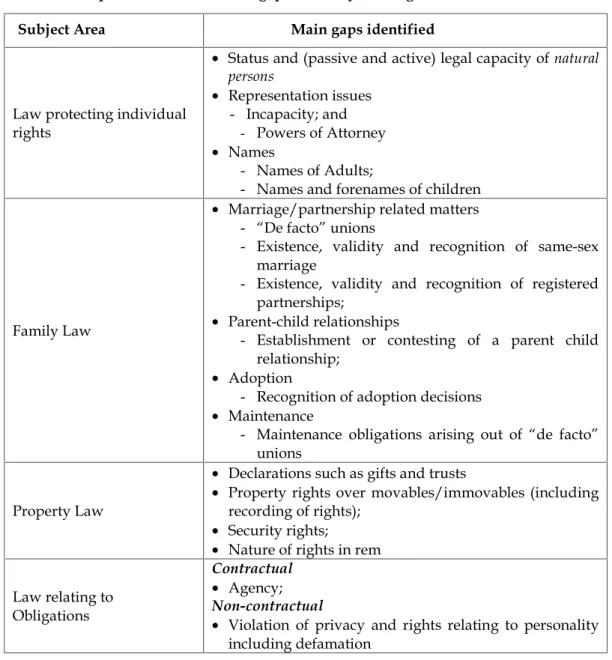
The table below provides an overview of the main gaps identified for this report.
Subject Area Main gaps identified
Law protecting individual rights
Status and (passive and active) legal capacity ofnatural persons Representation issues
- Incapacity; and
- Powers of Attorney Names
- Names of Adults;
- Names and forenames of children
Family Law
Marriage/partnership related matters - “De facto” unions
- Existence, validity and recognition of same-sex marriage - Existence, validity and recognition of registered
partnerships;
Parent-child relationships
- Establishment or contesting of a parent child relationship; Adoption
- Recognition of adoption decisions Maintenance
- Maintenance obligations arising out of “de facto” unions Property Law
Declarations such as gifts and trusts
Property rights over movables/immovables (including recording of rights);
Security rights;
Nature of rights in rem Law relating to
Obligations
Contractual Agency; Non-contractual
Violation of privacy and rights relating to personality including defamation Law relating to incorporated and unincorporated bodies Incorporated bodies
Foundation of commercial companies and organisations including implied companies;
Transfer of company seat;
Personal liability of company officers; Internal organisation;
Unincorporated bodies
Foundation of non-commercial organisations and not for profit organisations.
Key problems existing
Due to the gaps currently existing, problems are faced by citizens in their day to day lives. Citizens are deterred from exercising their right of free movement, as provided in Article 20 and 21 TFEU due to the variations in law existing in the Member States. The obstacles faced by citizens can be expressed in terms of costs, with these costs relating to legal uncertainty, legal costs (e.g. cost of litigation), costs of non-recognition and cost of delays. In addition, emotional costs are incurred by the citizens due to the emotional effect the gaps in PIL have on their private and family lives.
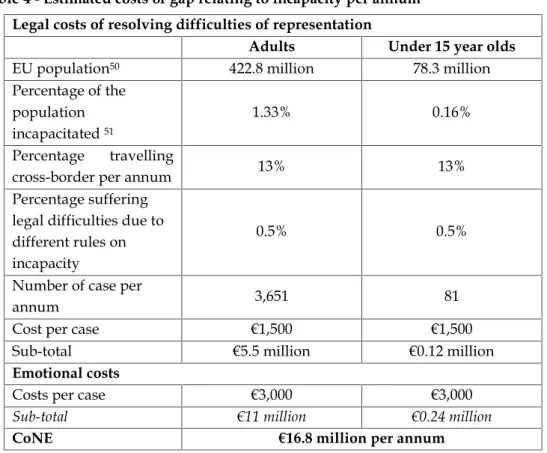
An example of a significant CoNE occurs due to the variation in Member State legal regimes relating to representation issues (incapacity and powers of attorney). Such differences create major problems for citizens when moving cross-border. For instance, Greg, a Welshman, has been living in Lithuania following his retirement 15 years ago. He has assets, including property, in both Member States. Greg suffers from dementia and is therefore not able to manage his affairs. In order to raise funds to financially support Greg’s living costs, his house in Vilnius needs to be sold. His son, Jasper, lives in Cardiff. Jasper has been granted power of attorney for Greg. Since no common legislation is in force between these countries, the powers of attorney are not recognised in Lithuania, with Jasper not being able to act on Greg’s behalf in selling his house in Vilnius. This gap currently existing in PIL leads to legal costs and emotional costs for EU citizens. It has been estimated that these costs amount to €16.8 million per annum, with emotional costs estimated at € 3,000 per case for an adult.
The total CoNE estimated in relation to the current gaps in EU level PIL amounts to approximately €138 million per annum. The approach taken to estimate the CoNE of gaps in EU level PIL has been to isolate specific costs directly associated with particular gaps.
Gap CoNE (€)
Legal Capacity 7.5
Incapacity 16.8
Names and forenames 2
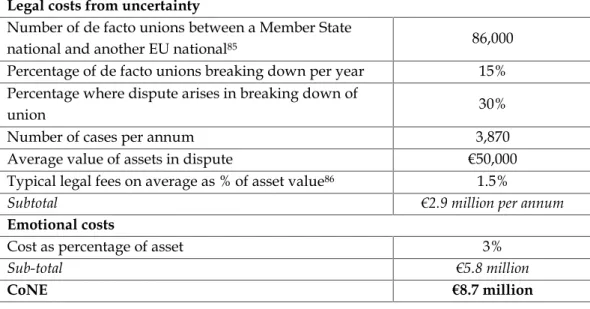
Recognition of de facto unions 8.7
Recognition of same-sex marriages 4.2
Parent-child relationships 19.3
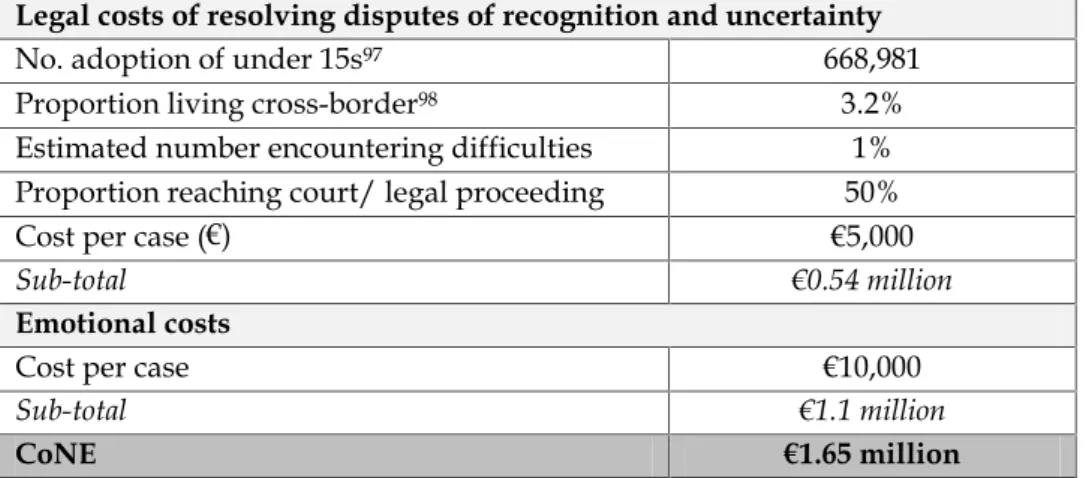
Adoption decisions 1.65
Maintenance of de facto unions 13.1
Gifts and trusts 5.6
Movable and Immovable property 5.56
Agency 14
Privacy 1
Corporations 38.3
The existence of such costs are likely to have wider impacts on individuals, families and companies, particularly small companies, considering decisions to move between Member States or to invest ‘cross border’. There are of course many factors that affect such decisions, including: language; cultural differences; prices; and, access to services. However, the uncertainty resulting from the absence EU level PIL in these areas coupled with the ‘difficult to understand’ differences between the laws in different Member States may combine to stop families taking choices they would otherwise prefer. The uncertainties about whether what would seem to be straightforward family matters could be resolved may act as a ‘tipping point’ that undermines free movement. For a small company, trading in products or services geared towards young people, concerns about differences in legal capacity and uncertainties about whether, if difficulties arose, they could be resolved easily, may well have the effect of the company deciding that cross border trading is ‘not worth the potential hassle’.
In order to reduce the CoNE of lack of PIL, the gaps in EU PIL could be filled through a sectoral approach or through codification. There are a number of advantages and disadvantages associated with codification. While codification would guarantee the transparency of PIL, simplify its process and save costs due to legal clarity, it could also create difficulties due to the legislative effort associated with creating a Code and the difficulties of reforming the Code on a regular basis. If either sectoral or codification legislative solutions were applied to reduce or eliminate the current gaps, the costs would be expected, on a gap by gap basis, to reduce by similar amounts.
Overall, codification is considered to be the preferred approach to reducing CoNE of gaps in EU PIL. Codification would make it easier (and less expensive) for individuals, families and businesses considering decisions that could be affected by the absence of EU PIL in more than one area, to inform their choices. Codification would provide individuals and businesses with greater legal certainty. Such certainty leads to greater confidence in the legal system in all Member States, thereby reducing the deterrent effect currently existing when EU citizens consider exercising free movement within the EU. For example, an individual or family might be contemplating exercising their right to free movement within the EU but are put off from doing so by the costs of legal uncertainty affecting several gaps (e.g. a family could be faced with difficulties over both being in a de facto union and wishing to have freedom over how to name their offspring). The codification approach would provide a single source and perhaps some assurance to the couple that there would be a logical and speedy path to reconciling any difficulties they might encounter. This would ensure that EU citizens enjoy the benefits associated with free movement and the operation of the internal market.
1. Introduction
The “Cost of Non-Europe report: The perspective of having a European Code on Private International Law” is an assignment being undertaken by ICF GHK on behalf of the European Parliament.
The Research Paper fits into an on-going process concerning the review of Private International Law ('PIL') in the context of civil law and the assumption that gaps and inconsistencies in PIL lead to unnecessary costs and legal uncertainty, which in turn has a negative impact on the workings of the internal market that are exacerbated by the need for increased free movement of businesses and individuals within the EU.
1.1
Objectives of the Research Paper
The aim of the Research Paper is to provide the European Parliament with necessary information and assessments, including information on the following:
“Gaps” currently existing in PIL which need to be filled;
Concrete costs (economic, social costs, costs related to incomplete protection of citizen’s rights) presently borne by various stakeholders related to the absence of harmonised provisions of PIL;
Quantification of economic costs for various stakeholders;
Wider economic effects of the gaps on the functioning of the internal market; Costs related to the complexity of the current framework for PIL including
existing duplications and overlaps;
The impact of the adoption of one single instrument on PIL in the form of a European code on the reduction of costs.
1.2
Key concepts and definitions
1.2.1
Private International Law
Private International Law aims to deal with the cross-border aspects of questions related to private law.1 Private law is “the part of law that deals with such aspects of
relationships between individuals that are of no direct concern to the state. It includes the law of property and trust, family law, the law of contract, mercantile law and the law of tort”.2
Three types of questions are distinguished in private international law:
Jurisdiction: Which court has to deal with a case with international elements;
1European Parliament, Directorate General for Internal Policies, Policy Department C: Citizen’s
Rights and Constitutional Affairs, “A European Framework for private international law: current gaps and future perspectives”, Brussels 2012, page 7. Available at
http://www.europarl.europa.eu/committees/fr/studiesdownload.html?languageDocument=EN &file=79510
Applicable law: What internal private law is applied to resolve the cross-border dispute;
Recognition and enforcement of judgments: Whether a judgment can be recognised as decisive and final in another state and whether it can compel a party to undertake an action.3
It is difficult to find a European definition of PIL, since the understanding of the term is intrinsically linked to the specific legal tradition of each Member State. In this sense, in Germany the term PIL (“Internationales Privatrecht”) is understood rather narrowly and only comprises legal rules on the question of what law is applicable to a certain set of facts. In comparison, in French Law, the term “Droit International Privé” covers not only the question of the substantive law applicable to a certain case, but includes questions of jurisdiction, of recognition and execution of foreign judgments and other aspects of civil procedure with foreign elements. This is reflected by the legislation of PIL in France and in those Member States influenced by the French legal tradition, such as Belgium, Italy or Spain.
The European concept of PIL is not quite clear. The scope of some Regulations, (i.e. Brussels I and Brussels II bis) is restricted only to the questions of jurisdiction and recognition of judgments. Other Regulations, (i.e. Rome I, Rome II and Rome III) only deal with governing law and totally exclude procedural aspects. A new type of Regulation, such as the Succession Regulation No. 650/2012 and the Proposals for Property Regulation of international couples (2011) cover all aspects of PIL in the wide French understanding of the concept.
For the purposes of this Research Paper, Private International Law will be understood as the area of Law that deals with: The cross-border questions relating to aspects of private relationships between individuals with regard to the applicable substantive law, the jurisdiction and the recognition of judgments.
1.2.2
Cost of Non-Europe
The Cost of Non-Europe (‘CoNE’) relates to the costs incurred by EU citizens and economic operators due to the differences existing in legal regimes between the Member States.
1.2.3
‘Gaps in PIL’
Private International Law has traditionally been a matter of national law.4Each Member
State has its own rules that deal with jurisdiction, applicable law and the recognition and enforcement of judgments from abroad. However, the integration process of the European Union has naturally meant that a European approach to certain PIL issues had to be introduced. The Amsterdam Treaty introduced a wider concept of judicial
3A European Framework for private international law: current gaps and future perspectives. Page
15.
cooperation and brought the three core issues of private international law into the scope of the EU. Hence, a number of instruments have been adopted at EU level in order to deal with some of the most crucial matters related to PIL (these are described in Section 1.4 below). Furthermore, the Treaty on the Functioning of the European Union (TFEU) entrusts the European Parliament and the Council with the task of adopting measures addressed at ensuring mutual recognition and enforcement of judgments and the compatibility of national rules with regards to conflicts of laws and jurisdiction (Article 81(2) a and c). Measures related to family law with cross-border implications have to be adopted by the Council unanimously (Article 81(3)).
In spite of all these efforts, several areas directly related to the citizen’s day-to-day lives are still left unregulated at European level. The inexistence of legislation dealing with certain matters of private law with cross-border implications entails severe consequences and significant costs for both the administration and EU citizens.
The existing gaps have been identified on the basis of the lack of EU regulation covering one or more of the above mentioned elements of PIL (i.e., applicable law, jurisdiction and recognition of judgments). In some cases, an area is considered as a ‘gap’ since there is absolutely no EU PIL legislation on the matter, whereas in other instances, a gap has been found due to the absence of coverage of either the applicable law, the jurisdiction or the recognition of judgments. This is explained for each of the gaps.
All EU instruments in force relating to jurisdiction, applicable law and the recognition and enforcement of judgments fall under the term ‘framework of private international law’.
1.2.4
Codification of PIL
As outlined in the European Parliament’s Study on a European Framework for Private
International Law5, the process of ‘codification’ at European level should be understood in accordance with Point 1 of the Interinstitutional Agreement of 20 December 1994 whereby a
Code would be the result of a “procedure whereby the acts to be codified are repealed and replaced by a single act containing no substantive change to those acts”.6
In this sense, the idea of a European PIL code would differ from the concept of codification stemming from certain national legal traditions, in which a particular area of the Law is systematised though the compilation of all rules applicable to it, regardless of their sources (customary law, case law or even general principles of the law).
This Research Paper follows the definition laid down by the European Parliament’s study and considers that a European PIL Code would be the result of bringing about the different (existing) instruments regulating questions of PIL at the European level as well as initially adding those instruments newly enacted to deal with the closing of gaps (e.g.
5European Parliament, European Parliament , “A European Framework for private international
law: current gaps and future perspectives”, p. 79,Ibid,p.10
the proposed Regulations on Matrimonial Property Regimes and Registered Partnerships). Codification is further discussed in Section 6 below.
1.3
Existing instruments
In order to better identify where gaps in PIL can be found, it is important to first outline the scope of the existing PIL instruments at the European level. A number of instruments currently exist at EU level which set out rules relating to jurisdiction and conflicts of laws. Moreover, instruments are also in place, or are currently being proposed, to provide for Private International Law in certain subject areas, such as matrimonial property. The existing instruments are described in turn below.
1.3.1
Instruments at EU level relating to jurisdiction
1.3.1.1 Council Regulation 44/2001 on jurisdiction and the recognition and enforcement of judgments in civil and commercial matters (Brussels I)7
The Regulation adopted on 22ndDecember 2001 applies to civil and commercial matters.
Themain principleof the Regulation is that jurisdiction corresponds to the courts of the Member State where the defendant is domiciled. The domicile will be determined in accordance with the law of the country where the issue is brought before a court.
The following are excluded from the scope of the Regulation:8
status or legal capacity of natural persons, matrimonial property rights, wills and succession;
insolvency proceedings; social security; and arbitration.
The Regulation does not apply to Denmark. It covers two of the three PIL elements described above (i.e., jurisdiction and recognition of judgments)
Regulation (EU) No 1215/20129of 12 December 2012 on jurisdiction and the recognition
and enforcement of judgments in civil and commercial matters was adopted in order to recast the Brussels I Regulation. The recast regulation simplified the system put in place by Brussels I by abolishing the procedure for the declaration of enforceability of a judgment in another Member State. The Regulation also included a rule on lis pendens which allows Member State courts to stay the proceedings, on a discretionary basis and dismiss proceedings where a court of a third state has been seized.10
7OJ L 12, 16.1.2001, p. 1–23 8Article 1.2
9http://eur-lex.europa.eu/LexUriServ/LexUriServ.do?uri=OJ:L:2012:351:0001:0032:En:PDF 10Information available at
1.3.1.2 Council Regulation 2201/2003 concerning jurisdiction and the recognition and enforcement of judgments in matrimonial matters and the matters of parental responsibility, repealing Regulation 1347/2000 (Brussels II)11
Adopted on the 27 November 2003, this Regulation applies to civil matters related to divorce, separation or annulment and parental responsibility.12 The Regulation lays
down a complete system of provisions governing the recognition of judgments and establishing the necessary rules to identify the competent courts. The Regulation does not apply to Denmark.
Article 1(3) specifies the areas which are not covered by the Brussels II Regulation: Establishment or contesting of a parent-child relationship
Adoption
Name and forenames of the child Emancipation
Maintenance obligations Trusts or succession
Measures taken as a result of criminal offences committed by children
1.3.2
Instruments at EU level relating to conflicts of law
1.3.2.1 Regulation 593/2008 of the European Parliament and of the Council on the law applicable to contractual obligations (Rome I)13
The Rome I Regulation determines the applicable law to contractual obligations in civil and commercial matters. The Regulation does not apply to Denmark.
The basic principle of the Regulation is outlined in Article 3 which provides that “contracts shall be governed by the law chosen by the parties”. Article 4 determines the applicable law in cases where the parties have not agreed on a particular law. Article 13 regulates the applicable law in cases of incapacity where a contract has been concluded between persons who are in the same country. Nevertheless, gaps still exists with regards to distance selling contracts and for those areas excluded from the scope of the Regulation.
Article 1(2) excludes a number of matters from its scope, which relate to: Legal capacity;
Matrimonial property rights; Maintenance obligations; Questions related to companies;
Agency (the question of whether an agent is able to bind a principal); and Trusts.
11OJ L 338, 23.12.2003, p. 1–29 12Article 1
1.3.2.2 Council Regulation 864/2007 on the law applicable to non-contractual obligations (Rome II)14
Rome II establishes the applicable law to non-contractual obligations in civil and commercial matters with a cross-border dimension. Article 1(1) excludes questions such as revenue, customs or the acta iure imperii(acts by right of dominion) from its scope. The Regulation is not applicable to Denmark.
Article 4 establishes the general rule for determining the law applicable to non-contractual obligations providing that “unless otherwise provided for in this Regulation, the law applicable to a non-contractual obligation arising out of a tort/delict shall be the law of the country in which the damage occurs irrespective of the country in which the event giving rise to the damage occurred and irrespective of the country or countries in which the indirect consequences of that event occur.”
Obligations arising out of the following are excluded from Rome II as provided under Article 1(2):
Family relationship (including maintenance obligations); Law of companies;
Law governing trustees; and Violations of privacy rights.
1.3.2.3 Council Regulation 1259/2010 implementing enhanced cooperation in the area of the law applicable to divorce and legal separation (Rome III)15
As explained above, any PIL measure concerning family law at European level needs to be adopted through a special legislative procedure involving a unanimous vote in the Council, as provided for in Article 81(3) TFEU. In those instances where unanimity is impossible to achieve, the possibility of enhanced cooperation is given to those Member States who want to advance further in the establishment of European PIL rules concerning family matters.
The Rome III Regulation implements enhanced cooperation among a number of Member States (Belgium, Bulgaria, Germany, Spain, France, Italy, Latvia, Luxembourg, Hungary, Malta, Austria, Portugal, Romania and Slovenia) in the area of divorce and legal separation.
The Regulation determines the law applicable to divorce and legal separation (Article 1.1). Article 1.2 lists the areas to which the Regulation shall not be applicable, even if they arise as a preliminary question within the context of divorce or separation. These excluded areas are:
14OJ L 199, 31.7.2007, p. 40–49 15OJ n. L 343, p. 10 ff.
the legal capacity of natural persons;
the existence, validity recognition or annulment of a marriage; the name of the spouses;
the property consequences of the marriage; parental responsibility;
maintenance obligations; and trusts or successions.
Chapter II of the Regulation (Article 5 ff.) lays down the rules to determine the applicable law in cases of divorce and separation with a cross-border dimension.
1.3.3
Instruments at EU level covering specific areas
1.3.3.1 Succession
Regulation 650/2012 of the European Parliament and of the Council on jurisdiction, applicable law, recognition and enforcement of decisions and acceptance and enforcement of authentic instruments in matters of succession and on the creation of a European Certificate of Succession16
The “Succession Regulation”, which “shall apply to the succession of persons who die on or after 17 August 2015” (Article 83.1), was adopted in July 2012 and will not enter into force in the UK, Ireland and Denmark. The Regulation will become applicable from 17 August 2015, as provided in Article 84 of the Regulation.
It regulates the three PIL elements identified above (applicable law, jurisdiction and recognition and enforcement of judgments) with regards to succession to the estates of deceased persons (Article 1.1.) Article 1.2 lays down an extensive list of exclusions to the scope of the Regulation that can instantly help to identify gaps in the current framework:
property rights transferred by a manner other than succession; trusts;
rights in rem; and
rights in immovable or movable property.17 1.3.3.2 Maintenance
Council Regulation 4/2009 on jurisdiction, applicable law, recognition and enforcement of decisions and cooperation in matters relating to maintenance obligations18
This Regulation, governs all relevant PIL matters with regards to maintenance obligations arising from a family relationship, parentage, marriage or affinity. Therefore, this instrument covers all necessary aspects of Private International Law with
16OJ n. L 201, p. 107 ff.
17Article 1(2) of Regulation 650/2012 18OJ L 7, 10.1.2009, p. 1–79
regards to maintenance obligations deriving from relationships with a cross-border implication. However, and as analysed below, the instrument is not applicable to “de facto” unions. The Regulation is not applicable to Denmark.
Chapter II establishes the rules applicable to the determination of Jurisdiction, Chapter III lays down the provisions for identifying the applicable law and Chapter IV deals with the recognition, enforceability and enforcement of decisions.
1.3.3.3 Insolvency
Council Regulation 1346/2000 on Insolvency Proceedings19
The Insolvency Regulation, which is currently under revision and is not in force in Denmark, applies to “collective insolvency proceedings which entail the partial or total divestment of a debtor and the appointment of a liquidator” (Article 1.1.). The Regulation excludes from its scope “insolvency proceedings concerning insurance undertakings, credit institutions, investment undertakings which provide services involving the holding of funds or securities for third parties, or to collective investment undertakings” (Article 1(2)). This Regulation is not applicable to Denmark.
Articles 3 and 4 determine the jurisdiction and the law applicable to insolvency proceedings with cross-border elements: the law of the Member State where insolvency proceedings are opened (lex concursus) applies (with the exception of certain elements excluded by Articles 5 to 15 of the Regulation). Likewise, Article 4 establishes that “the courts of the Member State within the territory of which the centre of a debtor’s main interests is situated shall have jurisdiction to open insolvency procedures”.
The Insolvency Regulation also covers recognition and enforcement of judgments. The decision on the opening of insolvency proceedings made in one Member State is automatically recognised in all other Member States according to Articles 16 and 17 of the Regulation. Other judgments related to the insolvency proceedings are recognized according to Article 25 of the Regulation. Enforcement of such decisions is governed by the Brussels I Regulation (Article 25 (1), second sentence).
1.3.3.4 The Hague Conventions on Child Abduction (1980) and on the Protection of Children (1996), and the Protocol on the Law applicable to Maintenance Obligations (2007)
These three international instruments have now been integrated in EU law. The 1980 Child Abduction Convention is focused on cases where children are wrongfully removed or retained. The 1996 Convention on the Protection of Children (ratified by all Member States) excludes a number of issues from its scope which are either regulated in other instruments or are not considered as falling within the scope of child protection (paternity, name, succession etc…).
Finally, the 1997 Protocol “shall determine the law applicable to maintenance obligations arising from a family relationship, parentage, marriage or affinity, including a maintenance obligation in respect of a child regardless of the marital status of the parents” (Article 1.1). The Hague Protocol is not applicable to the UK and Denmark. Danish and UK courts therefore continue to apply their national conflict of law rules in maintenance matters.
1.3.4
Proposed Instruments at EU level covering specific areas of law
1.3.4.1 Matrimonial Property Regimes
Proposal for a Council Regulation on jurisdiction, applicable law and the recognition and enforcement of decisions in matters of matrimonial property regimes20
This Proposal for a Regulation, currently debated in the Council, will apply, if adopted, to matrimonial property regimes (Article 1.1). The Regulation would exclude from the scope of application the following matters (Article 1.3):
the capacity of spouses; maintenance obligations; gifts between spouses;
the succession rights of a surviving spouse; companies set up between spouses; and
the nature of rights in rem relating to a property and the disclosure of such rights. Some of these matters are excluded since they are already regulated in a different instrument (Regulations on Maintenance Obligations, Succession). Nevertheless, some others (like the gifts between spouses, e.g.), will still remain unregulated and as such can be identified as potential gaps, as examined below.
1.3.4.2 Registered Partnerships
Proposal for a Council Regulation on jurisdiction, applicable law and the recognition and enforcement of decisions regarding the property consequences of registered partnerships21
Together with the proposal on matrimonial property rights, the Commission has adopted a proposal dealing with property rights stemming from registered partnerships. This is a sensitive legal and political issue, since the existence, scope and validity of registered partnerships differs from one Member State to another.
Article 1(1) of the proposed regulation provides that the instrument “shall apply to matters of the property consequences of registered partnerships”. Article 1.2 provides that the following shall be excluded:
20COM (2011) 126 final 21COM(2011) 127/2
the personal effects of registered partnerships; the capacity of partners;
maintenance obligations; gifts between partners;
the succession rights of a surviving partner; companies set up between registered partners; and
the nature of rights in rem relating to a property and the disclosure of such rights. As with the Proposal on Matrimonial Property Rights, some of the issues are excluded given the fact that they are already covered by other legislative instruments (Regulations on Maintenance Obligations, Succession). Those areas which are not will as well remain as unregulated and hence, can be considered potential gaps in the European framework of Private International Law.
1.3.4.3 Proposal for a Regulation amending Council Regulation (EC) No 1346/2000 on insolvency proceedings
22
In 2012, the Commission submitted a Proposal for a Regulation of the European Parliament and of the Council amending Council Regulation (EC) No 1346/2000 on insolvency proceedings. The Commission identified a number of shortcomings which required an amendment to the Insolvency Regulation. They related to (i) the scope of the Regulation which does not cover national pre-insolvency procedures; (ii) difficulties in determining jurisdiction for the opening of insolvency proceedings in cross-border cases; (iii) problems relating to secondary proceedings which can hamper the efficient administration of the debtor’s estate; (iv) problems relating to rules on the publicity of insolvency proceedings and the lodging of claims; and (v) insufficient rules relating to the insolvency of groups of companies.
1.3.5
Instruments at International Level
1.3.5.1 The Hague Convention on the International Protection of Adults of 13 January 2000
This Convention, to which several Member States (Germany, France, Czech Republic, Estonia, Finland and Scotland) are Contracting States, regulates the respective PIL problems (jurisdiction, applicable law and recognition of judgments) with regards to the consequences of mental diseases on the capacity of natural persons and on the legal representation of persons who for reasons of mental diseases have entirely or partially lost their legal capacity. However, as an International instrument, the Convention only obliges those Member States who have accessed to it and will therefore leave a considerable number of gaps for those Member States which are not part to it.
1.4
Method of approach
This Section provides an overview of the methodology used for the Research Paper. The Research Paper centered around three main tasks, discussed in turn in the subsections below.
1.4.1
Task 1 Identification of gaps to be investigated
The identification of gaps to be investigated under Task 1 determined the scope of the Research Paper. Emphasis was placed on areas not covered by the existing Regulations already adopted at EU level in relation to PIL. An initial list of ‘key gaps’ was drafted. This list took account of the gaps identified by the Team when examining the European Parliament’s 2012 Study on a European framework for private international law. In order to ensure that the Report examined gaps which affect day to day problems for EU citizens and businesses, a number of gaps identified by the 2012 Study were excluded following a first screening. These related to:
State liability including nuclear damage – This was excluded since the report should focus, as far as possible, on everyday life problems which affect citizens rather than those gaps which create problems on rare occasions;
Intellectual property law – This was excluded since work is currently being undertaken to establish measures for the creation of European Intellectual Property Rights. Article 118 TFEU provides a legal basis for creating European Intellectual Property rights in order to provide uniform protection of intellectual property rights throughout the EU to ensure the proper functioning of the internal market.23In 2011, the European Commission adopted a strategy
on Intellectual Property Rights in order to boost creativity and innovation, with a Communication published on a “Single Market for Intellectual Property Rights” which outlined the work which could be undertaken by the Commission to create European Intellectual Property Rights including the creation of a European Copyright Code and a “unitary” copyright title24;
Administrative law, social security and tax law – Though administrative, social security and tax law can be impacted by the absence of PIL, these individual aspects are part of Public Law which is traditionally considered to be sovereign in many Member States.
23Article 118 TFEU provides “In the context of the establishment and functioning of the internal
market, the European Parliament and the Council, acting in accordance with the ordinary legislative procedure, shall establish measures for the creation of European intellectual property rights to provide uniform protection of intellectual property rights throughout the Union and for the setting up of centralised Union-wide authorisation, coordination and supervision
arrangements.
The Council acting in accordance with a special legislative procedure, shall be means of regulations establish language arrangements for the European intellectual property rights. The Council shall act unanimously after consulting the European Parliament”.
Following an initial screening of gaps existing, a consolidated list was drawn up by the Team, with the gaps classified into the following main headings covering the main areas of law falling under PIL:
Law protecting individual rights; Family Law;
Law of Succession; Property Law;
Law relating to obligations;
Law relating to incorporated and unincorporated bodies.
When drawing up the list, legislation outlined in Section 1.3 was taken into account. This was particularly the case in relation to the Commission’s proposals for Regulations on matrimonial property, registered partnerships and insolvency since these instruments will have a significant impacts on gaps currently existing in PIL in these areas.
An Expert Panel meeting was held on 26 February 2013 where the list of gaps presented in the Interim Report was discussed with the external experts.
Following the Expert Panel meeting, a number of gaps which had initially been identified in the interim stages of the assignment were discarded. The gaps discarded and the reasons for doing so are outlined in Table 1 below.
Table 1 - Reasons for discarding Gaps identified at Interim stage Subject Area Gaps Reasons for discarding
Family Law Engagement and pre-nuptial relationships
The experts consulted considered that the number of cases relating to engagement and pre-nuptial relationships are extremely low. Moreover, when considering cross-border cases, these would be too few to cause a real problem. It is also envisaged that prenuptial contracts will be covered by the Proposal on Matrimonial Property Rights with Article 20 providing for the Law applicable to the form of marriage contract.25
Family Law Existence/ validation and recognition of marriage
It was agreed with the Expert Panel that focus would only be placed on differences existing in relation to the regulation of same-sex marriages and registered partnerships in the Member States.
25Article 20 of the Proposal on matrimonial property provides for the law applicable to the form
of marriage contract: (1) The form of marriage contract shall be that prescribed by the law applicable to the matrimonial property regime or by the law of the State where the contract is drawn up; (2) notwithstanding paragraph 1, the marriage contract must at least be set out in a document dated and signed by both spouses; (3) If the law of the Member State in which the spouses have their common habitual residence at the time the marriage contract is concluded provides for additional formal requirements for that contract, these requirements must be complied with.
Subject Area Gaps Reasons for discarding
Family Law Inter-spousal
relations The consulted experts highlighted that thoughinter-spousal relations do not fall under the proposal relating to matrimonial propertyper se, it is expected that should a question arise in this regard, the Court of Justice would rule that inter-spousal relations are included.
Family Law Rights and obligations from parenthood
In addition to the provisions in the Maintenance Regulation, the issues relating to rights and obligations from parenthood are already covered by the Convention of the Protection of Children 1996 (so-called Hague Convention) which all Member States have ratified. Article 4 of the Hague Convention outlines the rights which are not covered and does not refer to these exemptions to rights and obligations stemming from parenthood.
Family Law Visiting rights for persons who are not part of the legal parent-child relationship
It was agreed that this gap would be excluded from the scope of the report since it was questioned whether this was not already covered by existing legislation. Moreover, the numbers of cases relating to this issue are currently small, with the numbers of cross-border cases being very small.
Family Law Maintenance
obligations Maintenance obligations were initially includedin the list of gaps in order for the Expert Panel to check whether any aspects were not covered by Regulation 4/2009 on jurisdiction, applicable law, recognition and enforcement of decisions and cooperation in matters relating to maintenance obligations. It was concluded that all aspects of maintenance are covered by the Regulation and no gap therefore exists.
Property Law Pension rights There is currently no conflict existing on the applicable law relating to pensions, with problems arising concerning jurisdiction. Following discussions at the Expert meeting, it was outlined that there are only a few Member States (e.g. UK, Denmark) where pension funds can be divided equally among spouses (and children).26However, these Member States seem
to have found solutions to the problems which arise. For other Member States, pensions are usually a pure matter of Social Security. Pensions are also highly regulated since they offer tax advantages.
26The most detailed regime on splitting of future pension rights between spouses in case of
divorce in all Member States is provided for in Germany where a specific and comprehensive Statute on the subject exists (“Versorgungsausgleichsgesetz” of 2009). According to German understanding this Statute deals with private law, not with social security law.
Subject Area Gaps Reasons for discarding
Case law of the CJEU has also considered pension rights to be a matter relating to maintenance. Problems arising with private pensions would subsequently be addressed by the Maintenance Regulation.
Due to the strong link between pensions and social security, it was concluded that these do not fall under the scope of the Research Paper. Property Law Property rights
arising out of marriage and partnership
Property rights arising out of marriage and partnership were excluded from the scope of the assignment since the proposed Regulations on matrimonial property and registered partnerships sufficiently cover the gaps existing in these areas. However, it was agreed that the gap relating to property rights arising out of de facto unions would be discussed in its place. Property Law Estates Experts indicated that the gaps relating to estates
are sufficiently covered by the Succession Regulations.
Law relating
to Obligations Collectiveagreements Collective agreements were excluded from thescope of the Research Paper as expert opinion outlined that from a Constitutional point of view, parties should have the freedom to negotiate such agreements, with Member States not entitled to interfere. A satisfactory legal basis could therefore not be found.
Though some gaps were discarded, it was agreed that de facto unions should be included within the scope of the assignment, in addition to registered partnerships and same-sex marriages. Though de facto unions were discussed in the Commission’s Impact Assessment relating to registered partnerships they were not subsequently included within the scope of the proposed legislative instrument as the Commission considered that EU action on de facto unions was “premature”.27 Gaps therefore still
exist in relation to de facto unions since Member States treat these relationships in different ways. The Team considers it important to include the gaps relating to de facto unions in the report due to their high impact on citizens in the EU, with many couples being part of a de facto union and not choosing to formalise their relationship.
Following discussions on the list of gaps presented in the Interim Report, a revised classified list was created for the purposes of completing Tasks 2 and 3.
27The Commission stated in its Impact Assessment that “citizens who live together without being
married or in a registered partnership may have made an active choice not to have their property relations governed by substantive law in most countries – if those citizens wish to have their property relationships governed by substantive law, they could choose to get married or register a partnership”. The Impact Assessment also highlighted that “the vast majority of experts consider that an EU instrument will not provide appropriate answers to the problems faced by de facto unions” and “considered that EU level action on de facto unions is premature and cannot be justified at present”.
1.4.1.1 Legal Basis for EU Action
The legal basis relating to the gaps was examined in depth when finalising the list of gaps. Firstly, the provisions of the TFEU relating to free movement were examined. In order to simplify citizens’ daily lives, rules have been adopted by the EU in order to take advantage of the right of free movement. Article 20(2) TFEU provides that “Citizens of the Union shall enjoy the rights and be subject to the duties provided for in the Treaties. They shall have, inter alia: (a) the right to move and reside freely within the territory of the Member States”. Article 21(1) TFEU provides that “every citizen of the Union shall have the right to move and reside freely within the territory of the Member States, subject to the limitations and conditions laid down in the Treaties and by the measures adopted to give them effect”. Article 21(2) provides that “if action by the Union should prove necessary to attain this objective and the Treaties have not provided the necessary powers, the European Parliament and the Council, acting in accordance with the ordinary legislative procedure, may adopt provisions with a view to facilitating the exercise of the rights referred to in paragraph 1”.
In addition to Article 21, Articles of the Treaty provide a legal basis for EU action in relation to civil justice.
Article 67(1) of the TFEU provides that “the Union shall constitute an area of freedom, security and justice with respect for fundamental rights and the different legal systems and traditions of the Member States”. Moreover paragraph 4 of the same article provides that “the Union shall facilitate access to justice, in particular through the principle of mutual recognition of judicial and extrajudicial decisions in civil matters”. Article 81 TFEU provides a specific legal basis for judicial cooperation in civil matters. Article 81(1) provides that “the Union shall develop judicial cooperation in civil matters having cross-border implications, based on the principle of mutual recognition of judgments and of decisions in extrajudicial cases. Such cooperation may include the adoption of measures for the approximation of laws and regulations of the Member States. For the purposes of this Research Paper, the provisions of Article 81(2)(a),(c) and (e) are particularly examined in relating to EU private international law. Article 81(2) provides that “for the purposes of paragraph 1, the European Parliament and the Council, acting in accordance with the ordinary legislative procedure, shall adopt measures particularly when necessary for the proper functioning of the internal market, aiming at ensuring: (a) the mutual recognition and enforcement between Member States of judgments and of decisions in extrajudicial cases; […] (c) the compatibility of rules applicable in the Member States concerning conflict of laws and jurisdiction; […] (e) effective access to justice”.
The proper functioning of the internal market is mentioned in Article 81(2) but no longer seems to be a strict requirement for the purpose of private international law measures. This therefore can be considered as extending the legal basis for EU competence in this area.
Though there is a legal basis for EU action in civil law, Article 81(3) substantially reduces the competence for the EU to act in relation to family law since measures in this area must be adopted by the Council through unanimity. This therefore reduces the ability of the EU to regulate without the acceptance of all Member States. This is further discussed in Section 3 below.
With regard to property law, Article 345 TFEU provides that “the Treaties shall in no way prejudice the rules in Member States governing the system of property ownership”. This article substantially reduces the legal basis for the EU to regulate in this area since the law relating to property ownership in the Member States cannot be jeopardised. The revised list is included in Table 2 below.
Table 2 - Proposed Classification of gaps currently existing
Subject Area Main gaps identified
Law protecting individual rights
Status and (passive and active) legal capacity ofnatural persons Representation issues - Incapacity; and - Powers of Attorney Names - Names of Adults;
- Names and forenames of children
Family Law
Marriage/partnership related matters - “De facto” unions
- Existence, validity and recognition of same-sex marriage
- Existence, validity and recognition of registered partnerships;
Parent-child relationships
- Establishment or contesting of a parent child relationship;
Adoption
- Recognition of adoption decisions Maintenance
- Maintenance obligations arising out of “de facto” unions
Property Law
Declarations such as gifts and trusts
Property rights over movables/immovables (including recording of rights);
Security rights;
Nature of rights in rem Law relating to
Obligations
Contractual Agency; Non-contractual
Violation of privacy and rights relating to personality including defamation
Subject Area Main gaps identified
Law relating to incorporated and unincorporated bodies
Incorporated bodies
Foundation of commercial companies and organisations including implied companies;
Transfer of company seat;
Personal liability of company officers; Internal organisation;
Unincorporated bodies
Foundation of non-commercial organisations and not for profit organisations.
1.4.2
Task 2: The dimensioning of the broad scope of Costs of Non-Europe
in the areas of gaps and deficiencies/weaknesses of existing PIL
Task 2 related to dimensioning the broad scope of Costs of Non-Europe in the areas of gaps identified through Task 1. In order to dimension these costs, a broad typology of costs was determined. This included costs relating to legal uncertainty, legal costs (e.g. cost of litigation), costs of non-recognition, cost of delays. Moreover, the emotional costs incurred by the citizen were dimensioned.
When dimensioning the inconvenience incurred by citizens due the gaps existing, the Team was mindful of the relevant provisions of the European Convention on Human Rights, namely Article 8 (on the right to respect for private and family life) and Article 12 (on the right to marry). Article 8 of the Convention provides that “everyone has the right to respect for his private and family life, his home and his correspondence. There shall be no interference by a public authority with the exercise of this right except such as is in accordance with the law and is necessary in a democratic society in the interests of national security, public safety or the economic well-being of the country, for the prevention of disorder or crime, for the protection of health or morals, or for the protection of the rights and freedoms of others”. Article 12 provides that “Men and women of marriageable age have the right to marry and to found a family, according to the national laws governing the exercise of this right”. Moreover, the provisions of the TFEU, mainly relating to the four freedoms of the EU were considered when assessing the problems caused by the existing gaps.
1.4.2.1 Approach to quantification of the CoNE
The first step in quantification of CoNE involved the identification of those stakeholders affected (individuals, household and businesses) and the impacts of relevance (economic and social) to each legal gap in PIL. The following categories of impacts were the most prevalent when considering the practical implications of legal gaps:
Costs to the operation and conduct of business: This relates to situations where the gaps in PIL incur costs for business or which may constraint business activities (i.e. production, investment and employment). For example, debt owed to businesses which are unrecoverable or where contracts unintentionally
entered are not honoured cross-border generate losses in revenue for businesses;
Administrative costs incurred by stakeholders in attempting to trade, applying to have their civil status recognised or requesting permission/ eligibility to entitlements cross border. The EU’s Standard Cost Model (SCM) has been used in such cases where data is available to quantify these CONE;
Legal costs incurred by stakeholders in advising of legal procedures or resolving uncertainty created by gaps in PIL are significant in many cases. Costs can relate to validation of a cross-border contract, recognition of civil status/documents in a Member State other than where it was issued, representation in case of a legal dispute arising cross-border or advising due to the complexity of ownership/guardianship in relation to trusts, gifts, estates and other assets. Again, the SCM can be applied in such cases where data is available. In others, unit costs estimates may be available in the literature and can be scaled up by the number of cases of relevance.
Social (emotional) costs incurred by individuals and households for the inconvenience, loss of well- being and stress potentially caused by not having their civil status recognised, the discomfort of having to proceed through an often long and personal legal process (i.e. in relation to adoptions, marriage and divorce, or in the division of a deceased relative’s estate). For simplicity, the emotional costs have been assumed twice those of any legal costs incurred by the relevant gap in PIL.
Wider economic costs of gaps in PIL, driven primarily by the uncertainty and inconvenience described above due to business, legal and administrative costs which create a barrier to the movement of people, goods and services in the internal market. As a consequence, businesses and individuals are less likely to participate in the internal market and therefore are unable to realise the benefits it could potentially generate.
The EU’s Standard Cost Model (SCM) applied where feasible, involved using data on the average earnings of persons providing legal support or undertaking administrative tasks as full-time equivalent earnings (FTE) and assuming a 35 hour working week, the time taken to complete PIL related tasks. Further assumptions are presented by each defined gap. In other cases, the literature provided unit costs on the average legal costs of resolving legal disputes or completing cross-border transactions. These costs were then scaled up based on the number of cases estimated to occur per annum or equally the number of individual affected per annum gathered from Eurostat statistics and the published literature. Where evidence could only be found for a handful of Member States, scaling to EU level was undertaking based on GDP (economic impacts) and population (family law related issues). This approach applied also to assessment of the business related costs. In each case, the source of the unit cost used is referenced in the accompanying text.
Finally, the wider economic costs have been based on the Commission’s own estimates of the benefits of the single market achieved by 2008 in billion Euros. Assuming similar
rates of benefits can be generated from the internal market (2012-2020), it has been possible to estimate the monetary value of this potential. On the basis that PIL may have a marginal 1% impact on the achievement of this benefit, a conservative estimate of the wider CoNE is provided in the analysis. The wider costs of each gap are assumed additive, and as such the quantification of these is impacts do not double-count the costs.
Simple Microsoft Excel spreadsheets were used for each defined PIL gap. When scaling on the basis of unit costs obtained from Member States outside the Eurozone, appropriate exchange rates (i.e. £1=€1.2) have been applied and figures inflated to 2010 values where appropriate. Leading sources of published data referenced in the study includes:
Cross border trade by EU households - EC(2009): Communication from the European Commission to the European Parliament, the Council, the European Economic and Social Committee and the Committee of the Regions on Cross-Border Business to Consumer e-Commerce in the EU28
Benefits of the internal market - EC (2012): COM(2012) 573 final - Single Market Act II: Together for new growth29
Cross border population and births - Eurostat (2010: Number of citizens born in (other) EU Member States to the one they reside in30
EU population statistics - Eurostat database 2012 figures31
Property rights of international couple and costs – EC (2011): Clearer property rights for Europe's 16 million international couples32
Charitable giving of individuals per annum CAF (2006): CAF briefing paper -International comparisons of charitable giving, November 200633
1.4.3
Task 3: The dimensioning of the scale of costs of non-Europe that
could be “saved” through a Code addressing the gaps
Finally, Task 3 aimed to dimension the scale of costs of non Europe that could be “saved” through a code addressing the gaps. In order to dimension these costs, the Team took account of the reduction in costs that were anticipated through the existing PIL Regulations where these were estimated. Moreover, an intervention logic of the prospective Code applying to each area/gaps was rehearsed with the Experts in order
28Available athttp://ec.europa.eu/consumers/strategy/docs/COM_2009_0557_4_en.pdf 29Available at:http://ec.europa.eu/internal_market/smact/docs/single-market-act2_en.pdf;
and
http://ec.europa.eu/internal_market/top_layer/historical_overview/docs/workingdoc_en.pdf
30See
http://epp.eurostat.ec.europa.eu/cache/ITY_OFFPUB/KS-SF-11-034/EN/KS-SF-11-034-EN.PDF
31Available at:http://appsso.eurostat.ec.europa.eu/nui/show.do?dataset=demo_gind&lang=en 32Frequently asked questions, MEMO/11/175, 16/03/2011 available at:
http://europa.eu/rapid/press-release_MEMO-11-175_en.htmand
http://ec.europa.eu/danmark/documents/alle_emner/juridiske/110316_kom-125_en.pdf
33Available at:
to help identify how much of the direct costs could be realistically reduced. Consideration was also given on how the problem might evolve without the intervention of the Code.
The information provided in the following Sections is a combined result of the main tasks undertaken for the Research Paper.
1.5
Report structure
The remainder of the report has the following structure: Section 2: Law Protecting Individual Rights; Section 3: Family Law;
Section 4: Property Law;
Section 5: Law relating to Obligations;
Section 6: Law relating to incorporated and unincorporated bodies;
Section 7: The potential of PIL and codification to further reduce the costs of variations in legal regimes across the EU;
2. Law protecting individual rights
The gaps identified in relation to law protecting individual rights are the following: Status and (passive and active) legal capacity of natural persons;
Representative issues (incapacity and powers of attorney); and Names and forenames.
These are discussed in turn below.
2.1
Status and (passive and active) legal capacity of natural
persons
2.1.1
Existing PIL legislation and measures
The problems which derive from the conclusion of contracts with persons who may not have yet reached legal capacity are covered by Article 13 of the Rome Regulation which provides that ‘in a contract concluded between persons who are in the same country, a natural person who would have capacity under the law of that country may invoke his incapacity resulting from the law of another country, only if the other party to the contract was aware of that incapacity at the time of the conclusion of the contract or was not aware thereof as a result of negligence’.
2.1.2
Problems due to variations in legal regimes between Member States
Article 13 of the Rome Regulation only refers to cases regarding legal capacity where the contract is concluded in the territory of the same Member State. This does not cover cross-border trade cases such as e-commerce trade or contracts concluded via telephone. This can therefore cause problems due to the variations existing in legal capacity within the EU Member States.
Legal capacity of natural persons is usually assigned through age with individuals (e.g. parents) being able to have capacity for another person (e.g. child) until they reach the minimum age.
Capacity of minors
The age to reach full legal capacity for minors is 18 in all Member States. Full details are provided in Annex. However, in a number of Member States, a minor has restricted active legal capacity until adulthood. This age differs between Member States: a child has no active legal capacity until the age of 7 (Germany, Austria), 10 (Greece) and 15 (Slovenia) respectively.
The active legal capacity of a minor can be extended if the minor enters into marriage. In some Member States (e.g. Slovenia), this extension is done by virtue of law, whereas in others (France), the minor requires the consent of their legal representative.
Ages for being eligible to have capacity extended also differ: 15 years in Slovenia and 16 years in France. A minor with extended active legal capacity may independently enter into transactions in the same way as an adult, though he/she does not have the right to be a merchant. Cross-border issues may be raised in cases where a person who has not fully reached their capacity enters into a contract in a different Member State, provided that this contract is made by remote means (i.e., that is not concluded in the territory of only one Member State).
Box 1 provides an example of problems which could exist.
Box 1 - Example relating to differences in extended legal capacity
Case Example
Martina, a 15 year old Slovenian student, enters into a contract via the internet with a French telephone company. Martina wishes to use her French phone contract to call her boyfriend Pierre in Paris due to cheaper rates. However, the phone company receives notificat