Graduate Theses and Dissertations Iowa State University Capstones, Theses and Dissertations
2015
Genetic architecture and predictability of seedling
root traits in maize (Zea mays L.)
Jordon Michael Pace
Iowa State University
Follow this and additional works at:https://lib.dr.iastate.edu/etd Part of theAgriculture Commons, and theGenetics Commons
This Dissertation is brought to you for free and open access by the Iowa State University Capstones, Theses and Dissertations at Iowa State University Digital Repository. It has been accepted for inclusion in Graduate Theses and Dissertations by an authorized administrator of Iowa State University Digital Repository. For more information, please [email protected].
Recommended Citation
Pace, Jordon Michael, "Genetic architecture and predictability of seedling root traits in maize (Zea mays L.)" (2015).Graduate Theses and Dissertations. 14600.
Genetic architecture and predictability of seedling root traits in maize (Zea mays L.)
by
Jordon Michael Pace
A dissertation submitted to the graduate faculty in partial fulfillment of the requirements for the degree of
DOCTOR OF PHILOSOPHY
Major: Genetics Program of Study Committee: Thomas Lübberstedt, Major Professor
Jack Dekkers Candice Gardner
Michael Lee Daniel Nettleton Michael Castellano
Iowa State University
Ames, Iowa
ii
TABLE OF CONTENTS
CHAPTER ONE GENERAL INTRODUCTION………...1
Organization of thesis………...……...8
References………...9
CHAPTER TWO: ASSOCIATION ANALYSIS OF SINGLE NUCLEOTIDE POLYMORPHISMSIN CANDIDATE GENES WITH ROOT TRAITS IN MAIZE (ZEA MAYS L.) SEEDLINGS………....16
Abstract……….…...16
Introduction……...………..…..…17
Materials and methods………….………...…..…....19
Results…..………...……25
Discussion…..………...30
References………....36
Figures and tables………..………...……….….…..44
CHAPTER THREE: ANALYSIS OF MAIZE (ZEA MAYS L.) SEEDLING ROOTS WITH THE HIGH-THROUGHPUT IMAGE ANALYSIS TOOL ARIA (AUTOMATIC ROOT IMAGE ANALYSIS)………...56
Abstract…...………..………...56
Introduction……...………...…...…..57
Results…..……….………...……...60
Discussion…..…..………...………..63
Materials and methods………….………...……...67
References………..…..71
CHAPTER FOUR: GENOME-WIDE ASSOCIATION ANALYSIS OF SEEDLING ROOT
DEVELOPMENT IN MAIZE (ZEA MAYS L.)…….……….…....83
Abstract……….………..…………...….83
Background…….………...84
Results….………....87
Discussion…..………...91
Conclusions…..………...97
Materials and methods………..………...98
References………...103
Figures and tables……… ………...110
CHAPTER FIVE: GENOMIC PREDICTION OF SEELDING ROOT LENGTH IN MAIZE (ZEA MAYS L.)………..…...138 Summary…..………...138 Introduction……...………...139 Results…..……….………..…...142 Discussion…....………....147 Experimental procedures…………..………...…154 Acknowledgements……….………...160 References………....160
Figures and tables………..……….……...167
CHAPTER SIX: GENERAL CONCLUSIONS……….…..….170
1
CHAPTER ONE
GENERAL INTRODUCTION
The maize (Zea mays L.) root system is responsible for plant stability and uptake of water and nutrients such as nitrogen (N) in an efficient manner (Lynch, 1995; Aiken and Smucker, 1996). The root system interacts with the rhizosphere (Bais et al., 2006; Watt et al., 2006) and is able to adapt to changing environmental conditions such as excess water, drought conditions, and low nutrient availability (Hawes et al., 1998; McCully, 1988; Drew, 1975). Maize roots are formed during both embryonic and post-embryonic development (Feldman, 1994). There are five main types of roots in maize: crown, seminal, primary, lateral, and brace roots (Hochholdinger, 2009). The major portion of root biomass of mature plants is derived from postembryonic, shoot-borne roots. These postembryonic roots include crown roots and lateral roots, both formed below soil surface, and brace roots, formed above the soil surface (Hoppe et al., 1986). Their function is vital to whole plant performance as they are responsible for the majority of water and nutrient uptake in maize in later developmental stages. Embryonic roots consist of primary and seminal roots. The seminal roots are formed at the scutellar node in the embryo with the number of seminal roots largely dependent on the genetic background of the plant. The overall fate of embryonic roots is background dependent as in some inbred lines; both the primary and seminal roots remain intact in form and function while in other genetic backgrounds these root types become obsolete when compared to postembryonic shoot borne roots (Feldman, 1994).
Two to three week old seedling root systems are made up of primary roots, lateral roots, seminal roots, crown roots and root hairs (Zhu et al., 2006; Hochholdinger, 2009). Lateral roots
are initiated from the pericycle of other roots and have a strong influence on maize root
architecture (Esau, 1965, Lynch, 1995). Their function is important to plant performance as they are responsible for a crucial part of water and nutrient uptake in maize (McCully and Canny, 1988). Lateral roots branch outward from the primary root. Lateral roots increase the surface area of the root system and all root types contribute to water and nutrient uptake (W.R. Jordan, 1983; Lynch, 1995; Liu et al., 2008). Moreover, lateral roots contain root initiation points, leading to secondary, tertiary, and higher order root structures, with major influence on the overall root architecture of the root stock (Lynch, 1995).
Genetic control of root development
Understanding of all genetic factors contributing to root development is incomplete. Several genes have been identified that affect root development in maize including Rtcs (rootless concerning crown and seminal roots), Rth1 (roothairless 1), Rth3 (roothairless 3), and Rum1
(rootless with undetectable meristems 1). Rtcs controls crown root and seminal root formation;
Rtcn and Rtcl are paralogs of Rtcs. Rth1 and Rth3 control root hair elongation and development in maize. Rth3 has been shown to affect adult plant performance for grain yield in maize
(Taramino et al., 2007). Rum1 controls lateral root growth and seminal root growth. A paralog of
Rum1 is Rul1 (Taramino et al., 2007; Von Behrens et al., 2011). While these genes have been validated through mutational analysis, there are still many loci throughout the genome yet to be discovered that effect root development. To identify additional loci effecting root development, multiple genetic mapping techniques have been developed. Association mapping or linkage disequilibrium (LD) mapping is a useful tool for analyzing the genetic diversity of complex traits and identification of superior alleles (Yan et al., 2011). Unlike traditional linkage mapping, where bi-parental populations are developed, association mapping exploits ancestral
3
recombination in admixed populations to find marker-trait associations based on LD (Thornsberry, 2002). Researchers have utilized two strategies when conduction association mapping: a candidate gene approach, and a genome-wide approach. Candidate gene association mapping focuses on polymorphisms in predetermined genes known to affect traits of interest, conversely genome-wide association approaches survey the entire genome for polymorphisms associated with complex traits without a priori information of specific regions of the genome that affect traits under study (Merkangas, 1996). The advent of more economic sequencing
technologies allowed genome-wide studies as well as genomic selection studies to become more manageable (Metzker, 2010). The type of polymorphism or difference in loci used in genome wide association analysis and found in most abundance within the maize genome are single nucleotide polymorphisms (SNPs) (Rafalski, 2002). SNPs are single nucleotide (A, T, C, or G) variations within the genome that differ between members of a biological species. In candidate gene or genome wide association studies, the relationship between genotypes at a particular locus and phenotype are analyzed to detect whether or not a SNP is statistically associated with a particular trait. Most likely, if found associated, a SNP is in LD with a QTL or gene that affects the trait of interest being studied.
Importance or root development on plant performance
Plants can increase nutrient acquisition by developing larger root systems that will allow contact with a larger soil volume (Tian et al., 2006). Changes in root architecture may have played a large role in adaptation of maize hybrids to today’s planting densities, mirroring above ground canopy by narrowing the root branch angles helped for adaptation to higher planting densities (Hammer et al., 2009). Root structure and development have been shown to be a key component to nitrogen use efficiency (NUE) (Hirel et al., 2007) and drought tolerance (Ribaut et
al., 2007). A typical measure for (genetic) NUE in maize is the percentage of grain yield reduction under low N levels compared to high N levels (Presterl et al., 2003).
There is extensive phenotypic variation for root architecture. However, root traits are not routinely directly selected upon by plant breeders for improved nutrient uptake efficiency or yield improvement due to the difficulty in measuring root traits and their quantitative mode of inheritance (Salvi, 2007). Changes in maize root architecture may strongly affect yield (Hammer et al., 2009). Seminal roots play a key role in the acquisition of immobile and mobile nutrients such as phosphorus and N and can determine spatial and temporal domains of its environment and inter-root competition (Zhu et al., 2006). Studying adult roots using “shovelomics”, a high-throughput phenotyping technique that measures adult root traits (Trachsel et al., 2010), is time consuming, destructive, and laborious, and limits the number of experiments that can be
completed in a season (Trachsel et al., 2010). An alternative to adult root phenotyping would be to study roots at a seedling stage. The relationship between seminal root biomass in hydroponics and root lodging in a field study focusing on root strength and pulling resistance has been explored (Landi, 1998; Landi et al., 2001). Correlations found in hydroponic seedling root traits compared to adult field traits were r=0.44* for shoot weight and adult plant height, and r=0.22* for lateral root length with brace root development In another study, positive but low correlations were found between maize seedling and adult root traits, such as number of seminal roots and weight of seminal roots to root pulling resistance (r=0.07 and r=0.36*, respectively) (Nass and Zuber, 1971). Seedling phenotyping takes less time, is less laborious, and can be repeated many times during the year allowing for quicker turnover of results. Studying seedling root systems also allows to utilize digital image capture systems with more ease. Using digital imaging software to automate phenotypic analysis is an innovative and efficient way of accurately taking
5
measurements of plant physiological traits (Brewer et al., 2006, Chavarria-Krauser et al., 2008, Wang et al., 2009). With the development of custom root analysis systems, quantitative studies of root architecture are now possible (Le Bot et al., 2009, Zeng et al., 2008). Programs such as of RootReader2D and RootReader3D are examples of imaging software programs developed and made freely available that can be implemented easily without costly equipment (Clark et al., 2013). Expanding the number of seedling root traits and improving respective phenotyping procedures, may increase the chance of capturing strong relationships between different growth stages in maize.
Utilizing roots for crop improvement
Combining both phenotypic information and genomic information is the basis for
Genomic Selection or Prediction (GS and GP). The ability to predict high performing genotypes with high accuracy is of major importance in plant breeding. Marker assisted selection (MAS) has become a routine procedure in commercial breeding programs because of an increased gain per unit time by using MAS when compared to only using phenotypic selection (Eathington et al., 2007). GS, a form of MAS, has become a valuable tool in animal breeding, but has yet to be widely implemented in public plant breeding programs. Unlike MAS, where only markers known to be associated with a given trait are used, GS uses all markers simultaneously in order to capture the maximum amount of genetic variation possible to make predictions based on genotype alone. Success of genomic selection procedures depends on saturating the genome with sufficient markers (SNPs) to accurately capture all marker and haplotype effects for prediction of the breeding value of selected genotypes by a three-step process. The first step in conducting genomic prediction is the selection of a training population, one that should be a good
al., 2009) This population will contain information on the phenotypic traits of interest as well as genome-wide distributed markers. The second step is to establish a statistical model to predict trait performance in a validation (breeding) population based on estimated marker effects alone. These estimated marker effects are determined using the before mentioned prediction model. Accuracy of predicting performance in both plants and animals is affected by many factors. Examples are the extent of LD within both training and validation populations, genetic relationships between the validation and selection population, the genetic architecture of the traits being selected upon, the marker density, the training population size and also the
heritability of the traits being studied (Hayes et al., 2009; Luan et al., 2009; Zhong et al., 2009). Finally, the third step is validation of predicted performance for selected genotypes. This
information can then be combined with previous training data. Genomic prediction is a tool that could be utilized to predict and select root architectural traits in order to reduce input into resource intensive practices involved in plant root phenotyping.
Optimum root architecture (ideotype) for all environmental conditions has yet to be defined. Lines with better root architecture in relation to root surface area, greater total root length, or various other root traits, might help to improve the ability to take up water and
nutrients and consequently, to increase plant growth under nutrient deficiency, in particular for N (Marschener, 1998). A root ideotype for N and water deficient soils was outlined by Lynch (2013) as “steep, cheap, and deep” in accordance to how water and N availability is generally greater in deeper soil strata. Conversely, according to resource allocation theory, plants
expending more energy and resources into below ground biomass may have less resources into developing large above ground biomass, so a tradeoff is connected with increasing root biomass
7
for efficient plant development (Werner, 1981). It is thus critical; to understand what root trait characteristics are optimal for efficient growth and plant productions.
The overall goal of this work was to explore root trait variation between maize inbred lines, identify putative causative loci within already characterized root development genes as well as putatively associated loci throughout the genome involved in root development, and determine the predictability of root traits within a controlled environment model system based on genotypic information alone. The hypothesis of this study is that root traits and root development are quantitatively inherited with many loci throughout the genome associated with root
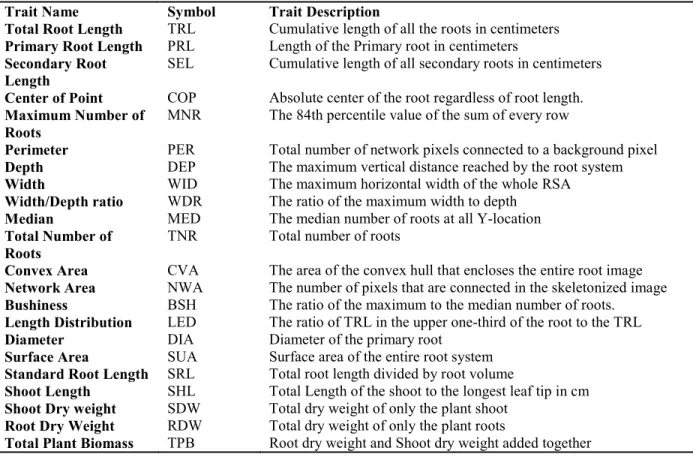
architecture development. Thus, the first objective (Chapter 2) in this project was to determine the impact of known root genes on a range of root phenotypes and identify potential causative loci. We did this by evaluating 74 inbred lines for root traits conducting a candidate gene based association analysis at the seedling stage with plants grown using a paper roll method (Woll et al 2005). The second objective (Chapter 3) was to develop a new tool for root trait extraction from images to enable more high-throughput root phenotyping for large scale mapping studies. The third objective (Chapter 4) was to expand upon objective one and survey for additional genes and QTL beyond known root development genes tested in Chapter 2. To do this we conducted a genome-wide association analysis based on 22 seedling root traits within an inbred line
association panel. The final objective (Chapter 5) of this research was to determine whether root traits could be subjected to a genomic prediction approach using the genome-wide association panel of Chapter 4 as a training population, and predict root trait performance in a larger
genotyped panel. The goal of this latter approach was to determine whether one could use GP to identify two sets of extreme genotypes using a subset of lines from a larger population, as well as test the predictability of seedling root architecture for TRL as a model for future studies.
Organization of the thesis
This thesis contains three published research articles (Chapters 2-4) and one manuscript in preparation (Chapter 5). The conclusions of all studies are summarized in a final chapter (Chapter 6). As each chapter contains its own introduction, the general introduction was kept brief. Literature for each individual experiment and procedure is introduced and discussed within the respective chapters.
Author Contributions Chapter 2
BK was first coauthor of study and helped design and carry out all experimental procedures including measurements, data analysis, and primary writer of the manuscript.
AG was first coauthor of study and helped design and carry out all experimental procedures including measurements and data analysis.
JP was coauthor, conducted resequencing of candidate gene Rth3 for candidate gene association analysis, analyzed data and made major revisions for publication.
JRM helped in design of the experiments and line selection.
FH helped select candidate genes for study and was integral in his expertise in the maize root system.
TL was PI of BK and JP and was involved in design of the experiment and data analysis. TL was also involved in writing the manuscript.
Chapter 3
JP designed all experiments, carried out phenotypic measurements, data analysis and was primary writer of the manuscript.
NL helped analyze images using ARIA and wrote much of the scripts for the program. HSK helped analyze images using ARIA and wrote much of the scripts for the program. BG is PI of NL and HSK and was heavily involved in advice for programing as well as developing parameters for the program.
9
TL was PI of JP and helped design the experiment as well and discuss results. TL was heavily involved in writing the manuscript.
Chapter 4
JP helped design the experiment, carried out all phenotypic measurements, data analysis, and was the primary writer of the manuscript.
CG helped in selecting lines to be used within mapping population as well as helped in revising written manuscript.
CR was instrumental in supplying genotypic marker data as well as helping with filtering data sets. Also helped with revising the manuscript and gave pointers for GWAS analysis.
BG was lead architect of developing the image analysis software ARIA. Also gave feedback on manuscript.
TL was PI of JP and helped design the experiment as well as look at data analysis with JP. TL was heavily involved with writing the manuscript.
Chapter 5
JP designed all experiments, carried out phenotypic measurements, data analysis and was primary writer of the manuscript.
XY helped with data management and filtering of genotypic data as well as advised JP throughout study.
TL was PI of JP and helped design the experiment as well as look at data analysis with JP. TL was heavily involved with writing the manuscript.
References
Aiken, R. M. and A. J. M. Smucker. 1996. ROOT SYSTEM REGULATION OF WHOLE PLANT GROWTH1. Annual Review of Phytopathology 34: 325-346.
doi:doi:10.1146/annurev.phyto.34.1.325.
Bais, Harsh P., Tiffany L. Weir, Laura G. Perry, Simon Gilroy and Jorge M. Vivanco. 2006. THE ROLE OF ROOT EXUDATES IN RHIZOSPHERE INTERACTIONS WITH PLANTS AND OTHER ORGANISMS. Annual Review of Plant Biology 57: 233-266.
Brewer, Marin Talbot, Lixin Lang, Kikuo Fujimura, Nancy Dujmovic, Simon Gray and Esther van der Knaap. 2006. Development of a Controlled Vocabulary and Software Application to Analyze Fruit Shape Variation in Tomato and Other Plant Species. Plant physiology 141: 15-25..
Buckler Iv, Edward S. and Jeffry M. Thornsberry. 2002. Plant molecular diversity and applications to genomics. Current Opinion in Plant Biology 5: 107-111..
Chavarria-Krauser, A., K. A. Nagel, K. Palme, U. Schurr, A. Walter and H. Scharr. 2008. Spatio-temporal quantification of differential growth processes in root growth zones based on a novel combination of image sequence processing and refined concepts describing curvature
production. New Phytol 177: 811-821.
Clark, R. T., A. N. Famoso, K. Zhao, J. E. Shaff, E. J. Craft, C. D. Bustamante, et al. 2013. High-throughput two-dimensional root system phenotyping platform facilitates genetic analysis of root growth and development. Plant Cell Environ 36: 454-466.
Drew, M. C. 1975. Nutrient Supply and the Growth of the Seminal Root System in Barley II. Localized, compensatory increases in lateral root growth and rates of nitrate uptake when nitrate supply is restricted to only part of the root system. Journal of experimental botany 26: 79.
Eathington, Sam R., Theodore M. Crosbie, Marlin D. Edwards, Robert S. Reiter and Jason K. Bull. 2007. Molecular Markers in a Commercial Breeding Program. Crop Science 47: S-154.
Esau K. 1965 Plant anatomy. New York Wiley
Feldman, L. 1994. The Maize Root. In: M. Freeling and V. Walbot, editors, The Maize Handbook. Springer New York. p. 29-37.
11
Hammer, Graeme L., Zhanshan Dong, Greg McLean, Al Doherty, Carlos Messina, Jeff Schussler, et al. 2009. Can Changes in Canopy and/or Root System Architecture Explain Historical Maize Yield Trends in the U.S. Corn Belt? Crop Science 49: 299.
Hayes, B. J., P. J. Bowman, A. C. Chamberlain, K. Verbyla and M. E. Goddard. 2009. Accuracy of genomic breeding values in multi-breed dairy cattle populations. Genet Sel Evol 41: 51.
Heffner, Elliot L., Mark E. Sorrells and Jean-Luc Jannink. 2009. Genomic Selection for Crop Improvement. Crop Science 49: 1.
Hirel, B., J. Le Gouis, B. Ney and A. Gallais. 2007. The challenge of improving nitrogen use efficiency in crop plants: towards a more central role for genetic variability and quantitative genetics within integrated approaches. J Exp Bot 58: 2369-2387.
Hochholdinger, Frank, editor. 2009. Handbook of Maize: Its Biology.
Hoppe, D. C., M. E. McCully and C. L. Wenzel. 1986. The nodal roots of Zea: their
development in relation to structural features of the stem. Canadian Journal of Botany 64: 2524-2537.
Landi, P, MM Giuliani, LL Darrah, R Tuberosa, S Conti and MC Sanguineti. 2001. Variability for root and shoot traits in a maize population grown in hydroponics and in the field and their relationships with vertical root pulling resistance. Maydica 46: 177-182.
Landi, P. 1998. Seedling characteristics in hydroponic culture and field performance of maize genotypes with different resistance to root lodging. Maydica 43: 111.
Le Bot, Jacques, Valérie Serra, José Fabre, Xavier Draye, Stéphane Adamowicz and Loïc Pagès. 2009. DART: a software to analyse root system architecture and development from captured images. Plant and Soil 326: 261-273.
Liu, Jianchao, Jiansheng Li, Fanjun Chen, Fusuo Zhang, Tianheng Ren, Zhongjuan Zhuang, et al. 2008. Mapping QTLs for root traits under different nitrate levels at the seedling stage in maize (Zea mays L.). Plant and Soil 305: 253-265.
Luan, T., J. A. Woolliams, S. Lien, M. Kent, M. Svendsen and T. H. Meuwissen. 2009. The accuracy of Genomic Selection in Norwegian red cattle assessed by cross-validation. Genetics 183: 1119-1126.
Lynch, Jonathan. 2013. Steep, cheap and deep: an ideotype to optimize water and N acquisition by maize root systems. Annals of Botany. doi: 10.1093/aob/mcs293
Lynch, Jonathan. 1995. Root Architecture and Plant Productivity. Plant physiology 109: 7-13.
Marschener, H. 1998. Role of root growth, arbuscular mycorrhiza, and root exudates for the efficiency in nutrient acquisition. Field Crops Research 56: 203-207.
McCully, M.E. and M.J. Canny. 1988. Pathways and processes of water and nutrient movement in roots. Plant and Soil 111: 159-170.
Merkangas, Neil Risch and Kathleen. 1996. The Future of Genetic Studies of Complex Human Diseases. Science 273.
13
Nass, H. G. and M. S. Zuber. 1971. Correlation of Corn (Zea mays L.) Roots Early in Development to Mature Root Development1. Crop Sci. 11: 655-658.
Rafalski, Antoni. 2002. Appications of single nucleotide polymorphisms in crop genetics. Current Opinion in Plant Biology 5: 94-100.
Ribaut, Jean-Marcel, Yvan Fracheboud, Philippe Monneveux, Marianne Banziger, Mateo Vargas and Changjian Jiang. 2007. Quantitative trait loci for yield and correlated traits under high and low soil nitrogen conditions in tropical maize. Molecular Breeding 20: 15-29.
Salvi, R. Tuberosa and S. 2007. From QTLs to Genes controlling Root Traits in Maize. p. 13-22.
T. Presterl, G. Seitz, M. Landbeck, E.M. Thiemt, W. Schmidt, H. H. Geiger. 2003. Improving Nitrogen-Use Efficiency in European Maize: Etimation of Quantitative Genetic Parameters. Crop Science 43: 1259-1265.
Taramino, G., M. Sauer, J. L. Stauffer, Jr., D. Multani, X. Niu, H. Sakai, et al. 2007. The maize (Zea mays L.) RTCS gene encodes a LOB domain protein that is a key regulator of embryonic seminal and post-embryonic shoot-borne root initiation. Plant J 50: 649-659.
Tian, Qiuying, Fanjun Chen, Fusuo Zhang and Guohua Mi. 2006. Genotypic Difference in Nitrogen Acquisition Ability in Maize Plants Is Related to the Coordination of Leaf and Root Growth. Journal of Plant Nutrition 29: 317-330.
Trachsel, Samuel, Shawn M. Kaeppler, Kathleen M. Brown and Jonathan P. Lynch. 2010. Shovelomics: high throughput phenotyping of maize (Zea mays L.) root architecture in the field. Plant and Soil 341: 75-87.
Von Behrens, I., M. Komatsu, Y. Zhang, K. W. Berendzen, X. Niu, H. Sakai, et al. 2011. Rootless with undetectable meristem 1 encodes a monocot-specific AUX/IAA protein that controls embryonic seminal and post-embryonic lateral root initiation in maize. Plant J 66: 341-353.
W.R. Jordan, W.A. Dugas, P.J. Shouse. 1983. Strategies for Crop Improvement for Drought-Prone Regions. Agriculture Water Management 7: 281-299.
Wang, Liya, Ioan Vlad Uilecan, Amir H. Assadi, Christine A. Kozmik and Edgar P. Spalding. 2009. HYPOTrace: Image Analysis Software for Measuring Hypocotyl Growth and Shape Demonstrated on Arabidopsis Seedlings Undergoing Photomorphogenesis. Plant physiology 149: 1632-1637.
Watt, Michelle, Wendy K. Silk and John B. Passioura. 2006. Rates of Root and Organism Growth, Soil Conditions, and Temporal and Spatial Development of the Rhizosphere. Annals of botany 97: 839-855.
Werner, J. D. Soule and P.A. 1981. Patterns of Resource Allocation in Plants, with Special Reference to Potentilla recta L. Torrey Botanical Society 109: 311-319.
Yan, Jianbing, Marilyn Warburton and Jonathan Crouch. 2011. Association Mapping for Enhancing Maize ( L.) Genetic Improvement. Crop Science 51: 433.
Zeng, G., S. T. Birchfield and C. E. Wells. 2008. Automatic discrimination of fine roots in minirhizotron images. New Phytol 177: 549-557.
15
Zhong, S., J. C. Dekkers, R. L. Fernando and J. L. Jannink. 2009. Factors affecting accuracy from genomic selection in populations derived from multiple inbred lines: a Barley case study. Genetics 182: 355-364.
Zhu, J., S. M. Mickelson, S. M. Kaeppler and J. P. Lynch. 2006. Detection of quantitative trait loci for seminal root traits in maize (Zea mays L.) seedlings grown under differential phosphorus levels. TAG. Theoretical and applied genetics. Theoretische und angewandte Genetik 113: 1-10.
CHAPTER TWO
ASSOCIATION ANALYSIS OF SINGLE NUCLEOTIDE POLYMORPHISMS IN CANDIDATE GENES WITH ROOT TRAITS IN MAIZE (ZEA MAYS L.) SEEDLINGS
Bharath Kumar†1, Adel H. Abdel-Ghani†2*, Jordon Pace1, Jenaro Reyes-Matamors3, Frank Hochholdinger4 and Thomas Lübberstedt1
Paper published in Plant Science Journal. Abstract, structure, and references are all formatted according to journal standards.
ABSTRACT
Several genes involved in maize root development have been isolated. Identification of SNPs associated with root traits would enable the selection of maize lines with better root architecture that might help to improve N uptake, and consequently plant growth particularly under N deficient conditions.In the present study, an association study (AS) panel consisting of 74 maize inbred lines was screened for seedling root traits in 6, 10, and 14-day-old seedlings. Allele re-sequencing of candidate root genes Rtcl, Rth3, Rum1, and Rul1 was also carried out in the same AS panel lines. All four candidate genes displayed different levels of nucleotide diversity, haplotype diversity and linkage disequilibrium. Gene based association analyses were carried out between individual polymorphisms in candidate genes, and root traits measured in 6, 10, and 14-day-old maize seedlings. Association analyses revealed several polymorphisms within the Rtcl,
Rth3, Rum1, and Rul1 genes associated with seedling root traits. Several nucleotide polymorphisms in Rtcl, Rth3, Rum1, and Rul1 were significantly (P<0.05) associated with seedling root traits in maize suggesting that all four tested genes are involved in the maize root
17
development. Thus considerable allelic variation present in these root genes can be exploited for improving maize root characteristics.
1. Introduction
The plant root system serves primarily to anchor plants in the soil, and to take up water and minerals. Roots are less visible than aboveground plant parts such as flowers, stems, and leaves. Therefore, root characteristics are seldomly considered as selection criteria [1], but they are no less important to the plant. The root system is affected by environmental conditions, management practices, and to a greater extent genotype dependent. While plants respond to limiting soil nutrients and water stress by increasing the amount of root biomass allocated to roots, and consequently increasing root to shoot biomass ratio [2-7], the acquisition of soil nutrients and available soil moisture by plants is more dependent upon root length and/or root surface area than total root biomass [8-9]. Genetic variation for root morphology in maize does exist, and has long been proposed for improvement of nutrient and water-use efficiency in maize [7, 10-14].
Root architecture traits can be determined using different methods including vertical root pulling force (RPF) and hydroponic characterization [15-18]. Field methods are frequently technically demanding and costly. Due to the difficulty in obtaining reliable root trait data from the field, there are very few reports on morphological characterization of maize roots in the field. Using paper rolls as a hydroponic method to study root architecture has several advantages in comparison with RPF and other field techniques [7, 14, 18-19]. These include: (i) the ease to score root traits as compared with vertical RPF, (ii) controlled environmental conditions, thus increasing repeatability of measurements, (iii) screening large numbers of lines in small space within a short period of time with an easy access to roots, and (iv) precise control of the
concentration of mineral nutrients and water soluble compounds. However, the main disadvantages are the artificial screening conditions which might not properly represent field conditions.
Maize varieties with high yield potential are expected to have favorable root architecture, which can effectively supply water and nutrients, leading to increased grain yield [7, 15-17]. This is particularly important in case of limited water or nutrient availability, such as under drought conditions.
The maize rootsystem consists of different root types that are formed during different stages of plant development. The root system in maize can be divided into embryonic and post-embryonic roots [20]. The embryonic root system is composed of a single primary root and a variable number of seminal roots, while post-embryonic roots are shoot-borne roots including crown and brace roots. Shoot-borne roots formed at consecutive underground nodes are called crown roots, while the respective roots formed at consecutive above-ground nodes of the shoot are called brace roots. Lateral roots which emerge from all major root-types also belong to the post-embryonic root system. Mutants affected in various aspects of root formation have been identified in maize including rtcs, rth1, rth3, and rum1 [19, 21-23]. Rtcl (Rtcs-like) is regarded as a paralog of Rtcs [22], and Rul1 (Rum1-like) as a paralog of Rum1. That the primary root and its lateral roots alone are sufficient to form a fertile mature plant was demonstrated by the monogenic recessive mutant rtcs, which forms only a primary root and its lateral roots but no seminal or shoot-borne roots [24]. The mutant rum1 is affected in lateral root formation, while the mutants rth1 [21] and rth3 [25] display reduced root hair elongation. Rtcs encodes a 244 amino acid (aa) Lateral Organ Boundaries (LOB) domain protein located on chromosome 1S. During evolution, Rtcs was duplicated. The Rtcl gene, which maps on chromosome 9, displays
19
72% aa sequence similarity with Rtcs. The Rtcs and Rtcl gene promoters share auxin responsive elements, and they are preferentially expressed in roots [22]. The Rth1 gene encodes a SEC3 homologue [21]. In yeast (Saccharomyces cerevisiae) and mammals, sec3 is part of the exocyst complex, which ropes together exocytotic vesicles prior to their fusion. The Rth3 gene belongs to the COBRA-like gene family [25]. Members of this plant-specific glycosylphosphatidylinositol anchored protein coding gene family are involved in cell expansion and cell wall biosynthesis [26]. The Rum1 gene located on chromosome 3 encodes a polypeptide of 269 aa which is a monocot specific AUX/IAA protein [23]. Rul1 is a closely related Aux/IAA protein coding gene, and is localized on chromosome 8. Rul1 encodes a polypeptide of 273 aa that displays 92% aa identity with Rum1.
Recombinant inbred lines have been used for mapping quantitative trait loci (QTL) to 10-30 cM regions [27-28]. However, QTL mapping is limited by, (i) the expense of generating such lines, (ii) their limited diversity, (iii) their separation from established processes in maize breeding, and (iv) the low number of informative recombinations [29]. In contrast, association mapping studies which are based on linkage disequilibrium (LD) allow identification of actual genes underlying these QTLs [30]. The success of gene based association studies depends on the candidate gene(s) chosen for a particular phenotypic trait. The first candidate gene-based association mapping study in maize associated individual dwarf8 polymorphisms with flowering time [30], which has been followed by numerous subsequent studies in maize [31] and other cereal crops [32]. Gene-based association studies ultimately lead to the identification of quantitative trait polymorphisms (QTPs) with causal genetic effects on agronomic traits, which can be converted into functional markers [33]. Breeding for a vigorous root system in maize may involve identification of superior alleles of candidate genes that affect nutrient and water use efficiency. Respective
candidate gene-based studies enabled identification of alleles affecting various relevant quantitative agronomic traits in maize [30, 34-38].
So far, no information is available on the genetic diversity of genes affecting root development in maize. Therefore, the objectives of this study were to: (i) examine the nucleotide and haplotype diversity for Rtcl, Rth3, Rum1, and Rul1 in a panel of 74 maize inbreds, (ii) estimate phenotypic means for root traits of lines included in the individual haplotypes, and (iii) to identify polymorphisms in candidate genes associated with root development.
2. Materials and methods
2.1. Plant materials
Allele re-sequencing of candidate root genes was carried out in 44 expired PVP lines, and 30 public inbred lines such as Nested Association Mapping (NAM) founder lines, 2009 released Germplasm Enhancement of Maize (GEM) lines and lines used in a maize diversity study (Appendix 1). The rationale for using expired PVP lines is to capture substantial genetic variation present in current elite germplasm. Other public inbred lines were chosen to enable detection of the majority of SNP and INDEL polymorphisms in the candidate genes studied, as a prerequisite to develop multiplexed SNP assays to be used for screening large numbers of genotypes at low costs in large-scale association studies. Seed was obtained from different seed resource centers such as North Central Regional Plant Introduction Station in Ames, IA (NCRPIS), and Maize Genetics Cooperation (Champaign, IL). All maize lines were selfed at the Agronomy farm, Iowa State University in summer 2009 to produce seed of equal origin and quality for this study.
21
2.2. Experimental design and phenotyping
Seedling root characteristics in maize lines were studied using a paper roll test described by Woll et al. [19]. Seeds were first surface sterilized with Clorox® solution (6% sodium hypochlorite) for 15 minutes. After surface sterilization, seeds were washed three times with sterile water. Surface sterilized seeds were then placed on a brown germination paper (Anchor Paper, St. Paul, MN) pre-moisturized with fungicide solution Captan® (2.5g/l), and afterwards rolled up vertically. Rolled germination papers were kept in 2 l glass beakers containing autoclaved deionised water. Experiments were carried out in growth chambers under a photoperiod of 16/8 h at 25/22 °C (light/darkness) with photosynthetically active radiation of 200 µmol photons m-2 s-1. The relative humidity in growth chambers was maintained at 65%, and lines were grown in a randomized complete block design with two replications. Each paper roll containing three seedlings was considered an experimental unit. 74 maize lines with different genetic background and origins were evaluated at three growth stages independently (6, 10, and 14 days after sowing). Each experiment was repeated twice. At the end of each growth stage (6, 10, and 14 days), root characteristics were evaluated. Seedlings were separated into root system and shoots at the crown root region. The root system was further separated into primary root, seminal, and crown roots, and respective root lengths were recorded. To measure lateral roots, the primary root was scanned, and the image was analyzed using WinRhizo Pro 2009 software (Regent Instruments, QC, Quebec, Canada). Total root length (TRL) was estimated by summing the lengths of primary root, crown, seminal, and lateral roots for each seedling. Roots were dried at
2.3. DNA extraction, amplification, and sequencing
Four candidate genes were chosen based on their role in root development to identify SNPs for association study analyses. SNPs from these candidate genes were tested for possible associations with TRL and RDW. Candidate genes chosen for our association study were: Rtcs,
Rtcn, Rtcl, Rth3, Rum1, and Rul1. Gene specific primers were designed to amplify the entire sequence of Rtcl, and parts of Rth3, Rum1, and Rul1 genes using the software program Primer 3.0 (http://frodo.wi.mit.edu/primer3/) (Table 3). In case of Rtcs and Rtcn, even after several attempts, amplicons from all 74 lines were not obtained. This might be due to the extensive nucleotide diversity at these candidate genes which prevents the binding of designed primers. Polymerase chain reaction (PCR) was performed using the designed primers for each gene separately in 50 μl volumes under the following conditions: 50 ng template DNA, 250 nM of each primer, 250 nM dNTPs, 2 U Taq polymerase and 250 μM MgCl2. Reactions were performed for each primer pair using the following PCR program in a thermocycler (MJ research, California): an initial 94 °C denaturation step for 2 min followed by 35 cycles of 94 °C for 30 sec (denaturation step), 57.5 °C for 30 sec (annealing step), and 72 °C for 90 sec (elongation step). The final extension step was followed by 72 °C incubation for 10 min. Amplified DNA fragments were resolved by gel electrophoresis (Biorad, California) using 1% agarose gels in Tris-EDTA (TE) buffer. Agarose gels were stained with 0.5 μg of ethidium bromide per ml. The running time was 90 min at 120 mV. Finally, gels were visualized and photographed by a UV illuminator system (Alphainnotech, California). For each gel, the first lane was specified for a 100 bp DNA ladder (Promega, Wisconsin), the second lane and the third lane were specified for positive and negative controls. Amplified fragments of Rth3, Rum1, and
23
amplicons were obtained from 69 lines. For sequencing, 10 μl of the amplified fragments were first purified by using 2 units of shrimp alkaline phosphatase and 2 units of exonuclease I at 37 °C for 1 h, followed by 72 °C for 15 min to deactivate the enzymes. Amplified gene products were then labeled for sequencing using the ABI Prism® BigDye® Terminator v3.1 cycle sequencing kit (Applied Biosystems, California). Labeling reactions were performed in 10 μl reaction volume containing 1 μl of PCR product, 1 μl of BigDye Terminators, 0.26 μl of 50 mM original PCR primers (either forward or reverse), 1.75 μl of 5× sequencing buffer and 5.99 μl deionized distilled water. The thermocycler cycle sequencing reaction was performed using the following cycling parameters: 96 °C for 2 min, 25 cycles of 96 °C for 30 sec, 50 °C for 1 min, and 60 °C for 4 min, finally cooled to 4 °C. Precipitated DNA was purified with 70% ethanol and dried thoroughly before re-suspending in ABI Hi-Dye formamide for sequencing on a sequencer (Applied Biosystems 3730 DNA Analyzer with a 96-capillary array). Sequencing was performed for each amplified fragment using forward and reverse primers separately with two replicates. Based on primers designed, expected sizes of PCR products were obtained for all tested genes. Sequences were aligned using Sequencher program 4.1 (Gene Codes Corporation, Michigan). In order to maximize read lengths and to obtain a sequencing quality >98%, two replicates of forward and reverse reads for each amplified fragment were aligned to get consensus sequences of amplified gene fragments from AS panel lines.
2.4. Phenotypic data analyses
The following linear mixed model was used to estimate variance components: yijk= µ+ Ei + Bj(i)
+ Gk +EGik + BGj(i)k, where yijk represents the observation from the ijkth experimental unit, µ is the overall mean, Ei is the effect of ith independent experiment, Bj(i) is the effect of jth block nested in ith experiment, Gk is the effect of kth line, EGik is the interaction effect of the ith
experiment with kth genotype, BGj(i)k is the interaction effect of jth block nested in ith experiment with kth genotype. Heritability (h2) on an entry mean basis was estimated as the ratio of genotypic to phenotypic variance according to Hallauer and Miranda [39]. Furthermore, experiment was considered as a fixed factor, whereas blocks and genotypes were regarded as random factors. Best linear unbiased estimates (BLUEs) were determined for maize lines for each trait. SAS 9.1 (SAS Institute, 1996) software packages were used for all calculations.
2.5. Analysis of sequence data
Respective gene sequences amplified from the association panel lines were analyzed using the software package DnaSp [40]. Haplotype diversity among candidate genes was analyzed based on the SNPs in the amplified fragment sequences from AS panel lines. Levels of nucleotide diversity in different parts of amplified fragments of the gene were estimated as π, the average number of nucleotide differences per site between two sequences [41]. A different estimator of nucleotide diversity θ, the neutral mutation parameter was calculated based on number of segregating sites [42] with a common expected value θ = 4N μ, where Ne equals the effective population size and μ the mutation rate per generation and site. Haplotype diversity (Hd) was estimated as the probability that two randomly chosen haplotypes from a given population were different [43]. Neutrality of mutations was checked using Tajima’s D statistics [44, 45]. These statistics are based on the different comparisons of θ =4 , where Ne equals the effective population size and the mutation rate [42]. Tajima’s D statistics results from the comparison of
θ based on number of pair-wise differences and the number of segregating sites between
25
2.6. Population structure and association analysis
All 74 lines in the AS panel were genotyped with 101 SNP markers distributed evenly across 10 maize chromosomes [46] to assess and control the effect of population structure. The software package Structure 2.0 [47] was used to estimate population structure (Q) within the AS panel using SNP data. In Structure 2.0, a burn-in length of 50.000 followed by 50.000 iterations for each of the clusters (K) varying from 1 to 20 (each K was run 20 times) were used to produce a Q matrix estimating membership coefficients for each line in each subpopulation. The Admixture model was applied with independent allele frequencies. An ad hoc (ΔK) statistic [48] based on the second order rate change of P (X|K) was used to identify the most probable value of K.
Loiselle kinship coefficients between lines (a K matrix) were estimated by the TASSEL program [49] based on the 101 SNP markers. Both Q matrix and a K matrix were used in the association analysis to control the spurious associations due to population structure and relatedness, respectively [50]. Association analysis between SNPs and root traits was carried out using a mixed linear model (MLM) implemented in the program TASSEL 2.10 software [49]. The MLM accounts for overall population structure (Q) and for finer scale relative kinship (K). The statistical model used in mixed linear model (Q+K) can be described in Henderson’s notation [51] as: y= Xβ+Zu+e, where y is the vector of observations; β is an unknown vector containing fixed effects including genetic marker and population structure (Q); u is an unknown vector of random additive genetic effects from multiple background QTL for individuals or lines; X and Z are the known design matrices; and e is the unobserved vector of random residuals.
TRL and RDW were measured in 6 (sTRL, sRDW), 10 (tTRL, tRDW), and 14 (fTRL, fRDW) day old seedlings, and used as root traits in our association study. False discovery rate was set at
0.05 [52] to control for multiple testing of SNP markers. Motifs in the Rtcl, Rth3, Rum1, and
Rul1 genes were searched using a PLACE (Plant cis-acting regulatory DNA elements) database [53] to determine, if any of the significantly associated SNPs might alter motif sequences in the candidate genes.
3. Results
3.1. Phenotypic variation
Complete statistical analysis of root traits measured in this study has been reported elsewhere [14]. In their principal component analysis, total root length (TRL) and root dry weight (RDW) explained most of the phenotypic variation. Moreover, both TRL and RDW were significantly and positively correlated with all other root-related traits. We, therefore, focused on TRL and RDW for association mapping in this study.
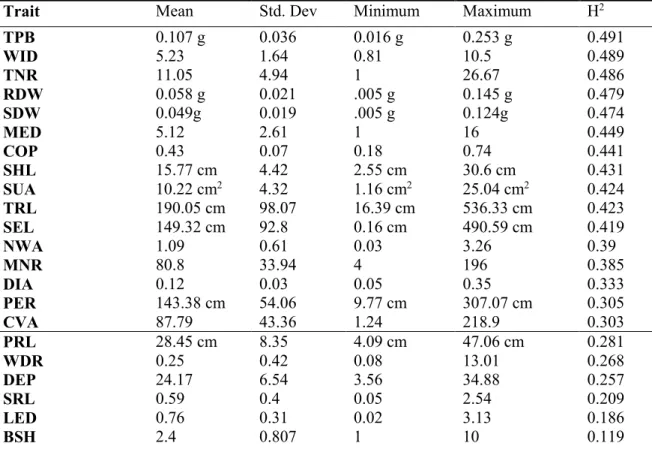
Frequency distribution of TRL and RDW measured in 6, 10, and 14-day-old seedling of 74 AS panel maize inbred lines are presented in supplementary figures 1 and 2. TRL ranged from 8.1-72.6 cm, 39.2-216.3 cm and 78.6-362.0 cm in 6, 10, and 14-day-old seedlings, respectively. RDW varied from 5.5-29.8 mg, 10.1-49 mg, and 14.9-82.0 mg in 6, 10, and 14-day-old seedlings, respectively. Both TRL and RDW had the highest co-efficient of variation (CV) in 6-day-old seedlings.
3.2. Sequence alignment and haplotypes
The Rtcl sequence alignment of 69 maize lines spanned 828 bp with no alignment gaps, such as indel polymorphisms. The 828 bp amplified fragment included two exons, i.e., exon 1 (420 bp), and exon 2 (279 bp), respectively, separated by an intron (129 bp). In exons 1 and 2, 16 and 22 SNPs were identified, respectively, whereas 7 SNPs were identified in the intron region. Out of the 38 SNPs in the exon regions, 32 altered the amino-acid sequences; the other 8 were
27
synonymous mutations (Table 1). In case of Rth3, 714 bp of the open reading frame (ORF) region of the gene was amplified from all 74 lines in the AS panel. Sequence alignment of Rth3
amplicons resulted in the identification of 15 SNPs with no indel polymorphisms. Out of 15 SNPs, 12 were synonymous mutations, and only 3 SNPs altered the amino-acid sequence (Table 2). Intron 4 and exon 5 were partially amplified for Rum1: 225 out of 461 bp in intron 4 and 207 out of 315 bp in exon 5. Sequence alignment of Rum1 amplicons from all 74 lines in the AS panel resulted in the identification of 12 SNPs. Out of 12 SNPs, 9 SNPs were from intron 4 and remaining 3 SNPs were from exon 5 region. Out of 3 SNPs identified in the exon region of Rum1
gene, two were synonymous mutations and the remaining one SNP altered the amino acid sequence (Table 3). For Rul1, intron 5 and exon 6 were partially amplified from all 74 lines of the AS panel. Sequence alignment of 411 bp from Rul1 consisting of 84 bp of intron 5 and 327 bp of exon 6 resulted in the identification of six SNPs, including five in exon 6. Four of those exon SNPs altered the amino-acid sequence (Table 4).
The number of haplotypes for the four genes ranged from 7 for Rul1, 9 for Rth3, 16 for Rtcl, to 22 for Rum1 (Tables 1-4). The range of haplotype means for TRL and RDW traits measured in 6, 10 and 14-day-old seedlings was larger for Rum1 gene compared to other three genes (Table 1-4).
3.3. Nucleotide diversity in four genes
Nucleotide diversity (π) was determined for Rtcl, Rth3, Rum1, and Rul1 coding and non-coding regions using the SNPs identified in respective amplicons from AS panel lines (Table 5). Overall, nucleotide diversity was π=0.021 in the entire region of Rtcl. Within Rtcl, nucleotide diversity was almost the same in both intron (π=0.022) and exon (π=0.021) regions. In Rth3
non-synonymous mutations (π=0.0002). For the Rum1, nucleotide diversity was higher in the non-coding region (π=0.017) than in the coding region (π=0.005), and for Rul1, there was not much difference in the nucleotide diversity between non-coding (π=0.007) and coding region (π=0.004). When the entire amplified region was considered, nucleotide diversity was lower in
Rum1 (π=0.011), Rth3 (π=0.007), and Rul1 (π=0.005) compared to Rtcl (π=0.021). The nucleotide diversity based on θ, the neutral mutation parameter, was also calculated for all four amplicons in a sliding window of 100 bp using a step size of 10 bp (Fig. 1). Based on θ, within
Rtcl, average nucleotide diversity was same in both intron and exon region. In case of the Rum1
gene, nucleotide diversity seems to be higher in the intron region compared to the exon, but it was the same in both the exon and the intron region in the amplified region of the Rul1 gene. Haplotype diversity (Hd) ranged from 0.873 in Rtcl to 0.624 in Rul1.
Tajima’s D was positive and significant when considering the entire Rtcl region as well as both coding and non-coding regions. Conversely, in case of Rth3, Rum1 and Rul1, Tajima’s D was non-significant in all regions except in the Rul1 non-coding region (Table 5). Complete analysis of LD decay in AS panel lines across Rtcl, Rth3, Rum1 and Rul1 genes has been reported elsewhere [54]. LD between all pairs of polymorphic sites from the sequenced region of the Rtcl,
Rum1, and Rul1 genes decayed very rapidly (r2 < 0.2), whereas LD persisted (r2 > 0.25) over the length of the sequenced region in the Rth3 gene.
3.4. Population structure and marker-trait associations
Based on the ad-hoc statistic values in Structure 2.0, lines in the AS panel were grouped into two sub-populations (K=2), which agrees with their pedigree and breeding history [54].
29
21 SNPs were significantly (P=0.05) associated with sTRL, and 16 SNPs were associated with sRDW (Table 6), with 14 SNPs associated with both sTRL and sRDW. Five of those SNPs were located in exon 1, four in the intron, and five in exon 2. Four SNPs in exon 1 and four in exon 2 caused non-synonymous changes in the protein sequence (Table 6), while the remaining two SNPs in the exon regions caused synonymous changes. In case of tTRL and tRDW, five and two SNPs were associated, respectively. SNPs at the sites 413, 473, 531, 547, and 554 were significantly associated with both sTRL and tTRL. Similarly, SNPs at sites 320 and 374 were significantly associated with both sRDW and tRDW. Out of these SNPs, SNPs at sites 320, 374, 413, and 554 caused non-synonymous changes in the amino-acid sequence. For fourteen-day-old maize seedlings, SNPs at sites 510 and 554 were associated with fTRL only. Moreover, the SNP at site 510 was associated with both sTRL and fTRL, whereas the SNP at 530 was associated with sTRL, tTRL and fTRL.
Using B73 as reference sequence, seven SNPs (290, 317, 320, 468, 510, 597, and 799) were significantly associated either with TRL and RDW traits affected putative functional sequence motifs in the Rtcl gene. These motifs are the signatures of the binding sites of several regulatory proteins (Supp. Table 1). Moreover, non-synonymous SNPs at 290, 317, and 320 affected the LOB domain amino acids in the RTCL gene (data not shown).
3.4.2. Rth3
13 polymorphisms in the Rth3 exon region were associated with sTRL, whereas the SNP at 621 was the only polymorphism associated with sRDW (Table 7). Of these associated SNPs, a synonymous polymorphism at the site 621 was associated with both sTRL and sRDW. In case of fTRL and fRDW, seven and eight SNPs were associated, respectively. The synonymous SNPs at sites 180, 234, 438, 465, 492, 519, and 600 were significantly associated with both fTRL and
fRDW. Moreover, these SNPs were also associated with sTRL. No SNP in Rth3 was associated with tTRL. Four SNPs (389, 399, 436 and 600) significantly associated with TRL and RDW affected the binding sites for regulatory factors in the Rth3 (Supp. Table 1). Since these SNPs were synonymous, they did not affect the COBRA domain in the Rth3 gene.
3.4.3. Rum1
One and two SNPs in Rth3 were associated with sTRL and sRDW, respectively. The SNP at site 303 in the intron 4 region was associated with both sTRL and sRDW. In case of tTRL and tRDW, the SNPs at sites 63 and 251 were associated with both traits. Moreover, these SNPs were also associated with fTRL and fRDW. SNPs at sites 118 and 302 were associated with sTRL and sRDW and also with fTRL and fRDW. The SNP at site 118 in the exon 5 region causes a non-synonymous change in the amino-acid sequence and also affects a binding site transcription factors in the Rum1 gene (Supp. Table 1).
3.4.4. Rul1
SNPs at sites 311, 336, and 389 in the exon 6 region of Rul1 were significantly associated with tRDW. The SNPs at sites 336 and 389 caused non-synonymous changes in the amino-acid sequence. A synonymous SNP at site 7 in the intron 5 region of Rul1 was associated with sRDW. No SNP from the amplified Rul1 gene region was associated with either fTRL or fRDW. 4. Discussion
4.1. High levels of phenotypic, nucleotide, and haplotype diversity
We observed substantial quantitative variation for root traits TRL and RDW in 6, 10, and 14-day-old seedlings indicating a considerable amount of morphological differences among 74 maize inbred lines in the AS panel (Supp. Figs. 1 and 2). We identified maize lines with both
31
under and well–developed root systems, which are attractive for identifying genomic regions controlling root traits [14].
In the present study, 2386 bp across four candidate genes involved in root development were amplified from the AS panel lines, resulting in 78 SNPs, and an average SNP frequency of 1 SNP/31bp (Table 5). Substantial differences in nucleotide diversity were observed between the four candidate genes (Table 5). Nucleotide diversity was highest in the RTCL gene (π=0.021), and lowest in Rth3 (π=0.007) and Rul1 (π=0.005) gene. The nucleotide diversity observed in the candidate genes is comparable to previous studies in maize inbreds for Sclce2 (π=0.0112; Li et al., 2011), 4CL2 (π=0.0102; [55]), COMT (π=0.008; [56]) and PAL (π=0.004; [35]). In other studies involving maize landraces, nucleotide diversities ranged from π = 0.001 – 0.0133 with an average value of π=0.004, and a SNP frequency of one SNP per 62 bp. When coding and non-coding regions were compared in candidate genes used in these studies, nucleotide diversity varied across the genes. In case of Rtcl and Rul1, both intron and exon regions had the same nucleotide diversity, whereas nucleotide diversity was higher in the intron region of Rum1 gene. This distribution of nucleotide diversity across intron and exon regions has also been found in other studies [55, 57]. All four candidate gene Rtcl, Rth3, Rum1, and Rul1 showed positive Tajima’s D values (Table 5). This indicates balancing selection with an excess of alleles with intermediate frequencies and a scarcity of rare alleles. Considerable haplotype diversity was found for Rtcl, Rth3, Rum1, and Rul1 (Table 5).
4.2. Polymorphisms associated with root traits
Several studies have shown the quantitative and qualitative importance of root traits in taking up nitrogen (N) from N-depleted soils [58-60]. Identification of the genetic regions associated with root traits would help not only to develop maize lines with a favorable root system, but also to
understand the relationship between plant growth, plant productivity and root architecture. In our previous study, we identified significant positive correlations between seed root traits such as SRL and RDW with grain yield under two N levels [7]. Here, we used association mapping to dissect the role of SNPs in Rtcl, Rth3, Rum1, and Rul1 for maize root development.
Taramino et al. [22] isolated the first root gene in maize (Rtcs) involved in seminal and crown root formation by map-based cloning. Rtcl, a paralog of Rtcs was used in our association mapping study. The role of Rtcl in maize needs yet to be determined. In our association study,
Rtcl was found to be associated with root development in 6, 10, and 14-day-old seedlings (Table 6). Several synonymous and non-synonymous SNPs in the Rtcl gene region were significantly associated with TRL and RDW. This suggests a potential role of Rtcl gene in maize root development. This likely role of the Rtcl gene in maize root development might be due to the sequence similarity it shares with its paralogous Rtcs gene, which has been demonstrated to be involved in root development. The paralogous Rtcl gene shares 72% sequence similarity at the protein level with Rtcs gene, contains a LOB protein domain, which was found in genes involved in root development [61], and both Rtcs and Rtcl gene promoters share auxin responsive elements that are preferentially expressed in roots [22]. It has also been shown that maize mutants with impaired LOB domain have reduced crown and seminal roots [62-64].
SNPs in Rth3 were significantly associated with TRL and RDW in 6 and 14–day-old seedlings. Even though root hair elongation was not measured in this association study, our study suggests that Rth3 affects other root characteristics in maize. Our findings are consistent with findings of Hochholdinger et al. [25], showing significant yield losses of the rth3 mutant in replicated field trials. Rth3 belongs to COBRA – like gene family specifically involved in cell expansion and cell wall biosynthesis [25-26]. The rth3 mutant has been shown to affect root hair elongation and
33
grain yield [25]. By this association mapping study we found that Rth3 affects both TRL and RDW in maize seedlings. The significant association between SNPs in the Rth3 gene with root length and biomass might be due to the role of root hairs in water and nutrient uptake. Previous studies have shown that plants lacking efficient uptake of water and nutrient have poor root characteristics [59, 65].
Von Behrens et al. [23] isolated the Rum1 gene that is auxin/indole acetic acid (IAA) inducible and encodes protein containing four conserved domains, and a bipartite nuclear localization sequence. The protein encoded by Rum1 is involved in the formation of embryonic seminal root and post-embryonic lateral roots. Rul1 is regarded as paralog of the Rum1 gene, since it shares 92% sequence identity at the amino acid level and is located in a duplicated region of the maize genome. The role of Rul1 gene in maize root formation is still unknown. In our association mapping study, Rum1 was associated with TRL and RDW in 6, 10, and 14-day-old seedlings, thus confirming the role of Rum1 in maize root development. Moreover, SNPs in the Rul1 gene were associated with RDW in 10 and 14-day-old seedlings. This suggests a role of Rul1 in root development, which has so far only been shown to be a paralog of Rum1 [23].
4.3. Molecular physiological basis of SNP– trait associations
Previous studies have shown the potential role of Rth3 and Rum1 genes in maize root development. Any impaired expression of these genes leads to defective root development. From our gene based association study, we not only confirmed the role of Rth3 and Rum1 genes in maize root development, but we also found that the two paralogous genes Rtcl and Rul1 are involved in the maize root formation. Thus, it is conceivable that polymorphisms in Rtcl, Rth3,
In the Rtcl gene, 13 non-synonymous and 4 synonymous SNPs were associated with TRL and RDW. Out of these associated SNPs, seven affected putative functional sequence motifs, mostly transcription factor binding sites. Moreover, out of these seven SNPs, three SNPs at sites 290, 317, and 320 also affected the LOB domain in the Rtcl gene. These SNPs seem to be critical not only for the formation of a proper LOB domain, which is required for root formation, but also for regulation of the Rtcl gene by affecting transcription factor binding sites. Similar results wherein the SNPs associated with traits affect transcription factor binding sites in the gene have been reported elsewhere [36, 43]. In our previous association mapping study involving SNPs from the
Rtcl gene and seedling root traits measured under contrasting nitrogen levels, these three SNPs were consistently associated with seedling root traits. The SNP at site 317 in Rtcl gene was associated with both RDW and TRL under high and low N conditions, whereas the SNP at site 320 was associated with RDW under both N conditions. In case of the SNP at site 290, associations were observed with RDW and TRL under high N. These consistent associations suggest the potential role of these SNPs in the Rtcl gene in maize root development. LD is very low between SNPs at sites 290-320 (r2 = 0.0255) and 317-320 (r2 = 0.0903), whereas it was moderate between 290-317 (r2 = 0.2827). Low to moderate LD between these significant SNPs suggests that these individual SNPs are putative causative polymorphisms, and can be of potential use in deriving markers to select root traits. For the Rth3 gene, 13 polymorphisms were found to be significantly associated with TRL and RDW. Of these 13 SNPs, four SNPs (site 393, 399, 438, and 600) in the exon region significantly affected the binding sites for regulatory factors in Rth3, but none of these SNPs affected the COBRA domain within the gene, as they were synonymous mutations. When the LD was estimated between these four SNPs, low LD was detected between SNPs at the sites 393-438 (r2 =0.0445), 393-600 (r2 =0.0323), 399-438
35
(r2=0.0445) and 399-600 (r2 =0.0323). However, there was a high LD between sites at positions 393-399 and 438-600. This suggests, that individual SNPs at 393 (or 399), 438 (or 600) are putative causative polymorphisms, and can potentially be used to derive markers to select root traits. In our previous association mapping study involving SNPs in the Rth3 gene and grain yield, the SNP at site 600 was associated with grain yield under high N suggesting that this SNP might potentially be used along with other SNPs to select for grain yield. In case of the Rth3
gene, full-length re-sequencing of this candidate gene would greatly increase the number of unlinked polymorphisms to be tested for associations due to the extent of LD over a long distance.
In our previous association mapping study, non-synonymous SNPs in Rum1 and Rul1 gene (site 118 in Rum1, 336 and 389 in Rul1) were associated with seedling root traits under HN and LN conditions. In the present study, these SNPs were also associated with TRL and RDW. A non-synonymous SNP at site 118 in Rum1 gene associated with RDW in 6 and 10-day old seedling also affected the putative functional sequence motifs which are the signatures of the transcription factor binding sites in the gene. LD is high between the sites 336-389 in Rul1 gene, so these polymorphisms are putatively causative with the root trait. Taken together, the SNP at site 118 in the Rum1 gene, and either SNP at sites 336 and 389 in the Rul1 gene can potentially be applied in breeding programs to improve root traits.
In the present study, genes and their paralogues have been tested for association with roots traits. From our results, it seems that Rtcl, Rth3, Rum1, and Rul1 can be considered as candidate genes to develop functional markers for root traits especially the significant SNPs in these genes with large effect on the trait (Supp. Table 2).
Functional markers are DNA markers derived from polymorphic sites within genes, causally involved in phenotypic trait variation [33]. All associations found in the current study are candidates as LD expands beyond the sequenced region, and could affect gene expression through regulatory elements outside the coding region such as the promoter. The confirmation of associated polymorphisms within candidate genes must be done in separate association mapping populations or through targeted mutation studies. Future studies will include adequate diversity and more lines to increase the statistical power to detect marker trait associations.
References
1. R. Tuberosa, S. Salvi, From QTLs to genes controlling root traits in maize, in: J.H.J. Spiertz, P.C. Struik, H.H. Van Laar HH (Eds.), Scale and complexity in plant systems research: gene–plant–crop relations, Springer, 2007, pp. 13–22.
2. H.A. Mooney, A.J. Bloom, F.S. Chapin III, Resource limitation in plants-an
economic analogy. Annu. Rev. Ecol. Syst. 16 (1985) 363-392.
3. D. Robinson, Compensatory changes in the partitioning of dry matter in relation to nitrogen uptake and optimal variations of growth, Ann. Bot.-London 58 (1986) 841-848.
4. D.W. Hilbert, Optimization of plant root: shoot ratios and internal nitrogen
concentration. Ann. Bot.-London 66 (1990) 91-99.
5. H.L. Reynolds, C. D’Antonio, The ecological significance of plasticity in root weight
ratio in response to nitrogen: Opinion. Plant Soil 185 (1996) 75-97.
6. K.D. Bonifas, D.T. Walters, K.G. Cassman, J.L. Lindquist, Nitrogen supply affects root: shoot ratio in corn and velvetleaf (Abutilon theophrasti), Weed Sci. 53 (2005) 670-675.