Why develop open-source software?
The role of non-pecuniary benefits,
monetary rewards, and open-source
licence type
Robert M. Sauer
Jerusalem Institute for Market Studies, Israel
Abstract
A review of the basic theory of optimal open-source softwarecontributions points to three key factors affecting the decisionto contribute to the open-source development process: non-pecuniarybenefits, future expected monetary returns, and open-sourcelicence type. This paper argues that existing large-scale softwaredeveloper surveys are inadequate for measuring the relativeimportance of these three factors. Previous econometric studiesthat collect their own unique datasets also fall short becausethey generally measure the importance of only one supply factorin isolation. To fill the gap, I specify an estimable dynamicprogramming model of joint labour supply and open-source participationdecisions that can provide empirical estimates of relative importancewithin a single unified framework of optimal decision-making.
Key Words: software • open source • labour supply • dynamic programming
I. Introduction
Over the past decade, there has been a phenomenal increase inthe adoption of open-source software by both firms and governments.In 1996, the market share of the open-source
operating systemLinux, in the global server market, was roughly 6 per cent.By the year 2003, Linux's market share had reached 28 per cent.Between 1996 and 2003, Linux overtook its proprietary softwarecompetitors Unix and Netware and substantially closed the gapwith the traditional leader in the sector, Microsoft Windows(see Wheeler, 2004).
The reasons why firms and governments have increased their adoptionof open-source software are generally well understood. In certaincomputing environments, the total cost of ownership (TCO) ofopen-source software can be lower than the TCO of proprietarysoftware. Open-source software is also now considered to beof equivalent or higher quality than many
proprietary softwarealternatives. The increasing demand for open-source softwareis mainly a function of falling TCO and improved program functionality(see MacCormack, 2003).1 In stark contrast to the demand side of the software market,the main determinants of the supply of open-source softwareare still unknown. The central puzzle is that most open-source software developers are volunteers who supply their labour forfree, and many developers agree to have their contributionslicensed in such a way that it is difficult for them to profit directly from the resulting software product. Previous researchaddressing this puzzle has pointed to non-pecuniary benefits,future monetary rewards, and open-source licence type as thethree key factors influencing the individual's decision to contributevoluntarily to open-source development (see, for example, Lernerand Tirole, 2002). However, there is currently very little empiricalevidence on the relative importance of these three supply factors.
Obtaining empirical measures of relative influence can be practicallyimportant for properly predicting future open-source supplylevels and assessing the impact of proposed changes in publicpolicy towards open-source development.
In this paper, the basic theory of open-source supply contributionsis outlined and the relevant econometric evidence is reviewed.It is pointed out that the empirical literature currently falls short because it generally looks at the role of monetary rewardsand open-source licence type in isolation. There are also nostudies, to the best of my knowledge, that attempt to identify
empirically the role of non-pecuniary benefits in the supplydecision. In order to fill this gap in the literature, I proposea model of joint labour supply and open-source software contribution decisions that can be used to measure the relative influenceof non-pecuniary benefits, future monetary rewards, and open-sourcelicence type in a single model. The dynamic model could be easilyempirically implemented were panel data to be collected on thedecisions of open-source and proprietary software developers.
The rest of the paper is organized as follows. In the next section,the basic theory of voluntary contributions to the open-sourcedevelopment process is outlined. In section III, the drawbacks of existing large-scale surveys are highlighted and previouseconometric findings from studies that collect their own uniquedata sets are discussed. In section IV, the forward-lookingmodel of software-developer employment and open-source contributiondecisions, incorporating all three supply factors in a singlemodel, is specified. The final section summarizes and
concludes.
II. The basic theory of voluntary software
contributions
Consider the case of a software developer who has written afix for a bug in an existing software program.2 Assume thatthe developer was originally motivated to write the patch for his own personal use of the program. In addition, assume thatthere is a very high degree of uncertainty regarding the valueof the patch to other software developers/consumers so that there is no non-zero price at which others are willing to buyit. Under these conditions, the developer of the patch willbe indifferent between keeping the patch for himself, whichyields zero profits, and distributing the patch to the publicfor free, which also yields zero profits (assuming zero costsof distribution). The costs that the developer initially incursto produce the patch are not relevant in the decision to releaseor not release because development costs are sunk.
In the above scenario, the software developer's indifferencebetween keeping the patch private, and releasing the patch tothe public for free, can be broken by assuming that there are
differential expected future returns between the two options.Raymond (1999c) maintains that higher future returns are capturedwhen the patch is released for free because it gives rise to reciprocal giving. That is, distributing the patch to the publicfor free will encourage other software developers to do thesame with their own privately produced patches, and many of these patches will turn out to be useful to others in the community.Hence, releasing the patch for free is the optimal choice foreach developer, and is the equilibrium outcome.
Although Raymond relies rather heavily on a social psychologicalnotion of reciprocal giving, this assumption is not at all necessaryfor breaking the tie between releasing and not releasing. Thesame equilibrium outcome of voluntary contributions could ariseif one's reputation as a skilled programmer is enhanced by distributingthe patch for free. That is, by revealing one's programmingcode, the developer can signal his skill level, or stock ofprogramming human capital, to the community of software developers.This could lead to differentially higher expected future returnsthrough higher future skill prices.
This labour-market signalling function of voluntary contributionsis the central notion in the work of Lerner and Tirole (2002).They also note that the signalling incentive to voluntary contributionssuggests that strategic complementarities may be important.In order to signal one's skills most effectively, an open-sourcedeveloper will mostly likely want to participate in open-sourceprojects that also attract many other developers. The marginalbenefit of
voluntarily contributing increases with the numberof developers involved in the project. Along these lines, Johnson(2002) models a developer's decision to invest effort in developingcode that will become a public good, and formally illustratesthe effect of a changing contributor population size.
Although the central focus in Lerner and Tirole (2002) is onthe signalling role of open-source participation, and in Raymond(1999c) it is on reciprocal giving, the role of non-pecuniary benefits is also clearly recognized in previous research. Forexample, in Raymond (1999b) the open-source community is conceivedof as a gift culture in which a developer's status in that communitydepends on the quality of the software gift that he/she givesto others. Another important source of non-pecuniary benefitsidentified by Raymond (1999b) is ego-gratification, or peerrecognition. Developers are likened to craftsman who want othersto admire their artistic style of coding. Non-pecuniary benefitscan also come in the form of ideological satisfaction for thosewho believe software should be supplied free of charge or thatMicrosoft abuses its market position.3
While it seems plausible that higher non-pecuniary benefitsand expected future monetary returns can be captured throughchoosing to contribute voluntarily, it is somewhat implausible to maintain that there are zero (or negligible) distributioncosts to open-source participation. In fact, distributing apatch to the public for free could be very costly when thereis a heavy ‘regulatory burden’ imposed upon submitters.For example, in some projects developers may be forced to complywith standards that require one to ‘clean up the patch,write a ChangeLog entry, and sign the FSF assignment papers’(Raymond, 1999c, p. 7). The advantages derived from ego-gratificationand higher future monetary rewards could be outweighed by thecurrent and future costs of submission and distribution.
It is interesting to note in this context that Raymond (1999c)characterizes the Linux project as one with a relatively liberalorganizational structure, and hence a relatively low cost of
submission. He sees this as an important reason why Linux continuesto grow and succeed. In contrast, projects with more centralizedstructures, such as those associated with the Free SoftwareFoundation (FSF), have a higher cost of submission and are generallynot growing as fast. Thus, variation in organizational structureand associated costs of distribution may be critical parametersin the open-source developer's optimization problem, and inthe eventual market share of an open-source product.
The voluntary contributions optimization model outlined abovenot only provides a useful and simple theoretical frameworkfor identifying the main factors that affect supply at the
individuallevel, but it can also be adapted to help explain the decisionof commercial firms voluntarily to open up internally developedcode. Following another example in Raymond (1999c), supposethe internally developed software is an intermediate good inthe firm's production process, e.g. an accounting package.4As in the individual developer's decision problem, the firmmay choose to keep the initially developed code closed, or mayrelease the code into the public domain. The initial developmentcosts are sunk.
The main expected future benefit to releasing the code intothe public domain is the receipt of programming input from hundredsof additional developers who can improve program
functionality.This has been expressed in Raymond (1999a) as ‘given enougheye balls, all bugs are shallow’.5 However, while thefirm may hope to benefit from the dispersed knowledge of developersin the wider open-source community, there is also a chance thatno help will be forthcoming at all. This is because the desireof developers to participate in an open-source project initiatedby a commercial firm may be weak. With firm-initiated projects,developers are less likely to reap non-pecuniary benefits relatedto ideological satisfaction and/or enhanced status in the open-sourcecommunity. For example, contributing to improved functionalityof an accounting package for a commercial firm is generallyconsidered to be less ‘challenging’ than contributingto a mathematical program to be used by researchers. Developersmay also
intensely fear that the firm will ‘hijack’the resulting software product and eventually close it off fromfurther open-source development.
It is for these latter reasons that the form of intellectualproperty protection, or the licence under which a project isreleased, can be a critical factor in the developer's decisionto supply labour to open-source development. In some cases,it may be that the only way a firm (or other project initiator)can induce developers to participate in an open-source projectis to put the project under a restrictive licence such as theGNU General Public Licence (GPL). GPL is a restrictive licencebecause it requires that the initial code and all modificationsremain freely available, that any derivative work is also licensedas GPL, and that the resulting code not be mixed with closed-sourcesoftware in any re-distributed works. GPL makes commercialization of the resulting code difficult. Placing the project under GPL,rather than Berkeley Software Distribution (BSD) or some otherless restrictive licence, can help satisfy ideological
preferences,reduce the fear of hijacking, and induce greater participationfrom the developer community.6
From the firm's perspective, opening up the code, even undera restrictive licence such as GPL, can be advantageous for reasonsother than improved program functionality. For example, releasingthe code can help spread the risk of development. If the coderemains closed, or internal to the firm, it could be costlyto find suitable replacement programmers after the originalin-house developers have left. Releasing the code to the open-sourcecommunity can provide more continuity and fluid program maintenance,acting as a form of insurance against the deleterious effectsof turnover in the market for developers (Raymond, 1999c).
Firmscan also benefit from providing complementary support and consultingservices for open-source products, from increased operatingsystem standardization which lowers the costs of providing complementaryproprietary software and hardware products, and from embedding open-source components in proprietary software and hardwarebundles in order to lower licensing fees. As a result of thesepotential benefits, several large firms have been known to fundopen-source projects directly and offer salaries to open-sourcedevelopers (see Berlecon Research, 2002).
On the cost side of opening up internally developed code, thefirm may suffer lost profits owing to competitors in the industrybeing able to free-ride and benefit from the program, withouthaving incurred initial development costs. The extent of lostprofits will likely depend on the generality of the programand the industry's market structure. For example, if there isa high degree of competition in the industry then the costsof releasing the code may be large (see von Hippel, 2002; Harhoffet al., 2003; Henkel, 2005; Maurer and Scotchmer, 2005). On the other hand, as Lerner and Tirole (2005b) point out, if networkeffects and switching costs are considerable, then there willbe little competition, the second-best software package may have only a tiny market share, and the loss in profits owingto releasing the code will be negligible.7
III. Empirical findings
Recently, a number of different surveys of open-source developershave become available to researchers. Most notable are the FLOSS(Free/Libre and Open Source Software) surveys which tend toover-sample developers from particular geographical regions.In the first subsection, we discuss the limited usefulness ofthe FLOSS-EU survey for studying the determinants of open-sourcesoftware supply. In the second subsection, we review several econometric studies of the factors that influence a developer'sdecision to participate in the open-source development process.
(i). FLOSS-EU
FLOSS-EU was one of the first developer surveys ever to be conducted.It was administered online between February and April 2002.The questionnaire was initially posted on several open-source/freesoftware (OS/FS) websites and was further distributed by developers themselves. The number of respondents in FLOSS-EU is 2,784.
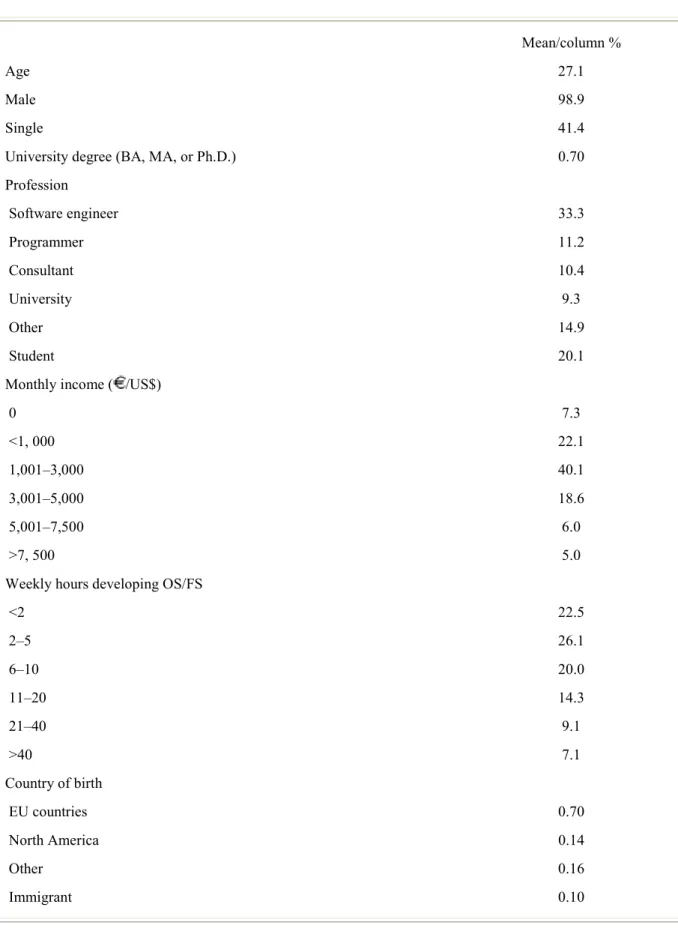
Tables 1 and 2 present a selected set of descriptive statisticsfrom FLOSS-EU calculated by Gosh et al. (2002). Table 1 indicatesthat the respondents are generally young, male, single, andhighly educated. The most common profession is software engineer,followed by
programmer, consultant, and university employee.A little more than 20 per cent of the sample consists of universitystudents.8
Approximately 70 per cent of the respondents earn less than3,000 /US$ a month, and 70 per cent work 10 hours or less aweek developing OS/FS. Since the survey was distributed viathe Internet, it reached developers in a number of differentcountries.
For example, 70 per cent were born in an EU country.Only 10 per cent of the respondents are working, at the timeof the survey, in a country other than the country in whichthey were born. More directly relevant to the determinants of open-source supply,FLOSS-EU contains a number of questions related to the motivationsof OS/FS developers. The top panel of Table 2 displays the percentageof respondents choosing a pre-selected set of reasons for becomingan OS/FS developer. Each respondent was allowed to choose morethan one reason in the list, so the percentages can add to morethan 100 per cent.
The table shows that 79 per cent of the respondents joined theOS/FS community because they were interested in learning anddeveloping new skills. The next most frequent reason,
accountingfor 49 per cent of respondents, was a desire to share alreadyexisting knowledge and skills. The desire to improve job opportunities,to get a reputation in the OS/FS community, and to make moneyare relatively less important, but are not negligible.
The bottom panel of Table 2 displays the distribution of responsesto a question on whether the developers receive monetary andnon-monetary rewards for development of OS/FS.
Respondents wereallowed to choose more than one answer. The response frequenciesreveal that more than half of the developers earn money fromtheir OS/FS activities. Among those that earn money, a non-negligiblenumber are directly paid for administering or developing OS/FS.A relatively high proportion claims to have secured their jobas a result of their OS/FS experience. Table 2 illustrates thatmonetary benefits to OS/FS participation are common. The form of the questions and responses in Table 2 make it difficultto use these data fruitfully for generalizing about key motivations.Many developers have a desire to share existing skills, wishto learn new skills (e.g. students), and earn money either directlyor indirectly from their open-source activities. However, itis not obvious how one could map these responses into metricsthat would enable a researcher to disentangle the relative importanceof non-pecuniary benefits, future monetary rewards, and open-sourcelicence type. A similar interpretational problem arises withthe responses to other developer surveys that have recentlybeen conducted (see, for example, Boston Consulting Group, 2003;Haruvy et al., 2003; Lakhani and von Hippel, 2003; Lakhani andWolf, 2005).
It is important to note that current developer surveys haveadditional drawbacks because they only reach software developersthat participate in open-source projects. A control group of software developers that does not participate in open-sourceprojects is completely absent. Another major problem is thatcurrent surveys are only cross-sectional, limiting the abilityof researchers to control for unobservable characteristics thatare fixed over time, such as developer ability. A survey thatreached a more diverse set of software developers, that was longitudinal in structure, and that was designed with the basiceconomic theory of voluntary contributions in mind, would greatlyhelp in empirically identifying the relative importance of thethree key factors in the open-source supply decision.
(ii). Econometric studies
One of the most notable econometric studies to date that isrelated to the supply of open-source software is Hann et al.(2004). The authors in this paper construct an original longitudinal dataset of 147 contributors to three different Apache projects.The study aims to measure the increase in developer wages owingto the extent of contributions made to Apache projects, as wellas the increase in wages due to achieving a higher rank withinthe Apache Software Foundation (ASF). If higher wages (skillprices) in the developer's regular employment are correlatedwith a higher volume of open-source contributions, then thisis interpreted as a human-capital or learning effect. A highervolume of contributions proxies more open-source programmingexperience and greater knowledge. Any increase in skill pricesderiving from a higher rank in ASF is interpreted by the authorsas a signalling or sorting effect. ASF rank may be an effectivemeans of conveying information about innate productivity levelsthat would otherwise be only imperfectly assessed in the market.9
With standard panel-data wage regressions that control for unobservedindividual fixed effects—such as developer ability—theauthors find that there is little return to the volume of contributions,but achieving a higher rank in ASF significantly increases wagesby 13–27 per cent, depending on the rank. The conclusionis that the signalling/sorting effect is much stronger thanthe human-capital/learning effect in open-source Apache projects.
Although Hann et al. (2004), exploit an original, longitudinaldata set with detailed information on open-source contributions,there are several limitations that cast doubt on the reliabilityof their results. As mentioned earlier in the context of existingdeveloper surveys, the sample only includes open-source developers.Individuals who choose not to participate in open-source projectsconvey information about the experience and signalling valueof open-source
participation, yet they are not accounted forin estimation. For example, the return to ASF rank may be upwardlybiased if those who do not participate in Apache projects knowthat they would not experience wage increases with higher ASFranks. Non-participants may not need to signal their productivityto the market for developers. Note that non-participants maybe open-source developers that choose to contribute to open-open-sourceprojects other than Apache, as well as developers that do notcontribute to any open-source projects.
An additional problem that may bias the results is that ASFrank may reflect additional dimensions of open-source experiencebeyond the number of lines of contributed code. Therefore, thecoefficient on rank may be partially absorbing the returns toopen-source experience. It should not be strictly interpretedas a return to signalling/sorting.10 Note that if open-sourceexperience, measured as lines of code contributed, does notaccurately measure true experience, then there may also be abias in the coefficient on experience owing to measurement error.That is, attenuation bias is another possible reason why lowestimated returns to open-source experience were obtained.
On the role of open-source licence type in open-source developmentactivity, Lerner and Tirole (2005a) examine the determinantsof licence choice using the SourceForge database which containsinformation on approximately 40,000 open-source projects. Lernerand Tirole (2005a) use the SourceForge database to run probitregressions in which the dummy dependent variable denotes eitherall licences in the project as highly restrictive (GPL), orin separate
specifications, some licences in the project ashighly restrictive. The independent variables capture projectcharacteristics and are grouped under the headings ‘developmentstage’ (e.g. pre-alpha, alpha), ‘environment’(e.g. X11, Windows), ‘intended audience’ (e.g. end-users, developers), ‘natural language’ (e.g. French, Spanish),‘operating system’ (e.g. POSIX, Microsoft), and‘topic’ (e.g. communications, security).
The probit results indicate that restrictive licences are moreprevalent among projects that are targeted to end-users (e.g.desktop tools and games) as opposed to other developers or system administrators. This is consistent with the hypothesis mentionedearlier, in the basic theory of voluntary contributions, thatrestrictive licences can substitute for otherwise low non-pecuniary benefits. Applications of this type may not have a strong ego-gratificationcomponent, so that placing the project under a restrictive licencemay be the only way substantially to increase utility and induceparticipation. Also consistent with the basic theory of voluntarycontributions is the finding that restrictive licences are significantlyless prevalent among projects geared towards other softwaredevelopers, or projects designed for operating in commercial
environments. These latter projects likely have a higher ego-gratificationcomponent and/or signalling value, and less of a need for arestrictive licence.
Although the Lerner and Tirole (2005a) study yields interestinginsights into the determinants of a project licence, it is limitedin that it remains at the level of establishing statistical
correlations. Data limitations prevent accounting for unobservedproject characteristics that could confound the relationshipbetween observed project characteristics and licence choice. This makes it doubtful that they have identified any causaleffects. The study also does not address the more interestingquestion of how licence choice affects open-source participationat the individual contributor level.
This latter question of how licence type affects open-sourcesupply decisions is directly addressed in a paper by Fershtmanand Gandal (2007). Also using the SourceForge database, theauthors construct a panel of 71 open-source projects observednine times over an 18-month period (once every 2 months). Theyrun linear regressions of output per contributor (measured aslines of code submitted) on licence type, controlling for otherproject characteristics and unobserved random project effects.The results show that protecting code under more restrictivelicences induces more output per contributor. The authors concludethat the significant effect of licence type is consistent withan ideological and/or status/signalling motivation to open-sourceparticipation, as hypothesized in the basic theory of voluntary contributions (see also Bonaccorsi and Rossi (2002)).
IV. The model
The review of the empirical literature in the previous sectionhighlights how prior econometric work has focused on the influenceof monetary rewards and type of open-source licence in isolation.In addition, there are no econometric studies that attempt toidentify the role of non-pecuniary benefits. In this section,we propose an econometric framework that can be used to identifythe relative importance of non-pecuniary benefits, monetaryrewards, and open-source licence type in a single model of forward-lookingoptimal decision-making.
Consider a software developer that chooses among three employmentstates and three open-source project participation states atthe start of each period t. Assume the decision problem beginsat t = (age 18) and the terminal period, t = T,is the year before retirement (age 64). The length of each timeperiod is a year. The three states in the employment choiceset, denoted as K, are unemployment (k = 0), post-secondaryschooling (k = 1), and full-time employment as a softwaredeveloper (k = 2). The employment choice variable, , is defined such that
if developer i choosesemployment state k at time t and otherwise. The three open-source project participation states, denotedas L, are specified as no open-source project participation(l = 0), participation in a project licensed underBSD or other licences less restrictive than GPL (l = 1),and participation in a project in which all licences are GPL(l = 2).11 The project participation choice variable, , is defined such that if developer i choosesopen-source participation state l at time t and otherwise. Because the developer chooses bothan employment state k and a project participation state l ineach time period t, the dimension of the choice set in eachperiod is K*L. However, the choice set is constrained by thereceipt of job offers and open-source project offers to be specifiedbelow. The objective of the software developer is to choose an employmentand project participation state in each time t to maximize theexpected present discounted value of remaining lifetime utility.Remaining lifetime utility at time t for developer i is
(1) where Vit is the value function, Uit (·)is the utility flow, is the subjective discount factor, and
Sit is the state space. Sit consists of all the factors knownto the individual at time t affecting
In the terminal period T, there is no futurecomponent to the value function and the individual maximizescurrent utility flow UiT.
For simplicity, UiT in (2) is assumed to be a linear functionof consumption and open-source
participation status, i.e.
where Cit is current period consumption, 1 is the non-pecuniary return to participating in an
open-sourceproject not licensed solely under GPL, and 2 is the non-pecuniarybenefit of
participating in an open-source project that is licensedonly under GPL. 1 and 2 capture
utility increases deriving fromego-gratification and ideological satisfaction that interactwith licence type. i1t and i2t in (3) are stochastic error termsthat capture heterogeneity in the appeal
of open-source projectswithin each licensing category.
Participation in open-source projects is assumed to be constrainedby the arrival of open-source project ‘offers’.In each period t, it is assumed that there is a non-zero probability,denoted by
, that a developerreceives an offer to participate in a project not licensed solelyunder GPL. With probability , a developer receives an offer to participate in a projectthat is licensed solely under GPL, and with probability 1 – – , the developer receives no offer and cannot choose to participate in an open-source project for that period.The open-source project arrival rates reflect prior licensingdecisions by project initiators and are taken as given by the
individual developer. The arrival rates could be further specifiedas functions of individual characteristics and current employmentstate in order to capture differential search intensity for projects on the part of developers. It is assumed that onlyone open-source project offer, at most, arrives in each periodt.
Consumption in each period t is determined by a budget constraintthat is assumed to be satisfied in each period and which takesthe following form,
(4) where:b0 is the current period return to being in the unemploymentstate and is meant to
capture unemployment insurance, welfarebenefits, liquidation of previous assets, and the net consumptionvalue of leisure; b1 is the deterministic component of the currentperiod return to
being a post-secondary school student; b1 reflectsin-school labour-market earnings and the net
consumption valueof schooling less tuition costs and other related expenses; i1t is the
stochastic component of schooling's current periodreturn which captures variability in in-school labour-marketearnings and other shocks to preferences for schooling; andwit is the
wage the individual receives as a full-time softwaredeveloper and is also allowed to be stochastic.12 The parameterc is the consumption cost of open-source project participation which is restricted to be the same regardless of open-sourcelicence type. The cost of project participation includes lostleisure time as well as the costs of submission/distributionof open-source code.
The wage wit in (4) is further specified to be a function ofeducation, experience, age, and an
unobserved individual effect.That is, wit = wit (xi1t, xi2t, osit, t, i, i2t) wherexi1t is accumulated
years of post-secondary education, xi2tis accumulated general experience as a software
developer, andosit is accumulated specific experience as an open-source softwaredeveloper.
The influence of age is captured by t, i is an unobservedindividual fixed effect, and i2t is a
productivity shock assumedto be i.i.d. and serially uncorrelated. The wage function canalso be augmented with observed individual characteristics,such as race and gender. However, it is generally difficultto estimate dynamic programming models of labour-force dynamicswith i2t
allowed to be serially correlated.
(5) withinitial conditions xi1 = xi2 = osi = 0.Accumulated open-source experience is augmented
by 1 year regardlessof open-source project licence type. However, if empiricallyimportant, it would be easy to allow for two different accumulatedopen-source experience variables. In order to minimize the number of distributional assumptionsin the model, the unobserved individual effect, i, is specifiedto be stochastic with a nonparametric mass point distribution.
That is, i is assumed to be a linear function of two unobserved‘type’ dummies,
(6) where A1i is a dummy variable for unobserved type 1 andA2i is a dummy variable for
unobserved type 2.A0i is a dummyfor unobserved ‘type’ 0. As the base type, A0i isexcluded
from (5). In this set-up, three type probabilities,which define the discrete non-parametric distribution of i,are estimated along with the two non-zero location points of i, denoted by 1
and 2.
Assuming a standard Mincerian wage function, wit can be writtenas,
(7) An additionalconstraint imposed on the maximization problem is that a developermust receive a job offer prior to receiving a wage offer determinedby (7). That is, with probability the developer receives a wage offer of wit, and with probability there is no wage offer
forthcoming in period t. In order to incorporate the possibilitythat open-source experience could have a signalling pay-offas well as a direct productivity return (as in Hann et al.,2004),
could be specifiedas a function of accumulated open-source experience at timet, as well as individual characteristics and previous employmentstate.
It is important to note that the model in equations (1)–(7)explicitly recognizes that education, employment, and open-sourceparticipation choices are jointly determined as well as forward-looking.Moreover, the model makes it clear which parameters are associatedwith current non-pecuniary benefits to open-source participation,and which parameters are associated with future monetary rewards.In addition, the influence of open-source licence type in thedecision to participate in an open-source project is made explicit.The relative importance of non-pecuniary benefits, future monetaryrewards, and open-source licence type can be empirically assessedin this model using the standard techniques of dynamic programmingsolution and structural estimation (see, for example, Keaneand Wolpin, 1994, 1997; Sauer, 1998).
V. Conclusion
A review of the basic theory of optimal open-source softwarecontributions points to three key factors affecting the decisionto contribute to the open-source development process. Thesethree factors are non-pecuniary benefits, future expected monetaryreturns, and open-source licence type. Unfortunately, the developersurveys that are available to researchers today are
inadequatefor studying the relative importance of these three key factors.Econometric studies that have collected original datasets arealso limited because they generally consider the role of monetaryrewards and licence type in isolation, and do not attempt tomeasure the influence of non-pecuniary benefits.
In order to fill the gap in the literature, this paper proposesa dynamic programming model of open-source participation decisionsthat could provide empirical estimates of the relative importanceof non-pecuniary benefits, monetary rewards, and licence typewithin a single model. The model allows for three employmentstates (non-employment, schooling, and employment as a softwaredeveloper) and three open-source participation states (no
participation,participation in a project not licensed under GPL, and participationin a project licensed under GPL). In the model, developers choosean employment state and a project participation state in eachperiod but are constrained by the arrival of employment andproject participation offers. As soon as suitable panel databecome available, the model could be estimated using the standardtechniques employed in the literature on the solution and estimationof dynamic programming models.
In sum, economists' understanding of the motivations and supplydecisions of open-source developers is still at an early stage.Higher-quality data and more comprehensive empirical modelsof the type proposed in this paper are needed to advance ourknowledge. A better understanding of the determinants of open-sourcesoftware supply is becoming increasingly important as businessesand governments rely more heavily on this ‘non-traditional’software to meet their computing needs. A firmer grasp of therelative importance of non-pecuniary
benefits, expected futuremonetary rewards, and open-source licence type would help predict future changes in open-source software supply, as well as helpeconomists evaluate more
Footnotes
I am grateful to Julian Morris, Eric Raymond, Corinne Sauer,and Margaret Stevens for providing insightful comments on previousdrafts.
1 Governments may also prefer open-source software solutionsfor ‘non-pecuniary’ reasons.
For example, open-sourcesoftware can in some cases be more easily adapted to meet linguistic and cultural preferences.
2 The following example is adapted from Raymond (1999c).
3 There are also developers that receive wages from commercialfirms for working on
open-source projects. The reasons why commercialfirms might want to pay developers to work on open-source projectsare mentioned below.
4 Raymond argues that approximately 95 per cent of all softwaredevelopment activities are for
intermediate goods in the productionprocess, such as accounting packages.
5 Raymond is essentially applying ideas developed in Hayek (1945)to the case of open-source
software production. That is, open-sourcedevelopers have different ‘local’ knowledge thatcan be effectively tapped to the firm's benefit through thecoordinating institution of open-source collaboration.
6 The BSD licence is more conducive to commercialization ofthe resulting code.
7 Firms operating in a low-transactions-costs environment maybe able to mitigate free-rider
costs of opening up the codeby forming a consortium (see, for example, West and Gallagher, 2004).
8 Nearly identical percentages of students are found in thedeveloper surveys analysed by
Hertel et al. (2003) and Lakhaniand Wolf (2005).
9 There are five ranks (levels of recognition) in ASF. Theyare: developer, committer, project
management committee member,ASF member, and ASF board member. Promotion to a higher rankis awarded upon positive peer review.
10 Indeed, median lines of code within ASF rank, which is usedas an instrument for rank in
2SLS versions of the regressions,is strongly correlated with ASF rank in first-stage regressions.Putting the likely endogeneity of the instrument aside, thefirst-stage results suggest that rank is another proxy for open-sourceexperience.
only two error terms. Therefore,it is not strictly necessary to specify the returns to unemploymentto be stochastic.
References
Berlecon Research. Firms' Open Source Activities: Motivations and Policy Implications (2002) FLOSS Final Report, International Institute of Infonomics, University of Maastricht.
Bonaccorsi A., Rossi C. Why Open Source Software can Succeed. Research Policy (2002) 32(7):1243–58.
Boston Consulting Group. Boston Consulting Group/OSDN Hacker Survey (2003) Boston, MA: Boston Consulting Group.
Fershtman C., Gandal N. Open Source Software: Motivation and Restrictive Licensing. International Economics and Economic Policy (2007) 4(2):209–25.[CrossRef]
Ghosh R., Glott R., Kriger B., Robles G. Free/Libre and Open Source Software: Survey and Study. (2002) University of Maastricht Institute of Infonomics and Berlecon
Research, mimeo.
Hann I., Roberts J., Slaughter S., Fielding R. An Empirical Analysis of the Economic Returns to Open Source Participation. (2004) Carnegie-Mellon University, unpublished working paper.
Harhoff D., Henkel J., von Hippel E. Profiting from Voluntary Information Spillovers: How Users Benefit by Freely Revealing Their Innovations. Research Policy (2003) 32:1753.
Haruvy E., Wu F., Chakravarty S. Incentives for Developers' Contributions and Product Performance Metrics in Open Source Development: An Empirical Investigation. (2003) University of Texas at Dallas, unpublished working paper. Hayek F. A. The Use of Knowledge in Society. American Economic Review (1945) 35(4):519–30.
Henkel J. The Jukebox Mode of Innovation—A Model of Commercial Open Source Development. (2005) Technische Universität Munich, mimeo.
Johnson J. P. Open Source Software: Private Provision of a Public Good. Journal of Economics and Management Strategy (2002) Winter. 11(4):637–62.
Keane M. P., Wolpin K. I. The Solution and Estimation of Discrete Choice Dynamic Programming Models by Simulation and Interpolation: Monte Carlo Evidence. Review of Economics and Statistics (1994) 76:648–72.
Keane M. P., Wolpin K. I. The Career Decisions of Young Men. Journal of Political Economy (1997) 105:473–522.
Lakhani K., von Hippel E. How Open Source Software Works: "Free" User-to-User Assistance. Research Policy (2003) 32:923–43.
Lakhani K., Wolf R. Why Hackers Do What They Do: Understanding Motivation and Effort in Free/Open Source Software Projects. In: Perspectives in Free and Open Source Software—Feller J., Fitzgerald B., Hissam S., Lakhani K., eds. (2005) Cambridge, MA, and London: MIT Press.
Lerner J., Tirole J. Some Simple Economics of Open Source. Journal of Industrial Economics (2002) 50(2):197–234
Lerner J., Tirole J. The Scope of Open Source Licensing. Journal of Law, Economics, and Organization (2005a) 21(1):20–56.
Lerner J., Tirole J. The Economics of Technology Sharing: Open Source and Beyond. Journal of Economic Perspectives (2005b) 19(2).
MacCormack A. Evaluating Total Cost of Ownership for Software Platforms:
Comparing Apples, Oranges and Cucumbers. (2003) AEI-Brookings Joint Center for Regulatory Studies, mimeo.
Maurer S. M., Scotchmer S. Open Source Software: The New Intellectual Property Paradigm. (2005) NBER Working Paper 12148.
Raymond E. The Cathedral and the Bazaar. In: The Cathedral and the Bazaar: Musings on Linux and Open Source by an Accidental Revolutionary (1999a) Cambridge, MA: O'Reilly. 19–64.
Raymond E. Homesteading the Noosphere. In: The Cathedral and the Bazaar: Musings on Linux and Open Source by an Accidental Revolutionary (1999b) Cambridge, MA: O'Reilly. 65–112.
Raymond E. The Magic Cauldron. In: The Cathedral and the Bazaar: Musings on Linux and Open Source by an Accidental Revolutionary (1999c) Cambridge, MA: O'Reilly.
Sauer R. M. Job Mobility and the Market for Lawyers. Journal of Political Economy (1998) 106:147–71.
von Hippel E. Open Source Projects as Horizontal Innovation Networks—By and For Users. (2002) MIT Sloan School of Management Working Paper No. 4366-02.
West J., Gallagher S. Key Challenges of Open Innovation: Lessons from Open Source Software. (2004) San Jose State College of Business, mimeo.
Wheeler D. Why Open Source Software/Free Software (OSS/FS)? Look at the Numbers! (2004) accessed 12 December 2004. available at
Table 1 Descriptive statistics, FLOSS–EU (N = 2,718)
Mean/column %
Age 27.1
Male 98.9
Single 41.4
University degree (BA, MA, or Ph.D.) 0.70
Profession Software engineer 33.3 Programmer 11.2 Consultant 10.4 University 9.3 Other 14.9 Student 20.1
Monthly income ( /US$)
0 7.3 <1, 000 22.1 1,001–3,000 40.1 3,001–5,000 18.6 5,001–7,500 6.0 >7, 500 5.0
Weekly hours developing OS/FS
<2 22.5 2–5 26.1 6–10 20.0 11–20 14.3 21–40 9.1 >40 7.1 Country of birth EU countries 0.70 North America 0.14 Other 0.16 Immigrant 0.10
Percentage Reason joined OS/FS community?
Learn and develop new skills 78.9
Share knowledge and skills 49.8
Participate in a new form of cooperation 34.5
Improve OS/FS products of other developers 33.7
Participate in OS/FS scene 30.6
Software should be free 30.1
Solve problem could not solve with proprietary software 29.7
Improve job opportunities 23.9
Get help in realizing idea for a software product 23.8
Limit power of large software companies 19.0
Get a reputation in OS/FS community 9.1
Distribute not marketable software product 8.9
Make money 4.4
Do not know 1.9
Receive monetary and non-monetary rewards from OS/FS?
No, do not earn money from OS/FS 46.3
Yes, directly; paid for administering OS/FS 18.4
Yes, indirectly; got job because of OS/FS experience 17.5
Yes, directly; paid for developing OS/FS 15.7
Yes, indirectly; but also develop OS/FS at work 12.8
Yes, directly; paid for supporting OS/FS 11.9
Yes, indirectly; other reasons 7.8
Yes, indirectly; job description does not include OS/FS work 5.2
Yes, directly; other reasons 4.4