Lessons from Volunteering and Free/Libre Open Source
Software Development for the Future of Work
1Kevin Crowston
Syracuse University School of Information Studies, [email protected]
Abstract. In this paper, we review research on voluntary organizations to identify key features of and problems in volunteer work and organizations. We then use the example of free/libre open source software (FLOSS) development teams to examine how those features and problems apply in this situation and how they might be affected by the use of information and communications technologies (ICT). We suggest that understanding volunteer organizations can illuminate the changing nature of all knowledge work, paid as well as unpaid.
Keywords: Free/libre open source software, volunteering, motivation, coordination, visibility of work
1 Introduction
In this paper, we discuss the features of volunteer work and organizations to gain insight into the future of work, in particular, information and communications technology (ICT) supported work. Our analysis focuses initially on organizations that seek to incorporate volunteer contributors. This approach is increasingly com-mon as many organizations seek to profit from Athe wisdom of crowds@ (Suroweicki 2002) or from user-led innovation (von Hippel and von Krogh 2003), forms of work that depend on unpaid voluntary contributions as well as ICT-enabled online com-munity spaces and shared information resources to channel the efforts of geographi-cally dispersed volunteer contributors. Wikipedia is the most dramatic, although not unique, example of this mode of work. This online encyclopedia has expanded rapidly (over 15 million articles in more than 270 languages), incorporating billions of contributions from voluntary contributors (more than six million account holders and 91,000 active contributors) who develop and edit content for the site. There are many similar but smaller-scale collaborations, ranging from blogs and discussion groups on
a wide variety of topics, evaluations of products or posts on sites like Amazon or Slashdot, and free/libre open source software (FLOSS) projects that bring together teams of programmers and users who contribute software and documentation.
Such efforts have been surprisingly successfulCsurprising in light of known difficulties of working across distance and with potentially unreliable collaborators. FLOSS, for example, has become a significant industry force, with leading market share in numerous categories. The apparent success of technology-enabled and volunteer-based organizations has sparked much interest among both researchers and practitioners, again leading to speculation on the future of work. Indeed, predictions have even been made that such forms of voluntary organizations will replace conventional organizations in some fields (e.g., bloggers replacing journalists or FLOSS replacing proprietary developers). While these predictions seem overblown, they reflect the perceived potential of this mode of work.
In this paper, we specifically use the lens of volunteering to examine the organi-zation of FLOSS development. We address the following research questions: 1. Which features of FLOSS development practices and structures result from
reliance on volunteer workers?
2. How does extensive use of ICT work-support affect the impact of the reliance on volunteer workers?
This analysis shows that certain features of FLOSS (such as a coreBperiphery group structure) are a consequence of the reliance on volunteer contributors. This analysis also indicates points where the use of ICT can mitigate observed problems with volunteer work and organizations (such as reduced real-time coordination and lack of knowledge of other workers).
But the implications of this analysis are potentially much broader: under-standing volunteer organizations illuminates the changing nature of all knowledge work, paid as well as unpaid (a point made by Pearce 1993). Indeed, in an interview, Peter Drucker stated, Aincreasingly employees are going to be volunteers, because a knowledge worker has mobility and can go pretty much every place, and knows it.... Businesses will have to learn to treat knowledge workers as volunteers@ (Collins and Drucker 1999). In other words, simply offering money and then telling people what to do might not be enough to attract the best and brightest, nor hold onto them or ensure that they do their best work. But to Atreat knowledge workers as volunteers@ requires a better understanding of the nature of such work.
The rest of the paper is structured as follows. We start by examining the litera-ture on volunteer organizations to describe a range of issues that arise in managing volunteers. We then examine what is known about these issues from research on an extreme example of technology-supported volunteer organizations, namely free/libre open source software (FLOSS) development teams. Finally, we discuss how the
lessons of volunteer organizations and FLOSS teams can be applied to ICT-supported work in employee-based organizations of the future and raise a series of questions for future research.
Before we start, we clarify a point of terminology. Butler (2004) suggested analyzing online communities as volunteer associations. However, in this paper, we draw on research on volunteer organizations, specifically, on purposive and utilitarian organizations. While volunteer associations and organizations have many similarities, they differ in that associations primarily serve their members while organizations create a valued good or service to serve those beyond the organization. Consider as an example the difference between a bridge club (an association that serves its members) and a volunteer fire department (an organization that serves a community) (Pierce 1993). The presence of an external customer to be served makes the volunteer contributions a kind of work.
2 Volunteer Organizations: A Review
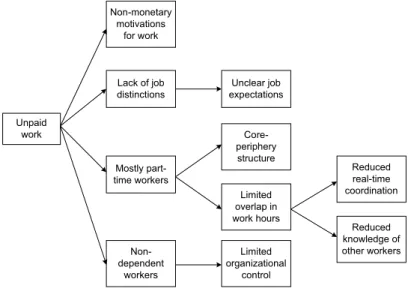
In this section, we discuss findings from research on volunteer work and organi-zations. The key feature that distinguishes volunteer work from conventional work is that volunteers are unpaid. Motivation for volunteers has been a major concern of those researching volunteer organizations, understandably, as organizations are eager to identify factors that attract volunteers. But researchers have identified a number of other issues for which the work of volunteers differs from that of traditional employees. We will discuss in turn clarity of job definitions, coreBperiphery organi-zational structure, organiorgani-zational understaffing, reduced opportunities for coordina-tion and knowledge of coworkers, and organizacoordina-tional control of volunteer workers. These issues are shown graphically in Figure 1.
Nonmonetary motivation for work. We start by considering motivations for work. Because volunteers receive no monetary compensation for their work, they must be assumed to have other motives for their contributions. The nature of volunteer motivations is an important question for organizations hoping to attract volunteer contributions and, as a result, the question has been a major focus of the volunteer research literature and research has identified a wide range of possibilities. Clary et al. (1988) suggested a combination of selfish and unselfish motives as the basis of sustained voluntarism. With respect to selfish motivations, they suggested that individuals volunteer as a method of self-education, as a social activity, or to assuage feelings of guilt concerning entitlement or privilege. Individuals also want to feel appreciated and needed; indeed, Pearce (1993) notes that leaders of volunteer organizations often stress the importance of volunteers= contributions, in part to contradict the impression that their work is valueless since it is unpaid. Volunteers may agree with the organization=s goals or want the organization=s outputs (Pierce 1993) and so be motivated to contribute. Individuals also volunteer on an unselfish
basis, springing from what Clary et al. identify as a combination of altruistic and humanitarian values. Finally, Clary et al. suggested that group-related motivations emerge when people volunteer to identify with or to maintain their status as a member of a valued group.
Figure 1. Effects of Volunteer Work
Unclear job expectations. A second implication of zero pay for true volunteers is that the lack of distinction in pay (all are equal) often leads to a lack of formal job distinctions among volunteers and unclear job definitions in general (Pierce 1993). As a result, new members are often left to work out for themselves how best to contribute, but unfortunately often have trouble determining exactly what they should be doing. Other volunteers may be too busy working to be able to assist with this process. Furthermore, volunteers may have an ambiguous relationship with the organization, since many volunteer organizations are governed by their members, meaning that volunteers are simultaneously workers and directors. This role ambi-guity again makes it difficult for a volunteer or those working with volunteers to assess what work performance is expected.
Organizational understaffing. A further implication of low or zero pay is that most volunteer organizations have trouble attracting sufficient numbers of workers and so are generally understaffed (Pierce 1993). Research on volunteer organizations suggests that understaffing in turn leads to lower requirements for job performance. Since every contribution is needed, the organization cannot afford to be overly selective or demanding: low levels of performance are better than none and so are tolerated. Understaffing also leads to a perceived need for constant recruitment to
Non-monetary motivations for work Lack of job distinctions Unclear job expectations Core-periphery structure Reduced real-time coordination Reduced knowledge of other workers Limited overlap in work hours Limited organizational control Non-dependent workers Mostly part-time workers Unpaid work
attract new volunteers, although the stream of new volunteers actually exacerbates the problem of lack of orientation for new members. Finally, the combination of understaffing and unclear job expectations can lead to overloading of active volunteers and burnout. When an individual is found who is willing to work, there is a temptation to ask that person to do more and more; without clear job definitions, it is not obvious what the limit should be.
CoreBperiphery structures. A third implication of work being unpaid is that most volunteers only work for the organization part time. Reliance on part-time employees has several implications for the structure of volunteer organizations and the conduct of work (Pierce 1993). First, the fact that most members are only contributing part time has been found to lead to a coreBperiphery organizational structure. A few members, perhaps those with higher commitment to the group or more free time, work more. As a result, these core members have a greater oppor-tunity to learn about the organization and each other, and thus build up a higher level of skills and knowledge, both about the tasks performed and the state of the organization. On the other hand, the majority of volunteers are peripheral, con-tributing at a low level and with a lower level of knowledge of the task and organization. These members have contact with core members, but likely not with each other. The organization likely has porous boundaries and fluid membership for such volunteers. New volunteers join with little fanfare. Dropping out is also unmarked: if a volunteer has not been seen in a while, is this because they have left the organization, or are they just busy at the present time and will contribute again later? On the one hand, this fluidity can be an advantage, as the organization can tailor the available workforce to the immediate need. On the other hand, at an organizational level, there may be uncertainty as to volunteers= skills, interests, capabilities, or even their exact number.
Reduced real-time coordination and knowledge of coworkers. Reliance on part-time workers has a second implication, namely, a lack of overlap in work hours among volunteers. Peripheral members in particular are likely to have only limited contact with other peripheral members. A lack of opportunities for regular contact between volunteers reduces the ability to coordinate work directly. As well, the lack of contact makes it difficult for workers to know what to expect from coworkers or for what contributions they can rely on them. As a result, many volunteer organizations find the need for formal coordinator roles (Pierce 1993). Such limited contact also reduces the likelihood of building social relations that motivate further contributions to the organization.
Limited organizational control of volunteers. A final issue is the question of control (or lack of control) over volunteer workers and its inverse, the reliability of their work. Research on volunteer organizations suggests that because volunteers are unpaid and do not depend on the organization for their living, the organization has reduced ability to control their behaviors. Rather than giving orders and expecting them to be carried out in return for pay, in volunteer organizations, authority is more often indirect. Furthermore, as noted above, volunteers may play mixed roles in the organization (workers and directors), again reducing a manager=s formal authority.
One strategy is for managers to appeal to shared goals and values. Such a strategy is powerful but limited: appeals have to be credible to carry weightCthe link from the goals to the actions must make sense to the volunteer. A further limitation is that goals do not specify means (Pearce 1993, p. 119). As a result, reliance on this mode of motivation can lead to organizational schisms, as different subgroups advocate different means to achieve the common goals. Alternately, leadership may be personal. Leaders can derive authority from knowledge and experience, rather than from normative power of a position or title. Being a recognized core member of the group can carry more weight than any title. Leading by example provides authority and helps set job expectations. Finally, volunteer organizations can motivate contributions through personal relationships and feeling of solidarity. As Pearce (p. 162) puts it, Avolunteers worked for one another@ and felt a commitment to the organization=s leaders and to fellow volunteers.
Summary. In summary, the literature on volunteer organizations identifies a set of issues stemming from reliance on unpaid workers, specifically the need to identify other sources of motivation for contribution, possible lack of job distinctions leading to unclear job expectations, a coreBperiphery structure with reduced opportunities for real-time coordination and reduced knowledge of other workers, and reduced organi-zational control of volunteers. These issues in turn require a different approach to managing volunteer workers, including personal contributions and development of personal relations.
3
Volunteering and Free/Libre Open Source Software Teams
In this section, we examine how the features of volunteer work and organizations described above apply to free/libre open source software (FLOSS) development teams. FLOSS is a broad term used to embrace software developed and released under a license allowing inspection, modification, and redistribution of the software=s source code. While there are important differences between free software and open source software, their software development practices are similar, hence our use of an umbrella term in this paper. The goal of this analysis is first to identify features of FLOSS work and organization that can be explained by the reliance on volunteer work and second to identify issues with volunteer work that are affected by use of ICT to support the work.
We focus in particular on what have been called Acommunity-based@ rather than company-sponsored projects (e.g., Apache rather than MySQL). These projects are developed by dynamic self-organizing teams comprising software professionals and users (von Hippel and von Krogh 2003). Although often informally organized, FLOSS project teams are teams. The core members of these projects have a shared goal of developing a product, a user base to satisfy, and a shared social identity. Team members are interdependent in their tasks and core members know and acknowledge each other=s contributions. Furthermore, as in volunteer organizations,
FLOSS developers are not paid by their projects. Some may be paid by other organizations to contribute to projects (e.g., IBM pays a number of its employees to work on Linux or Apache projects), but others contribute without any direct compen-sation. As a result, findings from prior research on volunteer work and organizations should be directly relevant to FLOSS project teams, and consideration of the issues discussed above should, therefore, help explain them.
In addition, FLOSS has attracted great interest among information systems researchers because it provides an accessible example of virtual work. FLOSS teams are virtual, as developers contribute from around the world, meet face-to-face infrequently, if at all, and coordinate their activity primarily by means of ICT (Raymond 1998; Wayner 2000). Discontinuities among team members make any kind of consistent process seemingly harder to attain, yet effective teams seem to have developed productive ways of working together, making their work practices of interest to those interested in virtual work. Thus, examination of this research setting will provide insight into how the known features of volunteer work are affected by the use of ICT to support that work.
In the remainder of this section, we consider in turn the factors of volunteer work identified above.
Nonmonetary motivation for work. One of the most striking features of FLOSS development is that developers are largely volunteers. As a result, many researchers have examined developer motivations for participation. Their studies have found heterogeneous individual motivations that are largely consistent with the research on volunteer organizations. Researchers have described three types of motives: extrinsic motivations, internalized extrinsic motivations, and intrinsic motivations. Reputation (Hann et al. 2004) and reward motives such as career development (Hann et al. 2002; Orman 2008) are the two most frequently mentioned extrinsic motivations. User needs (Lerner and Tirole 2002; Lu et al. 2006) are the most commonly mentioned internalized extrinsic motivations. Enjoyment-based motivations such as fun (Ghosh 1998) and sharing or learning opportunities (Shah 2006; Ye and Kishida 2003) are the two most commonly mentioned intrinsic motivations. Another frequently cited benefit of working on FLOSS projects is the freedom to work on a task entirely of one=s own choosing (Kuznetsov 2006). While employees are assigned work, volunteers choose it. Xu et al. (2009) further identified project community factors such leadership effectiveness, interpersonal relationships, and community ideology. Kavanagh (2004) noted that part of the motivation for some to contribute to FLOSS was identification with a narrative of resistance to proprietary software, an example of motivation from shared values.
Unclear job expectations. A lack of formal roles and the need to self-define contribution, as found in volunteer organizations, also seems to apply to FLOSS teams. A frequent comment in the literature is the difficulty of new members getting socialized into teams (Ducheneaut 2005). As might be seen in the volunteer organi-zations described above, Dahlander and Magnusson (2005) found that a common
reason for not contributing to a FLOSS project is that there did not seem to be a need. A further limitation of the FLOSS model is that the onus for socialization falls almost entirely on the would-be developer, rather than the team (von Krogh et al. 2003).
Organizational understaffing. Understaffing does seem to be an issue in FLOSS teams. A few projects attract a lot of attention, while the majority have only a small number of core developers. As a result, for most projects there is more work that could be done than developers to do it. Some FLOSS projects do engage in some amount of recruiting to attract new developers, especially those with the time to become core developers. However, most seem to rely on developers self-identifying and overcoming the barriers to joining.
CoreBperiphery structures. A coreBperiphery structure is seen quite commonly in FLOSS teams. Academic case studies of FLOSS projects (e.g., Gacek and Arief 2004; Mockus et al. 2000, 2002; Moon and Sproull 2000) suggested a model of FLOSS development with a hierarchical structure. The focus of these studies has largely been on the contribution of code. For example, Mockus et al. (2002) studied the Apache httpd project and found that development was quite centralized, with only about 15 developers contributing more than 80 percent of the code for new functionality. Bug reporting, on the other hand, was quite decentralized, with the top 15 reporters submitting only 5 percent of problem reports in the Apache project. They summarize this finding by hypothesizing that, AIn successful open source developments, a group larger by an order of magnitude than the core will repair defects, and a yet larger group (by another order of magnitude) will report problems@ (p. 329). Crowston and Howison (2006) examined interactions around bug reports and found a strong coreBperiphery structure, such as shown in Figure 2.
Figure 2. Interactions in Bug Reports for the Curl Project (from Crowston and
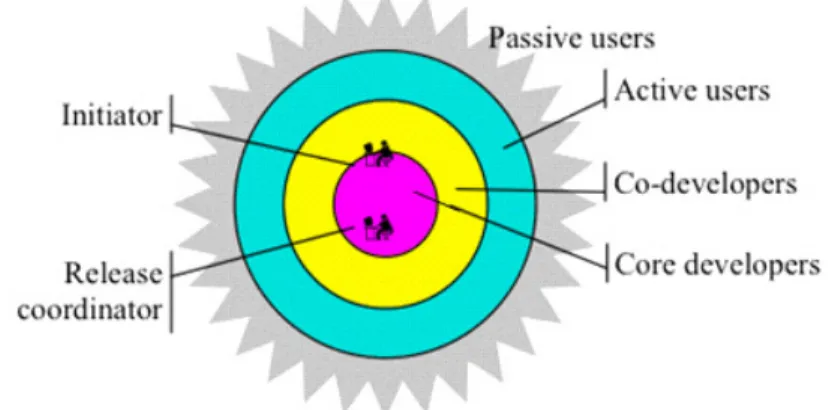
Overall, FLOSS teams exhibit an onion-like structure as shown in Figure 3. At the center of the onion are the core developers, who contribute most of the code and oversee the design and evolution of the project. In the next ring out are the codevelopers who submit patches (e.g., bug fixes), which are reviewed and checked in by core developers. Further out are the active users who do not contribute code but provide use cases and bug reports as well as testing new releases. Further out still, and with a virtually unknowable boundary, are the passive users of the software, those who use the software but who do not contribute to the project=s lists or forums. Even if the passive users do not contribute directly, they are still important, as the existence of a user base with needs for the software provides one motivation for further development.
Figure 3. CoreBPeriphery Structure in FLOSS Project Teams
Reduced real-time coordination and knowledge of other workers. FLOSS teams resemble other volunteer organizations in that members cannot rely on real-time coordinationCmembers contribute at their leisure and from many different time zones. However, few FLOSS teams seem to address this gap with appointed coordinators. Instead, many FLOSS teams eschew real-time communications and rely instead on asynchronous communication technology that can span discontinuities of time. This mode of interaction enables group members to stay in touch without seeing each other or having to work at the same time. In other words, the use of ICT provides a mech-anism for addressing this particular aspect of volunteer work. Another explanation for the low level of explicit coordination observed in FLOSS teams is increased reliance on modular job design that minimizes the need for coordination (e.g., by making source code highly modular). Work can be designed so that an individual can complete a task without needing extensive interaction with others. FLOSS teams have also been described as relying on self-assignment of work (Crowston and Scozzi 2008), again eliminating the need for task coordinators. Finally, an interesting possibility recently described in FLOSS teams is the use of stigmergic coordination (Bolici et al. 2009; Robles et al. 2005), that is, coordination performed through the
work itself. Developers in FLOSS teams can determine the current state of work by examining the shared code base; detailed discussion with other programmers may, therefore, be unnecessary for coordination.
In volunteer organizations, a lack of face-to-face contact means that volunteers often do not get to know coworkers other than core members. However, the fact that FLOSS work is mostly done online means that members can review the contributions of others and thus understand their background. Similarly, all members can follow discussions held on email, which can provide an avenue for joining and understanding the group. Furthermore, the coordination and work assignment practices noted above reduce the need for close coordination between members and so make development of mutual knowledge less critical. Again, this particular aspect of volunteer work is one that might be mitigated by the use of ICT.
Organizational control of volunteers. As with other volunteer organizations, FLOSS projects have few means of controlling volunteer contributors, making project leadership difficult. The nature of leadership in such teams has recently been ex-amined. Consistent with the research described above, the main duties of leaders in FLOSS projects have been described as providing a vision, attracting developers to the project, and keeping the project together and preventing forking (i.e., schisms) (Giuri et al. 2008; Lerner and Tirole 2002), rather than giving directions or assigning work.
Research has also addressed who can become a leader in FLOSS development teams. First, leaders are usually not appointed, and in most cases not formally identified, but rather emerge from participation in FLOSS development. Individuals are perceived by others as leaders based on their sustained and strong technical contributions (Scozzi et al. 2008) and diversified skills (Giuri et al. 2008). A novel feature of FLOSS teams is that they often exhibit shared leadership instead of having a single leader (Sadowski et al. 2008). According to Fielding (1999), shared leadership enables these teams to continue to survive independent of the participation of parti-cular individuals, and enables them to succeed in a globally distributed and volunteer organizational environment. However, Heckman et al. (2007) suggested that while virtual teams are characterized by shared leadership in the form of substantive task contributions, group maintenance, task coordination, and boundary spanning, leader-ship functions related to vision and norm setting are more likely to be centralized.
Summary. In summary, the research on FLOSS teams suggests that they embody many of the same features described in research on volunteer organizations (our first research question): reliance on nonmonetary motivations, unclear job expectations, organizational understaffing, and a coreBperiphery structure with reduced real-time coordination and reduced organizational control. FLOSS teams also have been characterized as exhibiting shared leadership on some aspects, such as task contri-bution and boundary spanning. However, the use of technology as the prime conduit for interactions among group members seems to enable new approaches for addressing two of these issues (our second research question): educed real-time coordination and lack of knowledge of other workers. In particular, FLOSS teams seem not to rely
on formal coordinator roles, but rather use the technology to enable asynchronous communications and to make work visible across the team.
4 Discussion
In this paper, we have examined research on volunteer organizations and on free/ libre open source software development teams to identify features of FLOSS work and organization that stem from a reliance on volunteer workers and how the use of ICT to support work changes this relationship. We conclude by drawing from this analysis to identify issues that might confront ICT-supported knowledge work in the future in general, and discussing managerial implications and opportunities for future research.
4.1 Managerial Implications
The analysis presented above offers several implications for managers of volunteer organizations in particular, but of all organizations to some degree.
Recognize additional motivations for work. First, managers should recognize motivations for work beyond financial. For example, as employees can be motivated in particular by their evaluation of the organization=s goals, managers should strive to make these values explicit. The research on FLOSS on the inherent interest of tasks suggests that there are benefits to allowing employees to self-select some of their work. For example, companies like 3M and Google reportedly allow some em-ployees to spend up to 20 percent of their time working on projects of their choice, both for the possible benefit of the projects as well as the increased motivation of the employee.
Expect coreBperiphery structures. Second, a common characteristic of volun-teer organizations is their reliance on part-time workers. Even though flexible job arrangements are becoming more common for employees, we would not expect to see all employees become part-time. However, some organizations now routinely assign workers to multiple teams simultaneously (Chudoba et al. 2005; Lu et al. 2006), a practice called multi-teaming. Employees assigned to multiple teams work full-time for the organization, but from the perspective of any particular team, they are essen-tially part-time. As a result, extensive use of multi-teaming can lead to a coreB periphery structure for each team, as each member picks a few teams to contribute to at a higher level, while participating only peripherally in the others. Pearce (1993) noted that increased use of contract workers can have a similar impact: the contractors are likely to have only minimal contact among themselves and so to be peripheral to the group.
In the face of developments like flexible work, contracting, and multi-teaming, managers should recognize that employees may make different levels of contribution
to projects. Organizations need to adjust their evaluation schemes to address the contributions of employees who are shared across multiple teams. Managers should recognize core members who contribute at a higher level and develop expertise with models of authority based on contribution. Perhaps more importantly, they should appreciate the importance of contributions from peripheral members, and ensure that their work is also recognized.
Clarify job expectations. Third, managers should clarify job expectations and provide examples of good work. This clarification is of particular importance for peripheral members and those who are true volunteers, as they often have little knowl-edge of the organization and so lack clarity about how they can contribute. For example, it may be useful to provide new volunteers specific tasks to perform, as with the lists of bugs published by many FLOSS projects. In general, allowing employees to self-select some or all tasks may lead to ambiguity about appropriate roles, making role setting important in these cases as well. Finally, managers should identify routes to becoming a core member for those who are interested, while recognizing that not all will be.
Enhance knowledge of other workers. Fourth, managers may want to pay close attention to the kinds of connections formed between team members. Findings from volunteer organizations suggest that a coreBperiphery structure, brought on by increased multi-teaming or use of contract employees, may lead to problems for team members and leaders in not knowing how much members can be counted on or even exactly who is in the team. For example, contractors may only know their contact and so be unable to directly coordinate their work with other team members; other team members may not be fully aware of the contractor=s role. These trends would be expected to lead to an increased need for formal coordinator roles to connect workers who do not have opportunities to interact for coordination or to develop mutual knowledge. The use of ICT may provide tools for distributed team members to get to know each other, but research suggests that forming strong ties over these media can be challenging.
To address this problem, particular attention should be paid to socialization of new members. For example, a welcoming ceremony can help new volunteers to identify their place in the organization and to feel more valued as members, and also provide an opportunity for current members to learn or establish what role the new members will play. Finally, managers should promote continuity of membership to enable development of social ties (Pearce 1993, pp. 124-126), which are the basis for better job performance as well as a source of motivation.
Make work visible. Fifth, the research on FLOSS teams suggests further oppor-tunities to use ICT to support virtual work. A recurrent theme is the value of making individual work visible to the entire team. Research on FLOSS teams suggests that it may be beneficial to use interaction media that enable all team members to see the status and contributions of others. Enabling team members to see each others= con-tributions provides new venues for coordinating work and for building mutual
knowledge of skills and interests. Furthermore, the use of asynchronous media and shared work products may enable effective coordination even in the absence of face-to-face interaction.
Develop alternative modes of leadership. Finally, organizations that seek to employ true volunteers might expect to face problems in control. However, organi-zations may face these problems more broadly, as the problem of getting more than minimal work from employees parallels the reluctance of volunteers to simply follow orders. For example, Howell and Dorfman (1986) noted that teams of highly trained individuals would resist and in fact might not need hierarchical direction, while Organ et al. (2006) described organizational citizenship behavior, acts beneficial to the organization but not directly a requirement of the job, as essentially voluntary.
A virtual team setting in particular seems likely to exacerbate difficulties for leadership. In the absence of face-to-face contact, appointed leaders may lack influ-ence over team members due to organizational or physical separation: Kerr and Jer-mier (1978) described distance as a leadership neutralizer, while Howell and Dorfman said that it makes leadership practices Anearly impossible to perform.@ These authors wrote before the extensive use of ICT for team interactions, but it is apparent that use of ICT does not completely ameliorate the problems of distance and separation. Hoegl et al. (2007) noted that leadership is less effective in dispersed groups. Team leaders often cannot directly observe member behavior or performance, which makes it difficult for them to manage task and social dynamics. Social interaction is reduced, making it difficult to moderate team process. Traditional forms of social control such as direct supervision, physical proximity, and shared experiences are largely absent in virtual team environments (Pinsonneault and Caya 2005). Oppor-tunities to receive feedback are reduced, as are opporOppor-tunities to assess perceived commitment to project or team goals (Kondradt and Hock 2007). These effects of distance make traditional methods of leadership less effective and suggest the need for reliance on modes similar to volunteer organizations: setting an example, providing a vision, attracting effort to the project, and keeping the project together, rather than giving directions or assigning work.
Summary. In summary then, work, in particular technology-supported work, appears increasingly to take on some of the characteristics of volunteer work. In part, these changes are due to attempts to include volunteers in the organization, but other developments suggest that the features will apply more broadly. In particular, employees may be motivated by more than pay, with implications for leadership, and organizations may have teams with a coreBperiphery structure, with implications for coordination.
4.2 Implications for Research
The work above also provides some implications for future research. A major methodological implication to consider is that teams may have unequal participation
from members, in contrast to the typical tacit assumption that all members contribute equally and full-time. The participant=s role and level of contribution should be assessed when sampling members, especially given that there are likely to be many more peripheral members than core members.
The work reviewed above suggests that the relevant model for studying online interaction may be volunteer management (Butler 2004). Example questions for future research include
1. What kind of motives are most effective in eliciting job performance from knowledge workers?
2. For what kinds of work does the motivational gain from allowing employees to choose their own tasks outweigh the possible reduction in effort on core tasks or increased coordination cost?
3. What kinds of tasks will volunteers be willing to take on in employee organizations?
4. What are the implications of multi-teaming for work performance? How should such work be evaluated?
5. What is the role of visible work in coordinating group work?
6. What is the nature of effective leadership in voluntary and ICT-supported organizations?
This shift in focus provides a good opportunity for further work, since there has been relatively little research about the nature of volunteer work beyond the focus on motivation. As a result, future research on technology-supported work, viewed as volunteering, may make basic contributions to our understanding of the future nature of work.
References
Bolici, F., Howison, J., and Crowston, K.: Coordination Without Discussion? Socio-Technical Congruence and Stigmergy in Free and Open Source Software Projects. In: 2nd
International Workshop on Socio-Technical Congruence, ICSE. Vancouver, Canada, May 19 (2009)
Butler, B. S.: When Is a Group Not a Group: An Empirical Examination of Metaphors for Online Social Structure. In: OCIS Division, Academy of Management. New Orleans, LA (2004)
Chudoba, K. M., Wynn, E., Lu, M., and Watson-Manheim, M. B.: How Virtual Are We? Measuring Virtuality in a Global Organization. Information Systems Journal, 15, 4, 279B306 (2005)
Clary, E. G., Snyder, M., Ridge, R. D., Copeland, J., Stukas, A. A., Haugen, J., and Miene, P.: Understanding and Assessing the Motivations of Volunteers: A Functional Approach. Journal of Personality and Social Psychology, 74, 1516B1530 (1998)
Collins, J., and Drucker, P.: A Conversation between Jim Collins and Peter Drucker. Drucker Foundation News, 7, 2, 4B5 (1999)
Cox, A.: Cathedrals, Bazaars and the Town Council, October 13, http://slashdot.org/ features/98/10/13/1423253.shtml (1998)
Crowston, K., and Howison, J.: Hierarchy and Centralization in Free and Open Source Soft-ware Team Communications. Knowledge, Technology & Policy, 18, 4, 65B85 (2006) Crowston, K., and Scozzi, B.: Bug Fixing Practices Within Free/Libre Open Source Software
Development Teams. Journal of Database Management, 19, 2, 1B30 (2008)
Dahlander, L., and Magnusson, M. G.: Relationships between Open Source Software Com-panies and Communities: Observations from Nordic Firms. Research Policy, 34, 4, 481B493 (2005)
Ducheneaut, N.: Socialization in an Open Source Software Community: A Socio-Technical Analysis. Computer Supported Cooperative Work, 14, 4, 323B368 (2005)
Fielding, R.T.: Shared Leadership in the Apache Project. Communications of the ACM, 42, 4, 42B43 (1999)
Gacek, C., and Arief, B.: The Many Meanings of Open Source. IEEE Software, 21, 1, 34B40 (2004)
Ghosh, R. A.: Interview with Linus Torvalds: What Motivates Free Software Developers? First Monday, 3, 3 (1998)
Giuri, P., Rullani, F., and Torrisi, S.: Explaining Leadership in Virtual Teams: The Case of Open Source Software. Information Economics and Policy, 20, 4, 305B315 (2008) Hann, I. H., Roberts, J., and Slaughter, S.: Why Developers Participate in Open Source
Soft-ware Projects: An Empirical Investigation. In: Proceedings of the 25th International
Conference on Information Systems, 821B830 (2004)
Hann, I. H., Roberts, J., Slaughter, S., and Fielding, R. T.: Economic Incentives for Parti-cipating in Open Source Software Projects. In: Proceedings of the 23rd International
Conference on Information Systems, 365B372 (2002)
Heckman, R., Crowston, K., and Misiolek, N.: A Structurational Perspective on Leadership in Virtual Teams. In: K. Crowston and Seiber (eds.), Proceedings of the IFIP Working Group 8.2/9.5 Working Conference on Virtuality and Virtualization. Springer, Portland, OR, 151B168 (2007)
Hoegl, M., Ernst, H., and Proserpio, L.: How Teamwork Matters More as Team Member Dispersion Increases. J. of Product Innovation Management, 24, 2, 156B165 (2007) Howell, J. P., and Dorfman, P. W.: Leadership and Substitutes for Leadership among
Profes-sional and NonprofesProfes-sional Workers. J. of Applied Behavioral Science, 22, 1, 29B46 (1986)
Kavanagh, J. F.: Resistance as Motivation for Innovation: Open Source Software. Com-munications of the AIS, 13, 615B628 (2004)
Kerr, S., and Jermier, J. M.: Substitutes for Leadership: Their Meaning and Measurement. Organizational Behavior and Human Performance, 22, 3, 375B403 (1978)
Konradt, U., and Hoch, J. E.: A Work Roles and Leadership Functions of Managers in Virtual Teams. Int=l. J. of E-Collaboration, 3, 2, 16B35 (2007)
Kuznetsov, S.: Motivations of Contributors to Wikipedia. ACM SIGCAS Computers and Society, 36, 2 (2006)
Lakhani, K. R., and von Hippel, E. A.: How Open Source Software Works: AFree@
User-to-User Assistance. Research Policy 32, 923B943 (2003)
Lerner, J., and Tirole, J.: Some Simple Economics of Open Source. J. of Industrial Economics, 2, 1, 197B234 (2002)
Lu, M., Watson-Manheim, M. B., Chudoba, K. M., and Wynn, E.: How Does Virtuality Affect Team Performance in a Global Organization? Understanding the Impact of Variety of Practices. J. of Global Information Technology Management, 9, 1, 4B23 (2006) Mockus, A., Fielding, R. T., and Herbsleb, J. D.: A Case Study of Open Source Software
Development: The Apache Server. In: Proceedings of the International Conference on Software Engineering (2000)
Mockus, A., Fielding, R. T., and Herbsleb, J. D.: Two Case Studies of Open Source Software Development: Apache and Mozilla. ACM Transactions on Software Engineering and Methodology, 11, 3, 309B346 (2002)
Moon, J. Y., and Sproull, L. S.: Essence of Distributed Work: The Case of Linux Kernel. First Monday, 5, 11 (2000)
Organ, D., Podsakoff, P., and MacKenzie, S.: Organizational Citizenship Behavior: Its Nature, Antecedents, and Consequences. Thousand Oaks, CA: SAGE Publications, (2006)
Orman, W. H.: Giving it Away for Free? The Nature of Job-Market Signaling by Open-Source Software Developers. Advances in Economic Analysis & Policy, 8, 1 (2008)
Pearce, J.: Volunteers: The Organizational Behavior of Unpaid Workers. London: Routledge (1993)
Pinsonneault, A., and Caya, O.: Virtual Teams: What We Know, What We Don=t Know. International J. of e-Collaboration, 1, 3, 1B16 (2005)
Raymond, E. S.: Homesteading the Noosphere. First Monday, 3, 10 (1998)
Robles, G., Merelo, J. J., and Gonzalez-Barahona, J. M.: Self-Organized Development in Libre Software: A Model Based on the Stigmergy Concept. In: 6th International
Workshop on Software Process Simulation and Modeling (2005)
Sadowski, B. M., Sadowski-Rasters, G., and Duysters, G.: Transition of Governance in a Mature Open Software Source Community: Evidence from the Debian Case. Infor-mation Economics and Policy, 20, 4, 323 B 332 (2008)
Scozzi, B., Crowston, K., Eseryel, U. Y., and Li, Q.: Shared Mental Models among Open Source Software Developers. In: Proceedings of the 41st Hawai=i International
Con-ference on System Sciences. Los Alamitos, CA: IEEE Computer Society Press (2008) Shah, S. K.: Motivation, Governance, and the Viability of Hybrid Forms in Open Source
Software Development. Management Science, 52, 7, 1000B1014 (2006) Surowiecki, J.: The Wisdom of Crowds. New York: Doubleday (2005)
von Hippel, E. A., and von Krogh, G.: Open Source Software and the APrivateBCollective@
Innovation Model: Issues for Organization Science. Organization Science, 14, 2, 209B213 (2003)
von Krogh, G., Spaeth, S., and Lakhani, K. R.: Community, Joining, and Specialization in Open Source Software Innovation: A Case Study. Research Policy, 32, 7, 1217B1241 (2003)
Wayner, P.: Free for All. New York: HarperCollins (2000)
Xu, B., Jones, D. R., and Shao, B.: Volunteers= Involvement in Online Community Based Software Development. Information & Management, 46, 3, 151B158 (2009)
Ye, Y., and Kishida, K.: Toward an Understanding of the Motivation of Open Source Software Developers. In: Proceedings of the International Conference on Software Engineering (ICSE). Portland, OR (2003)
About the Author
Kevin Crowston is a professor in the School of Information Studies at Syracuse University. He received his Ph.D. (1991) in Information Technologies from the Sloan School of Manage-ment, Massachusetts Institute of Technology. His research examines new ways of organizing made possible by the extensive use of information and communications technology. Specific research topics include the development practices of free/libre open source software teams and work practices and technology support for citizen science research projects, both with NSF support.