School Libraries
Cross-National
Evaluation
Summary | February 2015
All organizations wish to know whether they are having a meaningful impact on outcomes, but significant time and investment are required to assess this accurately and objectively. From 2009–2012, Room to Read—with support from the Bill and Melinda Gates Foundation—commissioned an external evaluation of our school libraries in India, Laos, Nepal, South Africa, Sri Lanka, and Zambia to determine the impact of our libraries on children’s reading habits, attitudes towards reading, and their reading skills.
Introduction
1.1
Overview
Room to Read’s school libraries are one component of our larger Literacy Program that transforms government primary schools into comprehensive learning environments that enable children to develop the skills and habit of reading and become life-long, independent readers. Room to Read establishes libraries in all 10 of our countries by:
• Providing schools with the resources necessary to establish a child-friendly library
• Enlisting the community to co-invest to ensure long-term sustainability of that library
• Building the capacity of teachers and librarians to manage the library and conduct reading activities for students
• Providing three years of ongoing monitoring and support to schools
1
Evaluated Countries
A S I A
Sri Lanka India Nepal LaosA F
R I C A
South Africa ZambiaStudy Design
2.1
How was the research conducted?
The evaluation was funded by the Bill and Melinda Gates Foundation and carried out by Juarez and Associates. The evaluation employed a multi-year methodology where data were collected from a randomly selected sample of schools with a Room to Read library and a comparable sample of schools without a Room to Read library. In Laos, Nepal, and Zambia, the evaluation began in 2009 and included annual data collection from 2009–2011. In India, South Africa, and Sri Lanka, the evaluation be-gan in 2010 and included data collection in 2010 and 2012 only. In all countries, the evaluation began prior to library establishment in the project schools and tracked the project and comparison schools over time.
Data were collected through principal, teacher, student, and parent interviews; school and library observations; and reading assessments. Individual children were not tracked over time; rather, a new group of children were randomly selected from each year of data collection. Across all six countries, the evaluator visited more than 2,400 schools (including 1,700 with Room to Read libraries) and interviewed more than 20,000 children.
study design 2
Children Tell Us:
If they find reading
interesting
Whether they read for
enjoyment at home
and at school
How many minutes
they read for enjoyment
Study Design
2.2
How did we measure reading habits?
Room to Read defines a habit of reading as reading that is done voluntarily and frequently. Children with a habit of reading will read inside and outside of school during assigned reading times and during their free time. In this evaluation, we used four measures of reading behavior to capture this broad definition:
• Whether or not children read for enjoyment at school
• Whether or not children read for enjoyment at home
• Time spent reading for enjoyment
• Whether or not children identified reading as an interesting activity
study design 2
READING FOR ENJ OYMENT AT HOM E
Room to Read libraries increased
the number of children who read for
enjoyment
Reading for Enjoyment at School
Reading for Enjoyment at Home
Schools with Room to Read's libraries Schools with Room to Read's libraries
Comparison schools Comparison schools
44%
56%
33%
40%
Findings
Room to Read libraries promote children's
reading habits
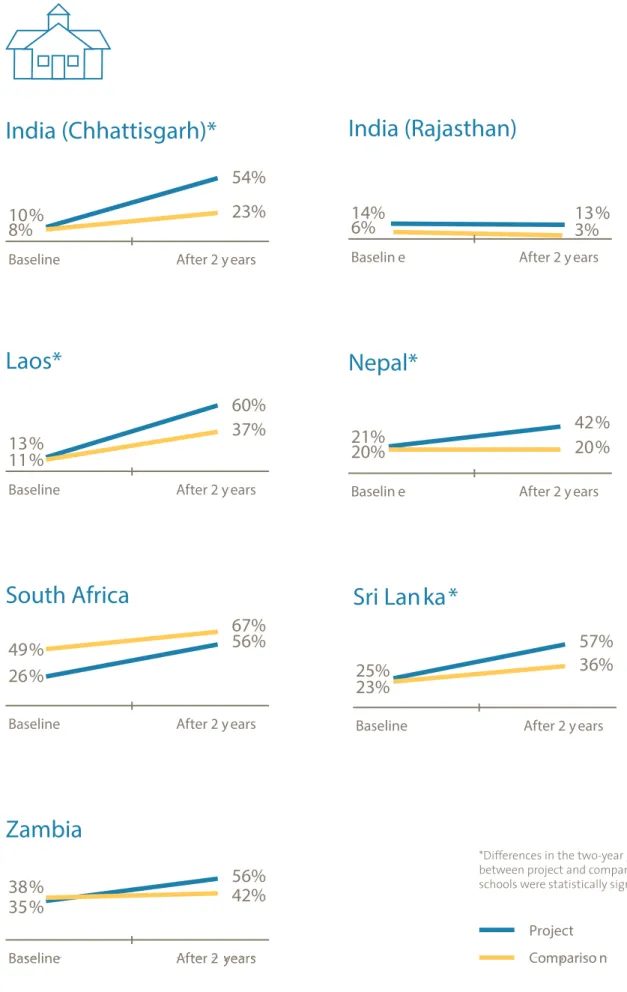
As shown in Figure 1 on page 8, our cross-national evaluation revealed that Room to Read libraries increased the number of children who read for enjoyment at school. Before the intervention began, schools with a Room to Read library (project schools) and a comparable set of schools without a Room to Read library (comparison schools) had roughly the same percentage of children reading for enjoyment at school. After two years, 44 percent of children from project schools were reading for enjoyment at school compared to only 33 percent of children from comparison schools. In India (Chhattisgarh), Laos, Nepal, and Sri Lanka, the impact of Room to Read libraries on reading for enjoyment at school was true even after statistically controlling for potential background differences between project and comparison schools such as school size, principal experience, student gender, student socioeconomic standing, and parental education. In two other countries (South Africa and Zambia), there was a positive improvement in children’s reading for enjoyment at school, but differences between project and comparison schools were not statistically significant.
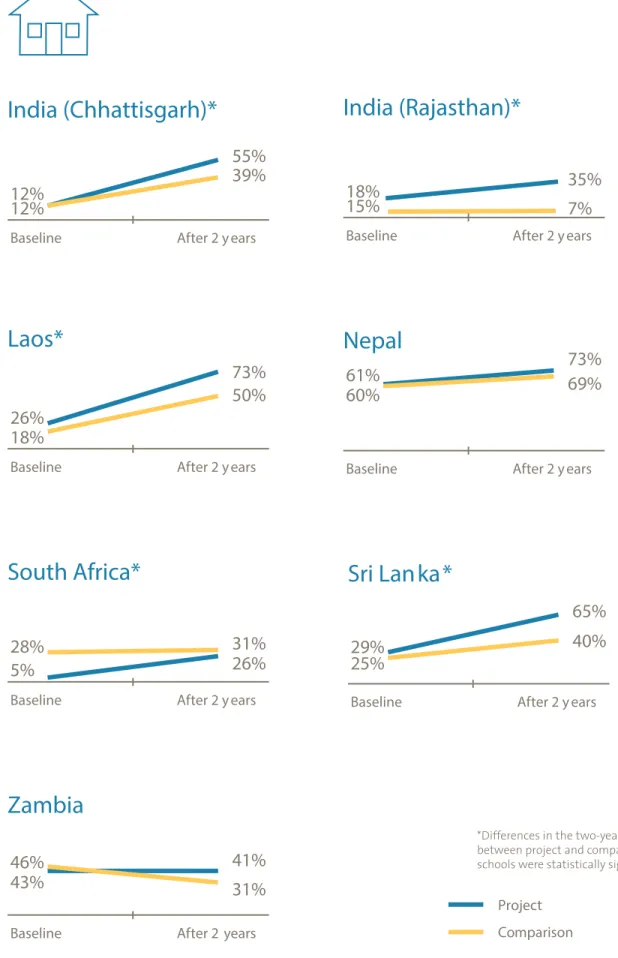
As shown in Figure 2 on page 9, Room to Read libraries also increased the number of children who read for enjoyment at home. Before the intervention began, 32 per-cent of children in both project and comparison schools were reading for enjoy-ment at home. After two years, 56 percent of children from project schools were reading for enjoyment at home compared to 40 percent of children from com-parison schools. The differences between project and comcom-parison schools in In-dia (Chhattisgarh and Rajasthan), Laos, South Africa, and Sri Lanka held up even after statistically controlling for potential background differences between the schools. In two other countries (Nepal and Zambia), differences between project and comparison schools were not statistically significant.
detailed findings 3
54%
23%
8%
10%
Baselin eIndia (Chhattisgarh) *
After 2 years13%
3%
6%
14%
Baselin eIndia (Rajasthan)
After 2 years60%
37%
11%
13%
Baselin eLaos*
After 2 years42%
20%
20%
21%
Baselin eNepal*
After 2 years67%
56%
26%
49%
Baselin eSouth Africa
After 2 years57%
36%
23%
25%
Baselin eSri Lanka*
After 2 years56%
42%
35%
38%
Baselin eZambia
After 2 years Project ComparisonFIGURE 1: Program Impact – Reading for Enjoyment at School
*Differences in the two-year gains between project and comparison schools were statistically significant.
Baseline After 2 years
54%
23%
8%
10%
BaselineIndia (Chhattisgarh)*
After 2 years13%
3%
6%
14%
Baselin eIndia (Rajasthan)
After 2 years60%
37%
11%
13%
BaselineLaos*
After 2 years42%
20%
20%
21%
Baselin eNepal*
After 2 years67%
56%
26%
49%
BaselineSouth Africa
After 2 years57%
36%
23%
25%
BaselineSri Lanka*
After 2 years56%
42%
35%
38%
Zambia
Project Compariso n*Differences in the two-year gains between project and comparison schools were statistically significant.
FIGURE 2: Program Impact – Reading for Enjoyment at Home
55%
39%
12%
12%
BaselineIndia (Chhattisgarh)*
After 2 years35%
7%
15%
18%
BaselineIndia (Rajasthan)*
After 2 years73%
50%
18%
26%
BaselineLaos*
After 2 years73%
69%
60%
61%
BaselineNepal
After 2 years31%
26%
5%
28%
BaselineSouth Africa*
After 2 years65%
40%
25%
29%
BaselineSri Lanka*
After 2 years41%
31%
43%
46%
BaselineZambia
After 2 years Project Comparison detailed findings 3Detailed findings
In some cases, results were difficult to interpret because baseline scores between project and comparison schools were different, indicating that the two groups were not well matched. This occurred because sometimes we had to select comparison schools from a different district than the project schools. In other cases, we found that Room to Read libraries had no effect on children’s habit of reading. We believe these findings point to specific program improvements that were needed and have subsequently been made. In Zambia, for example, Room to Read staff initially supported a large number of libraries. Staff are now allocated to fewer libraries in order to provide more effective support. In India, the implementation approach used in Chhattisgarh, one in which school staff managed the library and conducted reading activities, was more impactful than the implementation approach used in Rajasthan, one in which someone external to the school managed the library and conducted activities. As a result of these findings Room to Read is now exclusively implementing the more successful approach used in Chhattisgarh.
Country-specific findings
detailed findings 3
The cross-national evaluation also found a number of notable country-specific findings: • Room to Read libraries improved children’s attitudes toward reading. In Nepal and Sri Lanka, the program increased the number of children who thought reading was an interesting activity.
• Room to Read libraries were particularly effective for boys in some countries. In Nepal and India (Chhattisgarh), the program had a bigger impact on reading for enjoyment for boys than for girls. This was most likely because boys were reading less than girls in the absence of a Room to Read library, and the introduction of our libraries helped boys catch up.
• Room to Read libraries help children of both educated and uneducated parents, but in different ways. In India (Chhattisgarh), Nepal, Sri Lanka, and Zambia, the program had the biggest impact on reading for enjoyment or interest in reading among children whose parents had no formal education. This was most likely because these children had little access to books before Room to Read started its work. Interestingly, we found the opposite results for children’s reading skills. Here, the children of more educated parents benefited the most. This was most likely because the Room to Read library provided an opportunity for educated parents to work with their children on reading and thereby improve their reading skills further.
• Room to Read libraries can improve reading skills. In India (Chhattisgarh), Sri Lanka, and Zambia, children from project schools could read relatively more fluently or with better comprehension two years after the library opened than children from comparison schools.
Conclusion and next steps
We are having a positive impact on children’s
reading for enjoyment
Room to Read’s cross-national evaluation results show that we are having a positive impact on children’s reading for enjoyment at school and at home. These findings provide objective evidence that our school libraries are effective at promoting children’s reading habits. While the main objective of this evaluation was to determine if our school libraries are having an impact, the findings also point to some areas for growth and improvement. The table below summarizes the key findings and the steps Room to Read has taken based on these findings. Through these steps, Room to Read hopes to move further towards our goal of developing lifelong, independent readers.
school libraries cross-national evaluation summary 12
conclusion 4
Key Finding
Our school libraries promote children’s reading habits Not all children in our school libraries are reading
Our school libraries can improve reading skills
Parents influence how children benefit from our school libraries
Program
implementation of our school libraries matters
Next Steps
Build on program model. Continue to provide children with an opportunity to access books in an environment that promotes reading.
Improve library experience for all children. In 2011 we introduced a color-coded book leveling system that allows pupils to easily find books that match their reading levels. In 2012, we introduced library period activity guidelines that provide librarians and teachers with guidance on how to conduct activities that will increase children’s reading habits. Provide better support to schools. In 2013, we introduced a library rating system through which Room to Read can target support to those libraries that need it most.
Integrate reading instruction and school libraries. Data from the evaluation suggest that the school library can help promote reading skills, particularly for children of educated parents. We want to have this impact for all children, especially for the disadvantaged. As a result, we have steadily expanded our Literacy Program to include classroom reading instruction. Beginning in 2014, we also have taken steps to ensure that the reading instruction and school libraries components of our Literacy Program are closely coordinated.
Issue guidelines to promote parental involvement in children’s reading. In an effort to ensure that all children are supported in their reading behaviors, we introduced family and community engagement guidelines in 2013 that help schools increase parental support for the library and parental involvement in their children’s reading.
Ensure consistent implementation based on proven practices. In 2015, we introduced worldwide implementation packages that promote a consistent implementation approach for all libraries. These packages, which draw on research and prior experience, streamline our approach to implementing libraries and to providing training to librarians, teachers, and principals.
For more details on Room to Read’s School Libraries Cross-National Evaluation please go to www.roomtoread.org/measuringresults