Model-based Product-Oriented Certification
Damian Dechev
[email protected] Texas A&M University College Station, TX 77843-3112
Bjarne Stroustrup
[email protected] Texas A&M University College Station, TX 77843-3112
Abstract
Future space missions such as the Mars Science Laboratory and Project Constel-lation suggest the engineering of some of the most complex man-rated software sys-tems. The present process-oriented certification methodologies employed by NASA are becoming prohibitively expensive when applied to systems of such complexity. The process of software certification establishes the level of confidence in a software system in the context of its functional and safety requirements. Providing such certi-fication evidence may require the application of a number of software development, analysis, and validation techniques. We define product-oriented certification as the process of measuring the system’s reliability and efficiency based on the analysis of its design (expressed in models) and implementation (expressed in source code). In this work we introduce a framework for model-based product-oriented certification founded on the concept of source code enhancement and analysis. We describe a classification of the certification artifact types, the development and validation tools and techniques, the application domain-specific factors, and the levels of abstrac-tion. We demonstrate the application of our certification platform by analyzing the process of model-based development of the parallel autonomic goals network, a crit-ical component of the Jet Propulsion Laboratory’s Mission Data System (MDS). We describe how we identify and satisfy seven critical certification artifacts in the pro-cess of model-driven development and validation of the MDS goal network. In the analysis of this process, we establish the relationship among the seven certification artifacts, the applied development and validation techniques and tools, and the level of abstraction of system design and development.
1
Introduction
1 In this work we introduce a framework for
model-based product-oriented certification founded on the concept of source code enhancement and analysis by the utiliza-tion of advanced programming techniques and tools. As opposed to process-oriented certification (as suggested by DO-178B [24]), the product-oriented methodology[7] re-lies on the application of safety concerns directly on
imple-1This is the authors’ version of the work. It is posted here by permission
of the publisher. Not for redistribution. The definitive version is published in Proceedings of 16th Annual IEEE International Conference and Work-shop on the Engineering of Computer Based Systems (IEEE ECBS 2009), San Francisco, California, April 2009.
mentation source code and its formal models. The product-oriented approach is inherently more flexible by offering the developers the freedom to follow a variety of software development life-cycle paradigms. In addition, the certifi-cation authority itself has the ability to collect all required artifacts for the system’s safety and quality assurance. As suggested in [29], the rationale for source code enhance-ment is to seek an effective alternative to domain-specific programming languages for high-performance computing systems. A language enhancement can be achieved by su-persetting a programming language by a library defining domain-specific concepts and algorithms and at the same time employing program analysis and validation tools to en-sure the correctness of the introduced domain-specific no-tions. Source code enhancement allows a programmer to reach a high level of expressiveness and at the same time rely on the tool-chain of a mainstream programming lan-guage. We demonstrate the use of our certification platform by describing its application to the process of model-based development and verification of the autonomic goals net-work [6], a critical component of the Jet Propulsion Labo-ratory’s Mission Data System (MDS). MDS provides an ex-perimental goal- and state- based platform for model-driven testing and development of autonomous real-time flight ap-plications [21]. The process of software certification estab-lishes the level of confidence in a software system in the context of its functionalandsafetyrequirements. A soft-ware certificate contains the evidence required for the sys-tem’s independent assessment by an authority having min-imal knowledge and trust in the technology and tools em-ployed [7]. Providing such certification evidence may re-quire the application of a number of software development, analysis, verification, and validation techniques [18]. Our approach offers a classification of and establishes the rela-tionship among the certification artifact types, the develop-ment and validation tools and techniques, the application domain-specific factors, and the levels of abstraction. We further suggest the concept of semantic enhancement of the source code and the application of a number of program analysis and transformation techniques to achieve
ity and efficiency in the system implementation. Our case study in Section 4 illustrates the practical application of our approach. We describe how we identify and satisfy seven critical certification artifacts in the process of model-driven development and validation of the MDS goal network. In the analysis of this process, we establish the relationship among the seven certification artifacts, the applied develop-ment and validation techniques and tools, and the level of abstraction of system design and development.
2
Background and Previous Work
Future space exploration projects such as the Mars Sci-ence Laboratory (MSL) [31] and Project Constellation [27] suggest the engineering of some of the most complex man-rated software systems. As stated in the Columbia Accident Investigation Board Report [3], the inability to thoroughly apply the required certification protocols had been deter-mined to be a contributing factor to the loss of STS-107, Space Shuttle Columbia. Schumann and Visser’s discus-sion in [25] suggests that the current process-oriented certi-fication methodologies are prohibitively expensive for sys-tems of such complexity. A detailed analysis by Lowry [18] indicates that at the present moment the certification cost of mission-critical space software exceeds its development cost. The challenges of certifying and re-certifying avion-ics software has led NASA to initiate a number of advanced experimental software development and testing platforms, such as the Mission Data System (MDS) [21], as well as a number of program synthesis, modeling, analysis, and verification platforms, such as The JavaPathFinder [2], the CLARAty project [30], Project Golden Gate [10], The New Millenium Architecture Prototype (NewMAAP) [9].
2.1
Complex Systems Analysis
In [20] Perrow studies the risk factors in the modern high technology systems. His work identifies two significant sources of complexity in modern systems:interactionsand
coupling. The systems most prone to accidents are those
withcomplexinteractions andtightcoupling. With the
in-crease of the size of a system, the number of functions it has to serve, as well as its interdependence with other systems, its interactions become more incomprehensible to human and machine analysis and this can cause unexpected and anomalous behavior. Tight coupling [20] is defined by the presence of time-dependent processes, strict resource con-straints, and little or no possible variance in the execution sequence. Perrow classifies space missions in the riskiest category since both hazard factors are present.
2.2
Parallelism and Complexity
In a parallel application, there are a number of challenges that are not known in sequential programming: most impor-tantly to correctly manipulate data where multiple threads access it. The most commonly applied technique for con-trolling the interactions of the concurrent processes is the application of mutual exclusion locks. A mutual exclu-sion lock guarantees thread-safety of a concurrent object by blocking all contending threads except the one holding the lock. This can seriously affect the performance of the system and diminish its parallelism. For the majority of applications, the problem with locks is one of difficulty of providing correctness more than one of performance. The application of mutually exclusive locks poses significant safety hazards and incurs high complexity in the testing and validation of mission-critical software. Mutual exclusion locks can be optimized in some scenarios by utilizing fine-grained locks [14] or context-switching. Often due to the resource limitations of flight-qualified hardware, optimized lock mechanisms are not a desirable alternative [18]. Even for efficient locks, the interdependence of processes implied by the use of locks, introduces the dangers of deadlock, live-lock, and priority inversion. The incorrect application of locks is hard to determine with the traditional testing pro-cedures and a program can be deployed and used for a long period of time before the flaws cause anomalous behavior.
As discussed by Lowry [18], in July 1997 The Mars Pathfinder mission experienced a number of anomalous sys-tem resets that caused an operational delay and loss of sci-entific data. The follow-up study identified the presence of a priority inversion problem caused by the low-priority me-teorological process blocking the high-priority bus manage-ment process. The investigation furthermore revealed that it would have been impossible to detect the problem with the black box testing applied at the time to derive the certifica-tion artifacts. A more appropriate priority inversion inher-itance algorithm had been ignored due to its frequency of execution, the real-time requirements imposed, and its high cost incurred on the slower flight-qualified computer hard-ware. The efficient and reliable control of the subtle interac-tions in the concurrent applicainterac-tions of the modern aerospace autonomous systems is of critical importance to the over-all system’s safety and correct operation. Despite the chal-lenges in debugging and verification of the system’s con-current components, the existing certification process [24] does not provide guidelines at the level of detail reaching the development, application, and testing of concurrent pro-grams. This is largely due to the process-oriented nature of the current certification protocols and the complexity and high level of specialization of the aerospace autonomous embedded applications. In the near future, NASA plans to deploy a number of diverse vehicles, habitats, and
support-ing facilities for its imminent missions to the Moon, Mars and beyond. According to [21] some of the most significant challenges for such systems are managing a large number of tightly-coupled components, performing operations in un-certain remote environments, ability to respond and recover from anomalies, guaranteeing the system’s correctness and reliability, and the effective communication across the sys-tem’s components.
3
Principles of Model-based
Product-Oriented Certification
We define product-oriented certificationas the process of establishing the system’s reliability and efficiency based on the analysis of its design (expressed in models) and im-plementation (expressed in source code). In this section we describe a classification of the certification artifact types,
the development and validation tools and techniques, the
application domain-specific factors, and the levels of
ab-straction. In our framework acertification artifact typecan
be one of the following:
(1) Invariant (η): a critical property or assumption that is con-stant (does not change throughout the transformation of pro-gram/system states) and must hold at all time to ensure the va-lidity and correct operation of a program or a system.Example a.: the values stored in a given shared vector must be word-sized pointers. Example b.: a graph of temporal constraints [6] must contain no cycles.
(2) Guarantee (γ): a goal or condition that needs to be satisfied. Unlike invariants, goals can be defined differently at different moments of the lifecycle of a system.Example:an eventEa
must precede an eventEb in the autonomic operation of a
robot.
(3) Constraint (κ): a physical and resource constraint that need to be observed. Example: the physical memory available to store a graph of autonomic goals is 7168KB.
(4) Performance artifact (): an artifact describing the quality of operation and degree of optimization. Example:Complexity and space efficiency of a particular propagation scheme in a network of temporal constraints.
(5) Comprehension artifact (σ): an artifact measuring the human understanding of the interactions, coupling, and behavior of a system.Example:a list of all concurrent interleavings in a goal network leading to a state of inconsistency.
(6) Re-certification and maintenance artifact (µ): an artifact demonstrating the ability to re-establish the validity of the system upon its evolution and re-use.Example:an automated program analysis tool that checks for the separation of data and algorithms and thus can demonstrate the validity of the graph implementation upon the replacement of the constraint propagation algorithm.
3.1
Development
Satisfying the certification artifacts in a software system requires the application of a combination of software devel-opment, modeling, formal verification, and analysis tech-niques and tools. Expressing as well as checking the certi-fication requirements is enabled and directly dependent on the following software development dimensions:
(1) Model of Computation (∆M C): the computing architecture
defined by the hardware and the operating system. It defines the sequential or parallel memory model as well as the avail-able basic machine-level instructions and atomic primitives.
Example: an embedded multi-core platform with eight pro-cessing cores supporting only single-word atomic primitives, such as the single-word Compare-And-Swap (CAS). (2) Programming Language (∆P L): programming constructs,
li-braries, and techniques available. Example: The availability of a nonblocking vector [5] that can allow safe and lock-free access to shared data (and thus eliminate the hazards of dead-lock, livedead-lock, and priority inversion).
(3) Modeling Tools (∆M T): expressing design notions,
auto-mated code generation, and formal verification.Example:the application of the SPIN model checker [13] to exhaustively search all concurrent interleavings.
(4) Analysis Techniques (∆AT): program static and dynamic
analysis.Example:the application of static analysis utilizing a high-level program representation to guarantee high perfor-mance in parallel systems [29].
(5) Software Architecture (∆SA): defines the most significant
de-sign notions such as system states, system goals, and modes of communication.Example:The Mission Data System defines a unified model-driven architecture for testing and develop-ment of autonomous flight software based on the notions of system goals and states.
3.2
Application Domains
The application-domain factors have a direct impact in defining the certification requirements and the development process. We identify the following significant application-specific properties for mission critical software:
(1) Real-time (Rt): the system must achieve a goal or provide a response in a time-constrained manner.Example:The real-time operation of a robot demands asystem guaranteethat the meteorological process must complete prior to the initiation of communication with mission control.
(2) Safety-critical (Sc): establishes that a failure would lead to a catastrophic or hazardous consequences to the entire system. The DO-178B offers a hazards analysis process to assess the risk level upon a module or sub-system failure. Example:if the autonomous obstacle avoidance scheme fails, the rover
might crash. Thus, the systeminvariantsandguarantees as-suring the correct operation of the system aresafety-critical. (3) Embedded (Em): since the system is designed and optimized
according to a set of pre-defined goals, its software must of-ten control the hardware, consider strict resource constraints, and handle failures and events that may occur in the physical world. Example: the embedded nature and limited memory availability of the rover places theconstraintthat a goal net-work should not exceed 7168KB of memory space.
(4) Autonomous (Au): the system must achieve a set of goals with little or no human interaction, meanwhile possibly re-sponding to the conditions and events in its environment. Ex-ample:the autonomy of the meteorological and bus manage-ment processes requires theinvariantthat the system is free of the hazards of priority inversion.
3.3
Levels of Abstraction
We classify the system’s safety concerns according to their rank in the abstraction hierarchy:
(1) Physical and Hardware (Φ): related to constraints in the hardware resources, organization, and architecture and the conditions in the physical environment. Example: the lack of complex atomic primitives on the flight-qualified hard-ware requires all nonblocking code to rely on the single-word Compare-And-Swap (CAS) atomic primitive. This demands the specification of aninvariantthat the system must elimi-nate the possibility of occurrence of the ABA problem [5]. (2) Algorithms and Procedures (Θ): invariants of a particular
computational routine or algorithm. Example:the complex-ity of Floyd-Warshall’s all-pairs-shortest-path algorithm [4] is O(N3)
. Due to the frequent execution of the constraint prop-agation scheme in a goal network the direct application of the algorithm can be prohibitively expensive. To meet the per-formancerequirements a propagation scheme should execute with complexity of at mostO(N2).
(3) Libraries (Λ): domain-specific concerns on a set of algorithms that are grouped in a standard or custom language extension.
Example: a library of CAS-based nonblocking algorithms must guarantee its ABA-freedom.
(4) Modules and Sub-Systems (Ψ): guarantees and quality of ser-vice provided by the individual components and sub-systems.
Example:The rover’s module performing atmospheric exper-iments must coordinate its execution with the bus manage-ment and the communication systems. Such a coordination might lead to a number of safety-critical invariants and guar-antees (such as no priority inversion).
(5) System (Ω): goals critical for the successful completion of the mission. Example: the rover’s goal is to autonomously navigate the surface of Mars, perform scientific exploration of the planet’s atmosphere and geology, and communicate re-sults back to mission control. Meeting these goals impacts the guarantees defined by all of the robot’s sub-systems.
(6) Framework (Ξ): conditions related to the principle organi-zation and design of the software development. Example:
The Mission Data System defines the notions of states and goals. Their definition and requirements are described (inde-pendently from the implementation of a particular mission) in a number of MDS framework papers such as [21].
As emphasized by Stroustrup in [28], the concept of higher-level systems programming is of significant impor-tance to systems of high complexity and size. Higher-level systems programming implies that while low-Higher-level ef-ficiency is important, the emphasis is placed towards the de-sign, maintenance, and validation of the larger system. With respect to the system implementation, it is the programming language facilities for data abstraction and representation of domain-specific concerns that directly address this issue. As defined by Stroustrup [28]:
A programming language serves two related purposes: it pro-vides a vehicle for the programmer to specify actions to be ex-ecuted and a set ofconceptsfor the programmer to use when thinking about what can be done. The first aspect ideally re-quires a language that is ’close to the machine’, so that all important aspects of a machine are handled simply and effi-ciently in a way that is reasonably obvious to the programmer. The C language was primarily designed with this in mind. The second aspect ideally requires a language that is ’close to the problem to be solved’, so that the concept of a solution can be expressed directly and concisely. The facilities added to C to create C++ were primarily designed with this in mind.
The application of C++ in a framework for complex, au-tonomous, and embedded flight software, such as the Mis-sion Data System, further illustrates and emphasized the significance of the ability of C++ to excel in providing both, instructions ’close to the machine’ and facilities that are ’close to the problem to be solved’. Language facilities allowing the definition of high-level design concepts and domain-specific concern are often provided by language libraries. Such libraries enhance the language semantic model by defining notions and guarantees that belong to the problem domain.
Modeling and formal verification tools such as SPIN [13], Alloy Analyzer [15], and Eclipse [26] are used to express and validate high-level domain-specific and design concerns. The challenges associated with the application of modeling and formal verification tools in the development process are:
(1) Bridging the implementation source and the software models. (a) from implementation to models: as an abstraction and simplification of the software implementation, a model represents an aspect of the software solution based on a number of assumptions and rules. Defining these as-sumptions as well as the verification invariants, and
es-tablishing whether the model is trustworthy with respect to the source are some of the most challenging tasks. (b) from models to implementation: the application of
pro-gram synthesis techniques such as AutoFilter [8] have been applied successfully in a number or flight applica-tions. However, the certification of the produced soft-ware is challenged by the strict FAA requirement of hav-ing the program synthesis meet the same certification re-quirements as the produced flight software.
(2) Limited state space and heavy computational complexity: de-spite the advanced state space reduction techniques in many modern formal verification tools, the main limitations for their applicability arise from the heavy computational complex-ity imposed and the state space explosion problem. Program simplification and abstract interpretation techniques are often necessary to reduce the explored state space. However, ac-cording to the FAA certification standards, it is required to establish the preservation of the program semantics upon the application of any program transformation and abstract inter-pretation techniques.
(3) Project Scheduling: the application of formal logic can often be as demanding to the software developers as the engineering of the system implementation itself.
The semantic enhancement of the implementation can al-low for the direct validation of some software invariants and guarantees and thus reduce the state space and the compu-tational complexity required in the process of formal veri-fication. In addition, the increased expressiveness and ab-straction level of the implementation source can ease the manual or automated transition to and from the software models. Stroustrup and Dos Reis [29] present the notion of
Semantically Enhanced Library Languages(SELLs). As
de-fined by the authors, a SELL is a domain-specific language derived from a general-purpose programming language by extending it with libraries defining the concepts and func-tionalities of the problem domain and then applying an anal-ysis tool to guarantee the higher-level semantic invariants. The main advantages of defining and applying a SELL are founded in the availability of the maintenance, training, and tool chain of the general-purpose language that had served as its base. At the same time, a SELL’s main purpose is to deliver a special-purpose language tailored to the ideals and concepts of a specific application domain. The notion of SELL is fundamental for the application of our model-based product-oriented framework for software certification.
The following section presents a case study describing the details of how we extend the semantics of ISO C++ with the libraries defining Temporal Constraint Networks and Shared Containers with Nonblocking Synchronization. Furthermore, we demonstrate how the applied program-ming and modeling techniques, formal verification, pro-gram transformation, and static analysis (in the process of
validation and automatic parallelization of goal networks) relate to our classification framework.
4
A Case Study: Automatic Parallelization of
Goal Networks in MDS
Mission Data System (MDS) [21] is the Jet Propulsion Laboratory’s framework for designing and implementing complete end-to-end data and control autonomous flight systems. The framework focuses on the representation of three main software architecture principles (defining the highest ∆SA level of development in the certification
framework):
(1) System control: a state-based control architecture with explicit representation of controllable state [11]
(2) Goal-oriented operation: control intent is expressed by defining a set of goal and a goal network [1]
(3) Layered data management: an integrated data manage-ment and transport protocols [32]
In MDS a state variable provides access to the data ab-stractions representing the physical entities under control over a continuous period of time, spanning from the distant past to the distant future. In other words, a state variable is a programming (∆P L) and modeling (∆M T) representation
of a set of constraint (κ) certification variables (Sκsv)
ex-pressed in the library level of abstraction (Λ). As explained by Wagner [32], the implementation’s intent is to define a goal timeline overlapping or coinciding with the state vari-ables timeline. This means that the implementation must rely on an algorithm (abstraction levelΘ) that transforms the engineers intent together withSκsv into a set of
invari-antsSηsv and a set of guaranteesSγsv and establish the
va-lidity and consistency of all ηi ∈ Sηsv and allγi ∈ Sγsv
so that the system’s operations corresponds with itsRt,Sc, Em, andAubehavior.
Computing the invariants (a set of Sηgi) necessary for
achieving a goal (anyγi ∈ Sγsv) might require the lookup
of past states as well as the computation of projected fu-ture states. MDS employs the concept of goals to repre-sent control intent. Goals are expressed as a set of temporal constraints (Section 4.1). Each state variable is associated with exactly one state estimator whose function is to col-lect all available data and compute a projection of the state value and its expected transitions. Control goals are consid-ered to be those that are meant to control external physical states. Knowledge goals are those goals that represent the constraints on the software system regarding a property of a state variable. Not all states are known at all time. The most trivial knowledge goal is the request for a state to be known, thus enabling its estimator. A data state is defined as the in-formation regarding the available state and goal data and its
storage format and location. The MDS framework consid-ers data states an integral part of the control system rather than a part of the system under control. There are dedicated state variables representing the data states. In addition, data states can be controlled through the definition of data goals. A data state might store information such as location, for-matting, compression, and transport intent and status of the data. A data state might not be necessary for every state variable. In a simple control system where no telemetry is necessary, the state variable implementation might as well store the information regarding the variable’s value history and its extrapolated states.
The representation of the data states and the data man-agement in MDS is implemented in the Data Manman-agement Service module [32]. The problem of data management in an embedded control system (often requiring the satisfac-tion ofEm,Rt,Au, andSc-driven certification require-ments at the same time) is one of translating the intent of remote operations into actions and then safely returning the observed information. The system should be robust to the extent of overcoming possible communication loss, hard-ware failures or a system reboot. The resource constraint of an embedded control systems (its collection ofκvariables) dictate that command-oriented control systems typically do not retain information specific to the intent of the observa-tions. In addition, telemetry systems process and transport data in unlabeled packages where the scientific data is often mixed with other data. In this context, Wagner argues that it is of significant importance to address the challenges of pro-viding uniform models for managing the flow of observa-tion and control data. The MDS Data Management Service Library implements a Catalog for organizing the storage of physical observations in terms of storage products. Its func-tionality is responsible for the remote transport of data prod-ucts with respect to the behavior of other spacecraft compo-nents. According to the current lock-based Catalog design, locks are applied in a complex manner within the inheri-tance hierarchy that leads to an exponential increase of the verification state space.
To achieve higher reliability (expressed as a set of safety invariants Sηsaf ety) and enhance the performance
(mea-sured in terms of speed of execution in theexe variable),
we consider the application oflock-free synchronization. As defined by Herlihy [12], a concurrent object isnonblocking
(lock-free) if it guarantees thatsomeprocess in the system will make progress in afiniteamount of steps. Nonblock-ing algorithms do not apply mutually exclusive locks and instead rely on a set of atomic primitives supported by the hardware architecture. This means that a nonblocking tech-nique represents an algorithmic (Θ) or library (Λ) solution to an importantScproblem, namely avoidance of the haz-ards of deadlock, livelock, and priority inversion (expressed as three separateScinvariants: ηlvlock,ηdelock, andηpinv)
while at the same time offering a significant performance boost (measured in exe). The application of a library of
nonblocking algorithms shifts the complexity of engineer-ing shared data access from the user’s source into the lock-free library implementation. Thus lock-lock-free programming techniques can often help increase the comprehensibility of the concurrent interactions in the user’s implementation. In the process of creating a parallel network of temporal constraints (by utilizing nonblocking synchronization), we measure the increased simplicity of the code (in contrast to the application of mutual exclusion) with the certification variableσptcn.
Lock-free systems typically utilize CAS in order to im-plement an optimistic speculation on the shared data. A contending process attempts to make progress by applying one or more writes on a local copy of the shared data. Af-terwards, the process attempts to swap (CAS) the global data with its updated copy. Such an approach guarantees that from within a set of contending processes, there is at least one that succeeds within a finite number of steps (ex-pressed as the nonblocking invariant ηnb). The system is
non-blocking at the expense of some extra work performed by the contending processes. Linearizability [12] is an im-portant correctness condition for concurrent nonblocking objects: a concurrent operation is linearizable if it appears to execute instantaneously in a given point of time between the timet1of its invocation and the timet2of its completion
(expressed as the linearizability invariantηlin). The
consis-tency model implied by the linearizability requirements is stronger than the widely applied Lamport’s sequential con-sistency model [16]. According to Lamport’s definition, se-quential consistency requires that the results of a concurrent execution are equivalent to the results yielded bysome se-quential execution (given the fact that the operations per-formed by each individual processor appear in the sequen-tial history in the order as defined by the program).
Practical nonblocking programming techniques stand at a development level∆P L and when used properly help in
assuring safe and efficient access to shared data (in a con-current system defined by the system’s∆M C) and their
se-mantics and implementation is directly related to the atomic primitives available by the system’s Φ level (such as the availability of atomic primitives like Compare-And-Swap (CAS) or Double-Compare-And-Swap (DCAS) ). In hard-ware platforms that do not provide complex atomic prim-itives (involving the atomic update of more than a single-word location), the implementation of lock-free algorithms is CAS-based. Such systems impose yet another impor-tant invariant ηaba where the programmer must eliminate
the possibility of occurrence of the ABA problem [5]. The ABA problem [19] is fundamental to all CAS-based systems. There are two particular instances that create ABA hazards: 1. the user intends to store a memory address value
Amultiple times, and 2. the memory allocator reuses the address of an already freed object. In these scenarios a CAS speculation can succeed despite the fact that the speculating process has experienced an interrupt and the value about to be updated had been modified by other processes. The com-pletion of such a CAS speculation can lead to ABA and can seriously affect the semantics of the nonblocking algorithm. One approach to eliminating ABA is to strictly define the semantic usage pattern of a nonblocking algorithm (mean-ing that not all operations might be total at all time). Such usage rules are another example of a transformation of an invariant (ηaba) into a set of guarantees (Sγaba) variables
that need to be satisfied. One possibility is the application of static analysis [29] that can check for the exclusion of in-terleavings leading to ABA hazards. In such a scenario the ABA problem (ηaba) is resolved by the application of∆AT
development tools.
In our case study we describe the integration of a non-blocking vector in a parallel implementation of the Mis-sion Data System’s Temporal Constraint Network Library (TCN) in order to achieve higher thread safety and boost the performance of the MDS Goal Networks component.
4.1
Temporal Constraint Networks
A Temporal Constraint Network (TCN) defines the goal-oriented operation of a control system in the context of a system under control. The Temporal Constraint Networks (TCN) application is at the core of the Jet Propulsion Lab-oratory’s Mission Data System (MDS) [21] state-based and goal-oriented unified architecture for testing and develop-ment of mission software. A TCN consists of a set of tem-poral constraints (TCs) and a set of time points (TPs). In this model of goal-driven operation, a time point is defined as an interval of time when the configuration of the system is expected to satisfy a property predicate. The width of the interval corresponds to the temporal uncertainty inher-ent in the satisfaction of the predicate. Similarly, temporal constraints have an associated interval of time correspond-ing to the acceptable bounds on the interactions between the control system and the system under control during the performance of a specific activity. A TCN graph topology represents a snapshot at a given time of the known set of ac-tivities the control system has performed so far, is currently engaged in, and will be performing in the near future up to the horizon of the elaborated plan initially created as a solu-tion for a set of goals. The topology of a temporal constraint network must satisfy a number of invariants (Sηtcn).
(a) A TCN is a directed acyclic graph where the edges represent the set of all time points (Stps) and the vertices the set of all
temporal constraints (Stcs)
(b) For each time pointT Pi ∈ Stps, there is a set of
tempo-ral constraints that are immediate successors (Ssucci) ofT Pi
and a set,Spredi, consisting of all ofT Pi’s immediate
prede-cessors
(c) Each temporal constraintT Cj ∈ Stcshas exactly one
suc-cessorT Psuccj and one predecessorT Ppredj
(d) For each pair{T Pi, T Cj}, whereT Pi≡T Csuccj,T Cj∈
Spredi must hold. The reciprocal invariant must also be
valid, namely for each pair of{T Pi, T Cj}such thatT Pi ≡ T Cpredj,T Cj∈Ssucci
(e) The firing window of a time pointT Pi∈Stpsis represented
by the pair of time instances{T Pmini, T Pmaxi}. Assuming
that the current moment of time is represented byTnow, then T Pmini≤Tnow≤T Pmaxi, for everyT Pi∈Stps.
General-purpose programming languages lack the capabili-ties to formally specify and check domain-specific design constraints. Direct representation and verification of the TCN invariants (Sηtcn) in the implementation source code
would result in a slow and cumbersome solution. However, any implementation (in C++, Java or another programming language) must operate under the assumptions that the basic TCN invariants are satisfied. Thus, prior to implementing a solution to the TCN constraint propagation problem, it is necessary to guarantee the correctness and consistency of the topology of the goal network.
4.2
TCN Verification and Automatic
Parallelization
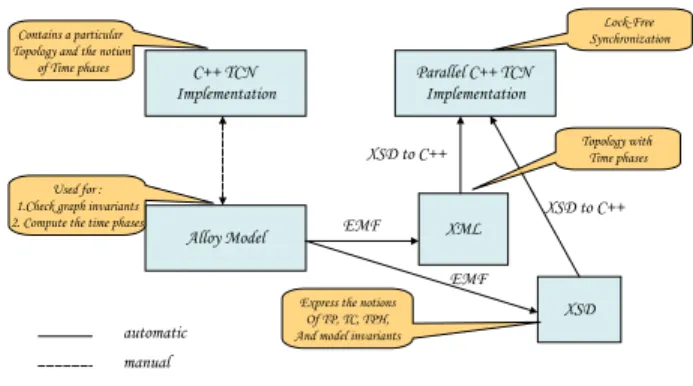
In this section we describe the design and application of a model-based framework for verification and paralleliza-tion of real-time C++ within JPL’s MDS Framework (Figure 1). The main goal of the framework is to provide a model-driven design of a parallel temporal constraint propagation scheme where the following seven critical certification vari-ables are satisfied: Sηsaf ety, exe, ηnb, ηlin, ηaba, Sηtcn,
andσptcn. The input to the framework is the MDS mission
planning and execution module that is based on the defi-nition of temporal constraint networks. At the core of the most recent implementations at JPL of this critical module is an optimized iterative algorithm for the real-time prop-agation of temporal constraints, developed and described by Lou in [17]. Constraint propagation poses performance challenges and speed bottlenecks due to the algorithm’s fre-quent execution and the necessary real-time update of the goal network’s topology. The end goal of the presented tool-chain is, given the implementation of the optimized it-erative propagation scheme and the topology of a particular goal network, to establish the correctness of the core TCN semantic invariants (see Section 4.1) andautomatically de-rive an implementation that can be executed concurrently. Our approach for achieving concurrent execution is based
on the idea of identifying Time Phases within a goal net-work, which allow the parallelization of the constraint prop-agation algorithm. A fundamental component of our model-driven design is the construction and execution of a formal verification model in Alloy[15] that represents the imple-mentation’s core semantics and functionality. We refine a formal modeling and analysis methodology [23] that helps us analyze the logical properties of the goal network model and automatically derive a meta-model for our parallel so-lution.
C++ TCN
Implementation Parallel C++ TCN Implementation
Alloy Model XSD XML automatic manual Contains a particular Topology and the notion
of Time phases
Used for : 1.Check graph invariants 2. Compute the time phases
Express the notions Of TP, TC, TPH, And model invariants
Topology with Time phases EMF EMF XSD to C++ XSD to C++ Lock-Free Synchronization
Figure 1.TCN Verification and Parallelization
4.3
Constraint Propagation
A classic solution to the problem of constraint propaga-tion in TCN is the direct applicapropaga-tion of Floyd-Warshall’s all-pairs-shortest-path algorithm[4], offering a complexity ofO(N3), whereNis the number of time points in the TCN
topology. Since, by definition, the goal of the TCN propa-gation algorithm is to compute the real-time values of the network’s temporal constraints, the algorithm is frequently executed and, given the massive scale of a real world goal network, can cause significant bottleneck for the overall system’s performance. In [17], Lou describes an innova-tive and effecinnova-tive TCN propagation scheme with a complex-ity close to linear. Lou’s TCN propagation is based on the concept of alternating forward and backward propagation passes. A forward pass updates the time interval at each time point by considering only its incoming temporal con-straints. Similarly, a backward pass recomputes the time windows at each time point by considering only its outgo-ing temporal constraints. The scheme utilizes a shared con-tainer, named apropagation queue, to keep track of all time
points whose successor time points’ windows are about to be updated next (during a forward pass) and all time points whose predecessor time points’ windows are about to be up-dated next (during a backward pass). A forward pass begins by selecting all time points with no predecessors and inserts them into the propagation queue. A backward pass begins by selecting all time points with no successors and inserts them into the propagation queue. Each iteration is carried out until:
(a) An iteration completes without updating any temporal constraints (thus indicating that there are no more up-dates to be performed during the pass). In this case, the TCN topology is considered to be temporally
consis-tent.
(b) The iteration has stumbled upon a time window of neg-ative value and the algorithm terminates with the out-come of having a temporally inconsistent network.
4.4
Model-based Development and
Certification
Alloy [15] is a lightweight formal specification and ver-ification tool for the automated analysis of user-specified invariants on complete or partial models. We use the Al-loy specification language [15] to formally represent and check the TCN main invariants (Sηtcn). In our C++ goal
networks implementation we have applied generic program-ming techniques and concepts [22], so that we can main-tain a higher level of expressiveness. As a result we have achieved a significant similarity in the way the main TCN notions and invariants are expressed in our actual imple-mentation and the Alloy verification models. In addition, we utilize the Alloy Analyzer to implement our paralleliza-tion approach. Our method for parallelizaparalleliza-tion of the goal network is based on the observation that in a topology we can identify groups of time points that would allow the concurrent execution of the propagation passes. A possi-ble criterion for identifying such groups would be to iden-tify the time points in a topology that allow disjoin-access to the shared data. Given the method used to compute the time window[T Pmini, T Pmaxi]for eachT Pi ∈ Stps,
we have observed that the functionally-independent time points are the time points that are equidistant (with respect to the longest path) from the root of the graph. Thus, in our methodology, we define aTime PhaseT phi as the set
of the time points (ST phi) in a topology that are
equidis-tant, with respect to the longest path, from the root of the graph. In such a way, by definition, the computations of
[T Pmina, T Pmaxa]and [T Pminb, T Pmaxb] for every pair
of{T Pa, T Pb}, such thatT Pa∈ST phiandT Pb∈ST phi,
are mutually independent and allow disjoin-access to the shared data. With the support of Alloy Analyzer we define
and identify the time phases in a goal network graph. Hav-ing identified the time phases in our temporal constraint net-work specification in Alloy, the aim of the rest of our tool-chain is toautomaticallyderive the C++ implementation of the parallel solution through a number of code transforma-tion techniques. Following Rouquette’s methodology [23] for model transformation through the application of the Ob-ject Constraint Language (OCL) and the Eclipse Modeling Framework (EMF), we are able to automatically derive an intermediary XML and XSD representations of the graph’s topology and the TCN semantic notions, respectively. We apply an XML parser (XercesC) and a CodeSynthesis XSD transformation tool to deliver the C++ implementation of the goal network and our parallel propagation method.
4.5
Analysis
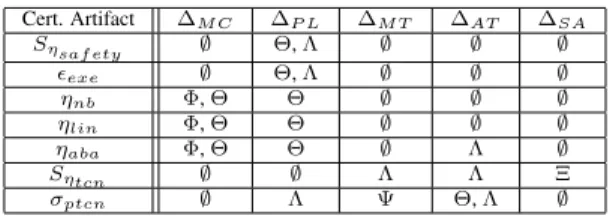
Table 1 provides a summary of the applied development tools that help us satisfy the seven critical certification vari-ables in the process of TCN verification and parallelization. Each non-empty cell indicates the level of abstraction of the applied development tool. Empty cells are designated by the∅ symbol. Below we briefly explain each entry in the
Cert. Artifact ∆M C ∆P L ∆M T ∆AT ∆SA Sηsafety ∅ Θ,Λ ∅ ∅ ∅ exe ∅ Θ,Λ ∅ ∅ ∅ ηnb Φ,Θ Θ ∅ ∅ ∅ ηlin Φ,Θ Θ ∅ ∅ ∅ ηaba Φ,Θ Θ ∅ Λ ∅ Sηtcn ∅ ∅ Λ Λ Ξ σptcn ∅ Λ Ψ Θ,Λ ∅
Table 1. Linking Certification Artifacts, Devel-opment Tools, and Levels of Abstraction
table:
(1) Sηsaf ety: to eliminate the dangers of deadlock (ηdelock),
live-lock (ηlvlock), and priority inversion (ηpinv) we have relied on
the use of a library of nonblocking algorithms that allow the fast and safe implementation of shared data access of the C++ STL vector. Thus our approach to deliver safe concurrent in-teractions is based on the application of innovative algorithms (Θ) and language library extensions (Λ).
(2) exe: as described in detail in [5], when used under contention
a nonblocking shared vector can deliver a significant perfor-mance boost (by a factor of10or more) when compared with the application of the most recent and optimized mutual ex-clusion schemes. In the scenarios when the shared data struc-ture access patterns show less contention, the nonblocking techniques provide a scalable and efficient solution with per-formance better or equal to the most optimal mutual exclusive schemes [6]. Achieving better performance and scalability of our parallel goal network is also based on the application of programming techniques at the algorithms/library level.
(3) ηnb: the careful application of CAS-based speculation on
single-word memory locations allows us to guarantee that among a set of contending processes trying to manipulate the shared vector, there is at least one that is guaranteed to progress. To construct our library of nonblocking algorithms we have relied on the atomic primitives provided by the hard-ware architecture (Φ) and a set of practical lock-free program-ming techniques (Θ).
(4) ηlin: some operations in a shared vector require the update
(in a linearizable fashion) of two or more memory locations. Such operations arepush back(need to update the tail and the size of the vector) andresize(need to update the size and copy all elements). Implementing such operations in a lin-earizable fashion with the support of only single-word atomic primitives is notoriously difficult. We have employed a set of practical lock-free programming techniques to guarantee that the vector’s operations are linearizable (such a technique is the use of Barne’s-style announcement [5]).
(5) ηaba: The ABA problem is fundamental to all CAS-based
systems and can affect the semantics of the nonblocking algo-rithms. In systems allowing complex atomic primitives such as CAS2 or DCAS, ABA can be easily avoided by attaching a version counter to each value. In such a case we would have had an algorithmic solution with a strong support from the hardware architecture. We cannot assume the availability of such complex atomic primitives in the hardware architecture of the flight-qualified embedded hardware. Our solution to the ABA problem is the application of a library for program analysis [29] that can help us eliminate hazardous interleav-ings.
(6) Sηtcn: to guarantee the correct operation of our autonomous
goal-driven application, we have build a framework (Figure 1) that relies on modeling, program analysis, and program transformation programming techniques.
(7) σptcn: we have increased the comprehensibility of our
par-allel goal network implementation by: a. shifting the com-plexity of allowing safe and efficient concurrent operations into a library of nonblocking containers (Λ), b. used the Al-loy modeling notation to express the software architectural and design notions (Ψ), and c. applied program analysis and transformation techniques to automatically derive the imple-mentation source. Any further evolution of the system would rely on high-level models expressed in simpler design-level domain-specific terms.
5
Conclusion
We introduced an innovative framework for model-based product-oriented certification founded on the concept of source code enhancement and analysis. We offered a clas-sification of the certification artifact types, the development and validation tools and techniques, the application domain-specific factors, and the levels of abstraction used in our
certification platform. We used our certification platform to analyze the model-driven development of a parallel prop-agation scheme of the MDS temporal constraint network module. In our analysis we identified seven critical certi-fication artifact: 1. providing the safety of the concurrent interactions (by eliminating the hazards of deadlock, live-lock, and priority inversion), 2. achieving better scalability and overall system performance, 3. allowing nonblocking synchronization, 4. having linearizable operations on the shared data, 5. eliminating the possibility of ABA corrupt-ing the concurrent operations’ semantics, 6. establishcorrupt-ing the correctness of the core TCN graph invariants, and 7. hav-ing simpler to analyze and maintain parallel processes. In our discussion we explained the relationships among these seven certification artifacts and the underlying hardware ar-chitecture, the applied programming techniques, and pro-gram analysis, modeling, and transformation techniques. Our certification framework helped us formulate, express, and analyze the process of product-oriented certification for a complex computer-based system, such as the model-driven development tool-chain of parallel autonomous goal networks.
References
[1] A. Barett, R. Knight, J. Morris, and R. Rasmussen. Mission Planning and Execution Within the Mission Data System. InProceedings of the International Workshop on Planning and Scheduling for Space, 2004.
[2] G. Brat, D. Drusinsky, D. Giannakopoulou, A. Goldberg, K. Havelund, M. Lowry, C. Pasareanu, A. Venet, R. Washington, and W. Visser. Experimen-tal Evaluation of Verification and Validation Tools on Martian Rover Software. InFormal Methods in Systems Design Journal, September 2005.
[3] Columbia Accident Investigation Board. Columbia Accident Investigation Board Report Volume 1.
[4] T. H. Cormen, C. E. Leiserson, R. L. Rivest, and C. Stein. Introduction to algorithms. MIT Press, Cambridge, MA, USA, 2001.
[5] D. Dechev, P. Pirkelbauer, and B. Stroustrup. Lock-Free Dynamically Resizable Arrays. In A. A. Shvartsman, editor,OPODIS, volume 4305 ofLecture Notes in Computer Science, pages 142–156. Springer, 2006.
[6] D. Dechev, N. Rouquette, P. Pirkelbauer, and B. Stroustrup. Verification and Semantic Parallelization of Goal-Driven Autonomous Software. In Proceed-ings of ACM Autonomics 2008: 2nd International Conference on Autonomic Computing and Communication Systems, 2008.
[7] E. Denney and B. Fischer. Software Certification and Software Certification Management Systems. InSoftCement05. Proceedings of the 2005 ASE Work-shop on Software Certificate Management, 2005.
[8] E. Denney, B. Fischer, J. Schumann, and J. Richardson. Automatic Certification of Kalman Filters for Reliable Code Generation. InProceedings of the 2005 IEEE Aerospace Conference, 2005.
[9] D. Dvorak. Challenging encapsulation in the design of high-risk control sys-tems. InProceedings of the 17th ACM Conference on Object-Oriented Pro-gramming, Systems, Languages, and Applications (OOPSLA’02), 2002.
[10] D. Dvorak, G. Bollella, T. Canham, V. Carson, V. Champlin, B. Giovannoni, M. Indictor, K. Meyer, A. Murray, and K. Reiinholtz. Project Golden Gate: Towards Real-Time Java in Space Missions. InIEEE ISORC, 2004.
[11] D. Dvorak, R. Rasmussen, and T. Starbird. State Knowledge Representation in the Mission Data System. InProceedings of IEEE Aerospace Conference, 2002.
[12] M. Herlihy. The art of multiprocessor programming. InPODC ’06: Proceed-ings of the twenty-fifth annual ACM symposium on Principles of distributed computing, pages 1–2, New York, NY, USA, 2006. ACM.
[13] G. Holzmann. The Spin Model Checker, Primer and Reference Manual. Addison-Wesley, Reading, Massachusetts, 2003.
[14] Intel. Reference for Intel Threading Building Blocks, version 1.0, April 2006.
[15] D. Jackson.Software Abstractions: Logic, Language and Analysis. The MIT Press, 2006.
[16] L. Lamport. How to make a multiprocessor computer that correctly executes programs, September 1979.
[17] J. Lou. An Efficient Algorithm for Propagation of Temporal Constraint Net-works.NASA Tech Brief Vol. 26 No. 4 from JPL New Technology Report NPO-21098, April 2002.
[18] M. R. Lowry. Software Construction and Analysis Tools for Future Space Mis-sions. In J.-P. Katoen and P. Stevens, editors,TACAS, volume 2280 ofLecture Notes in Computer Science, pages 1–19. Springer, 2002.
[19] M. M. Michael. Hazard Pointers: Safe Memory Reclamation for Lock-Free Objects.IEEE Trans. Parallel Distrib. Syst., 15(6):491–504, 2004.
[20] C. Perrow.Normal Accidents. Princeton University Press, September 1999.
[21] R. Rasmussen, M. Ingham, and D. Dvorak. Achieving Control and Interoper-ability Through Unified Model-Based Engineering and Software Engineering. InAIAA Infotech at Aerospace Conference, 2005.
[22] G. D. Reis and B. Stroustrup. Specifying C++ Concepts, ISO WG21 N1886, 2005.
[23] N. Rouquette. Analyzing and verifying UML models with OCL and Alloy.
EclipseCon 2008, 2008.
[24] RTCA. Software Considerations in Airborne Systems and Equipment Certifi-cation (DO-178B), 1992.
[25] J. Schumann and W. Visser. Autonomy Software: V&V Challenges and Char-acteristics. InProceedings of the 2006 IEEE Aerospace Conference, 2006.
[26] M. Sherriff and L. Williams. DevCOP: A Software Certificate Management System for Eclipse. InISSRE ’06: Proceedings of the 17th International Sym-posium on Software Reliability Engineering, pages 375–384, Washington, DC, USA, 2006. IEEE Computer Society.
[27] A. Stoica, D. Keymeulen, A. Csaszar, Q. Gan, T. Hidalgo, J. Moore, J. Newton, S. Sandoval, and J. Xu. Humanoids for lunar and planetary surface operations. InProceedings of the 2005 IEEE International Conference on Systems, Man and Cybernetics, October 2005.
[28] B. Stroustrup.The design and evolution of C++. ACM Press/Addison-Wesley Publishing Co., New York, NY, USA, 1994.
[29] B. Stroustrup and G. D. Reis. Supporting SELL for High-Performance Com-puting. InProceedings of the International Workshop on Languages and Com-pilers for Parallel Computing, LCPC 2005, 2005.
[30] R. Volpe, I. Nesnas, T. Estlin, D. Mutz, R. Petras, and H. Das. The CLARAty Architecture for Robotic Autonomy. InIEEE Aerospace Conference, March 2001.
[31] R. Volpe and S. Peters. Rover Technology Development and Mission Infusion for the 2009 Mars Science Laboratory Mission. In7th International Symposium on Artificial Intelligence, Robotics, and Automation in Space, May 2003.
[32] D. Wagner. Data Management in the Mission Data System. InProceedings of the IEEE System, Man, and Cybernetics Conference, 2005.