Boise State University
ScholarWorks
Accountancy Faculty Publications and
Presentations Department of Accountancy
1-1-2019
Real Tax Reform: An Efficient, Equitable, and
Simple Plan in the U.S.
Janet Mosebach Boise State University Michael Mosebach
This document was originally published inInternational Research Journal of Applied Financeby the International Research Journal of Applied Finance. Copyright restrictions may apply.
30
Real Tax Reform: An Efficient, Equitable, and Simple Plan in the U.S.
Janet Mosebach* Michael Mosebach
Abstract
This paper presents real tax reform that is not only efficient, equitable, and simple but revenue neutral. It also removes a significant amount of double taxation from the individual taxpayer. The underlying premise is that businesses do not actually “pay” income taxes but pass them on to the consumer. Our plan consists of eliminating all federal income taxation of individuals and changing business taxation from a tax computed on taxable income to a tax based on total audited revenue. After computing the combined amount of federal tax currently collected from individuals and all forms of businesses, we develop a revenue-based tax rate on businesses that provides the U.S. government with approximately the same amount of revenue as the current income tax system. In addition, this new revenue-based business tax reduces federal tax compliance costs for all taxpayers and the size of government.
Keywords: taxation, tax reform, flat tax, federal government.
I. Introduction
There is little doubt the American public wants a simplified federal tax code, officially known as the Internal Revenue Code (IRC). They want efficiency, and a system that treats all taxpayers equitably rather than the, at least perceived, current system that treats taxpayers differently based on their level of income. In other words, they want a system where the “rich” pay their fair share. Harvard University‟s Jason Furman echoes these concerns and suggests recent federal tax changes will not be the “last word.” We agree and believe the next step should be real tax reform rather than simply tinkering around the edges.
While federal tax rates are certainly an important concern, the larger issue is the almost incomprehensible complexity of the IRC. According to Hodge (2016), the IRC is two times longer than in 1985 and almost six times longer than it was in 1955. The recent federal tax law change, commonly known as the Tax Cuts and Jobs Act1, is over 500 pages in length and only made the IRC more complex by including new provisions for businesses operating globally and providing only temporary changes for individuals. This increasing level of complexity is costly, in both time and money, for all taxpayers.
1 Public Law 115-97 signed by the U.S. President and enacted on December 22, 2017.
We propose a new federal tax system that both simplifies the IRC and provides other economic advantages.2 Our first step is to completely eliminate the federal income tax on individuals, estates, and trusts, and the transfer tax on gifts and estates.3 This first step leads to a series of questions: 1) Is this more efficient, 2) Is this equitable, and finally, 3) How does the federal government replace this lost revenue?
2 This paper does not specifically address state income tax changes, but it is anticipated that states, most of
which already piggyback on the federal system, would adopt a system similar to what we propose at the federal level.
3 Henceforth, we will refer to the elimination of federal income tax on individuals, estates and trusts, and the
federal transfer tax on gifts and estates, as merely the elimination of federal income tax on individuals.
This is an efficient and equitable plan because no individual pays federal income tax directly, meaning they no longer need to file a federal tax returns. Eliminating the individual tax by itself would certainly reduce federal tax revenue. However, our analysis shows the revenue
31
lost by eliminating the individual income tax can be entirely replaced by a modified business tax, allowing our plan to be revenue neutral. This modified business tax is computed on the audited (or reviewed for smaller businesses) total revenue of each and every business, basically a gross receipts tax on businesses.
Barro and Redlick (2011) estimate that every 1% reduction in the individual average marginal tax rate adds 0.5% in growth to Gross Domestic Product (GDP). If the Barro and Redlick findings hold, eliminating the federal individual income tax will give individuals significantly more disposable income leading to higher consumer spending, thereby, increasing GDP.
II. Real Tax Reform and a Return To First Principles
First Principles: “The fundamental concepts or assumptions on which a theory,
system, or method is based.” Oxford English Dictionary
The first principle as it relates to a tax is to fund the government. There can be no doubt the federal government needs to be funded. The problem with the current federal tax system is that, in many cases, lawmakers have drifted away from first principles and allowed the IRC to morph into a system that influences behavior, and picks winners and losers.
In our return to first principles, we recognize the government has two basic sources of income taxes, individuals and businesses. Even though businesses pay income taxes, one must accept that, in an economic sense, it is the end user or consumer who pays all taxes. Businesses have more control over their bottom line than individuals and are able pass their tax liability on to consumers by increasing the price of their goods or services. Individuals, on the other hand, are not only unable to pass their taxes on but they must pay the business‟s taxes in the form of higher prices with funds that were already taxed when earned.
III. Tax Reform
We first discuss individual income taxes because our recommendation is that individuals pay no federal income tax directly. So, is our system efficient? Barro and Redlick (2011) estimate that every 1% reduction in the individual average marginal tax rate adds 0.5% in growth to GDP. If Barro and Redlick‟s findings hold, in principle, not only would our plan help all Americans, it would increase GDP.4 In addition, moving funds out of the government‟s hands and into the economy makes capital markets more efficient.
4 This is not to suggest a 10 or 20 percent increase in GDP but an increase of some magnitude.
Is our plan equitable and simple? Because individuals will not directly pay income taxes under our plan, it is equitable by definition. Every individual is treated exactly the same and pays zero income tax directly. As for simple, there is no need to do tax planning, prepare income tax returns or file income tax returns with the Internal Revenue Service (IRS). Hodge (2016) estimates the economic burden of federal income tax compliance on the U.S. economy. He finds the overall preparation burden for compliance with the IRC is $409 billion and 8.9 billion hours. Of this total, the burden for individual taxpayers alone is $99 billion and 2.6 billion hours.
Under our plan, individuals will save time and money by not having to prepare their own tax returns or paying a tax preparer to prepare their tax returns for them. In addition, no tax
32
returns means no interaction with the IRS at all; no filings, no audits, no collection efforts, no litigation, etc. All IRS activities related to individuals would cease and those resources could be deployed elsewhere, either within the IRS to deal with business taxpayers or outside the IRS in other areas of government. This plan could not be more equitable or simple.
While our plan to eliminate the individual income tax is relatively easy to explain, the reforms to the business income tax system are more complex. Even former Secretary of the Treasury, Jacob J. Lew, (2016) says “There is widespread agreement that our business tax system needs to be fixed.” Our plan eliminates the individual income tax and the resulting federal government revenue it generates. To replace this lost revenue and produce a revenue neutral system, our plan changes the business income tax system in such a way that there is no net loss of revenue for the federal government.
Currently, a business‟s income tax liability is computed by applying the appropriate income tax rate to their taxable income. Taxable income is not the same as net income for financial accounting purposes due to differences in how certain items of revenue and expense are treated for income tax purposes versus financial reporting purposes. We recommend businesses pay income tax based on their total audited (reviewed) financial statement revenue. Justification for this recommendation and an explanation of how it will maintain revenue neutrality is included below. Hodge (2016) estimates the tax preparation burden for businesses is $147 billion and 2.8 billion hours. This, combined with his estimate for individuals (noted in the prior section), makes the total costs for individuals and businesses $246 billion and 5.4 billion hours.5
The elimination of these costs will make the economy more efficient by allowing these dollars and hours to be used in a more productive manner.
5 The remaining $163 billion needed to get to the total of $409 billion in federal tax compliance costs is
distributed among 48 other costly IRC provisions and tax forms not specifically studied in the paper.
III.1 Efficiency
In the utopian state of a perfectly Pareto efficient economy, the addition of taxes leads to the economy becoming less efficient.6 Thus, removing the individual income tax will lead to the economy becoming more efficient, at least on the margin. We also posit that, in addition to the elimination of the distortion from the tax itself, individuals will tend to make better economic decisions thus further increasing the efficiency of the overall economy.
6
There are multiple definitions of Pareto efficiency. We define a Pareto efficient economy as an economy having resources allocated such that it is impossible to change the allocation without making one individual or group better off and making others worse off.
Although any tax reduces the efficiency of an economy, one is willing to accept the decrease in efficiency a tax will cause given the need to fund the government. In an April 18, 2017, Wall Street Journal article (page A15), Nina E. Olson, the National Taxpayer Advocate for the IRS, describes complexity as “the root of all evil in the tax code” (emphasis added) and calls for radical simplification. There can be little argument the IRC has risen to unreasonable levels of complexity and continues on that path. The most recent so-called tax reform legislation reduced income tax rates but did not simplify the federal tax system. In fact, it introduced many new business tax calculations, especially related to international operations.
To illustrate how this complexity decreases efficiency we look to Table 14 of Slemrod and Venkatesh (2002) which contains a list of some of the business activities companies have not pursued because of the income tax considerations. Some of the more notable activities
33
include deciding not to acquire another company, establish a foreign presence, expand, upgrade or build new buildings, or sell part or all of the company when these activities would have benefitted their company. We suggest this complexity, in and of itself, is another economic burden making the economy less efficient, in addition to the actual tax paid. If tax complexity decreases economic efficiency, it follows that removing tax complexity should improve economic efficiency. There are many ideas as to how this can be done. For example, Cochrane (2015) drawing on Dalton (1954) suggests the first thing to do is eliminate the corporate tax.7 One of Cochrane‟s reasons for this is (our words not his) double taxation. He very rightly points out “Every dollar of taxes that a corporation seems to pay comes from higher prices. . .” In addition to consumers paying higher prices to cover a business‟s income tax, they also purchase goods and services with dollars that were already subjected to income tax at the individual level as they were earned. Thus, double taxation. Cochrane also calls for fewer individual income tax brackets weighted towards the higher earners paying higher tax rates. We suggest multiple tax brackets are an unnecessary complexity and agree with presidential adviser and economist Arthur Laffer who, for years, has advocated for a flat tax as a means of simplifying the IRC.
7 Principles of Public Finance by Hugh Dalton (1954) basically states that if the obligation to remit a tax is
imposed on the seller or buyer, the result will be the same. If the obligation to remit is on the seller, they raise the price of the good or service, whereas, if the obligation is on the buyer, the seller keeps the price lower but adds on the tax at the time of sale.
In a follow-up article, Cochrane (2017) modifies his 2015 article (mentioned above) and calls for the complete elimination of both the individual and corporate income taxes in favor of a Value Added Tax (VAT)8
, suggesting a rate of approximately 20 percent would be necessary. The European Union (EU) is often cited as the reason the U.S. should use a VAT and all EU countries have a VAT. According to PWC‟s Worldwide Tax Summaries,9 112 countries, including the EU, with a VAT. The overall average VAT is 17 percent while the EU‟s average VAT is 21 percent. In addition, every country with a VAT also has both an individual and corporate income tax. The overall/EU average corporate tax rate is 23/21 percent.
8
For an in-depth explanation of the application of VATs, see Le (2003).
9 Accessible electronically at http://taxsummaries.pwc.com/ID/Value-added-tax-(VAT)-rates.
One of our main concerns with a VAT is that another large bureaucracy would be needed to administer it. We say „another‟ bureaucracy because other countries with a VAT retain their individual and corporate income taxes and it is likely that would also occur in the U.S. (contrary to Cochrane‟s suggestion) – meaning either additional IRS personnel or a new VAT agency would be needed. Under our plan there is no need for a new bureaucracy. In fact, our plan has the opposite effect – the potential to significantly reduce the size of the IRS.
Cochrane (2017) states “Much of the current tax mess results from taxing income.” This statement points out one of the inequities of the current system. For income tax purposes, businesses are allowed to deduct almost all of their ordinary and necessary business expenses so that they only pay income tax on their net income (income after expenses). Individuals, on the other hand, are strictly limited on what they can deduct and those deductions were recently limited even more by the Tax Cuts and Jobs Act of 2017.
34
Our plan changes incentives for businesses because businesses want their revenue to be higher for financial statement purposes but lower for income tax purposes. Cochrane (2017) also suggests that if the income tax is dropped in favor of a VAT, that change would lead to growth in the economy. We agree and suggest that our plan would be much simpler and more efficient than a VAT and lead to a more efficient economy without the need for a new bureaucracy.
We utilize Cochrane‟s thinking to a point, but where Cochrane eliminates the federal corporate income tax, our plan eliminates all federal individual income taxes. Our plan also assumes businesses will add the tax to the price of their goods or services. This eliminates the form of double taxation discussed above because, in the end, it is the consumer who pays the tax but with untaxed funds. Another advantage of our plan which adds more efficiency to the economy is businesses have a much better ability to adjust prices, allowing them to make better economic decisions. Businesses can drop products, raise prices, and move operations without the concern of whether the action would increase federal taxes. Most individuals, on the other hand, currently have very limited flexibility, if any, when it comes to adjusting their tax burden.10
10 This limited flexibility is also a factor in equitability as seen in the next section. III.2 Equity
Any time there is a discussion about tax reform, one of the first things that comes up is that the current IRC is unfair and gives the wealthy tax breaks that are unavailable to the average taxpayer. While this may or may not be true, it is the widely-held perception of many taxpayers. Warren Buffet‟s comment that he pays a lower percentage of his income in tax than his secretary only feeds this perception. These types of situations, whether perceived or actual, lead to “tax the wealthy” mantra of protestors.11
11 It also points out the lack of understanding of the difference between marginal and effective tax rates by the
general public but that is an issue for another paper.
Under our plan, Mr. Buffet will no longer pay a lower effective income tax rate than his secretary because they will both pay zero income tax. However, because income taxes paid by businesses will be passed on to the end consumer, Mr. Buffet and other wealthy individuals will pay more tax due to their ability to consume more goods and services.
III.3 Simplicity
For individuals, our plan completely eliminates the need to prepare or file an income tax return. For businesses, our plan requires them to pay income tax based on their gross audited (reviewed) revenue, a number that is already available. For most large businesses this information is currently available due to the required audit of their annual financial statements. For other businesses with lines of credit or loans from financial institutions, this information is also readily available because the financial institution requires the business to provide audited (or reviewed) financial statements. Businesses that do not currently have audited or reviewed financial statements will need to engage the services of a Certified Public Accountant (CPA) to audit or review their financial statements to certify their level of revenue.
Because the business tax base is determined during the annual audit or review of financial statements, there is no need to prepare lengthy and complex income tax returns. A business will be able to file their tax return on a postcard, something tax simplification proponents
35
have been talking about for years. In addition, the current rules regarding consolidation of entities for financial reporting purposes and tax purposes are different. Because the new business tax is based on revenue from the financial statements, a separate consolidation of entities process for tax purposes will no longer be necessary.
IV. How Do We “Pay” For This?
Given that the U.S. Congress tried to impeach John Koskinen, the IRS Commissioner, in 2016 and Nina Olson‟s comment about complexity being the root of all evil in the IRC, there can be little doubt that something is wrong with the current U.S. tax system. In addition to being revenue neutral, our plan has the added benefit of eliminating at least some of, what Slemrod (2002) calls “vast administrative bureaucracies involved in collecting and enforcing the remittance of tax monies,” otherwise known as the IRS. First, because our plan eliminates the individual income tax, IRS employees currently involved with the individual income tax (taxpayer assistance, correspondence, tax form filings, audits, appeals, collections, etc.) would no longer be needed. Second, the size and scope of the IRC and its associated regulations would be greatly reduced, meaning fewer employees tasked with updating them. Third, because business tax would be computed on audited (reviewed) revenue, the number of IRS employees tasked with interacting with businesses could be significantly reduced.12 Fourth, the IRS could shift remaining employees from dealing with business filings into enforcement and collection areas to insure compliance by businesses. The IRS agents in the Criminal Investigation Division (CID) who are trained in the use of firearms could be redeployed in other law enforcement agencies (city, state, or federal).
12 While we know that any reduction, or elimination, of the IRS would significantly reduce federal expenses, the
amount is, likely, unknowable as some employees would simply be redeployed in other areas of government as opposed to laid off or terminated.
There are other benefits associated with our plan in addition to reductions in the IRS workforce. If there is no individual income tax and business income tax is based on audited (or reviewed) revenue, there will be no need for tax shelters or other forms of hiding money from the IRS. Individuals will no longer need to set up Health Savings Accounts (HSAs) and Individual Retirement Accounts (IRAs), or participate in qualified retirement accounts (e.g., employer-sponsored 401(k) plans), etc., and businesses will not have to set up costly group retirement plans or other types of qualified employee benefit plans to manipulate the timing of income recognition by their employees. The need for income tax planning to avoid or shelter income would also cease to exist for all taxpayers.
The U.S. is basically a consumer-driven economy. While interviewing Kevin Brady, then the Chairman of the U.S. House of Representatives Ways and Means Committee on November 26, 2017, Maria Bartiromo referenced a prior interview with MacroMavens‟ president Stephanie Pomboy in which Ms. Pomboy said consumer spending is a major portion of the U.S. economy and the top 20 percent spend more than the bottom 60 percent.13
Under our plan, the wealthy will have more disposable income and pay their fair share due to their consumption patterns, and because businesses will pass their tax expenses on to their customers.
13
Transcript of Kevin Brady interview (accessed on 7/30/2018) can be found at
http://www.foxnews.com/transcript/2017/11/26/rep-kevin-brady-on-finding-common-ground-on-tax-reform.html.
Any increase in disposable income can be broken down into either consumption or savings. Most economists assume both the marginal propensity to consume (C) and the marginal
36
propensity to save (S) are less than or equal to 1 and greater than or equal to zero, and %C +%S must equal 100%. Therefore, as disposable income increases, consumers tend to either spend more or save more over time. As consumers spend more, total business revenue increases, meaning increased business income tax collections.
V. Analysis
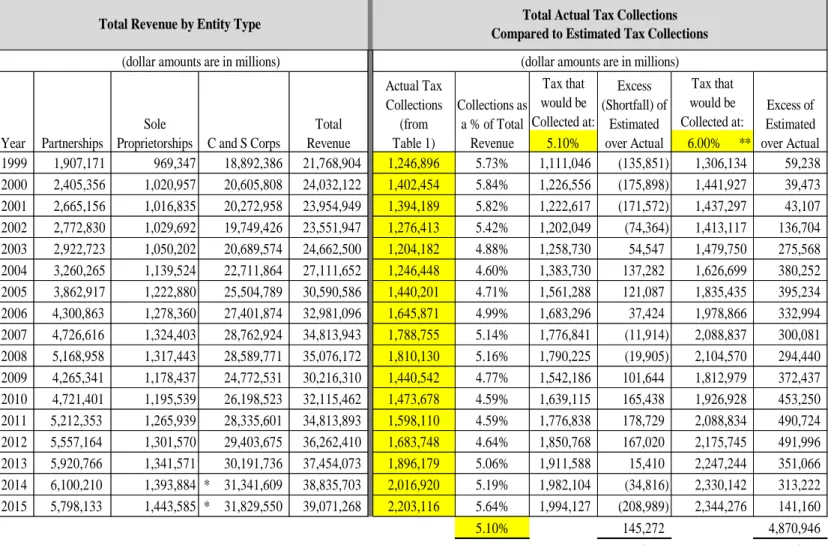
Our plan eliminates individual income tax and replaces the current business income tax with a tax on business revenue. To develop the new business tax rate necessary to make our plan revenue neutral (provide the federal government with at least the same amount of income tax revenue that is collected under the current system), we obtained the actual income tax collections by year from Table 6 of the 2017 IRS Data Book. Table I summarizes this data by year and taxpayer type (business and individual) for years 1999 through 2017 (the last year available).14 Individual income tax collections represent a much larger source of income tax revenue than business income tax collections, ranging from 3.32 to 6.47 times larger in 2006 and 2001, respectively. Combined individual and business income tax collections almost doubled from $1.247 trillion in 1999 to $2.205 trillion in 2017.
14 Although the complete IRS Table 6 includes both income and other taxes (employment and excise), we only
summarize and present the other taxes for reference because our plan focuses solely on income taxes.
Refer Table I
To determine the amount of business revenue available to be taxed under our plan, we obtained business revenue data from the IRS‟s Statistics of Income (SOI) Tax Stats-Historical Data Tables for sole proprietorships (SOI Table 10), partnerships (SOI Table 11), and corporations, both c-corporations and s-corporations (SOI Table 13) for the years 1999 to 2015.15 This data is summarized in Table II. Total revenue for all of these entity types combined increased from $21.8 trillion in 1999 to $39.0 trillion in 2015. Under our plan, all of that revenue would be taxed.
15 While sole proprietorship and partnership total revenue information is available through 2015, it is only
available through 2013 for corporations.
Under the current U.S. IRC, income from partnerships and s-corporations is passed-through and taxed on the income tax returns of their owners (partners and shareholders, respectively) but under our plan, their revenue would be taxed at the entity level. Sole proprietorships currently report their income and pay income tax on the owner‟s individual income tax return. Because our plan eliminates the individual income tax and the need for an individual to file an income tax return, it will be necessary for sole proprietorships to file a new income tax return of their own.
Refer Table II
For each year, we calculate the amount of actual income taxes collected (from Table I) as a percentage of total business revenue. We then average those percentages over the entire study period to develop the tax rate for plan. That average tax rate is 5.10 percent. We then applied this average tax rate to the actual tax collections for each year as a test to determine if this rate would generate enough tax revenue to be revenue neutral and discovered it did not. While, in total, this average tax rate generates a surplus of $145,272 million in tax revenue over the study period, it falls short in each year where the percentage of tax collections to total revenue exceeds 5.10 percent.
Because we are committed to revenue neutrality for the federal government, we use this average tax rate only as a starting point. Because it does not provide revenue neutrality, we
37
increased this tax rate until there were no years in which the tax calculated using our tax rate was less than the actual tax collections for that year. This requires we increase our new tax rate to 6 percent. At 6 percent, our new tax rate generates excess tax collections in each year of the study period and an overall surplus of $4,870,946 million. While, in actuality, the tax rate could be slightly lower than 6 percent and still achieve revenue neutrality, it makes sense to round up the tax rate to 6 percent for administrative ease. Providing excess tax revenue using 6 percent might also preclude Congress from attempting to raise the tax rate in the short term.
From a practical standpoint, the tax rate itself does not matter to businesses. First, regardless of whether the tax rate is 6 percent or 20 percent, it is a cost of doing business and passed on to customers just like any other expense. Second, the current U.S. tax system forces companies to make less than optimal decisions because of income tax considerations. One of the most discussed business decisions is whether profits generated and held overseas should be brought back to the U.S.16 Third, because businesses would no longer need staff to contend with federal income tax compliance, the overall expenses of businesses would be reduced. In their survey of 1,329 of the largest U.S. companies, Slemrod and Blumenthal (1996) found that, on average, these companies spent 2.6 percent of their revenue on federal tax compliance. One can assume that percentage would have only increased since the time of their study but, to be conservative, we assume it has not.
16 While this issue was addressed in the Tax Cuts and Jobs Act of 2017, the actual impact of the tax law change
is not yet clear.
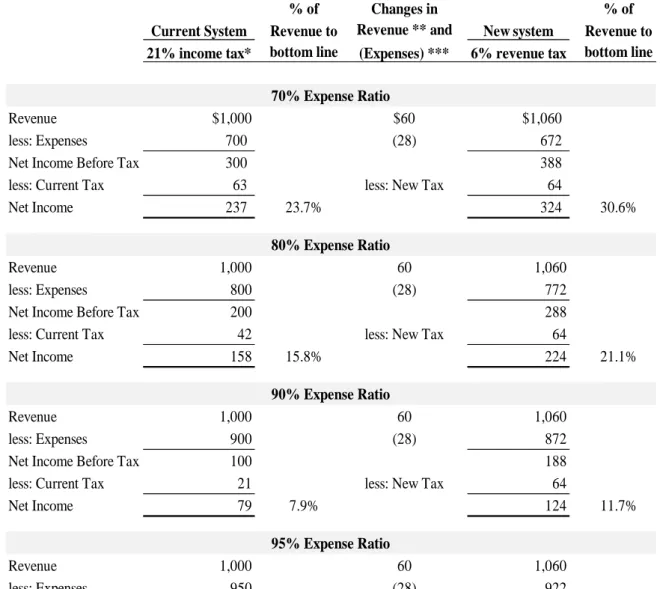
Implementation of this new income tax plan would impact the income statement and computation of earnings per share of every business. Total revenue would increase by 6 percent, due to passing the new tax cost on to customers in the form of higher prices. Expenses would go down by approximately 2.6 percent of total revenue, due to the elimination of the federal income tax compliance staff. This increase in revenue and decrease in expenses would result in an increase in the bottom line for businesses, the magnitude of which would depend on their expense ratio.
Table III provides a comparison of four hypothetical businesses, each with exactly the same amount of revenue but a different expense ratio to demonstrate the impact of our new revenue-based tax system on a business‟s net income. We make several reasonable assumptions in these comparisons. First, each business will pass the new 6 percent income tax on to their customers thus raising their revenue by that same 6 percent. Second, each business will reduce their expenses by 2.6 percent of revenue as a result of eliminating their federal tax compliance team. Third, each business is subject to the current flat tax rate of 21 percent for corporations under the Tax Cuts and Jobs Act 2017.
As shown in Table III, if we increase the expense ratio of a hypothetical business from 70 percent to 95 percent, net income continues to increase but at a decreasing rate. At a 70 percent expense ratio, net income is 30.6 percent higher under our new revenue-based tax system as opposed to the current income tax system. At a 95% expense ratio, net income is still higher but only 7.0 percent higher under our new revenue-based tax system than the current system. As expected, our new revenue-based system will both provide businesses with higher net income and be revenue neutral for the U.S. government.
Refer Table III
38
Our other concern is that lawmakers will increase the tax rate over time to something higher than the 6 percent we suggest. It is highly likely there will be upward adjustments in the rate, given the desire by Congress for increased government spending in response to various government needs, to spur economic growth, etc. However, if businesses did not believe they could pass all or part of that increase on to their customers, one can only imagine the lobbying efforts from industry groups and businesses themselves would be substantial. Any potential changes in individual spending and savings habits due to the elimination of the individual income tax, other than to suggest they would be more economically efficient, are beyond the scope of this study. But, when consumers receive what could amount to a significant increase in cash flow, there is a high probability of increased spending.
VI. Conclusion
While lawmakers and average taxpayers have been clamoring for tax reform for years, the most recent attempt, resulting in the Tax Cuts and Jobs Act of 2017, did not accomplish that goal. While it succeeded in tinkering with tax rates and adding more complexity, it came up short in terms of real tax reform. The major concern with the current U.S. income tax system is its almost incomprehensible complexity. A simpler IRC will reduce the time, effort, and expense that individuals and businesses spend on federal tax compliance and lead to a more efficient economy.
In this paper, we suggest a tax reform plan that goes a long way in eliminating both the complexity of the IRC and the need for complex federal regulations to interpret the intentions of Congress. Our tax plan is extremely simple, revenue neutral, and leads to a more efficient economy. As a result, it should lead to faster economic growth and return the IRC to its original purpose, namely, to fund the government.
Our plan eliminates the current double taxation of individuals – the direct taxation of individual incomes and indirect taxation when individual consumers purchase goods and services from businesses. We recommend eliminating all federal income taxes on individuals which results in only one level of taxation and a significant increase in disposable income. In order to remain revenue neutral after eliminating the individual income tax, our plan changes the way businesses are taxed from a tax based on taxable income to a tax based on total audited (reviewed) revenue for financial statement purposes. Based on our analysis, a revenue-based tax on businesses of 6 percent is necessary to replace the current income tax revenue. This new tax, like other business expenses, is passed on to the consumer, who is only being taxed once when they make a purchase. Even with this revenue-based tax, businesses will still be able to increase their bottom line.
Our plan also provides an opportunity to lower the cost of federal government by reducing the size of the IRS. Staff will longer be needed to monitor individual taxes because there will no longer be any individual regular income tax, alternative minimum tax, income tax on estates and trusts, or transfer taxes on gifts and estates. Staff tasked with writing tax regulations could also be reduced because of the elimination of individual taxes and a new business tax based on a readily available tax base, total audited (reviewed) revenue. It should be noted that our plan does nothing to change employment taxes as they serve to fund the social security benefits and Medicare systems.
Currently, businesses are taxed on their taxable income which leads to multiple inefficiencies for both businesses and the economy. Inefficiencies caused by management decisions based
39
on a desire to lower taxes but are not necessarily economically optimal. Our plan taxes total audited (reviewed) revenue from all sources, allowing businesses to make better economic decisions and leading to a more efficient economy.
The wealthy will pay their “fair share”, a common complaint of some regarding the current U.S. income tax system, as a result of their consumption patterns and because businesses will pass their federal tax expense on to customers. Individuals would only pay federal tax when they purchase goods and services, making our plan a consumption tax that is both simple to understand and apply. Economist and presidential adviser Arthur Laffer has, for years, advocated a flat tax as a means of simplifying the IRC and making the economy more efficient. Our plan provides an absolutely flat tax, zero for all individuals and 6 percent of total audited (reviewed) revenue for all businesses. If both individuals and businesses become more efficient it is reasonable to assume the economy, as a whole, will also become more efficient and grow faster.
References
Barro, R.J. and C.J. Redlick, 2011, Macroeconomic Effects of Government Purchases and Taxes, The Quarterly Journal of Economics, Vol. 126, Issue 1, 51-102.
Cochrane, J.H, 2017, Tax Consumption Through a VAT, and Voila, Wall Street Journal, September 5, A15.
Cochrane, J.H., 2015, Here‟s What Genuine Tax Reform Looks Like, Wall Street Journal, December 22, A23.
Dalton, H., 1954, Principles of Public Finance (Routledge, London).
Hodge, S.A., 2016, The Compliance Cost of IRS Regulations, Tax Foundation, June 15. Le, T.M., 2003, Value Added Taxation: Mechanism, Design, and Policy Issues, World Bank. Lew, J.J., 2016, Europe‟s Bite Out of Apple Shows the Need for U.S. Tax Reform, Wall
Street Journal, print edition: September 13.
Olson, N.E., 2017, Complexity Is the Root of All Evil (at Least in the Tax Code), Wall Street Journal, April 18, A15.
Slemrod, J. and M. Blumenthal, 1996, The Income Tax Compliance Cost of Big Business, Public Finance Quarterly, October, 411-438.
Slemrod, J. and V. Venkatesh, 2002, The Income Tax Compliance Cost of Large and Mid-size Businesses, Ross School of Business Paper No. 914, University of Michigan, September.
Slemrod, J., 2002, Tax Systems, NBER Reporter, National Bureau of Economic Research, Summer.
Author
Janet Mosebach*
*corresponding author
Associate Professor, Department of Accountancy, Boise State University, USA,
Michael Mosebach
40 (1) (2) (3) (4) (5) 1999 1,904,152 1,246,896 216,325 1,030,571 657,256 2000 2,096,917 1,402,454 235,655 1,166,799 694,463 2001 2,128,831 1,394,189 186,732 1,207,458 734,642 2002 2,016,627 1,276,413 211,438 1,064,975 740,214 2003 1,952,929 1,204,182 194,146 1,010,036 748,747 2004 2,018,502 1,246,448 230,619 1,015,828 772,055 2005 2,268,895 1,440,201 307,095 1,133,107 828,694 2006 2,518,680 1,645,871 380,925 1,264,947 872,809 2007 2,691,538 1,788,755 395,536 1,393,219 902,782 2008 2,745,035 1,810,130 354,316 1,455,814 934,905 2009 2,345,337 1,440,542 225,482 1,215,060 904,796 2010 2,345,056 1,473,678 277,937 1,195,740 871,378 2011 2,414,952 1,598,110 242,848 1,355,262 816,842 2012 2,524,320 1,683,748 281,462 1,402,287 840,572 2013 2,855,059 1,896,179 311,994 1,584,185 958,881 2014 3,064,301 2,016,920 353,141 1,663,779 1,047,381 2015 3,302,677 2,203,116 389,889 1,813,228 1,099,561 2016 3,333,449 2,183,709 345,552 1,838,156 1,149,740 2017 3,392,934 2,205,957 338,529 1,867,428 1,186,977
Source: Internal Revenue Service (IRS) Data Book 2017, Table 6
* IRS Table 6 begins in 1960. We reduced the number of years for presentation purposes. ** Includes estate and gift taxes, and income tax from estates and trusts.
*** Includes Employment and Excise Taxes. Table I
Gross Collections, by Type of Tax, Fiscal Years 1999–2017 *
Fiscal year Total Internal Revenue Collections Total Business and Individual Income Taxes Business Income Taxes Incividual **
Income Taxes Other ***
41 Tax that would be Collected at: 5.10% 6.00% ** 1999 1,907,171 969,347 18,892,386 21,768,904 1,246,896 5.73% 1,111,046 (135,851) 59,238 2000 2,405,356 1,020,957 20,605,808 24,032,122 1,402,454 5.84% 1,226,556 (175,898) 39,473 2001 2,665,156 1,016,835 20,272,958 23,954,949 1,394,189 5.82% 1,222,617 (171,572) 43,107 2002 2,772,830 1,029,692 19,749,426 23,551,947 1,276,413 5.42% 1,202,049 (74,364) 136,704 2003 2,922,723 1,050,202 20,689,574 24,662,500 1,204,182 4.88% 1,258,730 54,547 275,568 2004 3,260,265 1,139,524 22,711,864 27,111,652 1,246,448 4.60% 1,383,730 137,282 380,252 2005 3,862,917 1,222,880 25,504,789 30,590,586 1,440,201 4.71% 1,561,288 121,087 395,234 2006 4,300,863 1,278,360 27,401,874 32,981,096 1,645,871 4.99% 1,683,296 37,424 332,994 2007 4,726,616 1,324,403 28,762,924 34,813,943 1,788,755 5.14% 1,776,841 (11,914) 300,081 2008 5,168,958 1,317,443 28,589,771 35,076,172 1,810,130 5.16% 1,790,225 (19,905) 294,440 2009 4,265,341 1,178,437 24,772,531 30,216,310 1,440,542 4.77% 1,542,186 101,644 372,437 2010 4,721,401 1,195,539 26,198,523 32,115,462 1,473,678 4.59% 1,639,115 165,438 453,250 2011 5,212,353 1,265,939 28,335,601 34,813,893 1,598,110 4.59% 1,776,838 178,729 490,724 2012 5,557,164 1,301,570 29,403,675 36,262,410 1,683,748 4.64% 1,850,768 167,020 491,996 2013 5,920,766 1,341,571 30,191,736 37,454,073 1,896,179 5.06% 1,911,588 15,410 351,066 2014 6,100,210 1,393,884 * 31,341,609 38,835,703 2,016,920 5.19% 1,982,104 (34,816) 313,222 2015 5,798,133 1,443,585 * 31,829,550 39,071,268 2,203,116 5.64% 1,994,127 (208,989) 141,160 5.10% 145,272 4,870,946
Average Total Total
** We increase rate to 6 percent to insure estimated collections are greater than actual collections. Source:
Calculation of New Revenue-based Business Tax Rate
* For 2014 and 2015, the IRS has not released C or S Corp data. We use 2013 data and adjust it by percentage of GDP change based on St. Louis Federal Reserve Economic Data.
https://www.irs.gov/uac/soi-tax-stats-historical-data-tables
Table II
Total Revenue by Entity Type
(dollar amounts are in millions)
Total Actual Tax Collections Compared to Estimated Tax Collections
(dollar amounts are in millions)
Year Partnerships Sole Proprietorships Total Revenue Actual Tax Collections (from Table 1) Collections as a % of Total Revenue Excess of Estimated over Actual Tax that would be Collected at: C and S Corps Excess (Shortfall) of Estimated over Actual 1,306,134 1,441,927 1,437,297 1,413,117 1,479,750 1,626,699 1,835,435 1,978,866 2,088,837 2,104,570 1,812,979 2,344,276 1,926,928 2,088,834 2,175,745 2,247,244 2,330,142
42
% of Changes in % of
Current System Revenue to Revenue ** and New system Revenue to
21% income tax* bottom line (Expenses) *** 6% revenue tax bottom line
Revenue $1,000 $60 $1,060
less: Expenses 700 (28) 672
Net Income Before Tax 300 388
less: Current Tax 63 less: New Tax 64
Net Income 237 23.7% 324 30.6%
Revenue 1,000 60 1,060
less: Expenses 800 (28) 772
Net Income Before Tax 200 288
less: Current Tax 42 less: New Tax 64
Net Income 158 15.8% 224 21.1%
Revenue 1,000 60 1,060
less: Expenses 900 (28) 872
Net Income Before Tax 100 188
less: Current Tax 21 less: New Tax 64
Net Income 79 7.9% 124 11.7%
Revenue 1,000 60 1,060
less: Expenses 950 (28) 922
Net Income Before Tax 50 138
less: Current Tax 11 less: New Tax 64
Net Income 39 3.9% 74 7.0%
** The new 6% business tax is passed on to the consumer via increased prices and added to Revenue ($1,000 x 6%). *** The reduction in Expenses is 2.6% of New Revenue ($1,060 x 2.6%), the decrease found in Slemrod
and Blumenthal (1996) when the expense associated with federal tax compliance is eliminated. * The Corporate Income Tax Rate is 21% after the 2017 tax law change.
Hypothetical Businesses With Different Expense Ratios and the Impact of the New 6% Tax on Revenue
Table III
70% Expense Ratio
80% Expense Ratio
90% Expense Ratio