____PS
565
POLICY RESEARCH WORKING
PAPER
2555
Implicit Pension Debt,
China's population is agingrapidly: the old-age
Transition Cost,
dependency ratio will riseOptions
and
Impact
from II percent in 1999 toJpttons,
arlc
oImpact
25 percent in 2030 and 36of China's Pension Reform
percent in 2050. Currently,three workers support one retiree; without reform, the
A Computable General
system dependency ratio willEquilibrium Analysis
climb to 69 percent in 2030and 79 percent in 2050. The
Yani Wang pension system has been in
Dianqing Xu deficit, with an implicit
Zhi Wang pension debt in 2000 as high
as 71 percent of GDP. The
Fanl Zhlai
lack of an effective,
sustainable pension system is a serious obstacle to Chinese economic reform.
The World Bank World Bank Institute
Economic Policy and Poverty Reduction Division
Public Disclosure Authorized
Public Disclosure Authorized
Public Disclosure Authorized
POLICY RESEARCH WORKING PAPER 2555
Summary findings
The main problems with China's pension system-the Other scenarios assume that the transition cost will be heavy pension burdens of state enterprises and the aging financed by various taxes and that a new, fully funded of the population-have deepened in recent years. individual account will be established in 2001. The
Using a new computable general equilibrium model authors compare the impact of a corporate tax, a value-that differentiates between three types of enterprise added tax, a personal income tax, and a consumptioin ownership and 22 groups in the labor force, Wang, Xu, tax. They estimate the annual transition cost to be about Wang, and Zhai estimate the effects of pension reform in 0.6 percent of GDP between 2000 and 2010, declining China, comparing various options for financing the to 0.3 percent by 2050. Using a personal income tax to transition cost. They examine the impact that various finance the transition cost would best promote economic reform options would have on the system's sustainability, growth and reduce income inequality.
on overall economic growth, and on income distribution. Levying a social security tax and injecting fiscal The results are promising. resources to finance the transition costs would help make
The current pay-as-you-go system, with a notional the reformed public pillar sustainable. To finance a individual account, remains unchanged in the first benefit of 20 percent of the average wage, a contribution scenario examined. Simulations show this system to be rate of only 10 percent-12.5 percent would be enough to unsustainable. Expanding coverage under this system balance the basic pension pillar. Gradually increasing the would improve financial viability in the short run but retirement age would further reduce the contribution
weaken it in the long run. rate.
This paper-a product of the Economic Policy and Poverty Reduction Division, World Bank Institute-was presented at the conference Developing through Globalization: China's Opportunities and Challenges in the New Century (Shanghai, China, July 5-7,2000). The study was funded by the Bank's Research Support Budget under the research project "Efficiency and Distribution Effects of China's Social Security Reform" (RPO 683-52). Copies of this paper are available free from the World Bank, 1818 H Street NW, Washington, DC 20433. Please contact Agnes Datoloum, room J4-259, telephone 202-473-6334, fax 202-676-9810, email address [email protected]. Policy Research Working Papers are also posted on the Web at http://econ.worldbank.org. The authors may be contacted at ywang2Caworldbank.org or [email protected]. February 2001. (47 pages)
The Policy Research Working Paper Series disseminates the finzdintgs of work in progress to encourage the exchange of ideas about
development issues. An objective of the series is to get the findings out quickly, even if the presentations are less than fully polished. The papers carry the names of the authors and should be cited accordingly. The findirgs, interpretations, and conclusions expressed in this
paper are entirely those of the authors. They do not necessarily represent the view of the World Bank, its Executive Directors, or the
Implicit Pension Debt, Transition Cost,
Options and Impact of China's Pension Reform
-A Computable General Equilibrium Analysis
Yan Wang, Dianqing Xu, Zhi Wang, and Fan Zhai*
Paper prepared for the World Bank Policy Research Working Paper series, and also presented at the conference on Developing through Globalization: China's Opportunities and Challenges in the New Century, held in July 5-7, 2000, in Shanghai, China.
* Yan Wang is senior economist at The World Bank, Dianqing Xu is associate professor at the University of Western Ontario, Zhi Wang is economist at the U.S. Department of Agriculture, and Fan Zhai is associate research fellow at the Development Research Center, State Council, China. The authors are grateful to Estelle James and Mark C. Dorfinan for advice. They extend their thanks to Deepak Bhattasali, Louise Fox, Robert
Holzmann, E.C. Hwa, Shantong Li, Jun Ma, Yvonne Sin, Larry Thompson, Xiaoqing Yu, and Kangbin Zheng for comments and suggestions; as well as to participants at a NBER-CCER seminar held in July 1999, and a World Bank-MOF seminar on Managing Fiscal Risk held on June 12-15, 2000. Support from the Bank's
Executive Summary
A serious obstacle to China's economic reform is the lack of an effective and sustainable pension
system. Two major problems with China's current pension system, the short-run problem of the
heavy pension burdens of State enterprises, and the longer-term problem arising from the rapid aging of the population, have only deepened over the past few years. Using a newly designed Computable General Equilibrium (CGE) model that differentiates among three types of enterprise ownership and 22 labor force groups, this study estimates the effects of China's pension reform and compares various options for financing the implicit pension debt and transition cost. The study examines the impacts various reform options would have on the sustainability of the system, on overall economic growth, and on income distribution. Results from simulations of the various options are promising:
* The baseline scenario. Because China's population is growing at a decreasing rate, the labor force
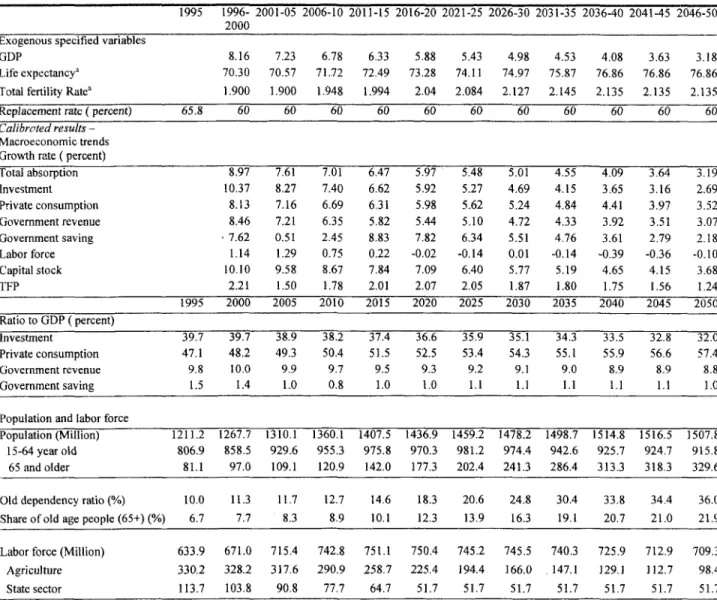
will stop growing between 2015 and 2020 and will decline afterward, but the populations age 65 and over will continue to grow. Thus, the old age dependency ratio will rise steadily from 11 percent in 1999 to 25 percent in 2030 and 36 percent in 2050. The system dependency ratio, which is currently as high as 30 percent with three workers supporting one retiree, will rise rapidly to 69 percent in 2030 and 79 percent in 2050. The pension system will be in deficit from 2000 onward, and the implicit pension debt in 2000 will be as much as 71 percent of the average annual GDP.
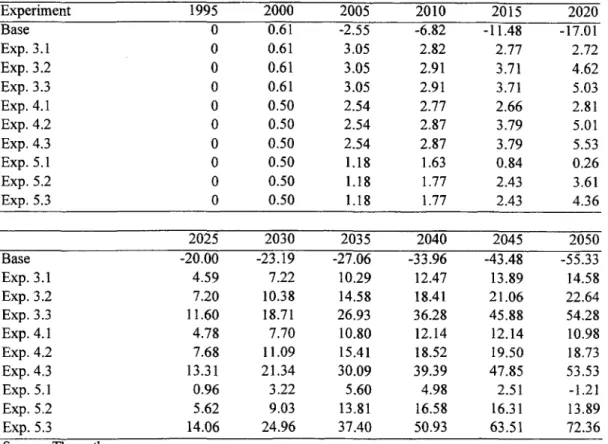
* Scenario set 1 assumes that the current system- pay-as-you-go with a notional individual account-remains unchanged. Simulation results confirm that this system is not sustainable. Expanding coverage under the current system will improve the financial situation in the short run, but it will
lead to a worsening of financial viability in the long run.
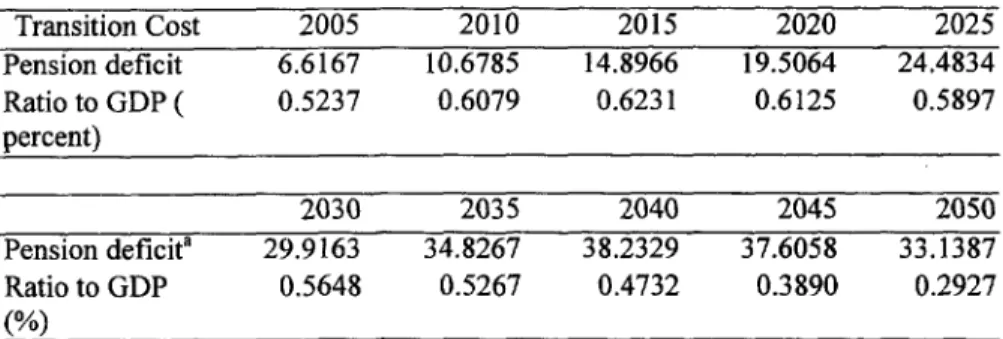
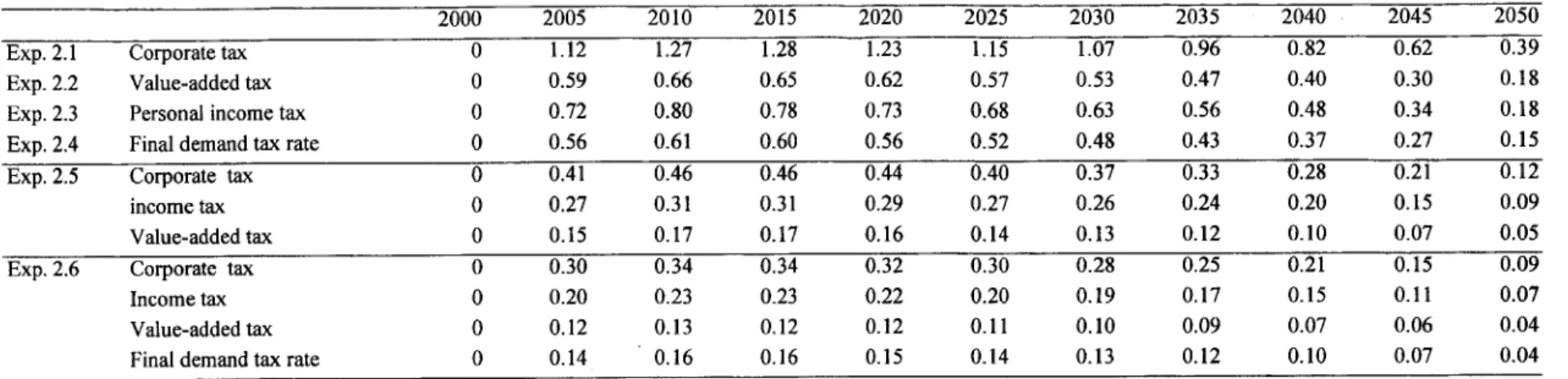
* The second set of scenarios assumes that the transition cost will be financed by various taxes, and a new fully funded individual account will be established as of 2001. Various options are considered: a corporate tax, a value-added tax (VAT), a personal income tax, and a final demand tax, and the impacts of these options are compared. The annual transition cost is estimated at around 0.6 percent of GDP between 2000 and 2010 and decline to 0.3 percent by 2050. Using personal income tax to finance the transition cost would best promote economic growth and reduce income inequality.
* Effects of the abovementioned reforms and levying a social security tax are shown in Scenario set 3. After injecting fiscal resources to finance the transition cost, the reformed public pillar becomes financially sustainable. To finance a benefit of 20 percent of average wage, a contribution rate of only 10 to 12.5 percent is sufficient to balance the basic pension pillar annually. If the retirement age of female workers is increased gradually by five years, the balanced contribution rate would be reduced to around 9 percent. In addition, if a new social security tax is levied to replace the current pillar 1 contributions, the pension system would become nationally unified and financially sustainable.
Table of Content
Pension Reforms in China and around the World Box 1. Pension reforms around the world Pension reforms in China
Implicit Pension Debt and Transition Issues in China
Box 2. Size of IPD and how to finance it: Intemational Experience
CGE Framework and Advantages
Structure of the Chinese CGE Model for Pension Reform Firm's Ownership Structure and production Domestic and Import Demand
Income Distribution and Government Policy Instruments Intra-period Equilibrium and Macro Closure
Inter-period Linkage and Recursive Dynamics Population and Labor Force Dynamics
Pension System and Transitional Cost
Simulation Design and Baseline Calibration Major Assumptions in Baseline Calibration
Simulation Scenario Design: Experiment set 1 to 5
Simulation Results
Financial Deficit of Current Pension System: Baseline Policy change under current pension system
Reform current pension system and financing transitional cost After-Reform sustainability and Levying a Social Security Tax Expanding coverage under proposed pension reform
Gradually Increase the Retirement Age
Conclusions
Tables and Charts
References
Annexes (available upon request from the authors):
Annex 1: Algebraic Specification of the Chinese CGE Model for Pension Reform Annex 2: Construction of Base Year Data Set
Implicit Pension Debt, Transition Cost, Options and Impact of China's Pension Reform
-A Computable General Equilibrium Analysis
China's population has been aging rapidly, and the burdens of supporting the elderly are distributed unevenly across regions and sectors. A serious obstacle to China's economic reform is the lack of an effective and sustainable national pension system. The World Bank's 1997 report Old Age
Security: Pension Reform in China pointed to the two major problems with China's current pension
system: the short-run problem of the pension burden of state-owned enterprises (SOEs), and the longer-term problem arising from the rapid aging of the population. Today these problems have become more severe than four years ago: for various reasons including slowing economic growth, many state enterprises have not been able to afford to pay payroll taxes and thus, pension funds in many municipalities are in deficit, which could threaten the fiscal stability of the central government as well as the local governments. ' Reforming the current pension system is now a matter of urgency.
Building on previous studies, this paper addresses the most urgent issue in China's pension reform, namely, how to finance the unfunded pension liabilities, put another way, this study investigates ways to recapitalize the pension system, which is financially nonviable. Previous studies have analyzed the problems of China's urban- and enterprise-based pay-as-you-go system and recommended a multipillar system combining social pooling and funded individual accounts, and
voluntary savings.2 Some analyses including World Bank 1997 have used actuarial models to simulate
the impacts of various pension reform options, is a partial equilibrium framework, however, and has some disadvantages as compared with a general equilibrium model.
Using a newly designed Computable General Equilibrium (CGE) model that differentiates three types of enterprise ownership and 22 labor force groups, this study estimates the effects of China's pension reform and compares various options for financing the implicit pension debt and transition cost. This study examines the impacts various reform design options would have on the sustainability of the system, on overall economic growth, and on income distribution.
Issues addressed by this paper have significant implications for China's fiscal stabilization and public sector reform and management, and for the alleviation of poverty and inequality. First, the unfunded pension liabilities represent a significant part of the direct and implicit (partly current and partly future) liabilities of the local and central governments.3 The deficit in social pooling funds in
1. Statistics from the Ministry of Labor and Social Security show that Chinese enterprises owed the government as much as RMB 38 billion (US$4.6 billion) in overdue pension contribution. Separately, it was reported that in 1999, the central government transferred more than RMB 17 billion to 25 provinces for pension payments (People's Daily 1999).
2. On China's pension reform, see, for example, Ahmad and Hussain 1991; James 1997, and 1999; Hussain 1993; China RGSSS 1995; Zhou 1994; Friedman, James, Kane, and Queisser 1996;Wang 1997; World Bank 1997, and recently Fox 2000, and Dorfman and Sin 2000.
3. Government liabilities can be classified into four categories: explicit and direct (such as formal debt, budgeted expenditure), explicit and contingent (e.g., government guarantees and deposit insurance schemes), implicit and current (e.g., social insurance expenditure), and implicit and contingent (e.g., default of SOEs, banks, and social insurance funds). See Brixi 1998.
many localities has already become a threat to local government finance. If not monitored and checked carefully, it could threaten the central government's fiscal sustainability. Second, pension reform is closely linked to restructuring of the state sector and financial sectors. It is desirable to find some synergy between the transition problems of the pension system and the state sector, as shown by international experience. All reform options involving taxation and other fonns of financing have benefits and costs; this study seeks to help making decision by comparing various reform options. Third, China's income inequality has been rising, from a Gini coefficient of 28 percent in the 1 980s to 40 percent in 1998, a trend that should not be allowed to continue (World Bank 2000).4 It is thus crucial to examine the impact of pension reform on poverty and inequality.
A major contribution of this research is combining the CGE model and population growth model into a recursive dynamic framework, which provides a new flexible tool to simulate various pension reform plans in a general equilibrium setting. Another contribution is differentiating production and employment by ownership type and organizing the demographic data in a matrix with four dimensions. Number of workers and worker income, two major variables of the pension system, have been organized in the model into a four-dimension matrix based on sector, age, sex, and
ownership of the enterprise.5
Pension reform in China and around the world
Over the next 35 years, the proportion of the world's population that is over age 60 will nearly double from 9 percent to 16 percent. Because of rapid improvements in life expectancy and declining fertility rates, populations are aging faster in developing countries than they did in industrial countries (World Bank 1994b). In China the proportion of the population over age 60 will rise rapidly from 9 percent in 1990 to 22 percent in 2030 (World Bank 1997). Based on new base year data and our estimates, China's old age dependency ratio (population 65+ /15-64 year-olds) will rise from 11 percent in 1999 to 25 percent in 2030 and 36 percent in 2050. Population aging has put severe pressure on pension systems around the world. Many countries have undertaken major or minor reforms of their pension systems. A review of the various approaches to pension reform puts China's reform into context and provides rationales for our simulation design.
Box 1. Pension reform around the world
Three criteria can be used to classify pension systems around the world: how benefits are calculated (defined contribution or defined benefit) and whether they are guaranteed by the government; how benefits are financed, funded or unfunded; and whether management of the system is public or private. Most formal pension systems are publicly managed, pay defined benefits according to a fornula, and are financed by payroll taxes on a pay-as-you-go basis, which implies that contributions made by today's workers are used to pay the pensions of today's retirees. It is now widely recognized that these systems generate many problems such as rising payroll tax rates, evasion and early retirement due to incentive problems, misallocation of public resources, lost
4Gini coefficients estimated by Chinese researchers seem to be higher, 45 percent in 1997, or 51 percent if the informal
economy is included (S. Wang 2000).
5. The database would include, for example, the following information: the total number of female workers age 30-34 employed in state-owned enterprises in the machinery sector is 356,722, and their average annual salary is RMB5122 per year.
opportunity to generate long-term savings, unintended intergeneration transfers (often to higher income groups that live longer), and the growth of a large implicit pension debt and financing gap in the face of aging population.6
To address the short-term and long-term fiscal viability problem as well as economic and distributive concerns, the World Bank (1994) has been recommending and many countries (including China) have been moving toward, multipillar systems that contain the following provision:
* A mandatory, tax-financed and publicly managed pillar for redistributive and coinsurance objectives;
* A mandatory, fully funded, defined contribution and privately-managed pillar (individual accounts) for savings;
* A voluntary, fully funded pillar funded via personal savings or commercial insurance for people who would like more protection for old age.
The multipillar pension system is defended by three main theoretical arguments that are supported by limited empirical evidence. First, it is often argued that the multipillar pension system will facilitate economic efficiency and growth, through removing labor market distortions and by providing better incentives, increased savings, and better allocation of resources (James 1999). For example, a high payroll tax could cause workers and employers to shift from the formal to the informal sector, thereby hurting productivity. Corsetti and Schmidt-Hebbel (1997) show that a payroll tax of 20 percent could lead to a 47 percent shift to the informal sector and reduce the economy-wide growth rate by more than 1 percent a year. Thus, a fully funded, defined contribution pillar would reduce this distortion: following Chile pension reform, the share of informal employment actually dropped, unemployment fell and wages rose between 1980 and 1990. Evidence is not conclusive on whether pension reform leads to a rise in national saving. Haindl Rondonelli (1996) indicates that Chile pension reform accounts for 6.6 of the 9.9 percentage point increase in the national saving rate, from 16.7 percent of GDP in 1976-80 to 26.6 percent in 1990-94. However, the fiscal cost of financing the pension transition initially may have canceled out the positive effect on private saving (Agosin et al 1996, Holzmann
1996). On the other hand, there is strong evidence of the positive effects of a fully funded second pillar (individual accounts) on financial market development, and hence on resource allocation and growth. (See, for example, Holzmann 1997a, Schmidt-Hebbel 1998, Vittas and Iglesias 1992, Vittas 1995.)
Another argument for the multipillar system is that it enhances the financial sustainability of the pension system and thereby provides better long-term protection for the elderly. Further, a multipillar system has a redistributive impact and, in particular, could improve intergenerational equity (James 1999). In principle, the entire population should have access to some old age income, at a minimum to a level above the poverty line, and all workers should have a portion of their earnings replaced, consistent with their work history and contribution. The pay-as-you-go system, however, cannot ensure the protection of the elderly and leads to unintended income transfers from the poor to the rich (who live longer). Overly generous benefits in some countries have led to unfair intergeneration redistribution, putting a heavy burden on future generations.
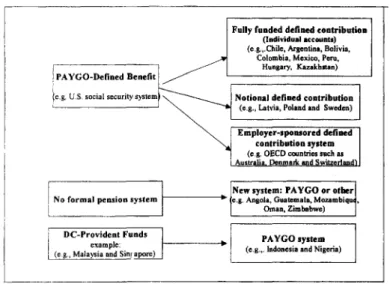
How have countries reformed their pension systems? Schwarz and Demirguc-Kunt (1999) provide a typology of pension reforms around the world. According to their classification, some 82 countries have carried out reforms, of which 21 implemented a major structural reform. Among major reformers, 10 countries are moving toward fully funded individual accounts (the Latin America model), three OECD countries are adopting an employer-sponsored, defined contribution system, and three countries (Latvia, Poland, and Sweden) are using notional defined contribution systems. Several other developing countries are moving in an opposite direction,
from defined contribution provident funds to the PAYGO defined benefit system (Figure 1).
6 These problems were recognized and analyzed by many seminal work on pension systems, for example, Aaron 1977,
Atkinson 1987, Auerback and kotlikoff 1987, Feldstein 1974, Feldstein and Samwick 1992, Seidman 1986, Arrau 1990, Kotilkoff 1995 and 1997, Holzmann 1988, James 1992 and 1994. See World Bank 1994 for a literature survey. See also Holzmann 1999 and other studies on Pension Reform Primer at www.worldbank.org/pensions.
Countries adopted differing pension reform paths based on their initial conditions and socio political situations. The pros and cons of various types of reform are discussed in detail in Schwarz and Demirguc-Kunt 1999 and James 1999. One of the factors influencing a country's choice of reform path was the size of implicit pension debt (IPD). A huge IPD forced some countries, such as Latvia, Poland, and Sweden, to adopt a notional defined contribution system (Disney 1999). Countries have used various options to finance the transition cost or IPD. These and other issues will be discussed later in the paper.
Figure 1. Classification of pension reforms/systems
Fully funded defined contribution (Indindual senants) (e.&,Clile, Argentina, Boliia,
Colombia, Mei-eo Pea', Hngagry. Ka-akhnn) , PAYGO-Defined Benefit
ke.g. U.S. social secwrity sstem \ Notional defined contribution (e.g, Ltlvia, Poland nd Sweden) K Employer-sponsored defined
contribntion system (e B OECD -oanties suhls as
l.Aootnli Deomam nd Switzerlad)
INew system: PAYGO or otber
No formal pension system e.g. Angola, G.atsnl, Moantiq Oman, Ziinb.bse
DC-Provident Funds PAYGO system
(e.g, Ma1aysia *nd Sin, a (eg., odonosia and Nigeia)
Source: Based on Schwarz and Demirguc-Kunt 1999, James 1999.
Pension reform in China
Past reforms. China used to have an urban- and enterprise-based PAYGO pension system covering
only the state sector and some large collective enterprises. After some experimentation beginning in 1982, pension reform was formally begun in 1986 when State Council Document 77 encouraged pension pooling across state enterprises on a limited basis at the municipal level, which individual contribution was implemented for contractual workers only. State Council Document 33 of 1991 called for individual contributions by all workers and encouraged experimentation including a role for individual accounts. It also, for the first time, called for the establishment of three tiers in the pension system: a basic benefit, a supplementary benefit to be provided by enterprises in sound financial condition, and a benefit based on individual saving.
Reform of 1995
In 1995 State Council Document 6 proposed two plans for the basic pension tier. Municipal and prefecture governments were given the right to select a reformn design and provincial governments the right to approve the choice. This led to a highly fragmented system in which provincial and local governments and line-ministries selected various combinations of the two plans. In collaboration with
the State Planning Commission, a World Bank mission visited 8 Chinese cities and provinces in 1995, and pointed out several problems with the new system, including:
* Fragmentation caused by wide dispersion of authority over pension policy; * Low and variable coverage;
* Inadequate pooling and portability;
High contribution rates, ranging from 10 percent (in civil aviation sector) to 29 or 30 percent in several municipalities (World Bank 1997).
The World Bank study recommended a multipillar system, which would consist of a small pay-as-you-go component for redistribution and social insurance (pillar 1), a large mandatory fully funded individual accounts component (pillar 2), and a supplemental voluntary pension accounts component funded via commercial insurance (pillar 3). Based on simulations using an actuarial model, the report proposed that pillar 1 to be financed by 9 percent of payroll tax with expanded coverage and provincial-level pooling, and that it provides 24 percent replacement rate, based on average provincial
wages (World Bank 1997, page 7). The study was optimistic, however, in its assumptions about
expanding coverage to 50 percent of township and village enterprises and other enterprises, leading to an over estimation of funds accumulated in the first and second pillars. Moreover, it could not investigate the effects of using different taxes to finance pillar 1 and transition cost, due to a limitation of the actuarial model.
Current reform and implementation
State Council Document 26 of July 1997 defined more clearly the direction of pension reform: a multi-tier pension system combining social pooling with individual account was to be instituted by 2000. Funds were to be pooled at the provincial level, with contributions from enterprises (no more than 20 percent of payroll) and individual workers (4 percent of a worker's wages, and gradually increasing to 8 percent). Pillar 1 was to be financed entirely by enterprise contributions of 13 percent, and would provide 20 percent replacement based on average wage. Pillar 2 individual accounts would be financed by individual contributions plus 7 percent from enterprises. This document provides the starting point of our policy simulation. In March 1998, a new ministry, the Ministry of Labor and Social Security (MOLSS), was established to oversee policy making for pension and other social security benefits. This has unified policymaking on pension reform with the administrative system. Several State Council documents and MOLSS decrees have been issued since 1998 to implement provincial-level pooling, and to clarify and enforce regulation of various aspects of the pension system,
such as the collection of contributions.'
But, China still has fragmented, municipality-based PAYGO system (plus notional individual accounts), that is publicly managed. This hybrid system is in the process of transition. Based on incomplete knowledge gained from interviews and seminars held with officials, China's current system has the following problems:
7
For example, State Council Notice [no. 28] on Related Issues on Implementing the Provincial Pooling of Enterprise Workers Basic Pension Insurance and Transferring Sector Pooling to Local Govemment's management (August 6, 1998); Provisional Regulation on Collection and Payment of Social Insurance Contributions (State Council Document 259); and MOLSS Decree no. I to 3 (March 1999).
* The system is stillfragmented. By mid-1999, only 5 (the provincial level municipalities Beijing,
Chongqing, Shanghai and Tianjin, plus Hainan province) of the 27, had achieved full pooling or unification. In 17 provinces small provincial adjustment funds were established using 1- 2 percent of total contributions sent from city pools. No such adjustment funds were possible for 5 provinces because of the lack of funds in municipal pools. It is reported that all 11 sectoral pools (existed until September 1998; see State Council Notice 28 of 1998) have been dissolved and are now participating in local social pooling. It is not clear, however, whether the accumulated reserves were transferred to the local pools.
* Social pooling is incomplete. In most localities, pension services are not socialized; that is,
contributions and pension expenditure are not administered separately by different agencies. An enterprise submits a net amount to the municipal pool, which equals the total contribution minus the total pension payments to retirees of that enterprise. Contribution rates vary significantly across provinces and cities and in some cases even across different enterprises.
* Coverage is narrow and uneven across regions. By the end of 1998, the basic pension insurance
system covered only 78.4 percent of workers in state-owned enterprises, 16.2 percent of workers in collective enterprises, and 5.4 percent of workers in other urban enterprises (Hang, 1999). There is no pension scheme for the urban self-employed or individual entrepreneurs. In some rural areas there is a pension scheme designed and managed by the Ministry of Civil Affairs, but the coverage
is small, and will be incorporated or merged under the MOLSS system.
* Individual accounts are largely notional. Reserves accumulated in these accounts over the past
five years have been used to pay current retirees, as the government has not made a clear decision on how to finance the transition cost.
X The funding problem is acute. Many local pension pools are financially bankrupt as compliance
rates are low and declining and the issue of how to finance the transition cost is unresolved. According to MOLSS statistics, state enterprises owe the government RMB 38 billion in pension arrears. Local governments have been using the reserves in pillar 2 to pay pensions to current retirees, leading to notional or empty individual accounts. And where funding has still been inadequate, local tax revenue has been used. The Ministry of Finance data indicates, in 1999, the MOF also transferred RMB 17 billion to 25 provinces to cover pension shortfalls in localities. The central government is in effect bailing out local pension pools, many of which are bankrupt. This trend, if unchecked, will become a threat to the fiscal sustainability of the central government.
Implicit Pension Debt and Transition Issues
Implicit pension debt (IPD) refers to the benefit promises a pension scheme makes to workers and
pensioners and is measured by adding the present value of benefits that have to be paid to current pensioners plus the present value of pension rights that current workers have already earned and would have to be paid if the system were terminated today. IPD usually is calculated under the termination hypothesis that the unfunded system is to be terminated immediately and that all pensioners and workers must be compensated for their future pensions and accrued rights. IPD, a stock concept, represents the direct and implicit liabilities that a government can predict with certainty and must include in its fiscal plans. Unlike a government's contingent liabilities (such as bailing out state banks), IPD poses no unexpected demand for fiscal expenditure.
Transition cost arises from the financing gap (a flow concept) created when expenditures to
pensioners and future retirees must continue even though part of the contributions have been diverted to funded individual accounts. Thus transition cost stems from the need to pay off, over some years, the debt of the old system. This financing gap stems from the IPD but it is not equal to the IPD, since some of the expenditures are for new obligations that accrue each day, and some of the current obligations are covered by ongoing contributions.
The size of IPD depends on many economic and demographic factors such as the age structure of covered workers and pensioners, pension system coverage, level of pension benefits, retirement age, replacement rates, indexation mechanism, and discount rates. World Bank (1997) estimated China's IPD at between 46 percent and 69 percent of 1994 GDP, based on a hypothesis that the system would be terminated in 1994. A recent estimate puts the IPD at 94 percent of the 1998 GDP ( Dorfman and
Sin 2000).
The Chinese government, reluctant to recognize explicitly the pension debt, has been looking at other options to reduce or finance the transition cost (see box 2). In fact, the government has tried to use a combination of three methods to reduce the IPD and finance the transition. First, China has kept a small PAYGO pillar, with a 13 percent of contribution and a 20 percent replacement rate (State Council document 26). About 4-percentage point of the contribution was designed to finance the
transition.8 Second, older workers were kept under the old system, which will reduce the IPD to some
extent. Third, the government did not cut pension benefits, but had hoped that expanding pension coverage would provide some extra funding, as workers in the private sector and township and village enterprises are younger.
It is now evident that these methods have not provided sufficient funding to finance the transition cost. The funding problem is acute: In 1998, 22 provincial pension pools had deficits amounting to RMB4.2 billion, and the other 10 provinces had RMB2.7 billion in surplus (Hang, 1999).9 By the end of 1998, total reserves in the basic pension system (pillars 1 and 2) amounted to RMB58.7 billion, which was distributed unevenly. Five coastal regions, Guangdong, Jiangsu, Shanghai and Zhejiang accounted for RMB26.7 billion; 21 provinces had only RMB31.1 billion; and five provinces had no reserves (Hang, 1999). In 1999 the situation worsened and the central government had to step in to provide funding for pension payments in 25 provinces. Obviously, extra funding resources must be found to finance the transition cost.
Based on international experience, several options can be considered by Chinese policymakers: * Reduce IPD by downsizing the existing system and reducing benefits,
* Use asset-debt swaps during corporatization or privatization of SOEs, * Use general tax revenue or issue debt.
A recent World Bank study further specified options to finance the transition costs which include (i) financing from general revenues or dedicated Social Security taxes; (ii) financing from central and/or
s According to World Bank 1997, 9 percent of payroll tax/contribution is sufficient to finance a small PAYGO pillar with a benefit level of 24 percent of provincial average wage (replacement rate). In State Council document 26, the contribution rate of 13 percent is obviously more than enough for a modest 20 percent benefit. The extra 4 percentage points in payroll
tax was designed to finance the transition cost.
9 However, since there is no national pooling, the central government cannot use the surpluses in several provincial pools. These surplus pools are located in the coastal region.
local government debt issuances; (iii) using proceeds of selling SOE or other assets; and (iv) increasing in salary-linked contribution rates (p.3, Dorfman and Sin 2000).
In this paper, we focus on the option of using various taxes to finance the transition cost. But it is still feasible to use proceeds from corporatization or privatization: Chile used proceeds from privatization to finance its transition cost from pension reform. The Bolivia government use proceeds from the privatization of its six largest state enterprises to establish a flat minimum pension for everyone. Though the benefit is low, it reaches the poorest and most vulnerable group in the countries-the elderly poor who cannot save for retirement.
Policymakers worry that corporatization or privatization will cause asset stripping from the State. State assets, if sold at their market prices, will not decline in value but only change composition, from physical assets to cash or revenue. The state can decide how to use this privatization revenue, whether to reduce its debt or invest in other projects. Hungary, for example, used the proceeds from privatization to repay its foreign debt and the subsequent reduction of interest payments and upgrading of the country's sovereign ratings have benefited the entire population (Komai 2000). China could still consider using some of the proceeds from corportization to repay its pension debt. This could be accomplished by taxing the IPO proceeds of those publicly listed companies, and using the revenue to set up a national pension adjustment fund, which could be either centrally managed or by private fund managers through competitive bidding (as in Bolivia). This topic, while extremely interesting, is beyond the scope of the present paper. '
Box 2. How to finance IPD: International experience
The size of IPD is affected by factors such as the pension system, pension benefit levels, retirement age, replacement rates, indexatior mechanism, and discount rates. It depends on the age distribution of the covered population and on a set of assumptions about economic and population growth, wages growth, vesting rules, and future rules of the pension system. In OECD countries IPD ranges from 100 percent to 200 percent of GDP (Table 1). The IPD estimated for Chile at the time of its reform (1981) was between 40 and 130 percent of GDP, depending on the discount rate used. In Hungary and Uruguay, which have high coverage, high system dependency ratios, and generous benefits, IPD was more than 200 percent of GDP.
Box Table 1 Implicit pension debt' and pension reform
Countries that have IPD as a percentageReforming IPD as a percentage Size of new
not reformedb of GDP countriesc of GDP public pillard
Senegal 27 El Salvador 35 LO
Mali 26 Peru 37 LO
Burkina Faso 15 Colombia 40 LO
Venezuela 30 Mexico 42 LO
Cameroon 44 Bolivia 48 LO
10 Readers interested in this topic may consult, among others, Dorfmnan, Lorch and Zhang 2000 "Linking Pension Reform and State Enterprise Reform in China", Alfonso C. Revollo, 2000 on the Bolivian experience..
Congo 30 Argentina 86 MED
Brazil 187 Kazakhstan 88 LO
Turkey 72 Chile 100 LO
Albania 67 Australia' 115 MED
China- 1994 46-69 United Kingdom' 184 MED
China-1998 94 Netherlandse 188 MED
Ukraine 141 Denmark' 189 MED
Switzerland 189 MED
United States 113 Sweden 210 HI
Japan 162 Hungary 213 HI Germany 157 Uruguay 214 HI France 216 Poland 220 HI Italy 242 Croatia 350 HI Canada 121 Note:
a. IPD is the present value of the accrued rights of pensioners and workers, under old system. b. Sources: Kane and Palacios, Finance and Development, June 1996, p. 38.
Robert Palacios for Albania, Cheikh Kane for Burkina Faso, Congo, Mali;
Paul Van der Noord and Richard Herd, Pension Liabilities in the Seven Major Economies, OECD 1993 for OECD Countries. World Bank 1997 for China-1994; Dorfman and Sin 2000 for China-1998 estimates.
c. Estimates by James based on current public expenditure. Details available upon request.
Hungary, Peru and Uruguay are taken from Kane and Palacios, Finance and Development, June 1996, p. 38. d. LO: minimum pension guarantee, financed out of general revenues (except Bolivia).
e. MED: flat (or compressed) public pillar and means-testing, usually financed out of general revenues. HI: large eamings-related public pillar, financed out of payroll tax.
f. Old system featured universal benefits financed out of general revenues, not out of earmarked payroll taxes. Hence, the IPD owed as repayment of past contributions is less applicable.
There are three principle ways to finance transition: cutting the size of IPD, finding special assets, and using taxation or issuing debt.
Reduce the value of IPD:
* Downsize the old system by reducing benefits, raising retirement age,
* Recognize past service cautiously through a recognition bond to be cashed upon retirement. The face value of the bond can be reduced if workers have confidence in the new system and young workers will be better off even without compensation for their past contributions. Mexico gives workers the right to return to the old system at the time of their retirement, if this would improve their welfare.
* Make only a partial switch to the new defined contribution system. Keep some workers in the old system, thus reducing the financing gap.
* Retain a PAYGO public pillar in the new system. Find special revenue sources:
* Use social security surplus, if there is a pre-existing reserve in the social security system. The U.S. social security trust fund can be used in this way.
* Use Asset-debt swaps. If public enterprises are being privatized, some of the proceeds can be used to pay off the pension debt. Bolivia, Peru and Poland, have used this strategy. Bolivia used proceeds from the
privatization of its six largest state enterprises to set up a pension fund and provide a flat pension for everyone. The fund is managed by two intemational fund managers selected through competitive bidding on administrative costs.
* Reduce evasion and increase coverage. This can only provide a temporary financing source, however.
Use general taxation and borrowing
* Cut other public expenditures to build a budget surplus, which can be used to cover the financing gap. * Issue general treasure debt to cover the remaining cash gap in the short run.
* Pay off explicit pension debt through taxation.
Source: based on James 1999.
CGE framework and its advantages
There has been a great deal of academic interest in analyzing and evaluating pension reform policies quantitatively. M. Feldstein (1974) pioneered the use of mathematical tools for describing aggregate capital accumulation in a social security system. Thomas J. Sargent and his colleagues (1995) used a rational expectation model to examine the impact of pension fund system. Laurence Seidman (1986), Patricio Arrau (1990), Laurence Kotilkoff (1997) and many others have advanced significantly the study of pension systems in recent years. The World Bank has developed a user-friendly computer program to calculate the effects of pension fund collection based on an actuarial model (Pension Reform Options Simulation Toolkit, PROST). While their research has provided important theoretical guidelines in this area, there have been repeated calls for more quantitative studies on social security to assist in the design of reform strategies.
Many quantitative studies in the past have relied on partial equilibrium analysis. For example, prices and wages were assumed as fixed: changes in the pension system would have no effect on the price level of products and input materials, no effect on the wage level of workers, no effect on the labor supply and demand, no effect on the structure of the economy and so on. In addition, these studies did not investigate the substitution effects between products and factors, nor did they consider the subsequent intersectoral reactions.
The Computable General Equilibrium model (CGE), which incorporates the fundamental general equilibrium links among production structure, pattern of demand, and incomes of various groups of households, has been widely used for economic policy analysis. Recent literature indicates a rapidly growing interest in these models. For instance, CGE models have been used to analyze the effects of various trade policies (J. Shoven and Whalley 1992), tax and fiscal policies (J. Piggott 1985), energy policies (T. Kehoe, 1992), and so on. Ayse Imrohoroglu, S. Imrohoroglu, and Duglas Joines (1992) used the CGE model to conduct a life cycle analysis of the U.S. social security system.
Employing the CGE model to analyze the impact of pension reform has the following advantages: First, the CGE model offers theoretical consistency. It can be thought of an incorporating particular specifications of production and demand functions in the well-known Arrow-Debreu general equilibrium framework. An economy wide consistency check can be performed by means of Walras' Law. Second, CGE models impose accounting consistency. A CGE model usually builds on a closed accounting system such as a social accounting matrix, which details all the basic identities for the
modeled economy. Therefore, there can be no sources of supply other than domestic production, inventories, or imports, and no destination of demand other than consumption, investment, inventory accumulation, and exports. Third, CGE models can provide much more concrete welfare analysis than other methods. Since any policy change has welfare consequences, properly measuring changes in welfare is important for policy evaluation. A multisector, multihousehold apparatus is justified because it generates such measures. Since CGE models can provide estimates of welfare effects in such complicated situations, they have been used extensively over the past two decades to evaluate pension reform programs. See concluding remarks on weaknesses.
Actuarial models and CGE models are complementary to each other. Both can be useful in building a bridge between economists and decisionmakers, and in providing them with a basis for dialogue and policy analysis. When policymakers need to look at links between pension reform and macroeconomic variables, CGE models are required. For pension system design issues, actuarial models should be used. Clearly, in order to analyze pension reform in China, significant innovation in the CGE model is needed and this innovation is possible because of the structural flexibility of CGE
models.
Structure of the CGE Model for Social Security Reform in China
Building on a long tradition of multisector CGE models used in analyzing trade and public policies (Dahl, Devarajan and Wijnbergen, 1986; de Melo and Tarr 1992; Beghin and others 1994; Garbaccio 1994; Wang and Slagle 1996; Wang 1997; Wang and Zhai 1998), our model is recursive dynamic and has the following features." It differentiates production and employment among three types of ownership, divides labor inputs into 22 age and gender groups, and has a built-in module on population dynamics and labor supply. The model includes ten production sectors, eight representative households, and is specified and solved in levels.'2
Firms' ownership structure and production
Assume that three types of firms'3 exist in each of the productive sectors: state-owned enterprise,
private and individual-owned enterprises 14, and other non-state-owned 5. Each firm produces only one
" For a survey of the literature on the application of CGE models in public policy, see Pereia and Shoven 1988, for
application in developing countries, see Robinson 1992; for application in on trade policies, see Garbaccio and Plummer
1997.
12 The model is implemented using the General Algebraic Modeling System (GAMS; Brooke, Kendrick, and Meeraus,
1988). Because of space limitation, only a description of the major characteristics of the model is presented. A detailed algebraic specification is available from the authors upon requests.
13 The Chinese economy is a mixed economy under transition. The state sector still plays an overwhelming role in
production and employment, and the non-state sector is expanding rapidly, consisting of village and township enterprises, joint stock companies, foreign joint venture companies, and private enterprises, as well as farm households in agriculture. Since 1997, the non-state sector has accounted for 74.5 percent of China's total industrial output and 72.2 percent employment. However, to avoid serious disruption of the economy, the share of state sector will be reduced gradually. This means that the multi-ownership structure of enterprises will persist for quite some time. Corresponding to this ownership structure, China's old pension system covers only part of state-owned enterprises. Thus, effective analysis of pension system reform and altemative scenarios of financing transition cost in such an economy will require a model that differentiates production and employment by ownership types.
product. Production by each firm uses primary factors and other products (both domestic and imported) as variable inputs in a cost-minimizing way, and is characterized by a multilevel nesting of constant elasticity of substitution (CES) functions. At the first level, firms are assumed to use a composite of primary factors, i.e., value-added and an aggregate intermediate input according to a CES cost function. Technology in all sectors is assumed to exhibit constant returns to scale, implying constant average and long-run marginal costs. At the second level, the division of other intermediate demand is assumed to follow a Leontief specification; therefore, there is no substitution among other intermediate inputs. At the same level, the value-added bundle is divided between land-capital and aggregate labor bundles, which are further split into three age groups - old, middle-age and young labor. Agricultural land and physical capital inputs are at the third level. In the fourth and fifth nests,
each aggregate labor age group is further divided into detailed age and gender groups16. All composite
bundles in each nest are assumed to substitute smoothly in a CES cost function. The degree of substitutability among them depends on their base year share in production costs and on the elasticity of substitution, which is assumed to be constant. Each firm allocates its production output between domestic sales and exports to the world market to maximize profits, subject to imperfect transformation between the two alternatives. Domestic sales and exports produced by different types of firms are assumed to be imperfect substitutes, a CES aggregation function with relatively high substitution elasticity is used to capture this property. In other words, buyers in both domestic and world markets choose a product mix among goods produced by the three types of firms within the same sector to minimize their cost.
Agricultural land as a sector-specific factor is used only in agricultural production, physical capital is ownership-specific, but mobile between sectors, while labor force is not only mobile across sectors, but also free to move among different ownership firms.
Domestic and import demand
Agents are assumed to consider products from domestic supply and imports as imperfect substitutes (the Armington assumption). The eight representative households (low, middle-low, middle, middle-high, and iiigh income households in urban areas and low, middle, and high income households in rural areas) are assumed to maximize a Stone-Geary utility function over the 10 composite (Armington) goods, subject to their budget constraints, which leads to an extended linear expenditure system of household demand functions. Household savings are treated as a demand for future consumption goods with zero subsistence quantity (Howe 1975). A household-specific, aggregate consumer price index is specified as the price of savings. It represents the opportunity cost of giving up current consumption in exchange for future consumption (Wang and Kinsey 1994). Other final demands, including public spending and investment demand, are based on constant share functions that fix their structure in real terms. The intermediate inputs for the firms, household consumption, and other final demands constitute the total demand for the same Armington composite of domestic products and imported goods from the rest of the world. A CES aggregation function is specified for each composite commodity. The total demand is divided between domestically produced
15 These include urban collective firms, rural collective enterprises, joint stock companies, and foreign joint venture
companies.
16 Workers aged 15 to 34 are classified as young labor, workers age 35 to 49 are classified as middle-age labor, and workers
and imported goods according to cost minimization. However, changes in stock are assumed as a demand for domestic products only.
Income distribution and government policy instruments
Production generates income, which is distributed to four major institutions, namely, enterprises (corporations), households, the government, and extra-budget public sectors. Corporate earnings equal a share of gross operating surplus, i.e., sum of capital remuneration across all sectors, minus corporate income taxes. A part of net company income is allocated to households as distributed profits based on fixed shares, which are the assumed shares of capital ownership by households. Another part of net company income is allocated to extra-budget public sectors as fee. Retained earnings, i.e., corporate savings for new investment and capital depreciation replacement, equals after-tax company income minus the distributed profits and fee.
Household income consists of labor earnings and the returns from land and capital the household owns. Additionally, households receive pension benefits, transfers and subsidies from the government, and remittances from the rest of the world. Household disposable income equals the sum of household income from different sources less various taxes.
The government derives revenues from direct corporate and household income taxes, import tariffs, and various types of indirect taxes. Subsidies and export tax rebates enter as negative receipts. There are three types of indirect taxes in the model. The value-added tax, which is the most important part of indirect tax in China after 1994 tax reform, is treated as a tax levied on production factors; its revenues equal total sector value-added multiplied by a tax rate. The value-added tax is also levied on imports while firms obtain rebates when they export. The second indirect tax, a sales tax, includes household consumption taxes and other final demand taxes. The tax rate constitutes the difference between the aggregate Armington prices and prices of various final demands. The other indirect tax, including various agricultural taxes, and business taxes on construction and services, is treated as a production tax levied on sectoral outputs.
All tax rates are taken as parameters in the model. However, they can be endogenized to meet government fiscal targets, in which case those adjustment parameters associated with each type of taxes become endogenous. They shift in or out to achieve government budget balance. Otherwise, the tax schedules are exogenous and the adjustment factors remain at their initial value of one. An adjustment factor on government transfers, similar to the adjustment factors on other taxes, provides another fiscal instrument to achieve a specified budget target.
Extra-budget public sectors collect fees from enterprise and households. Their income is allocated to consumption and saving. The spending by extra-budget public sectors and government constitutes public consumption, one type of the final demands.
Intra-period equilibrium and macroeconomic closure
Equilibrium is defined as a set of prices and quantities for goods and factors such that (a) demand equals supply for all goods and factors; (b) each industry earns zero profit; and (c) gross investment equals aggregate savings, which is the sum of domestic savings plus foreign capital inflows.
Macro closure in a CGE model involves both macroeconomic accounting balances and assumptions about adjustment behavior when imbalance induced by external shock.
There are three major macroeconomic balances in the model: (a) the government budget, (b) aggregate savings and investment, and (c) the balance of payments. In the benchmark equilibrium all these three accounting balances hold. The behavioral aspect of macro closure involves choosing a mechanism by which macroeconomic balances are brought back into equilibrium when exogenous shocks disrupt the benchmark during an experiment. Thus, a macroeconomic scenario is imposed on the CGE model, and then the sectoral implications of the assumed macroeconomic behavior can be traced out (Devarajan, Lewis, and Robinson 1990). Because such an adjustment is not based on intertemporal optimizing behavior by rational agents, different assumptions about the adjustment process may lead to different results.
Two government closure rules are implemented. Under the first rule, government savings is fixed at its baseline value and one of the taxes, or government transfers to households, is allowed to adjust to achieve the government fiscal target. Under the second closure rule, all tax levels and transfers are fixed, while real government savings is endogenous. This latter rule has significant impact on the level of investment because investment is driven by savings in the model. The total value of investment equals total resources allocated to the investment sector; it includes retained corporate earnings, total household savings, government savings, extra-budget savings, savings from pension funds and foreign capital inflows.
Given China's small trade share in the world, a small-country assumption is used for imports, i.e. we assume that the local consumption of imports does not affect the border price of imports. Exports are demanded by the rest of the world according to constant-elasticity demand curves, the price elasticity of which are high but less than infinite (Pomfret 1997). An exchange rate is specified to convert world prices into domestic prices. Either this exchange rate or the balance of payment can be fixed while the other is allowed to adjust, providing alternative closure rules.
Since the purpose of this paper is to estimate the implicit pension debt, and goverunent options in financing the transition cost, we keep the domestic savings and investment gap constant in all the simulations conducted. This is achieved by keeping the balance of payments and real government spending; except pension expenditure, fixed as share of GDP. In such a way, macroeconomic rigidity is imposed on the model. If government pension expenditure changes from the baseline because of an increase in government pension payment, an increase in government tax earnings must be implemented or a government deficit will occur. By a macroeconomic identity, this closure implies that a constant sum of domestic savings and taxes in real terms is needed to finance both real investment and real government expenditures. Thus, any changes in real gross domestic product (GDP) are induced by changes in real absorption, i.e., household consumption plus other final demand, thus making it easy to compare the efficiency impacts of different simulations.
Inter-period linkage and recursive dynamics
The intra-period equilibrium is solved recursively from 1995 to 2050. Between each two periods, dynamic growth in the model originates from three sources: rate and demographic structure of labor force growth, accumulation of physical capital stocks, and improvement of total factor productivity.
A built-in population and labor supply projection submodel generates the labor force growth rate and its demographic structure. It also takes participation rates by age and gender into consideration. A detailed description of this submodel will be given in next section.
Capital stock in each simulation period equals last period's capital stock plus gross investment minus depreciation. No optimal behavior is assumed for investment and capital accumulation. All net investments in the previous period are assumed to become new production capital in the next period.
Accumulation patterns for capital stock depend upon the depreciation rate and gross investment rate, which is set exogenously as a percentage of GDP. However, household and corporate savings, government surplus (deficit), and foreign capital inflow (foreign savings) are assumed to be perfect substitutes and collectively constitute the sources of gross investment.
Household saving decisions are endogenous in the model. It represents future consumption goods for the household with zero subsistence quantity (by assuming intertemporal separable preferences, ELES demand system). Government saving (deficit) is fixed and growth is at the same rate as real GDP.
In calibrating the baseline scenario, two economy wide, ownership-specific (one for SOEs, and one for IPEs and NSEs) Hicks-neutral efficiency factors are determined endogenously to obtain a pre-specified growth path of real GDP and total employment in SOEs. When alternative scenarios are simulated, the two TFP growth rates are set exogenously, while the growth rate of real GDP and the total employment in SOEs are solved endogenously.
Population projection and labor force dynamics
The sustainability of a pension system is closely related to the demographic structure of the labor force, which depends largely on the dynamics of population growth. Correctly modeling the structure and trend of population and labor force growth is a necessary condition for any successful pension reform design and analysis. Therefore, a population dynamics and labor supply submodel is an
indispensable component of the CGE model for China's pension reform.
Our population projection model is based on the deterministic difference equation model developed by Leslie (1945), which has been used widely in mathematical demography and population dynamics studies. In such a model, China's population is taken as a whole, all factors that influence population growth, such as fertility and motility rate, are defined in terms of statistical means. We assume that changes of time, birth, and death are the three major determinants of population growth. The influence of other social and economic factors is implicitly included in those three determinants. Economic growth is assumed to affect fertility rate and motility rate through exogenously specified total fertility rate and life expectancy changes. We do not consider migration as a determinant because the number of immigrants is very small compared with China's huge population.
Newborn population equals the number of women at their fertility age (age 15 to 49) multiplied by the corresponding fertility rate. The population in each age group equals previous year's population at the next younger age group multiplied by the corresponding motility rate. There will no people live longer than 100 years. Fertility and motility rates, proportion of each gender in the newborn population, and base year population demographic distribution can be obtained from population survey data.
Labor supply at each age (15-70) for a given year equals the population in that age group for that year multiplied by a labor participation rate, which is gender and age specific. These specified labor forces are then aggregated into the 22 groups of labor inputs specified earlier in the cost and labor demand functions. We assume that workers start to retire at age 40. The total new retirees in a given year is the sum of all surviving workers age 40 and over multiplied by a retirement rate that is gender and age-specific. The total retiree in a year is the sum of the surviving retirees from all previous
years plus new retirees'. Retirees are differentiated by ownership type. This enables the pension system in the model to reflect the fact that pension coverage for workers differs among ownership types of
firms in China.
Pension system and transitional cost
Pension system in the model consists of three different pension schemes that represent the actual pension institution in current China. The three pension schemes are provided only to SOEs and urban NSEs 7. IPEs and rural NSEs are not covered by any pension system. The first two pension schemes are pillar 1 and pillar 2 of the social pooling PAYGO system, respectively. Pillar 1 is called the basic social pooling fund, which receives contributions from enterprises and provides a replacement rate of 20 percent of final wages. The contribution rate for pillar 1 is 13 percent of a worker's wage. Pillar 2 is a mandatory individual account funded through a combination of employee and employer contributions. 11 percent of a worker's wage goes toward the individual account. Given that the fund in individual accounts is managed publicly together with the pillar 1 fund, and most individual accounts are empty, the individual accounts of pillar 2 are notional. Furthermore, because this system has been implemented gradually and very recently, and most retirees in the near future will not have accumulation in their individual accounts, retirees' pension benefits under pillar 2 are not defined based on their contributions to the individual accounts. Thus, pillar 2 is also specified as a
defined benefits PAYGO system with an assumed replacement rate of 40 percent1 8. Pension
contribution in these two pillars is implemented through payroll tax. Payroll tax for employees is considered a wage tax, and is levied on employees' labor income, while payroll tax for employers is levied on the capital income of enterprises.
The third pension scheme is provided to retirees not covered by the social pooling pension system. It is assumed to be an enterprise-based PAYGO system. Pension benefits in this scheme are fixed at a base-year level, which is sector- and ownership-specific. The contribution to this scheme is endogenously equal to pension expenditure and is levied on the capital income of the enterprise. All pension benefits in the three pension schemes are indexed by an economy- wide consumer price index.
Pension fund savings or deficits in pillar 1 and pillar 2 is the difference between pension revenue and pension expenditure in each of the two pillars. Pension fund saving or deficit, government saving or deficits, and the savings or deficits of extra-budget public sectors make up the aggregate public saving or deficit. A variable for government transfers to pension funds is entered into the saving-deficit equation of pillar 2, which is fixed at zero. But it can be endogenous when the saving or deficit of pillar 2 is set exogenous. In such cases, government transfers to pension funds are adjustable to achieve the balance of pension funds in notional individual accounts.
The model traces the accumulation of pension fund savings and deficits, which constitutes pension fund reserves and debts. The interest income and payments of a pension fund reserve and debts are assumed to be the revenue of pillar 1. An initial interest rate of 5 percent is assumed for the base year. The change in the interest rate is determined by the change of the average return of capital.
This study uses two measures related to transition: implicit pension debt (IPD) and transition cost. IPD, a stock concept, is the present value of total implicit pension obligations to current pensioners and current contributors if the current PAYGO system have to be stopped. Different from
17 We assume a constant share of the urban NSE workers in total NSE workers.
18 The final benefit received in individual accounts would depend on the length of work and amount of contribution to this
system and on how the money is invested. Officials in China estimated that on average the accounts would provide a replacement rate of at least 38.5 percent of final wages.