Artist-Programmers
and
Programming Languages for the Arts
Christopher Alex McLean
esis submied to Goldsmiths,
University of London,
for the degree of Doctor of Philosophy.
October 2011
Dedicated to Jess, Harvey, Mum, Dad, Andrea and Stuart and the rest of my family, to whom I owe everything, and with the memory of those who supported this work but passed away before seeing its end, namely my Father-in-Law Dr. David Elmore, and
Abstract
We consider the artist-programmer, who creates work through its description as source code. e artist-programmer grandstands computer language, giving unique vantage over human-computer interaction in a creative context. We focus on the human in this relationship, noting that humans use an amalgam of language and gesture to express themselves. Accordingly we expose the deep relationship between computer languages and continuous expression, exam-ining how these realms may support one another, and how the artist-programmer may fully engage with both.
Our argument takes us up through layers of representation, starting with symbols, then words, language and notation, to consider the role that these representations may play in hu-man creativity. We form a cross-disciplinary perspective from psychology, computer science, linguistics, human-computer interaction, computational creativity, music technology and the arts.
We develop and demonstrate the potential of this view to inform arts practice, through the practical introduction of soware prototypes, artworks, programming languages and im-provised performances. In particular, we introduce works which demonstrate the role of per-ception in symbolic semantics, embed the representation of time in programming language, include visuospatial arrangement in syntax, and embed the activity of programming in the improvisation and experience of art.
Anowledgements
I must first thank Geraint Wiggins for his aentive supervision, mentorship and insights, help-ing me along a fascinathelp-ing journey. I have greatly benefited from his strivhelp-ing focus on honest, rigourous research, and I do not doubt that his support through MSc and PhD research required a leap of faith on his part, showing both an open mind and deep generosity. My thanks extend to all the other members of the Intelligent Sound and Music Systems group for daily lunchtime discussions on all things, I thank you all and must name my co-supervisor Mark d’Inverno, my collaborator Jamie Forth, and also Daniel Jones for his generous and detailed criticism. My thanks extend further to envelop the department as a whole, including Tim Blackwell, Mick Grierson, Janis Jefferies, Frederic Leymarie and Robert Zimmer for their encouragement and support. It has been a great privilege to work amongst such creative minds.
e path leading to this thesis really began in the year 2000, when Adrian Ward encouraged me to experiment with algorithmic composition. We formed the generative music (and later, live coding) band Slub, joined by Dave Griffiths. Many of the ideas explored here have roots in this collaboration, and I cannot bear to imagine life without Slub. My thanks to both.
My forays into Electronic and Soware Art also paved the way to the present work, made possible with the support, encouragement and collaboration of Saul Albert, Amy Alexander, Geoff Cox, Olga Goriunova, Douglas Repeo, EunJoo Shin and Alexei Shulgin. My journey into research also received great support from my former colleagues at state51, particularly Paul Sanders, who has always been generous with rich ideas, encouragement and criticism. ank you all.
He may not remember, but my first thoughts about a research degree were planted by Rob Saunders, the AI and Creativity researcher. We have hardly crossed paths since, but without his encouragement I may not have made the leap. Following this, Simon Emmerson was extremely supportive, including helping secure funding for my MSc, making the whole thing possible. anks both.
Speaking of which, I must also sincerely thank the PRS Foundation for funding the fees for my MSc in Arts Computing, and the EPSRC for the full funding of my PhD studentship. It is
wonderful that these great institutions fund unusual areas of research.
e final stage of writing up the present thesis was completed within the OAK group at the University of Sheffield, special thanks go to Simon Tucker and Fabio Ciravegna for helping make the transition from research student to researcher so enjoyable.
I have met with many influential minds over the last four years, more than I could list here. But I really must thank Sam Aaron, Sarah Angliss, David Bausola, Renick Bell, Vaughan Bell, Ross Bencina, Alan Blackwell, Graham Booth, Ollie Bown, Andrew Brown, John Burton, Arturo Castro, Graham Coleman, Christof Damian, Eleanor Dare, Ben Fields, Philip Galanter, Joel Gethin-Lewis, Bruno Gingras, Sam Freeman, Mahew Fuller, Alex Garacotche, Enrico Glerean, Jake Harries, Cormac Heron, Sco Hewi, Tom Holley, Sampath Jagannathan, Sergi Jorda, Ryan Jordan, David Lewis, or Magnusson, Charles Mahews, Jon McCormack, An-drew McFarland, Daniel M¨ullensiefen, Rob Myers, Eric Namour, Ashraf Nehru, Julian Oliver, Fredrik Olofsson, Irini Papadimitriou, Rob Partington, Aneeta Patel, Marcus Pearce, Hester Reeve, Christophe Rhodes, Chris Roast, Julian Rohrhuber, Olivier Ruellet, Ash Sagar, Andrew Sorensen, Dan Stowell, Andy Studer, Patrick Tresset, Kassen Oud, Michele Pasin, Juan Romero, Ge Wang, Mitchell Whitelaw, Sco Wilson, Mahew Yee-King, and everyone in Dorkbot, eu-gene, openlab, POTAC and TOPLAP.
I must also thank those who having bought me drinks, proofread my work, shared their ideas and/or offered helpful advice, have failed to find their name above. My special thanks to you, and I apologise for forgeing about you at this crucial moment,especiallymy friend and collaborator Nick Collins, I have reached this point only by relying upon Nick as a deep well of inspiration and enthusiasm over the past 10 years, and he really deserves beer.
Finally I would like to thank Jess Elmore for her understanding and support, and our son Harvey McLean. Harvey is one month older than my PhD studentship, and his speedy develop-ment into a walking, talking, loving and complaining human being has been extremely useful in keeping me alert to the passing of time.
Contents
1 Introduction 13
1.1 Artist-Programmers . . . 14
1.1.1 Computer art . . . 14
1.1.2 Generative vs Soware art . . . 16
1.1.3 Discussion . . . 17
1.2 Programming Languages for the Arts . . . 17
1.3 Aims . . . 18
1.4 Structure . . . 18
1.5 Original contributions to knowledge . . . 19
2 Symbols 20 2.1 Situating symbols . . . 20
2.2 Symbols in cognition . . . 23
2.2.1 Mental imagery . . . 24
2.2.2 Mental Imagery and Programming . . . 26
2.2.3 Dual Coding in Source Code . . . 27
2.2.4 Language and Situated Simulation . . . 29
2.2.5 Conceptual Spaces . . . 30
2.2.6 Metaphor . . . 32
2.3 Anthropomorphism and Metaphor in Programming . . . 33
2.4 Synaesthesia . . . 35
2.5 Artistic synaesthesia? . . . 36
2.6 Acid Sketching – Semantic Imagery . . . 38
2.7 Phonemes . . . 40
2.8 Microphone . . . 41
C
3 Words 45
3.1 Perceiving Speech as Movement . . . 46
3.2 Vocable Words in Music Tradition . . . 48
3.3 Timbre . . . 51
3.3.1 Multi-Dimensional Scaling . . . 52
3.3.2 Grounding Timbre in Movement . . . 53
3.3.3 Music of Timbre . . . 54
3.3.4 Defining Timbre . . . 56
3.3.5 Timbral analogies . . . 57
3.3.6 Sound source modelling . . . 58
3.3.7 Universality of Timbre . . . 58
3.4 Articulation . . . 59
3.4.1 Rhythm in Speech . . . 60
3.4.2 Sound poetry . . . 60
3.4.3 Words in Music Technology . . . 61
3.5 Vocable synthesis . . . 62
3.5.1 Babble - vocable Karplus-Strong synthesis . . . 63
3.5.2 Mesh - vocable waveguide synthesis . . . 64
3.5.3 Vocable manipulation and analysis . . . 66
3.6 Discussion . . . 66
4 Language 68 4.1 Natural and Computer Language . . . 68
4.2 Music, Language and Cognitive Semantics . . . 72
4.3 Declarative vs Imperative . . . 75
4.4 Domain Specific Language for Paern . . . 77
4.5 Tidal . . . 79
4.5.1 Features . . . 79
4.5.2 Representation . . . 81
4.5.3 Paern generators . . . 83
4.5.4 Parsing strings into polymetric paerns . . . 84
4.5.5 Paern combinators . . . 86
4.6 Open Sound Control paerns . . . 90
4.6.1 Scheduling . . . 91
4.6.2 Sending messages . . . 91
C
4.6.4 Future directions . . . 92
4.7 Discussion . . . 93
5 Notation 95 5.1 Cognitive Dimensions of Notation . . . 95
5.2 Notation in Time . . . 97
5.3 Visual notation . . . 101
5.3.1 Patcher Languages . . . 102
5.4 Notation and Mental Imagery . . . 103
5.5 Geometry in Syntax . . . 104
5.6 Visual Programming with Texture . . . 107
5.6.1 Geometric relationships . . . 108
5.6.2 User Interface . . . 110
5.6.3 Texture in Practice . . . 110
5.6.4 Cognitive Dimensions of Texture . . . 112
5.6.5 Future directions . . . 113
5.7 Discussion . . . 114
6 Creativity 115 6.1 Programmer culture . . . 115
6.2 Concepts in creative behaviour . . . 117
6.3 Creative Processes . . . 118
6.3.1 Creative Process of Bricolage . . . 122
6.4 Symbols and Space . . . 123
6.5 Components of creativity . . . 124
6.6 Programming in Time . . . 127
6.7 Embodied programmers . . . 128
6.8 Live Coding in Practice . . . 129
6.8.1 “Obscurantism is dangerous. Show us your screens.” . . . 131
6.8.2 Cognitive Dimensions of Live Coding . . . 132
6.9 Live coders on computational creativity . . . 133
6.9.1 e subjects . . . 134
6.9.2 Creating language . . . 134
6.9.3 Code and style . . . 134
6.9.4 Live coding as a novel approach . . . 135
C
6.9.6 Discussion . . . 137
6.10 Slub . . . 138
6.10.1 Reflections following a Slub performance . . . 140
6.11 Discussion . . . 142
7 Future directions 144 7.1 e Freedom of Interpretation . . . 144
7.2 Soware engineering standards . . . 146
7.3 Cyclic revision control . . . 147
7.4 Conclusion . . . 149
A Live coding survey 166 A.1 Definitions of live coding . . . 166
Resear outputs
e present thesis has been developed and disseminated through the following activities and publications.
Practice
Acid Sketing (§2.6). Exploring drawn analogue symbols in digital art. Installed in the Dork-bot tent at the Big Chill Festival, August 2010.
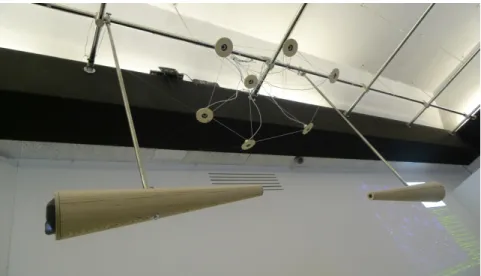
Microphone (§2.8). Exploring vocal analogue symbols in digital art. Created with EunJoo Shin, installed at the “Unleashed Devices” group show at Watermans Gallery, September/Oc-tober 2010.
Babble (§3.5.1). System for improvising musical timbre with wrien words. A permanent on-line work commissioned by Arnolfini, Bristol in November 2008.
Tidal (§4.4) and Texture (§5.6). Computer language designed for the improvisation of musical paern, with visuospatial notation. Released with a free/open source license, and used by the present author in public music performances.
Live Coding Performances (§6.8). e following is a list of live coding performances featur-ing the present author durfeatur-ing the period of research. ose marked with an asterisk were as part of a collaboration with Adrian Ward and/or Dave Griffiths as Slub, which is discussed in §6.10.
• Area10, Peckham, London, 12th April 2008*
• Ivy House, Nunhead, London, 4th April 2008*
• ursday Club, Goldsmiths, London, 5th June 2008*
• Public Life, London, 18th July 2008*
C
• Immersion, Flea Pit, London, 7th August 2008*
• Placard Headphone Festival, Cafe Oto, 20th September 2008*
• Noise=Noise, Goldsmiths, 21st January 2009*
• Worm, Roerdam, 9th April 2009*
• STRP, Eindhoven, 10th April 2009*
• pubcode1, Roebuck, 29th May 2009*
• pubcode2, Roebuck, 5th August 2009*
• spacecode, Plymouth Immersive Vision eatre, 20th August 2009*
• Shunt Lounge, London, 1st October 2009*
• Transfer, Goldsmiths 16th October 2009*
• Lambda Festival, Antwerp, 1st May 2010*
• Performance with Sco Hewi, Access Space, Sheffield, 29th October 2010
• With Mahew Yee-King, Jamie Forth and Sco Hewi, FACT Liverpool, 3rd September 2010
• Piksel Festival, Bergen, 19th November 2010*
• Performance with Nick Collins, ursday Club, London, 15th December 2010 • Performance with Nick Collins, LAB, Noingham, 17th December 2010 • VEX, Portland Works, Sheffield, 11th June 2011
• Placard Headphone Festival, Access Space, Sheffield, 16th July 2011
• Performance with Samuel Freeman, Dorkcamp, Watermillock, 20th August 2011 • Noise Box, York, 23rd September 2011
• Sony CSL Paris, 30th September 2011*
Refereed Publications
Forth, J., McLean, A., and Wiggins, G. (2008). Musical creativity on the conceptual level. In Proceedings of International Joint Workshop on Computational Creativity 2008.
Forth, J., Wiggins, G., and McLean, A. (2010). Unifying conceptual spaces: Concept formation in musical creative systems. Minds and Maines, 20(4):503–532.
McLean, A., Griffiths, D., Collins, N., and Wiggins, G. (2010). Visualisation of live code. In Proceedings of Electronic Visualisation and the Arts London 2010.
McLean, A. and Wiggins, G. (2008). Vocable synthesis. InProceedings of International Computer Music Conference 2008.
C
McLean, A. and Wiggins, G. (2009). Words, movement and timbre. In Proceedings of New Interfaces for Musical Expression 2009.
McLean, A. and Wiggins, G. (2010a). Bricolage programming in the creative arts. In22nd Psyology of Programming Interest Group 2010.
McLean, A. and Wiggins, G. (2010b). Live coding towards computational creativity. In Proceed-ings of the 1st International Conference on Computational Creativity 2010.
McLean, A. and Wiggins, G. (2010c). Petrol: Reactive paern language for improvised music. InProceedings of the International Computer Music Conference 2010.
McLean, A. and Wiggins, G. (2010d). Tidal - paern language for the live coding of music. In Proceedings of the 7th Sound and Music Computing conference 2010.
McLean, A. and Wiggins, G. (2011). Texture: Visual notation for the live coding of paern. In Proceedings of the International Computer Music Conference 2011.
McLean, A. and Wiggins, G. (in press). Computer programming in the creative arts. In McCor-mack, J. and d’Inverno, M., editors,Computers and Creativity. Springer.
Stowell, D. and McLean, A. (2011). Live music-making: a rich open task requires a rich open interface. In Proceedings of BCS HCI 2011 Workshop - When Words Fail: What can Music Interaction tell us about HCI?
C 1
Introduction
e history of computation is embedded in the history of humankind. Computation did not arrive with the machine, it is something that humans do. We did not invent computers, we invented machines to help us compute. Indeed, before the arrival of mechanical computers, “computer” was a job title for a human employed to carry out calculations. In principle, these workers could compute anything that modern digital computers can, given enough pencils, paper and time.
e textile industry saw the first programmable machine to reach wide use: the head of the Jacquard loom, a technology still used today. Long strips of card are fed into the Jacquard head, which reads paerns punched into the card to guide intricate paerning of weaves. e Jacquard head does not itself compute, but was much admired by Charles Babbage, inspir-ing work on his mechanicalanalytical engine (Essinger, 2004), the first conception of a pro-grammable universal computer. Although Babbage did not succeed in building the analytical engine, his design includes a similar card input mechanism to the Jacquard head, but with punched paerns describing abstract calculations rather than textile weaves. While the in-dustrial revolution had troubling consequences, it is somewhat comforting to note this shared heritage of computer source code and cloth, which contemporary artists still reflect upon in their work (Carpenter and Laccei, 2006).
is early computer technology was later met with theoretical work in mathematics, such as Church’s lambda calculus (Church, 1941) and the Turing machine (Turing, 1992, orig. 1947), which seeded the new field of computer science. Computer programmers may be exposed to these theoretical roots through their education, having great impact on their cra. As it is now practised however, computer programming is far from a pure discipline, with influences including linguistics, engineering and architecture, as well as mathematics. Digital computers now underpin the operation of business, military, academic and governing institutions, with impacts across human activity. ese diverse backgrounds bring different approaches to
pro-C 1: I
gramming, a great challenge for computer programming education.
As abstract machines, computers are multi-purpose, and are used in many ways towards many different ends. Judging by the contents of newstand magazines dedicated to them, the computer arts are most oen framed as the use of soware applications as design tools. Here soware is produced by soware houses, and bought and used by creative professionals. is situation has its merits, but is a diversion from our theme: we are interested in artists who write programs, not in those who only use programs wrien by others. Neither are we greatly concerned with the notion of computer programs as autonomous creative agents, although we will touch on this within broader discussion of programmer creativity (ch. 6). Instead we are interested in the practice of artists who get directly involved with computer languages as environments in which to create. ey are end-user programmers, in that they create soware not for others to use as tools, but as a means to realise their own work. We refer to such people asartist-programmers.
1.1 Artist-Programmers
e use of the termartist-programmer could be seen as over defensive. Alone, the word pro-grammer is oen used to imply a technician, tending a computing machine, or realising a de-signer’s dream. We could be more assertive, and use the wordprogrammerto establish a similar context effect to that which the wordpainterenjoys in the fine arts. But for the present thesis we keep the arts context explicit, while confronting the singular identity of the programmer as artist.
1.1.1 Computer art
We situate artist-programmmers within thecomputer arts, and so inherit important context from this field. We will first examine the role of industrial and military institutions in computer arts, before moving on to the issue of authorship and autonomy in the following section.
In Great Britain, computer art became established following theCybernetic Serendipity ex-hibition shown in the Institute of Contemporary Arts, curated by Jasia Reichardt in 1968. On the whole this exhibition was well received, both in terms of reviews and the number and diversity of visitors. However as Usselmann (2003) notes, while the exhibition was successful in bringing some of the possibilities of computer art to public consciousness, it was significantly compro-mised. Despite the turbulence of the late sixties, there was no political dimension apparent in the exhibition, which Usselmann aributes to the inclusion of sponsoring corporations in the exhibition itself. He argues that this exhibition cast computer art into a form which later
C 1: I
proved to be well suited for interactive museum exhibits, but has contributed lile to critical debate around technology. As Usselmann notes, visitors were compelled by the ICA to “lose their fear of computers”, whereas dissenting voices would advise otherwise, even then.
e model described by Usselmann persists far beyond Cybernetic Serendipity, for exam-ple the Decodeexhibition at the Victoria and Albert museum in 2009 was sponsored by SAP AG, who commissioned theBit.Codeartwork greeting visitors to the exhibition. In their press release, SAP noted that “Bit.Code is themed around the concept of clarity, which also reflects SAP’s focus on transparency of data in business, and of how people process and use digital information.” In a 40 year echo of Cybernetic Serendipity, the artworks were used to promote humanising aspects of technology, with the artists tacitly taking on the political stance of their sponsor.
Despite such compromises in the public presentation of computer art, there have always been computer artists who engage closely with the sociopolitical context around their work. A few years aer Cybernetic Serendipity, Nake (1971) published his essay “ere should be no computer art” in response to the political compromises he then saw as implicit in computer art. Nake also took aim beyond computer art, giving a leist perspective decrying the wider model of art dealer and art gallery, where art is sold for the aesthetic pleasure of the ruling elite. Taking the perspective of Usselmann (2003) alone, we might consider computer art as compromised, but Nake suggests that it is the whole art world that is compromised, and that the new computational media should establish alternative practices.
In a second 40 year echo, this time of Nake’s essay, Oliver et al. (2011) focus on the social rather than artistic role of thecritical engineer, quoting from their manifesto:
e Critical Engineer notes that wrien code expands into social and psycho-logical realms, regulating behaviour between people and the machines they inter-act with. By understanding this, the Critical Engineer seeks to reconstruct user-constraints and social action through means of digital excavation.
Oliver et al. (2011) are established artists, and exemplify the strong theme of activism present in contemporary digital arts. ey highlight the unique opportunity for engaging with political themes where the boundary between digital arts and activism is blurred. is boundary has been explored by artists from the outset, with their work well charted by Neural magazine (http://neural.it).
Perhaps this dichotomy between politically engaged and disinterested art could reflect two distinct views of the relationship between programmer and soware. is brings us to the subject of authorship in computer art.
C 1: I
1.1.2 Generative vs Soware art
e different approaches to digital art described above can be understood in terms of a di-chotomy drawn betweengenerative artandsoware art. Arns (2004) describes generative art as work which approaches use of technology as a black box, with focus on end results. In con-trast, she describes soware art as focusing on technology and technological culture, where the soware itself holds meaning.
Some argue that comparing generative and soware art in this way is a category error. e most commonly referenced definition of generative art, and the one addressed by Arns (2004), is provided by Philip Galanter:
Generative art refers to any art practice where the artist uses a system, such as a set of natural language rules, a computer program, a machine, or other procedural invention, which is set into motion with some degree of autonomy contributing to or resulting in a completed work of art. (Galanter, 2003, p.4)
Galanter (2003) states that his definition of generative art does not say anything about whyan artwork might be made or anything about its content, as a definition of soware art might. It is instead concerned only with a high level aspect ofhow art is made. He argues that the questioning theme of soware art runs orthogonal to the definition of generative art, and therefore that the two do not bear comparison. However, central to Galanter’s definition is the issue of autonomy: “Generative art must be well defined and self-contained enough to operate autonomously.” (Galanter, 2003, p.4). Contrary to Galanter’s assertion, the requirement of autonomy offers a strong constraint to the why of generative art; its operation must be considered separable from the programmer, who is in the business of creating activity external to their own influence. Soware art by contrast admits views of soware as an extension of the human, where the computer provides language which allows human expression to reach further.
According to Galanter’s definition, we view the generative artist as emphasising distance between themselves and their work, and the soware artist as embedding the activity of their soware in their own actions. We position the artist-programmer towards the laer, directly engaging and interacting with their code as an integral aspect of their work. In the case of generative art, authorship becomes a fundamental question, who or what produces the art: is it the programmer or their autonomous process? In the case of soware art, this question need not arise, as the process may just be viewed as part of the human artist’s activity.
From the above we can see evidence of a divide throughout the history of computer art, between focus on aesthetic output, and focus on the processes of soware, including its role in
C 1: I
society. ese are not mutually exclusive, and indeed Nake advocates both in balance. How-ever, there is a tendency for computer artists and their audiences to focus on processes as dis-embodied, autonomous activity (§4.1). By exposing the activity of programming, perhaps we can adjust the balance towards focus on human interaction rather than autonomous processes.
1.1.3 Discussion
In the following chapters, sociopolitical context and critical frameworks around computer art are not our focus. Instead we turn our aention inward towards the intimate relationship between artist-programmers and their systems of language, understanding programming as a human interaction. e artist is considered for their role as a visionary, in exploring and extending their human experience. We consider technological support in terms of extending their vision through processes of perception and reflection in bricolage creativity. In particular, we expand upon the remarkable notion of programming language, to consider the role of these languages in the activity of creative art.
1.2 Programming Languages for the Arts
e ‘tools’ that artist-programmers use to make their work are formal, artificial languages. ese languages are artificial in that they are constructed by individuals, rather than emerging from a wider cultural process as with natural languages. e wordartificialis problematic in implying fakery, but as we will argue in§4.1, computer languages are only artificial in the sense that a desk fan produces artificial wind – the air still moves.
ere are many thousands of programming languages, but they tend to fall within a small number of functional, structural and object oriented programming paradigms largely devel-oped between the 1950s and 1970s. e most widely used programming languages1 across institutions include Java, C, Basic and Python. ese are allgeneral purposelanguages, with a core definition abstract from any particular task, albeit with add-on libraries which may target a particular problem domain. In using general purpose programming languages, artists must build their work using technology ostensibly designed for the general case, but in practice de-signed for the expression of discrete, logical structures, in an abstract medium ungrounded in human experience.
In the present thesis we question the extent to which contemporary, general purpose pro-gramming language environments are suitable for Artist-Programmers. We will argue for new approaches to the design of programming languages for the arts, with human cognition and
C 1: I
perception as primary motivating factors. In particular, language environments that relate both discrete and continuous representations, that consider visuospatial and temporal experience in the design of their notations, and that support soware development as creative activity.
1.3 Aims
e work described by the present thesis is conducted towards two primary aims.
• To characterise human-computer interaction as a means for the improvisation of music and art, from the viewpoint of cognitive psychology, with strong focus on the human role in computer programming.
• To develop and demonstrate the potential of this theoretical understanding to enrich arts practice, through free/open source soware applications and programming languages, installation art, live coding performances and workshops.
1.4 Structure
e following five chapters provide the core of the present thesis, where each successive chap-ter builds upon the chapchap-ter before, each time broadening in scope. Firstly Symbols (ch. 2) will provide a representational basis for the thesis, exploring units of representation and their role in the production and experience of computer art. e following chapterWords(ch. 3) considers the composition of symbols into words, and the expressive role of words in speech, music and computer programs. Next we consider the composition of words into the structures ofLanguage(ch. 4), in particular the expression of paern and meaning in natural languages, computer languages, and in music. Zooming out once more we viewNotation(ch. 5), looking at the perceptual and temporal practicalities of how programmers may write programs. Finally our discussion will take in the wider context ofCreativity(ch. 6), the role of programming in a creative exploration, with particular focus on musical improvisation.
Overall, the focus will be not on digital representations within computation, and not on analogue expression either, but on the interactions between the two. Computers give us priv-ileged access to the digital realm, but we must not lose sight of the analogue, because humans experience and interact with the world as an amalgam of both.
is journey will be led by practice-based research, and research-based practice, in mutual support. Each of the following five chapters will introduce works informing and informed by the thesis, as listed in the above preface.
C 1: I
1.5 Original contributions to knowledge
e key contributions of this thesis are:1. e development ofvocable synthesis, a system for the terse description of a particular conception of timbre through the articulation of phonetic symbols informed by music tradition (§3.5).
2. e representation of music paerns in live music performance, as functions of events over time, demonstrated by Tidal (§4.5).
3. An approach to visuospatial syntax in pure functional language, based on relative dis-tance and type-compatibility, demonstrated by Texture (§5.6).
4. A characterisation of the creative processes of the artist-programmer in relation to es-tablished theoretical frameworks (§6.3 – 6.5).
C 2
Symbols
Our discussion begins in earnest with symbols, starting with discrete units of digital represen-tation. For our purposes, asymbol is simply something that is used to represent, or signify, something else. At their most basic level, computers use only two discrete symbols,1 and 0, which in combination represent other symbols, such as the leers of an alphabet. For the present discussion, there is not a great deal to say about discrete symbols in isolation. How-ever we are not only interested in digital computers, but also the artists who work with them. Accordingly our focus through this chapter will be on comparing the internal symbol systems of humans with those of computers, looking for correspondences and differences upon which to build the higher order concerns of later chapters.
While discrete computational representations are fully observable and comparatively well understood, neuroscience is some way from providing a clear picture of the representations underlying human thought. e pervasive cognitivist approach aempts to address this by postulating a central role for discrete computation in human cognition, likening the logical operation of electronic hardware to that of the carbon wetware of our brains. We will build an alternative view based upon Dual Code theory, which admits a role of discrete symbols in cognition, but places greater emphasis on analogue symbols. is will provide a base from which we later consider the role of human and computer symbol systems in the practice of computer programming.
2.1 Situating symbols
In taking a human oriented view of computer programming, we seek to understand the rela-tionship between digital symbols and the analogue world in which they are notated. We have already noted that acomputerwas once a job title (§1.1), since then however, computation has largely been mechanised, and perhaps to some extent dehumanised. e job of ‘computer’ is
C 2: S
now taken by electronic, digital machines, bringing increased speed and accuracy by several orders. However the human has not been entirely factored out of the process; on the contrary the role of writing program(me)s for computers to follow has developed into a rather unique profession, where programmers oen work in large teams writing huge tracts of code defin-ing the underlydefin-ing logic of modern institutions. Computer languages have been designed for parsimony by human programmers to support this work, allowing new approaches to human artistic expression as we will see in chapter 5. However, the underlying functional representa-tion, of operations over sequences of discrete symbols, remains the same as when computation was a wholly human task.
In Babbage’s Difference Engine (§1.1), 1s and 0s are represented by the punched/not punched states of paper cards. In modern computers, these binary states are provided by the binary on/off (or high/low) states of analogue electronic components. All discrete data may be represented within binary states, for example the true/false values of Boolean logic, or the ones and zeros of binary (base two) numbers. Such numbers may represent the instruction set of the computer processor, allowing a symbolic sequence to be interpreted as a sequence of operations over itself. is is the fundamental view of a computer program given to us by Turing (1992, orig. 1948) – a sequence of symbols, read by a machine, which interprets them as operations over that same sequence of symbols.
A discrete symbol system may represent aspects of the continuous world using a process calledanalogue to digital conversion. For example, sampling and storing sound input from a microphone is a process of averaging sound pressure over a given sample period, and approx-imating the average as a discrete number. e conversion cannot be perfect, as its accuracy depends on the granularity of the sample period and sample value. For example a period of one sample per 44100th of a second, with a range of 16 bits (65536 possible values) is used on standard Compact Disc recordings, and is taken to be in the same order as the distinguishing limits of human perception. We experience such a recording through inversedigital to analogue conversion, by sending the sampled data as stepped pulses of electricity to an electromagnet, moving the membrane in a loudspeaker to push sound pressure waves across the room, to be felt out by our ears.
Having digitally represented a sound signal, we may wish to perform some computation over it. In order to do so, some aspect of the continuous world it was sampled from is oen modelled or simulated. For example to store digital sound efficiently, psychoacoustic models are oen used, so that information beyond the ability of hearing is discarded. Likewise, to apply a reverb effect, a physical room may be modelled. It is apt to extend this concept of simulation to the function of computer hardware itself. If soware can simulate a continuous
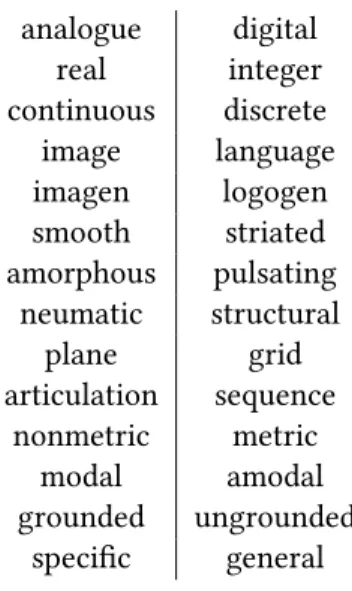
C 2: S analogue digital real integer continuous discrete image language imagen logogen smooth striated amorphous pulsating neumatic structural plane grid articulation sequence nonmetric metric modal amodal grounded ungrounded specific general
Table 2.1:analogue and digital - analogous antonyms.
domain in a discrete domain, then the job of hardware is to simulate a discrete domain in the continuous domain of analogue electronics. We construct computers to simulate a digital world, within which we may then construct a simulation of an analogue world. is simulation within simulation takes a recursive, fractal form, which may continue to arbitrary depth.
e paern of analogue and digital representations supporting one another also runs across humanexperience. By way of illustration, table 2.1 shows pairs of related antonyms used across the arts and sciences. e antonymssmoothandstriated bring to mind the smoothness of a pebble and the striated lines across weathered rock, one perceived as a continuous texture and the other as a series of discrete boundaries. But a stone can be simultaneously smooth and striated, perhaps marked by layers of limestone but washed smooth over millennia. e interdependence of the striated and smooth is described by Deleuze and Guaari (1987, p. 480) as the relation between points and lines; “in the case of the striated, the line is between two points, while in the smooth, the point is between two lines.” is is a necessarily circular definition, as we understand one in relation to another.
e distinction and relationship between the analogue and digital carries through to our perception of time, including within perception of music. Boulez (1990) relates striated time withpulsating, regular rhythm, and smooth time with anamorphous, irregular flow. In dis-cussing the notation of music, he contrastsneumatic and structural representations, where neumes are analogue lines, in contrast to the discrete structures of staff notation. Boulez tends towards the use of discrete symbols in notation, considering them more general and accurate, but of course discrete symbols are only more accurate if you wish to notate a pulsating rather
C 2: S
than amorphous temporal structure in the first place.1 e Western Classical tradition focuses on the former, but amorphous time is nonetheless present as an important aspect of dynamic performance, even when not notated. ere are however strategies for notating amorphous time in discrete computer language, exemplified by the constraint-based time seing used in the Bol Processor language and inspired by Indian Classical music (Bel, 2001).
e distinctions in table 2.1 betweenarticulationandsequence, andmodalandamodalare different aspects of the distinction betweengroundedandungrounded. Our environment, and our bodies moving through it, are by nature analogue, but our experience of our environment is both analogue and discrete. We may perceive a movement as a smooth articulation, while simultaneously abstracting it into a discrete sequence of events, by segmenting it at perceived points of discontinuity. Where we abstract it, we evoke a representation that is to an extent amodal, freed from the qualities of a particular mode or sense. However ‘ungrounded’ is per-haps too strong a term; just because we name a hue asred, it does not mean that we have lost all connection with perception; we have simply gone from a particular experience in colour space, to a discrete value that symbolises a region of possible experiences in colour space. We will expand on perceptual and conceptual spaces later in this chapter (§2.2.5).
In summary then, discrete and analogue domains are distinct, but hosted within one an-other. ey also interconnect, supporting and enriching one anan-other. is is of great impor-tance to the programming interface between humans and computers, profoundly so when we consider how the analogue/digital interconnection extends into the mind of the human pro-grammer.
2.2 Symbols in cognition
From a computer science perspective, digital symbol systems are shown to be remarkably ele-gant and with enormous practical use, so it is unsurprising that they are oen used as a descrip-tive model for the basis of complex phenomena, such as in biology and the cognidescrip-tive sciences. Wolfram (2002) shows that it is surprisingly likely for general computation to emerge from what would otherwise seem to be trivial rule systems. In particular, his exploration of one dimensional cellular automata led to the discovery ofRule 110. is rule is one of the family where a cell’s state is based only on its preceding state and that of its two immediate neigh-bours. It has been proved that despite this simplicity, Rule 110 is a universal computer in that it can carry out all the operations of the Turing machine, and therefore any other digital com-puter (Turing, 1992, orig. 1948). Wolfram takes his observation that computation falls out of 1Accuracy need not be the goal when notating amorphous structures however. e use of discrete symbols to denoteclassesof amorphous structure is of course possible, and is oen the most satisfactory choice.
C 2: S
such trivial interactions as evidence that the workings of nature are computational. We are in-terested in a more specific hypothesis than Wolfram; are digital symbols the representational basis of cognition? As computation arises from the simplest of rule sets, we certainly cannot discount it on the basis of Occam’s razor.
Great works on the Language of ought by Fodor (1980) and Pylyshyn (2007) do indeed point towards a discrete representational basis for cognition. Cognition is described by these thinkers as the subconscious workings within an innate language oen dubbedmentalese. is is not a natural language as we speak it, but an internal, universal language structuring subcon-scious thought. is presumed language is represented using discrete symbols, with cognition characterised as a process of computational operations over those symbols. Such computational accounts have strong traction across the cognitive sciences, and also support understanding in computer science; we understand the syntax of computer languages with reference to Chom-skian transformational grammar (§4.1).
We return however to the notion of digital supported by analogue, and analogue by digital. To focus solely on discrete computation is in denial of its essential interplay with analogue movement and shape. In comparison with humans, digital computers appear to lead a rather impoverished existence in terms of engagement with their analogue environment. Could this difference be due to differing symbolic foundations? ere is a line of thought which allows us to admit computational accounts of the mind, but in addition consider a second, complementary system of representation. is second system ismental imagery; an analogue symbol system grounded in perception.
2.2.1 Mental imagery
When presented with certain kinds of problems, a quasi-perceptualmental imagemay be con-sciously manipulated to solve a task. We can examine these subjective experiences through objective experiment, for example Shepard and Metzler (1971) identified that when matching rotated objects, subject reaction times have a strong, linear correlation with relative degree of rotation. is suggests that imagery is being rotated in the mind. It would appear that these quasi-perceptual states are an analogue system of symbolic representation, used here in cognitive problem solving.
e image in mental imagery is not specific to vision, but a broad term related to any quasi-perceptual state. For example the use of prosodic intonation in speech isparalinguistic, not entirely notated in wrien text, yet symbolising meaningful content. Indeed the meaning of a spoken text can be twisted, perhaps negated with sarcasm, through subtle paralinguistic phrasing. Furthermore, intonation is not just a concern in communication with others, the
C 2: S
phenomenon ofinner speewhile reading silently is understood to be a function supporting working memory, providing analogue, prosodic cues useful in comprehending text (Rayner and Pollatsek, 1994, p. 216).
Mental images then, are analogue symbols underlying visuospatial cognition. An image symbolises an object, using properties mapped directly from perception. For mental rotation tasks, the symbol may itself be rotated, as it shares essential geometric features with the object it symbolises. Some higher order tasks, such as the analysis of complex symmetries, may however be beyond the capabilities of mental imagery. For such tasks we may abstract properties of imagery to create a formal language, by which we mean a system of discrete symbols governed by grammatical rules. In the case of mental rotation, we identifygroup theory as a linguistic counterpart, developed to gain mathematical understanding of symmetries (du Sautoy, 2008). Group theory allows us to extend our understanding of symmetry with discrete logic, but does so in relation to the mental images we experience.
Empirical understanding of the psychology of analogue and discrete symbols is provided by Paivio (1990) through hisDual Codingtheory. His contention is not that there are two codes, but rather that there is a hierarchy of codes, which branch at the top into discrete linguistic codes and continuous perceptual codes, which Paivio nameslogogensandimagensrespectively. is split is shown in their concurrent processing; humans are able to comprehend language while simultaneously aending to imagery. Continuing with our earlier example of phrasing in speech, humans find it easy to simultaneously process and integrate prosodic and linguistic information, but rather more difficult to simultaneously read text and listen to speech. e explanation offered by Dual Coding theory is that there are distinct, yet integrated symbol systems for imagery and language. is theory sits well against the background of digital and analogue interdependence we noted in§2.1.
Neuropsychology provides support for Dual Coding through research into the fundamental brain structure of the two distinct hemispheres. Very broadly speaking, the le hemisphere is specialised for language, and the right for visuospatial tasks (Martin, 2006, pp. 128-129). We must be careful however not to over-simplify this relationship: the more closely it is examined, the less clear it gets. For example, from a meta-analysis of cerebral lateralisation of spatial abilities (Vogel, 2003) we see there is a strong sex difference in lateralisation of spatial tasks, where female subjects tend to show no hemisphere dominance and males tend to exhibit strong right hemisphere dominance. e same meta-analysis finds subjects classed as ‘high imagers’ also show no hemisphere dominance in visuospatial tasks, suggesting that high imagers are not those with a dominant ‘visual’ right hemisphere, but rather with high integration between both hemispheres. is laer finding has statistical significance, but is based on few studies
C 2: S
and so cannot be considered robust. However while it stands, it supports the view that the usefulness of mental imagery comes from integration between discrete and analogue codes.
2.2.2 Mental Imagery and Programming
Before we go any further, we should address Dual Coding theory to our overall theme. It may seem that computer programming is an overwhelmingly linguistic task in a wholly dis-crete domain, but if we focus on the programmer rather than the computer, we find this is not the case. Programmers may deal with formal, discrete and textual language, but they sup-port and structure their work in a variety of ways external to computer language itself. For example diagrammatic representations of code structure are widespread in the teaching and practice of soware development, such as those standardised in the Structured Systems Analy-sis and Design Method (SSADM) and Unified Modelling Language (UML). ese are highly formalised languages, but use spatial arrangement and connecting lines to present the struc-ture of a program in a visual manner. Further, the strucstruc-ture of programs is oen introduced in programming textbooks using visual metaphor, for example as interconnected roads (Griffiths and Barry, 2009, pp. 13–21) . We assert then that despite the discrete nature of computation, programmers oen use mental imagery to support their work.
Petre and Blackwell (1999) look for, and find reports of mental imagery during programming tasks. ey conducted verbal interviews with ten expert programmers, while they were in the process of solving programming tasks, prompting them to explain what they were ‘seeing’ in visual or auditory terms.2 We highlight and comment on a few reports from these interviews:
… no place holders, no pictures, no representation … just the notion, the sym-bol entities, semantic entities and the linguistic token … atomic notions. ey just ‘are’ (Petre and Blackwell, 1999, p. 17)
We contend that this is not a report of mental imagery as Petre and Blackwell (1999) imply. is is imaginative use of language, rather than modality-specific quasi-perceptual states.
… it moves in my head … like dancing symbols … I can see the strings [of symbols] assemble and transform, like luminous characters suspended behind my eyelids … (Petre and Blackwell, 1999, p. 14)
is is again a report featuring discrete symbols, but augmented with visual imagery. is appears to be simultaneous activation of both language and imagery, in line with Dual Coding theory.
2To counter known problems with interview protocols, the study was also complemented and to an extent confirmed by a second study, based on an undirected questionnaire of 227 programmers of the LABView visual programming environment.
C 2: S
It buzzes … there are things I know by the sounds, by the textures of sound or the loudness … it’s like I hear the glitches, or I hear the bits that aren’t worked out yet … (Petre and Blackwell, 1999, p. 15)
is is an intriguing example of a reported sonic image, again highlighting that mental imagery is modality specific, but not necessarily of the visual sense. Indeed the previous quote could be interpreted as simultaneously having both kinaesthetic and visual features. Petre and Blackwell (1999) report that all ten experts reported sound as an element in their imagery, although not in general as a typical element. It is worth noting however that subjects were specifically probed for sonic imagery, which may have influenced the programmers’ mental imagery and reports.
It’s like driving across a desert looking for a well. What you actually have is good solutions distributed across this desert like small deep wells and your opti-mizer trundling along looking for them… (Petre and Blackwell, 1999, p. 17)
is image appears to be visual-specific although could in addition be interpreted in a ki-naesthetic sense. at the programmer reports imagining a three-dimensional problem space is of relevance to the theory of Conceptual Spaces, which we will examine later in§2.2.5.
Again, it is wise to be cautious of introspective reports. Introspection is a subject of search in its own right, with one theory being that introspections are nothing other than re-constructed, ‘dramatised’ perceptions (Lyons, 1986). Nonetheless this should not discourage us from treating mental imagery seriously as a system for symbolic reference, and these reports give us cautious vantage over the cognitive processes of computer programming, towards un-derstanding how programmers may use mental imagery to support their work.
2.2.3 Dual Coding in Source Code
At base, the source code for a computer program is a one dimensional sequence of discrete symbols, ready for interpretation by a digital computer. How then could this relate to the Dual Code in human cognition, when we assert in the previous section that programmers employ mental imagery in their work? In answer we find that despite the discrete underlying representation, imagery is present both in the perception and organisation of source code.
In the Psychology of Programming field, a discipline bridging Psychology and Human-Computer Interaction, it is widely understood that there are notational features of source code besides formal discrete syntax, and further that these aspects are vitally important to human understanding of programs. Such features are known assecondary notation, which includes spatial layout, comments, colour highlighting and variable names. Secondary notation, and
C 2: S
its place within the Cognitive Dimensions of Notations framework will be further expanded upon in §5.1, but for now we focus upon the use of spatial layout in code, with respect to mental imagery. Consider the following code fragment wrien in the C programming language (Kernighan and Ritchie, 1988):
if ( condition == true) { display (" Welcome ."); beep ();
}
All spaces in the above example could be discarded, giving this: if( condition == true ){ display (" Welcome ."); beep ();}
As far as a C language compiler is concerned, these code fragments are equivalent, as all whitespace is discarded during tokenisation, an early stage of computer language parsing. For a human however, the former version of the code is much easier to comprehend, and for a much bigger program, the laer form would be close to impossible to understand on sight alone. e computer ‘sees’ a one dimensional string of symbols, parsed into the higher order data structure of a syntax tree. Humans however are able to perceive and navigate the fragments and wholes of a code structure in a manner analogous to a visual Euler diagram. By way of illustration, our code becomes even more difficult to read if we replace characters to remove the visual prompts of containment given by the symmetry of matching brackets:
if$condition == true@ˆdisplay$" Welcome ."@; beep$@ ;&
From this we argue that while both humans and computers understand programs as discrete symbols, humans use secondary notation to augment this representation with visual imagery. As such, source code is an amalgam of two symbol systems, one of which is discarded in the computational parsing process.
Programming languages with particularly visual notations are known asVisual Program-ming Languages. Programming has a reputation for being rather difficult to teach and learn (e.g. Lister et al., 2004), and so a recurring theme in language design is finding forms of notation that are more ‘natural’ or ‘intuitive’. A particular hope is that Visual Programming will lead to languages grasped easily by end users with lile or no training. Early enthusiasm has however not led to wide success, on the whole VPL has only taken hold for certain target domains, for example LABView in engineering and Patcher languages (§5.3.1) in audio/visual digital signal
C 2: S
processing. e lack of success of general purpose Visual Programming suggests that rela-tionships between discrete symbols and mental imagery are by nature particular to the task at hand. We should look then not for ways of adding ‘artificial’ visual metaphor to programming as has been unsuccessful in HCI in general (Blackwell, 2006e), but for ways of supporting a programmer’s own system of imagery, integrated with the text of source code. We will revisit and expand upon this point in our view of the notation of programs in§5.3.
We view source code then as supporting both language and imagery. Use of discrete sym-bols expressed within grammar rules are linguistic3, but are arranged to allow the support of visuospatial cognition in understanding and writing programs.
2.2.4 Language and Situated Simulation
Language and Situated Simulation (LASS) theory is a recent development of Dual Coding the-ory introduced by Barsalou et al. (2008). LASS adds empirical support broadly in agreement with Dual Coding, but with different detail and a strong change of emphasis. Whereas Paivio (1990) deals with imagens and logogens even handedly, Barsalou et al. place far greater em-phasis on imagery, which they refer to as the simulationsystem, reflecting its active role in cognition. According to LASS, the linguistic system issuperficial, acting as lile more than a control mechanism for the simulation system, which is responsible for deep conceptual struc-ture grounded in experience.
Simulations in LASS are described asperceptual symbols, but this does not imply conscious awareness of their use. Indeed in a break from Dual Coding theory, Barsalou (1999, §2.1.1) asserts that perceptual symbols are a neural representation with only limited correlates in consciousness. is proposal is similar to mentalese, in that it is an internal representation underlying subconscious cognition. e difference is that perceptual symbols are analogue and highly modal, being grounded in sensory-motor neural systems, whereas the notion of mentalese is as discrete and amodal.
e programmers’ reports from research reviewed in§2.2.2 were the result of probes for imagery in consciousness while programming, in keeping with the focus on conscious states by Paivio (1990). However we share the view of LASS, that analogue representations extend be-yond the confines of consciousness and aention, to structure the bulk ofunconsciousthought. erefore if anything, these reported experiences of mental imagery are only the tip of the iceberg.
C 2: S
Table 2.2:Levels of representation according to the theory of Conceptual Spaces (Gardenfors, 2000), aligned¨ with terms from Dual Coding theory (Paivio, 1990)
Experience G¨ardenfors Paivio Structure
Language Symbolic Logogens Discrete symbols
Perception Conceptual Imagens Low dimensional geometry Sensation Sub-conceptual – High dimensional neural nets
2.2.5 Conceptual Spaces
We have discussed perception with respect to analogue symbols at length, but how does this relate to concepts? In a major review of the field of concept theory, Murphy (2002, p. 5) defines the term concept as “a mental representation of a class of things”. So concepts allow us to structure our experiences through generalisation, but how is this done? e predominant view is that perception and cognition are independent functions of the brain, but an alternative view holds that functions of perception and concepts are integrated, relying upon shared neural resources.
How then could concepts, abstractions from the world, be structured in the same way as perception? Firstly it is important to recognise that perception is itself not a straightforward reflection of the world, rather a low-dimensional representation of high-dimensional sensory input, giving us a somewhat coherent, spatial view of our environment. Byspatial, we do not only mean in terms of physical objects or visual perception, but rather in terms of features in the analogue spaces of all possible tastes, sounds, tactile textures and so on. is scene is built through a process of dimension reduction from tens of thousands of chemo-, photo-, mechano-and thermoreceptor signals. G¨ardenfors (2000) proposes that this process of dimension reduc-tion is behind the construcreduc-tion ofConceptual Spaces. Moreover, he takes this as the primary model of conceptual representation, including that of higher-level concepts somewhat abstract from perception. at is, Conceptual Spaces are grounded in the cognitive resources of mental imagery, but are repurposed to represent conceptual relationships in geometric spaces.
e theory of Conceptual Spaces has great explanatory power in resolving conflict in the field of artificial intelligence (AI) between proponents of the high dimensional, statisti-cal graphs of artificial neural networks (ANNs) and the discrete symbols of good old-fashioned artificial intelligence (GOFAI). ANNs represent concepts through trained networks of connec-tions between cells, and GOFAI through the discrete constructs of language. In other words, ANNs work in the realm of sensation, and GOFAI in the realm of computation. G¨ardenfors seeks to unite these approaches by identifying a level of representation that mediates between
C 2: S
them: the low dimensional, geometric realm of the conceptual level.
Table 2.2 illustrates how the three levels of Conceptual Space theory align with the two channels of Dual Coding. Note some discrepancies in terminology; G¨ardenfors refers to lin-guistic representation as symbolic whereas we use the termdiscrete symbolic to distinguish from analogue symbols in Dual Coding theory. Note also that G¨ardenfors describes ANNs assub-conceptualin place of the more generally used termsnon-orsub-symbolic, to properly situate them beneath the geometry of the conceptual layer.
Conceptual Space theory has some agreement with LASS, in that conceptual representa-tion is considered to be largely outside the grasp of conscious introspecrepresenta-tion. Although these theories use different terms and have different emphases, they agree that the primary form of conceptual representation is within spaces, rather than within the syntax of the discrete sym-bolic layer. However whereas LASS focuses on simulations of physical objects, movements and interactions, Conceptual Space theory focuses more on the geometric structure of mental spaces.
Conceptual spaces are structured bysimilarity; concepts that are closer together are more alike. Furthermore, the dimensions of conceptual spaces are aligned with particular conceptual qualities. is is most easily explained with the example of colour space, where more similar colours are closer, within the quality dimensions of hue, chromaticism and brightness. As already alluded to in§2.1, the conceptredis not a point in colour space, but rather aconvex region, although we may pinpoint aprototypicalred as the centroid, or perhaps more holistically as the Voronoi generator (Okabe et al., 2000) of its region. e significance of convexity is clear if one considers that for any two hues of red, all the hues along the path between them will also be red. Redas a property is a concept in its own right, but can also form part of a more complex cross-domain concept, such asred ball.
e example of colour is straightforward, but it is rather harder to apply the theory to concepts without clear correlates to perceptual spaces in consciousness. However the theory of Conceptual Spaces makes the bold claim that the same processes of dimension reduction and spatial representation are applied to the majority of concepts. Despite the lack of subjec-tive conscious experience, we can hope to objecsubjec-tively identify the dimensions of higher order concepts through psychological experiment, such as those based on multi-dimensional scal-ing (MDS). In classic MDS experiments, human subjects are asked to grade pairs of stimuli by similarity, with their judgements interpreted as distance measurements, and then used to re-construct the conceptual space evoked by the stimuli. We will appraise MDS approaches in the context of musical timbre in§3.3.1. We may also construct conceptual spaces based on estab-lished theory: for example Forth et al. (2010) identify dimensions of musical metre based upon
C 2: S music theory.
e theory of Conceptual Spaces is particularly useful for our present discussion in provid-ing an account of how lprovid-inguistic and spatial representations may interact in cognition. Rather than placing the entire burden of higher-order representation on discrete, linguistic structure, it instead places emphasis on metaphor, both for relating spaces together and for grounding higher order concepts in embodied, perceptual spaces. Conceptual domains are low dimen-sional, in general having from one to three dimensions, in common with mental imagery and human perception in general. us, they may be explored and mapped through spatial reason-ing, as if they were physical spaces. is includes relating features of two spaces together, in other words drawing metaphorical relations between conceptual domains.
2.2.6 Metaphor
Metaphor is oen considered to be a form of poetic wordplay, a window dressing on lan-guage. In introducing their Conceptual Metaphor theory, Lakoff and Johnson (1980) argue on the contrary that metaphor is of central importance to language. Conceptual Metaphor the-ory is a defining contribution to the field of cognitive linguistics, and places metaphor in the role of structuring concepts relative to one another within a coherent system of meaning. For example, Lakoff and Johnson claim that “Well, thatboosted my spirits!” is a linguistic phrase structured by the underlying conceptual metaphor 4. A single conceptual metaphor may be expressed through many linguistic phrases, for example “I amdepressed”, “I am feeling down” and “My spiritssank” are instantiations of the same metaphor.
Lakoff and Johnson (1980) divide conceptual metaphors into two types; structural metaphors such as (e.g. “He is living on borrowed time”) and (e.g. “His claims areindefensible”), and orientational metaphors such as (e.g. “He isunder hypnosis”) and the aforementioned . Structural metaphors structure one concept in terms of an other, while orientational metaphors structure a whole system of concepts relative to fundamental directional and spatial relationships. Lakoff and Johnston assert that the majority of conceptual metaphors are orientational, coherent within a large system of metaphors (Lakoff and Johnson, 1980, p. 17). Orientational metaphors are organised relative to the body, oen with physical motivation, for example relates to the erect posture of a happy person versus drooping posture of a depressed person.
G¨ardenfors (2000) builds the notion of orientational conceptual metaphors into his the-ory of conceptual spaces (§2.2.5), asserting, like Lakoff and Johnston, that they form the pri-4Conceptual metaphors are by convention denoted with small block capitals, to differentiate them from the linguistic metaphorical phrases which refer to them.
C 2: S
mary structure of a human conceptual system. Orientational metaphors ground Conceptual Metaphor theory, and therefore the theory of Conceptual Spaces, in human physical and cul-tural experience. Gärdenfors proposes that these metaphors, and the geometric spaces they relate together, are the basis of semantics. We will return to this subject in discussion of music and language in§4.2.
2.3 Anthropomorphism and Metaphor in Programming
Metaphor appears to permeate our understanding of programming, as evident in the varied reports of mental imagery in programming tasks (§2.2.2). Perhaps this is due to the abstract na-ture of computer language syntax, requiring metaphorical constructs to ground programming language in everyday reasoning. Blackwell (2006d) used techniques from corpus linguistics on programming language documentation in order to investigate the conceptual systems of programmers, identifying a number of conceptual metaphors listed in Table 2.3. Rather than finding metaphors supporting a mechanical, mathematical or logical approach as you might expect, components were instead described as actors with beliefs and intentions, being social entities acting as proxies for their developers.
Blackwell (2006d) classifies orientational metaphors into the metaphors P , along with the related metaphor of movement in spaces, E . ese metaphors are reported to occur regularly, and reflecting on Conceptual Metaphor theory, we would expect orientational metaphors to provide the primary structure of programming concepts. Perhaps these metaphors could be broken down and related in a coherent, spatial system of metaphors such as A U and P F. A preliminary examination of the corpus indicates that this may be feasible, however further work is required.
It would seem then that programmers understand the structure and operation of their pro-grams by metaphorical relation to their experience as a human. e notion of including a com-puter in a creative process (§6.3) is by nature anthropomorphic; by embedding the development of an algorithm in a human creative process, the algorithm itself becomes a human expression. However, Dijkstra strongly opposed such anthropomorphic approaches in computer science:
“I have now encountered programs wanting things, knowing things, expecting things, believing things, etc., and each time that gave rise to avoidable confusions. e analogy that underlies this personification is so shallow that it is not only misleading but also paralyzing.” (Dijkstra, 1988, p. 22)
Dijkstra’s claim is that by focusing on the operation of algorithms, the programmer submits to a combinatorial explosion of possibilities for how a program might run; not every case can be