GSE Publications Graduate School of Education
November 2007
Understanding High School Students' Willingness
to Borrow to Pay College Prices
Laura W. Perna
University of Pennsylvania, [email protected]
Follow this and additional works at:http://repository.upenn.edu/gse_pubs
Postprint version. Published inResearch in Higher Education, November 2007, pages 589-606. Publisher URL: http://dx.doi.org/10.1007/s11162-008-9095-6
This paper is posted at ScholarlyCommons.http://repository.upenn.edu/gse_pubs/181
Recommended Citation
Perna, L. W. (2007). Understanding High School Students' Willingness to Borrow to Pay College Prices. Retrieved from
College Prices
Abstract
Although the use of loans to finance postsecondary educational expenses seems commonplace, the emphasis of the U.S. financial aid system on loans may limit college opportunity for individuals who are unwilling or unable to incur this type of debt. This study uses data from descriptive case studies of 15 high schools to examine four guiding questions: What are high school students' perceptions of loans? How do parents and school staff shape students' perceptions of loans? What other forces contribute to students' perceptions of loans? How do students' perceptions of loans vary across schools? The findings illustrate that, although virtually all students are aware of loans, willingness to borrow varies across schools. The study also describes the ways that families and school personnel shape students’ perceptions of loans. The paper concludes with implications for policy, practice, and future research.
Keywords
loans, college enrollment, counseling
Comments
Postprint version. Published inResearch in Higher Education, November 2007, pages 589-606. Publisher URL: http://dx.doi.org/10.1007/s11162-008-9095-6
UNDERSTANDING HIGH SCHOOL STUDENTS’ WILLINGNESS TO BORROW TO PAY COLLEGE PRICES
By Laura W. Perna Associate Professor Graduate School of Education
University of Pennsylvania 3700 Walnut Street, Room 424
Philadelphia, PA 19104 215.746.2522 [email protected]
Submitted to
Research in Higher Education
July 2, 2007
Revised and resubmitted: September 21, 2007 Accepted for publication
November 2007
Acknowledgements: This research was funded by the Lumina Foundation for Education. The opinions expressed in this paper are those of the author and do not necessarily represent the views of the Lumina Foundation or its employees. The author thanks Heather Rowan-Kenyon for her comments on an earlier draft of the manuscript. She also thanks Scott Thomas, the co-principal investigator for the broader study from which this paper is based, and the individuals who assisted with the collection of data: Robert Anderson, Angela Bell, Michelle Cooper, Greg Dubrow, Heather Rowan-Kenyon, and Patricia Steele.
ABSTRACT
UNDERSTANDING HIGH SCHOOL STUDENTS’ WILLINGNESS TO BORROW TO PAY COLLEGE PRICES
Although the use of loans to finance postsecondary educational expenses seems commonplace, the emphasis of the U.S. financial aid system on loans may limit college opportunity for individuals who are unwilling or unable to incur this type of debt. This study uses data from descriptive case studies of 15 high schools to examine four guiding questions: What are high school students’ perceptions of loans? How do parents and school staff shape students’ perceptions of loans? What other forces contribute to students’ perceptions of loans? How do students’ perceptions of loans vary across schools? The findings illustrate that, although virtually all students are aware of loans, willingness to borrow varies across schools. The study also describes the ways that families and school personnel shape students’ perceptions of loans. The paper concludes with implications for policy, practice, and future research.
UNDERSTANDING HIGH SCHOOL STUDENTS’ WILLINGNESS TO BORROW TO PAY COLLEGE PRICES
Loans are now commonly used to finance college expenses. In 2005-06 half (51%) of all financial aid used to finance postsecondary educational expenses was in the form of federal loans (College Board, 2006). Roughly 5.363 million undergraduates received a subsidized Stafford loan in the 2005-06 academic year (College Board, 2006). In 2003-04, median cumulative debt was $15,500 for those who borrowed and received bachelor’s degrees from public four-year institutions and $19,500 for those who borrowed and received bachelor’s degrees from private four-year institutions (College Board, 2006). The share of student financial aid awards to undergraduates in the form of loans has increased faster than the share of aid in the form of grants since 2001-02 (The College Board, 2006).
The prevalence of loans suggests that many students and/or their families opt to borrow to pay the price of attending college.1 Nearly half of full-time, full-year dependent
undergraduates with family incomes below $100,000 borrowed in 2003-04 (Berkner, He, Lew, Cominole, & Siegel, 2005). Among those who borrowed, average loan amounts were only slightly lower for students from the lowest-income families than for other students: $5,200 for dependent, full-time, full-year undergraduates with incomes below $20,000 and $5,800 for dependent, full-time, full-year undergraduates with incomes above $80,000 (Berkner et al., 2005).
Although the use of loans to finance postsecondary educational expenses seems commonplace, the emphasis of the U.S. financial aid system on loans may limit college opportunity for individuals who are unwilling or unable to incur this type of debt (Author, 2006b). A spring 2006 national poll found that the majority of adults believe not only that
college students graduate with more loan debt now than in the past (86%) but also “that college graduates today have too much student loan debt” (59%, Project on Student Debt, 2006, p. 2). Although most (71%) respondents believe that borrowing to pay college prices is “reasonable” given the benefits of college, 24% of adults believe that students should not take on debt (Project on Student Debt, 2006, p. 2).
These descriptive data are particularly problematic given that willingness to borrow is positively related to college enrollment (Callender & Jackson, 2005; Ekstrom, 1991). Using data from the High School and Beyond longitudinal survey of 1980 high school sophomores and seniors, Ekstrom found that students who reported that they would be willing to borrow to pay $1,500 in college prices that could not be covered by family or other sources of financial aid were more likely than other students to enroll in college within four years of graduating from high school, enroll in a four-year than a two-year institution, and enroll full-time than part-time even after controlling for background characteristics, educational aspirations, academic
achievement, encouragement from significant others, and knowledge of college costs and financial aid. Using data from surveys of 2,000 prospective higher education students in Britain, Callendar and Jackson found that the likelihood of applying to a university increased with students’ tolerance for debt even after controlling for educational achievement, social class, ethnicity, age, and mother’s educational attainment. Moreover, debt aversion had a greater negative relationship to the probability of applying for admission for students from low- than high-income families (Callender & Jackson, 2005).
Although research has examined the consequences of borrowing for such aspects of students’ postsecondary experiences as choice of college to attend (Kim, 2004), persistence and degree completion (DesJardins, Ahlburg & McCall, 2002; Dowd & Coury, 2006; Kim, 2007; St.
John, 2003), and graduate school enrollment (Choy & Carroll, 2000; Ehrenberg, 1991; Fox, 1992; Monks, 2001; Perna, 2004; Weiler, 1991), prior research on students’ perceptions of loans is limited in several respects. First, much of what is known about willingness to borrow is inferred from examinations of other indicators, such as the actual use of loans (e.g., ECMC Group Foundation, 2003), examines the loan-related perceptions and experiences of students who successfully enrolled in college (e.g., Baum & O’Malley, 2003; Christie & Munro, 2003; Christou & Haliassos, 2006; Monks, 2001; Porter et al., 2006; Wroblewski, 2007), and focuses on perceptions of loans among students in other nations (e.g., Callender & Jackson, 2005; Christie & Munro, 2003; Eckel et al., 2007). Second, while some research suggests that students’ perceptions of loans vary across groups (e.g., Christie & Munro, 2003; Christou & Haliassos, 2006; ECMC Group Foundation, 2003; Linsenmeier, Rosen, & Rouse, 2006), only a few studies have explored the forces that contribute to these differences (e.g., Christie & Munro, 2003).
Developing a better understanding of U.S. high school students’ perceptions of loans and the forces that shape these perceptions is particularly important, given the pervasiveness of loans as a mechanism to finance the accelerating price of higher education. Using data from
descriptive case studies of 15 high schools, this study finds that, although virtually all students are aware of loans, willingness to borrow varies based on characteristics of the school attended. The study also describes how parents and school personnel shape students’ perceptions of loans.
Literature Review and Conceptual Framework
To better understand students’ perceptions of loans and the forces that contribute to these perceptions, this study relies on a multi-level conceptual model (Author, 2006a). Specifically,
the study draws on a conceptual framework that I previously developed based on a
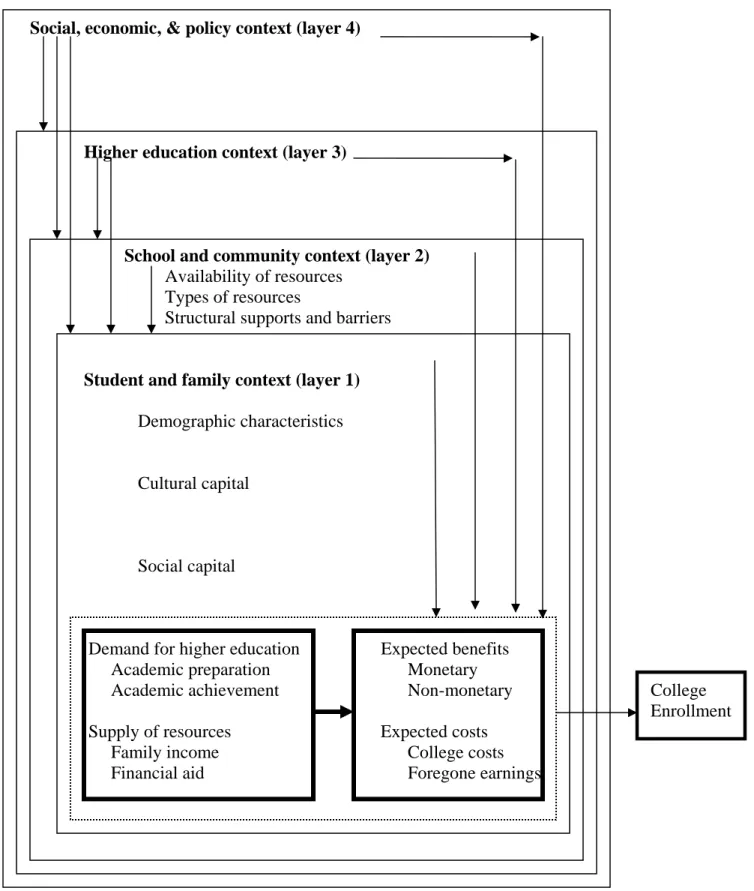
comprehensive review and synthesis of prior research to understand students’ college-enrollment decisions (Author, 2006b). The conceptual model draws on multiple theoretical perspectives and situates the college-enrollment decision-making process within several layers of context (Author, 2006a). Like “the student choice construct” (Paulsen & St. John, 2002; St. John & Asker, 2001), the conceptual model assumes that college-related behaviors reflect an individual’s “situated context.” As shown in Figure 1, the conceptual model assumes that students’ college-enrollment decisions are shaped by four nested contextual layers: the student and family context; the school and community context; the higher education context; and the broader social, economic, and policy context. For this study, I assume that students form perceptions about loans within the context of their families, but that these perceptions are shaped directly and indirectly by various forces outside of the family, particularly characteristics of the school a student attends and the broader social, economic, and policy context.
The Student and Family Context
At the most basic (i.e., first) level, the conceptual model assumes that, consistent with human capital theory, students make decisions about higher education based on a comparison of the perceived costs and benefits (Author, 2006a). Also consistent with human capital theory, a student’s academic preparation and achievement and access to financial resources are expected to influence the calculation of costs and benefits. Drawing on cultural and social capital, the model assumes that an individual’s assessment of the costs and benefits, including perceptions of academic and financial resources, are shaped by the availability of other resources as well
Consistent with these expected relationships, research indicates that willingness to borrow varies based on students’ race/ethnicity and financial resources. Using data from the U.S. Census Bureau and the 1999/00 National Postsecondary Student Aid Study (NPSAS), ECMC Group Foundation (2003) concluded that differences in the use of loans to finance college prices contributed to the lower observed college enrollment rates for Hispanics and American Indians than for Whites. African Americans, American Indians, and Hispanics were more likely than Whites to enroll in lower-price postsecondary educational institutions without borrowing even after controlling for socioeconomic characteristics. Socioeconomic
characteristics, particularly mortgage status and the householder’s educational attainment, were positive predictors of both enrolling and borrowing (ECMC Group Foundation, 2003).
Other research suggests that perceptions of loans differ by family income although the nature of the relationship is ambiguous. Some research demonstrates that students from low-income families are less willing than other students to borrow. Using data from a survey of 2,000 prospective higher education students in Britain, Callender and Jackson (2005) found that students from low-income families are more debt averse than other students even after
controlling for gender, ethnicity, and age. Using sophisticated econometric techniques,
Linenmeier, Rosen, and Rouse (2006) found that a financial aid program that replaces loans with grants for low-income students at one elite university has a greater positive impact on the
matriculation of low-income minority students than other students. After ruling out alternative explanations for the finding (e.g., the program changed the characteristics of the applicant pool), the authors concluded that low-income minority students are less willing than other students to use loans to pay college expenses.
In contrast, other research suggests that willingness to borrow is greater among students from lower- than higher-income families. For example, using data from the NPSAS, Christou and Haliassos (2006) found that, after controlling for demographic and other characteristics, undergraduates from low-income families are more likely than other students to borrow.
Similarly, using an experimental design with a sample of Canadian adults between the ages of 18 and 55, Eckel and colleagues (2007) found that, after controlling for other variables and taking into account interest in additional education, individuals with higher incomes are less likely than other individuals to be willing to use loans to finance postsecondary educational expenses. The analyses also show that individuals who are averse to debt are only less willing to use loans when the loan amount is “high” (i.e., $5,000) (Eckel, Johnson, Montmarquette & Rojas, 2007).
Three studies using data from other nations suggest that students’ perceptions of loans depend on their understanding of the benefits and costs of attending college, tolerance for risk, and family resources. Using interviews with students enrolled at two universities in the United Kingdom, Christie and Munro (2003) found that students from lower-class backgrounds are typically uninformed about the economic benefits of higher education and, thus, believe loans to be risky. In contrast, students from upper-class backgrounds are certain of the economic benefits of higher education, but, because of their parents’ resources, often do not need to use loans to pay college expenses. Eckel et al. (2007) found that Canadian adults who are more risk-seeking are more willing than others to use loans to finance postsecondary educational expenses.
Analyses of data from 2,000 prospective college students in Britain illustrated that, although students from low-income families are less likely than other students to believe that the benefits of borrowing to attend college exceed the costs, these observed differences are eliminated when
other variables, particularly measures of students’ perceptions of the benefits of attending college more generally, are taken into account (Callender & Jackson, 2005).
In summary, although research suggests that perceptions of loans vary based on students’ race/ethnicity and family income, much about students’ perceptions is not known. In particular, while research on students in other nations suggests that students employ a cost-benefit
framework when considering loans, few studies examine whether U.S. students also use this framework. In addition, few studies explore how parents’ perceptions and prior experiences with loans shape students’ willingness to borrow.
The School Context
The attention of the conceptual model to the school context (Figure 1, level 2) reflects, in part, McDonough’s (1997) notion of “organizational habitus” and recognizes the ways that school structures and resources facilitate or impede students’ college-enrollment behaviors. Research demonstrates how aspects of the school context, including the availability of resources at the school attended, delimit students’ college enrollment (McDonough, 1997; Perna & Titus, 2005; Stanton-Salazar, 1997).
Few studies examine the ways that the school context shapes students’ perceptions of loans. In one exception, McDonough and Calderone (2006) found, using data from interviews and focus groups of 63 college counselors at urban high schools in southern California, that counselors in these schools typically provide minimal information and assistance to students regarding college financing, encourage students to attend low-price institutions (e.g., community colleges) based on incomplete information about students’ ability to pay, and believe that
Although McDonough and Calderone’s (2006) study suggests that school counselors influence students’ understanding and use of loans, much about the role of the school context is unknown. In particular, few studies have explored the role of the school context in shaping students’ perceptions of loans from the perspectives of students or variations in the influence of the school context on these perceptions based on school characteristics.
The Higher Education and Broader Social, Economic, and Political Context
Little is also known about the ways that the higher education context (Figure 1, level 3) or the social, economic, and policy context (Figure 1, level 4) shape students’ perceptions of loans. In previous work (Author, 2006b), I speculate that societal expectations regarding the relative roles of parents and students in paying college prices may shape students’ knowledge of financial aid. I also speculate that students’ knowledge of financial aid may be shaped by such aspects of the policy context as the complexity of the student financial aid system and a state’s orientation toward financial aid (e.g., need- versus merit-based). Nonetheless, little is known empirically about the contribution of these contextual forces to students’ perceptions of loans.
Research Method
This study uses multiple descriptive case studies to address four guiding questions: What are high school students’ perceptions of loans? How do parents and school staff shape students’ perceptions of loans? What other forces contribute to students’ perceptions of loans? How do students’ perceptions of loans vary across schools?
Data for the study are drawn from descriptive case studies of 15 public high schools, three in each of five states. The conceptual model and research design view the state as one unit of analysis and the high school as an embedded unit of analysis (Yin, 2003a).
The five states in the study are: California, Florida, Georgia, Maryland, and
Pennsylvania. The research team purposively selected these states because of their variation on a number of demographic, economic, political, and educational characteristics (Author et al., 2006). Most relevant to this study, the five states vary in terms of their orientation toward college prices and financial aid. In 2006 average tuition and required fees for undergraduates at public two-year colleges ranged from $721 in California, to $1,470 in Georgia and $1,745 in Florida, to $2,751 in Pennsylvania and $2,837 in Maryland. Average tuition and required fees for undergraduates at public four-year institutions were substantially lower in Florida ($2,633), Georgia ($3,392), and California ($4,323) than in Maryland ($6,632) and Pennsylvania ($8,347, National Center for Education Statistics, 2006). The five states also vary in terms of their orientation toward financial aid. State grant aid is relatively more plentiful in Georgia and
relatively less plentiful in Maryland. In 2005-06, Georgia ranked second of the 50 states in terms of state grant dollars for undergraduates per undergraduate, whereas Pennsylvania ranked ninth, Florida ranked 14th, California ranked 20th, and Maryland ranked 31st (NASSGAP, 2006).
In each state, three high schools within one district or metropolitan area are purposively selected based on their variation on multiple demographic and academic characteristics (Author et al., in press). Selecting schools within one district or metropolitan area helps to control for alternative explanations for observed differences across schools, including the media, proximity to colleges and universities, and characteristics of the local labor market. One of the three selected schools in each state has above average student achievement and socioeconomic status
(i.e., “high-resource school”), one has average student achievement and socioeconomic status (i.e., “middle-resource school”), and one has below average achievement and socioeconomic status (i.e., “low-resource school”).
Data collection and analyses
Reflecting Yin’s (2003a) emphasis on the role of theory in guiding case study research, the research team developed data collection protocols based on the conceptual framework and a review of what is known from the literature about the predictors of college enrollment. The use of these protocols helped ensure comparability of data collection procedures across the 15 schools (Yin, 2003a). Part of a larger study of the influence of federal, state, and local policies that shape college opportunity, the protocols included such questions as: What public policies and programs are designed to promote college opportunity for students attending this school? What are the perceived and actual college-related outcomes? What are the barriers to college opportunity for students attending this school? How do counselors, teachers, and parents promote and impede college opportunity?
The research team completed the protocols using multiple sources, including: the demographic and academic school profiles, a review of the federal, state, and local policies in each state, and individual and focus group interviews. At each school, the research team conducted focus groups with 9th and 11th grade students and 9th and 11th grade parents and semi-structured interviews with teachers and counselors. Each focus group and interview lasted between 45 and 90 minutes. The individual interviews and focus groups were audio-recorded and transcribed. Between 20 and 58 students, teachers, counselors, and parents at each school
To analyze the data, the research team first created a case study database to organize the information collected (Yin, 2003b). The database included transcriptions from the focus groups and interviews, as well as data from the policy analyses and demographic and academic profiles. A preliminary list of codes using the conceptual framework and knowledge of prior research was developed, while also allowing additional codes to emerge. HyperResearch software was used to assist in the coding and compiling of data into categories.
Several strategies ensure the trustworthiness and credibility of the findings and conclusions (Yin, 2003b). To ensure construct validity, information from multiple sources including participants with different perspectives (i.e., students, parents, teachers, counselors) was collected. A chain of evidence (i.e., clear documentation of the sources of data and procedures for collecting the data) was established for each study finding and conclusion. In addition, the primary contact at each school (a school counselor) reviewed and provided feedback on a draft case study report for that school. The use of the case study protocol and case study database also helps ensure reliability (Yin, 2003b).
Findings
The findings shed light on students’ knowledge of loans, as well as the forces that shape students’ willingness to borrow. The findings also describe the messages that parents,
counselors, and teachers send to students about loans, and suggest that the state context plays a limited role in shaping students’ perceptions about loans. Each of these themes is discussed in turn.
Students’ perceptions of loans
Virtually all participating students indicate that they are aware that loans are used to finance postsecondary educational expenses. Many acknowledge the ubiquity of loans and express a preference for other forms of aid, but are resigned that loans may be necessary to attend college. In the words of one student, “I don’t want to have to take out a loan, but if it’s either take out a loan or don’t go to college, I’ll do that just so I can get there.”
The primary and consistently articulated reason for wanting to minimize the use of loans pertains to the need to repay the amount borrowed. While voiced by some students at all
schools, anxiety about the need to repay loans is especially common at the low- and middle-resource schools. For example, a student at one low-middle-resource school says that student loans are “like the last thing you really want to do, I think… because then you have to pay them back.” Beyond the need to repay loans, however, few students at any school describe specific features of loans. For example, no student identifies differences among the various federal loan programs or mentions private loans. One exception is the small number of students who are aware that loans may be forgiven in some situations. For instance, a student at one middle-resource school states that, if you take “a job that doesn’t make a lot of money, then whoever gave you the student loan will sometimes forgive you of paying it back.” Similarly, a student at another middle-resource school states, “I’ve also heard about when you go to college and you’re thinking about being in a certain career like health, that if you stay in that state and are a health worker, or in the medicine field, then you don’t have to pay back your loan.”
In contrast to this relatively sophisticated understanding, at least some students are strikingly uninformed about loans. For example, at least a few students are unaware of the
availability of loans from a trustworthy source (e.g., the federal government). As an example of this lack of understanding, a student at one low-resource school says:
It all depends on the type of person you’re getting the note from, you know… Probably the person is cold-hearted, like – has a very ambitious to the money, and tries to rip you off, like a con man. Or if the person’s generous, patient, probably you could get through in college, and after you graduated see that the person, you graduate, and then you can start working to repay your debt and everything.
Students’ Willingness to Borrow
Most students at the high-resource schools, some students at the middle-resource schools, and a few students at the low-resource schools, express a willingness to borrow to pay college expenses. For many of the participating students, willingness to borrow is based on a
comparison of the expected benefits and costs.
Expected benefits of loans exceed the costs
With a few exceptions, most students at the middle- and high-resource schools believe that the benefits of borrowing will exceed the costs. In other words, although a small number of students at the middle- and high-resource schools offer borrowing “horror stories,” the
substantially more common view at these schools is that loans are an expected and appropriate mechanism for financing college prices. Among the recognized benefits of borrowing are the ability to enroll in college immediately after graduating from high school, attend the first-choice institution, and pursue a desired and well-paying career. In a representative comment, a student at one high-resource school states: “I most likely will have to get a loan, too, because I’m probably – one of the schools that I want to go to, possibly, is a private school… eventually
[borrowing] pays off.” Similarly, a student at another middle-resource school says, “If I wanted to attend, like, a top-notch [school] or something that was really expensive and out-of-state, then loans would probably be the way to go.”
For many students at these schools, these positive benefit-cost calculations seem to be informed by examples of older siblings, friends, and others who have “successfully” borrowed. In a representative comment, a student at one high-resource school says, “My brother went to Stanford and by his senior year, owing something like $45,000. And we could definitely not pay for that. And I know that he has a whole lot of loans… He actually got hired right into a pretty well-paying job. So, I think he’s going to be able to pay all those off within two years. So that’s just one instance where it does work.”
Expected benefits of loans may not exceed the costs
In contrast to these positive views of loans, most students at the low-resource schools and some students at the middle-resource schools typically view loans as a “risky” decision.
Comments from these students suggest that their concern about repaying the loan is the primary reason for their reluctance to borrow. In a representative comment, a student at one low-resource school says, “I’m not worried about the money, unless I have to get a loan because I certainly don’t want to get out of college someday in debt.”
In contrast to the examples of successful borrowing provided by students attending middle- and high-resource schools, some students at the low-resource schools and a few students at middle-resource schools offer examples of individuals who are burdened by loan repayment. For example, a student at one low-resource school states, “But at the same time, they had to struggle finding jobs to pay back their money due to the interest charges that some of these loans have.” Similarly, a student at a middle-resource school says:
If you really want that job then you should have it. But, if you think you’re not going to be in debt because you have a high paying job, like, you’re wrong because my mom does not make the kind of money to put things – because she’s paying back those loans and it takes a lot of years.
Some participants at these schools believe that unwillingness to borrow causes students to either not enroll or to attend the local community college. In the words of the counselor at one middle-resource school: “And that’s, again, one of the reasons that kids will start at [the local community college], because they say, ‘I don’t want to,’ you know, ‘I don’t want to take out a loan. I can go to [the local community college] without taking out a loan.’”
Parents’ perceptions of loans
At the low-resource schools, parents generally do not want their students to use loans to pay college prices. Students hear this message. For example, a student at one low-resource school reports that her mother is discouraging her from using loans, as her mother tells her, “it takes forever to pay them, and I need to focus on schoolwork and not try to pay some bills.”
Like their student counterparts, a primary concern about loans for parents at the low-resource schools is their uncertainty about whether the benefits of borrowing will exceed the costs. In a representative comment, a parent at one low-resource school states that, “Our concern is that after paying so much money, that our kids will get into a field that they’re basically not able to find employment. And then they will take a job, that’s kind of like really not – in the meantime the college, I mean, you have to pay off the college loan.”
In contrast, with only a few exceptions, parents at the middle- and high-resource schools generally expect, and accept, that loans are required to finance college prices. As one example, a
parent at a high-resource school says that, although “we haven’t gotten [to the point of paying college prices,] I wouldn’t be shocked if I had to” use loans.
The acceptance of loans by most parents at the middle- and high-resource schools may reflect, at least in part, the parents’ own “successful” borrowing experiences. In the words of a parent at a middle-resource school:
The four years of college are some of the most important years of your whole life, and don’t be afraid of the debt. Because you know, I have a $1,900 [loan], my husband has $8,000, and I guess if you multiply that according to what it was at the time – we paid it off... You know, we’ve got the home equity loans, and all those stuff going on, and we just, you know, as long as you pay it off, don’t be afraid of the debt and go where you really want to go.
Parents at these schools also tend to view loans as an acceptable means of financing postsecondary educational expenses because, like their student counterparts, they believe that the benefits of borrowing exceed the costs. In the words of one parent at a middle-resource school: “Why wouldn’t [students] use [loans], especially if you consider what their salary might be when they get out of college?”
While generally acknowledging loans as an acceptable mechanism for paying college prices, parents at the middle- and high-resource schools hold differing views about whether their students will actually use loans. At most middle- and a few high-resource schools, at least some participants believe that students will use loans in order to assist parents with the financial burden of paying college prices. For example, one parent at a middle-resource school states, “They’re going to have to get loans. We can’t afford it. It’s – I don’t want to lose my house.” A second parent at this school adds, “I think we’re in the same position, where they’ll have to get
the loans and they’ll have to repay the loans. I don’t think we’ll take the loans. But we will pay for the undergrad at a [junior college].” Many students recognize the need to help pay the price of attending college, as suggested by the following comment from a student at a middle-resource school: “And I personally don’t think my parents will pay for college because they don’t have money for that, so they’re basically counting on me to get a scholarship and if not, then I’ll ask for a student loan...”
In contrast, a few parents at the middle- and high-resource schools indicate that they do not want their children to borrow because they have the financial means to help ensure that their students do not need to borrow and they do not want their children to be burdened by this debt. The latter is especially important, as these parents view the accumulation of undergraduate debt as a potential deterrent to their students’ future enrollment in graduate school, an expected behavior. In the words of a parent at one high-resource school, “I don’t want [my child to borrow]… I don’t want her to start off her life with college loans, if at all possible.”
A small number of parents at the middle-resource schools also believe that their students should not acquire debt for their undergraduate education but, because they currently lack sufficient financial resources, are trying to save and work to minimize students’ loan burden. In the words of one parent at a middle-resource school: “I’m saving. I just plan on working until he’s through it to pay for his education. So he comes out of college without debt.”
One source of variation in parental views of loans is parents’ cultural background, although the nature of this influence varies. For example, one parent at a low-resource school suggests her desire to adopt perceived U.S. norms regarding borrowing, stating that:
[In my native country,] you support your children until they have, like permanent jobs. It’s not like here. You are 18. You are outside or you have to work… That’s not my
culture, you know. I cannot tell my son. So, he was asking me, I said, ‘Son, but this country is different, you know. You have to find out somehow. I cannot put your college loan on my – on my name.’
In contrast, a student at a high-resource school states that, because of her cultural background, her parents do not want her to borrow. In the words of the student:
My family – and my grandparents are from Italy, and over in Europe, if you don’t have money, you don’t buy it. And I guess I’ve grown up with that. So, if I didn’t have any money to go to college, I’d take time off, I’d get a job, and I’d work up the money instead of borrowing it and having to pay loans back for the rest of my life.
Counselors’ and teachers’ perceptions of loans
Perhaps reflecting the shared belief that loans are expected and appropriate, few
counselors or teachers at the high-resource schools indicate that they talk to students about loans. At other schools, however, counselors and teachers appear to convey several loan-related
messages to students. Although some encourage students to borrow, more teachers at the low-resource schools stress the notion that repaying loans is a long-term obligation. For example, a teacher at a low-resource school reports that, “I have this one young lady, she asks me all the time, ‘Are you still paying on your loans?’ I was like, ‘I’ll be paying on my loans for the next 40 years – I’ll be paying on it when I retire.’” Similarly, a teacher at a low-resource school says, “You’re supposed to say you can go anywhere you want, ‘We’ll find the money.’ But I’m too realistic – do you want to be in debt forever?” Students hear these comments, as suggested by the following comment from a student at one low-resource school, “I hear all of my teachers talking about how loans stink, how they’re still paying them off.”
A second message from counselors and teachers at low- and middle-resource schools is that loans are necessary, especially if the student is attending a four-year college or university. For example, a counselor at a middle-resource school states that,
I don’t think hardly anybody can finance their education anymore solely based on
scholarships or financial aid. Maybe going to [local community college], I do know some kids that go to [the local community college] free and clear… But, I would say, you know, we tell them straight upfront that it’s almost a fact that they will have to take out some loans and they have to realize that and they have to think about that.
Similarly, a teacher at another middle-resource school says,
If a child says, ‘Well, I’m not going to college because I can’t afford it.’ I think that’s just an excuse, because even, ah, student loans now, the interest rate on them and being able to get a student loan is, ah, very open.
A third message conveyed by some counselors and teachers at the low- and middle-income schools is that students should make college choices that minimize use of loans. In a representative comment, a counselor at one middle-resource school says:
We don’t really encourage the loans, so we don’t talk a whole lot about loans. Now, I’ll tell you one of the problems we sometimes have at our school, and I know other high schools in the county do too, and that is the proprietary schools who come in and try to get the students to come to their schools and they do give them loans. And we always say, ‘Don’t, don’t, don’t do that. Wait. If you want to go to a proprietary school wait two or three years.’ But sometimes they get ITT, DeVry. And they’re okay schools. It’s just that they give them big loans. We really tell them to go to Miami Dade first.
The role of the state policy context in shaping students’ perceptions of loans Despite the differences across the five states in tuition and aid policies that are summarized in the methods section, the findings suggest that the state context plays a very limited role in shaping students’ perceptions of loans. The one exception is the potential
influence of Georgia’s relatively generous merit-based aid program on the expectation for loans among students attending the Georgia middle-resource school. Some students attending the Georgia middle-resource school state that they are willing to borrow but do not expect to need to borrow because of the availability of the Georgia HOPE Scholarship. In the words of a student at a middle-resource school, “If somehow I didn’t get HOPE, I guess I would just take out loans because I know that’s something I need.” No student at the Georgia low- or high-resource school made a connection between the HOPE Scholarship program and loans.
Discussion
Despite its strengths, the study has several limitations. First, the analyses describe students’ perceptions of loans at one point in time, the 2004-05 and 2005-06 academic years. Thus, for example, data were collected before the investigation of the student loan industry led by Attorney General of New York Andrew Cuomo in 2007. The findings are also based on data describing just 15 schools in only five states. Therefore, the generalizability of the findings to other schools, states, and time periods is limited. In addition, although participants are diverse in gender, race/ethnicity, and socioeconomic status, the data permit only disaggregation at the school-level, not the individual-level.
Nonetheless, this study suggests that willingness to borrow to pay college expenses is typical of the high-resource schools, common but not universal at the middle-resource schools, and relatively less common at the low-resource schools in this study. At the high-resource schools, students believe that loans are commonly used to finance college prices, that loans are a means for sharing the responsibility of paying college prices with their parents, and that the benefits of borrowing exceed the costs. Although participants believe loans to be an acceptable mechanism for financing college expenses, many students at the high-resource schools will not need to borrow because of their parents’ ability and willingness to pay college prices. In contrast, at the low-resource schools, students are generally reluctant to borrow, question whether the benefits of borrowing exceed the costs, and worry about the need to repay loans. Students’ views of loans are generally mirrored by their parents’ views and correlated with known examples of others’ (e.g., parents, friends) experiences with loans. School staff at the low- and middle-resource schools provide mixed messages to students about loans, with some
discouraging and others encouraging the use of loans.
Several conclusions may be drawn from the study’s findings. First, the findings
demonstrate the merits of a multi-level conceptual model for understanding students’ perceptions of loans. While previous work (Author, 2006b) speculated about the ways that particular aspects of context shape students’ understanding of financial aid, this study sheds light on how families and schools shape students’ perceptions of a particular type of financial aid, namely loans. The analyses suggest the general congruence between students’ and parents’ views, the interaction between parents’ understanding of loans and their financial resources, the contribution of the school context (specifically messages about loans from counselors and teachers especially at the low- and middle-resource schools), and the minimal role of the state context.
Second, like prior research (e.g., McDonough & Calderone, 2006), the findings from this study suggest that many students and parents form perceptions of loans using the benefit-cost comparison predicted by human capital theory. Whereas other research demonstrates that
students react differently to different forms of financial aid and respond to non-pecuniary aspects of aid (Avery & Hoxby, 2004; Heller, 1997), this study suggests that students draw varying conclusions about loans. Human capital theory does not assume that individuals have perfect and complete information, but that they make decisions based on available information about the benefits and costs (DesJardins & Toutkoushian, 2005). Thus, perceptions of loans may vary because of differences in students’ knowledge of loans, including their awareness of mechanisms that protect students’ from unfair treatment by lenders, potential for loan forgiveness and
forbearance, and availability of interest subsidies, as well as differences in their knowledge of the benefits and costs of attending college more generally (as suggested by Christie and Munro [2003] and Callender and Jackson [2005]).
Third, whereas McDonough and Calderone (2006) describe the role of habitus in shaping understandings of college affordability, this study illustrates the role of habitus in shaping
perceptions of loans more specifically. Habitus, or an individual’s internalized system of
thoughts, beliefs, and perceptions that are acquired from the immediate environment, conditions an individual’s college-related expectations, attitudes, and aspirations (Bourdieu & Passeron, 1977; McDonough, 1997). Thus, findings from this study suggest that differences in students’ perceptions of loans reflect differences in the messages students receive about loans from their parents, school counselors and teachers, and the broader state policy context.
Implications for policy and practice
The findings also have several implications for policy and practice. First, the findings (particularly the mixed messages that counselors and teachers send to students about loans) suggest the need for additional financial aid counseling, especially for students attending low- and middle-resource schools. Although the prevalence of student loans (College Board, 2006) and the high average levels of mortgage and consumer debt (Mishel, Bernstein, & Allegretto, 2005) indicate that borrowing is commonplace in American society today, this study suggests that at least some students, especially students attending low-resource schools, have remarkably little knowledge about student loan programs. In order to decide whether the costs of borrowing exceed the benefits, students need additional information about the implications of borrowing, as well as the benefits and costs of college enrollment more generally. Without this information, students may choose to not enroll in higher education or to pursue financing strategies that are not associated with persistence (i.e., working high numbers of hours; King, 2002; Gladieux & Perna, 2005). Financial aid counseling should focus on ensuring that students and their families have the information that is necessary to make informed decisions about loans (i.e., appropriate benefit-cost comparisons). Efforts to provide additional financial aid counseling should focus on providing information that is in a form that is accessible and useable by all students and their families, especially those from historically underrepresented groups (NACAC, 2007; Author, 2006b; Wroblewski, 2007).
Second, although additional financial aid counseling is necessary, students should not simply be advised to use loans. The finding that students attending low-resource schools commonly express anxiety about the need to repay loans may reflect the reality that lower- and middle-income families are more likely than higher-income families to face debt-related
challenges (Perna & Li, 2006). Both the percentage of households with high debt burdens (i.e., debt service payments represented at least 40% of household income) and the share of
households paying bills after the due date are inversely related to income (Mishel et al., 2005). In 2001, 27% of households with incomes below $20,000 and 16% of households with incomes between $20,000 and $39,999 had high debt burdens, compared to only 2% of households with incomes between $90,000 and $100,000 (Mishel et al., 2005).
Some of students’ and parents’ concerns about the negative consequences of borrowing may be appropriate, as borrowing is a good investment for many but not all students (Carey, 2004; Gladieux & Perna, 2005; Price, 2004). In a report published by the Education Trust, Carey (2004) warned that “hundreds of thousands of young people leave our higher education system unsuccessfully, burdened with large student loans that must be repaid, but without the benefit of the wages a college degree provides” (p. 5). Even after controlling for other individual,
institutional, and occupational characteristics, Price (2004) found that 1993 bachelor’s degree recipients from lower-income families and who were Black or Hispanic were more likely than other bachelor’s degree recipients to have excessive debt burdens four years after receiving their degrees, where “excessive debt burden” is defined as a ratio of monthly loan payments to gross monthly income that exceeds 8%. Gladieux and Perna (2005) found that more than one-fifth of individuals who began their postsecondary education in 1995-96 and borrowed did not complete their educational programs and were not enrolled in 2001 (i.e., “dropped out”). About one-fourth of these borrowers who dropped out defaulted on at least one student loan (Gladieux & Perna, 2005). Therefore, given differences in academic preparation and other factors that reduce the likelihood that students will complete their educational programs and obtain jobs with earnings that enable them to repay their loans (Gladieux & Perna, 2005), students should not be simply
advised that the benefits of loans will always exceed the costs. Ideally, students should receive individualized counseling and advice that reflects the students’ academic preparation for college and other circumstances.
In order to appropriately counsel students and their families about loans, high school counselors must be adequately trained. Although counselors typically provide information about financial aid as part of their duties, only one-in-four counselors responding to a recent national NACAC survey feel “very prepared” to guide students’ borrowing decisions. Counselors are particularly unsure about advising students about the amount to borrow, the optimal type of loan, or the consequences of failing to repay loans (NACAC, 2007). For students whose parents do not have relevant knowledge, including direct prior experience with higher education, counselors are an especially important source of information about financial aid and other aspects of college enrollment (McDonough, 1997; Author, 2004, 2006b; Tierney & Auerbach, 2004). Whereas McDonough and Calderone (2006) found that few of the 63 counselors they interviewed
proactively disseminated information to students about college prices or financial aid, this study also suggests that few high school counselors are systematically disseminating information to students about loans or consistently educating students about the benefits and costs of loans. Moreover, perhaps because of the absence of financial aid training for school counselors (McDonough, 2005), school staff likely rely largely on their own prior experiences with, and opinions about, loans when providing information about loans to students. Certainly providing appropriate guidance to students regarding the use of loans is challenging, given the risks of borrowing and the complexity of loan programs (e.g., four types of federal loan programs, private loan programs, college and university loan programs, NACAC, 2007). Nonetheless, as
counselors are ideally suited to provide this information, all counselors should receive appropriate training.
Finally, because structural constraints will continue to limit high school counselors’ time for financial aid counseling, high schools should also incorporate other mechanisms for
providing students and their families with necessary information about loans and other sources of financial aid (McDonough & Calderone, 2006; Author et al., in press). While this study suggests that families and high schools shape students’ perceptions of loans, other research illustrates that financial aid offices of colleges and universities shape the loan-related experiences of students who actually enroll (Wroblewski, 2007). Although mandatory entrance and exit counseling may improve borrowers’ understanding of some aspects of loans (Wroblewski, 2007), such
counseling comes too late to influence high school students’ perceptions of loans (as only students who successfully apply for and receive admission and financial aid and decide to borrow receive entrance counseling).
Some research (Author et al., in press) suggests the benefits to students that may accrue when high school counselors work with staff from local colleges and universities to provide financial aid information. One exploratory study suggests that at least some college students would like to know more about the implications of borrowing and the experiences of individuals who have borrowed and are repaying loans (Porter et al., 2006). The ways that schools may effectively collaborate with local colleges and universities as well as other entities (e.g., state financial aid commission) to effectively deliver information to students and their families about loans and other sources of financial aid should be explored in future practice and research.
Implications for future research
Although this study sheds light on students’ perceptions of loans and the forces that contribute to these perceptions, the findings suggest several areas for additional research. In addition to exploring alternative sources for delivering financial aid information, future research should also explore the implications of students’ perceptions of loans for students’ college-related behaviors. For example, although the findings in this study demonstrate that students attending low-resource schools are more worried about the need to repay loans than students attending high-resource schools, additional research should examine the ways that these anxieties about loans shape students’ college-related behaviors, including their academic preparation for college, decision to enroll in college, and choice of institution to attend. Some research suggests that students’ concerns about loans are unrelated to such outcomes as plans to attend graduate school or changes in career plans during college (e.g., Monks, 2003). But, such research considers the potential effects of loans only among students who successfully persisted through the senior year of college and does not consider differences in the relationship based on students’ gender, race, income, or academic achievement.
Second, future research should explore the ways that students’ perceptions of loans are shaped by their knowledge of different costs of attending college (e.g., tuition, opportunity costs) as well as their eligibility for different forms of financial aid. Comments from students attending the Georgia middle-resource school suggest that, when students are confident of their eligibility for grants (i.e., the Georgia HOPE Scholarship), they are less concerned about (and thus more willing) to use loans. Similarly, in their analyses of data from the NPSAS, Christou and Haliassos (2006) found that the likelihood of borrowing increases with the share of aid in the form of grants after controlling for demographic and other variables. Nonetheless, based on
analyses of data from focus groups with undergraduates, recent graduates, and parents of undergraduates, Wroblewski (2007) found that, “families often do not know to maximize scholarships and grants before using loans to finance college” (p. v). Thus, future research should further explore the ways in which students’ knowledge of grants (and lack thereof) shape students’ perceptions and use of loans.
Finally, future research should explore the most effective means for delivering information about loans to different groups of students and their families. Given differences across schools in perceptions’ of loans, different approaches to disseminating information are likely required for different groups. Future research should also explore the appropriate time to deliver information about loans to students and families, both in high school and once enrolled in college (Wroblewski, 2007). Based on its review of relevant research, the U.S. Government Accountability Office (U. S. GAO, 1990) concluded that schools should target financial aid information to parents of junior high school students. The GAO argued that, if knowledge of financial aid influences college-related behaviors, then families need this information early in the postsecondary-educational pipeline. Nonetheless, available research provides only indirect support for this recommendation (Author, 2006b).
Note:
1
Throughout the manuscript, I intentionally use the word “price” rather than “cost.” Although tuition, fees, and other college-related expenses are commonly referred to as “costs,” using the word “costs” masks the reality that the cost to a college or university of providing a college education is higher than the price that the institution charges to students. See Winston (1999) for further information.
References Author. (2004).
Author. (2006a). Author. (2006b). Author et al. (in press).
Baum, S., & O’Malley, M. (2003). College on credit: How borrowers perceive their education debt. Journal of Student Financial Aid, 33(3), 7- 19.
Berkner, L., He, S., Lew, S., Cominole, M., & Siegel, P. (2005). 2003-04 National
Postsecondary Student Aid Study (NPSAS:04) student financial aid estimates for 2003-04.
Washington, DC: U. S. Department of Education, National Center for Education Statistics. Bourdieu, P., & Passeron, J. C. (1977). Reproduction in education, society, and culture. Beverly
Hills, CA: Sage Publications.
Callender, C., & Jackson, J. (2005). Does the fear of debt deter students from higher education?
Journal of Social Policy, 34, 509-540.
Carey, K. (2004). A Matter of Degrees: Improving Graduation Rates in Four-Year Colleges and
Universities. Washington, DC: The Education Trust.
Choy, S., & Carroll, D. (2000). Debt burden four years after college. Washington, DC: U. S.
Department of Education, National Center for Education Statistics (NCES 2000-188). Christie, H., & Munro, M. (2003). The logic of loans: Students’ perceptions of the costs and
benefits of the student loan. British Journal of Sociology of Education, 24, 621-636.
Christou, C. & Haliassos, M. (2006). How do students finance human capital accumulation? The choice between borrowing and work. Journal of Policy Modeling, 28(1), 39-51.
DesJardins, S. L., Ahllburg, D. A., McCall, B. P. (2002). A temporal investigation of factors related to timely degree completion. Journal of Higher Education, 73, 555-581.
DesJardins, S.L., & Toutkoushian, R. K. (2005). Are students really rational? The development of rational thought and its application to student choice. . In J. C. Smart (Ed.), Higher
education: Handbook of theory and research, Volume 20 (pp. 191-240). Dordrecht, The
Netherlands: Kluwer Academic Publishers.
Dowd, A. & Coury, T. (2006). The effect of loans on the persistence and attainment of community college students. Research in Higher Education, 47(1), 33-62.
Eckel, C.C., Johnson, C., Montmarquette, C., & Rojas, C. (2007). Debt aversion and the demand for loans for postsecondary education. Public Finance Review, 35(2), 233-262.
ECMC Group Foundation. (2003). Cultural barriers to incurring debt: An exploration of
borrowing and impact on access to postsecondary education. Santa Fe, NM: Author.
Ehrenberg, R. G. (1991). Academic labor supply. In C. T. Clotfelter, R. G. Ehrenberg, M. Getz, & J. J. Siegfried (Eds.), Economic challenges in higher education (pp. 143-260). Chicago,
IL: University of Chicago Press.
Ekstrom, R. (1991). Attitudes toward borrowing and participation in post-secondary education.
Paper presented at the annual meeting of the Association for the Study of Higher Education. Fox, M. (1992). Student debt and enrollment in graduate and professional school. Applied
economics, 24, 699-677.
Gladieux, L., & Perna, L.W. (2005). Borrowers who drop out: A neglected aspect of the college
student loan trend. San Jose, CA: National Center for Public Policy and Higher Education.
Heller, D. E. (1997). Student price response in higher education: An update to Leslie and Brinkman. Journal of Higher Education, 68, 624-659.
Kim, D. (2004). The effect of financial aid on students’ college choice: Differences by racial groups. Research in Higher Education, 45(1), 43-70.
Kim, D.B. (2007). The effect of loans on students’ degree attainment: Differences by student and institutional characteristics. Harvard Educational Review, 77(1), 64-100.
King, J. E. (2002). Crucial choices: How students’ financial decisions affect their academic
success. Washington, DC: American Council on Education.
Linsenmeier, D. M., Rosen, H. S., & Rouse, C. E. (2006). Financial aid packages and college enrollment decisions: An econometric case study. Review of Economics and Statistics, 88,
126-145.
McDonough, P. M. (1997). Choosing colleges: How social class and schools structure
opportunity. Albany: State University of New York Press.
McDonough, P. M. (2005). Counseling matters: Knowledge, assistance, and organizational commitment in college preparation. In W. G. Tierney, Z. B. Corwin, & J. E. Colyar (Eds.),
Preparing for college: Nine elements of effective outreach (pp. 69-88). Albany, NY: State
University of New York Press.
McDonough, P. M., & Calderone, S. (2006). The meaning of money: Perceptual differences between college counselors and low-income families about college costs and financial aid.
American Behavioral Scientist, 49, 1703-1718.
Mishel, L., Ettlinger, M. & Gould, E. (2004). Less Cash in Their Pockets: Trends in Incomes,
Wages, Taxes, and Health Spending of Middle-Income Families, 2000-03. Economic Policy
Institute Briefing Paper #154. Retrieved October 26, 2005 from www.epinet.org.
Monks, J. (2001). Loan burdens and educational outcomes. Economics of Education Review, 20,
National Association for College Admission Counseling (2007). Balancing acts: How high
school counselors view risks and opportunities of student loans. Alexandria, VA: Author.
National Association of State Student Grant and Aid Programs (2006). 36th annual survey report
on state-sponsored student financial aid: 2004-05 academic year. Retrieved June 12, 2007
from www.nassgap.org.
National Center for Education Statistics (2006). Digest of education statistics 2005. Washington,
DC: Author (NCES 2006030).
Paulsen, M. B., & St. John, E. P. (2002). Social class and college costs: Examining the financial nexus between college choice and persistence. Journal of Higher Education, 73, 189-236.
Perna, L. W. (2004). Understanding the decision to enroll in graduate school: Sex and racial/ethnic group differences. Journal of Higher Education, 75, 4870527.
Perna, L. W., & Li, C. (2006). College affordability for middle-income students: Implications for college opportunity. Journal of Student Financial Aid, 36(1), 7-24.
Perna, L.W., & Titus, M. (2005). The relationship between parental involvement as social capital and college enrollment: An examination of racial/ethnic group differences. Journal of
Higher Education, 76, 485-518.
Porter, J. Y., Fossey, W. R., Davis, W. E., Burnett, M. F., Stuhlmann, J., & Suchy, P. A. (2006). Students’ perceptions of factors that affect college funding decisions. Journal of Student
Financial Aid, 36, 25-33.
Price, D.V. (2004). Educational debt burden among student borrowers: An analysis of the Baccalaureate and Beyond panel, 1997 follow-up. Research in Higher Education, 45,
Project on Student Debt (2006). Looking for relief: Americans’ view of college costs and student
debt. Retrieved May 22, 2007 from http://projectonstudentdebt.org.
St. John, E. P. (2003). Refinancing the college dream: Access, equal opportunity, and justice for
taxpayers. Baltimore, Johns Hopkins University Press.
St. John, E. P., & Asker, E. H. (2001). The role of finances in student choice: A review of theory and research. In M. B. Paulsen, & J. C. Smart (Eds.), The finance of higher education:
Theory, research, policy, and practice (pp. 419-438). New York: Agathon Press.
Stanton-Salazar, R. D. (1997). A social capital framework for understanding the socialization of racial minority children and youth. Harvard Educational Review, 67, 1-40.
Tierney, W. G., & Auerbach, S. (2004). Toward developing an untapped resource: The role of families in college preparation. In W. G. Tierney, Z. Corwin, & J. E. Colyar (Editor),
Preparing for college: Nine elements of effective outreach. Albany, NY: State University of
New York Press.
U. S. Government Accountability Office (1990). Higher education: Gaps in parents’ and
students’ knowledge of school costs and federal aid. (GAO/PEMD-90-20BR) Washington,
DC: Author.
Weiler, W. C. (1991). The effect of undergraduate student loans on the decision to pursue postbaccalaureate study. Educational Evaluation and Policy Analysis, 13, 212-220.
Winston, G.C. (1999). Subsidies, hierarchy, and peers: The awkward economics of higher education. Journal of Economic Perspectives, 13(1),13-36.
Wroblewski, M. (2007). Helping families finance college: Improved student loan disclosures and
counseling. Yonkers, NY: Consumers Union. Retrieved September 4, 2007 from
Yin, R. K. (2003a). Applications of case study research, 2nd edition. Applied Social Research
Methods Series, Volume 34. Thousand Oaks, CA: Sage Publications.
Yin, R. K. (2003b). Case study research: Design and methods, 3rd edition. Applied Social
Social, economic, & policy context (layer 4)
Higher education context (layer 3)
School and community context (layer 2) Availability of resources
Types of resources
Structural supports and barriers
Student and family context (layer 1) Demographic characteristics
Cultural capital
Social capital
Demand for higher education Expected benefits
Academic preparation Monetary
Academic achievement Non-monetary College Enrollment
Supply of resources Expected costs
Family income College costs
Financial aid Foregone earnings
Figure 1. Multi-Level Conceptual Model of College Student Enrollment. Source: Adapted from Author (2006a).