Zurich Open Repository and Archive University of Zurich Main Library Strickhofstrasse 39 CH-8057 Zurich www.zora.uzh.ch Year: 2019
On the Effectiveness of Manual and Automatic Unit Test Generation: Ten
Years Later
Serra, Domenico ; Grano, Giovanni ; Palomba, Fabio ; Ferrucci, Filomena ; Gall, Harald C ; Bacchelli, Alberto
Abstract: Good unit tests play a paramount role when it comes to foster and evaluate software quality. However, writing effective tests is an extremely costly and time consuming practice. To reduce such a burden for developers, researchers devised ingenious techniques to automatically generate test suite for existing code bases. Nevertheless, how automatically generated test cases fare against manually written ones is an open research question. In 2008, Bacchelli et al. conducted an initial case study comparing automatic and manually generated test suites. Since in the last ten years we have witnessed a huge amount of work on novel approaches and tools for automatic test generation, in this paper we revise their study using current tools as well as complementing their research method by evaluating these tools’ ability in finding regressions. Preprint [https://doi.org/10.5281/zenodo. 2595232], dataset [https://doi.org/10.6084/m9.figshare.7628642].
DOI: https://doi.org/10.1109/MSR.2019.00028
Posted at the Zurich Open Repository and Archive, University of Zurich ZORA URL: https://doi.org/10.5167/uzh-171578
Conference or Workshop Item Published Version
Originally published at:
Serra, Domenico; Grano, Giovanni; Palomba, Fabio; Ferrucci, Filomena; Gall, Harald C; Bacchelli, Alberto (2019). On the Effectiveness of Manual and Automatic Unit Test Generation: Ten Years Later. In: Proceedings of the 16th International Conference on Mining Software Repositories, Montreal, Quebec, Canada, 1 January 2019 - 1 January 2019, 121-125.
On the Effectiveness of Manual and Automatic Unit
Test Generation: Ten Years Later
Domenico Serra
1, Giovanni Grano,
2Fabio Palomba,
2Filomena Ferrucci,
1Harald C. Gall,
2Alberto Bacchelli
21
University of Salerno, Italy —2
University of Zurich, Switzerland
[email protected], [email protected], [email protected], [email protected], [email protected], [email protected]
Abstract—Good unit tests play a paramount role when it comes to foster and evaluate software quality. However, writing effective tests is an extremely costly and time consuming practice. To reduce such a burden for developers, researchers devised ingenious techniques to automatically generate test suite for existing code bases. Nevertheless, how automatically generated test cases fare against manually written ones is an open research question. In 2008, Bacchelli et al. conducted an initial case study comparing automatic and manually generated test suites. Since in the last ten years we have witnessed a huge amount of work on novel approaches and tools for automatic test generation, in this paper we revise their study using current tools as well as comple-menting their research method by evaluating these tools’ ability in finding regressions. Preprint [https://doi.org/10.5281/zenodo. 2595232], dataset [https://doi.org/10.6084/m9.figshare.7628642].
Index Terms—Software Testing; Automatic Test Case Genera-tion; Empirical Studies.
I. INTRODUCTION
Software testing is widely recognized as a crucial part of any software development process especially in the context of Continuous Integration (CI), where developers run both unit and integration tests against new changes to promptly discover the presence of software faults [1]. Unfortunately, writing good tests—particularly unit tests [2]—represents one of the most difficult and time consuming testing activities. Therefore, an increasingly large amount of effort has been devoted to implement approaches and tools toautomatically generate unit test suites[3].
The limited industrial adoption of tools for automatic test generation raises some questions about the actual effectiveness of these tools in reducing the burden of testing tasks for developers [4]. In fact, while it has been shown that tests automatically generated often reach a higher code coverage compared to their manual counterparts [4], the practical advantages of using automatically generated test suites versus manual ones are still unclear, as well as the to what extent these tests suites can complement each other.
In 2008, Bacchelli et al. [5] conducted a first exploratory study with the goal of empirically understanding the differences between manual and automatic unit test generation. The authors considered test effectiveness in terms of code coverage, mutation score, as well as error finding. In particular, Bacchelli et al. [5] investigated the FREENETproject [6] as the subject of their study.
Since FREENET used to lack of a significant test suite, the
authors first manually created tests for a subset of 15 classes.
Through this process, 14 distinct defects were discovered and fixed. Afterwards, the authors applied automatic test generation tools to the same defective classes and compared the automati-cally generated tests against the manually created ones. They selected three tools available at that time, namely RANDOOP[7] and JUNITFACTORY [8], designed for regression testing, and JCRASHER [9], designed for defect revelation. The study reported that automatically generated tests could achieve a higher code and mutation coverage than the manually generated ones, and the former could also generate unexpected scenarios that lead to the identification of faults, partially overlapping with those found manually.
The amount of research done in the last ten years in this field [3] calls for a re-assessment of the aforementioned findings: As an example, a tool like EVOSUITE[10]—which is widely recognized as the current state-of-the-art with respect to the generation of test suites [11], [12]—could not yet be considered by Bacchelli et al. [5]. Therefore, in this paper we report a replication of the reference study that compares (i) code coverage, (ii) mutation score, and (iii) fault detection ability of test cases generated automatically using current techniques. In doing so, we first manually reconstruct the scenario exploited by Bacchelli et al. [5], by digging into the source code repository of FREENET, and make the resulting dataset publicly available for further studies. Then, we compare the tests that were manually created in 2007 against those automatically generated by top three testing tools, namely EVOSUITE [10], RANDOOP [7], and JTEXPERT[13]. On top of the replication study, we also compare manually generated tests to automatically generated ones with respect to their abilities in finding regression faults. The key findings of our study confirm that the automatic tools can achieve very high line coverage and mutation score; however most of the actual defects cannot be identified.
II. RELATEDWORK
This work presented in this paper is a partial replication of the study of Bacchelli et al. [5], with the goal of evaluating the results of tools that are available nowadays, i.e., ten years after the initial study. The reference paper [5] aimed at comparing the manually and automatically generated tests considering code coverage, mutation score, and fault detection ability. Other authors have proposed a similar comparison. Fraser et al. [4] conducted a human study aimed at understanding the practical value of automated testing tools. The experiment was organized
in two studies: In the first one, they asked the participants to manually write tests for 4 different Java classes; in the second one, they asked them to generate test suites using EVOSUITEfor the same subjects. The authors showed that test case generation tools can achieve higher code coverage compared to manually created tests, while automatically generated tests resulted as less effective in detecting faults. Similarly, Shamshiri et al. [14] investigated the fault detection ability of automatically generated tests compared to the manually written ones. The study involved 3 testing tools ran over the Defects4j [15] dataset. In particular, they exercised the tools in a regression testing scenario, where the test suites were generated on the fixed versions of the code and then executed against the buggy versions. Their findings were in line with the ones of Fraser et al. [4]: The tools were only able to find about half of the bugs. Grano et al. [16] compared the readability of manually and generated tests, finding the latter as less readable. Finally, a comparison between manually and automatically generated tests has also been proposed in the context of the Java Unit Testing Tool Competition of the IEEE/ACM International Workshop on Search-Based Software Testing. The closest work has been proposed in the round four of the competition [17]: in particular, researchers compared four automatic tools against human made tests in terms of statement, branch, mutation coverage, and real-fault detection. Our study shares a similar experimental setup, but has a different goal: We strive to measure the improvement achieved by automated test generation techniques over the course of the last ten years. For this reason, differently from the competition [17], we consider another set of data (the same classes, tests, and defects of the reference paper, which we reconstruct and make publicly available) and add another metric (how able are the techniques to find defects not through regression).
III. METHODOLOGY
The goalof the study is to understand how automatically generated test cases compare to manually written ones, with the
purpose of assessing whether and to what extent automatically
generated tests can actually complement manual ones and increase the overall effectiveness of test suites. Theperspective
is of both researchers and practitioners: the former are interested in understanding how automatic test case generation can be improved, while the latter aims at evaluating the feasibility of using automatic testing tools in practice. To reach our goal, we set up a replication of the work done by Bacchelli et al. [5], performed with the new tools resulting from a decade of research. More specifically, our study is driven by the following research questions:
• RQ1 - Coverage:What is the code coverage of manual
tests versus automatically generated ones?
• RQ2 - Mutation: What is the mutation score of manual
tests versus automatically generated ones?
• RQ3- Fault Detection:What is the fault detection ability
of manual tests versus automatically generated ones?
By addressing the aforementioned questions, we want to provide an updated view of the capabilities of automatically
generated test suites when compared to manually created ones. We following detail the context of the study, as well as the methodological steps we perform in our empirical investigation.
A. Dataset Construction
To replicate the original study [5], we first re-construct the dataset that was originally exploited, which was unfortunately not publicly available. More specifically, such a dataset comes from the FREENETproject [6] where Bacchelli et al. [5] spent about dozens of hours to create a set of manual regression tests for 15 classes that also detected 14 different bugs. To do that, we proceeded as follows.
Detecting manually-written regression tests.For each class tested in the original paper, we detect the commit introducing the test suite for such a class (i.e., the one created by Bacchelli et al. [5]). The process is done by scanning each commit of the version history of FREENET and looking forTc
i , namely the
commiti that firstly introduced the test suiteT for the class
c. Since the test suite followed the naming convention that
dictates that each test has the suffixTestafter the name of the tested production class, we could do an accurate mapping between tests and the corresponding production classes. The tests identified in this step represent the manually-written
regression tests. At the same time, the corresponding production
classes available in the commitTc
i represent the versions where
the observed defective behavior isfixed: In fact, the tests were only committedafter the corresponding production class was fixed of any bug found during the testing.
Detecting defective classes. In the original dataset, one manually tested class could have zero or more defects. Thus, we need to identify, for each defect, the exact version of the production class with the defective behavior. In so doing, we execute a test suite introduced atTc
i over the previous commits
ofc: ifT fails on the production class in a certain commitci,
we assume that one defect is found. The procedure is repeated until all the defects declared in the reference paper are found. At the end of this process, for each defect we have a triple composed of (1) thedefective versionof the production class, (2) the corresponding manually written regression test, and (3)
thefixed version of the class.
Generating automatic regression tests. Once identified the set of defective classes and their fixes, we can generate regression tests automatically. To have an overview of the performance of different existing tools, we consider three state-of-the-art testing tools, namely EVOSUITE[10], RANDOOP [7], and JTEXPERT [13]. We run these tools on both defective and fixed versions of such classes, setting 180 seconds as search budget and leaving the remaining parameters to their default values, following the same methodology of previous work [12], [18], [19]. According to the experimentation done by Arcuri and Fraser [20], parameter tuning represents an expensive task that does not automatically imply better performance; as such, the choice of using the default settings is reasonable and often does not influence the overall results [20].
RANDOOP generates two kind of suites: aregressionsuite that record the current behavior and anerror-revealingsuite,
that checks for specific specifications or contract violations. In the fault-detection analysis we treated those two suites sepa-rately. Finally, to cope with the randomness of automatic test case generation due to the search-based techniques exploited, we repeat the generation 10 times for each production class. We run the process on a Linux server running Ubuntu 18.04, having 16 cores and 64GB of RAM.
Dataset validation.While the re-construction of the dataset is done following the description provided by Bacchelli et al. [5], we conduct an additional validation to ensure its reliability. To this aim, we ask the first author of the reference paper (who was developer at FREENET) to validate the re-constructed dataset. We provide him with a directory containing, for each defect, a separate sub-directory containing the triples previously generated: or each defect the author could peruse (i) the defective version of the production class, (ii) the corresponding regression tests (manually written), and (iii) the fixed version of the class. Furthermore, we provide the author with an additional file reporting the meta-information (e.g., message and author) of the commits referring to the files he can analyze. As a result of this validation, the author confirms that the operations done in the re-construction phase are correct: this makes us confident of the reliability of the dataset.
Dataset availability. The re-constructed dataset is publicly available [21].
B. Data Analysis
To address our research questions, we first compute line coverage (RQ1) and mutation score (RQ2) for both manually and automatically written test suites. To compute the mutation score we rely on PIT [22], which is currently the most mature tool available for mutation testing [23]. Since we perform multiple test generation runs for the automatic testing tools, in Section IV we report and discuss the mean values of coverage and mutation score achieved by the tests generated with the three experimented tools. To answer RQ3, we compute the number of times manually and automatically generated tests are able to correctly identify a failure: for the automated tests, we consider a failure to be detected if the tools identify it in at least one of the runs. It is important to note that the three employed automatic testing tools share the common goal of generating regression tests, while RANDOOP can be also employed to generate error-revealing suites. For this reason, in RQ3 we perform two complementary analyses. First, we generate tests for afixedversion and we check whether the generated tests can detect a failure in the defective versions. Second, we investigate the ability of the exploited tools to directly detect faults by generating tests for the defective versions of the classes.
IV. ANALYSIS OF THERESULTS
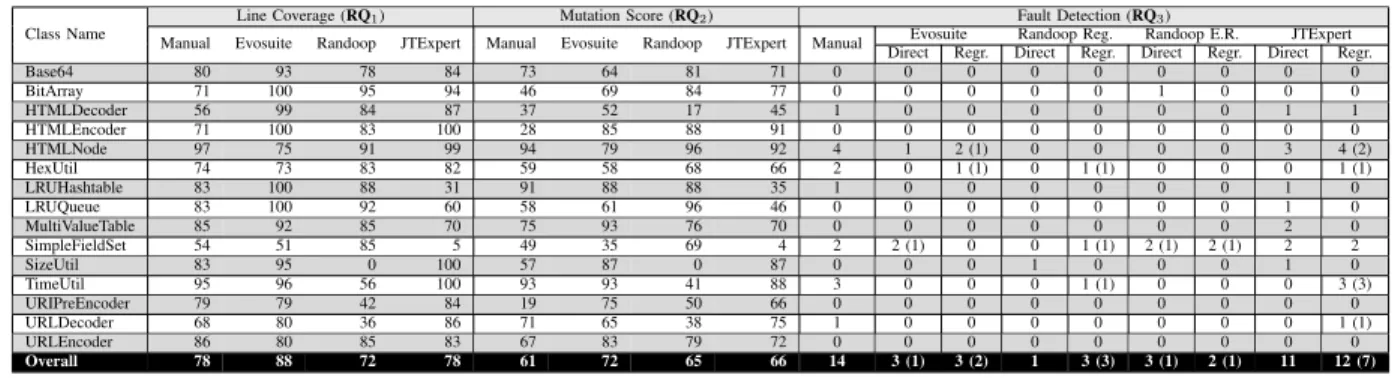
In the following, we discuss the results of each RQ, summarized in Table I for space reasons.
A. RQ1— On Code Coverage of Manual vs Automatic Tests
Looking at the results achieved when considering this perspective, the first observation is related to the coverage
achieved by the automatic testing tools: All of them have a line coverage comparable or even higher than the one achieved by the manual tests. This result likely reflects the way in which the generation process actually works. In fact, the primary goal of all the tools is optimizing the coverage of the test on the production code; as such, we confirm that they seem to reach their target of overcoming manual tests under this aspect.
Among the tools, EVOSUITEreaches the highest coverage (88% on average); this is generally true also looking at the individual classes, with a very few exceptions. On the contrary, RANDOOP reaches the lowest coverage, thus indicating that a random-based approach can, at times, be less performing than others–a finding that corroborates previous work in the field [24]. Compared to the results achieved in the study by Bacchelli et al. (Table 21in [5]), we see that the results achieved by RANDOOPten years later are 3 points percentage higher on average, but no tool is able to reach the coverage achieved by JUNITFACTORY ten years ago, thus indicating that this industrial tool is still the best performer along this dimension. Our results indicate that automatic test case generation tools can support developers in ensuring a high code coverage (compared to manual tests), yet the improvement with respect to the original study is limited.
B. RQ2 — On Mutation Score of Manual vs Automatic Tests
Mutation testing allows to measure the ability of test cases to cover the so-calledmutants, i.e., variation of the production code that make it defective and that the test is supposed to identify [25]. The discussion of our results is similar to what reported for code coverage. Indeed, the automated tools reach mutation score values superior to the one of manually written tests. Also in this case, EVOSUITE is the best tool among the experimented ones, while RANDOOPand JTEXPERT
achieve a similar score. Interestingly, we observe cases where it seems to exist some complementarity between manual and automatic tests. This is, for instance, the case for the class HTMLEncoder: while the mutation score of the manual test in this case is fairly low (28%), the automatic ones are much higher. In other cases, like with the classURLDecoder, not all the automated tools reach a high mutation score while the manual one can capture more generated mutants. This seems to highlight that manual and automatic tests can sometimes work in a complementary manner and interchangeably: we see this finding as a possible input for further research on the topic. Compared to the results achieved in the study by Bacchelli et al. (Table 3 in [5]), we still see that JUNITFACTORYremains the best performer after ten years (77% on average), yet the difference with EVOSUITEis small (five point percentage less) and the improvement achieved by RANDOOPis very significant (18 points percentage higher now). Overall, our results indicate that automatic test case generation tools can support developers in ensuring a high mutation score (even though manual tests are sometimes better) and there has been a significant improvement in the last years along this dimension of effectiveness.
Table I: Performance of manually versus automatically generated test suites. The column ‘Direct’ is the fault detection ability of the tests when trying to directly identify faults in production code, while the column ‘Regr.’ is the ability to detect regressions.
Line Coverage (RQ1) Mutation Score (RQ2) Fault Detection (RQ3)
Evosuite Randoop Reg. Randoop E.R. JTExpert Class Name Manual Evosuite Randoop JTExpert Manual Evosuite Randoop JTExpert Manual
Direct Regr. Direct Regr. Direct Regr. Direct Regr.
Base64 80 93 78 84 73 64 81 71 0 0 0 0 0 0 0 0 0 BitArray 71 100 95 94 46 69 84 77 0 0 0 0 0 1 0 0 0 HTMLDecoder 56 99 84 87 37 52 17 45 1 0 0 0 0 0 0 1 1 HTMLEncoder 71 100 83 100 28 85 88 91 0 0 0 0 0 0 0 0 0 HTMLNode 97 75 91 99 94 79 96 92 4 1 2 (1) 0 0 0 0 3 4 (2) HexUtil 74 73 83 82 59 58 68 66 2 0 1 (1) 0 1 (1) 0 0 0 1 (1) LRUHashtable 83 100 88 31 91 88 88 35 1 0 0 0 0 0 0 1 0 LRUQueue 83 100 92 60 58 61 96 46 0 0 0 0 0 0 0 1 0 MultiValueTable 85 92 85 70 75 93 76 70 0 0 0 0 0 0 0 2 0 SimpleFieldSet 54 51 85 5 49 35 69 4 2 2 (1) 0 0 1 (1) 2 (1) 2 (1) 2 2 SizeUtil 83 95 0 100 57 87 0 87 0 0 0 1 0 0 0 1 0 TimeUtil 95 96 56 100 93 93 41 88 3 0 0 0 1 (1) 0 0 0 3 (3) URIPreEncoder 79 79 42 84 19 75 50 66 0 0 0 0 0 0 0 0 0 URLDecoder 68 80 36 86 71 65 38 75 1 0 0 0 0 0 0 0 1 (1) URLEncoder 86 80 85 83 67 83 79 72 0 0 0 0 0 0 0 0 0 Overall 78 88 72 78 61 72 65 66 14 3 (1) 3 (2) 1 3 (3) 3 (1) 2 (1) 11 12 (7)
C. RQ3 — On Fault Detection of Manual vs Automatic Tests
As for the fault detection ability, Table I reports the number of defects identified by manual tests and by the three exploited tools. For RANDOOP, we report the results for the regression
and for theerror revealingconfigurations separately (indicated by the columns “Randoop Reg” and “Randoop E.R.”). The number in parenthesis represents the defects that were also found by the manual tests (e.g., EVOSUITEfound two defects in SimpleFieldSet, one of which was also discovered with the manual testing). We observe that manually written tests have much high fault detection capabilities, while the automatic ones create unexpected scenarios that lead to a defect identification in a small number of real defects. Surprisingly, EVOSUITE and RANDOOP capture only a few of the real faults, when introduced as regressions. All in all, our findings suggest that all the automated tools can support developers with keeping coverage and mutation score high, but their ability in detecting real defects is not as good. Interestingly, we observe that the defects identified by automated tools are generally different from those captured by manually written tests, thus bringing evidence that developers can employ automatically and manually written in a complementary fashion to find more defects in production code.
V. THREATS TOVALIDITY
To conduct the study, we re-constructed the original dataset used by Bacchelli et al. [5], following the exact procedure of the reference paper to identify manually written test cases, defective, and fixed versions of the production classes involved in each defect. As a further validation of our activities, we involved the first author of the reference paper, who confirmed the correctness of the re-constructed dataset.
To investigate the capabilities of automatically generated tests, we ran the considered tools using a search budget of 180 seconds, which allowed the tools to extensively optimize the generated test suites [26]–[28]. At the same time, we left the other parameters to their default configuration: according to the findings of Arcuri and Fraser, it is not easy to find settings that significantly outperform the default suggested values [20]. The selected tools explicitly aim at finding regression faults rather than defects already present in production code. However,
as shown by both Bacchelli et al. [5] and Pacheco et al. [7], such tools can also be configured to generate unexpected scenarios that may lead to discovering existing defects. Therefore, our study aimed at assessing to what extent newer testing tools can (i) help developers in finding existing defects, and (ii) actually identify regressions. This preliminary investigation took into account real defects from the FREENETproject: Our findings are likely to differ when considering other environments and projects.
VI. CONCLUSION
We empirically compared the performance of manually versus automatically created test suites, considering three perspectives: code coverage, mutation score, and fault detection ability. To this aim, we first re-constructed and made publicly available a dataset originally used by Bacchelli et al. [5]. Our findings revealed that current automatic test case generation tools are able to optimize coverage and mutation score more than manually written tests; nevertheless, the improvement in the last ten years has not been dramatic. In terms of defect finding, while there has been little improvement over the last years, it has not reached the same level of quality as the other dimensions. This is expected, as the goal of the current tools is creating regression tests that are able to capture the current behavior, rather than exposing problems. Nevertheless, in some cases, the automatically generated tests were indeed able to expose unexpected scenarios that were defective, thus indicating that this could be a potentially viable path for our future research focus.
Our future research agenda includes the comparison of manually and automatically written test code in the context of a larger set of projects and defects (e.g., by exploiting the DEFECT4Jdataset [15]) as well as the definition of strategies that can make automatic tests more effective. By publishing this work in the main mining software repositories venue, it is our hope that it can contribute to bring the mining community closer to that of automated software testing.
ACKNOWLEDGMENTS
A. Bacchelli and F. Palomba gratefully acknowledge the support of the Swiss National Science Foundation through the SNF Project No. PP00P2_170529.
REFERENCES
[1] P. M. Duvall, S. Matyas, and A. Glover, Continuous integration: improving software quality and reducing risk. Pearson Education, 2007.
[2] P. Runeson, “A survey of unit testing practices,”IEEE software, vol. 23, no. 4, pp. 22–29, 2006.
[3] P. McMinn, “Search-based software test data generation: a survey,”
Software testing, Verification and reliability, vol. 14, no. 2, pp. 105– 156, 2004.
[4] G. Fraser, M. Staats, P. McMinn, A. Arcuri, and F. Padberg, “Does automated unit test generation really help software testers? a controlled empirical study,” ACM Transactions on Software Engineering and Methodology (TOSEM), vol. 24, no. 4, p. 23, 2015.
[5] A. Bacchelli, P. Ciancarini, and D. Rossi, “On the effectiveness of manual and automatic unit test generation,” inThe Third International Conference on Software Engineering Advances. IEEE, 2008, pp. 252–257. [6] The Freenet Project: a peer-to-peer software platform for
censorship-resitant communication. [Online]. Available: https://freenetproject.org [7] C. Pacheco, S. K. Lahiri, M. D. Ernst, and T. Ball, “Feedback-directed
random test generation,” in Proceedings of the 29th international conference on Software Engineering. IEEE Computer Society, 2007, pp. 75–84.
[8] JUnitFactory webiste. [Online]. Available: http://www.junitfactory.com [9] C. Csallner and Y. Smaragdakis, “Jcrasher: an automatic robustness
tester for java,”Software: Practice and Experience, vol. 34, no. 11, pp. 1025–1050, 2004.
[10] G. Fraser and A. Arcuri, “Evosuite: automatic test suite generation for object-oriented software,” inProceedings of the 19th ACM SIGSOFT symposium and the 13th European conference on Foundations of software engineering. ACM, 2011, pp. 416–419.
[11] F. Gross, G. Fraser, and A. Zeller, “Search-based system testing: high coverage, no false alarms,” inProceedings of the 2012 International Symposium on Software Testing and Analysis. ACM, 2012, pp. 67–77. [12] F. Palomba, A. Panichella, A. Zaidman, R. Oliveto, and A. De Lucia, “Automatic test case generation: What if test code quality matters?” in
Proceedings of the 25th International Symposium on Software Testing and Analysis. ACM, 2016, pp. 130–141.
[13] A. Sakti, G. Pesant, and Y.-G. Guéhéneuc, “Instance generator and problem representation to improve object oriented code coverage,”IEEE Transactions on Software Engineering, vol. 41, no. 3, pp. 294–313, 2015. [14] S. Shamshiri, R. Just, J. M. Rojas, G. Fraser, P. McMinn, and A. Arcuri, “Do automatically generated unit tests find real faults? an empirical study of effectiveness and challenges (t),” in2015 30th IEEE/ACM International Conference on Automated Software Engineering (ASE). IEEE, 2015, pp. 201–211.
[15] R. Just, D. Jalali, and M. D. Ernst, “Defects4j: A database of existing faults to enable controlled testing studies for java programs,” in
Proceedings of the 2014 International Symposium on Software Testing and Analysis. ACM, 2014, pp. 437–440.
[16] G. Grano, S. Scalabrino, H. C. Gall, and R. Oliveto, “An empirical investigation on the readability of manual and generated test cases,” in
Proceedings of the 26th Conference on Program Comprehension, ser. ICPC ’18. New York, NY, USA: ACM, 2018, pp. 348–351. [Online]. Available: http://doi.acm.org/10.1145/3196321.3196363
[17] U. Rueda, R. Just, J. P. Galeotti, and T. E. Vos, “Unit testing tool com-petition—round four,” in2016 IEEE/ACM 9th International Workshop on Search-Based Software Testing (SBST). IEEE, 2016, pp. 19–28. [18] G. Fraser and A. Arcuri, “A large-scale evaluation of automated unit test
generation using evosuite,”ACM Transactions on Software Engineering and Methodology (TOSEM), vol. 24, no. 2, p. 8, 2014.
[19] A. Panichella, F. M. Kifetew, and P. Tonella, “Automated test case generation as a many-objective optimisation problem with dynamic selection of the targets,”IEEE Transactions on Software Engineering, vol. 44, no. 2, pp. 122–158, 2018.
[20] A. Arcuri and G. Fraser, “Parameter tuning or default values? an empirical investigation in search-based software engineering,”Empirical Software Engineering, vol. 18, no. 3, pp. 594–623, 2013.
[21] D. Serra, G. Grano, F. Palomba, F. Ferrucci, H. Gall, and A. Bacchelli, “Replication Package - On the Effectiveness of Manual and Automatic Unit Test Generation: Ten Years Later,” 3 2019. [Online]. Available: https://figshare.com/articles/On_the_Effectiveness_of_Manual_ and_Automatic_Unit_Test_Generation_Ten_Years_Later/7628642 [22] H. Coles, T. Laurent, C. Henard, M. Papadakis, and A. Ventresque, “Pit:
a practical mutation testing tool for java,” inProceedings of the 25th International Symposium on Software Testing and Analysis. ACM, 2016, pp. 449–452.
[23] M. Kintis, M. Papadakis, A. Papadopoulos, E. Valvis, N. Malevris, and Y. Le Traon, “How effective are mutation testing tools? an empirical analysis of java mutation testing tools with manual analysis and real faults,”Empirical Software Engineering, vol. 23, no. 4, pp. 2426–2463, 2018.
[24] S. Bauersfeld, T. E. Vos, and K. Lakhotia, “Unit testing tool competitions– lessons learned,” inInternational Workshop on Future Internet Testing. Springer, 2013, pp. 75–94.
[25] R. Just, D. Jalali, L. Inozemtseva, M. D. Ernst, R. Holmes, and G. Fraser, “Are mutants a valid substitute for real faults in software testing?” in
Proceedings of the 22nd ACM SIGSOFT International Symposium on Foundations of Software Engineering. ACM, 2014, pp. 654–665. [26] A. Arcuri and G. Fraser, “On parameter tuning in search based software
engineering,” inInternational Symposium on Search Based Software Engineering. Springer, 2011, pp. 33–47.
[27] G. Fraser and A. Arcuri, “The seed is strong: Seeding strategies in search-based software testing,” in2012 IEEE Fifth International Conference on Software Testing, Verification and Validation. IEEE, 2012, pp. 121–130. [28] S. Shamshiri, J. M. Rojas, G. Fraser, and P. McMinn, “Random or genetic algorithm search for object-oriented test suite generation?” in
Proceedings of the 2015 Annual Conference on Genetic and Evolutionary Computation. ACM, 2015, pp. 1367–1374.