A CASE STUDY ANALYSIS THROUGH
THE IMPLEMENTATION OF VALUE
ENGINEERING
Amit Sharma1, Harshit Srivastava1
1 ME Research Scholar, PEC University of Technology, Chandigarh (India) Dr. R.M.Belokar2
2
Asst. Prof., PEC University of Technology, Chandigarh (India)
Abstract — This paper presents the basic fundamental of Value Engineering and its different phases that can be implemented in any product to optimize its value. A case study is discussed of a bath fitting product in which the material of the product is changed according to the value engineering methodology. The material is chosen such that the cost is reduced without affecting the value of the product and its design. To find the best possible alternative from the choices we have incorporated a tool named as Decision Matrix. Decision Matrix gives the most appropriate result and is even easy to use. Hence the cost is reduced as a result of the analysis.
Keywords --- Value Engineering (VE), Various phases of VE, Analysis Worksheet, Decision Matrix
I. INTRODUCTION
Value Engineering (VE), which is originated from the US military industry in the early 60 of this century, has been extensively applied in construction industry nowadays. Foo, T.H.(2002) and Chong, S.N.(2002) has given some useful frameworks on the application of VE.[1] However, in India, VE is mostly associated to any alternative design with the intention of cost cutting exercise for a project, which is merely one of the initial intentions of the VE. This paper outlines the basic frameworks of Value Engineering and presents a case study showing the merits of VE in a Bath Fittings Manufacturing Industry.
II. DEFINITION OF VALUE ENGINEERING
Value Engineering is the systematic application of recognized techniques by multi-disciplined team(s) that identifies the function of a product or service; establishes a worth for that function; generates alternatives through the use of creative thinking; and provides the needed functions, reliably, at the lowest overall cost. Value Engineering may be defined in other ways, as long as the definition contains the following three basic precepts:
1. An organized review to improve value by using multi-disciplined teams of specialists knowing various aspects of the problem being studied.
2. A function oriented approach to identify the essential functions of the system, product, or service being studied, and the cost associated with those functions.
3. Creative thinking using recognized techniques to explore alternative ways of performing the functions at a lower cost, or to otherwise improve the design.
III. WHAT VALUE ENGINEERING ISN'T
IV. ROADBLOCKS TO COST EFFECTIVENESS
The practice of VE doesn't imply that there may be intentional "gold plating," conscious neglect of responsibility, or unjustifiable error or oversight by the design team. VE simply recognizes that social, psychological, and economic conditions exist that may inhibit good value.
The following are some of the more common reasons for poor value:
1. Lack of information, usually caused by a shortage of time. Too many decisions are based on feelings rather than facts.
2. Wrong beliefs, insensitivity to public needs or unfortunate experience with products or processes used in unrelated prior applications.
3. Habitual thinking, rigid application of standards, customs, and tradition without consideration of changing function, technology, and value.
4. Risk of personal loss, the ease and safety experienced in adherence to established procedures and policy.
5. Reluctance to seek advice, failure to admit ignorance of certain specialized aspects of project development.
6. Negative attitudes, failure to recognize creativity or innovativeness.
7. Over specifying, costs increase as close tolerances and finer finishes are specified. Many of these are unnecessary.
8. Poor human relations, lack of good communication, misunderstanding, jealousy, and normal friction between people are usually a source of unnecessary cost. In complex projects, requiring the talents of many people, costs may sometimes be duplicated and redundant functions may be provided.[2]
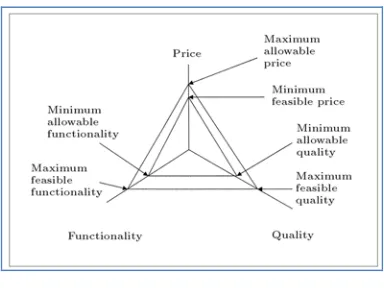
Cooper and Slagmulder, in their book, comprehensively discussed the interaction between the target costing method and value engineering. They elaborately present the Survival Zone for a product that consists of three characters:
1. Price, 2. Functionality, 3. Quality.
They discussed how these three factors interact with each other and provide the Zone for the operations of the firm. This Survival Zone is presented in Figure 1. The interaction of price and functionality was, also, discussed by them. Here, an attempt has been made to incorporate the third method (QFD) in this set. It is believed that a mathematical model is the proper tool for this incorporation and its feasible region precisely demonstrates the Survival Zone, which was described in.[3]
V. FIVE PHASES OF VE PROCESS DURING DESIGN PHASE
Information Phase - During this phase, the VE team gathers as much information as possible about the program requirements, project design, background, constraints, and estimated/projected costs. The team performs functional analysis of systems and subsystems to identify high cost areas. The project designer provides additional design data and participates in the initial VE team conference.
Figure 1. The survival zone for a product source
Evaluation/Analytical Phase - The ideas generated during the speculative/creative phase are screened and evaluated by the team. The ideas showing the greatest potential for cost savings and project improvement are selected for further study.
Development/Recommendation Phase - The team researches the selected ideas and prepares descriptions, sketches, and life cycle cost estimates to support the VE proposal (VEP) recommendations.
Report Phase - The team presents the VEP’s to the Government during an oral presentation at the conclusion of the workshop. Shortly after the completion of the VE workshop, a preliminary
VE report encompassing the entire VE effort is prepared by the VE team leader and submitted to the Government.[4,5]
VI. MEASURES TAKEN (POST-STUDY)
The preliminary VE report addresses any and all pertinent data or information that resulted from the study. Information typically will include, but is not limited to, an executive summary, a list of items or process examined, alternatives, functional and life cycle cost analyses, VEP’s and supporting information such as a description of the difference between existing and proposed design, advantages, and disadvantages; a list and analysis of design criteria or specifications that must be changed if the VEP’s are accepted by the Government; and the cost and schedule impact of the VEP’s if implemented by the Government. After the preliminary VE report is discussed with the project designer and the Government decisions are made, the VE team will prepare a final VE report to indicate those proposals that are accepted. In ARS, the decision to accept or reject VEP’s is with the Research Program Representatives after consultation with the Engineering Project Manager and Contracting Officer for the project.[6]
VII. ACCESS TO SUCCESS
There are many keys to the success of a VA program and it is wise to consider these issues before commencing the project, as errors in the project plan are difficult to correct, without causing frustration, once the VA project has started. One of the most important initial steps in developing the VA process is to create a formal team of individuals to conduct the exercise. These individuals must be drawn from different parts of the business that affect the costs associated with design, manufacturing, supply and other relevant functions. In addition, the team must be focused on a product or product family in order to begin the exercise. Further key success factors include:
a. Gain approval of senior management to conduct a Value Analysis exercise. Senior management support, endorsement and mandate for the VA project provide legitimacy and importance to the project within the business. This approval process also removes many of the obstacles that can prevent progress from being made by the team.
b. Enlist a senior manager as a champion of the project to report back directly to the board of directors and also to act as the program leader.
c. Once a program team has been developed it is important to select an operational leader to co-ordinate the efforts, monitor progress and to support the project champion. This leader will remain with the VA team throughout the life of the project and will be the central linking pin between the team and the senior management champion.
d. Establish the reporting procedure for the team and the timing of the project. This project plan needs to be formal and displayed as a means of controlling and evaluating achievements against time.
e. Present the VA concept and objectives of the team to all the middle and senior managers in the business.
Widespread communication of the VA project is important so that other employees, particularly managers (who may not be involved directly with the process) understand the need to support the project either directly by assigning staff or indirectly through the provision of data.
This form of promotion is important as it maintains a momentum and communicates the findings of the team as widely as possible.
g. Provide an office space and co-locate the team members where practical and possible to do so. The ability to locate a VA improvement group in one area of the business is important and assists the communication within the group. A convenient area can also be used to dismantle the product and also the walls of the area can be used to record, on paper charts, the issues that have been discovered by the team (and the associated actions that must be undertaken).
h. Select the product for the first study. Ideally the existing product, or family of products, will be one that is established, sells in volume and has a relatively long life expectancy. As such any improvement in the cost performance of the product will provide a large financial saving to the business
i. Write down the objectives of the project and the key project review points. Estimate the targets to be achieved by the project. These objectives provide a reference point and framework for the exercise. The objectives also focus attention on the outputs and achievements required by the company.
j. Select and inform any personnel who will act in a part time or temporary role during the project. This process is used to schedule the availability of key specialist human resources to support the team throughout the duration of the project.
k. Train the team in both the process of VA and also in basic team building activities. It is important that all members understand the nature of the project and its importance. The initial team building exercises are also a good way of understanding the attitude of all members to the project – especially those with reservations or a negative attitude to what can be achieved. As with most team exercises there is a requirement to allow the team to build and bond as a unit. It is often difficult for individuals, drawn from throughout the factory, to understand the language that is used throughout the business and also to understand the ‘design to market’ process when their own role impacts on a small section of this large and complex process. [7]
VIII. CASE STUDY
In this paper we have discussed a Bath Fitting product named CONC. FLUSH VALVE manufactured in LIDER (www.lider.co.in). LIDER ismaking a wide range of products conforming to international standards. It is the first company in India to be ISO 9001:2000 certified for designing and manufacturing of taps.
Value Engineering is applied to the Conc. Flush Valve. The steps used for this purpose are as follows :-
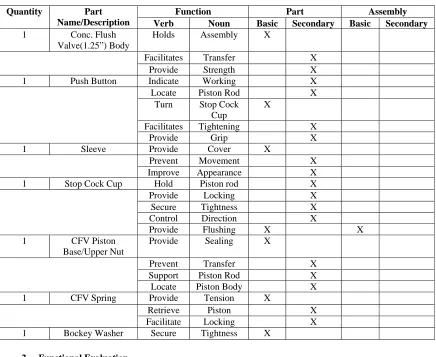
1. Functional Analysis Worksheet is prepared for the different parts of the product.
2. Functional Evaluation is done of each part
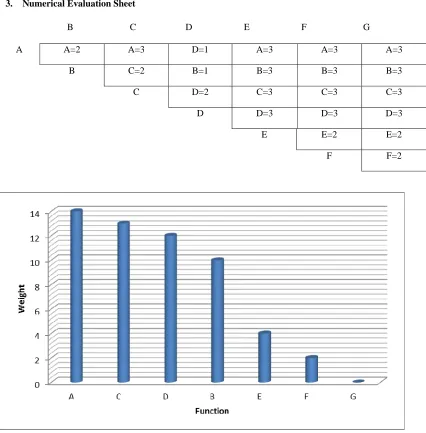
3. Numerical Evaluation Sheet is prepared
4. Creativity Worksheet
5. Selection of alternative is done through Decision Matrix
6. Finding And Recommendation
7. Conclusion
1. Functional Analysis Worksheet
Table 1: Functional Analysis Worksheet
Quantity Part Name/Description
Function Part Assembly
Verb Noun Basic Secondary Basic Secondary
1 Conc. Flush
Valve(1.25”) Body
Holds Assembly X
Facilitates Transfer X
Provide Strength X
1 Push Button Indicate Working X
Locate Piston Rod X
Turn Stop Cock
Cup
X
Facilitates Tightening X
Provide Grip X
1 Sleeve Provide Cover X
Prevent Movement X
Improve Appearance X
1 Stop Cock Cup Hold Piston rod X
Provide Locking X
Secure Tightness X
Control Direction X
Provide Flushing X X
1 CFV Piston
Base/Upper Nut
Provide Sealing X
Prevent Transfer X
Support Piston Rod X
Locate Piston Body X
1 CFV Spring Provide Tension X
Retrieve Piston X
Facilitate Locking X
1 Bockey Washer Secure Tightness X
2. Functional Evaluation
Product: Conc. Flush Valve
Basic Function: Provide Flushing
Table 2: Functional Evaluation
Key Letter Part Function Weight % Cost
A Conc. Flush
Valve(1.25”) Body
Holds Assembly 14 60.96
B Push Button Turn Stop Cock
Cup
10 16.04
C Sleeve Provide Cover 13 11.76
D Stop Cock Cup Provide Flushing 12 03.20
E CFV Piston
Base/Upper Nut
Provide Sealing 4 06.84
F CFV Spring Provide Tension 2 01.10
3. Numerical Evaluation Sheet
B C D E F G
A A=2 A=3 D=1 A=3 A=3 A=3
B C=2 B=1 B=3 B=3 B=3
C D=2 C=3 C=3 C=3
D D=3 D=3 D=3
E E=2 E=2
F F=2
Figure 2: Graph between weight & function of the product parts
The following part have been found to be costly from the Function Cost Matrix
1. Push Button
4. Creativity Worksheet
i. Function: Turn Stop Cock Cup ( Push Button )
I. Change the material to Aluminium II. Change the material to Aluminium alloy. III. Change the material to Plastic.
IV. Change the material to Polypropylene. V. Make it through Forging.
VI. Make the design simpler. VII. Make it in wood.
ii. Functional Development
Serial No Function Creative Ideas and
Development
Estimated Cost (Rs)
1 Turn Stop Cock Cup Use Aluminium Alloy 40
Use Plastic 20
Use Polypropylene 22
5. Decision Matrix
Function: Turn Stop Cock Cup
Objectives are :-
B1=Cost
B2=Reliability
B3=Performance
Weightage of each objective are:-
B2 B3
B1 B1=2 B3=1
B2 B2=1
B1 2 B2 1
B3 1 Total(P1) 4
Using wi = Bi/P1 we get w1=0.5, w2=0.25, w3=0.25
Alternatives are:
C1= Use Zamak (Aluminium Alloy)
C2= Use Plastic
C3= Use Polypropylene
Table 3: Decision Matrix
Objectives B1 B2 B3
Weightage 0.5 0.25 0.25 Value
C1
84
42 86 21.5 85 21.25 84.75
C2
90
45 73 18.25 71 17.75 81
C3
88
44 77 19.25 73 18.25 81.5
Alternative C1 has the maximum value of 84.75 Cost Improvement Recommendation
Potential Saving/Year: Rs. 2,80,000/-
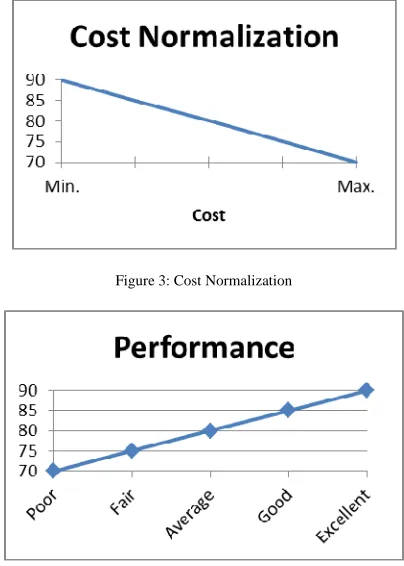
Figure 3: Cost Normalization
Figure 4: performance
6. Finding And Recommendation:
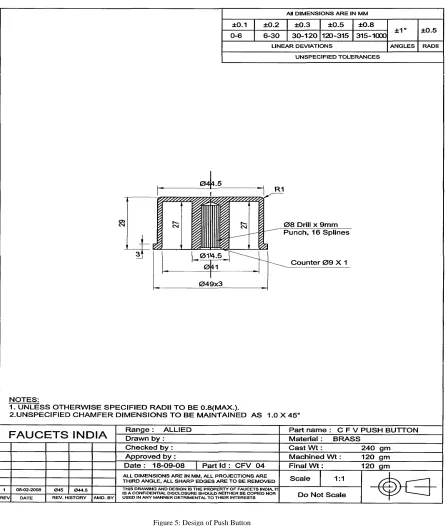
Push Button is a manufactured item. At present it is made from brass. The material is costly and hence the cost of the part made out from it is also costly.
It is recommended that the Push Button should be made in the factory without changing the design of it through pressure die casting process. The proposed Push Button is to be made from Zamak (an aluminium alloy) which is cheaper than brass and with the use of PDC (pressure die casting) process, the excessive cost of machining is also eliminated.
Calculation of saving:
Table 4: Cost Evaluation
Item Material cost (Rs.) Machining cost(Rs) Plating cost (Rs.) Total cost (Rs.)
Push Button (Brass) 62 8 5 75
Push Button (Zamak)
27 8 5 40
Part Eliminated - - - -
Figure 5: Design of Push Button
7. Conclusion:
The total saving which can be incurred per annum by the implementation of above recommendation is Rs. 2,80,000/-.
CONCLUSION & FUTURE SCOPE
leader and specialists is a key ingredient to the success of the VE program. It is more effective and influential on the performance, quality, and cost of a project when done relatively early in the project schedule.
In the Case Study discussed above we have seen how the VE is used for the cost reduction without the change in the product design & its value. A proper decision matrix is prepared for choosing the appropriate alternative from the feasible choices available.
In Future we can make the changes in the design so that the Value of the product can even be enhanced. Various other Industrial Engineering tools can be even made use in further improvement.
REFERENCES
[1] Application of Value Engineering to Geotechnical Design for a Factory Structures on Soft Alluvial Flood Plain in Indonesia, Ir.
Shaw-Shong Liew, Geology and Geotechnical Engineering Consideration to Coastal Development, 23 October, 2002
[2] Value Engineering Manual, West Virginia Department Of Transportation Division Of Highways Engineering Division, January 1,
2004
[3] Cooper, R. and Slagmulder, R., Target Costing and Value Engineering Productivity Press, Portland , OR, USA (1997).
[4] F. Jariri & S.H. Zegordi Quality Function Deployment, Value Engineering and Target Costing, an Integrated Framework in Design
Cost Management: A Mathematical Programming Approach, Scientia Iranica, Vol. 15, No. 3, pp 405-411 Sharif University of Technology, June 2008
[5] Policies and Procedures,United States Department of Agriculture Research, Education, and Economics, July 9, 1998
[6] Access to success: Value Engineering, Mani Mala, Advancements & Futuristic Trends In Mechanical & Industrial Engineering,
November, 2010
[7] Stuart D. Green, (1993) "Value Engineering During Early Design", Facilities, Vol. 9 Iss: 9, pp.10 – 13.
[8] R. Graeme Willersdorf, (1993) "Adding Value through Logistics Management", Logistics Information Management, Vol. 3 Iss: 4, pp.6 – 8
[9] Gage, W. L., (1967), ‘Value Analysis’, McGraw Hill, London