ENACTED SOFTWARE
DEVELOPMENT PROCESS BASED ON
AGILE AND AGENT
METHODOLOGIES
1
.DR. NACHAMAI. M *
Department of Computer Science, Christ University, Bangalore, India
2.
M. SENTHIL VADIVU
Department of Computer Science, The Oxford College of Science, Bangalore – 560 102 , India
3.
VINITA TAPASKAR
Department of Computer Science, The Oxford College of Science , Bangalore – 560 102 , India
Abstract:
Software Engineering gives the procedures and practices to be followed in the software development and acts as a backbone for computer science engineering techniques. This paper deals with current trends in software engineering methodologies, Agile and Agent Oriented software development process. Agile Methodology is to meet the needs of dynamic changing requirements of the customers. This model is iterative and incremental and accepts the changes in requirements at any stage of development. Agent oriented software’s is a rapidly developing area of research , Software agents are an innovative technology designed to support the development of complex, distributed, and heterogeneous information systems. The work of paper weight against factors of agile and agent oriented software development process on the basis of Architectural Design, Applicability, Project Duration, Customer Interaction Level, Team collaboration, Documentation, Software Models.
Keywords:
Software Development Process; Software Agent; Iterative Development Models; Prototyping Development Model; Distributed System; Objects; Artificial Intelligence.
I. Introduction
A software development process is a structure imposed on the development of a software product. During last few decades various software development methodologies have been into market to meet the needs of new demands of software development. Several models exist to streamline the development process. Each one has its pros and cons, and it's up to the development team to adopt the most appropriate one for the project. Sometimes a combination of these models may be more suitable. The most popular models used in software development process are Water Fall, Spiral, and Prototyping model which fall under traditional approaches. Object Oriented Analysis Design Approach based on UML is used for object oriented software development [Munassari and Govardhan, (2010)] [Chidamber and Kemerer, (1994)].
development phases is needed. Since each traditional methodology has its own inconveniences to meet these needs industries started moving towards the flexible mode of development.
In past few years there has been new style of software methodology used in the IT industry. One of such popular methodology is Agile Methodology. Agile oriented software development is used for faster development of the software. It breaks the project into multiple smaller modules with each incremental release, whereby the customer can give the feedback on each release and suggest the new requirement. The time and cost required for development is reduced and customer is satisfied which is the main aim of this model [Agile Alliance] [Erickson and Lyytinen et al. (2005)]. The prototyping model has customer acceptance taken in each iteration of incremented model, but do not provide the customer involvement in development phases and flexibility in changing the requirement.
AOSE is rapidly developing area of research. Software Agents are an innovative technology designed to support the development of complex, distributed, heterogeneous information system. Agent oriented software engineering methodology is used to incorporate software agents into systems. This field is motivated by two research fields’ software engineering and Artificial Intelligence. Agent-oriented software’s are being largely accepted into the various software design areas in the IT industry. Most application developed now are distributed and web based incorporating intelligence through agent will ease the development process [Shoham, (1993)].
In this paper we give an overview of various software development methods in section II, Section III compares agent and agile methods of software development; while section IV describes implementation and section V concludes the paper with summary and future work.
II. Methods and Material
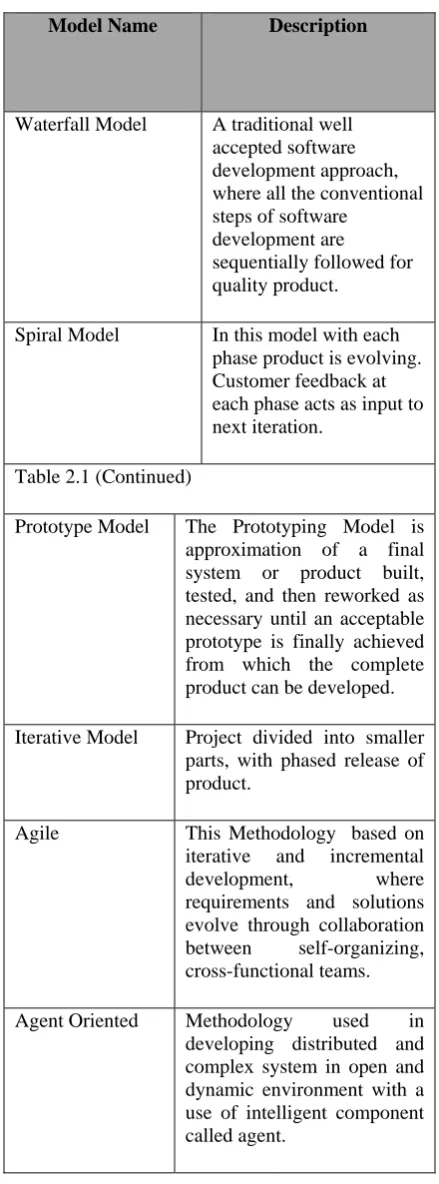
Before the Agile and Agent Oriented Methods of software development hit the IT industry, there was existence of many other methodologies which are listed below in the Table 2.1.
Table 2.1: List of Software Development Methods
Model Name Description
Waterfall Model A traditional well accepted software development approach, where all the conventional steps of software
development are
sequentially followed for quality product. Spiral Model In this model with each
phase product is evolving. Customer feedback at each phase acts as input to next iteration.
Table 2.1 (Continued)
Prototype Model The Prototyping Model is approximation of a final system or product built, tested, and then reworked as necessary until an acceptable prototype is finally achieved from which the complete product can be developed. Iterative Model Project divided into smaller
parts, with phased release of product.
Agile This Methodology based on iterative and incremental development, where requirements and solutions evolve through collaboration between self-organizing, cross-functional teams. Agent Oriented Methodology used in
developing distributed and complex system in open and dynamic environment with a use of intelligent component called agent.
OOAD approach is built with classes and objects, which brings in modular structure of software development.
The approach uses Unified Modeling Language to perform analysis and design [Chidamber and Kemerer, (1994)]. The Software engineering approach that models a system as a collection of interacting objects. Each object represents unit related to method which is being developed. These objects works in collaboration with each other to give requisite result.
Objects are passive as their methods are invoked only when the external entities sends a message to act and perform a specified task. In OOP, objects include public and private members, the object do not have control of accessibility of its public members, in this sense the called object do not have any power over methods invocation rather decision lies with the caller. Objects do not have flexibility and intelligence incorporated in them. Because of the above limitations in objects, agent is one among the proposed solution to develop flexible, large, distributed applications. Agent is active entity, it can handle task autonomously with its own intelligence under some prescribed conditions. As compare to object, agent is self initiative and have their own thread of control. Agent executes itself and has a power of decision making based on the user request [Iglesias and Garijo et al. (1999)].
Various approaches for software development co-exist in the IT industry [Munassari and Govardhan, (2010)] [Chidamber and Kemerer, (1994)] [Agile Alliance]. The customer needs from the project are changing because of this there is a need to adopt the approach which brings flexibility and satisfies the customer to the maximum extent. Agile method has bought solution to satisfy this need [Gonzalez and Pilar et al. (2009)] [Hock,(2009)] [Bonner and Nancy et al.(2010)] [Kenneth and Kendall et al.(2010)] [Chan and Thong, (2010)] [Esther and Nageswara,(2011
)] [Taromirad and Ramsin, (2008)] [Lu and DeClue, (2011)] [Likoebe and Maruping, (2009)]. One of the popular example in Agile based software development is Extreme Programming [Extreme Programming (2011)] [Erickson and Lyytinen et al. (2005)]. Due to growth of web technology the projects which are web based needs to be distributed on the global network. This brings in complexity in project development there is a need to fetch in intelligent and self – organized component, so that reusability can be increased and complexity can be reduced. Agent Oriented Software Engineering Approach is research area [Wooldridge (1997)] [Molesini1 and Andrea et al. (2009)] [Dzitac and Boldur et al. (2009)] [Scott and DeLoach, (2009)] [Sterling and Taverter, (2009)] [Abdelaziz and Elammari et al. (2008)] [Akbari and Faraahi , (2009)] An example of well known agent oriented software engineering approach is Tropos [Mouratidis and Haralambos, (2009)] [Ali and Dalpiaz , (2008)].
III. System Description
3.1 Architectural description
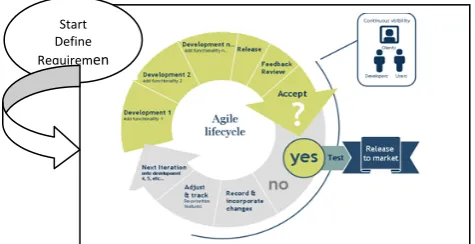
Agile development methodology attempts to provide many opportunities to access the direction of a project throughout the development lifecycle. Agile methods achieve the quality and productivity through regular iterations and interactions. Each iteration includes a software development team working through a full software development cycle including planning, requirements analysis, design, coding, unit testing, and acceptance testing as shown in Figure. 3.1.
Figure 3.1: Stages of Software Development in Agile Method
Start Define
Agile method adapt to changes, at the end of each stage lanunchable product is tested and released. In agile the changes are made without getting the entire programme rewritten this reduces overhead and upgrades the functionality of the programme. This agile methodology overcomes the problems which exist in traditional software developments like, dynamic changes in requirement specification by the customer, customer involvement in the development phases, miscommunication in the requirement specification between customer and developers[Agile Alliance][ Gonzalez and Pilar (2009)]. Following are the important features of Agile Methodology.
Highest priority is to satisfy the customer through early and continuous delivery of valuable software.
Welcome changing requirements, even late in development stages.
Deliver working software frequently, like couple of weeks to a couple of months, with a preference to the shorter timescale.
The most efficient and effective method of conveying information to and within a development team is face-to-face conversation
Business people and developers must interact frequently throughout development life cycle of the project.
Build projects around motivated individuals. Give them the environment and support they need, to get the job done.
Working software is the primary measure of progress.
Agile processes promote sustainable development. The sponsors, developers, and users should be able to maintain a constant pace indefinitely.
Continuous attention to technical excellence and good design enhances quality of project.
Simplicity- The approaches used for development may not be complex
The best architectures, requirements, and designs emerge from self-organizing teams.
At regular intervals, the team reflects on how to become more effective, then tunes and adjusts its behavior accordingly.
AOSE provides the developer the path to structure their applications using autonomous, communicative elements which are nothing but software agents.
AOSE methodology can be defined as economical process of development software where agent is used as key element. Developing software involves the phases from understanding the problem, requirements analysis, architecture design and implementation. In traditional development of projects the components or objects provide the business functionality.
But this approach of Software Development faces the challenges with distributed, complex and open systems. In distributed systems it is difficult to trace the single point of control because the objects are distributed. To overcome this difficulty the components must be capable of automatically interacting with each other and performing the required functionality as user needs it. Some Artificial Intelligence must be brought into the components of software.
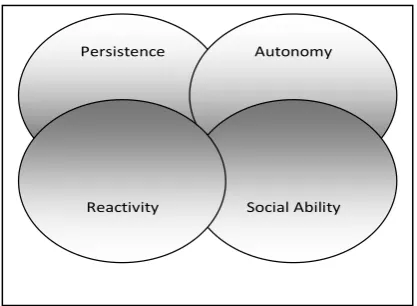
Figure 3.2 Agent Features
Agents have following properties broadly shown in Figure 3.2 to work on distributed or complex system intelligently:
Persistence: The component code will be active and will decide on its own when to execute the code based on the demand.
Autonomy: Agents have decision making capability. They can do selection, prioritization on behalf of user.
Social ability: Multiple agents may work in collaboration with each other. They can communicate with each other to perform the given task.
Reactivity: Agents can respond and react to the external environmental changes
3.2 Deployment scenario
Customer requirement keep changing due to evolving business needs. Most customers do not have clear vision about the specification of their requirements at the early stage. In such changing environment agile development methodology is suited. Agile development is a development strategy where the most importance is given to software solution that fits exactly what the client needs with minimum resources utilized [Hock , (2009)] [Bonner and Nancy et al. (2010)].
During past few years there is gradual increase in the complexity of projects; agent concept bought out of Artificial Intelligence provides solution to handle such complex systems.
For many software systems single point of control cannot be identified [Dzitac and Boldur et al. (2009)]. The entire implementation of the project is distributed across various nodes which are located remotely. Popular trend in distributed environment is Cloud computing which delivers IT as a service. It is an Internet-based computing solution where shared resources are provided. Computers in the cloud are configured to work together and the various applications use the collective computing power as if they are running on a single system. In such situations to develop complex, distributed based projects effectively, agent is introduced which in turn brings in AOSE.
Persistence Autonomy
Social Ability
Reactivity
3.3 Project duration
Agile methods focus on delivering features, they typically do not encompass the entire endeavor lifecycle omitting important pre-project work and beyond delivery activities due to this, project duration get reduced tremendously[Kenneth and Kendall et al. (2010)].
As Agile is iterative model the phases which are included is shown in Figure 3.3.
1. Initial Story Writing
2. Planning
3. Development
Figure 3.3: Development Phases in Agile
C D
Choose Card
Discussion on Feature
C D
New Card
Develop and Collect Feedback Write Feature
Discuss, Estimate,
Return Cardback
Planning and development activity will be repeated with each iteration. Based on the scope of project the duration may differ from six weeks to 6 months. The aim is to deliver many working versions of the software in short timed iterations.
For Agent oriented software development effort entire phases of software development are followed rigidly [Scott and DeLoach, (2009)]. The project which are developed using AOSE approaches are complex, distributed and long term project so project duration will be run into years. The phases and time requirement are explored in the following Figure 3.4.
Figure 3.4: Duration for AOSE
3.4 Customer interaction level
Lack of customer involvement leads to higher chances of project failure. First objective of the agile methodology is to develop software that satisfy customer, through continuous delivering of working software and receiving periodic feedback from customer [Chan and Thong , (2010)]. This involvement brings in more satisfaction and understanding of development process for the customer dynamic changes can be incorporated. There is communication between the developer and customer on daily basis.
Agent methodology uses software agents as building blocks, functional requirement for agents are defined initially by the customer in requirement gathering stage. Frequent changes to the functionalities of agents are not entertained [Scott and DeLoach, (2009)] [Sterling and Taverter , (2009)].
3.5 Team collaboration
In Agile Methodology the development team is small, strongly interactive, self – organized and with deeper technical, communicational skill [Esther and Nageswara, (2011)]. Developers are recognized for the critical role in building the system and are given more responsibility and trust. The entire software development process is based on face-to-face communication the team should be small and cannot be distributed in different location. In AOSE approach, each agent represents a role or functionality in the software. Teams needs to be large as complex systems require huge effort. Development teams can even be distributed as each team members may be working with different agent role [Sterling and Taverter, (2009)] and each team member may have been working from remote locations.
3.6 Documentation
In agile approach the duration of software development is reduced by eliminating certain steps in the standard software development approach. Agile methodology prefers software development over documentation [Taromirad and Ramsin,(2008)].
Agent oriented methods include documentation at each phase of development, which describes the role of agent and its communication. For complex and distributed project, documentation is needed as it helps to communicate requirement clearly from customer to developer, and further eases the maintenance of project[Abdelaziz and Elammari et al. (2008)] [Akbari and Faraahi ,(2009)].
3.7 Software models
Agile base software developments models are being widely used in Industry. These models are used in the IT market to develop customer – centric projects and projects which have small road map. This methodology is not suited for complex and large projects. For e.g. SCRUM
For AOSE many models were developed during past few years, but they lack industry acceptance due to lack of Agent Oriented Programming Languages, difficulty in learning those methods, relatively immature models, and lack of single methodology which fits all size and type of projects.
IV. Experimental Results
XP (Extreme Programming) is one of the well-liked Agile Methodology [Erickson and Lyytinen et al. (2005)]. This methodology provides simple and specific principles and values throughout all the stages of software development. The salient feature of this method is as follows [Extreme Programming (2011)]:
Incremental development with minimal design
Concentrates on delivering the function module
XP tends to use small size teams, thus reducing communication costs.
XP development approach has large Customer and developers interaction
XP works with index cards to expensive round-trip UML diagramming environments
XP's makes small size teams to work together to provide product as quickly as possible and how customer wants it.
XP uses template for coding which increases the quality of the product.
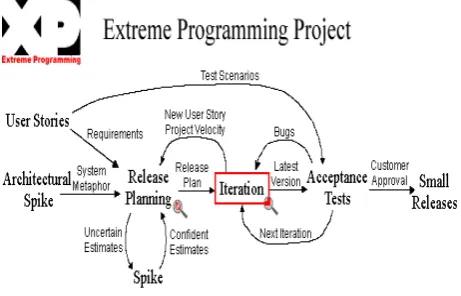
Figure 4.1: Project flow with XP
The Figure 4.1 shows the various steps followed in the development process using XP Methodology. This methodology used in developing small project with small teams for quick releases, as well accepting dynamic requirement at each stage.
such as goals and plans of agent, used in all phases of software development, (from early analysis down to the actual implementation). Second, Tropos covers the very early phases of requirements analysis, thus allowing for a deeper understanding of the environment where the software will eventually operate. [Mouratidis and Haralambos,(2009)]
Following are the concepts which are used in case Tropos methodology shown in Figure 4.2:
Figure 4.2: Concepts of Tropos Mythology
Actor: Intentional entity, role, position, agent (human or software)
Goal : Strategic interest of an actor
Task: Particular course of action that can be executed in order to satisfy a goal
Resource: Physical or informational entity (without intentionality)
Social dependency (between two actors) One actor depends on another to accomplish a goal, execute a task or deliver a resource [Ali and Dalpiaz et al. (2008)].
Tropos support four phases of software development:
Early requirements analysis concerned with the understanding of a problem by studying its organizational setting
Late requirements analysis where the system-to-be is described within its operational environment, along with relevant functions and qualities
Architectural design where the system's global architecture is decided in terms of subsystems, inter- connected through data, control, and other dependencies
Detailed design, where the behavior of each component is explained in further detail.
V. Conclusion
compact and business oriented applications. Agent methodology is growing technique for development complex, distributed and component oriented applications.
Future Work
This paper compares Agile and Agent Oriented software Development approaches on various factors, in future hands on can be done on other comparison factors like Cost and Budget, Testing Techniques, Quality of Software and Ease in Maintenance etc.
References
[1] Abdelaziz T; Elammari M; Branki C.(2008):Towards a comprehensive multiagent system development methodology, Meersman R, Tari Z., and Herrero P (Eds, OTM 2008 Workshops, LNCS 5333,pp. 108-117
[2] Agile Alliance. Manifesto for Agile Software Development Available at http://www/agilemanifesto.org
[3] Akbari Z; Faraahi A.(2009): A feature based framework for agent-oriented methodologies evaluation, in Proceedings of CCSR, Tehran, pp. 125-133
[4] Ali R; Dalpiaz F; Giorgini P.(2008): Location-Based Software Modeling and Analysis: Tropos-Based Approach, Lecture Notes in Computer Science, Volume 5231/2008, 169-182,
[5] Bonner; Nancy A; Teng; et al. (2010): The Perceived Advantage of Agile Development Methodologies By Software Professionals: Testing an Innovation-Theoretic Model”, AMCIS 2010 Proceeding". Paper 93
[6] Chan F; Thong J. (2010): The Effects of Agile Methodology Use on Knowledge Management Outcomes, Proceedings > Proceedings of IFIP 8.2/Organizations and Society in Information Systems (OASIS). Sprouts: Working Papers on Information Systems, 10(110). [7] Chidamber S ; Kemerer C. (1994) : A Metrics Suite for Object Oriented Design," IEEE Trans. Software Eng., vol. 20, no. 6, pp.
476-493.
[8] Dzitac I; Boldur E; Barbat. (2009): Artificial Intelligence + Distributed Systems = Agents, Int. J. of Computers, Communications & Control, ISSN 1841-9836, E-ISSN 1841-9844, Vol. IV, No. 1, pp. 17-26
[9] Erickson J; Lyytinen K; Siau K. (2005): Agile Modeling , Agile software Development and Extreme Programming : The state of Research: In Journal of Database Management 16(4),88-100
[10] Extreme Programming .What is Extreme Programming?[Online]Retrieved 14th March 18, 2011, Available at
www.extremeprogramming.org
[11] Gonzalez R; Pilar; Panadero Y; et al. (2009): Some Findings Concerning Requirements in Agile Methodologies. Product-Focused Software Process Improvement, 32 (4). 171 – 184pp.
[12] Hock M. (2009): Review Of Agile Methodologies in software development. International Journal of Research and Reviews in Applied Sciences, Volume 1,Issue 1.
[13] Iglesias C; Garijo M; Gonzalez J.(1999): A survey of Agent oriented Methodologies, Intelligent Agents IV: Agent Tehories Architevtures, and Languages, LNAI 1555, Spriner-Verlag, pp.317-330
[14] Kenneth E; Kendall; Kong S; et al. (2010): The Impact of Agile Methodologies on the Quality of Information Systems: Factors Shaping Strategic Adoption of Agile Practices, International Journal of Strategic Decision Sciences (IJSDS)(1)(1), 41-56 pp.
[15] Likoebe M; Maruping; Venkatesh V; ea tl.(2009): A Control Theory Perspective on Agile Methodology Use and Changing User Requirements, Journal: Information Systems Research, , Volume 20 Issue 3.
[16] Lu B; DeClue T.(2011): Teaching agile methodology in a software engineering capstone course, Journal of Computing Sciences in Colleges, Volume 26 Issue 5.
[17] Molesini1 A; Andrea O; Mirko V.(2009): Environment in agent-oriented software engineering methodologies , Multiagent and Grid Systems, Volume 5, Number 1 , 37-57pp.
[18] Mouratidis; Haralambos.(2009): Secure Tropos: An Agent Oriented Software Engineering Methodology for the Development of Health and Social Care Information Systems, International Journal of Computer Science and Security, 3 (3) 241-271.
[19] Munassari A; Govardhan A . (2010): A Comparison Between Five Models Of Software Engineering IJCSI International Journal of Computer Science Issues, Vol. 7, Issue 5.
[20] Scott A; DeLoach.(2009): Moving multi-agent systems from research to practice, International Journal of Agent-Oriented Software Engineering, Volume 3, 378–382.
[21] Shoham Y. (1993): Agent-oriented programming Artificial Intelligence, 60 (1) 51-92pp.
[22] Sterling L; Taverter K. (2009): The art of agent oriented modeling Cambridge, MA London , England, The MIT Press.
[23] Taromirad M; Ramsin R. (2008):
An Appraisal of Existing Evaluation Frameworks for Agile Methodologies, : Engineering of Computer Based Systems, ECBS. 15th Annual IEEE International Conference and Workshop, 418 – 427pp.
[24] Esther Jyothi V; Nageswara R.(2011): Effective Implementation of Agile Practices, (IJACSA) International Journal of Advanced Computer Science and Applications,Vol. 2, No.3.
[25] Wooldridge M. (1997): Agent-based software engineering IEEE Proc. on Software Engineering, 144(1) 26-37pp.