Amritsar College of Engg. & Technology, Punjab Technical University Amritsar, Punjab India
Abstract:
Shadow detection and removal is an important task when dealing with colour outdoor images. Shadows are generated by a local and relative absence of light. Shadows are, first of all, a local decrease in the amount of light that reaches a surface. Secondly, they are a local change in the amount of light rejected by a surface toward the observer. Most shadow detection and segmentation methods are based on image analysis. However, some factors will affect the detection result due to the complexity of the circumstances, like water and a low intensity roof because of the special material as they are easy mistaken as shadows. In this paper we present a hypothesis test to detect shadows from the images and then energy function concept is used to remove the shadow from the image.
Keywords: Shadow Removal, Contraharmonic Filter, Energy Function
1. Introduction
A shadow is an area where direct light from a light source cannot reach due to obstruction by an object. There have been few studies concerning shadow removal, and the existing approaches cannot perfectly restore the original background patterns after removing the shadows [1]. The patterns of shadow rely on size of objects and the angles of lighting source. This may lead to problems in scene understanding, object segmentation, tracking and recognition. Because of the undesirable effects of shadows on image analysis, much attention is paid to the area of shadow removal over the past decades and covered many specific applications such as traffic surveillance, face recognition, image segmentation and so on [2,3,4]. There are disadvantages like loss of information for the surface under the shadows present difficulties for image interpretation, image matching, detection and other applications. There are a number of cues which suggest the presence of shadows in a visual scene and that are exploited for their detection in digital images and image sequences [5, 6].
Shadow removal from respective image can be used for object detection, such as cancer detection, military object detection etc., as sometimes images are covered by shadows. After removing these shadows, objects in the images will appear more obviously so that they are recognized correctly.
2. Basic Approach of Shadow Remaval
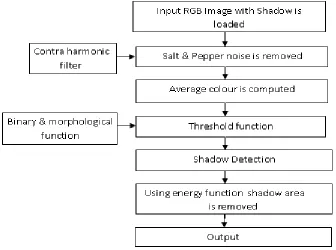
The algorithm used to remove the shadow is shown in figure 1. The first step is to load image with shadow, which have probably same texture throughout. Remove pepper and salt noise by applying contra harmonic filter. To remove shadow properly, average frame is computed to determine effect of shadow in each of the three dimensions of colour. So the colours in shadow regions have larger value than the average, while colours in non-shadow regions have smaller value than the average values. Images are represented by varying degrees of red, green, and blue (RGB). Red, green, and blue backgrounds are chosen because these are the colors whose intensities, relative and absolute, are represented by positive integers up to 255. Then, construct a threshold piecewise function to extract shadow regions.
Finally, convolute the noise-free binary image with the original image to separate the shadow from the non-shadow regions. By testing the effects of non-shadow on specific pixels located in the solid backgrounds, the effect of shadow can be derived for different pixel value combinations by applying binary and morphological function. Solid colours are utilized as a background in order to remove as many variables as possible from the experiment. Pixels with wide variations in colour may reside next to each other giving skewed results. The separate analyses of these three solid backgrounds showed a correlation utilized to predict the effect of shadow in a multitude of situations. Finally energy function is applied to remove shadow.
2.1. Contraharmonic Filters
The contra harmonic filter is the most popular nonlinear filter for removing impulse noise, because of its good denoising power and computational efficiency. It is a nonlinear digital filtering technique, often used to remove noise.The main idea of the contra harmonic filter is to run through the signal entry by entry, replacing each entry with the mean of neighboring entries. The pattern of neighbors is called the "window", which slides, entry by entry, over the entire signal. For 1D signal, the most obvious window is just the first few preceding and following entries, whereas for 2D (or higher-dimensional) signals such as images, more complex window patterns are possible (such as "box" or "cross" patterns). If the window has an odd number of entries, then it is simple to define: it is just the middle value after all the entries in the window are sorted numerically.
2.2. RBG Colour Model
The RGB colour model is an additive colour method in which red, green and blue light are added together in various ways to reproduce a broad array of colours [7, 8]. The average colour values of red, green¸ and blue (primary) components in image is obtained which is further considered as dark pixels of shadow regions. After this, shadows are detected by comparing average R, G, and B values with original R, G, and B values of image.
2.3. Hypothesis Test
A hypothesis test is utilized to detect shadows. The effect of the presence of a shadow on a particular pixel is that the representative values in the RGB primary colours are lowered. This is due to the fact that lower relative numbers represent darker colours. The lowering of the values of each of the RGB components is dependent on the relationship between each of the RGB components. For example, if the RGB components are relatively equal, shaded pixels follow a relatively or approaching linear path towards the origin. If the RGB components are not relatively equal, the shaded pixels are found to be contained in an ellipsoid whose centre is a linear path
is a constant multiple of white light. In the second method, it is assumed that the required light is a constant, not necessarily a multiple of white light. However, both the above methods emphasized the third assumption i.e. the illumination is close of being constant inside the shadow regions. Moreover for both the methods, there is a need to compute the average value for each colour (light) inside and outside shadow regions.Since shadows occur because of lack in light in certain region, shadows are removed by supplying more light to the shadows regions only. An effective noise reduction method for this type of noise involves the usage of a contra harmonic filter. The salt and pepper noise is also known as data drop out noise, speckle or intensity spikes.
3. Results
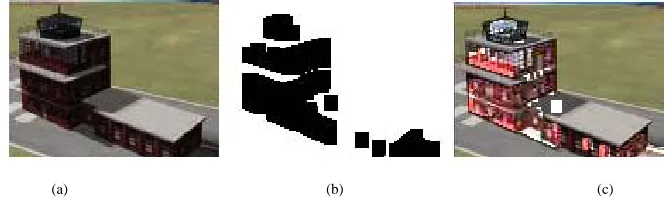
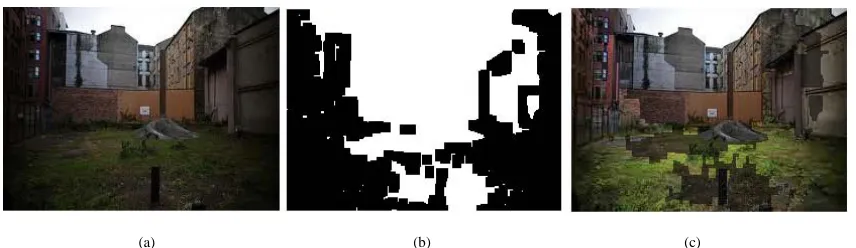
The effects of shadow on different combinations of colours are represented. The shadow pixels that belong to a corresponding colour are isolated and removed. In this work first preprocessing of image is done by filtering the image using contraharmonic filter where pepper noise is removed. Then, average colour values of red, green¸ blue (primary) components in image are obtained which are considered dark pixels as of shadow regions. Then hypothesis test is used to detect the shadow and shadows are detected by comparing average R, G and B values with original R, G and B values of image. After shadows are detected then shadow removal is done by using energy function. The algorithm of shadow removal is applied to various colour images and the results are shown in figures 2 to 6.
(a) (b) (c)
Fig. 2. (a) Original image (b) Shadow in image (c) Shadow enhanced image.
(a) (b) (c)
4. Conclusion
This paper represents the methodology to remove shadow for different coloured backgrounds. The ellipsoidal critical region employed presents an attempt to remove pixels that are the same colour as the average background pixel, though darker, and neglect data that is not related to the colour of the background, which is likely, a foreground object. The algorithm allows for the removal of a large percentage of shaded colours. This shows that it is possible to remove shadow from image without losing a large amount of pertinent data.
References
[1] C. Fredembach, G. Finlayson,: Simple shadow removal”, In Proceedings of International Conference on Pattern Recognition, (ICPR), pp. 832–835, 2006
[2] J.M. Wang, Y.C. Chung, C.L. Chang, S.W. Chen, “Shadow Detection and Removal for Traffic Images”, Proc. IEEE International Conference on Networking, Sensing and Control, volume 1, pp. 649 – 654, 2004.
[3] T. Chen, W. Yin, X.S. Zhou, D. Comaniciu, and T.S. Huang, “Illumination Normalization for Face Recognition and Uneven Background Correction Using Total Variation Based Image Models”, Proceedings CVPR, volume 2, pp. 532-539, 2005.
[4] Y. Adini, Y. Moses, and S. Ullman, “Face recognition: The problem of compensating for changes in illumination direction”, IEEE Transacations Pattern Analaysis Machine 5.Intelligence, volume 19, no. 7, pp. 721–732, 1997.
[5] G. Funka-Lea, “The visual recognition of shadows by an active observer”, PhD thesis, Department of computer and information science, university of pennsylania, 1994.
[6] C. Jiang, M.O. and Ward, “Shadow segmentation and classification in a constrained environment”, In CVGIP: Image Understanding, volume 59, no. 2, pp. 213-225, 1994.
[7] V.J.D Tsai, “A comparative study on shadow compensation of color aerial images in invariant color models [J]”, IEEE Transcations on Geoscience and Remote Sensing, volume 44, no. 6, pp. 1661-1671, 2006.
[8] A.C. Hurlbert, “The computation of colour”, Technical report, MIT Artificial Intelligence Laboratory.
[9] A. Cavallaro, E. Salvador, and T. Ebrahimi, “Detecting shadows in image sequences”, 1st European Conference on Visual Media Production. no. 1, 2, pp. 165–174, 2004.
(a) (b) (c)
Fig. 2. (a) Original image (b) Shadow in image (c) Shadow enhanced image.
(a) (b) (c)