Research Article
a
January
2018
Computer Science and Software Engineering
ISSN: 2277-128X (Volume-8, Issue-1)
CEERA: Improved Clustring Based Energy Efficient Routing
Algorithm for Mobile Ad Hoc Networks
Amit Pratap1, Surendra Pal Singh2, Prashant Kumar Pandey3
Department of Computer Science and Engineering1&2, Department of Electronic & Communication Engineering3 NIMS University Jaipur1&2, Goel Institute of Technology and Management, Lucknow3, India
Abstract: Ubiquitous smart devices with embedded sensors are paving the way for mobile ad hoc networks (MANETs) that enable users to communicate directly, thereby playing a key role in Smart City and Internet of Things applications. In such smart environments, people with smart devices (nodes) can freely organize and form self-configuring MANETs to send and forward data packets to a destination over multiple hops via intermediate nodes. However, the energy consumption during routing remains a challenge in such ensemble mobile environments due to the limited battery capacity of mobile devices. Thus the effectiveness of MANET not only depends on control protocols but also on management of network topology and energy administration. Clustering in MANET is useful to make network more manageable. Many clustering protocols and algorithms are proposed to make network more stable and trusted. In this paper we depict the most prominent factor related to the MANET. The motive of this paper is to perform investigational study including: routing structure, storage method, overhead, cryptographic authentication and misbehavior of nodes to clearly address relevant problem in cluster based routing protocol and provide a suitable solution by proposing a energy efficient clustering algorithm named as clustering based energy efficient routing algorithm (CEERA).
Keywords: MANET, Clustering, Efficiency, CEERA, Stability, NS2.
I. INTRODUCTION
The recent evolution of ad hoc wireless technologies has allowed mobile ad hoc networks (MANETs) to construct spontaneous connections among mobile devices without any infrastructure. MANET [1] is collaboration of wireless mobile nodes that build a temporary network without any centralized infrastructure. In MANET each node play a role of host and router itself. Nodes in MANET are mobile in nature thus building an energy efficient network is a primary issue. MANET is more vulnerable to attack as compared to wired network. Hence designing a trusted and energy efficient network is paramount challenge. Clustering [2] is the best approach for designing and managing the mobile ad-hoc network environments. A good clustering is beneficial in many ways such as: reuse of network resources, efficient and stable network, conserve communication bandwidth and reduce transmission overhead. The main purpose of cluster is to elect a most suitable node as cluster head that can coordinate for its cluster. Moreover it manages the reputation tables of nodes to note/… the behavior of node, so that the malicious node can isolate or punished.
In this paper we present a Clustering Based Energy Efficient Routing Algorithm (CEERA) that is new scalable, trusted and energy efficient clustering algorithm. This algorithm check the trust value of every invoked node then form a cluster of trusted nodes and a node has best material resources (high energy, low mobility, trust etc) elect as cluster head. In clustering procedure, a representative of each subdomain (cluster) is „elected‟ as a cluster head (CH) and a node which serves as intermediate for inter-cluster communication is called gateway. Remaining members are called ordinary nodes. The boundaries of a cluster are defined by the transmission area of its CH. With an underlying cluster structure, non-ordinary nodes play the role of dominant forwarding nodes, as shown in Figure 1.Cluster architectures do not necessarily include a CH in every cluster. CHs hold routing and topology information, relaxing ordinary MHs from such requirement; however, they represent network bottleneck points. In clusters without CHs, every MH has to store and exchange more topology information, yet, that eliminates the bottleneck of CHs. Yi et al. identified two approaches for cluster formation, active- 2 -clustering and passive clustering. In active clustering, MHs cooperate to elect CHs by periodically exchanging information, regardless of data transmission.
ISSN(E): 2277-128X, ISSN(P): 2277-6451, pp. 51-59
II. CLUSTERING ALGORITHMS IN MANET
A. Linked Cluster Algorithm(LCA)
The linked cluster algorithm (LCA) [3] performs the job of initial three tasks such as topology sensing, cluster formation and cluster linkage. Whereas the link activation algorithm (LAA) performs the job of link activation between the nodes in the network. The routing algorithm covers the details of the routing operations for packet communication. The objective of the current work is to focus on the basis of neighbourhood detection in changing topology and cluster formation. LCA could not meet certain criteria of the ad hoc network, but could become the base algorithm for other benchmark algorithms.
B. Lowest ID Algorithm(LID)
In this algorithm, every node is assigned with a unique non-negative identification number which is the deciding factor for the status of a node. In a mobile packet [4] radio network, anode has no a priori knowledge of the locations of other nodes as well as the connectivity of the network. So, as a first task when the network comes up, the connectivity among the nodes is discovered by every other node. This is accomplished by every single node that broadcasts its own ID to its neighbors. At the same time it also receives the same from its neighbors If a node listens to all the IDs that are higher than its own ID, then it declares itself as the cluster head among its immediate neighbors. And the neighbor nodes whose status is not yet decided become the members of the newly selected head. This process is repeated till all the nodes are assigned with the role of ahead or a member of a cluster.
Fig1. Cluster heads, gateways and ordinary nodes in clustering of mobile ad hoc network
C. Highest Connectivity Algorithm(HC)
This algorithm aims to reduce the number of clusters [5] in the network. In every cluster there exists a cluster head that belongs to the dominating set. In the HC algorithm, a node having highest degree of connectivity is selected as the cluster head. And the adjacent node whose status is not yet decided becomes the member of the selected cluster head. Higher degree of connectivity ensures efficient service to the member nodes by minimizing the number of heads. Here the efficiency means lowering the delay in communication through the head nodes.
III. RELATED WORK
Energy conservation in ad hoc networks is a relatively new field of research. Significant research in this area has been ongoing for nearly 30 years, also under the names packet radio or multi-hop networks. Some of the research works that has been done on this field are as follows: We also studied performance evaluation of routing protocols in based on clustering in that study various QoS parameters used were throughputs, end-to-end delay and network life time. But a real evaluation of performance of protocols must also describe the degree of variability in packet arrivals, which can be caused by network congestion (bursts of data traffic), timing drift or because of route changes.
Mehran Abolhasan et al. describe multimedia support in mobile wireless networks (MMWN) [8]:In MMWN routing protocol [8] hierarchical clustering is used to sustain the structure of network and information is stored in dynamic distributed database. Cluster formation is done using switches, endpoints and a location manager (LM). In MMWN [9]the location of each cluster is managed by Location Manager.
ISSN(E): 2277-128X, ISSN(P): 2277-6451, pp. 51-59
mobility and rest of the nodes as member nodes. Maintenance of cluster hierarchy is not required as cluster is maintained by cluster head. The cluster head controls over transmission medium and inter cluster communication. In CGSR member node maintain routes to its cluster head only that lead to reduce overhead.
Anderegg et al.[11] introduce a protocol VCG- a truthful and cost efficient routing protocol, that works on top of the dynamic source routing (DSR) [15]. This estimates the cost of forwarding the packets of other node using the cost-of-energy parameter. This provide means of cheat as nodes have to indicating signal strength at with they emit and forwarding information about their neighbour received signal strength. Author proved that this protocol is feasible only when one cheating node exists.
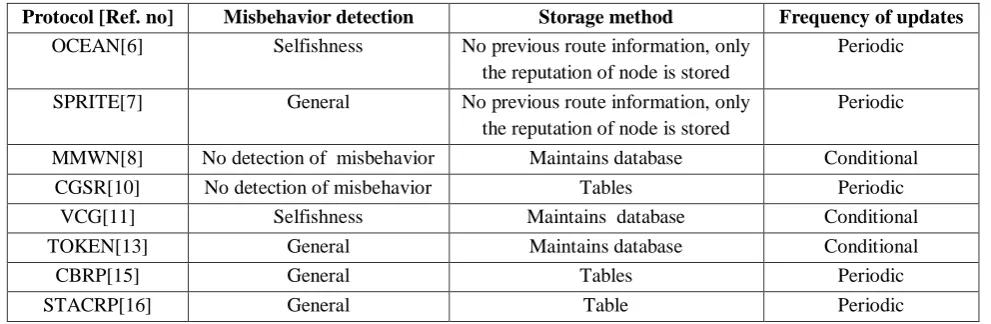
The related work with different methods are summarized in table 1.
Table 1: Related work with different attributes
Protocol [Ref. no] Misbehavior detection Storage method Frequency of updates
OCEAN[6] Selfishness No previous route information, only the reputation of node is stored
Periodic
SPRITE[7] General No previous route information, only the reputation of node is stored
Periodic
MMWN[8] No detection of misbehavior Maintains database Conditional
CGSR[10] No detection of misbehavior Tables Periodic
VCG[11] Selfishness Maintains database Conditional
TOKEN[13] General Maintains database Conditional
CBRP[15] General Tables Periodic
STACRP[16] General Table Periodic
Yang et al. [13], introduce a scheme that protects both routing and packet forwarding in the context of the AODV [9]. It is self-formed, without assuming any a-priori trust between the nodes or the existence of any centralized trust entity. It isolates the misbehaving nodes and employs threshold cryptography to enhance the tolerance against these nodes. The scheme is fully localized (one hop), and its credit based strategy produces overhead that is significantly decreased when the network is not harmed.
M. Jiang et al. describes Cluster-based routing protocol (CBRP). In CBRP[15] cluster based routing protocols nodes are arranged cluster form. Each cluster has a cluster-head, which coordinates the data transmission within the cluster and to other clusters [13]. In CBRP routing information is transferred through cluster head only, thus the number of control overhead carried through the network is far less as compared to the convention flooding techniques.
Pushpita Chatterjee [16] describe a game theoretic routing model. Two mechanisms Credit and reputation are to force the nodes to work honestly. This model mainly proposed to overcome the problem of selfish behavior of node, where the node behave idle and stop the transmission. Cost of forwarding packet for intermediate nodes are calculated using Procurement and Dutch mechanism. STACRP find selfish nodes and force them to cooperate, so that the throughput of network can be increased.
IV. SIMULATION ENVIRONMENT AND RESEARCH METHODOLOGY
ISSN(E): 2277-128X, ISSN(P): 2277-6451, pp. 51-59
Qos parameter for clustering evaluation are following:
(a) Network Life Time - Time until the head node or Cluster head nodes in the network runs out of energy.
(b) Throughput of Network-Throughput is defined as; the ratio of the total data reaches a receiver from the sender. The time it takes by the receiver to receive the last message is called as throughput. Throughput is expressed as bytes or bits per sec (byte/sec or bit/sec).
(c) Packet Delivery Ratio- Packet delivery ratio is the fraction of packets sent by the application that are received by the receivers and is calculated by dividing the number of packets received by the destination through the number of packets originated by the application layer of the source
(d) End-to-End Delay-The packet End-to-End delay is the average time that packets take to traverse the network. This is the time from the generation of the packet by the sender up to their reception at the destination‟s application layer and is expressed in seconds.
(e) Energy Consumption- The energy consumption is measured by the transmitting power or receiving power multiply the transmitted time.
Energy = power × time (1)
4.1 Proposed Work
We observe from previous research that the number of algorithms have been proposed and all are beneficial in specific tasks. Some are good in detecting the malicious (a node that misbehave in network) nodes [19] and isolate them, some punish and manage reputation table. In some algorithms nodes are encourages to cooperate and not to misbehave by giving credit. Some algorithms are energy efficient but the network is more vulnerable to attack because these algorithm are not meant for security. By keeping all these things in mind we proposed an algorithm that is trusted as well as energy efficient.
Clustering Based Energy Efficient Routing Algorithm (CEERA): Calculation of the Clustering Based Energy Efficient Routing Algorithm is based on Weightage of cluster head. This technique is implemented as per Weightage rules so this is known as weightage based Energy Efficient Clustering Based Algorithm (WB-EECBA). WB-EECBA is an enhancement of predictable CBA. In this protocol, the weight of each node is measured as metric for Clustering head selection. In WCA re-election takes place with the occurrence of certain events i.e., when there is a demand for it. Node parameters like degree of connectivity, mobility, transmission power and available battery power are considered for selection of a cluster head and are given different weights depending on the network scenario. For example, sensor networks where energy is a major constraint, battery power could be given higher weight.
4.2 Framework/Structure of Algorithm
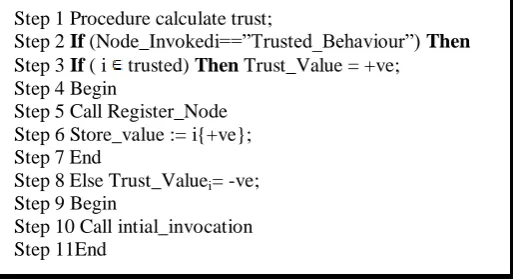
Initially when a node is invoked trust value of the node will be calculate that either the node is trusted or node. if the node will be trusted then it will be registered [20] as one of node of MANET. Otherwise the trust value of the node will be calculated again until it starts behaving well. Once the node will be registered network establishment will be divided into two parts: setting up of cluster and maintenance of cluster.
Fig 2: Structure of Algorithm
4.3 Setting Up of Cluster
All the nodes having +ve trust value will be registered on the network. Trust value of node is change with the change in behavior of node and it is updated in maintains table. Then a broadcast message is passed through all nodes to know the mobility and energy of node. This information is gathered to calculate the weight of the node. Calculate the weight of the node by the following formula.
Step 1 Procedure calculate trust;
Step 2 If (Node_Invokedi==”Trusted_Behaviour”) Then
Step 3 If ( i trusted) Then Trust_Value = +ve; Step 4 Begin
Step 5 Call Register_Node Step 6 Store_value := i{+ve}; Step 7 End
Step 8 Else Trust_Valuei= -ve; Step 9 Begin
ISSN(E): 2277-128X, ISSN(P): 2277-6451, pp. 51-59
W = T+ M+ E
To compute the weight positive trust value is chosen, low mobility and high energy of node is taken. Then the node having maximum weight is chosen for Cluster Head and the node having minimum energy becomes the member node. Computed weight value is stored in table for future use.
The Simulation parameters are summarized in table 2.
Table 2: Simulation Parameters Statistic Value
Routing Protocols CEERA
No. of Nodes 32 nodes
Application Traffic Constant Bit Rate Data rate 11 Mbps for 802.11
Transmit Power 0.005
Performance Parameter
Network Life Time, Throughput, Packet Delivery Ratio, Delay Channel Type IEEE 802.11 Wireless channel Simulation Time 15 minutes
Scenario Size 100*100m
Simulator NS2
4.4 Maintenance of Cluster
Trust value of the nodes change with the change in behavior of node and maintained in table. Current calculated value is also maintained in table. At a point cluster head runs out of energy and new cluster head needs to elect. Before going dead CH choose the node have maximum weight according to current updates in maintained table and delegates the
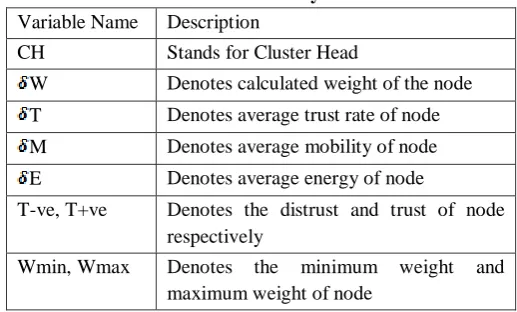
functionality of CH that lead to reduce the bandwidth and consume less energy and time. The Data Dictionary Attributes are summarized in table 3.
Table 3: Data Dictionary Attributes
Variable Name Description
CH Stands for Cluster Head
W Denotes calculated weight of the node
T Denotes average trust rate of node
M Denotes average mobility of node E Denotes average energy of node
T-ve, T+ve Denotes the distrust and trust of node respectively
Wmin, Wmax Denotes the minimum weight and maximum weight of node
V. SIMULATION RESULT AND OBSERVATIONS
We carried out simulations on NS2 simulator [21]14.5. The results show differences in performance between considered routing protocols, which are the consequence of various mechanisms on which protocols are based. We carried out our simulations with 32 nodes [22]. I have implemented this model in ns2. Ns2 is a discrete event simulator written in C++ and OTcl. NS is primarily useful for simulating local and wide area networks.
Figures 3,4,5 and 6 depicts the network life time, throughput, packet delivery ratio and delay of this network with respect to total simulation time which is taken as 15 minutes for which the simulation was run. In this simulation, the networks is set to 32 nodes, the CBR traffic with the data transmission rate is 11 Mbps, IEEE 802.11 Wireless channel with omni antenna direction.
A. Network Life Time:
ISSN(E): 2277-128X, ISSN(P): 2277-6451, pp. 51-59
Figure 3: Performance Analysis of Network Life Time using Cluster Formation over MN nodes
The proposed technique energy efficient clustering protocols from the result observe that proposed protocol technique life time is higher. The graph figure 3 states the network life time of proposed proposed protocols consume less energy, which will increases the network life time. Due to protection of the hidden node the rate of consumption of energy will degrades thus it increase the life of the cluster.
B.Throughput:
Throughput is the amount of data moved successfully from one place to another in the given time period.
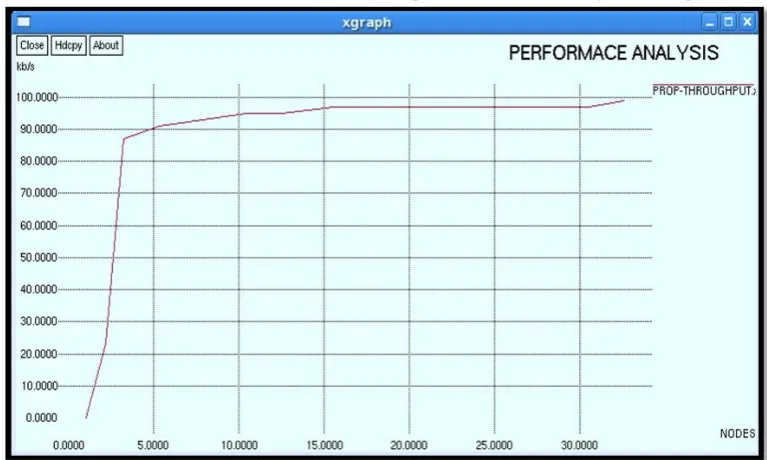
Figure 4 Performance Analysis of Throughput using Cluster Formation over MN nodes
In this figure 4 show that throughput of proposed Clustering Based Energy Efficient Routing Algorithm (CEERA), from the result it observe that proposed throughput rate is 98 kb/s with respect to time, the graph results proves that proposed algorithmic technique Clustering Based Energy Efficient Routing Algorithm (CEERA) have high throughput rate in network.
C. Packet Delivery Ratio:
ISSN(E): 2277-128X, ISSN(P): 2277-6451, pp. 51-59
Efficient Routing Algorithm (CEERA) from results it observes that the higher value of a packet delivery ratio was achieved due the trusted, high signal and bandwidth of the cluster head node. It observe that in proposed technique has 99.8% percentage of packets are delivered with respect to time. The graph results prove that proposed protocol delivers a maximum number of packets in network.
Figure 5: Performance Analysis of packet delivery ratio using Cluster Formation over simulation time
D. Delay:
The above graph figure 6 states the delay time of proposed protocol, from the result it observe that the delay time is estimated as 5.5s for packet transmission with respect to network density, the graph results proves that proposed protocol have low delay rate in network. With the increase the number node delay with respect to time also increases.
Figure 6: Performance Analysis of Delay with time using Cluster Formation over MN nodes
E. Energy Consumption:
ISSN(E): 2277-128X, ISSN(P): 2277-6451, pp. 51-59
Figure 7 Performance Analysis of Energy Consumption using Cluster Formation over MN nodes
VI. CONCLUSION
In this paper, according to simulation study of this work has been done for clustering based routing protocols in mobile ad-hoc network using CBR traffic. MANET has wide impact on research area from few years, and can be engaged in a broad range of applications in both civilian and military scenarios. The design of stable, secure and energy efficient routing protocols for MANETs is a challenging task. In this paper, we have presented an investigational study on weighted based clustering algorithm for routing protocols in MANETs and related different methodologies. Finally, we conclude that strut Clustering Based Energy Efficient Routing Algorithm (CEERA) protocol approach has long life time then the existing energy efficient clustering due to the less power consumption of the head node. The simulation results shows that the energy consumption by the proposed protocols has less as compare to the exiting energy efficient clustering methods due to providing the privacy and security to the node that protect from the hidden node, selfish node and man in middle attack that consumes the large part of energy of head node. As future work we intend being completing this algorithm by the implementation of the proposed method.
REFERENCES
[1] Kim, I.-Y., Kim, Y.-S., & Kim, K.-C. (2006). Zone-based clustering for intrusion detection architecture in ad-hoc networks. In Proceedings of the Ninth Asia-Pacific network operations and management symposium (APNOMS 2006), Lecture notes in computer science (Vol. 4238). Berlin: Springer.
[2] Samad, K., Ahmed, E., & Mahmood, W. (2005). Simplified clustering scheme for intrusion detection in mobile ad hoc networks. In Proceedings of the 13th international conference on software, telecommunications and computer networks (SoftCOM), September 2005.
[3] Chatterjee, M., Das, S. K., &Turgut, D. (2002). WCA: A weighted clustering algorithm for mobile ad hoc networks. Journal of Cluster Computing, 5(2), 193–204.
[4] Nocetti, F. G., Gonzalez, J. S., and Stojmenovic, I, "Connectivity Based k-Hop Clustering in Wireless Networks," Telecommunication systems, Vol. 22, 2003, pp. 205-220.
[5] Yu. 1. Y, Chong. P. H. J, "A survey of clustering schemes for mobile ad hoc networks," Communications Surveys & Tutorials, Vol. 7, 2005, pp. 32-48.
[6] S. Bansal and M. Baker, "Observation-based Cooperation Enforcement in Ad Hoc Networks", http://arxiv.org/pdf/cs.NI/0307012, July 2003.
[7] Zhong, S., Chen, J., Yang, Y.R.: Sprite: A simple, cheat-proof, credit-based system for mobile ad-hoc networks. In: Proceedings of IEEE INFOCOM 2003, pages, pp. 1987–1997, March–April (2003)
[8] Mehran Abolhasan, Tadeusz Wysocki and Eryk Dutkiewicz, ” A review of routing protocols for mobile ad hoc networks,” 2003 Elsevier
ISSN(E): 2277-128X, ISSN(P): 2277-6451, pp. 51-59
[10] C.-C. Chiang, Routing in clustered multihop mobile wireless networks with fading channel, in: Proceedings of IEEE SICON, April 1997, pp. 197–211.
[11] Anderegg, L., Eidenbenz, S.: Ad hoc-vcg: A truthful and cost efficient routing protocol for mobile ad hoc networks with selfish agents. In: Proceedings of MobiCom 2003, pp. 245–259, September (2003)
[12] Hu, Y.-C., Perrig, A., Johnson, D.: The dynamic source routing protocol for mobile ad hoc networks (dsr). draft-ietf-manet-dsr-10.txt, July 2004
[13] Yang, H., Meng, X., Lu, S.: Self-organized network-layer security in mobile ad hoc networks. In: Proceedings of ACM WiSe02, September (2002)
[14] Perkins, C., Royer, E.B., Das, S.: Ad hoc on demand distance vector(aodv) routing. IETF RFC 3561, July 2003 [15] M. Jiang, J. Ji, Y.C. Tay, Cluster based routing protocol, Internet Draft, draft-ietf-manet-cbrp-spec-01.txt, work
in progress, 1999.
[16] Pushpita Chatterjee • Indranil Sengupta • S.K. Ghosh, “STACRP: a secure trusted auction oriented clustering based routing protocol for MANET”, Springer Science+Business Media, LLC 2012.
[17] C. Tschudin, P. Gunningberg, H. Lundgren, and E. Nordstrom, "Lessons from Experimental MANET Research," Elsevier Ad Hoc Networks Journal, Vol. 3,Issue 3, March 2005.
[18] S. Rajeswari and Dr. Y. Venkataramani, “Traffic performance analysis of MANET Routing Protocol”, International Journal of Distributed and Parallel Systems (IJDPS) Vol.2, No.3, May 2011.
[19] R. Preston, J. Doane, and D. Kiwior, "Modeling Antenna Blockage in Airborne Networks", OPNETWORK 2005.
[20] Suhaib A. Obeidat and Sandeep K.S.Gupta “Towards Voice over Ad Hoc Networks: An Adaptive Scheme for Packet Voice Communications Over Wireless Links” IEEE International Conference on Wireless and Mobile Computing, Networking And Communications, WiMob. 2005, Montreal, Canada, , pp.419-425 August, 2005. [21] Perkins, C., Belding, E., Das, S., Ad hoc On- Demand Distance Vector (AODV) Routing - RFC 3561, 2003. [22] Eric Thibodeau el at. “Investigating MANET Performance in a VOIP Context” IEEE CCECE/CCGEI, Ottawa,
pp 920-923, May 2006.
[23] Suhaib A. Obeidat and Sandeep K.S.Gupta “Towards Voice over Ad Hoc Networks: An Adaptive Scheme for Packet Voice Communications Over Wireless Links” IEEE International Conference on Wireless and Mobile Computing, Networking And Communications, WiMob. 2005, Montreal, Canada, August, , pp.419-425, 2005. [24] Dimitri Perrin, Hiroyuki Ohsaki, “Impact of Mobility and Topology on Information Diffusion in MANETs”
IEEE (2012). Magazine, April 2007.
[25] Thomas Staub,' "Performance Comparison of MANET Routing Protocols in Ad-hoc and Hybrid Network", Computer Science Project, University of Berne, Switzerland, February 2004.
[26] J. Broch et al., “A Performance Comparison of Multihop Wireless Ad Hoc Network Routing Protocols“, Proc. IEEE/ACM MOBICOM ‟98,Oct.1998, pp. 85–97.