Essential
Intelligence
™
McGRAW-HILL 2012 ANNUAL REPORT
McGRAW HILL FINANCIAL
© 2013, McGRAW HILL FINANCIAL
M
cG
R
AW
-H
IL
L 2
01
2 A
N
N
U
AL R
EP
O
R
Years ended december 31 (in millions, except per share data)(a) 2012 2011 % change
revenue $4,450 $3,954 13
income from continuing operations
(attributable to the company’s common shareholders) 676(b) 607(c) 11
diluted earnings per common share from continuing operations $2.37(b) $2.00(c) 19
dividends per common share(d) $3.52 $1.00 252
total assets $7,052 $6,620 7
capital expenditures(e) 97 92 5
total debt 1,256 1,198 5
equity (including redeemable noncontrolling interest) 1,650 1,584 4
(a) The results of operations of McGraw-Hill Education have been reclassified to reflect the business as a discontinued operation and the assets and liabilities of the business have been reclassified as held for sale in our consolidated balance sheets.
(b) Includes pre-tax charges of $226 million primarily related to Growth and Value Plan related costs necessary to enable separation and reduce our cost structure, which primarily includes professional fees and restructuring charges. This was partially offset by $52 million related to a vacation accrual reversal.
(c) Includes pre-tax charges of $32 million for restructuring and $10 million for Growth and Value Plan costs.
(d) Dividends paid were $0.255 per quarter in 2012 and $0.25 per quarter in 2011. 2012 also includes a special dividend of $2.50.
(e) Includes purchases of property and equipment and additions to technology projects.
(f) Assumes $100 invested on December 31, 2007 and total return includes reinvestment of dividends through December 31, 2012. (g) The Peer Group consists of the following
companies: Thomson Reuters Corporation, Thomson Reuters PLC (through September 2009), Reed Elsevier NV, Reed Elsevier PLC, Pearson PLC, Moody’s Corporation and Wolters Kluwer.
contents
1 LETTER TO SHAREHOLDERS 5 FINANCIALS
65 DIRECTORS AND pRINCIpAL ExECuTIvES
SHAREHOLDER RETURN
FIVE-YEAR CUMULATIVE TOTAL RETURN(f)
(12/31/07 – 12/31/12)
MHP S&P 500 Peer Group(g)
08
YEAR-END SHARE PRICE
09 10 11 12
$44.97
$23.19
$33.51 $36.41
$54.67
07 08 09 10 11 12
08
REVENUE (in millions)
09 10 11 12
$4,450
08
DIVIDENDS PER SHARE
09 10 11 12
$1.02 $149
$109 $106 $100
$3,609 $3,483 $3,639 $3,954 $0.88 $0.90
$0.94 $1.00
sHare Price
aPPreciation
in 2012
22
%
Board of directors
Harold McGraw iii (e) chairman, president and chief executive officer
the mcgraw-hill companies, inc.
Pedro aspe (F) co-chairman evercore partners, inc.
sir Winfried Bischoff (c,e,F) chairman
lloyds banking group plc
William d. Green (c,n) retired executive chairman accenture
charles e. “ed” Haldeman, Jr. (a,c) Former ceo
Freddie mac
Linda Koch Lorimer (c,n) Vice president of the University Yale University
robert P. McGraw (F)
chairman and chief executive officer averdale holdings, llc
Hilda ochoa-Brillembourg (a,F) president and chief executive officer strategic investment group
sir Michael rake (a,e,F) chairman
bt group plc
edward B. rust, Jr. (a,c,e,n) chairman, president and chief executive officer
state Farm insurance companies
Kurt L. schmoke (F,n)
Vice president and general counsel howard University
sidney taurel (c,e,n) chairman emeritus eli lilly and company
richard e. thornburgh (a,F) Vice chairman
corsair capital, llc
PrinciPaL corPorate executives
Harold McGraw iii chairman, president and chief executive officer
John L. Berisford executive Vice president human resources
Jack f. callahan, Jr.
executive Vice president and chief Financial officer
d. edward smyth
executive Vice president, corporate affairs and executive assistant to the chairman, president and chief executive officer
charles L. teschner, Jr. executive Vice president global strategy
Kenneth M. vittor
executive Vice president and general counsel
PrinciPaL oPerations executives
Louis v. eccleston president s&p capital iQ chairman of the board s&p dow Jones indices
Glenn s. Goldberg president
commodities and commercial markets
douglas L. Peterson president
standard & poor’s ratings services
directors and PrinciPal executives
A – Audit Committee
C – Compensation & Leadership Development Committee E – Executive Committee
F – Financial Policy Committee
N – Nominating & Corporate Governance Committee
D es ig n b y A ddi so
n w
w w .ad di so n. com
This PDF version of the Annual Report reflects the Company’s amended Form 10-K filed in March 2013 and incorporates corrections to the printed version (corrections were to historical information in the Revenue chart shown above and the Five-Year Financial Review on page 60).
TO OUR SHAREHOLDERS
Two words sum up the transformative year that we delivered in 2012: growth and value. Last year, we achieved strong growth in our financial results and unlocked value for you, our investors. And we took important steps to pave the way for our company to generate sustainable growth, at a faster rate, in the years ahead.
This clear sense of purpose carried us through 2012 as we effectively executed our Growth and Value Plan. We fulfilled all of our commitments, including:
• Signing an agreement in November to sell McGraw-Hill Education to Apollo Global Management, LLC;
• Delivering nearly $175 million in run-rate cost reductions by the end of 2012, which exceeded our forecast of at least $100 million;
• Aggressively buying back shares ($1.8 billion over the last two years); • Investing for growth, including closing
five acquisitions and the S&P Dow Jones Indices joint venture.
The sale of McGraw-Hill Education will create two strong companies. It will enable the education company to continue developing digital learning systems for better outcomes for students and professionals around the world. And for our financial information company, under the McGraw Hill Financial* name, it will sharpen the focus on our high-growth, high-margin businesses—Standard & Poor’s Ratings Services, S&P Dow Jones Indices, S&P Capital IQ and Platts among them. Our new mission will be to promote sustainable growth by bringing transparency and essential insights to the global capital, commodities and commercial markets.
Every day our clients look to us for the essential intelligence—derived from our trusted benchmarks, analytics and research—that contributes to economic progress. In particular, we play a key role, especially in emerging countries, in the formation of capital markets that helps fund roads, power plants, hospitals and all the infrastructure necessary for a better life. We take the role we play in the markets very seriously and it is this responsibility that unites the 17,000 employees of the new McGraw Hill Financial. Our people are what set us apart, and it is their integrity and values—their commitment to the highest standards of fairness, impartiality and transparency— that inspire confidence in the future. In this, our 125th year, I could not be more proud of the work we are doing to keep markets and societies moving forward, or more positive about where we are headed.
EARNINGS GROWTH IN 2012
In 2012, we achieved excellent financial results. Note, these results exclude McGraw-Hill Education as this business has been reclassified as a discontinued operation because of its pending sale. Last year:
• Revenue rose 13%;
• Adjusted net income from continuing operations increased 24%; and • Adjusted earnings per share from
continuing operations jumped 32%. Those top- and bottom-line results were driven by the underlying strength of our business.
Nowhere was that strength more evident than Standard & Poor’s Ratings Services, which benefited from robust
Harold McGraw III Chairman, President and CEO
“ Every day our
clients look to
us for essential
intelligence.”
GROWTH IN ADJUSTED EARNINGS
PER SHARE FROM CONTINUING
OPERATIONS IN 2012
32
%
worldwide corporate bond issuance, as central banks kept interest rates extremely low. This economic environment, our global scale and our operational excellence propelled S&P to 15% revenue growth and 18% operating profit growth.
A discussion about S&P would not be complete without an update on our legal situation. Most recently, in February 2013, the U.S. Department of Justice and some states filed civil lawsuits regarding S&P ratings in 2007 of certain U.S. collateralized debt obligations (CDOs) and S&P’s rating models for residential mortgage-backed securities (RMBS). These claims are entirely without factual or legal merit, especially when you consider that our ratings were consistent with what the Federal Reserve and the U.S. Treasury were saying at the time. Claims that we deliberately kept ratings high when we knew they should be lower are simply not true. We will vigorously defend S&P against these unwarranted claims—as we have successfully defended against more than 40 other financial crisis–related cases. S&P has always been committed to serving the interests of investors and all market participants by providing opinions on creditworthiness based on available information. At all times, our ratings reflected our current best judgments about the RMBS and the CDOs in question. Unfortunately, S&P, like everyone else, did not predict the speed and severity of the coming crisis and how credit quality would ultimately be affected. Although we deeply regret that these 2007 CDO ratings did not perform as expected, 20/20 hindsight is no basis to take legal action against the good-faith opinions of professionals.
Since 2008 we have taken many steps to enhance our ability to provide high-quality ratings, including updating our methodologies and models and enhancing our global connectivity to interpret and respond to credit conditions. All told, we invested approximately $400 million in the systems, governance, analytics, and the methodologies we use to rate securities. The performance last year of McGraw-Hill also benefited from our new joint venture,
S&P Dow Jones Indices, which has been operating since last July. Our partnership with the CME Group combines powerful, complementary brands, including two of the most distinguished names in finance, the S&P 500 and Dow Jones Industrial Average, is very exciting and offers many opportunities for growth. At S&P Capital IQ, revenue grew 9% as we expanded the number of global users, including those from TheMarkets.com, to 71,000. During the year we made three targeted acquisitions that significantly expand our asset class coverage for data and pricing, add technology to move into live intraday coverage of over-the-counter securities, allow us to develop new cross-asset class portfolio analytics as well as offer high-speed exchange market data capabilities.
In the global commodities markets, 2012 was another strong year for Platts’ research, pricing and analytics offerings. This business grew at a double-digit pace, and we entered the important agriculture commodity market with the purchase of the pricing and analytics firm Kingsman SA.
S&P CreditMatters for the iPad® is an easy and informative way to keep up with Standard & Poor’s Ratings Services’ global perspective on important credit market developments.
“ Our business
generates strong
free cash flow.
Together with a
strong balance
sheet, we made
2012 another year
of value creation
for shareholders.”
J.D. Power’s benchmarks and insights are helping the automotive industry thrive in China and elsewhere in the Asia
our share price increased 22% in 2012, outperforming the 13% rise in the S&P 500. In 2013, we anticipate continuing our share repurchase program, subject to market conditions, once the funds from the sale of McGraw-Hill Education are received.
OUR GLOBAL GROWTH AGENDA IS CAUSE FOR OPTIMISM
Now, let’s look toward our exciting future. In the near term, we forecast 2013 adjusted diluted earnings per share of $3.10 to $3.20 for McGraw Hill Financial, which translates to approximately 15% growth versus last year’s adjusted diluted EPS from continuing operations of $2.75.
Earlier, I pointed out that the actions we took in 2012 will step up the pace of our growth, accelerating top-line growth from low single digits recently, including the results of McGraw-Hill Education, to double digits last year and our expectation for high single digits this year.
There are many reasons to be encouraged by what lies ahead for McGraw Hill Financial. Two stand out.
First, powerful market forces are driving the need for our content and analytics.
As companies and countries fund growth initiatives and the infrastructure of tomorrow, they are increasingly turning to debt markets for financing, which we expect will drive bond issuance and demand for S&P’s ratings and research. As financial markets have become more complex and interconnected, the need for independent benchmarks and unique insights has become clear. From the credit ratings of S&P to the commodity price assessments of Platts, our offerings give all market participants the same trusted
information that creates the transparency necessary for well-functioning, growing global financial markets. The integrity of what we offer gives our customers the confidence to embed our essential content and analytics in their workflows where it helps them manage risk and identify opportunities to grow. This fact underpins the durability of our franchise.
The evolution and globalization of financial markets are driving our international expansion. Non-U.S. revenue makes up 40% of our total sales and the businesses of McGraw Hill Financial have been increasing international revenue at a double-digit pace for the past four years. We believe we are very well positioned to capture new opportunities in both mature and growth markets in the years ahead.
The second cause for my optimism is that we have a strong record of innovation with iconic global brands in market leading positions. Our index business offers a good example. S&P Dow Jones Indices launched more than 100 new indices in 2012 to meet client needs, measure constantly evolving markets and new asset classes. Another example: S&P Capital IQ was named by Institutional Investor to its 2012 list of “Tech 50” companies, which the magazine recognized for “their vision and agility in translating innovation into operational and competitive advantage.”
Further, we are maximizing capabilities across our company, such as technology and data operations, allowing us to create new solutions quickly and effectively. The combination of global brand recognition and innovation gives us significant opportunities to drive organic growth. J.D. Power and Associates (JDPA) recorded
its best year ever as the U.S. auto market posted a comeback and China’s auto
industry continued expanding. Platts,
JDPA, McGraw-Hill Construction and
Aviation Week together produced 9% revenue growth.
Last year, the kindergarten to high school market experienced the worst conditions in a decade amid government funding declines. But we took big steps to prepare
McGraw-Hill Education for future success in a digital learning world. We selected a strong new management team, including President and CEO Buzz Waterhouse, reduced expenses and continued developing cutting edge digital learning products. A special thank you goes to all the McGraw-Hill Education employees who have handled this time of transition with such professionalism while maintaining a sharp focus on helping students, educators and professionals succeed.
GROWING RETURNS AND VALUE FOR SHAREHOLDERS
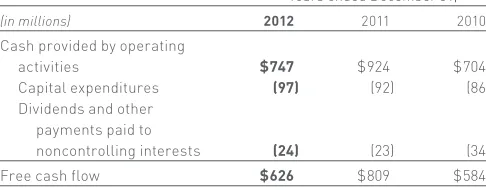
As you know, our business generates strong free cash flow. Together with a strong balance sheet, we made 2012 another year of value creation for shareholders. The actions the Board took in 2012 and at the start of 2013 include: • Declaring a $2.50 per share special
dividend;
• Raising our regular quarterly cash dividend 9.8%; and
• Buying back $295 million in stock. In total, we returned about $1.3 billion in the form of dividend payments and share repurchases last year. On top of that,
Terry McGraw visits the company’s new office in Singapore, a major financial hub. This new facility, located in the financial district, is home to more than 200 employees serving the capital and commodity markets and provides a platform for the company’s growth in the region.
RETURNED TO
SHAREHOLDERS
IN 2012
125 YEARS OF INTEGRITY AND RIGOROUS ANALYSIS
Of course, our accomplishments would not have been possible without our exceptional and talented employees. The Board of Directors and management team are enormously grateful for their creativity, dedication and integrity.
I especially want to commend our employees in the Northeast United States, who navigated effectively through Superstorm Sandy with ingenuity and perseverance. The men and women of our company excelled at serving clients and markets in the aftermath of the storm and kept our operations fully functional despite the temporary closure of our office in Lower Manhattan and many of our colleagues’ homes being without power. We clearly have terrific people all around us, including a world class Board. Our newest Director is Charles “Ed” Haldeman, Jr., who joined us last year and brings valued experience in financial markets. Most recently, as its CEO from 2009 to 2012, Ed got Freddie Mac back on track after it was placed in conservatorship. I also want to acknowledge Doug Daft, who retired from the Board last April after nine years of extraordinary service. I thank Doug for his guidance over the years and all of our current Directors for their leadership and oversight.
In 1888 my great-grandfather, James H. McGraw, founded the company with the purchase of the American Journal of Railway Appliances, and while we have
made significant changes in our company McGraw-Hill volunteers give young people in New York
the essentials of personal finance, which is a key component of the company’s commitment to good corporate citizenship.
“ The combination
of global brand
recognition and
innovation gives
us significant
opportunities
to drive organic
growth.”
over the last 125 years, some important things stay the same. Two constants are important to highlight because they help account for our enduring success. First, we have always been quick to adapt to serve the need for information about new economic and business trends, beginning with the development of power, transportation and electricity in the late 19th century and continuing to today’s global revolution in data and the explosion of the capital and commodity markets. The second thing that remains unchanged is our unwavering commitment to integrity and fairness in the information and opinions we provide. For example, James H. McGraw described the first editor he recruited for the American Electrician as someone who “made sure of his ground on any controversial subject and then expressed his opinions in his editorials frankly, fearlessly and convincingly.” These traits of innovation and integrity have earned the McGraw-Hill brands the highest respect around the world from customers and clients. Going forward, these admirable qualities will always be central to who we are: providers of essential intelligence that enables sustainable growth for markets and communities. Thank you for your ongoing support. Sincerely,
Harold McGraw III
Chairman, President and Chief Executive Officer
30 CONSOLIDATED STATEMENTS OF COMPREHENSIVE INCOME
31 CONSOLIDATED BALANCE SHEETS
32 CONSOLIDATED STATEMENTS OF CASH FLOWS
33 CONSOLIDATED STATEMENTS OF EQUITY
34 NOTES TO THE CONSOLIDATED FINANCIAL STATEMENTS
60 FIVE-YEAR FINANCIAL REVIEW
61 REPORT OF MANAGEMENT
62 REPORTS OF INDEPENDENT REGISTERED PUBLIC ACCOUNTING FIRM
64 SHAREHOLDER INFORMATION
MANAGEMENT’S DISCUSSION AND
ANALYSIS OF FINANCIAL CONDITION
AND RESULTS OF OPERATIONS
The following Management Discussion and Analysis (“MD&A”) provides a narrative of the results of operations and financial condition of The McGraw-Hill Companies, Inc. (together with its consolidated subsidiaries, the “Company,” “we,” “us” or “our”) for the years ended December 31, 2012 and 2011, respec-tively. The MD&A should be read in conjunction with the consolidated financial statements and accompanying notes included in our Form 10-K for the year ended December 31, 2012, which have been prepared in accordance with accounting principles generally accepted in the United States of America (“U.S. GAAP”).
The MD&A includes the following sections:
• Overview
• Results of Operations
• Liquidity and Capital Resources
• Reconciliation of Non-GAAP Financial Information • Critical Accounting Estimates
• Recently Issued or Adopted Accounting Standards
Certain of the statements below are forward-looking state-ments within the meaning of the Private Securities Litigation Reform Act of 1995. In addition, any projections of future results of operations and cash flows are subject to substantial uncertainty. See Forward-Looking Statements on page 28 of this report.
OVERVIEW
We are a leading content and analytics provider serving the capital, commodities and commercial markets. The capital markets include asset managers, banks, exchanges, issuers and financial advisors; the commodities markets include produc-ers, traders and intermediaries within energy, metals, and agriculture; and the commercial markets include professionals and corporate executives within automotive, construction, aerospace and defense and marketing/research informa-tion services.
As a result of our joint venture between CME Group and Dow Jones & Company, Inc., to form a new company, S&P Dow Jones Indices LLC and how we are managing this company, com-bined with the formation of McGraw Hill Financial, we have separated our previously reported S&P Capital IQ / S&P Indices segment into two separate reportable segments. Our operations now consist of four reportable segments: Standard & Poor’s Ratings (“S&P Ratings”), S&P Capital IQ, S&P Dow Jones Indices (“S&P DJ Indices”) and Commodities & Commercial (“C&C”). Our previously reported MHE segment is reported as a discon-tinued operation as discussed under the heading, “Separation
of MHE”.
• S&P Ratings is a provider of credit ratings, offering investors and market participants with information and independent ratings benchmarks.
• S&P Capital IQ is a global provider of digital and traditional financial research and analytical tools, which integrate cross-asset analytics and desktop services.
• S&P DJ Indices is a global index provider that maintains a wide variety of valuation and index benchmarks for invest-ment advisors, wealth managers and institutional investors. • C&C consists of business-to-business companies specializing
in commercial and commodities markets that deliver their customers access to high-value information, data, analytic services and pricing benchmarks.
GROWTH AND VALUE PLAN ACTIONS
On September 12, 2011, we announced that our Board of Directors had unanimously approved a comprehensive Growth and Value Plan that includes separation into two companies: McGraw Hill Financial (“MHF”), focused on providing essen-tial information to the capital, commodities and commercial markets, and McGraw-Hill Education (“MHE”), focused on edu-cation products and services and digital learning. The Growth and Value Plan has been focused on accelerating growth and increasing shareholder value through not only this separa-tion, but also through substantial cost-cutting initiatives and increased share repurchases.
As we approach the completion of the Growth and Value Plan we have achieved our objectives under our Growth and Value Plan relating to the separation of MHE, cost reductions, increased shareholder return and investing/divesting in tar-geted assets that position us for long-term growth.
Separation of MHE
The timing of completing the separation has been dependent on many factors, including whether the separation occurs through a spin-off to our shareholders or a sale. After carefully consider-ing all of the options for creatconsider-ing shareholder value, our Board of Directors concluded that a sale of MHE would generate the best value and certainty for our shareholders and most favor-ably position MHE for long-term success.
We plan to use the proceeds of the sale to pay off any short-term borrowing obligations, to make selective acquisitions that enhance our portfolio of brands and to sustain our share repur-chase program.
Cost Reductions
From the announcement of our Growth and Value Plan we have been committed to on-going cost savings by year-end of greater than $100 million. We have surpassed that goal by approaching $175 million in savings by the end of 2012 through a focused effort on our cost structure, including:
• select headcount reductions of approximately 670 employees within MHF and 530 employees within MHE,
• the migration of numerous accounting work-streams, human resource processes and selected information-technol-ogy support services to world-class partners that specialize in these operations, and
• redesigning the employee benefit plans including a freeze of our U.S. employee retirement plan.
These cost goals were focused across the entire Company, including MHE. Approximately two-thirds of these cost reduc-tions benefited MHE. Cost savings at MHF were partially offset by costs that were previously allocated to MHE, such as costs for centralized departments, that could not be classified as discontinued operations due to the nature of the expense. We will continue to look to extend outsourcing efforts to enhance cost synergies and realign administrative support for a leaner overall cost structure.
Increased Shareholder Return
During the two years ended December 31, 2012, we have returned $3.1 billion to our shareholders through a combi-nation of share repurchases, our quarterly dividend and a special dividend.
We completed share repurchases of $1.8 billion and distributed regular quarterly dividends totaling approximately $600 mil-lion during the two years ended December 31, 2012. During the fourth quarter of 2012, our Board of Directors approved on December 6, 2012 a special dividend in the amount of $2.50 per share on our common stock, payable on December 27, 2012 to shareholders on record on December 18, 2012. This returned an additional approximately $700 million to our shareholders.
Investing/Divesting Targeted Assets
During 2012, we completed several acquisitions that we believe will position us for long-term growth across all our segments.
• S&P DJ INDICES – our transaction with CME Group, Inc. and CME Group Index Services LLC to form a new company, S&P Dow Jones Indices LLC;
• S&P CAPITAL IQ – Credit Market Analysis Limited, a pro-vider of independent data concerning the over-the-counter markets; QuantHouse, an independent global provider of end-to-end systematic low-latency market data solutions; and R² Technologies, a provider of advanced risk and scenario- based analytics;
• C&C – Kingsman SA, a privately-held, Switzerland-based pro-vider of price information and analytics for the global sugar and biofuels markets;
• S&P RATINGS – Coalition Development Ltd., a privately-held U.K. analytics company.
Refer to Note 3 – Acquisitions and Divestitures to our consolidated financial statements for further discussion.
In addition to the agreement to sell MHE, we completed the sale of our Broadcasting Group, previously included in our C&C seg-ment, on December 30, 2011 and, accordingly, for the year ended December 31, 2011 and prior periods, the results of operations of the Broadcasting Group have been reclassified to reflect the business as a discontinued operation and assets and liabilities of the business have been removed from our consolidated bal-ance sheet as of December 31, 2011.
The Growth and Value Plan has required us to incur non-recurring costs necessary to enable separation, reduce our cost structure, accelerate growth and increase shareholder value. The table below summarizes these costs including restructur-ing charges for the year ended December 31, 2012:
(in millions) Continuing Discontinued
Professional fees $117 $17 Restructuring charges 68 39 Transaction costs for our S&P Dow Jones
Indices LLC joint venture 15 – Charges related to our lease commitments 8 3 Miscellaneous charges 18 2 $226 $61
KEY RESULTS
Years ended December 31, % Change 1
(in millions) 2012 2011 2010 ’12 vs ’11 ’11 vs ’10
Revenue $ 4,450 $ 3,954 $ 3,639 13% 9% Operating profit $ 1,211 $ 1,077 $ 1,026 12% 5% % Operating margin 27% 27% 28%
Diluted EPS from continuing operations $ 2.37 $ 2.00 $ 1.86 19% 8%
1% changes in the tables throughout the MD&A are calculated off of the actual number, not the rounded number presented.
2012
S&P RATINGS – Revenue and operating profit increased 15% and 18%, respectively. Revenue growth was driven by strong high-yield and investment grade corporate bond issuance related to robust refinancing activity and increases in bank loan ratings and structured finance. The increase was also impacted by increases in public finance driven by strong municipal bond issuance in the United States. Operating profit increased compared to 2011 primarily due to the increases in revenue, partially offset by higher incentive costs due to improved financial performance, an increase in legal expenses, restruc-turing charges of $15 million in the second half of 2012 and unfavorable foreign exchange rates.
S&P CAPITAL IQ – Revenue increased 9%, while operating profit decreased 3%. The revenue increase was primarily attribut-able to growth at Capital IQ driven by market share gains and increased contract values for existing accounts; and increases in our subscription base for the Global Credit Portal, which includes RatingsDirect®. Operating profit was significantly impacted by restructuring charges of $19 million recorded in the second half of 2012, as well as increased costs to fur-ther develop our content and software. The acquisitions of
R2 Technologies in February 2012, QuantHouse in April 2012
and Credit Market Analysis Limited (“CMA”) in June 2012 also impacted the results, particularly amortization charges relat-ing to the intangible assets.
S&P DJ INDICES – Revenue and operating profit increased 20% and 12%, respectively. The revenue increases were primar-ily due to revenue from our S&P Dow Jones Indices LLC joint venture. Excluding revenue from the joint venture, revenue increased 3%, primarily due to higher average levels of assets under management for ETF products and higher mutual fund revenue. Operating profit was significantly impacted by expenses for our joint venture, higher data fees and addi-tional personnel costs for targeted staff increases to drive future growth.
C&C – Revenue and operating profit increased 9% and 38%, respectively. These increases were primarily driven by con-tinued demand for Platts’ proprietary content as annualized contract values increased; growth across our automotive sec-tors at J.D. Power and Associates (“JDPA”), primarily in Asia and the United States; and a strong focus on the management of expenses across the brands. Partially offsetting the growth in
the segment were additional costs related to revenue growth, incentive costs at Platts and JDPA and restructuring charges of $12 million recorded in the second half of 2012.
2011
S&P RATINGS – Revenue increased 4% and operating profit declined 6%. Revenue growth was driven by an increase in non-transaction revenues due to growth in non-issuance related revenue at corporate ratings and increases at CRISIL, our majority owned Indian credit rating agency, partially offset by declines in structured finance. The decline in operating profit was driven by an increase in expenses resulting from staff increases and incremental compliance and regulatory costs as well as a decline in transaction revenue.
S&P CAPITAL IQ – Revenue and operating profit increased 13% and 25%, respectively. Increases were primarily driven by Integrated Desktop Solutions due to growth at Capital IQ, revenue from TheMarkets.com acquired in September 2010 and our subscription base for the Global Credit Portal, which includes RatingsDirect; and increases at Enterprise Solutions driven by growth at Global Data Solutions, which includes RatingsXpress. Also impacting operating profit were higher expenses from personnel costs and additional costs to further develop infrastructure.
S&P DJ INDICES – Revenue and operating profit increased 18% and 31%, respectively, due to growth in our exchange-traded fund products. Also impacting operating profit were higher expenses from personnel costs.
C&C – Revenue and operating profit increased 10% and 18%, pri-marily driven by strong demand for Platt’s’ proprietary content and growth in our syndicated studies and consulting services in the automotive and non-automotive sectors, partially offset by decreases in the construction business.
OUTLOOK
Four key trends are increasing the need for content and analytics in the markets we serve:
• The globalization of the capital markets: the global demand for capital and commodities markets trading and liquidity is expanding rapidly in both developed and growth markets; • The need for data-driven decision making tools:
develop-ments in technology, communications and data processing have increased the demand for time-critical, multi-asset class data and solutions;
• Systemic regulatory change: new global legislation (e.g. Dodd-Frank, U.S. Commodity Futures Trading Commission and Basel III) is creating new and complex operating and capital models for banks and market participants; and • Increased volatility and risk: amplified uncertainty and
market volatility around short-term events are driving the need for new methodologies to measure risk, return and profitability.
We are focused on delivering against these enterprise objectives:
• Extend Market Leadership: extend our position as a global leader in our market segments
• Build Scalable Capabilities: further institutionalize key capa-bilities such as technology and risk management
• Foster Talent: attract and retain top talent
• Create Shareholder Value: deliver high top-line and bottom-line growth and positive returns to shareholders
Our enterprise strategy, which will support the achievement of these core objectives, includes the following components:
• Organic Growth: support a portfolio of leading market brands that delivers high top-line and bottom-line growth
• Global Expansion: expand our global footprint to capture opportunities in both mature and growth markets
• Acquisitions and Partnerships: supplement organic growth with acquisitions and partnerships
• Scalable Capabilities: create and leverage efficiency and effectiveness through common platforms, processes and standards
• Talent Retention and Acquisition: leverage our position as a market leader to become an employer of choice in our chosen markets and geographies
There can be no assurance that we will achieve success in implementing any one or more of these strategies as a variety of factors could unfavorably impact operating results, including prolonged difficulties in the global credit markets and a change in the regulatory environment affecting our businesses.
Further projections and discussion on our 2013 outlook for our segments can be found within “Segment Review”.
RESULTS OF OPERATIONS
CONSOLIDATED REVIEW
Years ended December 31, % Change
(in millions) 2012 2011 2010 ’12 vs ’11 ’11 vs ’10
Revenue $ 4,450 $ 3,954 $ 3,639 13% 9%
Expenses:
Operating-related expenses 1,460 1,392 1,206 5% 15% Selling and general expenses 1,709 1,387 1,318 23% 5% Depreciation and amortization 122 111 96 11% 15% Total expenses 3,291 2,890 2,620 14% 10% Other income 52 13 7 N/M 82%
Operating profit 1,211 1,077 1,026 12% 5%
Interest expense, net 81 77 83 4% (7)% Provision for taxes on income 404 374 344 8% 9%
Income from continuing operations 726 626 599 16% 5%
(Loss) income from discontinued operations (234) 308 252 N/M 22%
Less: net income from continuing operations attributable to
noncontrolling interests (50) (19) (19) N/M 1% Less: net income from discontinuing operations attributable to
noncontrolling interests (5) (4) (4) 6% (4)%
Net income attributable to The McGraw-Hill Companies, Inc. $ 437 $ 911 $ 828 (52)% 10%
REVENUE
Years ended December 31, % Change
(in millions) 2012 2011 2010 ’12 vs ’11 ’11 vs ’10
Subscription/Non-transaction revenue $ 2,855 $ 2,672 $ 2,407 7% 11% Non-subscription/Transaction revenue $ 1,595 $ 1,282 $ 1,232 24% 4% Domestic revenue $ 2,684 $ 2,373 $ 2,253 13% 5% International revenue $ 1,766 $ 1,581 $ 1,386 12% 14%
2012
Revenue increased $496 million or 13% as compared to 2011, primarily due to strong high-yield investment grade corporate bond issuance, which impacted non-subscription/transaction revenue; growth in our global commodities products; growth for our Capital IQ product, strong municipal bond issuance in the U.S. and increases in bank loan ratings; increases in the subscription base for Global Data Solutions; and recent acquisi-tions, including, QuantHouse in April 2012 and CMA and our S&P Dow Jones Indices LLC joint venture in June 2012. See “Segment Review” below for further information.
Foreign exchange rates had an unfavorable impact of $40 mil-lion on revenue. This impact refers to constant currency comparisons estimated by re-calculating current year results of foreign operations using the average exchange rate from the prior year.
2011
Revenue increased primarily due to growth in our global commodities products, growth at Capital IQ, revenue from TheMarkets.com acquired in September 2010, non-transaction revenue growth at CRISIL, an increase in our corporate industrial ratings and higher sales of our exchange-traded fund products. This was partially offset by a decline in our construction business, public finance, structured finance and investment research products.
Foreign exchange rates had a favorable impact of $35 million on revenue. This impact refers to constant currency comparisons estimated by re-calculating current year results of foreign operations using the average exchange rate from the prior year.
TOTAL EXPENSES
The following tables provide an analysis by segment of our operating-related expenses and selling and general expenses for the years ended December 31, 2012 and 2011:
2012 2011 % Change
(in millions)
Operating- related expenses
Selling and general expenses
Operating- related expenses
Selling and general expenses
Operating- related expenses
Selling and general expenses
S&P Ratings $ 677 $ 479 $ 657 $ 362 3% 33% S&P Capital IQ 456 412 383 393 19% 5% S&P DJ Indices 1 73 96 75 56 (3)% 71% C&C 335 368 351 356 (5)% 3% Intersegment eliminations (69) – (63) – (9)% –% Total segments 1,472 1,355 1,403 1,167 5% 16% Corporate 2 (12) 354 (11) 220 7% 61%
$ 1,460 $ 1,709 $ 1,392 $ 1,387 5% 23%
1 For 2012, selling and general expenses includes transaction costs of $15 million for our S&P Dow Jones Indices LLC joint venture.
Operating-Related Expenses
Operating-related expenses increased $68 million or 5% as compared to 2011, primarily driven by increased costs at S&P Ratings of $50 million or 9% and S&P Capital IQ of $37 million or 15%. These increases were primarily a result of higher person-nel costs, including incentive compensation, at S&P Ratings and global staff increases at S&P Capital IQ. This was partially offset by lower compensation expense at C&C of $13 million or 15% due to a reduction in headcount from recent restructur-ing actions.
Intersegment eliminations relates to a royalty charged to S&P Capital IQ for the rights to use and distribute content and data developed by S&P Ratings.
Selling and General Expenses
During 2012, we recorded $226 million of Growth and Value Plan related costs necessary to enable separation and reduce our cost structure, which includes professional fees, severance charges, transaction costs for our S&P Dow Jones Indices LLC
joint venture and a charge related to a reduction in our lease commitments. Excluding these costs and $10 million of Growth and Value Plan costs for 2011, selling and general expenses increased $106 million as compared to 2011, due to higher costs associated with increased sales and additional stock-based compensation, mainly due to higher expected performance achievement and an increase in the grant price of our equity awards. Personnel costs increased $43 million at S&P Ratings, $26 million at C&C, $7 million at S&P DJ Indices and $5 million at S&P Capital IQ as revenue growth improved 15%, 9%, 20% and 9%, respectively. In addition, S&P Ratings had increased legal costs as compared to 2011.
Depreciation and Amortization
Depreciation and amortization increased $11 million or 11% as compared to 2011, primarily due to additional intangible asset amortization related to our recent acquisitions, partially offset by reduced purchases of furniture and computer equipment last year as we focused on continued cost controls.
The following tables provide an analysis by segment of our operating-related expenses and selling and general expenses for the years ended December 31, 2011 and 2010:
2011 2010 % Change
(in millions)
Operating- related expenses
Selling and general expenses
Operating- related expenses
Selling and general expenses
Operating- related expenses
Selling and general expenses
S&P Ratings $ 657 $ 362 $ 573 $ 321 15% 13% S&P Capital IQ 383 393 325 408 18% (4)% S&P DJ Indices 75 56 59 70 27% (20)% C&C 351 356 309 328 14% 9% Intersegment eliminations (63) – (56) – (13)% –% Total segments 1,403 1,167 1,210 1,127 16% 4% Corporate (11) 220 (4) 191 N/M 15% $ 1,392 $ 1,387 $ 1,206 $ 1,318 15% 5%
Operating-Related Expenses
Operating-related expenses increased $186 million or 15% as compared to 2010, primarily driven by increased personnel costs and additional costs to further develop infrastructure.
Intersegment eliminations relates to a royalty charged to S&P Capital IQ for the rights to use and distribute content and data developed by S&P Ratings.
Selling and General Expenses
Selling and general expenses increased $69 million or 5% as compared to 2010, primarily due to a fourth quarter restructur-ing plan we initiated across the Company as part of our Growth and Value Plan which resulted in a $32 million charge; higher costs associated with increased sales; higher compensation; and incremental compliance and regulatory costs, primarily in our S&P Ratings segment.
Depreciation and Amortization
OTHER INCOME
In the fourth quarter of 2012, we recorded a pre-tax gain of $52 million within other income in the consolidated statement of income related to a change in our vacation policy. The change in our vacation policy modified the number of days that employees are entitled to for unused vacation time upon termination of employment as they will only be paid for vacation days equivalent to what they have earned in the current year.
During 2011, we recorded a pre-tax gain of $13 million within other income in the consolidated statement of income, which related to the sale of our interest in LinkedIn Corporation in their initial public offering. This investment was held within our C&C segment.
During 2010, we recorded a pre-tax gain of $7 million within other income in the consolidated statement of income, which related to the sale of certain equity interests in India which were part of our S&P Ratings segment.
OPERATING PROFIT
We consider operating profit to be an important measure for evaluating our operating performance and we define operating profit as revenues less the related cost of producing the revenues and selling and general expenses. We also further evaluate operating profit for each of the reportable business segments in which we operate.
We internally manage our operations by reference to “segment operating profit” and resources are allocated primarily based on segment operating profit. Segment operating profit is defined as operating profit before allocated expenses, which are centrally managed costs and do not affect the operating results of our segments. Segment operating profit is one of the key metrics we use to evaluate operating performance. Segment operating profit is not, however, a measure of financial performance under U.S. GAAP, and may not be defined and calculated by other companies in the same manner.
% Change
(in millions) 2012 2011 2010 ’12 vs ’11 ’11 vs ’10
S&P Ratings $ 849 $ 720 $ 762 18% (6)% S&P Capital IQ 208 214 171 (3)% 25% S&P DJ Indices 1 212 189 144 12% 31% C&C 248 180 153 38% 18% Total segment operating profit 1,517 1,303 1,230 16% 6% Unallocated expense 2 (306) (226) (204) 36% 11% Total operating profit $ 1,211 $ 1,077 $ 1,026 12% 5%
1 2012 includes transaction costs for our S&P Dow Jones Indices LLC joint venture.
2 Includes depreciation expense and expenses for our Growth and Value Plan, including restructuring costs and other related non-recurring costs, partially offset by a vacation accrual reversal.
2012
SEGMENT OPERATING PROFIT – Increased $214 million, or 16% as compared to 2011. Segment operating income margins were 34% and 33% for 2012 and 2011, respectively. Restructuring charges and other non-recurring charges as noted above mitigated the margin improvement for the period. See “Segment Review” below for further information. In addition, segment operating profit benefited from reduced pension costs as we froze our U.S. Employee Retirement Plan effective on April 1, 2012.
UNALLOCATED EXPENSE – Increased by $80 million or 36% as compared to 2011, mainly as a result of $156 million of Growth and Value Plan related costs necessary to enable separation and reduce our cost structure, which includes professional fees of $117 million and restructuring charges of $21 million. This was partially offset by a vacation accrual reversal of $52 million. Unallocated expenses also includes an increase for costs that were previously allocated to MHE, such as costs for centralized departments, that could not be classified as discontinued opera-tions due to the nature of the expense.
Foreign exchange rates had an unfavorable impact of $6 million on operating profit for 2012. This impact refers to constant cur-rency comparisons and the remeasurement of monetary assets
and liabilities. Constant currency impacts are estimated by re-calculating current year results of foreign operations using the average exchange rate from the prior year. Remeasurement impacts are based on the variance between current-year and prior-year foreign exchange rate fluctuations on assets and liabilities denominated in currencies other than the individual business’ functional currency.
2011
SEGMENT OPERATING PROFIT – Increased $73 million, or 6% as compared to 2010. Segment operating income margins were and 33% 34% for 2011 and 2010, respectively. Restructuring charges as noted above mitigated the margin improvement for the period. See “Segment Review” below for further information.
UNALLOCATED EXPENSE – Increased by $22 million or 11% as compared to 2010, mainly as a result of $27 million of Growth and Value Plan related costs necessary to enable separation and reduce our cost structure, which includes restructuring charges of $17 million and professional fees of $10 million.
INTEREST EXPENSE, NET
Net interest expense increased 4% as compared to 2011, pri-marily due to increased interest expense related to uncertain tax positions, as well as lower international interest income from our investments in 2012 compared with 2011. Net interest expense decreased 7% compared to 2010 primarily due to higher international interest income from our investments in 2011 compared with 2010.
PROVISION FOR INCOME TAXES
Our effective tax rate from continuing operations was 35.8%, 37.4% and 36.4% for 2012, 2011 and 2010, respectively. The reduc-tion in the effective tax rate from the prior year periods was primarily due to the partnership structure of the S&P Dow Jones Indices LLC joint venture, the Growth and Value Plan and restructuring costs incurred primarily in the United States. Including discontinued operations, the effective tax rate was 45.8%, 36.5% and 36.4% for 2012, 2011 and 2010, respectively. The increase in the effective tax rate including discontinued opera-tions for 2012 was due to the goodwill impairment recorded at MHE.
Absent any impact of factors including intervening audit settle-ments, changes in federal, state or foreign law and changes in the geographical mix of our income, we expect our 2013 effective tax rate to decrease from our 2012 effective tax rate due to the full year effect of the S&P Dow Jones Indices LLC joint venture.
(LOSS) INCOME FROM DISCONTINUED OPERATIONS
2012
Loss from discontinued operations was $234 million in 2012 as compared to income from discontinued operations of $308 mil-lion in 2011, primarily as a result of revenue declines and several non-recurring items.
Revenue at MHE decreased $230 million or 10% as compared to 2011, primarily due to decreases in the adoption states as well as open territory sales at School Education Group. Also contrib-uting to the reduction was a substantial increase in deferred revenue due to higher sales of programs that contain digital components that will be delivered over multiple years. In the Higher Education, Professional and International Group, sales of new editions have been impacted by the growth of the used book and rental market. However, digital sales across MHE con-tinue to increase as compared to 2011.
Non-recurring items impacting the loss from discontinued operations included:
• Intangible asset impairments of $497 million that consisted of goodwill, prepublication and inventory assets at MHE’s School Education Group (“SEG”).
• As a result of the offer we received from Apollo Global Management, LLC in the fourth quarter of 2012, we per-formed a goodwill impairment review at MHE, which resulted in a full impairment of goodwill of $478 million at SEG.
• An impairment charge of $19 million was recorded on cer-tain prepublication and inventory assets as targeted school programs were shut down.
• Restructuring charges of $39 million consisting primarily of employee severance costs related to a workforce reduction of approximately 530 positions.
• Direct transaction costs of $17 million for legal and profes-sional fees related to the sale of MHE.
• A charge related to a lease commitment of $3 million. • These charges were partially offset by a vacation accrual
reversal of $17 million related to a change in our vaca-tion policy.
2011
SEGMENT REVIEW
S&P RATINGS
Credit ratings are one of several tools that investors can use when making decisions about purchasing bonds and other fixed income investments. They are opinions about credit risk and our ratings express our opinion about the ability and willingness of an issuer, such as a corporation or state or city government, to meet its financial obligations in full and on time. Our credit ratings can also relate to the credit quality of an individual debt issue, such as a corporate or municipal bond, and the relative likelihood that the issuer may default.
S&P Ratings differentiates its revenue between transaction and non-transaction. Transaction revenue primarily includes fees associated with:
• ratings related to new issuance of corporate and government debt instruments, and structured finance debt instruments; • bank loan ratings; and
• corporate credit estimates, which are intended, based on an abbreviated analysis, to provide an indication of our opinion regard-ing creditworthiness of a company which does not currently have an S&P Ratregard-ings credit ratregard-ing.
Non-transaction revenue primarily includes fees for surveillance of a credit rating, annual fees for customer relationship-based pricing programs and fees for entity credit ratings.
Years ended December 31, % Change
(in millions) 2012 2011 2010 ’12 vs ’11 ’11 vs ’10
Revenue:
Transaction $ 903 $ 651 $ 662 39% (2)% Non-transaction 1,131 1,116 1,033 1% 8% Total revenue $ 2,034 $ 1,767 $ 1,695 15% 4% % of total revenue:
Transaction 44% 37% 39% Non-transaction 56% 63% 61%
Domestic revenue $ 1,102 $ 910 $ 919 21% (1)% International revenue $ 932 $ 857 $ 776 9% 10% Operating profit $ 849 $ 720 $ 762 18% (6)% % Operating margin 42% 41% 45%
Revenue
2012
Transaction revenue grew significantly as compared to 2011 driven by strong high-yield and investment grade corporate bond issuance related to robust refinancing activity. Borrowers took advantage of low rates replacing existing bonds with cheaper debt, particularly in the second half of 2012 as issuers refinanced in advance of the uncertainty surrounding the U.S. fiscal cliff and Presidential election. The significant increase was also attributable to weak results in the second half of 2011 resulting from the impacts of the sovereign crisis in Europe and a slow eco-nomic recovery. Additionally, increases in 2012 in public finance contributed to growth in transaction revenue, primarily from strong municipal bond issuance in the U.S. as refunding activity increased dramatically over 2011. Strong growth in bank loan ratings, resulting from a favorable interest rate environment, was also a key driver contributing to the growth in structured finance revenues, specifically an increase to U.S. collateralized loan obligations (“CLO”) transaction revenue. U.S. asset backed securities (“ABS”) transaction revenue also increased due to favorable spreads, expansion of both bank & non-bank issuance and solid refinancing activity of student loans.
Non-transaction revenue remained relatively flat as growth in non-issuance related revenue at corporate ratings, primar-ily for entity credit ratings and rating evaluation services, was offset by declines in annual fees and program fees in structured finance. Annual fees include surveillance fees and other customer relationship-based fees. Additionally, CRISIL’s acquisition of Coalition Development Ltd. in July of 2012 had a favorable impact on non-transaction revenue in 2012. Non-transaction revenue includes an intersegment royalty charged to S&P Capital IQ for the rights to use and distribute content and data developed by S&P Ratings. Royalty revenue for 2012 and 2011 was $69 million and $63 million, respectively.
Foreign exchange rates had an unfavorable impact of $37 mil-lion on revenue for 2012.
2011
the years ended December 31, 2011 and 2010 was $63 million and $56 million, respectively. Foreign exchange rates had a favor-able impact of $25 million on revenue for 2011.
The decrease in transaction revenue was driven primarily by declines in public finance and structured finance. These declines were partially offset by increases at corporate ratings due to growth in bank loan ratings and high-yield corporate bond ratings revenue. U.S. municipal bond issuance decreased as municipal market volume declined driven by the expiration of the Build America Bond program at the end of 2010. Declines in structured finance were driven by lower issuance volumes in the U.S. of residential mortgage-backed securities (“RMBS”), collateralized debt obligations (“CDO”) and ABS.
Revenue derived from non-transaction related sources increased compared to 2010, primarily as a result of growth in non-issuance related revenue at corporate ratings, primar-ily for entity credit ratings, ratings evaluation services and surveillance fees, and CRISIL, our majority owned Indian credit rating agency, primarily for outsourcing services and the acquisition of Pipal Research in December 2010. This was partially offset by declines in structured finance related to lower annual fees that were adversely impacted by increased deal maturities and defaults, primarily on CDO deals. Non-transaction revenue represented a larger percentage of total S&P Ratings revenue for 2011 compared to 2010 as transaction revenue decreased and non-transaction revenue increased in 2011 due to the factors discussed above.
Operating Profit
2012
Operating profit increased compared to 2011 primarily due to the increases in revenue as noted above. These increases were partially offset by increased expenses resulting from higher incentive costs due to improved financial performance, an increase in legal expenses, restructuring charges of $15 million in the second half of 2012 consisting of employee severance costs related to a workforce reduction of approximately 100 positions, CRISIL’s acquisition of Coalition Development Ltd. in July of 2012 and an unfavorable impact from foreign exchange rates of $13 million.
2011
Operating profit decreased compared to 2010 due to increased expenses resulting from staff increases, incremental compli-ance and regulatory costs, restructuring charges of $9 million in the fourth quarter of 2011 consisting of employee severance costs related to a workforce reduction of approximately 30 posi-tions and a decline in transaction revenue, partially offset by growth in non-transaction revenue as noted above and a favor-able impact from foreign exchange rates of $12 million.
Issuance Volumes
We monitor issuance volumes as an indicator of trends in transaction revenue streams within S&P Ratings. Issuance vol-umes noted within the discussion that follows are based on the domicile of the issuer. Issuance volumes can be reported in two ways: by “domicile” which is based on where an issuer is located
or where the assets associated with an issue are located, or based on “marketplace” which is where the bonds are sold. The following tables depict changes in issuance levels as compared to the prior year, based on Thomson Financial, Harrison Scott Publications, Dealogic and S&P Rating’s internal estimates.
2012 Compared to 2011 Corporate Issuance U.S. Europe
High-Yield Issuance 51% 35% Investment Grade 29% 20% Total New Issue Dollars – Corporate Issuance 35% 21%
• Corporate issuance in the U.S. and Europe was driven by strong high-yield debt issuance and investment grade debt issuance as borrowers took advantage of low funding rates to opportunistically refinance existing debt. Both investment grade and high-yield issuance comparisons also benefited from low volumes in 2011.
2012 Compared to 2011 Structured Finance U.S. Europe
Residential Mortgage-Backed Securities (“RMBS”) 49% (51)% Commercial Mortgage-Backed Securities (“CMBS”) 46% * Collateralized Debt Obligations (“CDO”) 115% * Asset-Backed Securities (“ABS”) 43% (1)% Covered Bonds * (46)% Total New Issue Dollars – Structured Finance 54% (42)%
* Represents low issuance levels in 2012 and 2011.
• RMBS volume is up in the U.S. due to higher re-REMIC activ-ity. RMBS grew off of a low base in 2011. RMBS volumes in Europe were down reflecting issuers taking advantage of the Bank of England’s Funding for Lending Scheme.
• CMBS issuance is up in the U.S. as improving economic conditions, stabilizing delinquency rates and narrowing spreads have increased the attractiveness and competitive-ness of the CMBS market, particularly in the fourth quarter. European CMBS issuance continued to remain constrained with low issuance levels in both periods.
• Issuance in the CDO asset class in the U.S. was driven by strong CLO issuance due to an increase in corporate loan activity. European issuance in the CDO asset class was mini-mal due to economic uncertainty and increases compare to a very low level of activity in 2011.
• ABS issuance in the U.S. is up primarily due to strength in autos, partially due to growth in subprime lending as well as an expansion of bank lending on prime loans. An increas-ingly tighter spread environment has triggered a substantial return of credit card activity from banks and also resulted in significant refinancing opportunities in the student loan sector which also contributed to the growth. European ABS issuance levels remained in line with 2011.
Industry Highlights and Outlook
Strong high-yield and investment grade issuance in 2012 was driven by robust refinancing activity as borrowers took advantage of low rates replacing existing bonds with cheaper debt. During the second half, issuance was driven by issuers refinancing in advance of the uncertainty surrounding the U.S. fiscal cliff and Presidential election. In 2013, opportunistic issu-ance is expected to continue at a slightly slower pace as many refinancings were completed in 2012, however, we believe the longer term outlook for the corporate bond market continues to be healthy.
Structured finance issuance in the U.S. continued its turn-around throughout 2012 and 2013 looks to build on this momentum. The U.S. RMBS market is expected to remain modest given continuing home pricing pressures, histori-cally low mortgage origination levels, and continued high unemployment nationally. European RMBS issuance volumes continued to remain low during 2012 and we expect the Bank of England’s Funding for Lending Scheme will continue to dampen European RMBS issuance in 2013. U.S. CMBS issuance experienced growth, particularly in the fourth quarter, due to improving economic conditions, low interest rates, stabilizing delinquency rates, and narrowing spreads. Healthier U.S. CMBS issuance levels are expected to continue in 2013.
The U.S. CDO market experienced strong CLO activity in 2012. We expect this activity to remain strong as we move into 2013. U.S. ABS issuance volume in 2012 was robust with strength in autos leading the way as vehicle sales have increased and the outlook for 2013 remains strong. European ABS issuance volume experienced strong growth in autos and credit cards in the fourth quarter of 2012. These trends are also expected to continue in 2013.
Legal and Regulatory Environment
The financial services industry is subject to the potential for increased regulation in the U.S. and abroad. The businesses conducted by our S&P Ratings segment are, in certain cases, regulated under the Credit Rating Agency Reform Act of 2006, the U.S. Securities Exchange Act of 1934 and/or the laws of the states or other jurisdictions in which they conduct business.
Standard & Poor’s Ratings Services is a credit rating agency that is registered with the SEC as a Nationally Recognized Statistical Rating Organization (“NRSRO”). The SEC first began designating NRSROs in 1975 for use of their credit ratings in the determination of capital charges for registered brokers and dealers under the SEC’s Net Capital Rule.
The “Credit Rating Agency Reform Act of 2006” (the “Act”) cre-ated a new SEC registration system for rating agencies that choose to register as NRSROs. Under the Act, the SEC is given authority and oversight of NRSROs and can censure NRSROs, revoke their registration or limit or suspend their registration in certain cases. The rules implemented by the SEC pursuant to the Act address, among other things, prevention or misuse of material non-public information, conflicts of interest and improving transparency of ratings performance and meth-odologies. The public portions of the current version of S&P Ratings’s Form NRSRO are available on S&P Rating’s Web site.
Outside the U.S., regulators and government officials have been implementing formal oversight of credit rating agencies. S&P Ratings is subject to regulations in several foreign jurisdic-tions in which it operates and continues to work closely with regulators globally, including the International Organization of Securities Commissions, the European Securities and Markets Authority and others to promote the global consistency of regulatory requirements. S&P Ratings expects regulators in additional countries to introduce new regulations in the future.
We have reviewed the new laws, regulations and rules which have been adopted and have implemented, or are planning to implement, changes as required. We do not believe that such new laws, regulations or rules will have a materially adverse effect on our financial condition or results of operations. Other laws, regulations and rules relating to credit rating agencies are being considered by local, national, foreign and multinational bodies and are likely to continue to be considered in the future, including provisions seeking to reduce regulatory and inves-tor reliance on credit ratings, rotation of credit rating agencies and liability standards applicable to credit rating agencies. The impact on us of the adoption of any such laws, regulations or rules remains uncertain, but could increase the costs and legal risks relating to S&P Rating’s rating activities.
For a further discussion of competitive and other risks inherent in the S&P Ratings business, see Item 1a, Risk Factors Specific to
our Standard & Poor’s Ratings Segment, in our Form 10-K.
In the normal course of business both in the U.S. and abroad, the Company and its subsidiaries are defendants in numerous legal proceedings and are involved, from time to time, in gov-ernmental and self-regulatory agency proceedings which may result in adverse judgments, damages, fines or penalties. Also, various governmental and self-regulatory agencies regularly make inquiries and conduct investigations concerning compli-ance with applicable laws and regulations.
S&P CAPITAL IQ
S&P Capital IQ’s portfolio of products brings together integrated data sets, indices, research, and analytic insights in an integrated desktop solution to serve multiple investor segments across the financial community. In addition, the segment has products that integrates its content for delivery to the financial market via feeds, as well as through on-demand and customizable delivery tools. Specific products include:
• Capital IQ – a product suite that provides data, analytics and third-party research for global financial professionals;
• Global Credit Portal – a web-based solution that provides real-time credit research, market information and risk analytics, which includes RatingsDirect®;
• Global Data Solutions – combines high-quality, multi-asset class and market data to help professional investors, traders, and analysts meet the new analytical, risk management, regulatory and front-to-back office operation requirement, which includes RatingsXpress®; and
• investment research products.
Years ended December 31, % Change
(in millions) 2012 2011 2010 ’12 vs ’11 ’11 vs ’10
Revenue $ 1,124 $ 1,031 $ 916 9% 13% Subscription revenue $ 1,014 $ 922 $ 812 10% 14% Non-subscription revenue $ 110 $ 109 $ 104 1% 5% Domestic revenue $ 749 $ 693 $ 622 8% 11% International revenue $ 375 $ 338 $ 294 11% 15% Operating profit $ 208 $ 214 $ 171 (3)% 25% % Operating margin 19% 21% 19%
Revenue
2012
Revenue grew compared to 2011, primarily due to growth at Capital IQ, Global Data Solutions and the recent acquisitions of R² Technologies, QuantHouse and CMA.
The increase at Capital IQ was driven by market share gains and increased contract values for existing accounts, however headcount reductions in the financial services industry have tempered growth. The number of clients have still increased 7% from 2011 and the spend from the top accounts continues to grow. The client increase includes a certain percentage of clients on TheMarkets.com platform that have been migrated to the Capital IQ platform. The subscription base for the Global Credit Portal increased slightly as difficult market conditions due to budget constraints and reductions in headcount across the customer base affected revenue in 2012. Clients continue to reduce staff levels to manage their spending levels and layoffs have continued to be announced through the fourth quarter of 2012.
The subscription base for Global Data Solutions is growing from new client relationships and expanded relationships into existing accounts as the number of RatingsXpress® custom-ers have increased 10% in 2012 as compared to 2011. However, average contract values for those customers have declined due to customer budget constraints amidst difficult market conditions. Client cancellations have also been higher than in the prior year due to increased merger and acquisition activ-ity during the year that caused those clients to reevaluate their subscriptions.
Traditionally, revenue has been primarily domestic, how-ever, due to increases in Europe for the subscription base for RatingsXpress®, continued sales efforts of the Capital IQ desktop in Europe and Asia and recent acquisitions in Europe, international growth continued to occur throughout 2012.
2011
Revenue grew compared to 2010, primarily due to platform enhancements resulting in market share gains and increased contract values for existing accounts at Capital IQ; the acquisi-tion of TheMarkets.com in September 2010; and growth in the subscription base, both in new clients and in further expand-ing the existexpand-ing customer base for the Global Credit Portal, which includes RatingsDirect®. Global Data Solutions also contributed to the increase driven primarily by growth in the subscription base from new client relationships and expanded relationships into existing accounts.