PROGRAMMED CAPTURE SCRUTINY
AND PANIC SCHEME USING
BACKDROP WORKING OUT
ALGORITHM
Pughazendi.N G.L.SandhyaJeninfer
Faculty / Department of M.C.A PG Scholar / Department of M.C.A Panimalar Engineering College Panimalar Engineering College Chennai, India Chennai, India
[email protected] [email protected]
Abstract-- A low-cost intelligent web cam-based wireless video surveillance solution using moving object recognition technology is proposed in this paper. The proposed solution can be applied not only to various security systems, but also to environmental surveillance. Firstly, the basic principle of moving object detecting is given. Limited by the memory consuming and computing capacity of a web cam, a backdrop working out algorithm presented for adaptation. Then, a self-adaptive background model that can update automatically and timely to adapt to the slow and slight changes of natural environment is detailed. When the subtraction of the current captured image and the background reaches a certain threshold, a moving object is considered to be in the current view, and the web cam will automatically notify the central control unit or the user through phone call, SMS. The proposed algorithm can be implemented in an embedded system with little memory consumption and storage space, so it’s feasible for web cams and other embedded platforms, and the proposed solution can be used in constructing mobile security monitoring system with low-cost hardware and equipments. Thus our first result implemented in Wireless toolkit and the results show the effectiveness of proposed solution
1. INTRODUCTION
A typical security guard spends most of his time watching scrutiny monitors throughout the night and periodically patrols the compound of the area he is guarding. In larger buildings, he might find there are two many monitors to watch; hence unwanted activity might slip past him. When the guard patrols the compound, he leaves the monitor unwatched. This could also happen if he needs to take a break or speak to a person. During these occasions, the guard would find it very useful to be automatically alerted via his cell phone of any undesired activity caught on the scrutiny cameras. We have undertaken the study so as to help
solve the above problems. The scope of the research covers mainly the aspects of image processing relevant to differentiate two images quickly and accurately and the automation of message sending, be it email, SMS, with no human interaction.
First, any suspect intrusion need be detected. In order to detect any moment or change in the recorded image, method 1 and method 2 have been investigated. Having taken into account all pros and cons of both methods, due to nature of security system that speed of detection and simplicity of the actions undertaken are both the most crucial so as to reduce the changes of error and delay. Therefore, as the method 1 was insufficient in meeting the need, method 2 is used in our research.
Once any suspect intrusion is detected, the scrutiny camera will capture the frame with the intrusion and send to the handheld device of the people related. Command line clients- for SMS and email have been investigated and will be explained in details in the following sections.
Experimental results show that it is applicable to replace traditional human video scrutiny monitor system by the programmed one.
2. SYSTEM OVERVIEW
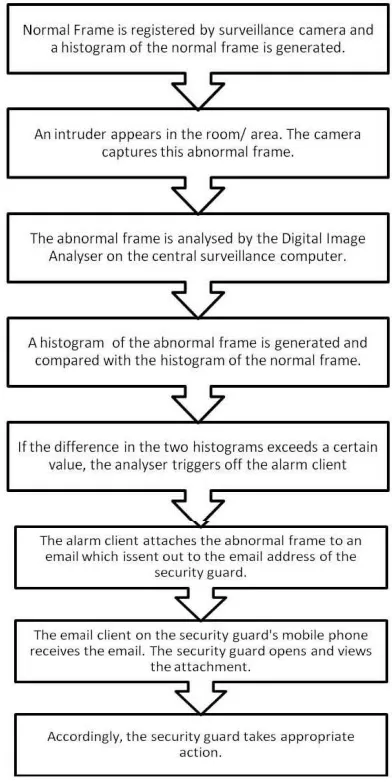
and transmitted to the computer instantaneously for processing. Videos are sampled to capture frames to compare with the abnormal peaceful scene frame by histogram difference. Once abnormal frame is detected, the abnormal frame will be sending to the handheld device, e.g., mobile phone, of the people related, e.g., security guard. The flow of the system, which sends the email with the possible intrusion detected to security guard’s mobile phone, is demonstrated in figure 1.
3.
P
ROPOSED PANIC SCHEMEEssentially, the project of two parts: digital image processing relavent to differentiate two images quickly and accurately and the automation of two message sending through email, SMS, with no human interaction.
Section 3.1 will deal with abnormal frame detection using histogram and section 3.2 will deal with automated message sending.
3.1. ABNORMAL FRAME DETECTION
An image is defined as a two-dimensional function, f(x,y) and its amplitude is equivalent to the gray level or intensity. The field of digital image processing refers to analyzing digital images with a computer. This section describes the mechanism used in the research that detects any movement or change in the recorded image and sends the signal to trigger the automated message sending client. Method 1 and method 2 have been investigated.
3.1.1. METHOD 1
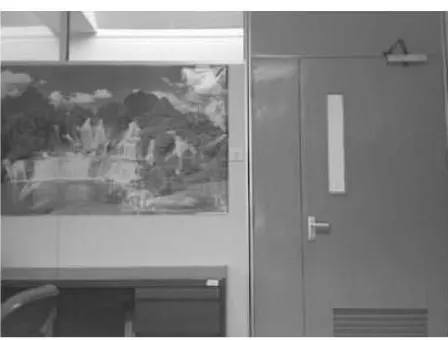
For method 1comparison, the ideal situation frame (a still shot of the door with no foreign objects in front of it) in the computers memory and the frames transmitted from the camera are compared on a method 1 basis to determine whether the two images match. If the transmitted frames’ the first method do not match that of the ideal stored image, it indicates that a foreign object is now in front of the door. This will then trigger the automated message client.
One advantage of this method is that it allows one to locate exactly the region whereby discontinuity in uniformity of the two frames occurs and hence is far more extensive in the data collected. This could potentially allow us to detect abnormal movements and give a rough image of the size and exact position of the intruder object/person. If the intruder holds a weapon, it will be seen as an abnormally in the frames and hence will also be detected and the security guard will be alerted of such danger.
However, the method has its own limitations. For example, if the camera shifts slightly due to natural elements such as wind, the image it transmits to the image processing computer will have a totally differing set of pixels from to of the ideal image. This will cause a total failure in the system and the alarm will sound unnecessarily and the manual correction of the camera position will be required.
Also, comparing frames method 1 requires a large amount of data to be analysed and hence is very slow for the computers. Therefore, it would cause our system to have a delay before realizing the difference in pixels and the presence of an intruder. As such, the high computing complexity and overwhelming amount of information that needs to be processed will hinder the efficiency of the system.
3.1.2. METHOD 2
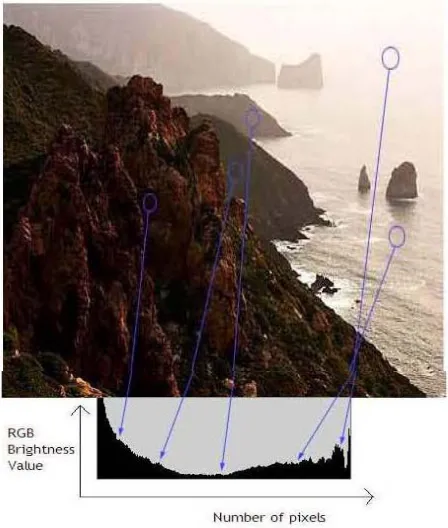
The method 2 analyses the frame as a whole instead of. Method 1 and its charts a histogram of the brightness level of a pixel against the number of pixels with that particular brightness level ranging from 0 to 255.
Figure 2 illustrates how a histogram describes the brightness intensity of a given image. This method again comes with many problems and advantages.
One problem that arises from the use of histogram is the loss of positional information and data. Therefore, if the intruder were to carry a weapon, the likelihood of detection of this weapon would be lower as it cannot be singled out. As such we have no way to predict the threats capacity to intrude or fight
Also, if the intruder were to wear a color very similar to that of the door and background, the overall histogram values might not change very much due to insignificant change in lighting of the overall frame. This will slightly lesson the system’s sensitivity to intrusion.
However, this method has its strength as well as method 2 neglect positional data, the complexity of the processing and computing is far less extensive thus leading to faster detection of abnormalities and differences.
Secondly, the concept of method2 comparison of the two frame is simple. And meets all the requirements of Programmed capture security and panic scheme effectively as only the essential information is processed therefore making it a for better option than of method 1 comparison which is impractical in most aspects due to unnecessary actions being taken
3.1.3 METHOD ADOPTION
Having taken into account all pros and cons of both methods, we decided that speed of detection and simplicity of the actions undertaken are both the most crucial to our system so as to reduce the changes of error and delay. Therefore, as the method 1 was insufficient in meeting our needs, we thus chose to the more fitting alternative, namely the method 2.
In this research, images recorded are digitally processed and broken down into method 2 data. The system keeps watch for any alterations in the method 2 data value.
3.2 AUTOMATED MESSAGE TRANSFER
Two types have been implemented to send the message automatically.
3.2.1 SENDING MMS TO MOBILE PHONE
First was to use a GPRS Datacard to execute the alarm system. When there would be a change in the normal frame caused by the presence of an unidentified object (such as an intruder) in the room, the image analysis software detects the change by realizing the difference between the normal frame and the the frame with the intrusion. Once the difference is detected, the frame with the intrusion will be sending from the central security computer to the security guard’s handheld device or mobile phone. This can be done via MMS, which requires a GPRS datacard to be connected to the computer.
GPRS
General packet radio service (GPRS) is a mobile data service available to users of global system for mobile communications (GSM) mobile phones. GPRS data transfer is typically charged per megabyte of transferred data. It can be used for services such as Wireless Application Protocol (WAP) access, Short Message Service (SMS), Multimedia Messaging Service (MMS), and for Internet communication services such as email and World Wide Web access.
MMS
The Multimedia Messagaing Service (MMS), is intended to provide a rich set of content to subscribers via GPRS (pictures, audio, games, etc). it is designed to be transported largely over IP rather than traditional GSM (SS7) networks. It is also designed to interoperate with messages are typically transported over WAP, and are encoded using WAP MIME formats.
GPRS Datacard
A HUAWEI Mobile Connect GSM/GPRS Datacard Model E600 is used in this research for the above purpose. This particular datacard supports th GPRS packet data service with a maximum transmission rate of 53.6kbps and also supports WCDMA packet domain data service with a maximum transmission rate of 384kbps.
Command line MMS client
the image analysis program would detect (thus implying that an intruder was present in the room) once this would be detected by the image analysis software, the command line MMS client would be triggered and an MMS containing the abnormal frame would be sent to the security guard’s handheld device.
SMSLib is adopted and successfully sent messages from a computer to our mobile phone using the Huawei GSM/GPRS Datacard.
One client, nowMMS client (http://www.nowmms.com/) is shown in figure 3 to demonstrate the basic functions of these clients. Other clients, such as MBuni MMS client is also available.
3.2.2 SENDING EMAIL TO MOBILE PHONE
This new technique will involve sending the abnormal frame as an attachment via email from the central scrutiny computer using an open source command line email client. The email will be received by the security guard’s handheld device via GPRS. He can then access the email, view the abnormal frame and hence take appropriate action. Illustrations should be original drawings or photographic prints of originals. Photographs should be glossy prints. Photocopies are often not good enough and should be avoided.
The advantage of this technique compared to MMS one is that it does not require the use of a GSM/GPRS Datacard. Thus, essentially if this system were to be implemented commercially, eliminating the purchase of a Datacard would help in reducing the costs of this security system.
Figure 3. NowMMS client
Figure 4. Flowchart of MMS
Also, free open source command line email clients are very much easier to find on the internet as compared to open source command line MMS clients. Email clients were easily available and quite often, were free and open source.
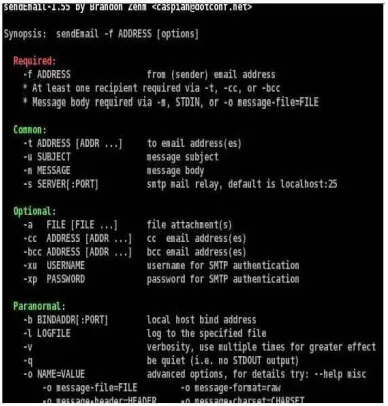
One client, SendEmail client (http://caspian.dotconf.net/menu/software/SendEmail/) is shown in figure 5 to demonstrate the basic functions of these clients. Other clients, febooti, BMail, CliMail, Softbar are also available.
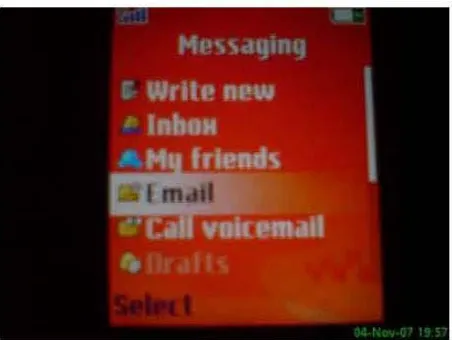
The email sending panic scheme works in a similar manner as the MMS one. Once suspect intrusion is detected, the suspect frame will then be sent from the central security computer to the security guard’s handheld device or mobile phone via email as a picture attachment. The email will then reach the email client inbox in the security guard’s mobile phone, an example of which is shown in figure 6 and he will be alerted. The security guard can then open the attachment and determine the gravity of the situation, and then accordinly he can choose what is to be done next.
4. EXPERIMENTAL RESULTS AND CONCLUSION
The Experiments have been conducted based on some testing video. Some students were posing as intruders, walking directly in front of the door. In the video, footage of the door under normal conditions and abnormal conditions were captured, which means that the door with nothing in front of it and the door with a person standing in front of it. We did this so as to simulate a possible scenario in order to test our system and further improve on it.
Following that we split the whole video down into frames and extracted key frames such as the door with nobody standing there (the normal frame, as shown in figure 7)and the door with an intruder in front of it (the abnormal frame, as shown in figure 8)
Figure 6. Email Client inbox on mobile phone
From these specific frames, we obtained histograms containing information about gradient values of these frames respectively and identified the differences between the two histograms which is shown in figure 9. Also, a percentage of the magnitude of which they differ was collated. This magnitude was translated into the standard value to trigger the alarm. By doing so, we avoid triggering the panic if a stray animal or smaller object enters the vision of the camera and hence reduce the possibility of false alarms.
Figure 7. The normal frame
Figure 8. The Abnormal frame
Figure 9. Histograms of the abnormal and normal frame respectively
REFERENCES
[1] R.T. Collins, A.J. Lipton and T.Kanade, Introduction to the special section on video surveillance,” IEEE Trans, Pattern Analysis Machine Intelligence, Vol 22, no. 8, pp. 745-746, 2000.
[2] Gonzalez, R.C. and Woods, R.E. 2002. Digital Image Processing, Prentice- Hall [3] http://www.mbuni.org/userguide.shtml.
[4] http://www.febooti.com/products/command-line-email
[7] http://www.softbar.com/site/sclec
[8] A.Pentland, ”Looking at people: sensing for ubiquitous and wearable computing”, IEEE Trans. Pattern Analysis Machine Intelligence, vol.22, no.1, pp.107-117,2000.
[9] I.Haritaoglu, D.Harwood, and L.S.Davis, \W4;Who? When? Where? What?A real time system for detecting and tracking people,” in proceedings Int’l conf.Face and Gestyre Recognition, pp. 222-227,1998.
AUTHORS PROFILE
N.Pughazendi is presently working as a Faculty, Master of Computer Application at Panimalar Engineering College, Chennai. He is Pursuing his Doctoral Program in Manonmaniam Sundaranar University. He has 8 years teaching experience. He has attended more than 22 Faculty Development Programs in and around India. He has presented research papers in more than 6 national and international conferences. His research areas include Data mining and Network security.