Wearable Haptic Based Pattern Feedback Sleeve
System
Anuradha Ranasinghe, Kaspar Althoefer, Prokar Dasgupta, Atulya Nagar, and Thrishantha Nanayakkara
Liverpool Hope University, Liverpool, United Kingdom Queen Mary, University of London, London, United Kingdom, MRC Centre for Transplantation, DTIMB & NIHR BRC, Kings College London,
United Kingdom
Kings College London, United Kingdom
{[email protected],[email protected],[email protected], [email protected],[email protected]},
Abstract. This paper presents how humans trained in primitive
hap-tic based patterns using a wearable sleeve, can recognize their scaling and shifting. The wearable sleeve consisted of 7 vibro-actuators to stim-ulate subjects arm to convey the primitive haptic based patterns. The used primitive haptic patterns are the Gaussian template (T), shifted right (R), shifted left (L), half Gaussian (H), and shrink (S) hereafter denoted by templates. The results of this paper would give an idea as to how humans mentally construct the cutaneous feedback in di↵erent sce-narios such as shifting and scaling with respect to trained patterns and how they recognize all trained patterns when played randomly. These insights will help to develop more efficient haptic feedback systems us-ing a small number of templates to be learnt to encode complex haptic messages. Therefore, the results provide new insights and design guide-lines/algorithm to convey messages encoded in vibro-tactile actuator ar-rays specially in where vision and audition are less reliable scenarios like search and rescue, factories. For example, the results would be used to convey a message to the human to give an idea of the shape and sti↵ness of obstacles that come into contact with the robot during haptic based guiding in low visibility conditions in human-robot interactions.
Keywords: Haptics, Human-robot interactions, vibro-actuator arrays, guidelines and algorithm
1
Introduction
insight as to how to convey messages to humans when they work in noisy or uncertain environments like factory or search and rescue.
There have been some studies demonstrating that haptic feedback can be used to navigate humans [4], [3], [5]. Vibro-actuators have been used for dif-ferent purposes to convey messages to humans. For example, the study in [5] presented an active belt which is a wearable tactile display that can transmit multiple directional information in combination with a GPS directional sen-sor and 7 vibro-actuators. Furthermore, in some studies vibro-tactile displays have used to improve the quality of life in di↵erent ways such as reading de-vices for those with visual impairments [6] to provide feedback of body tilt [7], balance control and postural stability [8], and navigation aid in unfamiliar envi-ronment [9]. Until now there have been many studies that used vibro-actuator belts for di↵erent purposes. However, this paper attempts to understand how to use vibro-tactile actuator arrays to understand representation of distributed haptic feedback which can be used to convey messages to humans.
Amplitude has been widely used to stimulate the human skin in most of the previous studies [10], [11], [12], [13]. However, we argue that frequency would be better for persistent perception. The monotonic nature in amplitude could e↵ect humans’ responses.
It has been shown that humans learn movements through flexible combina-tion of primitives that can be modeled using Gaussian like funccombina-tions [14]. There-fore, in this paper we try to understand whether human somatosensory system also uses primitive patterns that can be modeled using Gaussian like functions to represent haptic perception. These insights will help to develop more efficient haptic feedback systems using a small number of templates to be learnt to encode complex haptic messages.
Basic two scientific questions are tested in this paper. 1) whether the human somatosensory system uses primitive patterns that can be modeled using Gaus-sian like functions to represent haptic perceptions, 2) whether these primitive representations are localized (cannot be shifted along the skin) and magnitude specific (cannot be scaled).
A B
A wearable haptic sleeve with 7 Pico Vibe 10 mm vibroactuators
Power amplifier
circuit Arduino mega microcontroller
C
A vibroactuator
Fig. 1.Hardware design for wearable haptic sleeve: A) Pico Vibe 10 mm vibro-actuator, B) A wearable vibro-tactile actuator arrays with 7 Pico Vibe 10 mm vibro-actuator motors, and C) Arduino Mega motherboard and power amplifier circuit to generate di↵erent intensity patterns.
2
Materials and Methods
The results of three experiments would answer the following scientific questions: Experiment 1: How humans generalize a Gaussian template in scaling and shift-ing, and Experiment 2: How humans can recognize trained templates even they
Subject wears a wearable haptic sleeve
The demarcated area Arduino mega microcontroller Power amplifier circuit
A
B
Subject’s drawing
After the trial
are presented in a random order given by a set of discrete vibro-actuators on the arm.
Pico Vibe 10 mm vibration motor - 3 mm type (Precision Micro-drives) in Fig. 1A was used to make wearable haptic based pattern feedback system as shown in Fig. 1B. There are 7 Pico Vibe 10 mm vibro-actuators arranged in equal distance (7 cm) in the array as shown in Fig. 1B. The 7 Pico Vibe 10 mm vibro-actuators are attached to the seven belts which can be adjusted by strapping securely to arm of the di↵erent subjects. The di↵erent intensities for the vibrators are generated by Arduino Mega motherboard and the amplitude was modulated by a simple power amplifier circuit as shown in Fig. 1C.
2.1 Haptic primitive templates generation
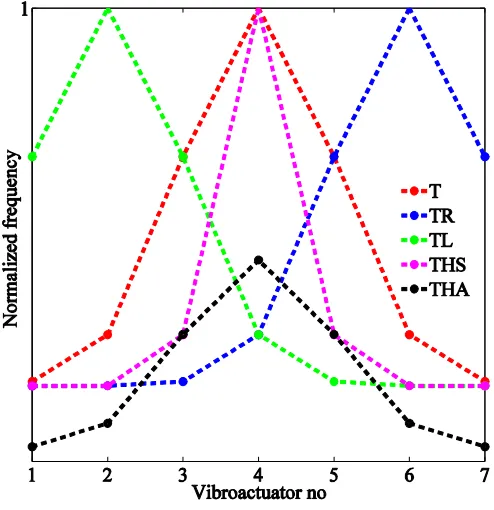
The standard Gaussian function was used to generate templates. The templates were generated byy=gaussmf(x,[sig, c]) by MATLAB 2014b, wheresig=std, andcis the center of the distribution. Thesigfor pattern T, TR, TL, and THA
Table 1.The Intensities (Hz) for di↵erent templates in experiment 1 and experiment 2
Vib. 1 Vib. 2 Vib. 3 Vib. 4 Vib. 5 Vib. 6 Vib. 7 T 103.33 140.60 281.96 400.00 281.96 140.60 103.33 TR 100.00 100.10 103.33 140.60 281.96 400.00 281.96 TL 281.96 400.00 281.96 140.60 103.33 100.10 100.00 THS 100.00 100.10 140.60 400.00 140.60 100.10 100.00 THA 51.66 70.30 140.98 200 140.98 70.30 51.66
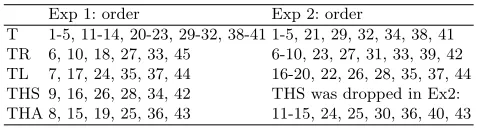
Table 2.The order for di↵erent templates in experiment 1 and experiment 2
Exp 1: order Exp 2: order
T 1-5, 11-14, 20-23, 29-32, 38-41 1-5, 21, 29, 32, 34, 38, 41 TR 6, 10, 18, 27, 33, 45 6-10, 23, 27, 31, 33, 39, 42 TL 7, 17, 24, 35, 37, 44 16-20, 22, 26, 28, 35, 37, 44 THS 9, 16, 26, 28, 34, 42 THS was dropped in Ex2: THA 8, 15, 19, 25, 36, 43 11-15, 24, 25, 30, 36, 40, 43
are 1 and 0.5 for THS respectively. Moreover the amplitude of the THA was maintained at half of the rest of the templates.
2.2 Experimental procedure
Subjects wore the haptic based pattern feedback sleeve as shown in Fig. 2A. Subjects were asked to keep the arm outstretched during the experiments. The smooth curves of Fig. 3 were selected as templates to generate di↵erent stimula-tion patterns. During a trial, all vibro-actuators vibrate simultaneously. Single trial ran for an average of 80 milliseconds. During the first five trials, the tem-plate (T) in Fig. 3 was played. Before playing each temtem-plate, subjects were shown the printed template. Subjects were asked to draw a smooth curve representing what they perceive on an ipad sketching app (Draw free app (Apple Inc)) after each trial as shown in Fig. 2B. A drawing area on the ipad was clearly demar-cated to match the size of the printed template as shown in Fig. 2B. Just after the drawing, the next stimulation was given. On average inter-stimulus interval was 82 ms on average with: 8.3 ms standard deviation. On average, experiment stimulation was limited to 80 ms. After that period, subjects were free to start the drawing the estimated template.
2.3 Data processing and statistical analysis
TL T TR THS
THA
Sub. 1 Sub. 2 Sub. 3 Sub. 4 Sub. 5 Sub. 6 Sub. 7 Sub. 8 Sub. 9 Sub. 10 Template
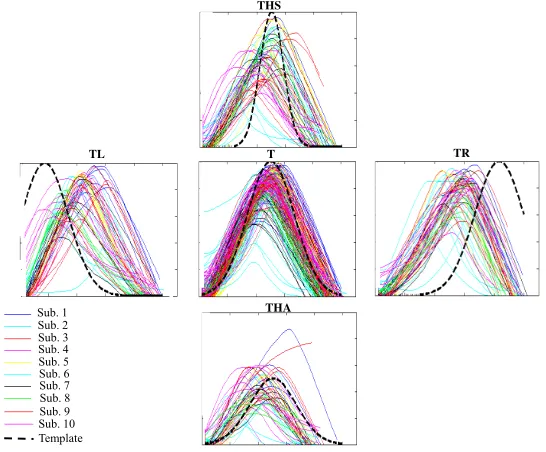
Fig. 4.The raw data for experiment 1: The sketched data for pattern T, TL, TR, THS, and THA for all trials. The all templates are shown by black dashed line.
2.4 Experiment 1: To understand how humans generalize a Gaussian pattern in scaling and shifting
Eight healthy naive subjects (6 - male, 2 - female) age between 24 to 39 partici-pated in the experiment 1. The experiment 1 was conducted to test how humans generalize a primitive template pattern (T) with respect to scaling and shifting. The shifting was done by left shift (TL) and right shift (TR), not up or down and scaling was done by shrinking (THS), and half in magnitude (THA) as shown in Fig. 3.
A B
TR THA TL THS
TR TA TL THS ! TR
TA TL THS
! !
C
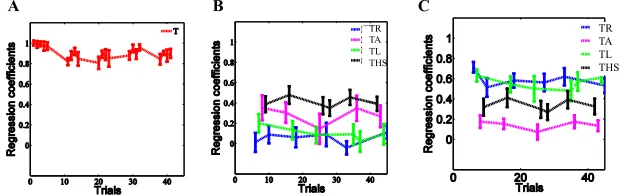
Fig. 5.Experiment 1: Average regression coefficients (In this experiment subjects were trained only for template T): A) Regression coefficients for training template T over the trials, B) Testing session regression coefficients for templates TL, TR, THS, and THA when the data are regressed with its respective templates, and C) Regression coefficients for templates TL, TR, THS, and THA when the data are regressed with template T.
other templates to train template T as shown in Table 2. During the training blocks, subjects were informed that the printed template was shown prior to the trial. For all training sessions (when T played) the visual cue was provided. At the end of each trial subjects were asked to draw what they felt during the trial. Pattern T repeated four times like in a block as shown in Table 2. Likewise four blocks of templates were played during the experiments after first five trials. The rest of four intensity patterns (TR, TL, THA, and THS) played six times each during the experiment randomly as shown in Table 2. Therefore, subjects participated in 45 trials during the experiments. For more clarity, the frequncies and the trial number and respective played patterns are shown in Table 1 and Table 2 respectively.
2.5 Experiment 2: To understand how humans can recognize trained templates when they are presented in a random order
TL T TR
THA Sub. 1
Sub. 2 Sub. 3 Sub. 4 Sub. 5 Sub. 6 Sub. 7 Sub. 8 Template
Fig. 6.The raw data for experiment 2(a): The sketched data for pattern T, TL, TR, and THA for all trials in experiment 2. The templates are shown by black dashed line. The template THS in experiment 1 was dropped in experiment 2.
four training templates were played in pseudo random order to achieve counter balancing. Each template was played 6 times making the total number of trials experienced by each subject to be 44.
3
Results
3.1 Experiment 1
Training Testing
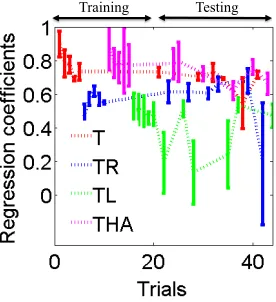
Fig. 7. A) Experiment 2: Average regression coefficients when data regressed with respective template in Fig. 3. Standard deviation of the regression coefficients are shown by error bars.
as shown in Fig. 5C (Note that in Fig. 5B the regression was done against the actual pattern that was played).
3.2 Experiment 2
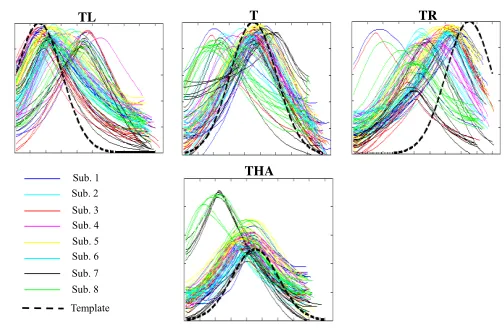
The sketched raw data for the pattern T, TL, TR, and THA in experiment 2 are shown in Fig. 6. The templates are shown by black dashed line. The sketched data in Fig. 6 were regressed against respective templates. The average regression coefficients are shown in Fig. 7 when subjects were trained and tested in a random order of patterns T, THA, TL, and TR in experiment 2. In general, in Fig. 7 all regression coefficients have improved with respect to Fig. 5B for all templates. The average regression coefficients of training session are higher for T and THA with respect to TL and TR as shown in Fig. 7. It implies that subjects have a better ability to recognize scaled template than shifted ones as noticed in experiment 1. Moreover, it can be seen in sketched data in Fig. 6 too. Interestingly, subjects can recognize these four templates when they are played in random order, provided they were trained earlier. Therefore, those results show that subjects can recognize trained primitive patterns when vibro-actuator array generates di↵erent stimulations.
4
Discussion
experiments that provide insights into how humans recognize trained cutaneous feedback patterns as well as their shifts and scales. The results in this papper provide new insights into an important area of tactile input to inform shape recognition. The subjects’ drawings of stimulus waveforms were captured and regression coefficients were used to understand humans’ ability to recognize the given stimulations by di↵erent templates a via vibro-actuator array.
It would be interesting to test whether subjects could decode the messages from the wearable haptic sleeve when the user is mobile and active. It will inform to develop a vocabulary to be used in a haptic language for special information and to design training protocols.
A deeper understanding of humans’ ability to generalize and recognize trained templates are important to convey some messages via vibro-actuator stimuli when humans have to work in noisy environments. Moreover, those trained tem-plates could be considered as primitives of a haptic based language. Those prim-itives and subjects’ responses would give an idea as to how they can be used to increase humans’ perception when they are in noisy environments like factory, search and rescue.
Acknowledgments. The authors would like to thank UK Engineering and Physical Sciences Research Council (EPSRC) grant no. EP/I028765/1 and grant no. EP/NO3211X/1, the Guy’s and St Thomas’ Charity grant on developing clinician-scientific interfaces in robotic assisted surgery: translating technical innovation into improved clinical care (grant no. R090705), Higher Education Innovation Fund (HEIF), and Vattikuti foundation.
References
1. Hale, K. S., Stanney, K. M.: Deriving haptic design guidelines from human phys-iological, psychophysical, and neurological foundations, Computer Graphics and Ap-plications, IEEE, vol. 24, no. 2, 33-39, (2004)
2. Gilson, R. D., Redden, E. S., Elliott, L. R., Remote tactile displays for future sol-diers, tech. rep., DTIC Document (2007)
3. Jones, L. A., Lederman,S. J., Human hand function. Oxford University Press (2006) 4. Gilson, R. D., Redden, E. S., Elliott, L. R., Remote tactile displays for future
sol-diers, UNIVERSITY OF CENTRAL FLORIDA ORLANDO, (2007)
5. Tsukada, K., Yasumura, M., Activebelt: Belt-type wearable tactile display for direc-tional navigation, Springer Berlin Heidelberg In UbiComp 2004: Ubiquitous Com-puting, 384–399, (2004)
6. Bliss, J. C., Katcher, M. H., Rogers, C. H., Shepard, R. P., Optical-to-tactile image conversion for the blind, IEEE Transactions on Man-Machine Systems, 11(1), 58–65, (1970)
7. Wall III, C., Weinberg, M. S., Schmidt, P. B., Krebs, D. E., Balance prosthesis based on micromechanical sensors using vibrotactile feedback of tilt, IEEE Transactions on Biomedical Engineering, 48(10), 1153–1161, (2001)
8. Priplata, A. A., Niemi, J. B., Harry, J. D., Lipsitz, L. A., Collins, J. J., Vibrating insoles and balance control in elderly people, The Lancet, 362(9390), 1123–1124, (2003)
9. Rupert, A. H., An instrumentation solution for reducing spatial disorientation mishaps, IEEE Engineering in Medicine and Biology Magazine, 19(2), 71–80, (2000) 10. Van Erp, J. B., Guidelines for the use of vibro-tactile displays in human computer
interaction, IEEE In Proceedings of eurohaptics, pp. 18–22, (2002)
11. Stepanenko, Y., Sankar, T. S., Vibro-impact analysis of control systems with me-chanical clearance and its application to robotic actuators, Journal of dynamic sys-tems, measurement, and control, 108(1), 9–16, (1986)
12. Benali-Khoudja, M., Hafez, M., Alexandre, J. M., Khedda, A., Moreau, V., VITAL: a new low-cost vibro-tactile display system, IEEE International Conference onIn Robotics and Automation, 1, 721–726, (2004)
13. Zaitsev, V., Sas, P, Nonlinear response of a weakly damaged metal sample: a dis-sipative modulation mechanism of vibro-acoustic interaction, Journal of Vibration and Control, 6(6), 803–822, (2000)