current trends in utilization rates and
recommendations for their inclusion at the
Canadian Memorial Chiropractic College
Brian J. Gleberzon,
DC*
Since its establishment in 1945, the Canadian Memorial Chiropractic College (CMCC) has predominately adhered to a Diversified model of chiropractic technique in the core curriculum; however, many students and graduates have voiced a desire for greater exposure to chiropractic techniques other than Diversified at CMCC. A course structure is presented that both exposes
students to a plethora of different “Name techniques” and provides students with a forum to appraise them critically. The results of a student survey suggested that both of these learning objectives have been successfully met. In addition, an assignment was designed that enabled students to recommend which, if any, “Name techniques” should be included in the curriculum of the College. The recommendations from these assignments were compiled since the 1996/97 academic year. The results indicated an overwhelming demand for the inclusion of Thompson Terminal Point, Gonstead, Activator Methods, Palmer HIO and Active Release Therapy techniques either as part of the core curriculum or in an elective program. These recommendations parallel the practice activities of Canadian
chiropractors.
(JCCA 2000; 44(3):157–168)
K E YW O R D S: brand name techniques, diversified technique, curriculum.
Depuis sa fondation en 1945, le Canadian Memorial Chiropractic College a surtout adopté le modèle de techniques Diversified dans son programme de base; cependant, beaucoup d’étudiants et de diplômés ont exprimé le désir d’étudier plus en profondeur d’autres techniques de chiropratique. Une structure de cours a été élaborée de manière à présenter aux étudiants un large éventail de techniques et à leur offrir une tribune pour qu’ils puissent en faire l’évaluation critique. Un sondage mené auprès des étudiants révèle que les deux objectifs visés ont été atteints. De plus, les étudiants peuvent faire des recommandations, dans le cadre d’un travail, quant aux techniques qui devraient être intégrées dans le programme d’enseignement du collège. On tient la liste des recommandations depuis 1996–1997. Les résultats indiquent une forte préférence pour les techniques suivantes : Thompson Terminal Point, Gonstead, Activator Methods (méthodes au moyen d’un activateur), Palmer HIO et Active Release Therapy (thérapie par la libération active); celles-ci pourraient faire partie du programme de base ou d’un programme optionnel. Les recommandations sont le reflet des différentes techniques appliquées par les chiropraticiens au Canada.
(JACC 2000; 44(3):157–168)
M O T SC L É S : noms de différentes techniques, techniques diversified, curriculum.
* Assistant professor, Canadian Memorial Chiropractic College, 1900 Bayview Avenue, Toronto, Ontario, Canada M4G 3E6. (416) 482-2340
Introduction
Since its establishment in 1945, the Canadian Memorial Chiropractic College (CMCC) has predominately adhered to a Diversified model of chiropractic care in the core curriculum. Students, however, have consistently voiced their desire for increased exposure to, and instruction in, other chiropractic technique systems, such as Gonstead and Thompson Terminal Point techniques. Taken to-gether, this group of chiropractic technique systems is commonly referred to as “Brand Named” techniques or simply “Name” techniques due to the fact that their origins can be traced back to individual developers. A review of the Applied Chiropractic Department at CMCC (which is responsible for instruction in the psycho-motor skills of Diversified technique) was conducted in 1998.1 This re-view involved faculty, clinicians and students and con-sisted of survey instruments, interviews and focus groups. The review revealed that 87% of students (N= 385) ex-pressed a desire for increased exposure to Name tech-niques other than Diversified.1
Currently, the primary exposure to Name techniques in the core curriculum at CMCC is during a course titled
Integrated Chiropractic Practice and Principles. This course provides an opportunity for guest lecturers (typi-cally field practitioners) who utilize a particular Name
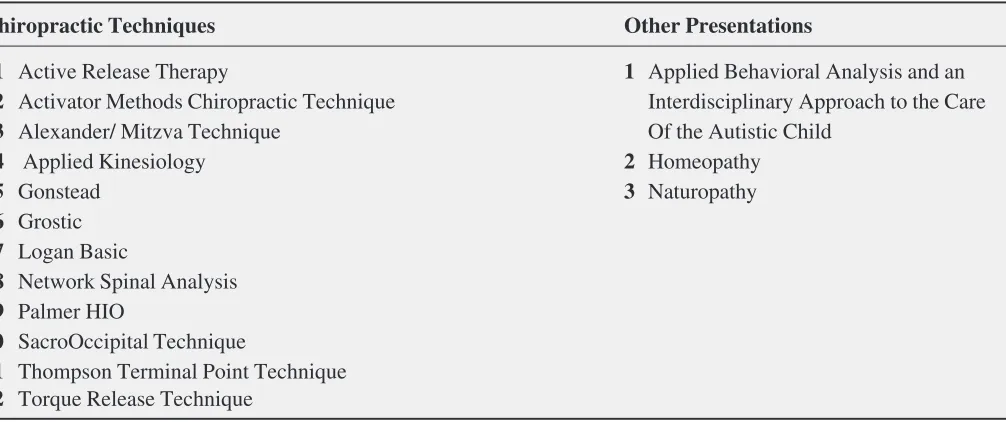
technique to present the technique to students. Lecturers provides an historical account, description of the philo-sophical model or approach (mechanistic, postural, reflex-ive, tonal) and a demonstration of the diagnostic and therapeutic methods utilized by each technique. Some “hands-on” exposure to each technique is provided in the psycho-motor skills labs. During the 1999/2000 academic year, 15 guest lecturers presented 12 different Name tech-niques (Table 1).
Although this course is offered to fourth-year students during their internship, clinic treatment policies prohibit students from utilizing any technique other than Diversi-fied with their patients.2–4 The policy on “Alternate Thera-pies” for the CMCC outpatient clinics states: “Patients admitted to the CMCC clinics will be treated by chiroprac-tic methods as instructed in the CMCC curriculum.”3 This policy results from concerns that clinical faculty, who may not be familiar with the protocols of a particular technique, cannot provide appropriate intern supervision. Other con-cerns involve allocation of human resources and schedul-ing conflicts.2 However, in some cases, a clinician may have sufficient training in a particular technique to provide adequate supervision, and may allow an intern who wishes to employ a particular Name technique to do so, provided he or she follow specific clinical guidelines.4
Table 1
Topics presented to the fourth year students in the 1999/2000 academic year during the Integrated Chiropractic Practice and Principles course.
Chiropractic Techniques Other Presentations
1 Active Release Therapy 1 Applied Behavioral Analysis and an
2 Activator Methods Chiropractic Technique Interdisciplinary Approach to the Care
3 Alexander/ Mitzva Technique Of the Autistic Child
4 Applied Kinesiology 2 Homeopathy
5 Gonstead 3 Naturopathy
6 Grostic
7 Logan Basic
8 Network Spinal Analysis
9 Palmer HIO
10 SacroOccipital Technique
11 Thompson Terminal Point Technique
With the implementation of the new curriculum at CMCC in the 1999/2000 academic year, the Integrated Chiropractic Practice and Principles course will be pro-vided to students at the beginning of their second year. At this time, however, there is neither an elective program of-fering students instruction in Name techniques nor is in-struction in Name techniques offered through the continuing education department. Therefore, there is to some degree a “gap” between the CMCC undergraduate Chiropractic pro-gramme and reported professional practice activities.
In order to provide students with the opportunity to ex-plore Name techniques further, and to identify those par-ticular Name techniques that students wished to learn in greater depth, the author (who is the coordinator of the course) increased the number of guest lecturers, developed a problem-based learning forum and designed an investi-gative assignment. The objectives of the re-structuring of the course and the investigative assignment were to
broaden student exposure to a variety of Name techniques of varying philosophical, diagnostic and therapeutic proaches while, concurrently, encouraging students to ap-praise them critically.
As an additional learning objective, the investigative assignments required students to determine if any particu-lar Name technique warranted inclusion in the curriculum of the college. The recommendations from these assign-ments have been compiled since the 1996/1997 academic year. The preference for certain Name techniques became apparent, and these preferences parallel the current prac-tice activities of Canadian chiropractors.
Methods
At the beginning of the course, the class of 150 students was randomly assigned to groups of 16. Each group of students then divided themselves into working pairs. Each pair of students was responsible for the investigation of
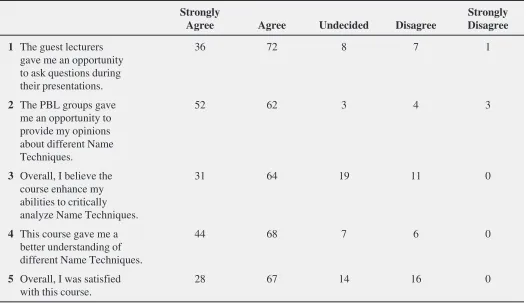
Table 2
Evaluation of Integrative Chiropractic Practice and Principles by 1999/2000 fourth year students (N= 125).
Strongly Strongly
Agree Agree Undecided Disagree Disagree
1 The guest lecturers 36 72 8 7 1
gave me an opportunity to ask questions during their presentations.
2 The PBL groups gave 52 62 3 4 3
me an opportunity to provide my opinions about different Name Techniques.
3 Overall, I believe the 31 64 19 11 0
course enhance my abilities to critically analyze Name Techniques.
4 This course gave me a 44 68 7 6 0
better understanding of different Name Techniques.
5 Overall, I was satisfied 28 67 14 16 0
one particular Name technique. The allocation of responsi-bilities was decided by the students. Each pair of students conducted an investigation of the chosen technique. Inves-tigation criteria included an historical account of the devel-oper of the technique, the philosophical approach of the technique, a description of the diagnostic and therapeutic protocols of the technique, outcome measures, and an as-sessment of any relevant research regarding the efficacy of the technique.
Students were permitted to chose their own topics. The rationale behind this approach was that a student with an interest in a technique may have in his or her possession information that would be difficult to obtain from standard investigative sources. For example, a student may possess
seminar notes and may be aware of pertinent research in non-indexed peer reviewed journals. A student may also have first-hand experience with a particular technique. This student would therefore be in a position to provide a much more extensive and detailed review.
Each pair of students presented their findings to the large group of 16 students in a faculty-facilitated, prob-lem-based learning (PBL) environment. The facilitators were chiropractors, most of whom were tutors in the psy-cho-motor skills labs and all of whom were in private clini-cal practice. After the presentation, the group debated the merits of each technique, considering its strengths and weaknesses. The students then voted as to their recom-mendation on whether to include the technique in the core
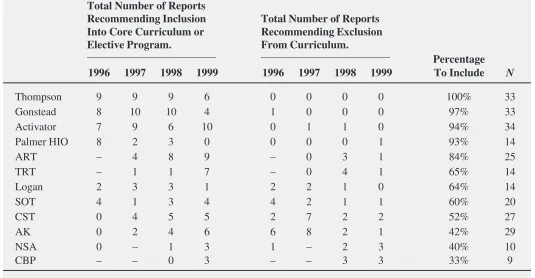
Table 3
Compilation of Results from Student Investigative Reports (1996–1999)* (N= 263)**
Total Number of Reports
Recommending Inclusion Total Number of Reports
Into Core Curriculum or Recommending Exclusion
Elective Program. From Curriculum.
Percentage
1996 1997 1998 1999 1996 1997 1998 1999 To Include N
Thompson 9 9 9 6 0 0 0 0 100% 33
Gonstead 8 10 10 4 1 0 0 0 97% 33
Activator 7 9 6 10 0 1 1 0 94% 34
Palmer HIO 8 2 3 0 0 0 0 1 93% 14
ART – 4 8 9 – 0 3 1 84% 25
TRT – 1 1 7 – 0 4 1 65% 14
Logan 2 3 3 1 2 2 1 0 64% 14
SOT 4 1 3 4 4 2 1 1 60% 20
CST 0 4 5 5 2 7 2 2 52% 27
AK 0 2 4 6 6 8 2 1 42% 29
NSA 0 – 1 3 1 – 2 3 40% 10
CBP – – 0 3 – – 3 3 33% 9
* Techniques that were investigated by fewer than three groups total over the four year period were not included in the summation (N= 14).
** Assignments that did not provide a definitive recommendation to either include or exclude the investigated technique were not included in this summation (N= 25).
curriculum, to develop an elective program, or to continue to exclude the technique from the current curriculum. In this manner, even if a pair of students had a passionate interest in a particular technique and provided a charis-matic presentation, the larger group could still vote for the technique’s exclusion from the curriculum.
The investigations and recommendations were com-bined into a report submitted for evaluation. The author has compiled the recommendations gathered from a four year period (1996 to 1999). In order to avoid any potential bias, the results from previous years are not disclosed to students prior to the submission of their reports.
Results
Assessment of satisfaction with the course format
A course survey of fourth year students was conducted in the fall of 1999 (Table 2). The survey revealed that 86.4% of respondents (N= 125) agreed or strongly agreed with the statement that the guest lecturers provided an opportu-nity for students to ask questions during their presenta-tions. Furthermore, 91.2% of respondents agreed or
strongly agreed with the statement that the PBL groups provided the students with an opportunity to express their opinions about Name techniques. Also, 76% of the stu-dents agreed or strongly agreed with the statement that the course enhanced their abilities to analyze Name tech-niques critically, with 15.2% of students undecided. The survey also revealed that 92.8% of respondents agreed or strongly agreed with the statement that the course gave them a better understanding of different Name techniques. Lastly, 76% of students agreed or strongly agreed with the statement indicating that they were satisfied with the course overall, with 11.2% of students undecided. The re-sults of this survey suggested that the primary learning objectives of the course were successfully met.
Recommendations from student investigative reports
Over the past four years, a total of 42 student investigative reports have been submitted for evaluation. Each report contained between 6 to 10 research assignments on a par-ticular technique. A total of 302 research assignments on 21 different Name techniques have been submitted. If an assignment did not provide a definite recommendation
0% 10% 20% 30% 40% 50% 60% 70% 80% 90% 100% CBP
NSA AK CST SOT Logan
TRT ART Palmer HIO Activator Gonstead Thompson
Include Exclude
Figure 1
(N= 25), or if a technique was researched by fewer than 3 groups over the four year period (N= 14), that assignment was excluded from the summation. The results of the re-maining 263 investigative assignments from each aca-demic year have been tabulated (Table 3, Figure 1).
Examination of the results reveal distinct trends. Spe-cifically, students independently and yet consistently rec-ommend inclusion in the curriculum of Thompson Terminal Point (100%), Gonstead (97%), Activator Meth-ods (94%), Palmer HIO (93%) and Active Release Therapy (84%) techniques. Students appear to be less in-terested in Torque Release (65%), Logan Basic (62%), SacroOccipital Technique (60%), CranioSacral Therapy (52%), Applied Kinesiology (42%), Network Spinal Analysis (40%) and Chiropractic Biophysics (33%).
Discussion
Name techniques at CMCC
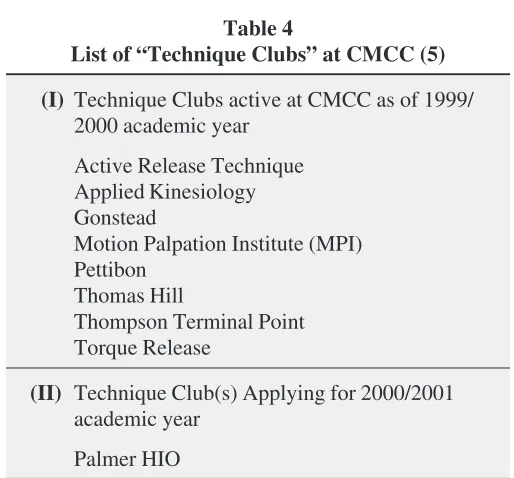
One need look no further than the proliferation of “Tech-nique Clubs” at CMCC to conclude that students have a tremendous interest in Name techniques. Currently, there are 8 techniques offered by “technique clubs’ under the purview of the Student Administrative Council, with 1 more proposed for the 2000/2001 academic year (Table 4).5
Utilization of name techniques by Canadian chiropractors
A review of the literature reveals that a significant propor-tion of Canadian chiropractors utilize Name techniques in clinical practice. For example, in 1993, the National Board of Chiropractic Examiners released their findings of a job analysis of chiropractors in Canada.6 This analysis indi-cated that, although 87.3% of respondents utilized Diversi-fied technique, 44.2% utilized SacroOccipital Technique, 43.6% Activator, 37.7% Meric, 35.0% Gonstead, 32.4 NIMMO/tonus receptor, 31.0% Applied Kinesiolgoy, 30.0% Thompson, 25.9% Logan Basic, 22.4% Cox/ Flexion-Distraction, 22.3% Palmer HIO, 22.2% “Cranial” and 15.5% “other” techniques.6
Kopansky-Giles and Papadopoulos conducted a prac-tice pattern survey of Canadian chiropractors in 1995.7 Two findings are of particular relevance here. The first is that 72.7% of respondents (N= 2,587) reported that they utilized Diversified techniques for 76% to100% of their patients, indicating that one out of four chiropractors utilized a technique other than Diversified for 76% to 100% of their patients. In addition, the respondents also indicated that, for 1% to 25% of their patients, they utilized Activator (31.4%), SacroOccipital Technique (18.8%), Thompson (14.3%), Gonstead (10.9%), CranioSacral Therapy (8.3%) and Palmer HIO (6.9%) techniques.7 This preference in the utilization of Diversified technique un-doubtedly reflects the fact that, as of 1995, the vast major-ity of respondents (over 90%) had been educated at CMCC7 and may preferentially utilize the only technique (Diversified) that they were taught.
Secondly, this survey predicted that the number of Ca-nadian chiropractors would increase from 5,000 to 10,000 by the year 2005.7 CMCC graduates approximately 150 students a year. Over a ten year period, therefore, 1,500 new chiropractors will have graduated from CMCC. The remaining 3,500 new Canadian chiropractors must there-fore be graduates of colleges other than CMCC.
According to the Canadian Chiropractic Examining Board (CCEB), 608 candidates sat for the Canadian Board Examinations in 1999, as compared to only 186 in 1992.8 Between 1995 and 1999, a total of 1,812 candidates sat for the Canadian Board examinations. Only 40% (N= 730) were graduates of CMCC. The other candidates were graduates of Western States (N= 194), National Col-lege (N= 155), Palmer College West (N= 150),
North-Table 4
List of “Technique Clubs” at CMCC (5)
(I) Technique Clubs active at CMCC as of 1999/ 2000 academic year
Active Release Technique Applied Kinesiology Gonstead
Motion Palpation Institute (MPI) Pettibon
Thomas Hill
Thompson Terminal Point Torque Release
(II) Technique Club(s) Applying for 2000/2001 academic year
western College (N= 102), Palmer College (N= 100) and other chiropractic colleges (N= 381).9
Many other chiropractic colleges provide extensive ex-posure to a wide variety of Name techniques either in the core curriculum or within an elective program. With such a large influx of chiropractors into Canada from different chiropractic colleges, it can be predicted with confidence that the utilization rates of Name techniques by Canadian chiropractors will rise dramatically over the next few years.
A survey of CMCC students and graduates by Watkins and Saranchuk, completed in July 1999, sought to com-pare professional practice activities with the educational programming at CMCC.10 This survey gathered informa-tion pertaining to the techniques primarily and regularly
utilized by CMCC graduates between 1993/4 and 1997/8 (N= 325) as well as techniques fourth year students (N= 95) thought they would primarily or regularly utilize after graduation. The survey revealed 84.5 % of students thought they would primarily utilize Diversified tech-nique. However, the same group of students thought they would regularly utilize Activator (21.6%), Applied Kinesiology (15.5%), CranioSacral Therapy (14.4%), Thompson Terminal Point (12.4%), Motion Palpation In-stitute (MPI) (11.3%), Gonstead (11.3%), and “other” techniques (13.6%) once they were in private practice.10
Watkins and Saranchuk reported that utilization rates of Name techniques among CMCC alumni were even higher than those predicted by students.10 While 86.7% of gradu-ates primarily utilize Diversified technique, 33.3% re-ported regularly using Activator, 22% MPI, 20.7% Thompson Terminal Point, 11.3% Gonstead, 9.7% CranioSacral, 9.1% Palmer HIO and 13.6% reported uti-lizing “other” Techniques. It must be emphasized that these relatively high rates of “regular” Name technique utilization were gathered from CMCC graduates who re-ceived only a preliminary introduction, and thus no formal training, in any technique other than Diversified from the college curriculum.
The high rates of “regular” utilization of Name tech-niques by CMCC graduates may be related to the finding in the same survey that only 32.7% of CMCC graduates (and 30.9% of CMCC students) obtained their continuing education from CMCC. In contrast, 64.4% of graduates and 69.1% of students sought their continuing education from sources other than CMCC.10 It is possible that a
ma-jority of the continuing education sought from outside sources is for instruction in different Name techniques. For example, when certain seminars are offered in Toronto (notably Active Release Therapy), student attendance in CMCC classes noticeably declines, despite the hefty cost of some of these outside presentations. (A weekend in-structional seminar in Active Release Therapy costs a stu-dent approximately $1,000 US.)
Student appraisals of name techniques
Within the investigative assignments, students were reluc-tant to recommend certain Name techniques for inclusion in the curriculum at CMCC for a variety of different rea-sons. Many students concluded that, while a particular Name technique may provide positive therapeutic out-comes, the philosophy of the technique would integrate poorly with the paradigm of the Diversified technique model. This was often the argument against recommend-ing such tonal techniques as Network Spinal Analysis (NSA) and Torque Release Technique (TRT). Some stu-dents were unsure if a particular technique should even fall under the label of “chiropractic care”; this was the case often made against CranioSacral Therapy. Students also correctly identified that the incorporation of certain tech-niques would be complicated by trademark or copyright protection laws. An example of this situation is Active Release Therapy.
Some students felt that the research into a particular Name technique was currently inadequate or inconclusive. A study by Blanks et al.11 of patients under Network care illustrates this point. The study involved a large group of patients (N= 2,818) who reported significant benefits while under Network care (measured as improvements in their “wellness coefficient”). However, because the study was retrospective, the researchers were unable to question those patients who discontinued care, possibly because of lack of satisfaction or benefit. This could skew the results. Also, assessing a patient’s perceived improvements after a lengthy (and costly) treatment regimen may influence pa-tient responses. Papa-tients may wish to validate their time and money commitments and report disproportionally more favorable results than may have actually been achieved.
other than certain types of headaches and acute and chronic low back pain are generally few and far between. In addition, while studies may indicate the poor inter-ex-aminer reliability of diagnostic tests such as prone leg length analysis, a test ubiquitous to many Name tech-niques and not endorsed by Diversified technique, many studies assessing the inter-examiner reliability of motion palpation, a core Diversified diagnostic test, fare as poorly. A few representative examples are provided in the refer-ences.12–20
An argument can be made that only those techniques that are “evidence-based” should be offered in chiroprac-tic curricula; however, good quality research comprising this evidence is sparse for every technique, Diversified included. Furthermore, Sackett, an expert on evidence-based medicine, recently commented that “evidence-evidence-based medicine means integrating individual clinical expertise with the best available external clinical evidence from sys-tematic research ... especially from patient-centered clinical research”.21 This emphasizes the importance of studies such as the one by Blank et al, notwithstanding its methodologi-cal flaws.
Meeker recently identified many theoretical challenges facing chiropractic science in order to develop evidence of chiropractic “success”, not the least of which is devel-oping definitions of health that can be measured.22 As Cooperstein and Schneider opine, “colleges today are con-fronting the challenges of charting a path between the Scylla of an initially disappointing run at technology as-sessment and the Charybdis of an anachronistic faith in chiropractic procedures.”23
Students did not recommend abandoning the curricular commitment to a Diversified model of chiropractic care. Rather, students recommended the addition of Name tech-niques to their armamentarium of diagnostic and therapeu-tic skills that may be of benefit to patients with specific clinical conditions. For example, the use of an adjusting instrument (Activator or Integrator, used in Torque Release) or low force techniques (Logan Basic, Sacro-Occipital Technique) may be of benefit for treating chil-dren, patients with advanced osteopenic disorders, patients with severe pain upon palpation and for those patients who do not like manual adjustments with audible releases. Similarly, comprehensive knowledge of adjusting tech-niques that utilize tables with drop piece capabilities (such as Thompson Terminal Point) may be helpful if there is a
significant discrepancy in size between a large patient and a diminutive doctor.
Other issues germane to name technique use
Other techniques, such as Gonstead, Thompson and Palmer HIO, offer methods of cervical adjusting that are non-rotatory.24,25,26 Cervical rotation has been identified as the position that places a patient at a relatively higher risk of injury (notably stroke) as compared to non-rotatory positions,27 although this cannot be concluded with cer-tainty.28 Instrument adjusting may also minimize the risk of cerebral vascular accidents during cervical adjusting, although a few injuries have recently been reported.29 Lastly, some practitioners may be attracted to techniques that support a vitalistic paradigm of chiropractic care, such as Palmer HIO, Torque Release or Network Spinal Analysis.
Some critics of Name techniques point to the “cook-book” approach of many of the techniques, accusing some practitioners of abandoning avenues of individual clinical reasoning. While it is possible some practitioners may be over-reliant on the algorhythmic simplicity inherent in some Name techniques, it is the author’s experience that practitioners who utilize Name techniques continue to meet the level of clinical competence required of a “rea-sonable” chiropractor. In addition, were Name techniques to become part of the curriculum at CMCC, there would continue to be an emphasis on palpatory, orthopedic and neurological examination skills for purposes of both diag-nosis and the monitoring of therapeutic outcomes.
Chiropractic and allopathic clinical practices are fraught with uncertainty.30,31 As O’Malley observed, many practitioners can relate anecdotal examples of a seemingly capricious patient’s body responding to treat-ment at variance with text-book expected outcomes of predefined syndromes.32 For those practitioners (and pa-tients) uncomfortable with this clinical uncertainty, those Name techniques embracing a vitalistic paradigm offer a degree of reassurance.
courses at CMCC, including those in the Applied Chiro-practic Department. Oftentimes these hard sciences are used to refute aspects of the Diversified model which are simultaneously being taught to students.23,30 However, Cooperstein has cautioned the chiropractic profession that the over-reliance on the “hard sciences” in chiropractic pedagogy may be what Hayek (an economist) termed “scientism” – the overly ambitious attempt to emulate the methods of mathematical physics in an inappropriate field.30 Such fields include the healing arts, sociology, eco-nomics, sociocultural anthropology– in short, any field that studies or considers humans as social beings. Cooperstein warns that “scientifically-based educators have no choice but to defetishize the standard chiropractic totems, but they should not deconsecrate such religious totems without attempting to erect a secular model of equal interest.”30 In the absence of such new models, student frustration and confusion may mount.
The author is unaware of any protocols that exist in Diversified technique that guide a practitioner for the opti-mal sequencing of adjustments to be delivered to a patient, in the event the patient requires adjustments of various regions of the spine. For example, if a patient requires adjustments to the cervical spine, thoracic spine and to the pelvis, Diversified technique offers no guidance as to which adjustment to preferentially perform first. While the sequencing of adjustments may not be clinically impor-tant, if a practitioner believes that there is an optimal se-quence of adjustments that should be delivered, he or she must adopt protocols from other Name techniques that allow for this determination, such as Activator or Thompson Terminal Point.
Diversified technique can be considered an eclectic group of diagnostic and therapeutic methods adopted from other, more established Name techniques. It is thought by some to be a representation of the best aspects of many other techniques, while others consider it a stand- alone technique.33 (It is for this reason that a capital “D” has been used throughout this article when denoting Diversified technique.) Diversified is arguably the least dogmatic of all the chiropractic techniques, with some historians sug-gesting it was developed as a response to the rigidity and dominance of BJ Palmer during the 1940s.33 However, others consider Diversified technique to be a amalgam of many of the Name techniques, a technique that adopts the procedures of other techniques, divorced from their
found-ing principles. The dichotomy that may exist between edu-cational programming in the Chiropractic Principles Pro-gram at CMCC and student perceptions (concerns) of the importance and extent of emphasizing chiropractic prin-ciples in the curriculum have been investigated.34 For ex-ample, Waalen, Watkins and Saranchuk reported that students indicated that philosophy was a very important part of their chiropractic education and they felt their needs were not being met by the present program.34 Moreover, students perceived that faculty were unappre-ciative of philosophy, although a survey of faculty was found to be at odds with the student’s perceptions.34
It is appealing to believe that Diversified technique is the linear culmination of a natural evolution of chiroprac-tic techniques, analogous to the evolution of Homo sapiens (Austropithicines begat Homo habilus begat Homo erectus
and so on). The problem with this thinking is that anthro-pologists now know evolution is not linear, but rather a meandering experiment through time.35,36 Moreover, the principle of “ontogeny recapitulates phylogeny” may ap-ply as equally to human evolution as to chiropractic evolu-tion: To paraphrase Einstein, in order for chiropractic to see further, it should stand on the shoulders of its giants.
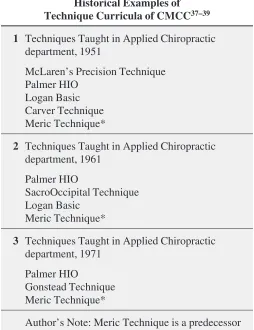
Nevertheless, Diversified technique has an inherent plasticity to its structure which is often lacking in other Name techniques, the protocols of which are considered immutable. This plasticity of curricular structure in Diver-sified technique is apparent from an historical review of the Applied Chiropractic department of CMCC. While in-struction in Diversified technique has always been taught in the core curriculum, examination of course calenders reveals that instruction has also been provided in Gonstead, Palmer HIO, Logan Basic and SacroOccipital Technique (Table 5).37–39
feasible and not without historical precedent.
On the other hand, the inclusion of Name techniques in the core curriculum may be unfeasible (due to time con-straints caused by the introduction of the new “integrative curriculum”) or even undesirable, and the development of an elective program may cause tension with the clinical administration. However, Name techniques could be of-fered through the Continuing Education (CE) program. For example, acupuncture is offered by the CE program but is no where to be found in the core curriculum of CMCC. Offering these courses within the CE program would ensure high standards in content and presentation. Such a bold direction would require a deviation from the ethnocentrism which may exist in some educational insti-tutions.
The CMCC has embarked on the development of a new, integrated curricular model, which began in the 1999/2000
academic year for students entering the program. The three central components were that the curriculum was to be (i) competency-based, (ii) integrated and (iii) practice-related. The inclusion of Name techniques would specifi-cally comply with the third component.
When considering curricular integration of Name tech-niques, it is possible for CMCC to be responsive to student desires, which cannot be ignored when one remembers that college revenues are so highly tuition dependent.23 This should not be interpreted as a suggestion to pander to student’s every whim. However, a curriculum that reflects current practice activities of Canadian chiropractors (in-cluding CMCC graduates) may ultimately have a positive influence on alumni membership.
Recommendations and conclusions
Innovative course structure and assignments, such as those utilized for the Integrated Chiropractic Practice and Prin-ciples course discussed here, can achieve high levels of student satisfaction while fulfilling specific learning ob-jectives important to chiropractic pedagogy.
Practice pattern studies suggest the landscape of the chi-ropractic profession in Canada will undergo a tremendous upheaval over the next few years. Combining the results of demographic trends, student and alumni surveys, and the results obtained from student recommendations reported here, can enable CMCC to be responsive to predictable changes. Name techniques are part of chiropractic reality in Canada now, and are likely to play an even greater role in the future. Technique system entrepreneurs have had an unfair advantage over colleges because they can make vir-tually any unsubstantiated claim they want without fear of professional censure.23 By contrast, a college is account-able to many different stakeholders, not the least of which are third party payers, public health agencies, the scientific community, alumni, students and its own faculty.23 It is therefore the responsibility of CMCC, as an educational institution, to provide students with a better education in these areas, especially if it is to meet its own mandate of a practice-based integrated curriculum, while simultane-ously struggling to prevent the more outlandish techniques from taking hold among students through exploitation of their inexperience.
The college should therefore consider including those Name techniques (or significant components thereof), identified by students and utilized by field practitioners,
Table 5
Historical Examples of Technique Curricula of CMCC37–39
1 Techniques Taught in Applied Chiropractic department, 1951
McLaren’s Precision Technique Palmer HIO
Logan Basic Carver Technique Meric Technique*
2 Techniques Taught in Applied Chiropractic department, 1961
Palmer HIO
SacroOccipital Technique Logan Basic
Meric Technique*
3 Techniques Taught in Applied Chiropractic department, 1971
Palmer HIO
Gonstead Technique Meric Technique*
that are most compatible with a Diversified model of chiropractic care into (1) the core curriculum, (2) an elec-tive program or (3) an extension of the CE program.
Acknowledgements
The author would like to express his appreciation to Dr. Dave Waalen, Dr. Ayla Azad, Dr. Lisa Caputo, Joe Piccininni MSc, CAT(C), Carol Hagino MSc and Ron Saranchuk PhD for their assistance in this article, and to the many students and faculty members of the Canadian Memorial Chiropractic College, without whose participa-tion this study would not have been possible.
References
1 Waalen D, Gleberzon B, Saranchuk R. Review of Applied Chiropractic Department (in press). Presented at the Association of Chiropractic Colleges, Orlando, Florida, March 1999.
2 CMCC Division of Clinical Education, Internal Memorandum, dated November 30, 1998. 3 CMCC Division of Clinical Education, Internal
Memorandum, dated April 1, 1999.
4 CMCC Division of Clinical Education, Internal Memorandum, dated July 6, 1999.
5 Student Administration Council, 1999/2000.
6 National Board of Chiropractic Examiners. Job analysis of chiropractors in Canada. Greely, Colorado, 1993:84. 7 Kopansky-Giles D, Papadopoulos C. Canadian
Chiropractic Resource Databank (CCRD): A profile of Canadian chiropractors. J Can Chiropr Assoc
1997; 41(3):155–191.
8 McEwen M. Chairmen, Canadian Council of Examining Board. Personal Communication.
9 www.CCEB.ca
10 Watkins T, Saranchuk R. Analysis of the Relationship between Educational Programming at the Canadian Memorial Chiropractic College, and the Professional Practices of its Graduates. In Press.
11 Blanks R, Schuster T, Dobson M. A respective assessment of Network Care using a survey of self-rated health, wellness and quality of life. J Vertebral Subluxation Research 1997; 1(4):15–31.
12 DeBoer K, Harmon R, Savoie S, Tuttle C. Inter- and intra-examiner reliability of leg-length differential measurement: a preliminary study. J Manipulative Physiol Ther 1983; 6(2):61–66.
13 Rhudy TR, Burk JM. Inter-examiner reliability of functional leg-length assessment. Am J Chiro Med 1990; 3(2):63–66.
14 Rhode DW et al. Comparison of leg length inequality measurements methods as estimators of the femur head height differences on standing x-ray. J Manipulative Physiol Ther 1995; 18(7):448–452.
15 Meijne W, van Neerbos K, Aufdemkampe G, van der Wurff P. Intraexaminer and interexaminer reliability of the Gillet tests. J Manipulative Physiol Ther 1999; 22(1):4–9. 16 Carmichael JP. Inter- and intraexaminer reliability of
palpation for sacro-iliac joint dysfunction. J Manipulative Physiol Ther 1987; 10:164–171.
17 Herzog W, Read LJ, Conway PJW, Shaw LD, McEwen MC. Reliability of motion palpation procedures to detect sacro-iliac joint fixations. J Can Chiropr Assoc 1980; 24:59–69.
18 Mior S, King R, McGregor M, Bernard M. Intra and interexaminer reliability of motion palpation in the cervical spine. J Can Chiropr Assoc 1985; 29(4):195–198. 19 Haas MH, Raphael R, Panzer D, Paterson D. Reliability of
manual end play palpation of the thoracic spine. Chiropractic Technique 1995; 7:120–124.
20 Ross JK, Bereznick DE, McGill S. Atlas-axis facet asymmetry: implications in manual palpation. Spine 1999; 24:1203–1209.
21 Sackett D. Evidence-Based Medicine. Spine 1998; 23(10):1085–1086.
22 Meeker WC. Concepts germane to an evidence-based application of chiropractic theory. Topics in Clinical Chiropractic 2000; 7(1):67–73.
23 Cooperstein R, Schneider MS. Assessment of chiropractic techniques and procedures. Topics in Clinical Chiropractic 1996; 3(1):44–51.
24 Fuhr A, Colloca C, Green J, Keller T. Activator Methods Chiropractic Technique Mosby-Year Book Inc. USA 1997: 401–430.
25 Coelho L. Applied Chiropractic. Share International II. Fort Worth, Texas, USA. 1997: 159–186, 187–220. 26 Plaugher G. Textbook of Clinical Chiropractic. A Specific
Biomechanical Approach. Baltimore: Williams and Wilkins 1993.
27 Terrett A. Vertebral basilar stroke following manipulation. National Chiropractic Mutual Ins. Co. W. Des Moines, Iowa, USA. 1996.
28 Haldeman S, Kohlbeck F, McGregor M. Risk factors and precipitating neck movements causing vertebrobasilar artery dissection after cervical trauma and spinal manipulation. Spine 1999; 24(8):785–794.
29 Nykoliation J, Mierau D. Adverse effects potentially associated with the use of mechanical adjusting devices: a report of three cases. J Can Chiropr Assoc 1999; 43(3):161–167.
30 Cooperstein R. Brand-Name techniques and the confidence gap. J Chiropr Ed 1990; 4(3):89–93.
31 Quill T, Suchman A. Uncertainty and control: learning to live with medicine’s limitations. Human Medicine 1993; 9(2):109–120.
33 Cooperstein R. On Diversified technique. J Chiropractic Humanities 1995; 5(1):50–55.
34 Waalen D, Watkins T, Saranchuk R. The philosophy of chiropractic: an action research model of curricular review. J Can Chiropr Assoc 1999; 43(3):149–160.
35 Tattersall I, Matternes D. Once we were not alone. Scientific America. Jan 2000; 282(1):56–62.
36. Havilland W. Anthropology. 8th. Ed. Harcourt Brace College Publishers. USA 1997.
37 CMCC Course Calendar, c1951. 38 CMCC Course Calendar, c1961. 39 CMCC Course Calendar, c1971.
Chiropractic Foundation for Spinal Research
Dr. David Peterson, DC
Calgary, Alberta
President, CFSR
Dr. Ron Carter, DC, PhD
Calgary, Alberta
Chair, Fund Raising Committee
Dr. Martin Gurvey, DC
Winnipeg, Manitoba
Chair, Fund Allocating Committee
Dr. Robert Allaby, DC
Fredericton, New Brunswick
Treasurer
Dr. Benno Nigg, Dr. sc. Nat.
Calgary, Alberta