A School-Based Sleep Education
Program for Adolescents: A Cluster
Randomized Trial
Yun Kwok Wing, FRCPsycha, Ngan Yin Chan, MSca, Mandy Wai Man Yu, MPHa, Siu Ping Lam, FHKAM (Psych)a, Jihui Zhang, MD, PhDa, Shirley Xin Li, PhDa, Alice Pik Shan Kong, FRCPb, Albert Martin Li, FHKCPaed, MDc
abstract
OBJECTIVES:To evaluate the effectiveness of a multilevel and multimodal school-based education
program.
METHODS:A cluster randomized controlled trial with 14 secondary schools in Hong Kong and
a total of 3713 students (intervention: 1545 vs control: 2168; 40.2% boys; mean age6SD: 14.7261.53 years) were included in thefinal analysis. The intervention included a town hall seminar, small class workshops, a slogan competition, a brochure, and an educational Web site. Their parents and teachers were offered sleep education seminars. The control schools did not receive any sleep program. Data were collected before and 5 weeks after the intervention.
RESULTS:The students in the intervention group had significantly improved sleep knowledge
compared with the control group (mean difference: 3.64 [95% confidence interval (CI): 3.21 to 4.07]; Cohen’s d= 0.51) as measured by using a sleep knowledge questionnaire. Weekday sleep duration was reduced in both groups, and the significant difference in weekday sleep duration was lost in the intention-to-treat analysis (mean difference: 0:01 [95% CI:–0:00 to 0: 04]). In addition, the intervention group had a lower incidence of consuming caffeine-containing energy drinks (adjusted odds ratio: 0.46 [95% CI: 0.22 to 0.99]) and had better behavioral (mean difference:–0.56 [95% CI:–1.02 to –0.10]; Cohen’sd= 0.13) and mental health (mean difference:–0.30 [95% CI:–0.15 to –0.46]; Cohen’sd= 0.11) outcomes.
CONCLUSIONS:A school-based sleep education program was effective in enhancing sleep
knowledge and improving behavioral and mental health, but it had no significant impact on sleep duration or pattern among adolescents.
WHAT’S KNOWN ON THIS SUBJECT:Sleep deprivation is a worldwide problem in
adolescents. The effectiveness of sleep education in enhancing sleep knowledge with consequent modification of sleep habits remains uncertain, in view of small sample sizes and lack of control groups in previous studies.
WHAT THIS STUDY ADDS:This large-scale, cluster randomized controlled study found that a school-based sleep education program was effective in enhancing sleep knowledge and improving behavioral and mental health, but it had no significant impact on sleep duration or pattern among adolescents.
Departments ofaPsychiatry,bMedicine and Therapeutics, andcPaediatrics, Faculty of Medicine, The Chinese
University of Hong Kong, Shatin, Hong Kong SAR, China
Drs Wing, Kong, and A.M. Li conceptualized and designed the study, drafted the initial manuscript, and critically reviewed the manuscript; Ms Chan, Ms Yu, Dr Lam, and Dr S.X. Li designed the data collection instruments, coordinated and supervised data collection at school sites, and critically reviewed the manuscript; Dr Zhang conducted the initial analyses and reviewed the manuscript; and all authors approved thefinal manuscript as submitted.
This trial has been registered with the Chinese Clinical Trials Registry (ChiCTR-TRC-12002798). The trial protocol can be accessed at: http://www.chictr.org/en/proj/show.aspx?proj=3955.
www.pediatrics.org/cgi/doi/10.1542/peds.2014-2419
DOI:10.1542/peds.2014-2419 Accepted for publication Dec 19, 2014
Address correspondence to Yun Kwok Wing, FRCPsych, Department of Psychiatry, The Chinese University of Hong Kong, Shatin Hospital, Shatin, Hong Kong SAR, China. E-mail: [email protected]
PEDIATRICS (ISSN Numbers: Print, 0031-4005; Online, 1098-4275).
Although sleep deprivation has emerged as a worldwide problem in adolescents, controversy exists regarding the definition of optimal sleep and consensus on the
recommended sleep for children and adolescents.1,2Nonetheless,
consistent data suggest a cross-cultural difference at which Asian adolescents obtained much less sleep (∼1 hour) than their European and US counterparts.2,3Compensation of sleep debt during weekends with.2 hours of discrepancy was often documented among young students.4,5Sleep deprivation is associated with daytime sleepiness, attention impairment, and poor academic performance,6–9and it is also empirically linked to heightened risk of mood disorders, obesity, hyperlipidemia, and high blood pressure in young students.10–14An interactive network of internal and external factors contributes to insufficient sleep in adolescents. Although adolescents experience a marked change in circadian timing with a consequent delay of bedtime,15 school start time, academic work, extracurricular activities, media usage, and parental sleep pattern can all impede their sleep–wake
schedule.16
Dissemination of relevant information on the importance of adequate sleep among schools, families, and society remains limited.17,18Noland et al19 showed that nearly one-half of the students wrongly perceived watching television and exercising immediately before bedtime were beneficial sleep practices. Educators and caregivers were generally unaware of the debilitating effect of sleep deprivation on adolescents’health and
learning.20,21
Compared with other health-related behaviors, such as dietary intake and physical activity, relatively less emphasis and research are placed on sleep intervention, although sleep is one of the most essential biological needs. A recent review reported
that only 12 school-based sleep educational studies have been reported in the literature; among these studies, 4 were presented in an abstract format.22In general, these programs were successful in improving sleep knowledge but less effective in improving sleep duration, with only 2 studies reporting specific improvements in sleep duration after the intervention.22,23These previous studies were also limited by their small sample size, with low statistical power23–26and a lack of a control group.23,26Moreover, there were marked variations in the duration and intensity of these educational programs; they varied from using only an educational leaflet27to twelve 50-minute activities within 1 month.23Moreover, previous studies have also overlooked the important role of parents and teachers in shaping adolescents’sleep patterns and behaviors because none of these school-based sleep education programs involved significant others.28
Thus, the goal of the present study was to rigorously evaluate the effects of a large-scale multilevel and multimodal school-based sleep educational program in adolescents. We hypothesized that adolescents in the intervention group would report greater improvement (compared with students in a control group) in the following: (1) sleep knowledge; (2) sleep–wake pattern (eg, sleep duration, regularity of bedtime and wakeup time); and (3) daytime functioning and behavior (eg, daytime sleepiness, mental health).
METHODS
Participants
The present study was part of our sleep education program (Healthy Sleep, Healthy School Life) that involved both primary and secondary school students. In light of the potential age effect on sleep, only data collected from secondary schools
are presented in this article. The study design and recruitment process of secondary schools are shown in Fig 1. In this study, all seventh- to 11th-grade students aged between 12 and 18 years were recruited. Originally, 15 schools were randomized (at a 1:1 ratio), but 1 school in the intervention arm withdrew consent after
randomization. The randomization in the present study was based on a single sequence of random
assignments to individual schools as a cluster. One of the authors (M.W.M.Y.) was responsible for the
randomization process, including generating the random allocation sequence, enrolling the school, and assigning a school to the
intervention group or the control group. Six schools were randomized into the active intervention group, and 8 schools were randomized into the control group. Ethical approval was granted by the Joint CUHK-NTEC Clinical Research Ethics Committee (CRE-2011.249-T), and the trial was registered with the Chinese Clinical Trial Registry.
Sample Size
Previous school-based trials showed that the effect size of improving sleep duration was between 0.03 and 0.10.29,30Using the medium effect size (0.07) as the consideration for sample size estimation (with a type I error of 0.05 and a power of 0.90), the target sample size of the present study was 2586 (at least 1293 in each group). Assuming that 60% of the students would agree to enroll in the study and that 60% would complete the follow-up assessment, the planned sample size would be at least .7000 students.
Procedure
packed in coded envelopes were distributed to all eligible students. They were asked to return the questionnaires, together with the parental consent and individual assent, within 1 week.
Intervention
Schools in the intervention group attended a 1-hour town hall seminar provided by physicians experienced in sleep medicine (Y.K.W., A.M.L., S.P.L., and A.P.S.K.) and two 40-minute small class workshops (held once per month, 30–40 students per class) led by our trained research staff who had attended 2 training sessions and a practical mock session.
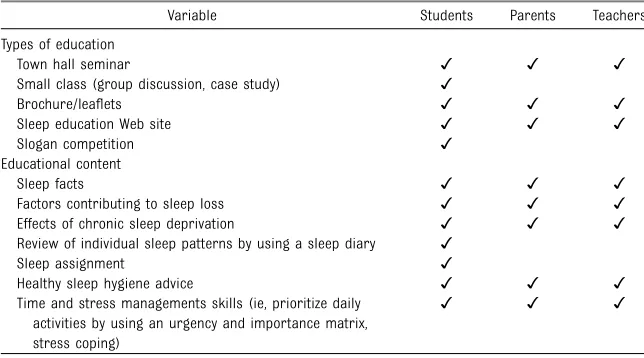
A set of structured educational materials (Table 1) was developed that covered the following: (1) the
importance of sleep; (2) the consequences of sleep deprivation; (3) factors contributing to insufficient sleep; and (4) good sleep practice. The town hall seminar involved didactic teaching and aimed to provide adolescents in the intervention group with a brief introduction of our program together with a general understanding of sleep medicine; it also provided them with tips for better sleep hygiene practices. The small class workshop was characterized by interactive small group discussions (4–5 students per group) and case studies. Students were asked to chart a 7-day sleep diary after the first workshop to review their individual sleep patterns. The program also included time and stress management skills; the goal was to equip students with effective
schedule arrangement and stress-coping skills so that they could prioritize the importance of sleep. Supplementary materials, including leaflets, brochures, and access to our self-developed sleep educational Web site (www.pae.cuhk.edu.hk/sleep/ index.html), were also offered to all students, teachers, and parents (Supplemental Appendices 1 and 2) to enhance participants’accessibility to the sleep knowledge and
information. A slogan design
competition was also held during the intervention period. Participants were asked to create a slogan, with the goal of raising awareness regarding the importance of sleep and healthy sleep practices. A total of 2168 slogans from 3028 invited participants (71.6%) were collected. Parents and teachers were
separately invited to attend a 1-hour sleep education seminar. All schools in the intervention group received the same package of sleep education except that 1 school omitted the town hall seminar and 1 school omitted the seminar for parents (attributed to their tight school schedule). The sleep education program was implemented from February to early May 2012. Baseline data were collected during late December 2011 to early February 2012, and the follow-up assessment was conducted 1 month after the end of the intervention.
Measurements
The package of questionnaires included several different tools. The General Sleep Questionnaire (HKCSQ) is a comprehensive and validated questionnaire used to measure various sleep issues such as insomnia symptoms and sleep–wake patterns during school days and weekends, with an adaptation to measure the sleep variables over the last
month.31,32The insomnia symptoms were measured according to frequency and were defined as abnormal if they occurred$3 times per week. Sleep duration was FIGURE 1
calculated as the difference between wakeup time and bedtime for weekday and weekend, respectively. It has been shown that sleep duration as subjectively measured by using a questionnaire and objectively measured by using actigraphy was significantly correlated with an intraclass correlation coefficient of 0.72.11The HKCSQ was used to collect information on socioeconomic demography, caffeine beverage and energy drink intake consumption, and smoking and alcohol habits. It is defined as abnormal if adolescents consumed caffeinated drinks$3 times per week in the past one month. A single item with“Do you think you have enough sleep?”was added to measure students’ perception whether they had
“adequate sleep.”The HKCSQ has satisfactory psychometric property for measuring sleep problems (Cronbach’sa= 0.868).32
The Pediatric Daytime Sleepiness Scale was used to assess adolescents’ daytime sleepiness.33The 12-item General Health Questionnaire (GHQ-12) was used to assess the current mental health status of the adolescents.34
The Chinese version of the Sleep Knowledge Questionnaire is a 15-item, self-administered questionnaire measuring sleep knowledge; total scores range from–30 to 30.35The
Strengths and Difficulties Questionnaire is a local validated questionnaire assessing 5 aspects of adolescent life, including emotional problems, conduct problems, peer relationships, hyperactivity/
inattention, and prosocial behaviors.36
Statistical Analysis
To adjust for clustering effect, the present analysis was conducted mainly by using generalized
estimating equations, with school as a subject variable and individual identification as a within-subject variable. Descriptive data are presented as mean6SE differences between follow-up and baseline for continuous variables and as percentages for discrete variables. Quantitative measures were analyzed by using linear regression, and dichotomous outcomes were
analyzed by using logistic regression. For discrete data, subjects were first divided into 2 groups based on their baseline responses. Those without baseline symptoms were used to explore incidence rates; subjects with baseline symptoms were used to explore for persistence rate
(persistence versus remission). Effect size was estimated by using
Cohen’sdand was interpreted as small (d#0.3), medium (d = 0.5), and large (d= 0.8).37In addition, an intention-to-treat (ITT) analysis was
performed to take into account the number of dropouts.
The primary outcome of the study was sleep duration; secondary outcomes included sleep knowledge, daytime sleepiness, sleep quality (eg, sleep latency, insomnia symptoms), sleep hygiene practice (including nap habits), lifestyle practice in terms of caffeine consumption, mental health, and behavioral difficulties. Age and gender were used as covariates in the analyses. APvalue of ,.05 was considered statistically significant. SPSS Statistics 20.0 for Windows (SPSS Statistics, IBM Corporation, Armonk, NY) was used for all tests.
RESULTS
Sample Characteristics
Of a total of 8236 eligible students, 5219 (63.4% [2032 in the
intervention group, 3187 in the control group]) returned the parental consent, student assent, and
questionnaires. After the
implementation of the program, 4456 participants (response rate: 85.4% [1773 intervention subjects, 2683 control subjects]; 43.5% boys; mean age: 14.7261.57 years) returned the follow-up questionnaires. The interval between baseline and follow-up assessment in the intervention group was similar to the control group (mean6SD: 4.360.72 vs 3.86 0.71 months;P..05). The follow-up assessment of the intervention group was conducted at a mean6SD of 562.6 weeks after the end of the intervention. Participants with incomplete baseline data (n= 385 [131 (6.4%) in the intervention group, 254 (8.0%) in the control group]) and follow-up data (n= 326 [73 (4.1%) in the intervention group, 253 (9.4%) in the control group]) regarding the main measurements were excluded from analysis. Participants aged$18 years (n= 32 [24 intervention subjects, 8 control subjects) were also excluded. A total TABLE 1 Educational Materials for the Intervention Group
Variable Students Parents Teachers
Types of education
Town hall seminar ✓ ✓ ✓
Small class (group discussion, case study) ✓
Brochure/leaflets ✓ ✓ ✓
Sleep education Web site ✓ ✓ ✓
Slogan competition ✓
Educational content
Sleep facts ✓ ✓ ✓
Factors contributing to sleep loss ✓ ✓ ✓
Effects of chronic sleep deprivation ✓ ✓ ✓
Review of individual sleep patterns by using a sleep diary ✓
Sleep assignment ✓
Healthy sleep hygiene advice ✓ ✓ ✓
Time and stress managements skills (ie, prioritize daily activities by using an urgency and importance matrix, stress coping)
of 3713 participants (1545 intervention subjects, 2168 control subjects; 40.2% boys; mean6SD age: 14.7261.53 years) were thus included in thefinal analysis.
Students who dropped out were similar to the study sample with regard to gender, age, and
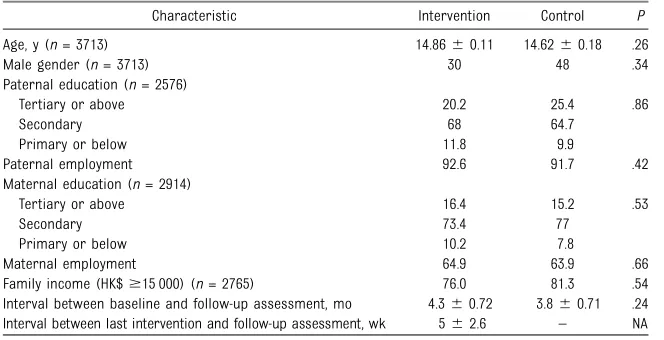
sociodemographic status. They had comparable weekday and weekend sleep duration, but they adopted a later weekend bedtime (mean6SE: 24:1860:35 vs 24:0960:33;P= .04) and wakeup time (10:2160:46 vs 10:0760:44;P= .03) than those who completed the study. There were no differences in age, gender, or sociodemographic data between the intervention and control groups (Table 2). The 2 groups had similar baseline sleep–wake patterns except that the intervention group woke up earlier during weekdays than the control group (mean6SE: 6:4060:12 vs 6:5060: 12;
P= .04).
Weekday and weekend sleep duration of the whole sample was 7 hours 27 minutes and 9 hours 59 minutes, respectively. Nearly two-thirds (64.5%) of students reported having ,8 hours of sleep during weekdays. A large proportion of students (66%) had a weekday/weekend sleep time difference.2 hours. More than one-half (58.4%) of the subjects reported having inadequate sleep, as noted by
their subjective perception of sleep sufficiency.
Effects of the Intervention on Sleep, Health, and Behavioral Aspects
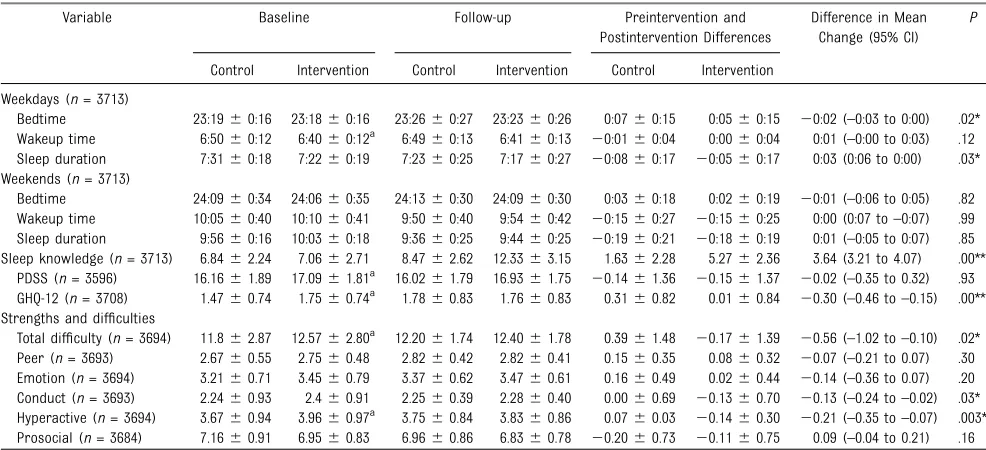
The means, mean differences, and SEs in sleep, sleep knowledge, daytime sleepiness, and mental and behavioral functioning for the control and intervention groups are summarized in Table 3. The intervention group demonstrated a marked enhancement in their sleep knowledge compared with subjects in the control group (mean change, intervention versus control: 5.2762.36 vs 1.6362.28; Cohen’sd= 0.51,P,.001). Both groups of students had a later bedtime at follow-up, but the intervention group had less delay than the control group (0:0560:15 vs 0:0760:15; Cohen’sd= 0.06,
P= .02). The overall sleep duration of both groups was shortened, but the decrement was less in the
intervention group (mean change:
–0:0560:17 vs–0:0860:17; Cohen’sd= 0.06,P= .03). We also used an ITT analysis by treating baseline data before dropout as the observation of follow-up assessment. The significant difference in sleep knowledge was retained in the ITT analysis, but the difference in weekday bedtime (intervention versus control: 0:0560:11 vs 0:0660:11; mean difference:–0:00 [95% confidence interval (CI):–0:02 to
0:00]) and sleep duration
(intervention versus control:–0:046 0:12 vs–0:0660:12; mean
difference: 0:01 [95% CI:–0:00 to 0: 04]) was lost. In addition, there was no significant effect on weekend practices. The regularity of the sleep pattern, sleep latency, insomnia symptoms, nap habits, and daytime sleepiness between the 2 groups yielded no significant differences.
Students in the intervention group had improved scores on several behavioral domains, including conduct (mean change: intervention versus control,–0.1360.70 vs 0.006 0.69; Cohen’sd= 0.09,P= .03), hyperactivity (–0.1460.30 vs 0.076 0.03; Cohen’sd= 0.11,P= .003) and total difficulty (–0.1761.39 vs 0.396 1.48; Cohen’sd= 0.13,P= .02). In addition, mental health status (as shown by using the GHQ-12) was also better in the intervention group (mean change: 0.0160.84 vs 0.3160.82; Cohen’sd= 0.11,P,.001).
We also measured students’lifestyle practices in terms of the
consumption of caffeinated drinks (Table 4). The incidence rate of energy drink consumption for the intervention and control groups was 0.9% and 2.1% (adjusted odds ratio: 0.46 [95% CI: 0.22 to 0.99]), respectively. Similar incidence rates, however, were found in the intake of other caffeinated products (allP..05). The improvement in behavioral, mental health, and reduced incidence rate of energy drink consumption remained significant after ITT analysis (allP,.05).
The majority of students (70% and 60%) reported that the program was effective in increasing their sleep knowledge and raised their awareness toward sleep deprivation, respectively. However, only 32% of the students believed that the program would change their sleep habits.
Subgroup Analysis
To explore the relationship between sleep knowledge acquisition and TABLE 2 Sociodemographic Characteristics of Subjects in the Intervention and Control Groups
Characteristic Intervention Control P
Age, y (n= 3713) 14.8660.11 14.6260.18 .26
Male gender (n= 3713) 30 48 .34
Paternal education (n= 2576)
Tertiary or above 20.2 25.4 .86
Secondary 68 64.7
Primary or below 11.8 9.9
Paternal employment 92.6 91.7 .42
Maternal education (n= 2914)
Tertiary or above 16.4 15.2 .53
Secondary 73.4 77
Primary or below 10.2 7.8
Maternal employment 64.9 63.9 .66
Family income (HK$$15 000) (n= 2765) 76.0 81.3 .54
Interval between baseline and follow-up assessment, mo 4.360.72 3.860.71 .24 Interval between last intervention and follow-up assessment, wk 562.6 – NA
behavioral change, subjects were further divided into 2 groups on the basis of the sleep knowledge difference by using the upper quartile as a cutoff within the intervention group (Supplemental Tables 5 and 6). The comparison between these subgroups indicated that improvement in sleep
knowledge was associated with a significant lowering of the persistence rate of insomnia
(difficulty initiating sleep)
(intervention versus control: 19% vs 35.2%; adjusted odds ratio: 0.39 [95% CI: 0.18 to 0.85]) but not other sleep practices (P..05).
DISCUSSION
To our knowledge, this study is the first large-scale, cluster randomized controlled trial to evaluate the efficacy of a sleep education program in promoting good sleep
practices among adolescents. Our study further confirmed the high prevalence of sleep deprivation and irregular sleep patterns among adolescents in Hong Kong, especially compared with white
adolescents.2,3,11
In agreement with previous studies,23–27,29,30there was a prominent enhancement of sleep knowledge among adolescents in the intervention group, with a medium TABLE 3 Adolescent Sleep–Wake Pattern, Daytime Sleepiness, and Psychological and Behavioral Profiles at Baseline and During Follow-up
Variable Baseline Follow-up Preintervention and
Postintervention Differences
Difference in Mean Change (95% CI)
P
Control Intervention Control Intervention Control Intervention
Weekdays (n= 3713)
Bedtime 23:1960:16 23:1860:16 23:2660:27 23:2360:26 0:0760:15 0:0560:15 20:02 (–0:03 to 0:00) .02* Wakeup time 6:5060:12 6:4060:12a 6:4960:13 6:4160:13 20:0160:04 0:0060:04 0:01 (–0:00 to 0:03) .12 Sleep duration 7:3160:18 7:2260:19 7:2360:25 7:1760:27 20:0860:17 20:0560:17 0:03 (0:06 to 0:00) .03* Weekends (n= 3713)
Bedtime 24:0960:34 24:0660:35 24:1360:30 24:0960:30 0:0360:18 0:0260:19 20:01 (–0:06 to 0:05) .82 Wakeup time 10:0560:40 10:1060:41 9:5060:40 9:5460:42 20:1560:27 20:1560:25 0:00 (0:07 to–0:07) .99 Sleep duration 9:5660:16 10:0360:18 9:3660:25 9:4460:25 20:1960:21 20:1860:19 0:01 (–0:05 to 0:07) .85 Sleep knowledge (n= 3713) 6.8462.24 7.0662.71 8.4762.62 12.3363.15 1.6362.28 5.2762.36 3.64 (3.21 to 4.07) .00**
PDSS (n= 3596) 16.1661.89 17.0961.81a 16.0261.79 16.9361.75 20.1461.36 20.1561.37 20.02 (–0.35 to 0.32) .93 GHQ-12 (n= 3708) 1.4760.74 1.7560.74a 1.7860.83 1.7660.83 0.3160.82 0.0160.84 20.30 (–0.46 to–0.15) .00** Strengths and difficulties
Total difficulty (n= 3694) 11.862.87 12.5762.80a 12.2061.74 12.4061.78 0.3961.48 20.1761.39 20.56 (–1.02 to–0.10) .02* Peer (n= 3693) 2.6760.55 2.7560.48 2.8260.42 2.8260.41 0.1560.35 0.0860.32 20.07 (–0.21 to 0.07) .30 Emotion (n= 3694) 3.2160.71 3.4560.79 3.3760.62 3.4760.61 0.1660.49 0.0260.44 20.14 (–0.36 to 0.07) .20 Conduct (n= 3693) 2.2460.93 2.460.91 2.2560.39 2.2860.40 0.0060.69 20.1360.70 20.13 (–0.24 to–0.02) .03* Hyperactive (n= 3694) 3.6760.94 3.9660.97a 3.7560.84 3.8360.86 0.0760.03 20.1460.30 20.21 (–0.35 to–0.07) .003* Prosocial (n= 3684) 7.1660.91 6.9560.83 6.9660.86 6.8360.78 20.2060.73 20.1160.75 0.09 (–0.04 to 0.21) .16 Discrepancies in total values are due to missing responses. Significant differences in weekday bedtime and sleep duration were lost in the ITT analysis, whereas significant improvements in sleep knowledge and GHQ-12 and Strengths and Difficulties Questionnaire subscale scores remained. Weekday and weekend sleep data are presented as mean6SE (hh:mm). PDSS, Pediatric Daytime Sleepiness Scale.
aSignificant difference between groups at baseline.
TABLE 4 Incidence and Persistence Rate for Insomnia Symptoms and Caffeine Consumption Practices
Variable Incidence Persistence
N(%) Control (%) Intervention (%) OR (95% CI) N(%) Control (%) Intervention (%) OR (95% CI) Insomnia symptoms
DIS($3times/wk) 72 (2.1) 1.8 2.5 1.53 (0.90 to 2.60) 80 (34.3) 35.5 33.0 0.89 (0.63 to 1.26) DMS($3times/wk) 66 (1.8) 1.8 1.9 0.99 (0.52 to 1.90) 24 (24.5) 22.6 26.7 1.17 (0.60 to 2.25) EMA($3times/wk) 68 (1.9) 1.9 1.9 1.05 (0.77 to 1.44) 19 (26.8) 28.6 24.1 0.64 (0.36 to 2.46) Any insomnia
symptoms($3times/wk)
118 (3.6) 3.3 4.1 1.29 (0.84 to 1.99) 109 (35.3) 36.2 34.2 0.90 (0.63 to 1.29)
Caffeine consumption
Tea($3times/wk) 142 (4.3) 4.3 4.4 0.99 (0.59 to 1.67) 151 (39.2) 39.1 39.4 0.99 (0.70 to 1.41) Coffee($3times/wk) 77 (2.2) 2.2 2.1 1.45 (0.97 to 2.91) 38 (30.6) 35.1 24.0 0.95 (0.24 to 1.65) Energy drink($3times/wk) 56 (1.6) 2.1 0.9 0.46 (0.22 to 0.99)* 9 (17.6) 22.6 10.0 1.24 (0.14 to 11.13)
Alcohol($3times/wk) 4 (0.1) 0.1 0.1 0.37 (0.02 to 6.23) 1 (9.1) 0 16.7a —
Beverage($3times/wk) 214 (6.5) 7.3 5.5 0.75 (0.50 to 1.14) 174 (43.7) 46.5 38.9 0.87 (0.61 to 1.24) Cigarette($3times/wk) 7 (0.2) 0.3 0.1 0.22 (0.02 to 2.49) 3 (25) 28.6 20.0 1.38 (0.06 to 33.18)
Three or more times per week was defined as abnormal. DIS = difficulty initiating sleep; DMS = difficulty maintaining sleep; EMA = early morning awakening; OR, odds ratio.
effect size. The marked increase in sleep knowledge, however, did not translate into a change in sleep behavior. In fact, weekday sleep duration was reduced in both groups. The decline in sleep duration across the academic term was mainly due to later bedtime, indicating that
students’sleep quantity was worse as the academic quarter progressed38 and/or possibly associated with advancing age.3Although students in the intervention group had a lesser degree of reduction in sleep duration compared with the control group during the initial analysis, this apparent effect was lost when the ITT analysis was used. The lack of concomitant improvement in daytime sleepiness and the fact that the average sleep duration was far below the recommended sleep time suggest that the current educational program was not able to improve adolescents’sleep duration and pattern.
Nonetheless, the incidence rate of regular energy drink consumption was significantly lower in the intervention group, which supports the notion that acquiring adequate sleep knowledge might potentially improve some specific sleep hygiene practices among students.24 Furthermore, in the subgroup analysis, the persistent rate of insomnia symptoms among those students who achieved better sleep knowledge was lower. Because chronic insomnia is a common problem among children and adolescents (with a moderate persistent rate),39 ourfinding suggests that sleep knowledge provisions may be beneficial to certain subgroups of students who have mastered sleep knowledge.
There was a significant enhancement in students’behavioral and mental health, as reflected by their improvement in scores on the Strengths and Difficulties Questionnaire and the GHQ-12,
respectively. Because there was no significant improvement in sleep duration or pattern, the exact reasons for the observed
improvements in these 2 profiles are unclear. The possibility remains of some generalized nonspecific or placebo effects (ie, receiving attention or encouragement from sleep educators) in the intervention group.22,40However, the
improvements could also be related to other educational components of our program, such as time and stress management skills. Moreover, the current program also involved significant others (parents and teachers) in addition to written and electronic information. Although we did not assess the degree of parental and teacher engagement in the current study, numerous data suggest that these key stakeholders have profound effects on shaping adolescents’development and well-being.41–43
Implications
The findings of the present study add to the increasing literature that enhanced knowledge by itself is insufficient in changing adolescents’ sleep behaviors. Compared with other health practices, advising adolescents to sleep more was more challenging due to its perceived low priority.17Even when they realized the importance of sleep, the subjects’propensity to change was low given the highly packed daily life schedule among this age group.16,18Thus, simply educating students to sleep better may not be adequate to change their sleep behavior, although we already had a multilevel and multimodal education program. Future studies may need to emphasize ways of motivating students to change and incorporate a self-efficacy element, which aims to enhance one’s perceived control to change and confidence in making changes by providing continuous feedback and modification of the positive sleep
habits throughout the
intervention.22,30,44In addition, instead of targeting the entire school population, it may be more cost-effective to specifically target high-risk adolescents (eg, those who suffer from severe sleep
deprivation). Finally, schools and education authorities should consider incorporating a sleep education component into their regular school curriculum to equip teachers and students with essential sleep knowledge.
Strengths and Limitations
The main strength of the present study was our use of the clustered randomized control design, with a good retention rate and a large sample size, to ensure
a comprehensive evaluation with adequate statistical power. The study had limitations, however. First, all data were gathered by using self-administered instruments without objective sleep
measurements. Nonetheless, self-reported measures have been shown to offer sufficient validity in
studying sleep habits in adolescents in large-scale
population studies.31,39,45In fact, our previous study found
CONCLUSIONS
The present study demonstrated that this multilevel and multimodal school-based sleep education program was effective in improving sleep knowledge among students, with positive effects on their mental health, lifestyle practice, and behavioral
aspects, but with no significant improvement in sleep duration. Further studies (with a longer follow-up period) are needed to identify the gap between sleep knowledge and behavioral change by introducing strategies to promote motivation and self-efficacy among adolescents.
ACKNOWLEDGMENTS
The authors thank all the principals and teachers of the participating secondary schools for approving and accommodating the implementation of the program. They also thank all the parents, teachers, and students who participated in the study.
FINANCIAL DISCLOSURE:Dr Wing has received sponsorship from Lundbeck Export A/S, Servier Hong Kong Ltd, and Celki Medical Company and was a part-time paid consultant for Renascence Therapeutics Limited. Dr Kong has received honorarium for consultancy or giving lectures from AstraZeneca, Pfizer, Sanofi, Novo Nordisk, Eli Lilly, Merck Serono, and Nestlé. The other authors have indicated they have nofinancial relationships relevant to this article to disclose.
FUNDING:Supported by the Public Policy Research of University Grants Committee (Reference number: CUHK4012-PPR-11), Hong Kong SAR, China. The funding body had no role in the conception, design, conduct, interpretation, or analysis of the study or in the approval of the publication.
POTENTIAL CONFLICT OF INTEREST:The authors have indicated they have no potential conflicts of interest to disclose.
REFERENCES
1. Matricciani L, Olds T, Petkov J. In search of lost sleep: secular trends in the sleep time of school-aged children and adolescents.Sleep Med Rev. 2012;16(3): 203–211
2. Matricciani L, Blunden S, Rigney G, Williams MT, Olds TS. Children’s sleep needs: is there sufficient evidence to recommend optimal sleep for children?
Sleep. 2013;36(4):527–534
3. Gradisar M, Gardner G, Dohnt H. Recent worldwide sleep patterns and problems during adolescence: a review and meta-analysis of age, region, and sleep.Sleep Med. 2011;12(2):110–118
4. Yang CK, Kim JK, Patel SR, Lee JH. Age-related changes in sleep/wake patterns among Korean teenagers.Pediatrics. 2005;115(suppl 1):250–256
5. Wing YK, Li SX, Li AM, Zhang J, Kong AP. The effect of weekend and holiday sleep compensation on childhood overweight and obesity.Pediatrics. 2009;124(5). Available at: www.pediatrics.org/cgi/ content/full/124/5/e994
6. Fallone G, Owens JA, Deane J. Sleepiness in children and adolescents: clinical implications.Sleep Med Rev. 2002;6(4): 287–306
7. Wolfson AR, Carskadon MA. Understanding adolescents’sleep patterns and school performance: a critical appraisal.Sleep Med Rev. 2003; 7(6):491–506
8. Curcio G, Ferrara M, De Gennaro L. Sleep loss, learning capacity and academic
performance.Sleep Med Rev. 2006;10(5): 323–337
9. Reid GJ, Hong RY, Wade TJ. The relation between common sleep problems and emotional and behavioral problems among 2- and 3-year-olds in the context of known risk factors for
psychopathology.J Sleep Res. 2009;18(1): 49–59
10. Hidalgo MP, Caumo W. Sleep disturbances associated with minor psychiatric disorders in medical students.Neurol Sci. 2002;23(1):35–39
11. Kong AP, Wing YK, Choi KC, et al. Associations of sleep duration with obesity and serum lipid profile in children and adolescents.Sleep Med. 2011;12(7):659–665
12. Patel SR, Hu FB. Short sleep duration and weight gain: a systematic review.Obesity (Silver Spring). 2008;16(3):643–653
13. Spiegel K, Leproult R, Van Cauter E. Impact of sleep debt on metabolic and endocrine function.Lancet. 1999; 354(9188):1435–1439
14. Au CT, Ho CK, Wing YK, Lam HS, Li AM. Acute and chronic effects of sleep duration on blood pressure.Pediatrics. 2014;133(1) . Available at: www. pediatrics.org/cgi/content/full/133/1/e64
15. Carskadon MA, Vieira C, Acebo C. Association between puberty and delayed phase preference.Sleep. 1993; 16(3):258–262
16. Zhang J, Li AM, Fok TF, Wing YK. Roles of parental sleep/wake patterns,
socioeconomic status, and daytime activities in the sleep/wake patterns of children.J Pediatr. 2010;156(4):606–612, e5
17. Gruber R, Cassoff J, Knäuper B. Sleep health education in pediatric community settings: rationale and practical suggestions for incorporating healthy sleep education into pediatric practice.
Pediatr Clin North Am. 2011;58(3): 735–754
18. Cassoff J, Knäuper B, Michaelsen S, Gruber R. School-based sleep promotion programs: effectiveness, feasibility and insights for future research.Sleep Med Rev. 2013;17(3):207–214
19. Noland H, Price JH, Dake J, Telljohann SK. Adolescents’sleep behaviors and perceptions of sleep.J Sch Health. 2009; 79(5):224–230
20. Amschler DH, McKenzie JF. Elementary students’sleep habits and teacher observations of sleep-related problems.
J Sch Health. 2005;75(2):50–56
21. Owens JA, Jones C, Nash R. Caregivers’ knowledge, behavior, and attitudes regarding healthy sleep in young children.J Clin Sleep Med. 2011;7(4): 345–350
22. Blunden SL, Chapman J, Rigney GA. Are sleep education programs successful? The case for improved and consistent research efforts.Sleep Med Rev. 2012; 16(4):355–370
in school and university.Mind Brain Educ.2008;2(1):34–46
24. Blunden SL. The implementation of a sleep education program in adolescents.Sleep Biol Rhythms. 2007; 5(s1):A31
25. De Sousa IC, Araujo JF, De Azevedo CVM. The effect of a sleep hygiene education program on the sleep-wake cycle of Brazilian adolescent students.Sleep Biol Rhythms. 2007;5(4):251–258
26. Rossi CM, Campbell AL, Vo OT, Charron T, Marco CA, Wolfson AR. Middle school sleep-smart program: a pilot evaluation.
Sleep. 2002;25(s):A279
27. Bakotic M, Radosevic-Vidacek B, Koscec A. Educating adolescents about healthy sleep: experimental study of
effectiveness of educational leaflet.
Croat Med J. 2009;50(2):174–181
28. Short MA, Gradisar M, Wright H, Lack LC, Dohnt H, Carskadon MA. Time for bed: parent-set bedtimes associated with improved sleep and daytime functioning in adolescents.Sleep. 2011;34(6):797–800
29. Moseley L, Gradisar M. Evaluation of a school-based intervention for adolescent sleep problems.Sleep. 2009; 32(3):334–341
30. Cain N, Gradisar M, Moseley L. A motivational school-based intervention for adolescent sleep problems.Sleep Med. 2011;12(3):246–251
31. Li AM, Cheung A, Chan D, et al. Validation of a questionnaire instrument for
prediction of obstructive sleep apnea in Hong Kong Chinese children.Pediatr Pulmonol. 2006;41(12):1153–1160
32. Zhang J, Li AM, Kong AP, Lai KY, Tang NL, Wing YK. A community-based study of insomnia in Hong Kong Chinese children: prevalence, risk factors and familial aggregation.Sleep Med. 2009;10(9):1040–1046
33. Yang CM, Huang YS, Song YC. Clinical utility of the Chinese version of the Pediatric Daytime Sleepiness Scale in children with obstructive sleep apnea syndrome and narcolepsy.Psychiatry Clin Neurosci. 2010;64(2):134–140
34. Chan DW, Chan TS. Reliability, validity and the structure of the General Health Questionnaire in a Chinese context.
Psychol Med. 1983;13(2):363–371
35. Gallasch J, Gradisar M. Relationship between sleep knowledge, sleep practice and sleep quality.Sleep Biol Rhythms. 2007;5(1):63–73
36. Lai KY, Luk ES, Leung PW, Wong AS, Law L, Ho K. Validation of the Chinese version of the strengths and difficulties
questionnaire in Hong Kong.Soc Psychiatry Psychiatr Epidemiol. 2010; 45(12):1179–1186
37. Cohen J.Statistical Power Analysis for the Behavioral Sciences. NewYork, NY: Routledge Academic; 1988
38. Hawkins J, Shaw P. Self-reported sleep quality in college students: a repeated measures approach.Sleep. 1992;15(6): 545–549
39. Zhang J, Lam SP, Li SX, Li AM, Lai KY, Wing YK. Longitudinal course and outcome of chronic insomnia in Hong Kong Chinese children: a 5-year follow-up study of a community-based cohort.Sleep. 2011;34(10): 1395–1402
40. Lipsey MW, Wilson DB. The efficacy of psychological, educational, and behavioral treatment. Confirmation from meta-analysis.Am Psychol. 1993;48(12): 1181–1209
41. Morawska A, Haslam D, Milne D, Sanders MR. Evaluation of a brief parenting discussion group for parents of young children.J Dev Behav Pediatr. 2011;32(2): 136–145
42. Lim M, Tormshak EA, Dishion TJ. A one-session intervention for parents of young adolescents.J Emot Behav Disord. 2005;13:194–199
43. Quach J, Hiscock H, Ukoumunne OC, Wake M. A brief sleep intervention improves outcomes in the school entry year: a randomized controlled trial.
Pediatrics. 2011;128(4):692–701
44. De Vries H, Mudde AN. Predicting stage transitions for smoking cessation applying the attitude social infl uence-efficacy model.Psychol Health. 1998;13: 369–385
DOI: 10.1542/peds.2014-2419 originally published online February 16, 2015;
2015;135;e635
Pediatrics
Shirley Xin Li, Alice Pik Shan Kong and Albert Martin Li
Yun Kwok Wing, Ngan Yin Chan, Mandy Wai Man Yu, Siu Ping Lam, Jihui Zhang,
Randomized Trial
A School-Based Sleep Education Program for Adolescents: A Cluster
Services
Updated Information &
http://pediatrics.aappublications.org/content/135/3/e635 including high resolution figures, can be found at:
References
http://pediatrics.aappublications.org/content/135/3/e635#BIBL This article cites 44 articles, 3 of which you can access for free at:
Subspecialty Collections
http://www.aappublications.org/cgi/collection/sleep_medicine_sub Sleep Medicine
http://www.aappublications.org/cgi/collection/school_health_sub School Health
_sub
http://www.aappublications.org/cgi/collection/community_pediatrics Community Pediatrics
following collection(s):
This article, along with others on similar topics, appears in the
Permissions & Licensing
http://www.aappublications.org/site/misc/Permissions.xhtml in its entirety can be found online at:
Information about reproducing this article in parts (figures, tables) or
Reprints
DOI: 10.1542/peds.2014-2419 originally published online February 16, 2015;
2015;135;e635
Pediatrics
Shirley Xin Li, Alice Pik Shan Kong and Albert Martin Li
Yun Kwok Wing, Ngan Yin Chan, Mandy Wai Man Yu, Siu Ping Lam, Jihui Zhang,
Randomized Trial
A School-Based Sleep Education Program for Adolescents: A Cluster
http://pediatrics.aappublications.org/content/135/3/e635
located on the World Wide Web at:
The online version of this article, along with updated information and services, is
http://pediatrics.aappublications.org/content/suppl/2015/02/10/peds.2014-2419.DCSupplemental Data Supplement at:
by the American Academy of Pediatrics. All rights reserved. Print ISSN: 1073-0397.