More Evidence for Reach Out and Read: A Home-Based Study
Carol Cohen Weitzman, MD; Lisa Roy, MD; Theodore Walls, PhD; and Ricarda Tomlin, BS
ABSTRACT. Objective. Reach Out and Read (ROR), a clinic-based literacy program, has been shown to im-prove literacy outcomes in impoverished children. No study has used direct observation to assess a child’s home literacy environment or to control for important confounders, such as the quality of the home environ-ment. The objective of this study was to determine the relationship between the frequency of ROR encounters that a family receives during well-child visits and a child’s home literacy profile, while accounting for impor-tant confounders, such as the quality of the home envi-ronment.
Methods. A cross-sectional study was conducted of 137 children (aged 18-30 months) who received pediatric well-child care at the Yale-New Haven Hospital Primary Care Center. The number of ROR encounters that the family received was determined though parent inter-view, direct observation, and a review of the medical record. After a brief waiting room interview, a home visit was conducted. An assessment of the child’s home liter-acy environment was completed on the basis of 10 vari-ables that were obtained from parent report and direct observation within the home. These variables were summed to form a Child Home Literacy Index. The Home Observation for Measurement of the Environment, a standardized measure of the nurturing quality of the home environment, was also administered. Hierarchical linear regression was conducted to determine the signif-icance of ROR on a child’s home literacy environment.
Results. A total of 100 families completed both a waiting room interview and a home visit. Families re-ceived between 0 and 6 books in the ROR program. A total of 93% of families reported reading to their chil-dren, but only 35% of parents identified reading as a favorite activity of their child and 45% of parents re-ported that this was a favorite joint activity. Hierarchical linear regression demonstrated that increasing frequency of ROR encounters contributed a small but significant portion of the variance explaining a child’s home literacy profile (5%), with this model accounting for a total of 19% of the variance.
Conclusions. A modest literacy intervention, such as ROR, can have a significant impact on a child’s home literacy environment. Pediatrics 2004;113:1248 –1253; pe-diatric literacy, Reach Out and Read, primary care, read-ing.
ABBREVIATIONS. ROR, Reach Out and Read; PCC, Primary Care Center; HOME, Home Observation for Measurement of the
Envi-ronment; SORT-R, Slosson Oral Reading Test Revised; CHLI, Child Home Literacy Index.
T
he literacy level of American children and adults is currently an enormous societal prob-lem. Approximately 90 million Americans lack the ability to read adequately, and two thirds of children in the United States read below their grade level.1This failure to develop sufficient reading skills disproportionately affects children from socially and economically disadvantaged families.2Studies have shown that the failure to read at grade level leads to frustration and low self-esteem and may contribute to school drop out, teenage pregnancy, substance abuse, and propagation of the cycle of economic hardship.3–6Considering such drastic consequences, it is im-perative to promote the development of early liter-acy among impoverished children. In 1985, a Na-tional Commission on Reading reported that the single most important activity for literacy develop-ment and eventual reading success is reading aloud to children starting at an early age.7Research on the acquisition of literacy has shown that the frequency of storybook reading starting as early as infancy is a significant contributor to the development of emer-gent literacy skills in early childhood and to success in learning to read at school.8,9Specifically, reading aloud to very young children has been shown to increase expressive and receptive language skills in toddlers10,11and contribute to higher reading scores and verbal performance in elementary school.12–14
Pediatricians, in particular, are in a unique posi-tion to help prevent illiteracy because they have fre-quent, regular visits with infants and preschoolers and because many parents place a certain impor-tance on advice given to them by their physician. Pediatric clinic-based literacy promotion programs, such as Reach Out and Read (ROR), have been de-signed to target at-risk preschoolers and provide families with the materials, education, and support needed to make reading a part of young children’s lives. ROR was initially implemented in Boston in 1989 and has since spread to hundreds of pediatric clinics across the United States. It consists of antici-patory guidance about the importance of reading to young children, the distribution of a developmen-tally and culturally appropriate book to the families at each well-child visit between 6 months and 5 years of age, and volunteers who read to children in clinic waiting rooms and model reading behaviors.7
Several studies have demonstrated that a modest literacy-promoting intervention such as ROR can
sig-From the Department of Pediatrics, Yale University School of Medicine, New Haven, Connecticut.
Received for publication Dec 20, 2002; accepted Jul 23, 2003.
Reprint requests to (C.C.W.) Department of Pediatrics, Yale University School of Medicine, 333 Cedar St, New Haven, CT 06520-8064. E-mail: [email protected]
nificantly enhance a young child’s early literacy en-vironment by increasing the frequency of parent– child book-sharing activities,15–17 changing parental attitudes toward reading with their children,16,17and even facilitating language development in impover-ished preschool children.18,19
A weakness of previous studies is that information about a child and a parent’s literacy behaviors was obtained exclusively through parental report at in-terviews conducted in the clinic waiting room or via the telephone. No study to date has used direct ob-servation to ascertain a child’s home literacy envi-ronment or the quality of the home envienvi-ronment—an important potential confounder when assessing the impact of the ROR intervention on literacy outcomes in impoverished preschool children.
In this study, we used a combination of a report from a parent provided during a home visit and direct observation of a family’s home literacy envi-ronment to develop a broad assessment of the child’s home literacy profile. In addition, we assessed the quality of the home environment in an effort to con-trol more fully for potential confounders. We hy-pothesized that a significant relationship exists be-tween the frequency of ROR encounters and a child’s home literacy profile, even after accounting for im-portant potential confounders such as the quality of the home environment.
METHODS
Between July 1999 and December 2000, families who presented for routine pediatric care to the Pediatric Primary Care Center (PCC) at Yale-New Haven Children’s Hospital, an inner-city health clinic, were approached to participate in this study. Fami-lies were eligible when 1) the adult who accompanied the child to the clinic was the primary caregiver and could speak English well enough to participate in the initial interview and consent to a subsequent home visit and 2) the child was between 18 and 30 months of age at the time of the enrollment interview. We decided to study children of this age for 2 reasons. First, parents often start reading to their children at this time as their children’s verbal and attentional skills expand, so there is greater opportunity to sample a variety of parents’ reading behaviors that might not have been evident in early infancy. Second, we wanted to sample children when they had had the potential to receive at least 3 encounters with the ROR program, an intensive enough dose to study its impact.
Families were excluded from the study when 1) the child was born at ⬍34 weeks of gestational; 2) the child had a known handicapping condition that affected development and may have affected a child’s or a parent’s reading behaviors; 3) the child had been hospitalized⬎14 days since birth; or 4) family members had a documented history in the medical record of substance abuse, criminal behavior, or significant mental illness, which therefore may exclude the most at-risk children and families. These families were excluded because performing a home visit may pose a risk to research assistants.
Procedures
Eligible families were approached in the waiting room and asked to participate in a study that would examine the interests, activities, and day-to-day lives of toddlers. Our interest in literacy was not disclosed to prevent bias in caregivers’ responses to questions about literacy or behaviors in the home. Caregivers consented to a short interview in the waiting room and also to a more extensive interview in their home that took ⬃1 hour to complete and was arranged at their convenience. Institutional Review Board approval was obtained from the Yale University School of Medicine. Caregivers provided oral consent before par-ticipating in the study.
When the family met eligibility criteria, the initial interview, which was conducted in the clinic waiting room and took⬃10 minutes to complete, consisted of obtaining demographic infor-mation, a report of the favorite activities/toys of the child, and information to determine the number of ROR encounters that the family had received. To minimize bias, a separate research assis-tant recruited the majority of the families from the PCC, thereby allowing the research assistant who conducted the subsequent home visits to be blinded to the number of ROR encounters that each family reported receiving.
A more extensive interview was then conducted in the home and included the administration of 2 scales: the Home Observa-tion for Measurement of the Environment (HOME)20 and the Slosson Oral Reading Test Revised (SORT-R).21In addition, infor-mation was obtained about a family’s literacy behaviors, and direct observation of the child’s home environment and interac-tions among family members in their usual surroundings were observed. The research assistant also counted the number of chil-dren’s books (ROR and non-ROR) and adult reading materials present in the home, determined whether a child had access to books and was allowed to manipulate them during the home visit, and observed whether the child or the caregiver initiated book sharing at any time during the home visit. The purpose of this project was not revealed to families until the completion of the visit as questions were asked about a range of topics, of which literacy was just one. At the completion of the visit, more direct questions were asked to confirm the number of ROR encounters that a family had received and their experiences with the program. Families were then asked to show to the research assistant all ROR books that they had received. At the conclusion of the home visit, a $10 gift certificate to Toys-R-Us was given to the families as an acknowledgment of their donation of time.
Six caregivers declined to participate in the study. All who declined participation cited time constraints as the reason for not participating, specifically that they were afraid that the initial interview would cause a delay in seeing their child’s provider or that they did not have enough time to set aside for a home visit. Of the 137 families who initially consented to participate in the study and completed the waiting room interview in the PCC, home visits were completed on 100 (73%). Of the 37 families who did not complete the home visit, 13 changed their mind and refused the home visit, 11 said that they no longer had time, 7 gave telephone numbers that were no longer in service, 4 were not home on multiple scheduled visits, and 2 moved from the area.
Measures
HOME
Over the course of the home visit, the HOME,20 a 45-item standardized measure of the nurturing quality of the home envi-ronment, was administered and then scored immediately after the home visit was completed. The HOME is administered by inter-viewing families about many topics related to parenting and by direct observation of items in the home and parent– child behav-iors. The HOME scale measures 6 dimensions of the home envi-ronment: 1) the primary caregiver’s emotional and verbal respon-sivity to the child, 2) avoidance of restriction and punishment, 3) the organization of the environment, 4) the provision of appropri-ate play mappropri-aterial for the child, 5) the primary caregiver’s involve-ment with the child, and 6) the opportunities for variety in daily stimulation. Scores on these 6 subscales were summed to form a total HOME score for each family. Psychometric properties of this instrument have been well validated in similar study samples.22
Four of the 45 items that compose the HOME scale are directly concerned with literacy and are very similar to items that are measured in our primary outcome variable. To minimize this colinearity, we removed these 4 items from the HOME scale and created a Modified HOME, to be used in multivariate analyses.
SORT-R
ascending order of difficulty. In a national normative sample, the mean score for young adults was⬃183, with higher scores reflect-ing better word recognition and greater readreflect-ing proficiency. The normative sample reflects US trends with 40% of the sample having a high school education and 34% of the sample having greater than a high school education. Gender, race, and geo-graphic location approximate a US population strata. Normative samples are not provided specifically for impoverished families. Correlations with the Peabody Individual Achievement Test and the Woodcock-Johnson Tests of Achievement, detailed measures of reading ability, are⬎0.90.23
Compliance With Well-Child Care
Because compliance with well-child care was likely to be strongly associated with the number of ROR encounters, after the completion of the home visit, the child’s medical record was reviewed. Information was collected about 1) whether immuniza-tions were up to date and 2) whether an appropriate number of well-child visits were completed. For this study, we defined ap-propriate as whether families had completed the recommended number of well-child visits according to the American Academy of Pediatrics guidelines to within 2 visits. When children had both up-to-date immunizations and an appropriate number of well-child visits, they were classified as compliant. When either immu-nizations were incomplete or there were an inappropriate number of well-child visits or both, families were classified as noncompli-ant.
Independent Variable: Number of ROR Encounters
To characterize our main independent variable, the number of ROR encounters received, we used 4 separate sources of data to determine this number more accurately. These included 1) parent report during the waiting room interview, 2) parent report at the completion of the home visit, 3) direct observation of the number of ROR books in the home at the completion of the home visit, and 4) review of the medical record. When at least 2 of these 4 sources were in agreement, that number was used to represent the number of ROR encounters. When all of the sources of information were discrepant, the median value was assigned as the number of ROR encounters.
Outcome Variable: Child Home Literacy Index
To assess the major outcome, we combined 10 variables that were obtained from the caregiver’s report during the home visit and direct observation within the home to create a variable that broadly describes the child’s home literacy environment. Informa-tion for each of these variables was embedded in the interview that was conducted to score the HOME. Therefore, questions about literacy were asked in addition to other questions about parenting and the daily activities of children in the home. Obser-vations about literacy behaviors were also made during observa-tions of the parent– child relaobserva-tionship necessary for scoring the HOME.
The variables obtained by caregiver report were many of those included in previous studies16,18: 1) bedtime routine includes readingⱖ5 nights per week, 2) caregiver reports regularly reading to child, 3) reading is reported as one of child’s favorite things to do, 4) reading is reported as one of caregiver’s favorite things to do with child, 5) child regularly initiates reading as a shared activity (defined as the child bringing a book to the caregiver ⬎50% of the time that reading between a parent and child occurs), and 6) caregiver spends own resources to purchase children’s books. The variables obtained by direct observation within the home were 7) books are accessible to the child and the child can read them and look at them if he or she chooses, 8) child owns⬎10 books (excluding ROR books), 9) child approaches parent with a book during the home visit, and 10) parent provides books for child during the home visit.
Participants were given a score of 1 for each variable in which a “yes” was reported or observed. The total score was based on a summation of these 10 variables and has a range from 0 to 10. This total score formed the primary outcome variable, the Child Home Literacy Index (CHLI). A higher total score indicates a greater presence of literacy-promoting behaviors within a child’s home environment.
Data Analysis
Initial analyses consisted of calculating individual Pearson cor-relations with the number of ROR encounters and potential con-founders with our main outcome variable, the CHLI. A hierarchi-cal linear regression was conducted as part of the multivariate analysis to determine the change in the value of R2 that was contributed by the number of ROR encounters after controlling for important confounders. Potential confounders entered into the model included the age of the child, the educational level of the mother, the modified HOME score, the SORT-R score, and the rating of compliance with well-child care ratings on the basis of a priori considerations, whether they were significant or not on bivariate analyses. Data were analyzed using SPSS Software, Ver-sion 10 (SPSS Inc, Chicago, IL).
RESULTS Demographic Characteristics
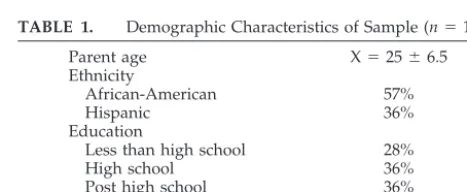
The demographic characteristics of the 100 families who completed home visits are presented in Table 1. This sample was composed primarily of minority families; 36% of caregivers had completed high school and had no additional education, and 36% of caregivers had some post– high school education. Families were primarily of low income, with 90% receiving Medicaid.
We compared the demographic characteristics of these 100 families with the 37 families who did not complete the home visit. The 2 groups were statisti-cally different only in the percentage of participants who were employed: 67% of declining participants were employed either full or part time, compared with 55% of the final sample.
Independent Variable: Number of ROR Encounters The distribution of ROR encounters is shown in Table 2. As can be seen from this table, there was a broad range of ROR encounters received by families, with a predominance of families (31%) experiencing 3 ROR encounters.
Discrepancies between sources of reporting were the rule rather than the exception. At least 2 of 4 sources of information were discrepant in 49% of participants. There were 19 occurrences in which parents reported receiving a different number of ROR encounters by ⬎1 encounter on their initial interview in the PCC and during the home visit. There were 13 occasions on which the medical record was discrepant with parent report or direct observa-tion of ROR books by⬎2 ROR encounters.
Parent Literacy
Observations of adult reading materials were made during the home visit. In 97% of homes, there were no newspapers visible, in 80% no magazines for
TABLE 1. Demographic Characteristics of Sample (n⫽100)
Parent age X⫽25⫾6.5
Ethnicity
African-American 57%
Hispanic 36%
Education
Less than high school 28%
High school 36%
Post high school 36%
Medicaid insurance 90%
adult readers, and in 78% no books designed for adults. Only 10% of parents reported that they ever read for their own personal pleasure. In contrast to the paucity of reading materials observed, the mean score on the SORT-R was 182.3 with a standard deviation (SD) of 21. A perfect score is 200, and national mean scores for young adults is 183. Scores ranged from 75 to 200.
Quality of the HOME Environment
The mean total HOME score was 33.7, with an SD of 4.8. Scores ranged from 14 to 44. Higher scores reflect a more nurturing home environment. Scores of ⬎38 have been associated with a good develop-mental outcome, and scores of ⬍28 have been re-ported to be associated with poor developmental outcomes.24
Compliance With Well-Child Care
Fifteen of the 100 families were rated as noncom-pliant with medical care because they had at least 2 fewer number of well-child visits than the American Academy of Pediatrics recommends or because their child’s immunizations were incomplete. Of this group, 7 families had incomplete immunizations and an inadequate number of well-child visits; the 8 re-maining families had inadequate numbers of well-child visits, but the well-child’s immunizations were up to date.
Outcome Variable: CHLI
The CHLI had a mean score of 4.9 with an SD of 1.9. The frequencies of positive answers for each variable are shown in Table 3. There was wide vari-ability in the presence of these various literacy be-haviors. Parents reported reading to their child in 93% of families, but only 22% of families reported having a regular bedtime routine that included books. In addition, only 35% of families identified reading as a favorite activity of their child, but⬎50%
of children own at least 10 books. As shown in Fig 1, the distribution of CHLI scores assumes a bell-shaped curve.
Relationship Between Number of ROR Encounters and CHLI
Bivariate analyses were conducted to determine correlations between individual variables and our primary outcome, the CHLI. Three variables were significantly related to the CHLI and included fre-quency of ROR encounters (r ⫽ .318, P ⫽ .005), modified HOME scores (r ⫽ .261, P ⬍ .05), and educational level of the mother (r⫽ .284, P ⬍ .05). Three additional variables that were entered into the multivariate analysis were not significant: the age of the child, compliance with well-child care, and SORT-R scores. These variables, however, were en-tered into a multivariate model because of an a priori determination of their potential to confound the re-lationship between the frequency of ROR encounters and a child’s home literacy environment. Hierarchi-cal linear regression analyses were conducted to de-termine the contribution of the frequency of ROR encounters to a child’s home literacy profile after controlling for important confounders. Six variables were entered into the model in the following order: age of the child, educational level of the mother, SORT-R score as a measure of parental literacy, mod-ified HOME score as a measure of the quality of the home nurturing environment, compliance with well-child care, and the number of ROR encounters. Re-sults of this analysis are shown in Table 4. This model explains ⬃19% of the variance describing a child’s home literacy profile. Three variables—par-ent education, HOME score, and number of ROR encounters— each predicted a significant portion of the variance. The number of ROR encounters ac-counts for ⬃5% of this variance in a child’s home literacy profile even after controlling for the other important confounding variables.
DISCUSSION
This study builds on previous studies examining the effect of ROR on a child’s home literacy profile by
Fig. 1.The distribution of Child Home Literacy Index scores, which is the total number of positive responses to 10 literacy variables that are obtained through direct observation in the home and parent report.
TABLE 2.
Frequency of ROR Encounters % Families
0 11
1 11
2 15
3 31
4 19
5 12
6 1
Total 100
TABLE 3. Child Home Literacy Index
Yes
Parent reports reading to child 93%
Parent buys books 85%
Child has access to books 80%
Child owns⬎10 books 52%
Child initiates reading 47%
Reading favorite of parent 45%
Reading favorite of child 35%
Bedtime routine includes reading 22%
Parent provided book 16%
more thoroughly controlling for potential confound-ers. Some of these confounders were based on direct observation, such as measures of the quality of the home environment. In addition, direct observation was used in this study to confirm the frequency of ROR encounters that a family received and to assess the presence of both child and adult literacy materi-als in the home.
We found that ROR contributed a small but statis-tically significant portion of the variance even after controlling for a number of potential confounders, including family demographics, parent literacy, quality of the nurturing environment of the home, and compliance with well-child visits. Our study demonstrated that all of these variables explained
⬃19% of the variance related to a child’s home liter-acy profile, and ROR contributed 4.7% of this vari-ance.
The results of this study add to a growing body of evidence supporting the impact of ROR on child literacy.16–19High et al16found a strong relationship between ROR and receptive and expressive vocabu-lary in older toddlers. Similar to our findings of overall explained variance and ROR’s contribution to the variance, High et al found that ROR predicted 4% to 6% of the variance in receptive and expressive vocabulary with ⬃26% to 32% of the total variance accounted for. The study suggested that the effect of the intervention was primarily mediated through in-creased reading aloud to toddlers. Mendelsohn et al19 replicated these findings in a study that com-pared a cohort of children who had received ROR with a similar group of children who attended a different pediatric clinic that did not provide ROR. The children who had received ROR had signifi-cantly higher receptive and expressive language scores than children in a comparison group, and scores increased with the frequency of ROR encoun-ters.
In addition to improvements in language skills, positive findings have been identified with ROR. High et al16 also found significant differences be-tween families who received the intervention and control families in Child Centered Literacy Orienta-tion, which is characterized by identifying books as one of the child’s favorite activities or greater fre-quency of parent– child book sharing at bedtime.
One of the aims of this particular study was to use direct observation to characterize more accurately a child’s home literacy environment. For this study, we developed a child home literacy index, which com-bined variables that are based on parent report and
direct observation. We were not able to determine in this study whether the addition of items using direct observation offered greater precision in assessing home literacy environments because of the small sample size and a narrow sample that reflects only a small segment of the population. Additional research is needed to explore this further. The widely varying responses to the items in the CHLI suggest that much remains to be learned about parent– child book-shar-ing patterns within the inner city. For example, al-though 93% of parents reported reading to their child, only 22% of parents reported reading as part of a bedtime routine. This differs somewhat from High et al,16who found that 32% of intervention families reported reading as part of a bedtime routine ⬎6 nights in a week. Additional exploration is needed to understand more fully literacy behaviors of inner-city families and underlying motivations of families to read to their children.
A striking finding in this study was the sharp contrast between parents’ own reading behaviors and the literacy behaviors in which they engaged with their children. Most families had a paucity of adult-level reading materials in the home, including books, magazines, and newspapers, and reported that they do not often read for pleasure. It is possible that the home visitor did not enter a room that con-tained adult-level reading materials, but attempts were made to view all rooms within the home with-out being intrusive. Other studies, too, have noted the limited literacy behaviors of adults in the inner city.25 Although the study of High et al16 reported higher parent literacy behaviors, in that study, the ROR intervention did not have a significant effect on most measures of parents’ own literacy behaviors. Additional study is needed to explore this inconsis-tency between parents’ reading behaviors for them-selves and the behaviors that these same parents practice regarding encouraging literacy in their chil-dren.
An interesting and unanticipated finding of this study was the inconsistencies that were noted when 4 sources were sampled to determine the number of ROR encounters that a family received. Nearly half of all participants showed inconsistencies between at least 2 sources of information. Of note, in nearly 20% of cases, parents reported differently from an initial interview in the PCC and during an interview in their home. This highlights some of the inherent weaknesses of relying solely on parent report. The medical record was also significantly discrepant (dif-ference of⬎2 ROR encounters) with direct observa-tion of books in the home and parent report in 13% of cases. In our clinic, residents have to check a box on a computer screen rather than write in whether a book was given, which may have facilitated record-ing errors. These discrepancies highlight that in re-search that does not follow a randomized, control trial study design in which the “doses of an inter-vention” are carefully controlled, one must be wary of accepting parent report and greater research is needed to understand what types of prompts may be most effective in getting accurate reporting.
There are 3 major limitations to this study. First, TABLE 4. Hierarchical Linear Regression
Variable R2Change F PValue
Parent age .001 .110 NS
Compliance .002 .200 NS
SORT-R .029 2.5 NS
Modified HOME .049 4.7 ⬍.05
Parent education .062 5.7 ⬍.05
No. of ROR encounters
.047 4.7 ⬍.05
this was a cross-sectional study, which did not allow us to examine baseline literacy behaviors before fam-ilies had experienced any ROR encounters and then assess changes in literacy behaviors over time. Sec-ond, this study did not have a control group that did not receive the intervention. We were able to assess a “dose response” to an increasing number of ROR encounters on a child’s literacy environment, but we were not able to do this through a randomized, con-trolled trial. Our moderate sample size did not allow us to subdivide our sample and compare groups because only 22 families had received 0 or 1 book. Third, the attrition rate in this study was moderate. Of the 137 families who consented to participate in the study, only 100 completed home visits. This rep-resents an attrition rate of 27%. Families who pleted home visits and families who did not com-plete home visits were similar except for higher employment rates in the 37 families who did not complete home visits (67% vs 55%). This degree of attrition is not surprising when one considers that a home visit was required, with which many families may be uncomfortable.
In summary, our results indicate that the greater the frequency of encounters that families have with ROR, a modest and relatively inexpensive literacy-promoting intervention, the greater the impact on a child’s home literacy environment. Additional study is needed to continue to explore urban, impover-ished families’ motivations for and patterns of read-ing to their children. Additional research also is needed to determine whether direct observation strengthens an assessment of a child’s home literacy environment above parent report.
ACKNOWLEDGMENTS
This study was supported by the Friends of the Children’s Hospital at Yale-New Haven Hospital.
We acknowledge John Leventhal, MD, for helping with this manuscript and the Friends of the Children’s Hospital at Yale-New Haven Hospital for bringing Reach Out and Read to Yale and for funding this research.
REFERENCES
1. National Center for Education Statistics. The Condition of Education. Washington, DC: US Department of Education, Office of Educational Research and Improvement; 1996
2. Teale W. Home background and young children’s literacy develop-ment. In: Teale WH, Sulzby E, eds. Emergent Literacy: Writing and Reading. Norwood, NJ: Ablex Publishing Corp; 1986
3. Weitzman M, Siegel D. What we have not learned from, what we know about excessive school absence and school dropout.J Dev Behav Pediatr.
1992;13:55–58
4. Lloyd DN. Concurrent prediction of drop-out and grade of withdrawal.
Educ Psychol Measure.1976;36:983
5. Brown AL, Palinscar AS, Purcell L. Poor readers: teach don’t label. In: Neisser U, ed.The Academic Performance of Minority Children: A New Perspective. Hillsdale, NJ: Erlbaum; 1985:105–143
6. Berlin G, Sum A.Toward a More Perfect Union: Basic Skills, Poor Families and Our Economic Future. New York, NY: Ford Foundation, Project on Social Welfare and the American Future; 1988
7. Klass P, Needlman R, Zuckerman B.Reach Out and Read Program Man-ual. 2nd ed. Boston, MA: Reach Out and Read National Center, Boston Medical Center; 1999
8. DeLoache JS, DeMendoza OAP. Joint picturebook interactions of moth-ers and 1-year-old children.Br J Dev Psychol.1987;5:111–123 9. Bus AG, Van Ijzendoorn MH. Mother-child interactions, attachment,
and emergent literacy: a cross-sectional study. Child Dev. 1988;59: 1262–1272
10. DeBaryshe B. Joint picture-book reading correlates of early oral lan-guage skill.J Child Lang.1993;20:455– 461
11. Payne A, Whitehurst G, Angell A. The role of the home literacy envi-ronment in the development of language ability in preschool children from low-income families.Early Child Res Q.1994;9:427– 440 12. Scarborough H, Dobrich W, Hager M. Preschool literacy experience and
later reading achievement.J Learn Disabil.1991;24:508 –511
13. Scarborough H, Dobrich W. On the efficacy of reading to preschoolers.
Dev Rev.1994;14:245–302
14. Wells G. Preschool literacy-related activities and success in school. In: Olson D, Torrance N, Hillyard A, eds.Literacy, Language and Learning.
Cambridge, England: Cambridge University Press; 1985:229 –255 15. Needlman R, Freid L, Morley D, Taylor S, Zuckerman B. Clinic-based
intervention to promote literacy: a pilot study.Am J Dis Child.1991; 1345:881– 884
16. High P, Hopmann M, LaGasse L, Linn H. Evaluation of a clinic-based program to promote book sharing and bedtime routines among low-income urban families with young children.Arch Pediatr Adolesc Med.
1998;152:459 – 465
17. Golova N, Alario AJ, Vivier PM, Rodriguez M, High PC. Literacy promotion for Hispanic families in a primary care setting: a random-ized, controlled trial.Pediatrics.1999;103:993–997
18. High PC, LaGasse L, Becker S, Ahlgren I, Gardner A. Literacy promo-tion in primary care pediatrics: can we make a difference?Pediatrics.
2000;105:927–934
19. Mendelsohn AL, Mogilner LN, Dreyer BP, et al. The impact of a clinic-based literacy intervention on language development in inner-city pre-school children.Pediatrics.2001;107:130 –134
20. Caldwell BM, Bradley RH: Home Observation for Measurement of the Environment. Little Rock, AR: University of Arkansas at Little Rock; 1984 21. Slosson, Richard L.Slosson Oral Reading Test. East Aurora, NY: Slosson
Educational Publications, Inc; 1963
22. Bradley R, Caldwell B, Elardo R. Home environment, social status and mental test performance.J Educ Psychol.1977;69:697–701
23. Duggan MD.A Study of the Relation Between the Slosson Reading and Intelligence Tests and Other Standardized Tests at the Second Grade Level. Unpublished Master’s thesis, Cardinal Stritch College; 1968
24. Ertem IO, Forsyth BW, Avni-Singer AJ, Damour LK, Cicchetti DV. Development of supplement to the Home Scale for children living in impoverished urban environments. J Dev Bevhav Pediatr. 1997;18: 322–328; discussion 329-330
DOI: 10.1542/peds.113.5.1248
2004;113;1248
Pediatrics
Carol Cohen Weitzman, Lisa Roy, Theodore Walls and Ricarda Tomlin
More Evidence for Reach Out and Read: A Home-Based Study
Services
Updated Information &
http://pediatrics.aappublications.org/content/113/5/1248 including high resolution figures, can be found at:
References
http://pediatrics.aappublications.org/content/113/5/1248#BIBL This article cites 15 articles, 2 of which you can access for free at:
Subspecialty Collections
rning_disorders_sub
http://www.aappublications.org/cgi/collection/cognition:language:lea
Cognition/Language/Learning Disorders
al_issues_sub
http://www.aappublications.org/cgi/collection/development:behavior
Developmental/Behavioral Pediatrics
following collection(s):
This article, along with others on similar topics, appears in the
Permissions & Licensing
http://www.aappublications.org/site/misc/Permissions.xhtml in its entirety can be found online at:
Information about reproducing this article in parts (figures, tables) or
Reprints
DOI: 10.1542/peds.113.5.1248
2004;113;1248
Pediatrics
Carol Cohen Weitzman, Lisa Roy, Theodore Walls and Ricarda Tomlin
More Evidence for Reach Out and Read: A Home-Based Study
http://pediatrics.aappublications.org/content/113/5/1248
located on the World Wide Web at:
The online version of this article, along with updated information and services, is
by the American Academy of Pediatrics. All rights reserved. Print ISSN: 1073-0397.