Child Passenger Safety
Dennis R. Durbin, MD, MSCE, FAAP, a Benjamin D. Hoffman, MD, FAAP, b COUNCIL ON INJURY, VIOLENCE, AND POISON PREVENTION
Child passenger safety has dramatically evolved over the past decade;
however, motor vehicle crashes continue to be the leading cause of death
for children 4 years and older. This policy statement provides 4
evidence-based recommendations for best practices in the choice of a child restraint
system to optimize safety in passenger vehicles for children from birth
through adolescence: (1) rear-facing car safety seats as long as possible;
(2) forward-facing car safety seats from the time they outgrow rear-facing
seats for most children through at least 4 years of age; (3) belt-positioning
booster seats from the time they outgrow forward-facing seats for most
children through at least 8 years of age; and (4) lap and shoulder seat belts
for all who have outgrown booster seats. In addition, a fifth evidence-based
recommendation is for all children younger than 13 years to ride in the rear
seats of vehicles. It is important to note that every transition is associated
with some decrease in protection; therefore, parents should be encouraged
to delay these transitions for as long as possible. These recommendations
are presented in the form of an algorithm that is intended to facilitate
implementation of the recommendations by pediatricians to their patients
and families and should cover most situations that pediatricians will
encounter in practice. The American Academy of Pediatrics urges all
pediatricians to know and promote these recommendations as part of child
passenger safety anticipatory guidance at every health supervision visit.
abstract
Improved vehicle crashworthiness and greater use of child restraint
systems have significantly affected the safety of children in automobiles.
Major shifts in child restraint use, particularly the use of booster seats
among older children, have occurred in response to public education
programs and enhancements to child restraint laws in nearly every
state.
1–3In addition, there has been a substantial increase in scientific
evidence on which to base recommendations for best practices in child
passenger safety. Current estimates of child restraint effectiveness
indicate that child safety seats reduce the risk of injury by 71% to 82%
4, 5and reduce the risk of death by 28% when compared with children of
similar ages in seat belts.
6Booster seats reduce the risk of nonfatal injury
among 4- to 8-year-olds by 45% compared with seat belts.
7Despite this
To cite: Durbin DR, Hoffman BD, AAP COUNCIL ON INJURY, VIOLENCE, AND POISON PREVENTION. Child Passenger Safety. Pediatrics. 2018;142(5):e20182460
aDepartment of Pediatrics, The Ohio State University College of Medicine and Nationwide Children's Hospital, Columbus, Ohio; and bDepartment of Pediatrics, Oregon Health and Science University, Portland, Oregon
Drs Durbin and Hoffman were equally responsible for conception and design of the revision, drafting, and editing of the manuscript.
This document is copyrighted and is property of the American Academy of Pediatrics and its Board of Directors. All authors have filed conflict of interest statements with the American Academy of Pediatrics. Any conflicts have been resolved through a process approved by the Board of Directors. The American Academy of Pediatrics has neither solicited nor accepted any commercial involvement in the development of the content of this publication.
Policy statements from the American Academy of Pediatrics benefit from expertise and resources of liaisons and internal (AAP) and external reviewers. However, policy statements from the American Academy of Pediatrics may not reflect the views of the liaisons or the organizations or government agencies that they represent.
The guidance in this statement does not indicate an exclusive course of treatment or serve as a standard of medical care. Variations, taking into account individual circumstances, may be appropriate.
All policy statements from the American Academy of Pediatrics automatically expire 5 years after publication unless reaffirmed, revised, or retired at or before that time.
DOI: https:// doi. org/ 10. 1542/ peds. 2018- 2460
Address correspondence to Benjamin D. Hoffman, MD, FAAP. E-mail: [email protected]
PEDIATRICS (ISSN Numbers: Print, 0031-4005; Online, 1098-4275).
Copyright © 2018 by the American Academy of Pediatrics
FINANCIAL DISCLOSURE: The authors have indicated they do not have a financial relationship relevant to this article to disclose.
FUNDING: No external funding.
POTENTIAL CONFLICT OF INTEREST: The authors have indicated they have no potential conflicts of interest to disclose.
Organizational Principles to Guide and Define the Child Health Care System and/or Improve the Health of all Children
progress, each year, nearly 1000
children younger than 16 years die in
motor vehicle crashes in the United
States.
8The American Academy of Pediatrics
(AAP) strongly supports optimal safety
for children and adolescents of all ages
during all forms of travel. This policy
statement provides 5 evidence-based
recommendations for best practices
to optimize safety in passenger
vehicles for all children, from birth
through adolescence (summary of
recommendations in Table 1):
1. All infants and toddlers should
ride in a rear-facing car safety seat
(CSS) as long as possible, until
they reach the highest weight
or height allowed by their CSS
’
s
manufacturer. Most convertible
seats have limits that will permit
children to ride rear-facing for 2
years or more.
2. All children who have outgrown
the rear-facing weight or height
limit for their CSS should use a
forward-facing CSS with a harness
for as long as possible, up to the
highest weight or height allowed
by their CSS
’
s manufacturer.
3. All children whose weight or
height is above the forward-facing
limit for their CSS should use a
belt-positioning booster seat until
the vehicle lap and shoulder seat
belt fits properly, typically when
they have reached 4 ft 9 inches in
height and are between 8 and 12
years of age.
4. When children are old enough and
large enough to use the vehicle
seat belt alone, they should always
use lap and shoulder seat belts for
optimal protection.
5. All children younger than 13
years should be restrained in the
rear seats of vehicles for optimal
protection.
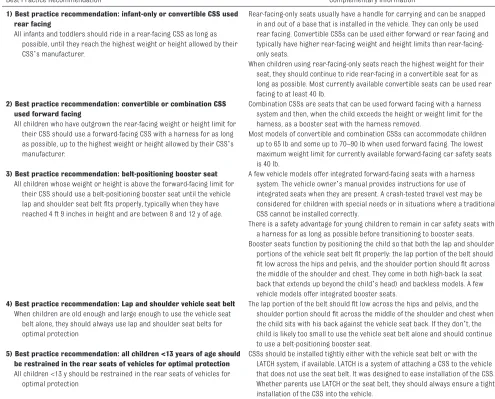
TABLE 1 Summary of Best Practice Recommendations
Best Practice Recommendation Complementary Information
1) Best practice recommendation: infant-only or convertible CSS used rear facing
All infants and toddlers should ride in a rear-facing CSS as long as possible, until they reach the highest weight or height allowed by their CSS’s manufacturer.
Rear-facing-only seats usually have a handle for carrying and can be snapped in and out of a base that is installed in the vehicle. They can only be used rear facing. Convertible CSSs can be used either forward or rear facing and typically have higher rear-facing weight and height limits than rear-facing-only seats.
When children using rear-facing-only seats reach the highest weight for their seat, they should continue to ride rear-facing in a convertible seat for as long as possible. Most currently available convertible seats can be used rear facing to at least 40 lb.
2) Best practice recommendation: convertible or combination CSS used forward facing
All children who have outgrown the rear-facing weight or height limit for their CSS should use a forward-facing CSS with a harness for as long as possible, up to the highest weight or height allowed by their CSS’s manufacturer.
Combination CSSs are seats that can be used forward facing with a harness system and then, when the child exceeds the height or weight limit for the harness, as a booster seat with the harness removed.
Most models of convertible and combination CSSs can accommodate children up to 65 lb and some up to 70–90 lb when used forward facing. The lowest maximum weight limit for currently available forward-facing car safety seats is 40 lb.
3) Best practice recommendation: belt-positioning booster seat
All children whose weight or height is above the forward-facing limit for their CSS should use a belt-positioning booster seat until the vehicle lap and shoulder seat belt fits properly, typically when they have reached 4 ft 9 inches in height and are between 8 and 12 y of age.
A few vehicle models offer integrated forward-facing seats with a harness system. The vehicle owner’s manual provides instructions for use of integrated seats when they are present. A crash-tested travel vest may be considered for children with special needs or in situations where a traditional CSS cannot be installed correctly.
There is a safety advantage for young children to remain in car safety seats with a harness for as long as possible before transitioning to booster seats. Booster seats function by positioning the child so that both the lap and shoulder
portions of the vehicle seat belt fit properly: the lap portion of the belt should fit low across the hips and pelvis, and the shoulder portion should fit across the middle of the shoulder and chest. They come in both high-back (a seat back that extends up beyond the child’s head) and backless models. A few vehicle models offer integrated booster seats.
4) Best practice recommendation: Lap and shoulder vehicle seat belt The lap portion of the belt should fit low across the hips and pelvis, and the shoulder portion should fit across the middle of the shoulder and chest when the child sits with his back against the vehicle seat back. If they don’t, the child is likely too small to use the vehicle seat belt alone and should continue to use a belt-positioning booster seat.
When children are old enough and large enough to use the vehicle seat belt alone, they should always use lap and shoulder seat belts for optimal protection
5) Best practice recommendation: all children <13 years of age should be restrained in the rear seats of vehicles for optimal protection
CSSs should be installed tightly either with the vehicle seat belt or with the LATCH system, if available. LATCH is a system of attaching a CSS to the vehicle that does not use the seat belt. It was designed to ease installation of the CSS. Whether parents use LATCH or the seat belt, they should always ensure a tight installation of the CSS into the vehicle.
All children <13 y should be restrained in the rear seats of vehicles for optimal protection
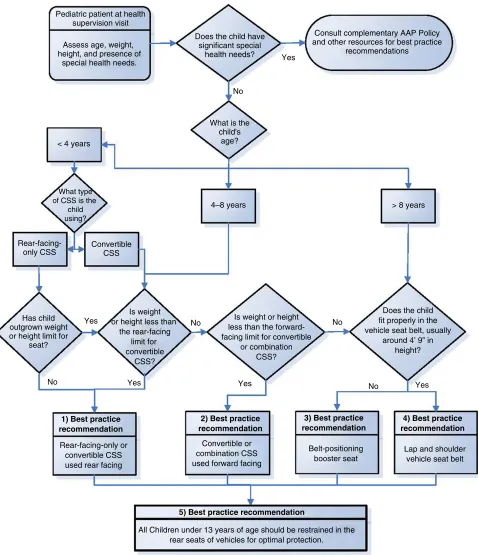
FIGURE 1
Of note, the recommendation that
all children be restrained in a
rear-facing-only or convertible CSS
used rear facing as long as possible
represents a significant change from
previous AAP policy and is based on
data from the United States
9as well
as extensive experience in Sweden.
10, 11It is important to note that nearly
all currently available CSSs have
weight limits for rear-facing use that
can accommodate children 35 to 40
lb.
12Certain considerations contained in
this policy statement are relevant
to commercial airline travel as well
and are noted in the accompanying
technical report. Additional AAP
policy statements provide specific
recommendations to optimize safety
for preterm and low birth weight
infants,
13children in school buses,
14and children using other forms of
travel and recreational vehicles.
15–17In addition, complementary
AAP policy statements provide
recommendations for teen drivers
18and for the safe transport of newborn
infants
19and children with special
health care needs.
20, 21Pediatricians play a critical role in
promoting child passenger safety.
To facilitate their widespread
implementation in practice,
evidence-based recommendations for optimal
protection of children of all ages in
passenger vehicles are presented
in the form of an algorithm (Fig
1) with an accompanying table of
explanations and definitions (Table
2). A summary of the evidence in
support of these recommendations
is provided in the accompanying
technical report.
22Because
pediatricians are a trusted source of
information to parents, pediatricians
need to maintain a basic level of
knowledge of these best practice
recommendations and promote
and document them at every health
supervision visit. Prevention of
motor vehicle crash injury is unique
in health supervision topics, as it is
the only topic recommended at every
health supervision visit by
Bright
Futures
.
23Pediatricians can also use
this information to promote child
passenger safety public education,
legislation, and regulation at local,
state, and national levels through
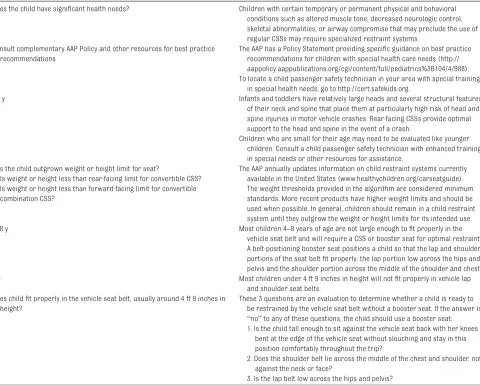
TABLE 2 Explanations of Decision Points and Additional ResourcesDoes the child have significant health needs? Children with certain temporary or permanent physical and behavioral conditions such as altered muscle tone, decreased neurologic control, skeletal abnormalities, or airway compromise that may preclude the use of regular CSSs may require specialized restraint systems.
Consult complementary AAP Policy and other resources for best practice recommendations
The AAP has a Policy Statement providing specific guidance on best practice recommendations for children with special health care needs (http:// aappolicy. aappublications. org/ cgi/ content/ full/ pediatrics%3 B104/ 4/ 988). To locate a child passenger safety technician in your area with special training
in special health needs, go to http:// cert. safekids. org.
<4 y Infants and toddlers have relatively large heads and several structural features of their neck and spine that place them at particularly high risk of head and spine injuries in motor vehicle crashes. Rear-facing CSSs provide optimal support to the head and spine in the event of a crash.
Children who are small for their age may need to be evaluated like younger children. Consult a child passenger safety technician with enhanced training in special needs or other resources for assistance.
Has the child outgrown weight or height limit for seat?
Is weight or height less than rear-facing limit for convertible CSS? Is weight or height less than forward-facing limit for convertible combination CSS?
The AAP annually updates information on child restraint systems currently available in the United States (www. healthychildren. org/ carseatguide). The weight thresholds provided in the algorithm are considered minimum standards. More recent products have higher weight limits and should be used when possible. In general, children should remain in a child restraint system until they outgrow the weight or height limits for its intended use. 4–8 y Most children 4–8 years of age are not large enough to fit properly in the
vehicle seat belt and will require a CSS or booster seat for optimal restraint. A belt-positioning booster seat positions a child so that the lap and shoulder portions of the seat belt fit properly: the lap portion low across the hips and pelvis and the shoulder portion across the middle of the shoulder and chest. 8 y Most children under 4 ft 9 inches in height will not fit properly in vehicle lap
and shoulder seat belts. Does child fit properly in the vehicle seat belt, usually around 4 ft 9 inches in
height?
These 3 questions are an evaluation to determine whether a child is ready to be restrained by the vehicle seat belt without a booster seat. If the answer is “no” to any of these questions, the child should use a booster seat: 1. Is the child tall enough to sit against the vehicle seat back with her knees
bent at the edge of the vehicle seat without slouching and stay in this position comfortably throughout the trip?
2. Does the shoulder belt lie across the middle of the chest and shoulder, not against the neck or face?
a variety of advocacy activities,
including aligning their state
’
s child
passenger safety law with the best
practice recommendations promoted
in this policy statement.
Pediatricians are urged to keep
abreast of the evolving and
multifaceted guidance and resources
on motor vehicle safety for children.
In particular, many communities
have child passenger safety
technicians who have completed
a standardized National Highway
Traffic Safety Administration course
and who can provide hands-on
advice and guidance to families. In
most communities, child passenger
safety technicians work at formal
inspection stations; a list of these
is available at https:// www. nhtsa.
gov/ equipment/ car- seats- and-
booster- seats#install- inspection.
If your community does not have
an inspection station, you can find
a child passenger safety technician
in your area via the National Child
Passenger Safety Certification Web
site at http:// cert. safekids. org or via
the National Highway Traffic Safety
Administration Child Safety Seat
Inspection Station Locator at http://
www. nhtsa. dot. gov/ cps/ cpsfitting/
index. cfm. Car Seat Check Up Events
are updated at https:// www. safekids.
org/ events/ field_ type/ check- event.
In addition, additional resources
for pediatricians and families can
be found at www. aap. org or www.
healthychildren. org.
LEAD AUTHORS
Dennis R. Durbin, MD, MSCE, FAAP Benjamin D. Hoffman, MD, FAAP
COUNCIL ON INJURY, VIOLENCE AND POISON PREVENTION, 2018–2019 Benjamin D. Hoffman, MD, FAAP, Chairperson Phyllis F. Agran, MD, MPH, FAAP
Sarah A. Denny, MD, FAAP Michael Hirsh, MD, FAAP Brian Johnston, MD, MPH, FAAP Lois K. Lee, MD, MPH, FAAP Kathy Monroe, MD, FAAP Judy Schaechter, MD, MBA, FAAP
Milton Tenenbein, MD, FAAP Mark R. Zonfrillo, MD, MSCE, FAAP Kyran Quinlan, MD, MPH, FAAP, ex-officio CONTRIBUTOR
Stuart Weinberg, MD, FAAP, Partnership for Policy Implementation
LIAISONS
Lynne Janecek Haverkos, MD, MPH, FAAP – National Institute of Child Health and Human Development
Jonathan D. Midgett, PhD –Consumer Product Safety Commission
Alexander W. (Sandy) Sinclair –National Highway Traffic Safety Administration
Richard Stanwick, MD, FAAP –Canadian Paediatric Society
STAFF Bonnie Kozial
ABBREVIATIONS
AAP: American Academy of
Pediatrics
CSS: car safety seat
REFERENCES
1. Durbin DR, Kallan MJ, Winston FK. Trends in booster seat use among young children in crashes. Pediatrics. 2001;108(6). Available at: www. pediatrics. org/ cgi/ content/ full/ 108/ 6/ e109
2. Winston FK, Chen IG, Elliott MR, Arbogast KB, Durbin DR. Recent trends in child restraint practices in the United States. Pediatrics. 2004;113(5). Available at: www. pediatrics. org/ cgi/ content/ full/ 113/ 5/ e458
3. Insurance Institute for Highway Safety. Child Restraint/Belt Use Laws. Arlington, VA: Insurance Institute for Highway Safety, Highway Loss Data Institute. Available at: http:// www. iihs. org/ iihs/ topics/ laws/ safetybeltuse. Accessed August 17, 2010
4. Arbogast KB, Durbin DR, Cornejo RA, Kallan MJ, Winston FK. An evaluation of the effectiveness of forward facing child restraint systems. Accid Anal Prev. 2004;36(4):585–589
5. Zaloshnja E, Miller TR, Hendrie D. Effectiveness of child safety seats vs
safety belts for children aged 2 to 3 years. Arch Pediatr Adolesc Med. 2007;161(1):65–68
6. Elliott MR, Kallan MJ, Durbin DR, Winston FK. Effectiveness of child safety seats vs seat belts in reducing risk for death in children in passenger vehicle crashes. Arch Pediatr Adolesc Med. 2006;160(6):617–621
7. Arbogast KB, Jermakian JS, Kallan MJ, Durbin DR. Effectiveness of belt positioning booster seats: an updated assessment. Pediatrics. 2009;124(5):1281–1286
8. National Highway Traffic Safety Administration. Fatality analysis reporting system (FARS) encyclopedia. Available at: http:// www- fars. nhtsa. dot. gov/ . Accessed August 21, 2018 9. McMurry TL, Arbogast KB, Sherwood
CP, et al. Rear-facing versus forward-facing child restraints: an updated assessment. Inj Prev. 2018;24(1):55–59 10. Isaksson-Hellman I, Jakobsson L,
Gustafsson C, Norin HA. Trends and effects of child restraint systems based on Volvo’s Swedish accident database. In: Proceedings of Child Occupant Protection 2nd Symposium; November 12, 1997; Warrendale, PA 11. Jakobsson L, Isaksson-Hellman I,
Lundell B. Safety for the growing child: experiences from Swedish accident data. In: Proceedings from the 19th International Technical Conference on the Enhanced Safety of Vehicles; June 6–9, 2005; Washington, DC. Abstr 05-0330
12. American Academy of Pediatrics. Car Safety Seats: Product Listing for 2018. Elk Grove Village, IL: Healthy Children, American Academy of Pediatrics; 2018. Available at: www. healthychildren. org/ carseatlist. Accessed June 8, 2018 13. Bull MJ, Engle WA; Committee
on Injury, Violence, and Poison Prevention and Committee on Fetus and Newborn; American Academy of Pediatrics. Safe transportation of preterm and low birth weight infants at hospital discharge. Pediatrics. 2009;123(5):1424–1429
Council on School Health. School transportation safety. Pediatrics. 2007;120(1):213–220
15. American Academy of Pediatrics, Committee on Injury and Poison. All-terrain vehicle injury prevention: two-, three-, and four-wheeled unlicensed motor vehicles. Pediatrics. 2000;105(6):1352–1354
16. American Academy of Pediatrics, Committee on Injury and Poison Prevention. Bicycle helmets. Pediatrics. 2001;108(4):1030–1032
17. American Academy of Pediatrics, Committee on Injury and Poison Prevention. Personal watercraft use by children and adolescents. Pediatrics. 2000;105(2):452–453
18. Weiss JC; Committee on Injury, Violence, and Poison Prevention, American Academy of Pediatrics; Committee on Adolescence, American Academy of Pediatrics. The teen driver. Pediatrics. 2006;118(6):2570–2581
19. Bull M, Agran P, Laraque D, et al; American Academy of Pediatrics, Committee on Injury and Poison Prevention. Safe transportation of newborns at hospital discharge. Pediatrics. 1999;104(4, pt 1):986–987
20. O’Neil J, Hoffman BD; Council on Injury, Violence, and Poison Prevention. School bus transportation of children with special health care needs [published correction appears in Pediatrics. 2018;142(1):e20181221]. Pediatrics. 2018;141(5):e20180513
21. Bull M, Agran P, Laraque D, et al; American Academy of Pediatrics, Committee on Injury and Poison Prevention. Transporting children with special health care needs. Pediatrics. 1999;104(4, pt 1):988–992
22. Durbin DR, Hoffman B; American Academy of Pediatrics, Committee on Injury, Violence, and Poison Prevention. Child passenger safety. Pediatrics. 2018;142(5):e20182461
23. American Academy of Pediatrics. Bright futures: health care