Reflexive Monism
Max Velmans, Goldsmiths, University of London; email [email protected];
http://www.goldsmiths.ac.uk/psychology/staff/velmans.php
Journal of Consciousness Studies (2008), 15(2), 5-50.
Abstract. Reflexive monism is, in essence, an ancient view of how consciousness relates to the material world that has, in recent decades, been resurrected in modern form. In this paper I discuss how some of its basic features differ from both dualism and variants of physicalist and functionalist reductionism, focusing on those aspects of the theory that challenge deeply rooted presuppositions in current Western thought. I pay particular attention to the ontological status and seeming “out-thereness” of thephenomenal worldand to how the “phenomenal world” relates to the “physical world”, the “world itself”, and processing in the brain. In order to place the theory within the context of current thought and debate, I address questions that have been raised about reflexive monism in recent commentaries and also evaluate competing accounts of the same issues offered by “transparency theory” and by “biological naturalism”. I argue that, of the competing views on offer, reflexive monism most closely follows the contours of ordinary experience, the findings of science, and common sense.
Key words: Consciousness, reflexive, monism, dualism, reductionism, physicalism, functionalism, transparency, biological naturalism, phenomenal world, physical world, world itself, universe itself, brain, perceptual projection, phenomenal space, measured space, physical space, space perception, information, virtual reality, hologram, phenomenological internalism, phenomenological externalism, first person, third person, complementary
What is Reflexive Monism?
Monism is the view that the universe, at the deepest level of analysis, is one thing, or composed of one fundamental kind of stuff. This is usually contrasted with Substance Dualism, the view found, for example in the writings of Plato and Descartes that, fundamentally, the universe is composed of two kinds of stuff, physical stuff and the stuff of soul, mind or consciousness. There are three basic ways in which the apparent differences between physical and mental “stuff” can be understood in monist terms:
1. Mind might be nothing more than a particular aspect or arrangement of physical matter (physicalism; functionalism).
2. Physical matter might be nothing more than a particular aspect or arrangement of mind (idealism). 3. Mind and physical matter might be aspects or arrangements of something more fundamental that is in itself neither mental nor physical (neutral monism; dual-aspect theory).1
Reflexive Monism is a dual-aspect theory (in the tradition of Spinoza) which argues that the one basic stuff of which the universe is composed has the potential to manifest both physically and as conscious experience. In its evolution from some primal undifferentiated state, the universe differentiates into distinguishable physical entities, at least some of which have the potential for conscious experience, such as human beings.2 While remaining embedded within and dependent on the surrounding universe and composed of the same fundamental stuff, each human, equipped with perceptual and cognitive systems has an individual perspective on, or view of, both the rest of the universe and him or her self. In this sense, each human participates in a process whereby the universe differentiates into parts and becomes conscious in manifold ways of itself, making the entire process reflexive.
A brief historical note
In one or another form, Reflexive Monism has been present in human thought for more than 3,500 years. For example, one can find versions of it in later Vedic writings such as the Upanishads and in “The revelation of the soul of Shu”, inscribed in ancient Egyptian hieroglyphs on a sarcophagus in the British Museum dating back to the period 1650—1850 B.C.3 However, the version of it that I present below has an entirely modern source, resulting from contemporary efforts to understand how consciousness relates to the brain and external physical world in a way that is consistent with common sense, everyday experience, and the scientific findings of modern consciousness studies.
2I have adopted the cautious phrase “at least some of which have the potential for conscious experience” for
the following reason: RM is form of dual-aspect monism which accepts that human minds, viewed from the outside, look like brains, while, from the perspective of those who have them, the operations of mind appear as conscious experiences. In short, the human mind appears to have both exterior (physical) and interior (conscious experiential) aspects, and whatever the true nature of mind might be, it must be one that supports both these views we have of it. While this does not commit RM to panpsychism, it is entirely consistent with it. On the basis of the available evidence human minds have such dual-aspects—and it would make sense if this dual-aspect of human nature were typical of nature in general, as panpsychism or panexperientialism suggest. However, as we are not certain of the necessary and sufficient conditions for consciousness in humans, we do not as yet have grounds to rule out alternative, logical possibilities, and, as I have stressed in Velmans (2000) none of the arguments for or against reflexive monism require one to settle this issue. The dual-aspect monism that RM adopts is nevertheless very different to, say, emergent materialism (EM). According to EM, consciousness emerges only when physical matter gains higher level features of particular kinds (sufficient complexity, the ability to interact with the world in an adaptive way, etc.) making
consciousness “supervenient” on such emergent physical features. According to RM, both brain states and their accompanying experiences are aspects of something more fundamental, co-emerging from the mind itself. On this view, conscious states and their neural correlates are equally basic features of the mind itself. The conditions for theexistenceof consciousness (within the mind itself) also have to be distinguished from theaddedconditions that determinethe many forms that conscious states can take. As material forms evolve and develop in complexity, their accompanying conscious experiences co-evolve and develop in complexity. Simple cellular life for example might be conscious in some primal, biological way, while complex biological organisation might be required for the complex forms of consciousness that we recognize in our own experience (see Velmans, 2000 chapter 12 for an extensive discussion of these and related issues).
Being a non-reductionist dual-aspect theory, Reflexive Monism (RM) is paradigmatically different in its background assumptions from both dualism and the reductionist variants of physicalism and functionalism that currently dominate philosophical thinking in this area. I have to confess, therefore, that before I developed my own first, crude version of RM over the years 1976 to 1977, I shared the conventional assumptions about consciousness that form the departure point for the classical dualist versus reductionist debate. In particular, I took it for granted that the physical world and brain were public, objective, and observer-independent, and that conscious experiences were private, subjective, and observer-dependent. I also assumed that while physical bodies had location and extension in space, conscious experiences, being brain processes or properties, must either be without a clear location or extension, or be located and extended somewhere in the brain.
My first speculations about the relation of consciousness to the brain were similarly conventional. I was tempted, for example, by the possibility that consciousness was an emergent property of the brain (related, perhaps, to its magnetic field) that allowed disparate regions of the brain to communicate with one another, thereby enabling the brain to operate in a unified, integrated way. I was even tempted by the thought that one might be able to detect variations in the operation of consciousness by measuring variations in the brain’s magnetic field.4 However, my confidence in these, and related ideas only lasted a few days.
What changed? While human consciousness might or might not be related to the brain’s magnetic field, it seemed obvious, on reflection, that I was not consciously aware of different parts of my brain, let alone how they communicate with one another. Given that these communication processes operate entirelyoutside of consciousness, it seemed odd to suggest that they were the functionof consciousness—and given that we have very little first-person conscious knowledge of the details of our own mental processing, the same appeared to be true of the many other functions that had been (and continue to be) attributed to consciousness in the cognitive science literature, making the function of the phenomenology of consciousness in mental life deeply problematic.5 Even worse, on re-examination, my conventional assumptions about the separation of conscious experience and its properties from what I normally thought of as the “physical world” did not seem to match up to thephenomenologyof my own experience! If one looks at the “physical world” it has the appearance of aphenomenal world composed of objects surrounding one’s body located and extended in a three-dimensional space through which one can move and with which one can interact. Crucially, while gazing at the world, there appears to be no other experience of the world
4It turned out that a similar proposal had already been made by Sperry (1969, 1970); a similar suggestion that the function of consciousness is to “broadcast” information throughout the brain allowing its different regions to communicate was also later developed by Baars (1988) in the form of “cognitive workspace” theory, which is still a popular theory about the function of consciousness (see Baars, 2007, Dehaene & Naccache, 2001). The association of consciousness with the brain’s emergent magnetic field was also later suggested by McFadden (2002) and by Pockett (2002).
5There are many additional problems associated with the function of conscious phenomenology, for example,
the causal closure of the physical world, the difficulties of reducing conscious phenomenology to its associated physically or functionally specified neural correlates, and so on. For example, even if phenomenal
consciousness does turn out to correlate with the brain’s magnetic field, one cannot conclude that the
“in the brain” inaddition tothis three-dimensional phenomenal world that one can see. In sum, in terms of visual phenomenology, what I normally thought of as the “physical world”, the “phenomenal world”, “the world as experienced”, and my “experience of the world” wereone and the same! And I had no doubt that this was a communally shared experience.
It goes without saying that the everyday perceived world is not the same, in every respect, to the world as described by modern physics (in terms of quantum mechanics, relativity theory and so on). However, it is the everyday physical world that we can see that we normally think of as public, objective and observer-independent in the ways outlined above. The observation that this phenomenal physical world is actually part of conscious experience (not apart from it) therefore provides a very different departure point for an understanding of consciousness. But it also raises some immediate questions. Whereis this phenomenal world? It seems to be out there in space— but is it really where it seems to be, or is it really in the brain? And what is the ontological status of this phenomenal world? Is it public, objective and observer-independent, or is it private, subjective, and observer-dependent?
Let us consider the options. A dualist model of perception.
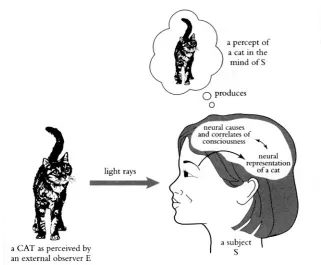
Conventional assumptions about the ontology and location of the phenomenal world have their origin in a dualist understanding of the way physical objects in the world relate to perceptual processing in subjects’ brains and their consequent experiences (see Figure 1).6
6Dualist thinking is common in folk psychology, and in the Western tradition has its origins in the writings of
Plato and Descartes. Prominent dualists over the last hundred years have included Wilder Penfield, Charles Sherrington and John Eccles and, within the scientific community, it persists in current discussions of the role of conscious experiences in quantum mechanics, for example in the writings of Bohr, Von Neumann, and Stapp (see Stapp, 2007a,b,c, for reviews). Within philosophy, a form of “naturalistic dualism” has also been
Figure 1. A dualist model of perception
In this model, perception involves a simple, linear, causal sequence. Viewed from the perspective of an external observer E, light rays travelling from the physical object (in this case, a cat) stimulate the subject's eye, activating her optic nerve, occipital lobes, and associated regions of her brain. Neural conditions sufficient for consciousness are formed, and result in a conscious experience (of a cat) in the subject’s mind. This model of visual perception is, of course, highly oversimplified, but for now we are not interested in the details. We are interested only in the ontology of physical objects, brains and conscious experiences and in where external physical objects, brains and experiences areplaced.7
7Figure 1 is deliberately oversimplified, as its only purpose is to illustrate the dualist separation of the objects
It will be clear that there are two fundamental “splits” in this model. Firstly, the contents of consciousness are clearly separated from the material world (the conscious, perceptual “stuff” in the upper part of the diagram is separated from the material brain and the physical cat in the lower part of the diagram). This conforms to Descartes’ view that the stuff of consciousness (res cogitans, a substance that thinks) is very different to the stuff of which the material world is made (res extensa, a substance that has extension and location in space). Secondly, the perceiving subject is clearly separated from the perceivedobject(the subject and her experiences are on the right of the diagram and the perceived object is on the left of the diagram).
This dualist model of perception supports a dualist view of the universe in which the universe is split into two realms, the material realm and the mental realm (the latter including consciousness, mind, soul and spirit). In interactionist forms of dualism these two realms interface and causally interact somewhere in the human brain.
A reductionist (physicalist) model of perception
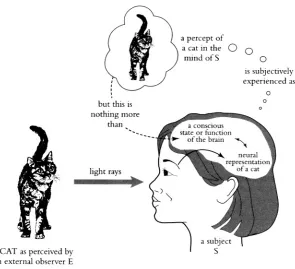
The problems of assimilating such dualism into a scientific worldview are serious (cf. Velmans, 2000 chapter 2). Consequently, it is not surprising that 20th Century philosophy and science tried to naturalise dualism by arguing or attempting to show that conscious experiences are nothing more than states or functions of the brain. A reductionist model of visual perception is shown in Figure 2.
Figure 2. A reductionist model of perception
argue that it isreallya state or function of the brain. In short, the reductionist model in Figure 2 tries to resolve the conscious experience—physical world split by eliminating conscious experience or reducing it to something physical that E (the external observer) can in principle observe and measure. But reductionism retains the split (implicit in dualism) between the observer and the observed. The perceived object (on the left side of the diagram) remains quite separate from the conscious experience ofthe object (on the right side of the diagram).8
This supports a reductionist view of a universe composed entirely of physical material, of which conscious experiences are a tiny part (they are nothing more than the bits of human and other brains that are identified with those experiences).
Note that in spite of their disagreement about the ontology of conscious experiences, modern dualists and reductionists broadly agree about how conscious experiences relate to the brain and physical world. In visual perception, for example, they would agree that physical input stimuli innervate the optic nerve and visual system, forming preconscious representations of that input in the brain. If that input is attended to, and the necessary and sufficient conditions for consciousness are met, a conscious experience will result along with its neural correlates in the brain. This agreement about potentially observable neural causes and correlates makes it clear that the dualist versus reductionist dispute is moreconceptualthanempirical. It has more to do withpretheoretical assumptions about the nature of consciousness (whether it is entirely material, or whether consciousness resides in some separate, spiritual realm) than with anything observable about the brain. Consequently, one cannot easily resolve this dispute with neuroscience. The empirical discovery of neural causes and correlates won’t settle a dispute about whether experiences are nothing more thantheir causes and/or correlates.
Note too that dualists and reductionists largely agree about where the external physical world, the brain and conscious experiences areplaced. In spite of their dispute about whatexperiences are, they agree (roughly) about where they are. Reductionists, for example, take it for granted that experiences are really brain states or functions, so they must bein the brain. Although dualists take experiences to be immaterial (and, strictly speaking, without location or extension) they again take it for granted that these must interface and interact with the physical world somewhere in the brain. In short, the brain is as close to experiences as one can get—and if experiences are in the brain, they cannot be located in, or part of, the external physical world. One could describe this view as phenomenological internalism.
A reflexive model of perception
According to the reflexive model of perception, neither dualist nor reductionist pretheoretical assumptions about the nature of conscious experiences conform to what can be readily observed about those experiences. In fact, as I have suggested above, both sets of beliefs largely conflict with
8I stress again that Figure 2 is highly oversimplified and is intended only to represent some common features
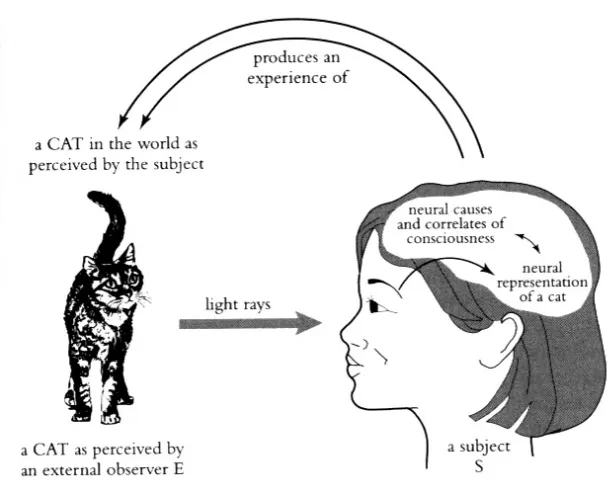
the first-person evidence. This applies to their beliefs about (a) what conscious experiencesare like, and (b) where conscious experiences seem to be placed in relation to the brain and the physical world. If this is true, it is hardly surprising that their dispute is irresolvable, and that the nature of consciousness remains a puzzle for science. A reflexive model of the nature of conscious experience and how it relates to the brain and physical world is shown in Figure 3.
Figure 3. A reflexive model of perception
For reasons that I will present in a later section, the reflexive model also makes the strong claim that, insofar as experiences are anywhere,they are roughly where they seem to be.9For example, the phenomenal cat in Figure 3 both appears to be, and is out in the phenomenal world, a pain in the foot is in the experienced foot, and this perceived print on this visible page really is out here on this visible page. Nor is a pain in the foot accompanied by some other,additionalexperienceofpain in the brain, or is this perceived print accompanied by some additional experience of print in the brain.In terms of phenomenology, this perceived print, and my experience ofthis print areone and the same.
Technically, this is a form ofphenomenological externalism. Note, however, that although I will focus on phenomena that have apparent external location and extension for the purposes of this paper, the reflexive model is not externalist (for any doctrinal reason) about all experiences. Whether an experience appears to be located in external phenomenal space, on the body surface, inside the head, or nowhere, is an empirical matter that is entirely dependent on its phenomenology. For example, the phonemic imagery that accompanies the thought that 2+2=4 does not have a clear location, or might seem, at best, to be roughly located inside the head (see Velmans, 2000, ch6). Note too, that, barring perceptual errors, illusions and hallucinations, perception remains reflexive wherever the experiences seem to be placed. Once preconscious perceptual processing has operated, objects and events in the external word are reflexively experienced to be located and extended in the external world, stimuli originating at the body surface are reflexively experienced to be located at the body surface, and the cognitive processes in the mind/brain that result in thoughts are reflexively experienced to be located “in the head” or “in the mind/brain” where they originate (in so far as they are located at all).
Given that the reflexive model conforms closely to everyday experience, it should be easy to grasp the essence of the argument so far. Descartes’ focus onthoughtas the prime exemplar of conscious experience led him to suggest that experiences are a state of “thinking stuff” that has no location and extension in space—and reductionists commonly agree that experiences seem to have such ephemeral qualities (that is why they want to give them a more secure ontology in states or functions of the brain). While I agree that thoughts and other “inner” experiences appear to have such qualities, most other experiences do not have those qualities. On the contrary, most experienced phenomena seem to have a clear location and extension in phenomenal space.
To those immersed in dualist or reductionist modes of thought this proposed expansion of the contents of consciousness to include those aspects of the phenomenal world that we normally think of as the “physical world” may seem radical and the notion that many experiences have at least a phenomenal location and extension might appear strange. But, thus far, this proposal is hardly new. In one or another form it appears in the work of George Berkeley (1710), Immanuel Kant (1781), C.H. Lewes (1877), W.K. Clifford (1878), Ernst Mach (1885), Morton Prince (1885), William James (1890, 1904),
9
The claim that experiences “are roughly where they seem to be”, commits RM to a form of realism about conscious appearances. However this is not naïve realism. The relation of phenomenal location tomeasured
Edmund Husserl (1931), A.N. Whitehead (1932), Charles Sherrington (1942), Bertrand Russell (1948), Wolfgang Köhler (1966), and Karl Pribram (1971, 1974, 1979, 2004). Similar analyses of what consciousnessseems to be like have also recently been given by Antti Revonsuo (1995, 2006), Steven Lehar (2003, 2006), Michael Tye (1995, 2007), Shepard & Hut (1997), Hans Dooremalen (2003), Jeffrey Gray (2004), Rupert Sheldrake (2005), and Ted Honderich (2006).
William James (1904) for example, suggests that to convince oneself about where experiences are the observer only needs to
“... begin with a perceptual experience, the 'presentation', so called, of a physical object, his actual field of vision, the room he sits in, with the book he is reading as its centre, and let him for the present treat this complex object in the commonsense way as being 'really' what it seems to be, namely, a collection of physical things cut out from an environing world of other physical things with which these physical things have actual or potential relations. Now at the same time it is just those self-same things which his mind, as we say, perceives, and the whole philosophy of perception from Democritus's time downwards has been just one long wrangle over the paradox that what is evidently one reality should be in two places at once, both in outer space and in a person's mind. 'Representative' theories of perception10avoid the logical paradox, but on the other hand they violate the reader's sense of life which knows no intervening mental image but seems to see the room and the book immediately just as they physically exist”.
James placed his trust in the “reader’s sense of life” and developed a form of “neutral monism”11to support it. But as he points out, the observation that the phenomenal worldseemsto be out-there beyond the body surface can be interpreted in a number of different ways:
1. It might be that the phenomenal world seems to be out-there beyond the body surface but it is really in a mind that has no location and extension.
2. It might be that the phenomenal world seems to be out-there beyond the body surface but it is really in the brain.
3. It might be that the phenomenal world really is out-there where it seems to be.
4. It might be (to quote James) “that what is evidently one reality should be in two places at once, both in outer space and in a person’s mind.”
As noted above, dualism adopts 1, physicalist reductionism adopts 2, and reflexive monism (like James) adopts 3. In ways that I will make clear, RM also makes sense of 4.
10Representative theories for James are those that identify the experience of an external object or event with
in internal representation or image of that experience or event in the mind.
11Unlike reflexive monism (a form of dual-aspect theory in the tradition of Spinoza), neutral monism of the kind
adopted by Mach (1885), James (1904) and Russell (1948) argues that mental events and physical ones are not aspects of some morefundamentalreality but simply different ways ofconstruingthe world as-perceived. On this view, there is only one, neutral stuff of which the perceived world is composed, which Mach refers to as
"sensations", James as "pure experience," and Russell, as "events". Although the terms they use to describe the perceived world differ, the central argument used to support neutral monism is the same: What we observe inthe world is neither intrinsically mental nor physical. Rather, wejudgewhat we experience to be "mental" or
Although options 1 to 4 can be simply stated, the differences between them are so fundamental that they lead to radically different ways of thinking about the nature of consciousness and its relationship to the brain and surrounding world—with associated consequences for how one makes sense of first-person versus third-first-person knowledge, public versus private events, subjectivity versus objectivity , the relation of the phenomenal world to the world described by modern physics, the scope and limits of a science of consciousness and much else (see Velmans, 2000). These differences are so extensive that they amount to different paradigms or worldviews, much of which cannot be covered in one journal article.
In what follows, therefore, I will focus only on the first steps—where RM most obviously departs from competing theories and on the immediate consequences of heading off in a different direction.12To clarify the issues I will also address some challenges to, and misinterpretations of RM that have been published since its first introduction in Velmans (1990) and, where appropriate, I will also contrast the immediate consequences of RM, with those of (currently dominant) physicalism.
Immediate consequences of the reflexive model of perception
In terms of their phenomenology the “physical world”, the “phenomenal world”, the “world as experienced”, and our “experiences of the world” are one and the same—which, according to RM, supports a reflexive model of perception.13This does however raise three immediate questions:
1. Given that the proximal neural causes and correlates of experiences are inside the brain, how can one explain the fact that most visually experienced objects and events seem to be outside the brain?
2. Are these experienced objects and events really where they seem to be? 3. What is the ontological status of the phenomenal world?
How can one explain that some experiences seem to be outside the brain?
From the contemporary literature, let us consider three competing ways of making sense of the seemingly external, three dimensional nature of the visual world: “transparency” theory, “biological naturalism”, and reflexive monism.14
12I also focus only on vision. For a treatment of other sense modalities, see Velmans (2000) chapter 7. 13
This does not mean, of course, that these terms have exactly the samemeaningin all contexts. The term “physical world” for example is ambiguous: in everyday life we commonly use the term to describe the world as perceived, but in science, the term usually refers to the world as described by physics (e.g. quantum mechanics, relativity theory etc.), which may differ in major ways from the world as normally perceived. The “world as experienced” also has a different emphasis to “experiences of the world” in that these phrases focus our attention in different ways. The first phrase places what isobservedin the foreground, which, in the reflexive model, is the initiating stimulus. If we are interested primarily in what is going on in the world, this is appropriate. The second phrase draws our attention to the results of perceptual processing in theobserver, that is, to the resulting experience. If we are interested primarily in what is going on for the subject, this is appropriate. But this does not alter the fact that when we look at an object in the world, we experience only an object in the world, whichever way that experience is conceived.
Transparency Theory
According to Tye (1995, 2007) perceptual experiences are transparentand visual perception is rather like peering through a pane of glass:
“Suppose that you have just entered a friend’s country house for the first time and you are standing in the living room, looking out at a courtyard filled with flowers. It seems to you that the room is open, that you can walk straight out into the courtyard. You try to do so and, alas, you bang hard into a sheet of glass, which extends from ceiling to floor and separates the courtyard from the room. You bang into the glass because you do not see it. You are not aware of it; nor are you aware of any of its qualities. No matter how hard you peer, you cannot discern the glass. It is transparent to you. You see right through it to the flowers beyond. You are aware of the flowers, not by being aware of the glass, but by being aware of the facing surfaces of the flowers. And in being aware of these surfaces, you are also aware of a myriad of qualities that seem to you to belong to these surfaces. You may not be able to name or describe these qualities but they look to you to qualify the surfaces. You experience them as being qualities of the surfaces. None of the qualities of which you are directly aware in seeing the various surfaces look to you to be qualities of your experience. You do not experience any of these qualities as qualities of your experience. For example, if redness is one of the qualities and roundness another, you do not experience your experience as red or round. ….. Visual experiences, according to many philosophers, are like such sheets of glass. Peer as hard as you like via introspection, focus your attention in any way you please, and you will only come across surfaces, volumes, films, and their apparent qualities. Visual experiences thus are transparent to their subjects (Moore 1922). We are not introspectively aware of our visual experiences any more than we are perceptually aware of transparent sheets of glass. If we try to focus on our experiences, we see right through them to the world outside. By being aware of the qualities apparently possessed by surfaces, volumes, etc., we become aware that we are undergoing visual experiences. But we are not aware of the experiences themselves. ” (Tye, 2007, p30)
Tye rightly notes that, in normal perception, we feel that we experience the world, and that it doesn’t really make sense to say that one “experience one’s experiences”. Wehaveexperiences or, to use Tye’s words, we undergo them, but “experiencing one’s experiences” does seem to involve an unnecessary (and non-existent) regression.
There are nevertheless two obvious problems with this analysis:
Tye is a physicalist and adopts the view that experiences are nothing more than representations in the brain that are “transparent”. Consequently, on his account, when we “introspect” our experiences, we “see right through” perceptual representations in the brain to see the colours, smells and other qualities that actually exist in the world. While this has a certain force as a metaphor, it is difficult to see how this translates into a viable theory. How can one “see right
through” one’s brain states? Who is it that does the peering? For dualists that “someone” would presumably be a disembodied mind. But for physicalists that “someone” would itself have to be a state of the brain that somehow sees through some other state of the brain. Either way, this sounds suspiciously like an added, inner perceiver (or homunculus)—a suggestion that is routinely dismissed in scientific and philosophical theories of conscious perception (a) on the grounds that there is no evidence for such a homunculus, and (b) on the grounds that even if there were, all the problems of perception would simply regress to the homunculus (so it has little explanatory value).
Tye does not deny that we do have experiences of colour, smell and so on; so, if these are not properties or qualities of experience as such (as Tye insists), they must be properties of the world, as there is nothing else left of which they could be properties—a form of “direct realism”. Although this view has some currency amongst direct-realist, physicalist philosophers for the reason that they need it to make their version of physicalism work as a theory of consciousness, it is routinely dismissed by scientists.
Why? As van der Heijden et.al (1997) note in their commentary on a similar position adopted by Block, (1995), such a view simply does not take the natural sciences seriously.
“That there are colours in the external world is a naive idea, unsupported by physics, biology, or psychology. Ultimately, it presupposes that the representation (the perceived colour) is represented (as a perceived colour). A perceptual system performs its proper function when itdistinguishesthe relevant things in the outer world. For vision, the information about these relevant things is contained in the structure and composition of the light reflected by the outer world that enters the eyes. For distinguishing the relevant things in the external world, a unique and consistent representation of the corresponding distinctions in the light is all that is required.” (Van der Heijden, et al, 1997, p158).
However, according to Block (1997), van der Heijden et.al are “wildly, unbelievably wrong. They say that we should give up the idea that a rose or anything else is ever red. The only redness, they say, is mental redness. But why not hold instead that roses are red .... rejecting colors in the mind? Why not construe talk of red in the mind as a misleading way of expressing the fact that P-conscious states15represent the world as being red? And a representation of red need not itself be red (like the occurrences of the word “red” here).” (P165).
Of course Block is right that neural representations of red roses need not themselves be coloured. But few claim that they are. Whatisclaimed is that once a normal, human visual system is activated in an appropriate way, a visual experience of a red colour will result, irrespectiveof whether that colour corresponds to a physical property out in the world. Penfield & Rasmussen (1950), for example, demonstrated that direct microelectrode stimulation of the visual system resulted in visual experiences, stimulation of the temporal lobe in auditory experiences, stimulation of the somatosensory system in tactile experiences, and so on. Given that such visual, auditory, and tactile qualia can existin the absence ofthe external physical properties that they normally represent, it is not easy to see how they can bereducedto such physical properties.
Tye nevertheless tries to argue that qualia such as colour do reduce in this way, basing his case partly on how things appear to us, and partly on evidence that perceived qualia really do correspond quite well to properties measured by Physics. As Tye (1995) notes, “Certainly we do not experience colors as perceiver-relative. When, for example, a ripe tomato looks red to me, I experience redness all over the facing surface of the tomato. Each perceptible part of the surface looks red to me. None of these parts, in looking red look to me to have a perceiver-relative property. I do not experience any part of the surface as producing a certain sort of response in me or anyone else. On the contrary, I surely experience redness as intrinsic to it, just as I experience the shape of the surface as intrinsic to it.” (p145). Given that we experience such colours as not being perceiver-relative, he regards the view that theyareperceiver-relative as “just not credible” (p145).
Given that physicalism routinely denies the reliability of appearances as a guide to what experiences are really like16, Tye rests his case on shaky ground. There are many obvious counterexamples. The colours of surfaces may seem to be observer-independent, but the colours of after-images do not. For example, if one stares at a red spot for a few minutes, one will experience a green after-image that projects onto any surface that the eye fixates. The apparent size of the after-image also increases as the judged distance of the surface increases. So, if apparent, observer-dependence is to be the criterion of what is “mental”, after-images are surely mental. The observer-dependence of colour attached to surfaces in the world also becomes evident once the visual system no longer functions in a normal way. In cases of red-green colour blindness, for example, red can no longer be distinguished from green—and in cases of achromatopsia the entire world appears in shades of grey! More fundamentally, the reason that surfaces just appear coloured (without any conscious contribution on our part) is due to the fact that visual processing operatespreconsciously. That is, once structured visual scenes appear in conscious experience, the binding of colour with shape, movement and so on has already taken place (Zeki, 2007). Finally, it is important to note that variations inhowthings are experienced cannot be used to decidewhether or notthings are aspects of experience!
Tye’s second main argument relies on evidence that in some circumstances the qualia – physical property correspondence may be relatively invariant. Colours remain fairly similar for example when viewed outdoors, indoors (illuminated by incandescent lamps), or through sunglasses. Tye asks, “Why should this be? Surely the most straightforward answer is that the human visual system has, as one of its functions, to detect the real, objective colors of surfaces. Somehow, the visual system manages to ascertain what colors objects really have, even though the only information immediately available to it concerns wavelengths.” (p146) After a review of some of the relevant evidence, Tye concludes that
“Colors are objective, physical features of objects and surfaces. Our visual systems have evolved to detect a range of these features, but those to which we are particularly sensitive are indirectly dependent on facts about us. In particular there are three types of receptor in the retina, each of which responds to a particular waveband of light, and the spectral reflectances of surfaces at those wavebands (that is, their disposition to reflect a certain percentage of incident light within each of the three bands) together determine the colors we see. So the colors themselves may be identified
16For example, physicalism routinely claims that conscious qualia,contraappearances, are just states of the
with ordered triples of spectral reflectances. An account of the same general sort may be given for smells, tastes, sounds, and so on.” (Tye, 1995, p150)
Tye is right to point out that the way perceived colour maps onto given patterns of light reflectance may be more invariant than is sometimes thought. After all, it makes evolutionary sense for our perceptual systems to pick out physical invariances when they occur and to translate these into relatively invariant experiences. However even a perfect correlation between perceived qualia and events described by Physics would not establish their ontological identity.17 Indeed, Physical descriptions as such do nothing to explain why one pattern of light reflectances should be perceived as “red,” and another as “green,” while a pattern of light reflectances in the ultra-violet region is seen as nothing at all (unless one happens to be a bee). Nor do physical descriptions explain the rather arbitrary way the visual system translates electromagnetic energies with wavelengths ordered on a ratio scale into colour categories ordered on a nominal scale.18 If our experiences simply “mirrored” the world, we would expect the relationships between properties described by Physics to be more faithfully preserved in the way such relationships are experienced. To this one must add the many differences in the way given physical properties can be experienced both within and between species (see Velmans, 2000, chapter 7 for a review). As van der Heijden et al (1997) note, the view that perceived qualia exist in the world in a way that is free of such biological influences simply does not take the natural sciences seriously.
Biological Naturalism versus Reflexive Monism
Although Biological Naturalism (BN) and Reflexive Monism (RM) offer very different ways of understanding the relationship of consciousness to the brain and physical world, they share many background assumptions and explanatory features. Consequently, to sharpen the issues in contention, I will discuss them in tandem.
Unlike transparency theorists who view colour, spatial extension and so on as observer-independent properties of the world, BN and RM both accept that experiences themselves have qualities. These qualities usuallyrepresentaspects of the world in useful ways developed over the course of biological evolution, but are not necessarily qualities of theworld itself. Rather, if we take seriously the many alternative representations of the world offered by physics and other sciences, our everyday experiences must only be rough and ready representations of what is really going on19—a standard
17Causation, correlation, and ontological identity are very different relationships. If A is identical to B, then B is identical to A (symmetry) and all the properties of A are the same as all the properties of B (identity obeys Leibniz’s Law). Correlation is also symmetrical (if A correlates with B, then B correlates with A) but it doesnot
obey Leibniz’s Law, for example height correlates with weight in humans but all the properties of height are not the same as all the properties of weight. Causation is neither symmetrical nor does it obey Leibniz’s Law. Similar caveats apply to the relation of conscious experiences to their neural correlates in the brain—see Velmans (1998a, 2000 chapter 3), and discussion below.
18Wavelengths of 700 nm are longer than wavelengths of 400 nm (by a ratio of 7/4). However, while red is
different from violet it is not “longer” than it!
view in science variously known as “indirect realism” or “critical realism”, with a lineage dating back to Newton, Galileo, and Locke.
In short, both BN and RM adopt a form of appearance-reality distinction which accepts that the appearances of the world only indirectly represent (and sometimes misrepresent) the nature of the world itself. For the purposes of the following discussion I will call this “the world appearance-reality distinction”.
In the form defended by Lehar (2003), and Revonsuo (1995, 2006), BN, like RM also accepts that spatial extension is fundamental to visual experience, and that the three-dimensional phenomenal world appearsto be outside the brain. However, BN is a form of physicalism. Consequently, unlike RM, Lehar and Revonsuo also insist that this three-dimensional phenomenal world can be nothing more than a brain state that must be inside the brain. To reconcile this difference between how the phenomenal worldappearsand how itreally is, they suggest that the visual phenomenal world is in fact a form of virtual reality. One’s experienced body with its surrounding experienced world is part of this virtual reality—and, despite appearances, this entire virtual world really only exists inside one’s brain.20
In claiming conscious experiences that seem to be outside the brain to be nothing more than brain states located in the brain, BN therefore goes on to adopt a secondappearance-reality distinction applied not to the contrast between the appearances and nature of the world, but to the appearances and nature of the appearances themselves. Let us call this “the appearance appearance-reality distinction”.
It is on this issue that BN and RM part company. RM accepts the world appearance-reality distinction, but, rejects the appearance appearance-reality distinction. According to RM conscious appearances really are (roughly) how they seem to be.21
The appearance appearance-reality distinction is, of course, entirely congenial to those reductionist and eliminativist philosophers who wish to question the nature or even the existence of conscious appearances. However, BN (like RM) claims to be anonreductionisttheory, which raises the tricky issue of how one can both argue that conscious appearances are really very different to how they appear to be,andthat one is being nonreductive about conscious appearances.
John Searle, for example, was one of the first to grapple this issue. As he noted,
20Virtual reality provides a useful metaphor for visual experience that is also exploited by Reflexive Monism (Velmans, 1993b, 1998b, 2000 chapter 6) as we will see below.
21I stress once again that in rejecting the appearance appearance-reality distinction, RM is committed to a form of realism about appearances, but not to naïve realism about appearances--and I have added the qualifier “roughly” to take account of the fact that our descriptions and understanding of our own phenomenology are revisable depending on many factors: how we attend to that phenomenology, what descriptive systems or measurement systems are available and so on. Consequently our beliefs about our conscious experiences are revisable, but they are not, under normal circumstances,completely wrong. We might for example erroneously believe that we wouldalwaysnotice major changes in the areas of the visual field to which we attend, although experiments on change blindness show this to be false. On the other hand, we are not usually wrong about our ability tosee(unless we suffer from anosagnosia) or, in ordinary
"Common sense tells us that our pains are located in physical space within our bodies, that for example, a pain in the foot is literally in the physical space of the foot. But we now know that is false. The brain forms a body image, and pains like all bodily sensations, are parts of the body image. The pain in the foot is literally in the physical space in the brain." (Searle 1992, p63)
At the same time, Searle wishes to defend the reality of conscious appearances. Indeed, later in the same book, he concludes that
"...consciousness consists in the appearances themselves. Where appearance is concerned we cannot make the appearance-reality distinction because the appearance is the reality." (Searle 1992, p121—my italics).
Lehar (2003, 2006) develops the same point. He does not deny that the phenomenal worldappears to be out-there in space. On the contrary, “The inescapable conclusion is that visual experience is spatially structured. To deny the spatial aspect of experience is to deny the single most characteristic property of that experience, or what makes visual experience what it is.” (Lehar, 2006). Nor does he have any doubt that such experiences are real.22On the contrary, “the eliminative hypothesis turns epistemologyon its head and asks us to doubt the existence of the one and only thing that we can be absolutely certain to exist, and that is our own experience. … Even in the case of dreams and hallucinations, I can be absolutely certain that I am having an experience, andI can be absolutely certain that that experience has the properties I experience it to have. To claim that conscious experience is any different than it is experienced to be, is a contradiction in terms!(Lehar, 2006—my italics)
This illustrates the acute problem that apparent, external spatial location poses for biological naturalism: If biological naturalism is true, experiences are states of the brain, which are necessarily in the brain. However, if “the appearance is the reality”, and if “I can be absolutely certain that experience has the properties that I experience it to have”, then if the pain appears to be in the foot, it really is in the foot, and if the phenomenal world appears to be out there beyond the body surface then it really is out there beyond the body surface.23 Either biological naturalism is true, or the appearance is the reality. One can’t have both.
Let us weigh the alternatives. Has science discovered that (despite appearances) pains really are in the brain as Searle suggests? It is true of course that science has discoveredrepresentations of the body in the brain, for example, a tactile mapping of the body surface distributed over the somatosensory cortex (SSC). However, no scientist has observed actual body sensations to be in the brain, and no scientist ever will, for the simple reason that, viewed from an external observer's perspective, the bodyas experienced by the subjectcannot be observed; one cannotdirectlyobserve another person’s experience—and, given the importance of this issue to BN, we return to it below.
22Lehar would claim to be a “nonreductive physicalist”, but is nevertheless reductive in the sense that he
insists that,contraappearances, conscious experiences are nothing more than brain states. However he is not an eliminativist for the reason that he believes that these conscious brain states are real.
Science has nevertheless investigated the relationship of the body image (in SSC) to tactile experiences. Penfield & Rassmussen (1950), for example, exposed areas of cortex as they prepared to remove cortical lesions that were responsible for focal epilepsy. To avoid surgical damage to areas essential to normal functioning, they first explored the functions of these areas by lightly stimulating them with a microelectrode and noting the subject's consequent experiences. As expected, stimulation of the somatosensory cortex produced reports of tactile experiences. However, these feelings of numbness, tingling and so on were subjectively locatedin different regions of the body, not in the brain. In sum, science has discovered that neural excitation of somatosensory cortex causestactile sensations, which are subjectively located in different regions of the body. Rather than being scientific evidence for BN, this effect is precisely the “perceptual projection” that the reflexive model describes!24
What is perceptual projection?
The reflexive model of perception in Figure 3 shows, in schematic form, how reflexive monism works in human visual perception. As will be evident from the arrows at the top of Figure 3 leading from the subject’s brain to the perceived cat, the reflexive model posits a form of perceptual projection that completes the reflexive process. It is however important to be clear about what is meant by “perceptual projection” in order to convey it’s precise role in the model. Crucially, perceptual projection refers toan empirically observable effect, for example, to the fact that this print seems to be out here on this page and not in your brain. In short, perceptual projection is an effect that requires explanation; perceptual projection is not itself an explanation. We know that preconscious processes within the brain, interacting with events in the external world, produce consciously experienced events, which may be subjectively located and extended in the phenomenal space beyond the brain, but we don’t really know how this is done. We also know that this effect is
24Given that direct cortical somatosensory stimulation bypasses normal sensory input channels, this projective
subjective, psychological, and viewable only from a first-person perspective. Nothing physical is projected from the brain.25
That perceptual projection viewed as a psychological effect may be both real and scientifically investigable will come as no surprise to experimental psychologists. But it has sometimes been seriously misunderstood and misrepresented by those who wish to argue for competing positions. Lehar (2003, 2006) for example, does not deny that the phenomenal world appears to be out-there in space, and, unlike eliminative materialists, he has no doubt that such experiences are real. On the contrary, “I can be absolutely certain that that experience has the properties I experience it to have. To claim that conscious experience is any different than it is experienced to be, is a contradiction in terms!” (See quote above.) At the same time, his commitment to the view that experiences are really in the brain, requires him to attack perceptual projection on the grounds that,
“the only thing that is projected is conscious experience, a subjective quality that is undetectable externally by scientific means. But … the problem with this notion is that the sense-data that are experienced to exist do not exist in any true physical sense, and therefore the projected entity in Velmans’ theory is a spiritual entity to be believed in (for those who are so inclined) rather than anything knowable by, or demonstrable to, science.”(Lehar 2003) And later, in his 2006 Tucson address, he goes on to assert that “It is a theory which cannot be falsified, because its prediction, that nothing will be detected, is identical to the null prediction, that nothing is projected. Therefore it is not a scientific hypothesis about how spatial experience arises from the brain, but rather, it is a theory that banishes the most interesting and challenging part of that problem into a spirit world of ghostly structures that have no mass, occupy no space, consume no energy, and have no physical presence in the world known to science.” (Lehar 2006)
The scientific status of perceptual projection
This is truly confused. Within RM, phenomena that are experienced to be in the external, phenomenal world are one variety of “conscious experience”—and I have never claimed such consciously experienced phenomena to be spiritual entities that are unknowable by or demonstrable to science. On the contrary, I have argued that such phenomena form the very basis of empirical science (see Velmans, 2000, chapter 8, Velmans, 2007c, and the further discussion of the ontology of conscious experiences below). I have also made it perfectly clear that “perceptual projection” in RM is not a hypothesis or theory about how experience arises from the brain. Rather, “perceptual projection is apsychological effectproduced by unconscious perceptual processing” (Velmans, 2000, p 115)—a point I have repeated in direct exchanges with Lehar, for example in my commentary on his 2003 target article (see Velmans, 2003b).26
This distinction between effects and theories that attempt to explain them is important. One cannot falsifyeffects (demonstrate them to be false). They are either observed to occur or not. And in this
25Unlike Empedocles, I amnotsuggesting that there are rays emitted from the eyes that light up the world.
However, contrary to what Van de Laar (2003) suggests, the fact that perceptual projection is not “physical” in this sense, does not make it just “metaphorical.” Psychological effects are real and investigable by science, not metaphorical.
26Like Lehar, much of Van de Laar’s (2003) commentary on perceptual projection also confuses perceptual
case, the effect is ubiquitous. The evidence for it is all around us (in every phenomenon perceived to be in the external world). Ironically, Lehar and I are in complete agreement on this point. As he notes, “To deny the spatial aspect of experience is to deny the single most characteristic property of that experience, or what makes visual experience what it is.” (See quote above.)
How can one investigate this effect scientifically? There is convincing evidence that the experience of depth is, in part, a construction of the mind/brain, for example in cases of depth perception arising from cues arranged on two-dimensional surfaces in stereoscopic pictures, 3D cinemas, holograms, and virtual realities—and I have reviewed scientific evidence for perceptual projection in various other sense modalities in Velmans (1990, 2000 chapter 6). Underlying processes such as the perception of distance and location in space are standard topics in the psychology of perception that one can find in any introductory psychology textbook. One can study the cues, or information in the light that contribute to depth perception (Hershenson, 1998), one can study the neural structures that support it (e.g. Milner and Goodale, 1995; Goodale, 2007) and one can study the various instances where depth perception breaks down (Robertson, 2004). One can also study how the judged metrics of phenomenal space relate to physical measurements of space (e.g. Lehar, 2003) and how both of these relate to neural state space. Given that neural state space is (by definition) in the brain, and that phenomenal state space is (according to RM) mostly outside the brain, an understanding of how neural state space relates to phenomenal state space would also provide a topologyof perceptual projection.
In short, accepting “perceptual projection” as a ubiquitous, but poorly understood perceptual effect does not place it beyond science. Rather, it draws attention to the need to investigate it more deeply. Accepting that the phenomenal world ispart of conscious experience also encourages an expanded study of how perceptual processes in the brain combine to support such an integrated, three-dimensional experience (a point on which RM and BN fully agree). A fuller understanding of perceptual projection also offers a more unified understanding of a wide range of phenomena experienced to have both location and extension, including phenomena as diverse as lucid dreams, hallucinations, eidetic imagery, the creation of virtual realities, the construction of a body image, and the normal perception of events in three-dimensional space. Accepting perceptual projection as a normal effect (when perceptual processes form representations of events in the world) also makes it easier to understand what happens in pathological or artificial situations. For example, hallucinations can be understood to result from mental models that erroneously project information that has an internal rather than an external origin (consequent on a breakdown of the usually reliable modelling of internal versus external events). And three-dimensional virtual worlds can be understood to arise from artificial stimulation of the same projective processes that create normal, phenomenal worlds.
There is however an important caveat. While such all studies all contribute to our understanding of space perception, including perceptual projection viewed as a psychological effect, they do not fully explainhow proximal neural causes within the brain support visually experienced events that seem to be outside the brain. For this, we require an added explanatory model—and no adequate explanatory model currently exists.27 28Holograms and virtual realities nevertheless provide tempting analogies.29
Let us suppose, for example, that the information encoded in the subject’s brain is formed into a kind of neural “projection hologram.” A projection hologram has the interesting property that the three-dimensional image it encodes is perceived to be out in space, infrontof its two-dimensional surface, provided that it is viewed from an appropriate (frontal) perspective and it is illuminated by an appropriate (frontal) source of light. Viewed from any other perspective (from the side or from behind) the only information one can detect about the object is in the complex interference patterns encoded on the holographic plate. In analogous fashion, the information in the neural “projection hologram” is displayedasa visual, three-dimensional object out in space only when it is viewed from the appropriate, first-person perspective of the perceiving subject. And this happens only when the necessary and sufficient conditions for consciousness are satisfied (when there is ‘illumination by an appropriate source of light’). Viewed from any other third-person perspective the information in S’s ‘hologram’ appears to be nothing more than neural representations in the brain (interference patterns on the plate).
The projection hologram is, of course, onlyan analogy but it is useful in that it shares some of the apparently puzzling features of conscious experiences. Viewed from an external observer’s perspective, theinformationdisplayed in the three-dimensional holographic image is encoded in two-dimensional patterns on a plate, but there isnosense in which the subject’s three-dimensional image isitself“in the plate”. Likewise, according to RM (and contra BN) there is no sense in which the phenomenal cat observed by S is “in her head or brain.” In fact, the 3D holographic image does not even exist(as an image) without an appropriately placed observer and an appropriate source of light. Likewise, the existence of the phenomenal cat requires the participation of S, the experiencing agent, and all the conditions required for conscious experience (in her mind/brain) have to be satisfied. Finally, a given holographic image only exists fora given observer, and can only be said to be located and extended where that observerperceivesit to be. S’s phenomenal cat is similarly private and subjective. It can only be said to be out in phenomenal space beyond the body surface to the extent that she perceives it to be out in space beyond the body surface. In this sense, phenomenal location isobserver-relative, an issue to which we return below.
phenomenal world (including both one’s experienced skull and its visually experienced surround) is part of a virtual reality that is literally located inside the real skull and brain, then experiences might not actually be outside the brain. However that does not alter the way that theyseemto be—and this manoeuvre gets one no closer to explaining why things seem to be the way that they do. While BN rightly makes the point that what we normally think of as the “skull” is just a virtual skull (a skull as experienced), not to be confused with the real one, the virtual external world still appears to be outside the virtual skull. So within BN the problem of out-thereness simply regresses to relationshipswithinthe virtual model (to relationships between the virtual skull and virtual surrounding world, supposedly located inside the brain).
28The absence of an adequate explanatory model for how neural causes and correlates inside the brain
support conscious experiences outside the brain does not rule out the possibility of such a model any more than the current absence of adequate models rules out their possibility in other areas of science. Nor is a spatial separation of neural cause from experienced effect an impediment to theory development. The existence of non-local connectedness is not peculiar to brain states and projected experiences. Physics for example accepts that there are various forms of non-local causation, such as gravity, non-locality in quantum mechanics, and electromagnetism (for example in the way electrical current in a wire produces a magnetic field outside the wire).
While virtual realities do not completely explain perceptual projection either, they provide added ways of studying its operation. In virtual reality oneappears to interact with a virtual world outside one's body although there is noactual(corresponding) world there. So, in this situation, there is no danger of confusing the appearance of the virtual world with an actual world that one sees. Yet, objects in a VR world appear to have 3D location and extension. Virtual objects can also be given what appear to be classical “physical” properties such as “hardness”; for example, the observer may wear a gauntlet on her hand which is programmed to resist closing around a visually perceived, virtual object, making the latter feel "solid." In truth, however, there is nothing solid there.
Such virtual appearances do not fit easily into either a dualist or reductionist understanding of consciousness (see Velmans, 1998b). And contra BN, in spite of being nothing more thanseemings, they do not seem to be “in the head or brain”. But they fit naturally into the reflexive model. When visual input from screens in VR headsets are appropriately co-ordinated with head and body movements, they provide information which resembles that arriving from actual objects in the world. The mind/brain models this information in the normal way, and constructs what it normally constructs when it receives such input—a perceived, phenomenal world located and extended in the three-dimensional space beyond the body surface!
It should be apparent from the above that scientific investigations of the spatial nature of perception can inform both BN and RM equally, as they both accept that visual perception has spatial characteristics. I would argue that available analogies such as holograms and virtual realities apply more naturally to RM than they do to BN for the reasons mentioned above.30Nevertheless, judged on these grounds alone, there is little to separate the theories. Let us turn, therefore, to the real issues that divide them.
Critical differences between biological naturalism and reflexive monism
Driven by its physicalist philosophy, BN is forced to argue that conscious appearances are really nothing more than brain states that are, by definition, in the brain. On this view not only are conscious appearances not what they appear to be, but they are also not where they appear to be. Given that defenders of BN also wish to claim that “where appearance is concerned we cannot make the appearance-reality distinction because the appearance is the reality” (Searle) and that “I can be absolutely certain that that experience has the properties I experience it to have” (Lehar), this produces a serious internal inconsistency, as we have seen. Either the appearance-reality distinction applies to conscious appearances, or it doesn’t. One can’t have both. The insistence that the apparent location of experiences has no bearing on their actual location also makes this aspect of BN unfalsifiable.
In contrast, I suggest that RM is an internally consistent, “commonsense” position that closely follows the contours of everyday experience, which accepts that conscious appearances really are (roughly) how they seem. It is consistently realist about experiences without being naïvely realist about experiences. RM also fully accepts the findings of science regarding the evidence for perceptual projection and its causes, along with the evidence for other neural causes and correlates
of conscious experience in the brain. In sum, RM understanding of conscious phenomenology conforms closely to allthe first- and third- person evidence, giving it greater ”ecological validity” than BN which requires one to discount those aspects of the first person evidence that relate to apparent spatial location and extension.31 Perhaps, given the current physicalist zeitgeist, these differences between BN and RM are not decisive. However, these differences have some further, surprising consequences—and it is in terms of these consequences that the theories can be judged. Is the phenomenal world inside the brain?
Like RM, BN (as developed by Lehar, Revonsuo, and Gray) takes it as self-evident that the 3D phenomenal world extends to one’s perceptual horizons and the perceived dome of the sky. However unlike RM, BN claims that this entire phenomenal world is just a virtual reality located inside the brain. This leads to a surprising conclusion. As Lehar (2003) rightly points out, if the phenomenal world is inside the brain, the real skull must be outsidethe phenomenal world (the former and the latter are logically equivalent).
Let me be clear: if one accepts that
a) The phenomenal world extends to the experienced horizon and dome of the sky. b) The phenomenal world is literally inside the brain.
It follows that
c) The real skull (as opposed to the phenomenal skull) is beyond the experienced horizon and dome of the sky.
While Lehar (2003), Revonsuo (2006) and Gray (2004) accept that this conclusion is entailed by a) combined with b), Lehar admits that this consequence of biological naturalism is “incredible”.
Note that the difference between RM and BN on this issue also has very different consequences for how one thinks about the nature of the real skull and brain. RM adopts critical realism—the conventional view that, although our experiences do not give us a full representation of how things really are, they normally provide useful approximations. As a first approximation, brains are what one finds inside the skulls that we feel sitting on the top of our necks, that one can find pictures of in neurophysiological textbooks, and that are occasionally to be seen pickled in jars. Although I accept that these “skulls” and “brains” are really phenomenal or experienced skulls and brains, these mental models are roughly accurate. Consequently, the location and extension of the phenomenal and real skull and brain closely correspond.
Lehar also accepts that phenomenal skulls and brains are mental models of real ones, but BN forces him to claim that the real skull is beyond the experienced dome of the sky. If so, our assumption that the real brain is more or less where it seems to be (inside the experienced skull) must be a delusion. The alternative is that the BN account of conscious phenomenology is wrong. Not only is the notion of a skull beyond the experienced universe unfalsifiable (it would always be beyond any phenomena that one could actually experience), but it is also hard to know in what sense something
31“Ecological validity” is a standard test of a psychological theory that assesses how well it applies to real life