Intelligent Quality Management Expert System Using PA-AKD in large
Databases
K. SRIKANTH* A. HARISH* CH. HEYMARAJU* N. ASHOK KUMAR* J. ANITHA*
*
Department of Information Technology, GITAM University, AP. ABSTRACT
Today’s, Domain Driven Data Mining (D3M for short) generally targets Actionable Knowledge Discovery (AKD for short) in complex domain problems of large databases with quality engineering research field. D3M generates the business impacts and solves business problems and the results brunt with the complex context in a kind of artwork. The application of Intelligent Quality Management (IQM for short) expert system in databases became one of the focuses of this research field. In this paper, we present a formal view of AKD from decision-making perspectives and propose an IQM expert system with Post Analysis of Actionable Knowledge Discovery (PA-AKD for short) framework. With the IQM, it is capable to develop an intelligent decision-making system by using PA-AKD framework by integrating and balancing both the technical significance and business expectations of the enterprise. The Intelligent Quality Management system with PA-AKD approach develops the relationships between the enterprise and management processes. The proposed system improves the supportive ability of the enterprise for monitoring the process effective, efficient and adaptable.
Keywords: Intelligent Quality Management, quality control, Actionable Knowledge Discovery, Post Analysis, D3M, PA-AKD.
1. Introduction
Total Quality Management (TQM) is a management approach to long-term success through customer satisfaction. Important aspects of TQM include customer-driven quality, top management leadership and commitment, continuous improvement, fast response, actions based on facts, employee participation. Once it is recognized that customer satisfaction can only be obtained by providing a high-quality product, continuous improvement of the quality of the product is seen as the only way to maintain a high level of customer satisfaction. As well as recognizing the link between product quality and customer satisfaction, TQM also recognizes that product quality is the result of process quality. As a result, there is a focus on continuous improvement of the company's processes. This will lead to an improvement in process quality. In turn this will lead to an improvement in product quality, and to an increase in customer satisfaction. To achieve customer satisfaction, the company has to respond rapidly to customer needs. These can be achieved with customer-driven and process-oriented product development because the resulting simplicity and efficiency greatly reduce the time involved.
Product development in a TQM environment is very different to product development in a non-TQM environment. Without a TQM approach, product development is usually carried on in a conflictual atmosphere. Strategic plan must integrate quality as core component. TQM refers to an integrated approach by management to focus all functions and levels of an organization on quality and continuous improvement. TQM organizations integrate customer knowledge with other information and use the planning process to orchestrate action throughout the organization to manage day to day activities and achieve future goals.
Total Quality Management, or Constant Quality Improvement, or Strategic Quality Management, or any of the other titles used to describe the principle of constantly striving to improve the products and services. TQM can also be defined from the perspective that is concerned with the performance and the original quality design specification and the quality value gives the clear approach for the quality improvement. This quality improvement from the more number of products in database can be increased through the application of post-analysis actionable knowledge discovery framework.
2. Actionable Knowledge Discovery Database
Actionable Knowledge Discovery considers how to take the output of data mining algorithms as input and generate collections of high-quality actions to perform in order to bring out the desired world states, which can be solutions to some complicated business problems. It rather gives collections of actions that can be executed either automatically or semi-automatically, to effect the final outcome of the system. It involves relevantly ubiquitous intelligence surrounding the business problem-solving, such as human intelligence, domain intelligence, network intelligence and organizational/social intelligence, and the meta-synthesis of such ubiquitous intelligence into a human-computer-cooperated closed problem-solving system.
AKD must cater for domain knowledge, environmental factors, technical significance and business expectations from both objective and subjective perspectives, and support automatically converting patterns into deliverables in business-friendly and operable forms such as actions or rules. It is expected that the AKD deliverables will be business-friendly enough for business people to interpret, validate and action, that they can be seamlessly embedded into business processes and systems. If that is the case, data mining has good potential to lead to productivity gain, smarter operation and decision making in business intelligence. Such efforts actually aim at the KDD paradigm shift from traditionally technical interestingness-oriented and data-centered hidden pattern mining toward business use-oriented and domain-driven actionable knowledge discovery.
AKD is critical in promoting the productivity of data mining and knowledge discovery for smart business operations and decision-making rules. With regard to AKD approach, the existing work mainly focuses on developing post-analysis techniques to filter/prune rules, reduce redundancy and summarize learned rules. Real-world data mining is a complex problem-solving system. From the view of systems and micro economy, the endogenous character of AKD determines that it is an optimization problem with certain objectives under a particular environment [4].
3. Issues within IQM Expert System
Total Quality Management” system is a kind of quality control system based on the information integration technology, takes combination between quality control and quality management as main principle, and fulfills enterprise’s long-term operating strategies finally [2]. Reviewing previous contributions a dominant insight among experts seems to define TQM as an approach to management characterized by some guiding principles or core concepts that embody the way the organization is expected to operate, which, when effectively linked together, will lead to high performance. Although with some differences, there is a general agreement regarding the assumptions included in the TQM concept, which can be summarized in four main points [3].
An effective system for integrating the quality development, quality-maintenance, and quality-improvement efforts of the various groups in a firm so as to enable marketing, engineering, production, and service at the most economical levels which allow for full customer satisfaction.
Setting quality standards;
Appraising conformance to these standards;
Acting when standards are not met;
Planning for improvement in these standards.
The quality chain starts with the identification of all customers’ requirements and ends only when the product or service is delivered to the customer, who remains satisfied. Thus, all functional activities, such as marketing, design, purchasing, manufacturing, inspection, shipping, installation and service, etc., are involved in and influence the attainment of quality. Identifying customers’ requirements is a fundamental initial point for achieving quality. IQM requires a high degree of effective functional integration among people, machines, and information, stressing a system approach to quality. A clearly defined intelligent quality management expert system is a powerful foundation for TQM.
This papers attempts to propose an IQM Expert System embracing Actionable mining technology and knowledge discovery in databases. The basic thought is to integrate the information of quality control and quality management to primary database, and establish intelligent quality actionable knowledge discovery system and quality evaluation decision system.
4. Development of Intelligent Quality Actionable Knowledge Discovery System
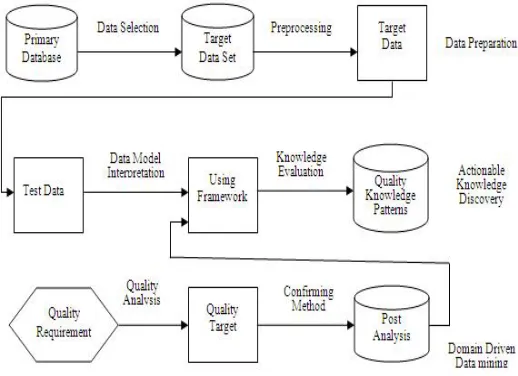
finished products. The architecture of the system consists of three main modules namely, data preparation, Actionable knowledge discovery and Domain Driven Data Mining as shown in Figure 1.
Figure 1: Architecture of IQM-AKD System
Data preparation module can reduce data dimensions furthermore, enhance valuable quality information and simplify the operation effectively, through eliminating unnecessary or lighter influential attribute. Analyzing data is an important and exciting step in the quality control process. It is the time that you may reveal important facts about your customers, uncover trends that you might not otherwise have known existed, or provide irrefutable facts to support your plans. By doing in-depth data comparisons, you can begin to identify relationships between various data that will help you understand more about your respondents, and guide you towards better decisions. In the module, there are three main links namely, data selection, preprocessing, data reduction. Data selection is used to collect relevant data from the primary quality database according to the need for quality knowledge discovery. The main function of preprocessing is reducing the noise, looking over integrality and consistency of quality data and dispelling the redundant data. Data reduction can analyze the initial characteristic attribute of the dataset further after reducing the amount of test data.
The aim of D3M module is just ascertaining the target of quality improvement. Because different quality targets will adopt different intelligent frameworks during the concrete process of Quality Actionable Knowledge Discovery, the model will first confirm the actual types of quality discovered in the process through analysis of quality demanding. After ascertaining quality target, the suitable PA-AKD framework. Then quality mathematics model are set up through corresponding Actionable Knowledge Discovery approach.
In order to discover more effective quality knowledge, Actionable Knowledge Discovery module might return to the steps of some preceding treatment sometimes, and execute repeatedly. First the relevant quality deliverables can be discovered from the sample data by using the PA-AKD, which can also be expressed by some commonly used expression methods or specific ways. But the in-depth patterns obtained by the above mining algorithm might be “new” or “interesting” one.
5. Implementation Process of Quality Discovery
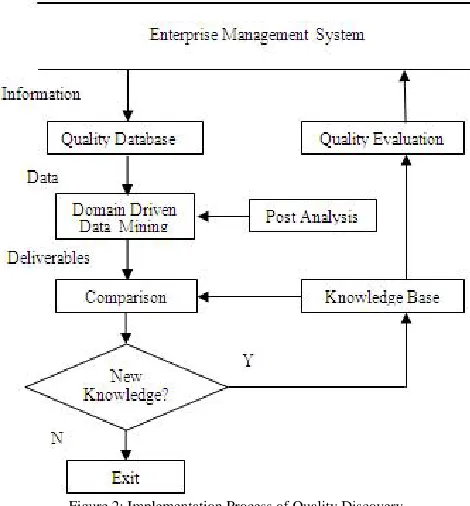
Implementation process of quality discovery is mainly composed of quality knowledge base, primary quality database, method base and data mining module. According to the concrete characteristic of IQM information processing, basing on quality data, production process parameters and monitoring data in comprehensive quality database of IQM system, many kinds of actionable knowledge mining methods can be used to discover valuable quality information for enterprises. Among those various mining methods, the domain driven data mining approach is chosen for the implementation of Enterprise Management System. A critical aspect of planning for quality improvement is to discover the relationship between process features and quality features or results automatically.
Figure 2: Implementation Process of Quality Discovery
The Quality Discovery technology chooses and preprocessing initial quality data in primary database, which plays a role in features extraction of quality information. The system can categorize and reason characteristic from primary quality information by machine learning with existing quality knowledge obtained from the enterprise database in-order to catch up the customer requirements, evaluate the quality state in the on-the-spot production process. At the same time, the suitable artificial intelligent algorithm is chosen from the knowledge base to mine quality information by the PA-AKD approach of D3M, finds potential quality knowledge of actionable knowledge discovery deliverables, and compares the result with the relevant information in the knowledge base. If there is no repetitiveness between them, it can be regard as “new quality knowledge” and be sent to the quality knowledge base after reviewing. The implementation process of quality discovery is discussed in the next section.
6. Architecture of the Intelligent Quality Management Expert System
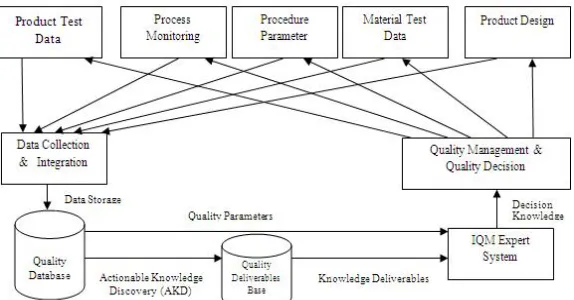
In the IQM Expert System, the quality information is large-scale and complicated. But the knowledge source of the traditional quality knowledge base mainly comes from the manual summary, which is the experience sum up by relevant experts engaged in quality control. Obviously, the process of Quality Actionable Knowledge Discovery, with very strong randomicity and uncertainty, is too complicated to human brain. Therefore, the conventional quality expert system has “bottleneck problem” of poor quality knowledge’.
D3M technology well meets the need of quality knowledge acquisition of IQM Expert System. It can discover new quality deliverables from the primary quality database constantly, establishes and enriches the quality knowledge patterns base constantly, offers the new deliverables evidence for IQM expert system.
Figure 3: Intelligent Quality Management Expert System
7. Conclusion
In this paper we proposed a system architecture, design for implementing entrepreneur-oriented Intelligent Quality Management expert system and discuss how this approach can be applied to support decision making process in various domains in an organization. In fact, the Domain Driven Data Mining is closely linked to the large potentiality of Business Intelligence with the future of Intelligent Quality Management Expert system. PA-AKD system is then used to extract truly interesting patterns from the database. By using both technical interestingness and business expectations patterns of PA-AKD system, the efficiency of accessing the data from their database can be efficiently improved. It will predictably bring Intelligent Quality Management Expert system more extensive application prospect, customer satisfaction and market value. The value must make enterprise in different level compete and win totally with now, and play a vital role to the core competitiveness, which strengthen enterprises.
References
[1] Xiaoh Wang, “Intelligent Quality Management using Knowledge Discovery in Databases”.
[2] A. Azadeh, “Design and development of integrated quality control system,” SICE Annual Conference, Okayama, Japan, 2005, pp. 3090-3094.
[3] H. Eriksson, and R. Garvare, “Organisational performance improvement through quality award process participation,” International Journal of Quality & Reliability Management, 2005, vol. 22, no. 9, pp.894–912.
[4] Longbing Cao, Yanchang Zhao, Huaifeng Zhang, Dan Luo, Chengqi Zhang, E.K. Park,”Flexible Frameworks for Actionable Knowledge Discovery”, IEEE TRANSACTIONS ON KNOWLEDGE AND DATA ENGINEERING, vol. 1,NO.1.2008 [5] J.C. Bou-Llusar, A.B. Escrig-Tena, and V. Roca-Puig, “An empirical assessment of the EFQM Excellence Model: Evaluation as
a TQM framework relative to the MBNQA Model,” Journal of Operations Management, 2009, vol. 27, no. 1, pp. 1-22.