DYNAMIC REDUCTS IN OBJECT
ORIENTED INFORMATION SYSTEM
USING ROUGH SET THEORY
N. Ravi Shankar
1, T. Srikanth
2, B. Ravi Kumar
21
Department of Applied Mathematics, GIS, GITAM University, Visakhapatnam, India
2
Department of Computer Science, GIS, GITAM University, Visakhapatnam, India
Abstract
We introduce dynamic reducts in object oriented information system using rough set theory. To develop dynamic reducts in object oriented information system using rough set theory ,we propose object-oriented information system into rough set models. To accomplish this, we construct the class, object, and name structures using rough set theory. Next, combining class, name and object structures, we propose object-oriented information systems. Moreover, we introduce indiscernibility relations on the set of objects, lower and upper approximations, and object-oriented rough sets in the object-object-oriented information systems and we introduce the concept of object object-oriented reducts, object oriented reducts using indiscenibility matrix.
Keywords: rough set, object-orientation, discernibility matrix, reducts
1. Introduction : Rough set theory ([1,2,3]), proposed by Z. Pawlak in 1982, offered an effective mathematical method to deal with uncertainty knowledge. Recently, rough set theory and its application have been developed rapidly, which are mainly concentrated on the generalization of rough set model, the research on uncertainty theory in rough set, rough set operations and their connections with other uncertainty operations, rough set and its contacts with other mathematical theories and so on.
Rough set theory [1, 2] provides a theoretical foundation of approximation of objects. Information systems represent characteristics of objects by attributes and its values, and for any given concepts, that is, any subsets of objects, lower and upper approximations by indiscernibility relations illustrate set-theoretic approximations of concepts. However, “traditional” rough set theory has the following two constraints:
1. All objects have the same attributes, thus it is difficult to illustrate different kinds of objects in one information system simultaneously.
2. There is no structural dependence between objects, for example, concrete / abstract relationship, and part/ whole relationship. In this paper, to weaken these constraints, and explicitly treat different kinds of objects and structural hierarchy among objects when we consider approximation by rough set theory, we introduce the object-oriented paradigm[4] to the rough set theory, and propose object-oriented rough set models.
Reducts generated from information systems are sensitive to changes in the system. This can be seen by removing a randomly chosen set of objects from the original object set. Those reducts frequently occurring in random subtables can be considered to be stable , it is these reducts that are encompassed by dynamic reducts[11]
2. Rough Sets and Information Systems
An information systemis a pair S = (U,A) where Uand Aare finite and nonempty sets. U is called the universe, and each element x∈Uis called an object, respectively. On the other hand, each element a ∈A is called an attribute, which is identified with a function
a
:
U
→
v
athat assigns a value to each object x∈U, wherev
a is the set of values of the functiona
.For any subset B ⊆ Aof attributes, we construct an indiscernibility relation RBon U as follows: xRBy ⇔ a(x) = a(y) , ∀ a∈ B … (1)
where a(x) means the value of the object x∈Uat the attribute a. x RB y means that we can not discern x and yby any combination of attributes in B. It is clear that the indiscernibility relation RBis an equivalence relation. We denote the equivalence class by RBthat contain x as
[
x
]
RB. The class of all equivalence classes by RBprovides a partition U/RBof U.For a given information system S=(U,A), a given subset B ⊆A of attributes, and any subset X ⊆ U, we construct a lower approximation
R
B(
X
)
and an upper approximationR
B(
X
)
of X as follows, respectively:)
(
X
R
B ={
x
∈
U
/
[
x
]
B⊆
X
}
… (2))
(
X
R
B ={
x
∈
U
/
[
x
]
B∩
X
≠
φ
}
… (3) The lower approximation of X is the set of objects x that the equivalence classB
R
x
]
[
of x is included to X, and the upper approximation of X is the set of objects x thatB
R
x
]
[
has a non-empty intersection with X. Note that we have the following set-inclusion relation:R
B(
X
)
⊆ X ⊆R
B(
X
)
.A rough set of X is a pair R(X) = (
R
B(
X
)
,R
B(
X
)
)of the lower approximation and the upper approximation ofX. The rough set R(X) provides an approximation of the set X in the information system Sbased on attributes in B. If we have
R
B(
X
)
=X=R
B(
X
)
,X is called RB-definable. On the other hand, if we haveR
B(
X
)
⊂ X⊂
R
B(
X
)
,X is called RB-rough.Quality of approximation of X by the rough set RB(X) is numerically evaluated as follows:
|
)
(
|
|
)
(
|
X
R
X
R
B B… (4)
where, for any set S, |S| means the cardinality of S. It is clear that the quality of approximation is equal to 1 if and only if X is RB-definable.
Let P and Q be equivalence relations over U, then the positive , negative and boundary regions are defined as :
)
(
~
)
(
/X
Q
POS
P Q U X P ∈∪
=
… (5))
(
~
)
(
/X
U
Q
NEG
P Q U X P ∈∪
−
=
… (6))
(
~
)
(
~
)
(
//
X
X
Q
BND
P Q U X P Q U X P ∈ ∈∪
−
∪
=
… (7)Let S= (U,C,D) be information system where C is set of condition attributes and D is set of decision attributes. The set of attributes R ⊆ C is called a reduct of C, if S' = (U,R,D) is independent and POSR(D) =
POSC(D).The set of all the condition attributes indispensable in T is denoted by CORE (C) = ∩ RED (C) where
RED (C) is the set of all reducts of C.
2.2. Object-Oriented Paradigm
In this subsection, we review object-oriented paradigm briefly. Contents of this subsection are based on [4]. Object-orientation is a framework for software engineering based on objects and classes, which provides modeling and implementation methodologies of systems. According to [4], object-oriented paradigm is summarized as the following characteristics by Alan Kay [5]:
The object oriented paradigm draws heavily on the general systems theory as a conceptual background. A system can be viewed as a collection of entities that interact together to accomplish certain object tools. Entities may represent physical objects such as equipment and people and abstract concepts such as data files and functions. In object oriented analysis, the entities are called objects.
The object oriented paradigm places greater emphasis on the objects that encapsulate data and procedures. Computation is performed by objects communicating with each other, requesting that other objects perform actions. Objects communicate by sending and receiving messages. A message is a request for action bundled with whatever arguments may be necessary to complete the task. Each object has its own memory, which consists of other objects. Every object is an instance of a class. A class simply represents a grouping of similar objects, such as integers, or lists. The class is the repository for behavior associated with an object. That is, all objects that are instances of the same class can perform the same actions. Classes are organized into a singly-rooted tree structure, called the inheritance hierarchy. Memory and behavior associated with instances of a class are automatically available to any class.
3. Object-Oriented Rough Set Models
In this section, we propose object-oriented information systems that illustrate hierarchical structures of object oriented concepts. First, we propose class structures that represent abstract data forms and hierarchical structures between classes. Next, we define object structures that illustrate many kinds of objects and actual dependence among objects by has-a relationship and offers-a relationship.
Moreover, we define name structures that introduce strict constraint to guarantee consistency of structures. Name structures provide concrete design of objects, and connect the class structure and the object structure consistently. Finally, combining these structures, we provide object oriented information systems as generalization of “traditional “information systems of rough set theory.
3.1. Class
Definition 1: A class structure C is the following triple:
( C, Rc, Sc) --- (6)
Where C is finite non-empty set, Rc is acyclic binary relation on C that is Rc satisfies the following property : ∃ c1,c2 ,…cn ∈ C such that c1 Rc c2, c2 Rc c3 ,… cn-1 Rc cn , cn Rc c1
and Sc is a reflexive, transitive, and asymmetric binary relation on C. Moreover, CR and CS satisfying the following
property:
∀ ci, cj, ck ∈ C , ci Sc cj , cj Rc ck ⇒ cj Rc ck …. (7)
Each c ∈ C is called a class that represents an abstract data form. Note that each class corresponds to a sort in many-sorted logic [6] and order-many-sorted logic [7].
Two relations Rc and Sc illustrate hierarchical structures among classes. The relation Rc is called a
offers-a reloffers-ation, which illustroffers-ates poffers-art / whole reloffers-ationship between cloffers-asses. ci Rc cj means “ci offers a cj”. The relation Sc
Because C is a finite non-empty set, and Rc is acyclic, there is at least one class c such that c has no other
class
c
′
, that is, c Rcc
′
for anyc
′
∈ C. We call such class c an attribute, and denote the set of attributes by AT .Formally,AT is defined as follows:
AT = {c ∈ C / c Rc
c
′
, ∀c
′
∈ C } … (8)Example 1:Let = (C, RC,SC ) be class structure with
C={University,College,Department,Faculty,Student,Course,Ncollege,Ndept,Nstudents } and have the following relations.
has-a relation: University Sc College,
College Sc Department,
University Sc Department,
……….
Offers- a relation: College Rc Department
Department Rc Courses.
Suppose moreover that Ncollege, Ndept and Nstudents are attributes.
By the Property(6) ,these relations illustrate connection between classes, for example , “University has a College” and “College offers Department “ imply “University offers department”
(or)
“University has a Department ” and “Department offers Course” imply “University offers Course ”
3.2. Object
We define an object structure that illustrates hierarchical structures among objects. Definition 2: An object structure O is the following triple:
(O, Ro ,So) … (9)
where O is a finite non-empty set, Ro is an acyclic binary relation on O, and So is a reflexive, transitive, and
asymmetric binary relation on O. Moreover, similar to the definition of class, Rc, and Sc satisfy the following
property:
∀ oi ,oj, ok∈ O, oi So oj , oj Ro ok⇒ oi Ro ok … (10)
We intend that every object o ∈ O is an instance of some class c ∈C. To represent this intention, we define a class identifier function idC as follows.
Definition 3: Let C=( C, Rc, Sc) be the class structure and O = (O, Ro ,So)
be the object structure. A function idC:O→C is called class identifier iff idc a p-morphism between O and C(cf.[8],p142) that is, the function idC satisfies the following conditions:
1. ∀ oi, oj∈ O , oi Ro oj⇒ idC (oi) Rc idc(oj) … (11)
2. ∀ oi∈ O , ∀ cj c C , idC (oi) Rc cj⇒ ∃ oj∈ O s.t. oi Ro oj and idc (oj) = cj … (12)
and the same conditions are also satisfied for So and Sc. idC_(o)=c means that the object o is an instance of the class
c.
For any object x , if idc (x) = a and a ∈ AT, we call such object x a value object of the attribute a. The value object x
is an instance of the attribute a represents a “value” of the attribute. Thus, if y is another value object of a , it is natural to enable us to compare the “value” of x and y. We introduce the concept of “value” of value objects.
Definition 4: For any object x, if idC(x)=a and a ∈ AT, we call such object x a value object of the attribute a. We
3.3. Name
We introduce a name structure to provide concrete design of objects, and connect the class structure and the object structure consistently. The class structure provides abstract data forms of objects, however, does not provide constraints about the number of parts and their identification. Suppose we have ci Rc cj and we intend that any
instance oi of the class ci has m objects of cj as parts of oi and each object of cj should be strictly identified. Direct
connection between objects and classes by the class identifier idC.
Definition 5 : Let C= ( C, Rc, Sc) be the class structure. A name structure N for C
is the following triple:
(N, RN ,SN ) … (13)
where N is a finite non-empty set such that |C| ≤ |N| , RN is an acyclic binary relation on N, and SN is a reflexive,
transitive, and asymmetric binary relation on N. Moreover, similar to the definition of class, RN and SN satisfy the
following property :
∀ ni , nj, nk∈ N , ni SN nj , nj RN nk⇒ ni RN nk … (14)
We call each n ∈ N a name.
We intend that a naming function fn : N→ C provides names to each class. To introduce the naming function
precisely, we define the following notations.
Definition 6: Let C = ( C, RC,SC) be the class structure, N = (N,RN,SN) be the name structure, and f : N → C be a
function. For any name n ∈ N, we denote the set of names that n has by :
HN (n) = { nj∈ N / n RN nj} … (15)
Moreover, using the function f, we denote the set of names of a class c ∈ C that n has by f
n
H
(c/n) = { nj∈ N / n RN nj , f(nj) = c } … (16)Definition 7: Let C = ( C, RC,SC) be the class structure, N = (N,RN,SN) be the name structure.A function fn : N → C
is called a naming function if and only if fn is a surjective p-morphism between N and C and satisfies the following
name preservation constraint:
For any ni , nj ∈ N, if fn(ni) = fn(nj) then
)
/
(
)
/
(
i nf jf
n
c
n
H
c
n
H
n=
n… (17) is satisfied for all c ∈ C.
Example 2: This example is continuation of Example1. Let C = ( C, RC,SC) be the class structure in Example1, N =
(N,RN,SN) is a name structure with
N={university,college,department,faculty,student,college2,course,ncollege,ndept,nstudents} and the following relationships:
Has- a relation: : university SN college,
college SN department,
university SN Department,
Offers-relation :
College RN Department
Department RN Courses.
Moreover, suppose we have a naming function fn : N → C such that
fn (university) = University,
fn(department) = Department,
fn (faculty) = Faculty,
fn(student) = Student,
fn( course) = Course,
fn(ncollege) = Ncollege,
fn(ndepartment) = Ndepartment,
fn(nstudent) = Nstudent.
Note that we have HN (College/university) = {college, college2}, and
HN (Ndepartment/ college) = HN (Ndepartment/ college2) = {ndepartment}.
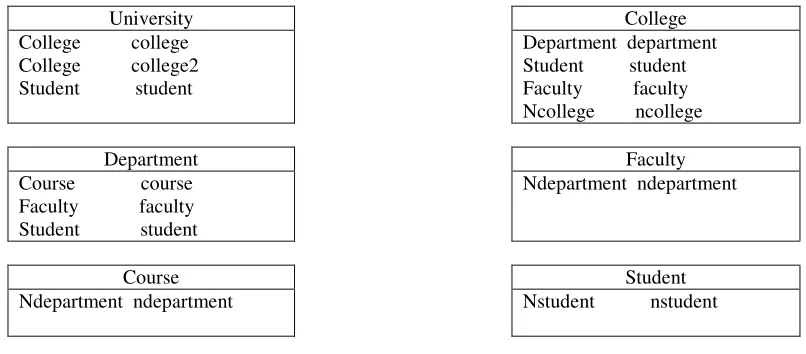
Here, to illustrate connection between the classes and names, we use class diagrams of UML[9] authorized by OMG[10] as in Fig 1. For example, the class diagram “University” illustrates that University class has two objects of the College class , called “college” and “college2”, respectively, one object “student” of the Student class , and one object “faculty” of the Faculty class.
University College
College college College college2 Student student
Department department Student student Faculty faculty Ncollege ncollege
Department Faculty
Course course Faculty faculty Student student
Ndepartment ndepartment
Course Student
Ndepartment ndepartment Nstudent nstudent
Fig 1. Class diagrams in example 2
Definition 8 : Let O = ( O, Ro, So) be the object structure and N = (N,RN,SN) be the name structure. A function
a
n: O → N is called a name assignment if and only ifa
n is a p-morphism between O and N satisfies the following uniqueness condition :For any x ∈ O, if HO(x) ≠φ , the restriction of
a
n into HO(x) :n
a
/HO(x) = HO(x) → N … (18)is injective, where HO(x) = { y ∈ O / x RO y} is the set of objects that x has
a
n(x) = n means that the name of the object x is n.Definition 9 : Let C = ( C, RC,SC) be the class structure, N = (N,RN,SN) be the name structure, O = ( O, Ro, So) be
the object structure. Moreover, let idC : O → C be the class identifier. We say that C, N and O are well defined if
and only if there exists a naming function fn : N → C and a name assignment
a
n: O → N such that idC = fn oa
n … (19)that is, idC (x) = fn (
a
n(x)) for all x ∈ O .Definition 10 : Let C, N and O be well definedstructures. Suppose we have o1,o2,… ok∈ O , n1, n2,…nk∈ N, and
c1,c2,…ck∈ C such that oi RO oi+1 for 1 ≤ i ≤ k-1, and
a
n(oi) = ni , fn(ni) = ci for 1 ≤ i ≤ k. We denote o1.n2…niinstead of oi for 2 ≤ i ≤ k by means of “the instance of ci named ni as a part of the instance of ci-1…as a part of o1”. Example 3 : This example is continuous of Example 2. Let C = ( C, RC,SC) and N = (N,RN,SN) are the
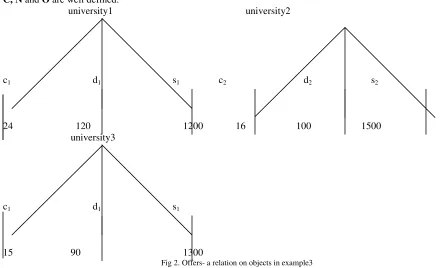
same class structure and name structure in example 2, respectively. Moreover, let O = ( O, Ro, So) be an object
x SO x , ∀ x ∈ O and
university3 SO university1 , university3 SO university2.
Moreover, let
a
n :O → N be the following name assignment : na
(university1) =a
n(university2) = college, na
(university3) = college2, na
(c1) =a
n(c2)=a
n(c3) = college, na
(c4) = college2, na
(s1) =a
n(s2) =a
n(s3) = student, na
(f1) =a
n(f2) =a
n(f3) = faculty, na
(24) =a
n(16) = ncollege, na
(150) =a
n(120) = ndepartment, na
(2400) =a
n(1200) = nstudent.We define the class identifier idC : O → C by Eq.(19) using
a
n and fn used in example 2. It is not hard to check that C, N and O are well defined.university1 university2
c1 d1 s1 c2 d2 s2
24 120 1200 16 100 1500 university3
c1 d1 s1
15 90 1300
Fig 2. Offers- a relation on objects in example3
Object-Oriented Information System
Using well defined class, name structure and object structures, we introduce an object oriented information system that corresponds to the information in “traditional” roughset theory.
Definition 11: Let C = ( C, RC,SC) and N = (N,RN,SN), O = (O, Ro ,So) be well defined class, name, object structures
respectively, An object oriented information system OOIS(O,C,N) is the following structure: OOIS(O,C,N)= (O,C,N,o,idc) … (20)
where idc = fn o
a
nThe object oriented information system can be illustrate “traditional” information system as special case. In particular ,for any information system IS(U,A) ,we can construct an object oriented information system OOIS(OIS, CIS,NIS ) that corresponds to IS: First, using the information system IS = (U,A), we construct a name structure. NIS = (NIS ,
IS IS N
N
S
NIS = A ∪ {IS} IS
N
R
= {(s,a) / a∈ A}IS
N
S
= {(n,n) /n ∈ NIS}Where s is a symbol that doesnot appear in A. We also construct and object structure
OIS = (OIS ,
IS IS O
O
S
R
,
) as follows :OIS = U ∪ (
{
v
/
a
,
x
,
v
v
a,
a
(
x
)
v
}
xa A
a
∪
∈∃
∃
∈
=
)IS
O
R
= { (x,v
ax) /x∈ U}IS
O
S
= {(o,o) /o ∈ OIS}Where
v
ax is a new symbol that corresponds to the value of the object of the attribute a as a part of the object x , and v (v
ax) = v.We set a class structure CIS = (CIS ,
R
CIS,
S
CIS ) as CIS = NIS ,R
CIS =R
NIS andS
CIS=S
NIS. Finally, we construct a name assignment( )
IS
N n
a
, a naming function( )
IS
C n
f
, and a class identifierIS
C
id
,respectively. Suppose a function
( )
a
n NO
ISN
ISIS
:
→
by( )
a
n NIS (o) =
∈
∃
∈
∈
U
x
v
o
if
a
U
o
if
s
x a,
The function
( )
IS
N n
a
becomes a name assignment : if o∈ U,then we have HO(o) = {v
/
a
A
}
o
a
∈
, that is, the set of value objects about o, and by the construction of value objects o av
, each oa
v
anda
=( )
IS
N n
a
v
ao ∈ NS corresponds one to one. Otherwise, we have o =x a
v
, and therefore HO(o) = φ. Wedefine the naming function
( )
f
n CN
ISC
ISIS
:
→
by( )
f
n CIS(n) = n ∈C
IS for all n ∈ NIS.Using
( )
IS
N n
a
, we getIS
C
id
=( )
IS
C n
f
o( )
IS
N n
a
.OOIS (OIS, CIS,NIS ) satisfies the following property : a(x) = v ⇔val (x,a) =v , ∀x ∈ U, ∀a ∈A.
4. Indiscernability Relations and object orient Rough sets
4.1 Equivalence as instance
We provide indiscernability relation on O based on structural aspects of objects. At first, we introduce an equivalence relation that illustrates “equivalence as instances of a class”. To evaluate equivalence of instances, we use names of parts of instances as follows.
Definition 12: Let OOIS ( O,C,N) be the object oriented information system. We define a binary relation ~ on O recursively as follows:
x ~y ⇔ x and y satisfy the following two conditions : 1. idC(x) = idC(y) and
2. x.n ~y.n, ∀n ∈ HN (
a
n(x) ) if HN (a
n(x) ) ≠φ,val(x) = val(y) … (21) where HN(
a
n(x)) is the set of names thata
n(x) has, and defined by Eq.(15).Example 4: This example is continuation of Example3. Let OOIS (O,C,N) be the object-oriented information system based on the class structure C, the object structure O and the name structure N used in example 3. We construct the equivalence relation ~ on O by Eq.(20). Equivalence classes by ~ are as follows:
[university3]~ ={university 3}, [s1]~ ={s1,s2,s4}, [s2]~ = {s2}, [d1]~={d1} ,[d2]~ ={d1,d2}, [c1]~={c1,c2}, [c3]~ ={c3},
[24]~={university1.college.dept,university3.college.dept, university3.college2.dept} [16]~={university2.college2.dept}
Note that
a
n(c1) =a
n(c3)=a
n(c4) = college,a
n(c4)=college2 and fn(college) = fn(college2) = college. By thename preservation constraint, we have HN(Ndepartment/college) = HN (Ndepartment/college2) = {ndepartment} as
illustrated in example 2. Therefore, for example, we can evaluate the equivalence of
c1 (= university.college) and c4(=university3.college2) by evaluating the equivalence of university1.college. department and university3.college2.department.
4.2. Object-Oriented Rough Sets
Definition 13: Let OOIS ( O,C,N) be the object oriented information system, and ~ be the equivalence relation defined by Eq.(20). For any non-empty subset B ⊆ N, we define a binary equivalence relation ~B on O as follows :
x ~B y ⇔ x and y satisfy the following two conditions:
1. B ∩ HN (
a
N(
x
)
) = B ∩ HN (a
N(
y
)
) , and , … (22) 2. ∀ n [ n ∈ B∩ HN (a
N(
x
)
)⇒x.n ~y.n]Definition 14: Let OOIS ( O,C,N) be an object oriented information system, B ⊆ N is a non-empty subset of names, and ~B be the equivalence relation defined by Eq.(22). For any subset X⊆O of objects, the lower
approximation
~
B(
X
)
and upper approximation)
(
~
BX
of X by ~B are defined as follows, respectively:)
(
~
BX
= { x ∈ O / [x]~B⊆X} … (23))
(
~
BX
= { x ∈ O / [x]~B ∩ X ≠φ } … (24)Moreover, the object –oriented rough set ~B (X) of X by ~B is the following pair :
(
~
B(
X
)
,~
B(
X
)
) … (25)• X is roughly ~B –definable, if and only if
~
B(
X
)
≠φ and~
B(
X
)
≠ U.• X is internally ~B undefinable, if and only if
~
B(
X
)
= φ and~
B(
X
)
≠ U.• X is externally ~B – undefinable, if and only if
~
B(
X
)
= φ and~
B(
X
)
= U.• X is totally ~B – undefinable, if and only if
~
B(
X
)
= φ and~
B(
X
)
= U.The quality of approximation of X by the rough set ~B is defined by
|
)
(
~
|
|
)
(
~
|
X
X
B B
and some properties of approximations are as follows.
1.
~
B(
X
)
⊆ X ⊆~
B(
X
)
2.
~
B(
φ
)
=~
B(
φ
)
= φ,~
B(
O
)
=~
B(
O
)
= O. 3.~
B(
X
∪
Y
)
=~
B(
X
)
∪
~
B(
Y
)
4.
~
B(
X
∩
Y
)
=
~
B(
X
)
∩
~
B(
Y
)
.6.
~
B(
X
∪
Y
)
⊇
~
B(
X
)
∪
~
B(
Y
)
7.~
B(
X
∩
Y
)
⊆~
B(
X
)
∩
~
B(
Y
)
8.~
B(
−
X
)
= -~
B(
X
)
9.
~
B(
−
X
)
= -~
B(
X
)
10.
~
B(
~
B(
X
))
=
~
B(
~
B(
X
)
)
=
~
B(
X
)
11.~
B(
~
B(
X
))
=
~
B(
~
B(
X
)
)
=
~
B(
X
)
where –X denotes O-X.Definition 15 : Let O = (O,RO,SO) be the object structure and D= {d1, d2,…dn} be set of decision attribute values
and d ∉ AT where AT is set of all condition attributes. A function gn : O → D is called decision function if and only
if gn is a surjective p-morphism and satisfies the following constraint :
∧
c
i⇒
d
i where ci∈ AT and di∈ D ( i= 1, 2,…|AT|) … (26)Example 5: This example is continuation of Example 4. Suppose B={college},using the equivalence relation ~ constructed in example 4, we construct the equivalence relation ~B and equivalence classes by ~B are as follows :
[university1]~B ={university1,university3}, [university2]~B = {university 2}
[c1] ~B = O – {university1,university2,university3}.
The equivalence classes [university1] ~B correspond to the set of objects with the “24 college” and [university2]~B is the set of objects with “16 colleges”. On the other [c1]~B represents the set of objects that has no instance of the College class. Note that university1 and university3 are in the same university class [university1]~B even though
idC(university1) ≠ idC(university3).
Let X={university2,university 3}. The lower approximation
~
B(
X
)
and upper approximation~
B(
X
)
of X by ~B are constructed as follows ,respectively.}
]
/[
{
)
(
~
BX
=
x
∈
O
x
~B⊆
X
={university2},}
]
/[
{
)
(
~
BX
=
x
∈
O
x
~B∩
X
≠
φ
={university1.university2,university3}, Thus object oriented rough set ~B (X)is :(
~
(
),
~
(
)
)
)
(
~
BX
=
BX
BX
=({university2},{university1,university2,university3})and the quality of approximation of X={university2,university3} by the roughest ~B(X) is
3
1
.5. Object oriented reducts
We provide definition of reducts in the object –oriented rough set models and propose algorithms for calculating reducts.
Consider the attributes that preserve the indiscernibility relation and, consequently, set approximation. There are usually several subsets of attributes and those which are minimal are called reducts.
Positive ,Negative and Boundary Regions :
Let P and Q be equivalence relations over O, then the positive , negative and boundary regions are defined as :
)
(
~
)
(
/X
Q
POS
P Q O X P ∈∪
=
… (27))
(
~
)
(
/X
O
Q
NEG
P Q O X P ∈∪
−
=
… (28))
(
~
)
(
~
)
(
//
X
X
Q
BND
P Q O X P Q O X P ∈ ∈∪
−
∪
The positive region comprises all objects of O that can be classified to classes of O/Q using the information contained within attributes P. The boundary region
BND
P(
Q
)
, is the set of objects that can possibly, but not certainly, be classified in this way. The negative region,NEG
P(
Q
)
, is the set of objects that can not be classified to classes of O/Q.Dispensable & Indispensable attributes
Let c∈AT. Attribute c is dispensable in OOIS if
POS
AT(
D
)
=
POS
(AT−{c}(
D
)
, otherwise attribute c isindispensable in OOIS. The AT-positive region of D:
)
(
~
)
(
/
X
D
POS
ATD O X AT
∈
∪
=
… (30)Independent Object oriented Information system :
OOIS (O,C,N) is independent if all c∈AT are indispensable in OOIS.
Reduct and Core :
• The set of attributes R ⊆ AT is called a reduct of AT, if OOIS'(O,R,N)is independent and
)
(
)
(
D
POS
D
POS
R=
AT .• The set of all the condition attributes indispensable in T is denoted by CORE (AT) = ∩ RED (AT) where RED (AT) is the set of all reducts of AT.
Feature Dependency and significance :
An important issue in data analysis is discovering dependencies between attributes. Intuitively , a set of attributes Q depends totally on a set of attributes P, denoted P⇒Q, if all attribute values from Q are uniquely determined by values of attributes from P. If there exists a functional dependency between values of Q and P, then Q depends totally on P. In object oriented rough set theory, dependency is defined in the following way :
For P,Q ⊂ AT, it is said that Q depends on P in a degree k ( 0 ≤ k ≤1), denoted P⇒k Q, if
k =
|
|
|
)
(
|
)
(
O
Q
POS
Q
PP
=
γ
. … (31)By calculating the change in dependency when a feature is removed form the set of considered possible features, an estimate of the significance of that feature can be obtained. The higher the change in dependency, the more significant the feature is. If the significance is 0, then the feature is dispensible. More formally, given P,Q and a feature x ∈P, the significance of feature x upon Q is defined by
σ
P(
Q
,
a
)
=
γ
P(
Q
)
−
γ
P−{a}(
Q
).
… (32)Reducts
For many application problems, it is necessary to maintain a concise form of the object oriented information system. One way to complement this is to search for a minimal representation of the original data set. For this, the concept of a reduct is introduced and defined as a minimal subset R of the initial attribute set AT such that for a given set of attributes D,
γ
R(
D
)
=
γ
AT(
D
)
.From the literature ,R is a minimal subset if)
(
)
(
}
{a
D
RD
R
γ
γ
−≠
for alla
∈
R
. This means that no attributes can be removed from the subset affecting the dependency degree. Hence, a minimal subset by this definition may not be the global minimum(a reduct of smallest cardinality). A given dataset may have many reduct sets ,and the collection of all reducts is denoted by
R
all=
{
X
/
X
⊆
AT
,
γ
X(
D
)
=
γ
AT(
D
);
γ
X−{a}(
D
)
≠
γ
X(
D
),
∀
a
∈
X
}
…. (33)The intersection of all the sets in Rall is called the core, the elements of which are those attributes that cannot be
eliminated without introducing more contradictions to the representation of the dataset.
For many tasks, a reduct of minimal cardinality is ideally searched for. That is, an attempt is to be made to locate a single element of the reduct set Rmin ⊆ Rall :
R
min=
{
X
/
X
∈
R
all,
∀
Y
∈
R
all,
|
X
|
≤
|
Y
|
}
… (34) Discernibility Matrix :
c
ij=
{
a
∈
AT
/
a
(
x
i)
≠
a
(
x
j)}
i
,
j
=
1
,...,
|
O
|
… (35) Each cij contains those attributes that differ objects i and j .A discernibility function fOOIS for an object oriented information system is a boolean function of m Boolean
variables
a
1*,...,
a
m* corresponding to the membership of attributesa
1,
a
2,...,
a
m to a given entry of the discernibility matrix defined as below :
f
OOIS(
a
1*,...,
a
*m)
=
∧
{
∨
c
ij*/
1
≤
j
≤
i
≤
|
O
|,
c
ij≠
φ
}
… (36)where
c
ij*=
{
a
*/
a
∈
c
ij}.
By finding the set of all prime implicants of the discernibility function, all the minimal reducts of a system may be determined.Example 6: Consider the following table which shows an example of object oriented data set.
x∈O Ncollege Ndepartment Nstudent ⇒ Granting Research
Fund(GRF)
university1 5 10 100 Yes
university2 6 12 110 No
university3 8 14 100 Yes
university4 5 10 100 No
university5 6 12 110 Yes
university6 7 15 100 Yes
university7 8 14 100 No
university8 9 15 140 No
The indiscernibility classes defined by
R= {Ncollege, Ndepartment, Nstudent} are { university1, university4},{ university2, university5},{ university3, university7},{ university6},{ university8}.
Let G = {x /GRF(x) = Yes}. G1 = {o/ G(o) =Yes}
= { university1, university3, university5, university6}
1
G
R
= { university6}1
G
R
= { university1, university4, university2, university5, university3, university7, university6}G2 = {o/ G(o) =Yes}
= { university2, university4, university7, university8}
2
G
R
= { university8}2
G
Let P = {Ncollege, Ndepartment, Nstudent}, Q= {GRF}.
(
)
(
)
/
P
X
Q
POS
Q U X P ∈∪
=
=
R
G
1
∪R
G
2
= { university6, university8}
)
(
)
(
/
P
X
O
Q
NEG
Q U X P ∈∪
−
=
= O – {
R
G
1
∪R
G
2
} = O-O = φ)
(
)
(
)
(
//
P
X
P
X
Q
BND
Q U X Q U X P ∈ ∈∪
−
∪
=
= {university1,university3, university4, university5, university7, university8} REDUCT1 = {Ndepartment, Ncollege}
REDUCT2 = {Ncollege, Nstudent} CORE = REDUCT1 ∩ REDUCT2 = {Ncollege}
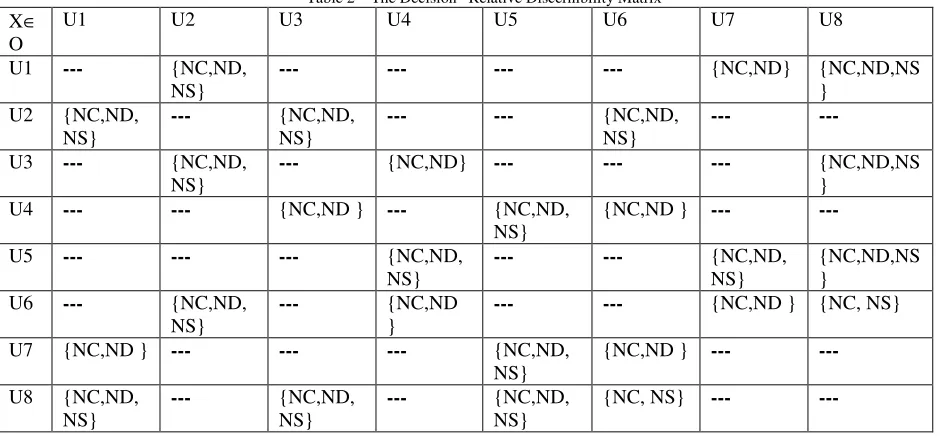
Let C= {Ncollege, NDepartment, Nstudent} and D={GRF} be set of condition and decision attributes respectively. Discernibility Matrix is
Table 2 – The Decision –Relative Discernibility Matrix X∈
O
U1 U2 U3 U4 U5 U6 U7 U8
U1 --- {NC,ND,
NS}
--- --- --- --- {NC,ND} {NC,ND,NS
}
U2 {NC,ND,
NS}
--- {NC,ND,
NS}
--- --- {NC,ND,
NS}
--- ---
U3 --- {NC,ND,
NS}
--- {NC,ND} --- --- --- {NC,ND,NS
}
U4 --- --- {NC,ND } --- {NC,ND,
NS}
{NC,ND } --- ---
U5 --- --- --- {NC,ND,
NS}
--- --- {NC,ND,
NS}
{NC,ND,NS }
U6 --- {NC,ND,
NS}
--- {NC,ND
}
--- --- {NC,ND } {NC, NS}
U7 {NC,ND } --- --- --- {NC,ND,
NS}
{NC,ND } --- ---
U8 {NC,ND,
NS}
--- {NC,ND,
NS}
--- {NC,ND,
NS}
{NC, NS} --- ---
where NC,ND,NS represents Ncollege, NDepartment, Nstudent respectively.
From table2 , the decision relative discernibility function is (with duplicates removed): fD(Ncollege, Ndepartment, Nstudent) = (Ncollege∨ Ndepartment∨ Nstudent) ∧
(Ncollege∨ Ndepartment) ∧ (Ncollege∨ Nstudent) = (Ncollege∨Ndepartment) ∧ (Ncollege∨ Nstudent) Therefore, the minimal reducts are { Ncollege,Ndepartment} and {Ncollege, Nstudent}.
6. Dynamic reducts
Let OOIS ( O, AT ∪{d}) be a decision table. By P(OOIS) we denote the set of all subtables of OOIS. If F is a family of subtables of OOIS, then
DR (OOIS,F) = RED (OOIS,d) ∩ {
RED
(
OOI
S
,
d
)
F s OOI′
∩
∈By introducing a threshold, 0 ≤ε≤ 1, the concept of (F, ε)- dynamic reducts can be defined :
DR
ε(
OOIS
,
F
)
=
{
OOI
S
′
∈
RED
(
OOIS
,
d
)
:
S
F(
OOI
S
′′
)
≥
ε
},
... (37)where
|
|
|
)}
,
(
:
{
|
)
(
F
d
S
OOI
RED
S
OOI
F
S
OOI
S
OOI
S
F′′
=
′
∈
′′
∈
′
is the F-stability coefficient of C. Thisgives the restriction that a dynamic reduct must appear in every generated subtable. Now, a reduct is considered to be dynamic if it appears in a certain percentage of subtables, determined by the value ε. For example, by setting ε to 0.5, a reduct is considered to be dynamic if it appears in at least half of the subtables. Note that if F= {OOIS}, then DR(OOIS,F) = RED (OOIS,d). Dynamic reducts may then be calculated according to the algorithm given below. First, all reducts are calculated for the given object oriented information system, OOIS. Then, the new subsystem OOISj are generated by randomly deleting one or more rows from OOIS. All reducts are found for each object
oriented subsystem, and the dynamic reducts are computed using
S
F(
OOI
S
′′
,
R
)
which denotes the significance factor of reduct C within all reducts R.Dynamic Reduct algorithm : Dynamic RED(OOIS, ε, nt)
OOIS, the object oriented decision table;
ε , the dynamic reduct threshold; nt , the number of iterations.
(1) R ← { }
(2) OOIS ← calculate all reducts (OOIS) (3) for (j =1 ; j <= nt ; j++)
(4) OOISj← delete random rows (OOIS)
(5) R← R ∪ calculate AllReducts (OOISj)
(6) ∀
OOI
S
′′
∈ OOIS (7) IfS
F(
OOI
S
′′
,
R
)
≥ε (8) outputOOI
S
′′
This is based on the hope that by finding stable reducts they will be more representative of the real world, i.e., it is more likely that they will be reducts for unseen data. A comparison of dynamic and nondynamic approaches can be found in [4], where various methods were tested on extracting laws from decision tables. In the experiments, the dynamic method and the conventional rough set method both performed well. In fact, it appears that the Rough set method has, on average, a lower error rate of classification than the dynamic rough set method.
Conclusion : We have introduced dynamic reducts in object oriented information system using rough set theory. We have proposed object-oriented information system into rough set models . Moreover, we have introduced indiscernibility relations on the set of objects, lower and upper approximations, and object-oriented rough sets in the object-oriented information systems and we have introduced the concept of object oriented reducts, object oriented reducts using indiscenibility matrix.
We can develop techniques for object oriented dynamic reducts using probability and we can also develop decision and dynamic rules for object oriented dynamic reducts.
References :
[1] Z.Pawlak, “Rough sets”, International Journal of Computer and Information Sciences 11,1982, 341-356.
[2] Z.Pawlak, Rough sets : Theoretical Aspects of Reasoning about Data, vol.9, kluwer Academic Publishers, Dorderecht, The
Netherlands, 1991.
[3] Z.Pawlak, A. Skowron, “Rudiments of rough sets”, Information Sciences ,1, 2007,3- 27.
[4] T. A. Budd, “An Introduction of Object-Oriented Programming, 2ndEdition,”Addison Wesley Longman, 1997.
[5] A. C. Kay, “The Early History of Smalltalk,” Proceedings of the 2nd SCMSIGPLAN History of Programming languages Conference,
ACM SIGPLAN Notice 28, Vol.3, pp. 69-75, 1993.
[6] R. Socher-Ambrosius and P. Johann, “Deduction Systems,” Springer, 1996.
[8] S. Popkorn, “First Steps in Modal Logic,” Cambridge University Press, 1994. [9] http://www.uml.org/
[10] http://www.omg.org/
[11] J.Bazan, A. Skowron, and P.Synak, “Dynamic reducts as a Tool for Extracting Laws from Decision Tables”, Proc. Eighth