Analysis the Behavior of Building with Different
Soft Story
Avinash Mishra Mrinank Pandey
Department of Civil Engineering Department of Civil Engineering
Government Engineering College Azamghar Madan Mohan Malaviya University of Technology, Gorakhpur
Abstract
Recent earthquakes have shown that the soft storey in building possess adverse effect on stability of structure. Heavy destruction of buildings with soft storey during the earthquakes has prompted research and analysis of the effects and stability of such buildings under earthquake condition .To analyze the effect of soft storey in seismic condition for multi-storeyed reinforced concrete building frame, building models (12 storey’s) with identical building plan were analyzed. Soft storey level was changed from stilt floor to top floor for each model including a bare frame and a full infill. Equivalent static analysis was carried away using STADD-PRO Analysis. Results shows that the presence of soft storey at the top level does not significantly affect the structural performance of fully infill frame. While the presence of soft storey at the lower level greatly affects the structural performance. Keywords: Earthquakes, Soft story, High-rise building, STADD-PRO
________________________________________________________________________________________________________
I. INTRODUCTION
Due to urbanization and less availability of space multistory buildings in India have open first storey (soft storey). According to Indian seismic a soft story is one whose lateral stiffness is less than 50% of the story above or below. During EQ total seismic base shear imposed on a building is depend upon its natural period. The mass along the height and stiffness distribution is the main factor to affect the seismic force distribution. In soft first storey buildings the upper storey’s experienced smaller inter-story drift in comparison of first storey due to stiffness. Due to maximum shear force at soft storey level the strength requirement at soft storey level is maximum. The soft storeys are especially dangerous in earthquakes because they cannot cope with the lateral forces due to sway mechanism of building. The study suggests that the presence of soft storey at the first storey level is most undesirable as it attracts large lateral forces that cannot be resisted alone by soft storey columns
II. PRELIMINARIES
A soft story is characterized by vertical discontinuity in stiffiness. When an individual storey in a building (often the ground level story) is made taller and more open in construction it is called soft storey. The beam and column of soft storey are designed to withstand two and half times the storey shears and moments calculated for specified seismic loads.
In case of tall, relatively open ground floor is necessary, any of the following additional arrangement may be provided to reduce the effect of soft storey.
1) Some of the open bays of the buildings may be braced.
2) The building plan periphery may be kept open while the interior frames may be braced. 3) The numbers of ground columns are increased.
III. DESCRIPTION OF STRUCTURAL MODELS
The research work so far is focused on the behavior of building with soft storey. it is observed that the designed forces in the buildings with open ground storey has not been has not been addressed adequately in the existing design codes. The amplification factor for the design forces in the open ground storey depends upon the number of stories, type and number of infill walls. They proposed an amplification factor to consider the nonlinear effects, for the design base shear based on liner analysis. The presence of soft storey either in ground story or in the upper storey, may lead to a dangerous sway mechanism in the soft story due to the formation of plastic hinges at the top and bottom end of the columns as these columns are subjected to relatively large cyclic deformation. The Indian standard recommend that the dynamic analysis of the structure is to be carried out considering the strength and stiffness contribution of infill frames, the inelastic deformation of the members, particularly those in the soft story and the members, particularly those in the soft storey and the members designed accordingly
IV. BUILDING DESCRIPTION
Here the model is of a twelve story moment resisting framed building having the plan dimensions of 15Mx20m with the bay of length of 5m in both direction and floor height of 3.2m is considered in the study.
The structure is modeled as 3D frame using Staad Pro, and the masonry infill is modeled as quadrilateral shell element of uniform thickness of 0.23mm.The 14 models of 12 storied RC frame structure are prepared, the bare frame model considering the mass of the brick infill but neglecting its stiffness contribution of the brick infill are the basic models considered in the study .the sectional properties of building elements are given.
Size of Elements
Size of column 600mmX600mm Size of Beam 300mmX600mm Thickness of slab 125mm
Properties of material
Modulus of Elasticity Poisson’s Ratio Grade Concrete 285000 MPa 0.2 M25
Steel 210000 MPa 0.3 Fe 415 Masonry 3500 MPa 0.2 -
Load Consideration
Seismic Zone Importance Factor Soil Type Live Load
5 1 2 3.5KN/m2
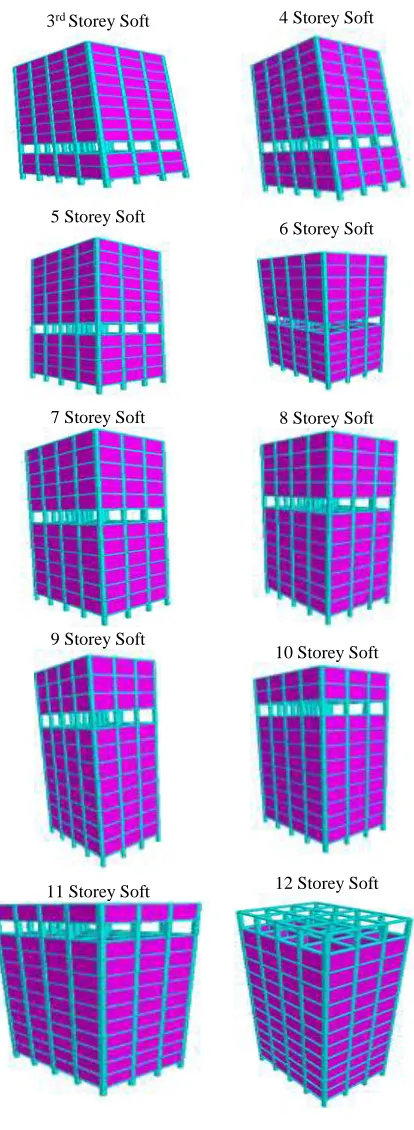
STADD- Pro Designing
BARE FRAME FULL INFLL
1ST Storey Soft
3rd Storey Soft 4 Storey Soft
5 Storey Soft
6 Storey Soft
7 Storey Soft 8 Storey Soft
9 Storey Soft
10 Storey Soft
11 Storey Soft 12 Storey Soft
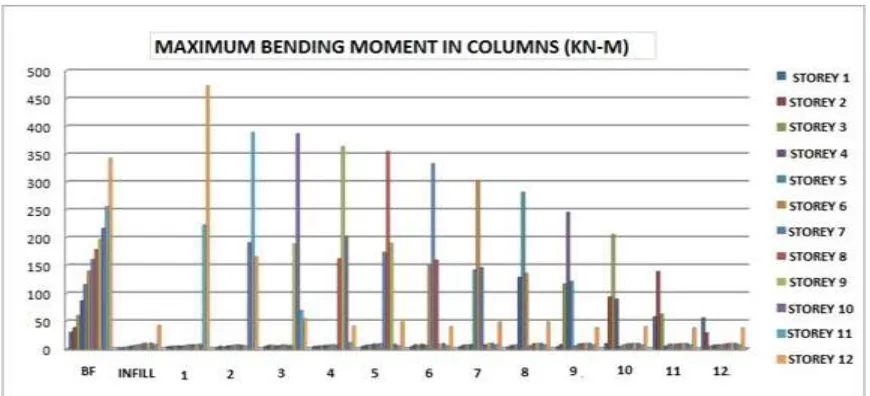
7 140.03 7.61 6.79 7.24 7.6 7.78 9.8 152 303 136 5.6 8.12 8.5 8.2
6 161 8.6 7.63 7.69 6.59 7.02 174 333 146 6.33 9.2 9.35 8.9 8.8
5 178.73 10.51 7.95 6.86 6.49 162.3 355 160 7.68 9.89 10 10.1 9.7 9.9
4 196.81 10.02 8 5.89 189 364 190 8.7 10.2 10.4 11 10.2 10 10
3 217 10.61 8.63 191 387 203 8.8 10 10.4 10.4 10 10.2 10 10
2 256.13 8.14 223 389 69.2 11.57 6.1 6.2 7.77 7.78 7.8 7.77 7.8 7.7
1 343.02 42.62 473 166 55 41.17 49 41 48.8 48.8 38 40 38 38
0 0 0 0 0 0 0 0 0 0 0 0 0 0 0
Table – 7
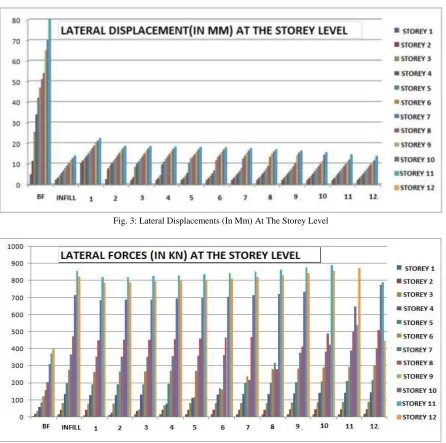
Lateral Displacement (mm) at Storey Level
Storey Bare Frame Infill Different storey level
1 2 3 4 5 6 7 8 9 10 11 12
12 140 13.82 22.32 18.64 18.4 18.23 18.03 17.8 17.4 17 16.3 15.5 14.39 13.72
11 132 12.76 21.15 17.55 17.32 17.15 16.96 16.7 16.4 15.9 15.3 14.3 12.03 11.76
10 110 11.6 19.98 16.37 16.15 15.94 15.8 15.5 15.2 14.8 14 11.1 10.89 10.75
9 98.7 10.2 18.75 15.14 14.92 14.76 14.58 14.3 14 13.3 10.1 9.84 9.78 9.67
8 79.6 9.05 17.49 13.87 13.65 13.5 13.32 13.2 12.5 8.95 8.7 8.68 8.63 8.54
7 60 7.89 16.22 12.59 12.38 12.23 12.52 11.5 7.78 7.52 7.51 7.49 7.45 7.39
6 48.05 6.65 14.97 11.32 11.11 10.97 10.52 6.6 6.33 6.33 6.33 6.32 6.29 6.24
5 33.8 5.44 13.74 10.08 9.88 9.47 5.45 5.16 5.18 5.18 5.18 5.17 5.15 5.12
4 25.4 4.18 12.58 8.91 8.43 4.34 4.05 4.07 4.07 4.08 4.08 4.07 4.06 4.04
3 11.2 3.13 11.5 7.53 3.32 3.02 3.03 3.04 3.04 3.05 3.05 3.05 3.04 3.03
2 4.8 2.2 10.15 2.42 2.07 2.08 2.09 2.09 2.1 2.1 2.1 2.1 2.1 2.1
1 2.32 1.16 2.78 1.14 1.11 1.12 1.12 1.12 1.12 1.12 1.13 1.13 1.13 1.13
Table – 8
Lateral Force (KN) At the Storey Level
Storey Bare Frame Infill Different storey level
1 2 3 4 5 6 7 8 9 10 11 12
12 402 824 788 790 794 799 805 812 821 832 844 858 874 446
11 373 857 820 823 826 831 838 845 855 866 878 892 540 793
10 311 716 686 687 690 695 700 706 714 723 734 423 648 775
9 255 588 562 564 567 570 574 580 586 593 357 522 624 636
8 205 472 451 453 455 458 461 465 470 283 413 491 500 511
7 161 368 353 354 356 358 360 364 219 318 378 384 391 399
6 121 278 266 267 268 270 272 163 237 281 285 290 295 301
5 87 201 193 193 194 195 116 169 200 203 206 209 213 217
4 59 136 130 130 131 78 113 134 135 137 139 141 144 147
3 36 83 80 80 48 69 81 82 83 84 85 87 88 90
2 19 44 42 25 36 42 43 43 44 44 45 46 46 47
1 7 17 10 14 16 16 16 17 17 17 17 17 18 18
The following observations are made, based on the results presented in Table 1to 3 that in MI-RC frame in comparison to the bare frame indicates large increase in lateral stiffness due to substantial stiffness contribution of masonry infill.
Fig. 2: Maximum Bending Moment in Columns (KN/M) At Storey Level
Fig. 3: Lateral Displacements (In Mm) At The Storey Level
Fig. 4: Lateral Forces (In KN) At the Storey Level
VII.CONCLUSIONS
The presence of soft storey at the lower levels of the building structure , especially at the first storey level is most undesirable, as it attracts larger storey force with greater storey drift in comparison to fully infill frame
The stiffness contribution of masonry infill in the lower stories (specially the first storey) is very large compared to the stiffness contribution of the upper storey.
The amplification factor of the seismic action effects in the vertical structural elements of soft storey needs to be scaled down, factor provided depends upon storey height, that’s the soft storey is in lower portion or in upper portion.
REFERENCES
[1] ACI Committee 318, ACI, Structural Building Code and Commentary, American Concrete Institute, 2002.
[2] Applied Technology Council, ATC 40, Seismic Evaluation and Retrofit of Concrete Buildings, Volume 1-2, California, 1996. [3] Army Corps of Engineers, Seismic Evaluation and Rehabilitation for Buildings, US. Washington, 1999.
[4] Association of Bay Area Governments, ABAG Earthquake and Hazards Program-Mitigation Policy Review, 2005.
[5] Athanassiadou C.J., Seismic Performance of RC Plane Frames Irregular in Elevation, Engineering Structures, doi:10.1016/j.engstruct.2007.07.015, 2007. [6] Attard T. and Fafitis A., Modeling of Higher-Mode Effects Using an OptimalMulti-Modal Pushover Analysis, Earthquake Resistant Engineering Structures
V, 2005.