© 2016, IJCSMC All Rights Reserved 621 Available Online atwww.ijcsmc.com
International Journal of Computer Science and Mobile Computing
A Monthly Journal of Computer Science and Information Technology
ISSN 2320–088X
IMPACT FACTOR: 5.258IJCSMC, Vol. 5, Issue. 5, May 2016, pg.621 – 626
A Study on Different Channel Estimators for
Wireless Communication Optimization
Swati Malik
Research Scholar, Deptt. Of ECE, Sat Priya Group of Institutions,
Rohtak, Haryana. [email protected]
Ajay Khokhar
H.O.D, Deptt. Of ECE, Sat Priya Group of Institutions,
Rohtak, Haryana. [email protected]
Abstract— Wireless communication is a channel driven transmission in open environment. This channel model driven knowledge driven communication with environment propagation can increase the channel error, noise and disruption. In this paper, a study to this channel modeling and different disruption types are defined. The AWGN based channel modeling is defined in open environment. Later on the paper has defined different types of channel estimators to identify these channel associated problems. Four different measures are here defined with relative equation formulation.
Keywords: LS, Estimator, MMSE, AWGN
I. INTRODUCTION
© 2016, IJCSMC All Rights Reserved 622
A) Additive White Gaussian Noise (AWGN) Channel
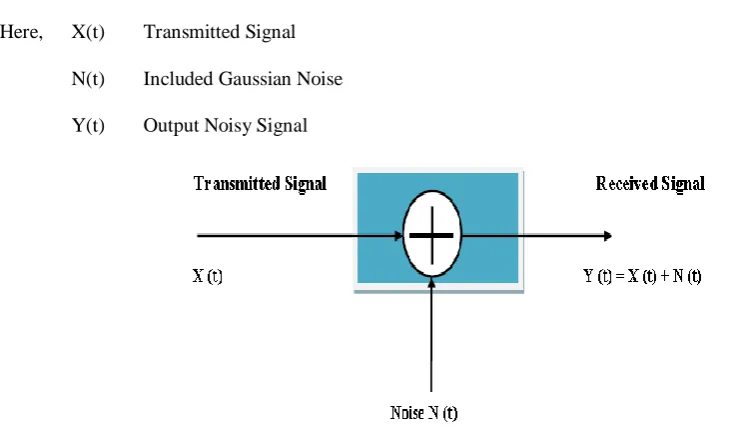
It is the simplest communication form in which communication is applied on noisy channel. This common noise form is Gaussian noise modeling. The equational representation of this noise is shown here
Y(t)=X(t)+N(t)
Here, X(t) Transmitted Signal
N(t) Included Gaussian Noise
Y(t) Output Noisy Signal
Figure 1 : AWGN channel
The noise adaptive channel modeling is here applied on input transmitted signal and the noise is included because of AWGN channel. This noisy channel is then used to transmit data in noisy form. The noise inclusive communication can distort the data and gives some communication loss over the channel. There is the requirement of some evaluation method which can provide the effective and reliable communication under modulation format. The signal transmission at different propagation models can be applied for environment adaptive communication. There is the requirement to observe the communication under different aspects including noise, mobility, transmission symbol, bandwidth etc. In this section different error forms are defined with different noise form. In this section these different noise forms are discussed.
B) Channel Errors
As the communication in real wireless environment because of multiple communications as well as environmental conditions, there are chances of some kind of impurities inclusion in communication. These impurities, noise or the turbulence disturb th e communication and increases the loss while transmission. The errors can induced in the signal at difference phases. The common error forms are phase error, PAR, ICI, ISI etc. Some of the common error forms for which the rectification is required is discussed in this section.
a) Phase Noise
This error form occurred as the noise when random jitter is applied to the signal and it is generated because of oscillators. This noise form affects the phase of the signal so that the transmission cannot remain stable. The effect of phase noise also increases other kind of noise including the ICI (Inter-channel Inference). The noise affects the channel driven communication and in multi-communication architecture, the criticality of this noise form increases. The phase error also affects the oscillation and requires some tracking and decoding methods to provide rectified signal communication. The generalized error can be reduced over the signal for different SNR values. This kind of error also increases the global signal error by increasing the bit error over the signal.
b) Frequency Offset
© 2016, IJCSMC All Rights Reserved 623
In this paper, a discussion on different channel estimation methods is defined. In this section, the channel modeling and the communication behavior in wireless environment is discussed. The section also identified different noise forms and disruption s are discussed. In section II, the work defined by earlier researchers is discussed. In section III, the different common estimators for effective channel communication are discussed and described in detail. In section IV, the conclusion of this work is defined.
II. EXISTING WORK
High speed communication in wireless network is defined under some standards but because of some interference or the environment impact. To identify these impact over the channel, there is the requirement of some channel estimation techniques. The average error estimation techniques are provided by different researchers as well as integrated with different optimization methods. In this section, some of the errors of earlier researchers for channel estimation are discussed. Pandana et. al.[1] has provided a work on channel experience observation to estimate the inaccuracy in the channel using polynomial method. Author provided the leakage effect analysis is provided for providing priority driven transmission. Author defined a pilot assisted model for decision directed modeling for channel estimation. Author observed the channel condition to control the multimedia communication. Haghighi et. al[2] has provided an OFDM analysis using Least Square (LS) and Minimum Mean Square Error (MMSE). Author provided the channel modeling and selective channel estimation using Wiener filter for channel estimation. Author improved the iteration specific estimation and reliable communication in selective channel mode. Hwang et. al.[4] provided a work on filtered communication under decision directed method. An optimized filter specific adaptive estimation method is provided. A correlated estimation method with statistical characterization was provided for fading channel. Ingmar et. al.[5] provided a work on time variant channel estimation to reduce the channel system impairment. Author provided a linear expansion to the channel estimation under channel specific communication for OFDM system. The work used the cyclic prefix method for channel slope estimation to reduce the ICI over the channel and provide the noise reduction over the channel. Tomasoni et. al.[7] provided a criteria driven estimation for OFDM network based on descriptive channel analysis. Author applied an investigation on training sequence to apply data driven tracking and decoded signal analysis. Author provided complexity robust analysis method for reducing the communication challenges.
Ibrahim et. al.[8] defined a criteria driven measure to reduce the estimation error. Author provided a probability based cooperative analysis applied on protocols in an integrated form to provide time synchronized communication. Author provided the relay specific observation to identify the channel impact and to improve the system performance in cooperative way. Chen et. al.[11] provided a length estimation based likelihood estimation under sequence level observation for wireless network. Author improved the conventional least sequence method using joint synchronization and channel length driven estimation. The propagation against performance and complexity analysis model was proposed by the author to provide the effective communication in distributed network. Tomasoni et. al.[11] provided a cost and complexity driven recursive analysis model to provide the effective channel communication based on response analysis. Author provided the data aided communication tracking in decoded environment and provided the complexity reduction modeling for channel estimation and complexity estimation with channel length estimation. Wang et. al.[13] has provided a work on channel estimation with problem opposing method to identify the pilot training with associated signal method. Author provided the edition under pilot driven method. A monte carlo based probabilistic estimation was provided for effective channel utilization. Ando et. al.[15] provided a power line based band pass analysis for effective broad band communication. Author applied the pilot driven iterative analysis against impulse noise to improve signal strength of OFDM communication.
© 2016, IJCSMC All Rights Reserved 624
decision and conditional matrix driven estimation. Author provided the spatial multiplexing based communication modeling to achieve iterative equalization.
III. CHANNEL ESTIMATORS
The signal transmission over the channel in wireless environment affects through different channel, communication and environment specific vectors. These all vectors can induce different kind of noise or impurities in the channel. To provide the rectified communication solution, the first requirement is to identify the impurities in the signal. This signal quantization is required at block level to identify these errors. The error analysis is required under time and frequency domain with different estimator. Here the basic steps of signal generation and the noise inclusion are defined at frequency level. Based on which a local signal estimator is required and shown in equation (1) and graphically shown in figure (2)
y k= Hk xk+ nk, (1)
where k= 0,1,2…N-1 nk is the FFT of sampled noise
X is Generated Signal Y is transmitted noisy signal
h
0n
0x
0x
N -1y
0y
N -1x
x
+
+
n
N -1h
N -1Figure 2 : Gaussian Channel
Here figure showing the Gaussian channel based communication under equation (1). The analysis applied at receiver level, the signal is defined by Y=Xh + n. Here X is the diagonal matrix based transmitted signal and with noise included signal. But the internal and external measures are applied to rectify the signal. The noise included signal is here represented by Y. To provide the signal rectification, there is the requirement to estimate the signal. Some such common signal estimators are described in this section.
A) Channel Estimators
The first requirement here is to analyze the error over the signal by applying the appropriate channel estimators. Two such common estimators are Least Square (LS) and MMSE (Minimum Mean Square Estimator). The estimators are able to improve the performance of communication system and able to provide the communication with low complexity. The basic structure of estimators is shown in figure3.
Y
0Y
N -1X
00x
x
X
0N-1ID
F
T
Q
D
F
T
h
0h
N-1© 2016, IJCSMC All Rights Reserved 625
B) LS(Least Square Estimator)
Least Square estimator is a predictive estimator applied under zero forcing method and applied estimator. This estimator is cyclic and defined an impulse response minimize the signal ratio analysis. The least square based analysis modeling is shown here
Qls = (FH XH XF)-1
In the reduced form the equation is given as
h’LS =X-1y
C) MMSE(Minimum Mean Square Estimator)
This channel estimation is structure level analysis under the Gaussian modeling to identify the noise and to provide the correlated analysis. The channel noise estimation under mean square observation is given by
g’MMSE = Rg y R-y y y
Here, g,y are covariance of matrix
Based on this matrix, the estimation measure using MMSE is given by
h’M MSE = F g’M MSE=F Q’M MSE FH XH y
This estimator can be applied to identify the disruption of the gaussian noise.
D) MLS (Modified Least Square)
This modified estimator is able to identify the noise instance over the signal and based on which the signal matrix can be generated because of the communication. The communication matrix can be defined for effective performance derivation so that the noise instances can be identified. For this analysis, the tap driven modeling is defined. These taps are defined as the smaller signal segments based on which the signal analysis and the partial point based estimation can be applied. The basic structural estimation defined under modified least square method is shown in figure 4.
Figure 4 : Structure of Modified Estimators
The tap segmented method can be defined for signal estimation by observing the energy level. The modified least square method under equation form is given as
h’LS=T Q’LS TH XH y
where,
Q’LS = ( TH XH XT)-1
D) MMMSE (Modified Minimum Mean Square Error)
This is also a tap driven method can be applied to estimate the signal under the performance and noise vector so that the reliability can be improved. The tap driven segmented analysis is here defined to obtain the noise and distortion ratio over the signal and a free form estimation is required to provide effective communication over the channel. The complexity analysis and reduction is required to identify the error position so that realistic enhancement can be implied over the signal. The equation for this estimator is given by
h’M MSE=T Q’M MSE TH XH y
where,
Q’M MSE =R’gg [(TH XH XT)-1
n2 + R’gg ]-1 [(TH XH XT)-1I D
F T
D F T Q
X0
© 2016, IJCSMC All Rights Reserved 626
IV. CONCLUSION
In this paper, a study on different channel estimators is defined and to provide the effective channel communication. In this paper, the channel modeling on noisy channel and critical environment is defined. Later on four different channel estimators are defined to identify these errors so that the signal rectification can be obtained and the safe communication will be transmitted.
R
EFERENCES[1] C. Pandana, Yan Sun and K. J. R. Liu, "Channel-aware priority transmission scheme using joint channel estimation and data loading for OFDM systems," in IEEE Transactions on Signal Processing, vol. 53, no. 8, pp. 3297-3310, Aug. 2005.
[2] S. J. Haghighi, S. Primak and X. Wang, "Effects of Side Information on Complexity Reduction in Superimposed Pilot Channel Est imation in OFDM Systems," Vehicular Technology Conference (VTC 2010-Spring), 2010 IEEE 71st, Taipei, 2010, pp. 1-5.
[3] T. Y. Liu, Y. C. Chen and Y. W. P. Hong, "Artificial noise design for discriminatory channel estimation in wireless MIMO syst ems," 2014 IEEE Global Communications Conference, Austin, TX, 2014, pp. 3032-3037.
[4] S. S. Hwang, S. S. Yun and S. C. Kim, "Decision directed recursive least square adaptive channel estimation for OFDMA uplink system," Wireless Telecommunications Symposium (WTS), 2011, New York City, NY, 2011, pp. 1 -4.
[5] I. Groh, C. Gentner and S. Sand, "Iterative Intercarrier Interference Mitigation for Pilot-Aided OFDM Channel Estimation Based on Channel Linearizations," Vehicular Technology Conference (VTC Fall), 2012 IEEE, Quebec City, QC, 2012, pp. 1 -5.
[6] X. Gao, B. Jiang, X. You, Z. Pan, Y. Xue and E. Schulz, "Efficient Channel Estimation for MIMO Single-Carrier Block Transmission With Dual Cyclic Timeslot Structure," in IEEE Transactions on Communications, vol. 55, no. 11, pp. 2210-2223, Nov. 2007.
[7] A. Tomasoni, S. Bellini, M. Ferrari, D. Gatti and M. Siti, "Efficient OFDM channel estimation via an information criterion," 2012 IEEE International Conference on Communications (ICC), Ottawa, ON, 2012, pp. 3936-3941.
[8] A. S. Ibrahim and K. J. R. Liu, "Mitigating channel estimation error with timing synchronization tradeoff in cooperat ive communications," in IEEE Transactions on Signal Processing, vol. 58, no. 1, pp. 337-348, Jan. 2010.
[9] Ying Peng, S. Armour and J. McGeehan, "Performance evaluation of channel estimation techniques for MIMO -OFDM systems with adaptive sub-carrier allocation," IEEE Wireless Communications and Networking Conference, 2006. WCNC 2006., Las Vegas, NV, 2006, pp. 1056 -1061.
[10] Jyh-Hau Chen and Yumin Lee, "Joint synchronization, channel length estimation, and channel estimation for the maximum likelihood sequence estimator for high speed wireless communications," Vehicular Technology Conference, 2002. Proceedings. VTC 2002-Fall. 2002 IEEE 56th, 2002, pp. 1535-1539 vol.3. [11] A. Tomasoni, D. Gatti, S. Bellini, M. Ferrari and M. Siti, "Efficient OFDM Channel Estimation via an Information Criterion," in IEEE Transactions on
Wireless Communications, vol. 12, no. 3, pp. 1352-1362, March 2013.
[12] H. M. Kim, D. Kim, T. K. Kim and G. H. Im, "Frequency domain channel estimation for MIMO SC -FDMA systems with CDM pilots," in Journal of Communications and Networks, vol. 16, no. 4, pp. 447-457, Aug. 2014.
[13] X. Wang, H. C. Wu, S. Y. Chang, Y. Wu and J. Y. Chouinard, "Efficient Non-Pilot-Aided Channel Length Estimation for Digital Broadcasting Receivers," in IEEE Transactions on Broadcasting, vol. 55, no. 3, pp. 633-641, Sept. 2009.
[14] M. Higashinaka, H. Kubo and A. Okazaki, "Channel estimation with interference cancellation for a MIMO receiver using iterativ e equalization and decoding," 2008 IEEE 19th International Symposium on Personal, Indoor and Mobile Radio Communications, Cannes, 2008, pp. 1 -5.