ISSN (Online): 2320-9364, ISSN (Print): 2320-9356
www.ijres.org Volume 3 Issue 4 ǁ April. 2015 ǁ PP.29-35
OMR Form Inspection by Web Camera Using Shape-Based
Matching Approach
AzmanTalib
1, Norazlina Ahmad
2, WoldyTahar
31
(Department of Electrical Engineering, Politeknik Kota Kinabalu, Malaysia) 2(Department of Electrical Engineering, Politeknik Kota Kinabalu, Malaysia) 3(Department of Electrical Engineering, Politeknik Kota Kinabalu, Malaysia)
ABSTRACT
: The role of computer vision system as a vital component for high quality image analysis mainly in inspection and recognition process cannot be denied. The system is developed to overcome the discrepancy and drawback from human error and high-cost peripherals. This paper proposes shape-based vision algorithm, a hierarchical template-matching approach that implemented in this system to verify the imaging and inspecting the correct answer of the Optical Mark Recognition (OMR) sheet form. An OMR answer sheet schemes with all correct answers are marked on the paper and will be used as a template for object recognition during matching process. Region of interest (ROI) is selected and filtered into grey level to extract the contour of the object. The image is then pre-processed and trained using image processing technique. A low-cost 1.3 MP web camera is used to acquire the marked OMR image for all questions together with the sequence number; this is to ensure the system can distinguish between different questions having the same answer. The student’s answer in the OMR sheet form which matched with the template will be recognized as correct. This approach result shows that the algorithm works better with detection rate and matching accuracy of more than 96%. The approach can be applied in school as teachers able to know the effect of learning and teaching easily and quickly or any other areas which apply shape in their application.Keywords
-computer vision system, shape-based matching, OMR questions, Region of interest (ROI)I.
INTRODUCTION
Optical Mark Recognition (OMR), also called “mark sensing”, is a technique to sense the presence or absence of marks by recognizing their depth (darkness) on sheet [1][3]. A mark is a response position on the questionnaires sheet that is filled with pencil. The way of marking is simple and OMR device can process mark information on sheets rapidly. Thus, OMR has been widely used as a direct input device for data of censuses and surveys and is fit for handling discrete data, whose values fall into a limited number of values. In the field of education, OMR technique is often used to process objective questionnaires in the national general examination in Malaysia such as UjianPenilaianSekolahRendah (UPSR), PenilaianMenengahRendah (PMR) and
SijilPelajaran Malaysia (SPM) or even in common exams at every schools and education institutions.
However, there are a few distinct drawbacks which limit the application of OMR technology. First, the questionnaires sheets which can be processed by OMR devices must be 90-110 gsm (grams per square meter, unit of paper weight [4]). Such high quality papers are much more expensive than the common plain papers (60 – 70 gsm) and general schools cannot afford to use them in common exams. Second, the high precision layout of standard questionnaires sheet is required. The questionnaires sheets must be precisely designed and printed. The printing and cutting slips need to be and ±0.2 mm or even less which can only be obtained through professional printing house [5]. Finally, OMR machine is dedicated device that can only be used to process OMR sheets. This is a burden carried by the institutions.
In this paper, a low-cost web camera with a casing box as the imaging device and shape-based vision algorithm technique as the vision system processing is presented. Besides implementing all the functions of the traditional OMR, this approach supports any kind of OMR design and low printing quality questionnaires sheets. Hence, the computer vision system development must be flexible enough to inspect the various types of OMR sheet form, efficient in recognizing the presence of marked images, verify the matching process and inspect for the correct answers.
II.
RELATED
WORK
The OMR scanners were originally developed in the 1950s with more desktop-sized models entering the marketplace in the 1970s. The original technology was called 'mark sensing' and used a series of sensing brushes in detecting graphite particles on a document that is passed through the machine [1][2].
the quality of printed circuit board [7]. The researchers applied normalized cross correlation (NCC) in computing the matching score of the reference object for template and candidate comparison. Three methods to register template which is direct representation matching (DRM), principal axes matching (PAM) and circular profile matching (CPM) are studied and compared to identify the imprinted tablet quality [8].
Recognition in shape characteristic is applied on the inspection of surgical instruments such as scissors, forceps and clamp [9]. The width dimension of those instruments are measured and compared to the standard specification given by the surgeons. JianchengJia inspected medical syringes assembly on two sample images; needle end vision and thumb end vision [10]. The tolerances for measurement have been set up based on manufacturer’s standardization using pattern matching method. Such approaches also have been implemented and developed to inspect the quality of bottling system [11][12], and size measurement [13][14].
Texture analysis is studied by Jiaoyan Ai and Xuefeng Zhu to detect pit and spot-like defect on the ceramic glass surface [15]. They measured the distance in the sub-image histogram to detect the pit and applied Markov random field approach for spot-like detection in their research. Texture recognition also had been studied to identify several defects on magnetic disk surface such as head ding, contamination and sputter using ranking order co-occurrence spectrum [16].
III.
SHAPE-BASED
VISION
ALGORITHM
This research is an extended concept studied on the pattern recognition using shape template-matching algorithm to control the subsequent process [2]. The algorithm is designed using image processing tool provided by MVTecHalcon; a machine vision software to detect the object presence and measure the matching accuracy. This approach consists of two phases which is training phase and recognition phase as depicted in Fig. 1.
Figure 1. OMR shape-based matching phase.
1. Training Phase
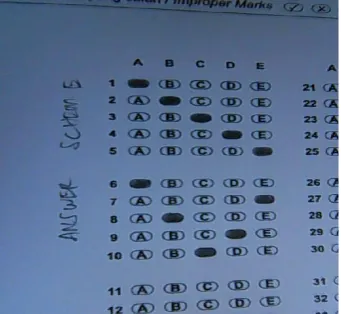
1.1 Acquire Image: The OMR sheet form focused on selected area is captured by web camera for its image. The camera focus and distance between camera and object are adjusted for better and sharper image. To enhance the visual quality of the image under inspection, USB lamps have been added inside the box to obtain high contrast and clear image as in Fig. 2.
1.2 Pre-processing: In this step, the acquired OMR image is further processed to eliminate noises inside the image simultaneously enhancing the result of the output. The methods used in this stage are listed as below :
1.2.1 Color Filtering: color filtering is applied to decompose the color image which consists of red, green, and blue component into grey scale image.
1.2.2 Smoothing Filter: mean or averaging filter is applied to retain the image’s useful features. This filter helps in removing the grain noise from image and speed up the process.
1.3 Determine Training Parameter :
1.3.1 Region of Interest (ROI) creation: ROI selection can be done by creating a rectangular shape around marked image together with the sequence number as in Fig. 3. The reason to include the sequence number in this process is to recognise only that particular number have either A, B, C, D or E answer. This is to distinguish with other number of questions which have the same answer too. This is done manually by the user to allow the inspection to be run on the desired area as in Fig. 3. The ROI creation ensures that only specific region of the OMR sheet form will be used for the next stage. ROI also has several advantages such as to speed up the process because it contains fewer pixels, focuses only on the specific area and can be used as template.
1.3.2 Image Segmentation: The ROI on image is segmented by means of threshold the image to extract the shape of the image. It is then called as template which representing the model and appears during the matching process. Since the image comes on the same color background, the image contrast is not much affected during the matching process. However the luminous from the lamp must be sufficient and constant during the whole process. Threshold method is applied to overcome the color contrast and invariant illumination changes.
Figure 3. Region of Interest (ROI) creation step.
1.4 Train model: One or more models can be created respectively to the ROI selection. The ROI image together with control parameters such as number of pyramid levels and contrast value are very important and affected in recognition phase. Image pyramid concept really helps by speeding up the matching process even if the search images have contrast variation. Image pyramid consists of the original, full-sized image and a set of down-sampled images as shown in Fig. 4. The number of the pyramids level is set as much as possible so that the model is still recognizable and contains a sufficient number of points on the highest pyramid level.
Figure 4. Train model step (pyramid image).
2. Recognition Phase
Figure 5. Apply matching step.
2.2 Results: In this stage, the marked OMR contours that overlap at the found position of the search image are displayed with the best matching possibility in percentage values for detecting the object.
IV.
RESULTS
AND
DISCUSSION
The selected OMR sheet image is captured by a web camera with resolution of 1.3 megapixels. For the processing part MVTecHalcon vision software is used to process and analyze the image. The experiment is initially done by means of obtaining the best OMR answer scheme which will be used as an object template for recognition.
Two prerequisite parameters are identified to enhance the process; first is minimum score that shows high comparability, trained shape invisible in the image and second is greediness that shows the rate of searching process. Greediness within the range value begin from value 0 is safe but will slow the process while value 1 is much faster but some images to be recognize might be missed.
For this experiment, the optimum value of greediness is set to 0.96 and minimum score value is set within the range of 0.80 to 0.85. As the result, all OMR sheet samples used in this experiment shows all of it pass the matching process with the average of 96 to 99 percent of recognition level.
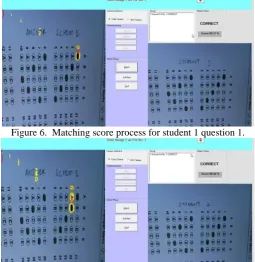
Figure 6. Matching score process for student 1 question 1.
Figure 8. Matching score process for student 5 question 10.
TABLE1. STUDENT 1OMR SHEET MATCHING SCORE
TABLE2. STUDENT 2OMR SHEET MATCHING SCORE
TABLE3. STUDENT 3OMR SHEET MATCHING SCORE
TABLE4. STUDENT 4OMR SHEET MATCHING SCORE Student Question (No.) Matching (%) Note(s)
1 99.12
2 98.08
3 99.29
4 98.49
5 97.83
6 97.70
7 96.99
8 98.73
9 98.45
10 98.75
1
Student Question (No.) Matching (%) Note(s)
1 99.08
2 98.60
3 98.69
4 98.96
5 97.71
6 98.85
7 99.27
8 98.72
9 98.96
10 98.19
2
Student Question (No.) Matching (%) Note(s)
1 98.93
2 0.00 Intentionally wrong answer
3 99.05
4 0.00 Intentionally wrong answer
5 97.65
6 0.00 Intentionally wrong answer 7 0.00 Intentionally wrong answer 8 0.00 Intentionally wrong answer 9 0.00 Intentionally wrong answer
10 98.57
TABLE5. STUDENT 5OMR SHEET MATCHING SCORE
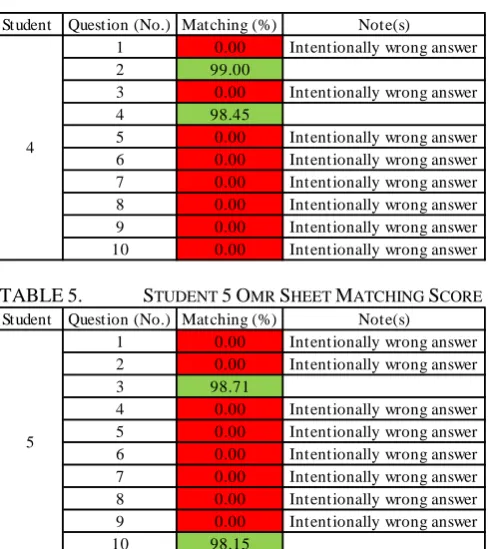
Fig. 6 to 8 shows examples for student’s OMR sheet through the test. The results recognition rate yields are more than 96 percent as depicted in the Table 1 to 5. Template matching based on shape performs very well in transforming the color image into their RGB components during training and recognition process and also in constant luminous.
V.
C
ONCLUSIONIn this study, shape-based matching vision algorithm is proposed to inspect the marked answer on the OMR sheet questionnaires compared to traditional OMR technique by using scanner. The result shows the successful of computer vision in recognition and matching process of the OMR marking. The filtering and ROI selection in template creation are very useful techniques to enhance the target image contrast in matching and recognition process.
This approach evidently shows that shape-based matching is useful in recognize and matching the template with the tested OMR sheet and satisfy the marking characteristics’. This technique can be adopted at any learning institutions to investigate the effect of learning and teaching easily and quickly.
R
EFERENCES[1] A. M. Smith, “Optical mark reading - making it easy for users”, In Proceedings of the 9th annual ACM SIGUCCS conference on User services, United States, 1981, pp: 257- 263.
[2] E. Greenfield, OMR Scanners: Reflective Technology Makes the Difference, Technological Horizons In Education, Vol. 18, pp: 199
[3] K. Toida, “An Overview of the OMR technology: based on the experiences in Japan”. Workshop on application of new information technology to population: paper based data collection and capture, Thailand, 1999.
[4] International Paper and Card Sizes, http://www.designtechnology. info/graphics/page14.htm
[5] NCS Pearson. OpScan® optical mark read (OMR) scanners. (NCS Pearson Inc., 2003 Online publication http://www.pearsonncs.com/scanners/)
[6] H.J. Lin, Y.T. Kao, S.H. Yen, and C.J. Wang, “A study of shape-based image retrieval,” Distributed Computing System Workshops. ICDCSW 04. 24th International Conference, pp. 118–123.
[7] S. Sassanapitak, and P. Kaewtrakulpong, An efficient translation-rotation template matching using pre-computed scores of rotated templates,Electrical Engineering/Electronics, Computer, Telecommunications and Information Technology 2009. ECTICON 2009 6th International Conference on 2009, pp. 1040–1043.
[8] Z. Spiclin, M. Bukovec, F. Pernus, and B. Likar, Matching images of imprinted tablets, Emerging technologies and factory automation 2007, ETFA 2007, IEEE Conference on 2007, pp. 916–919.
[9] Shuyi Wang, Xunchao Yin, Bin Ge, YanhuaGao, HaimingXie and Lu Han, Machine vision for automated inspection of surgical instruments, Bioinformatics and Biomedical Engineering 2009. ICBBE 2009 3rd International Conference on 2009, pp. 1–4.
[10] JianchengJia, A machine vision application for industrial assembly inspection, Machine Vision 2009. ICMV 2009. 2nd International Conference on 2009, pp. 172–176.
[11] A.S. Prabuwono, R. Sulaiman,, A.R. Hamdan and A. Hasniaty, Development of Intelligent Visual Inspection System (IVIS) for Bottling Machine,TENCON ‘06. IEEE Region 10 Conference on 2006, pp. 1-4.
Student Question (No.) Matching (%) Note(s) 1 0.00 Intentionally wrong answer
2 99.00
3 0.00 Intentionally wrong answer
4 98.45
5 0.00 Intentionally wrong answer 6 0.00 Intentionally wrong answer 7 0.00 Intentionally wrong answer 8 0.00 Intentionally wrong answer 9 0.00 Intentionally wrong answer 10 0.00 Intentionally wrong answer 4
Student Question (No.) Matching (%) Note(s) 1 0.00 Intentionally wrong answer 2 0.00 Intentionally wrong answer
3 98.71
4 0.00 Intentionally wrong answer 5 0.00 Intentionally wrong answer 6 0.00 Intentionally wrong answer 7 0.00 Intentionally wrong answer 8 0.00 Intentionally wrong answer 9 0.00 Intentionally wrong answer
10 98.15
[12] D. Kurniawan, and R. Sulaiman, Design and Implementation of Visual Inspection System in Automatic Bottling System based on PLC,Modelling and Simulation 2008. AICMS ‘08. 2nd Asia International Conference on 2008, pp. 760-764.
[13] A.S. Prabuwono, and H. Akbar, The design and development of automated visual inspection system for press part sorting,Computer Science and Information Technology 2008. ICCSIT 2008. International Conference on 2008, pp. 683-686.
[14] L.Y. Lei, X.J. Zhou, and M.Q. Pan, Automated Vision Inspection System for the Size Measurement of Workpieces,
Instrumentation and Measurement Technology Conference 2005. IMTC ‘05. Proceedings of the IEEE on 2005, pp. 872 -877.
[15] Jiaoyan Ai, and Xuefeng Zhu, Analysis and detection of ceramic-glass surface defects based on computer vision,Intelligent Control and Automation 2002. Proceedings of the 4th World Congress on 2002. WCICA 2002. vol.4, pp. 3014 - 3018.