ISSN (e): 2250-3021, ISSN (p): 2278-8719
Vol. 08, Issue 7 (July. 2018), ||V (I) || PP 17-21
Generating subtour elimination constraints for the Traveling
Salesman Problem
Soufia Benhida
1, Ahmed Mir
21, 2(Laboratory of Industrial Engineering and Computer Science, National School of Applied Sciences ENSA,
Avenue Tamesoult، Agadir 80000, AGADIR, MOROCCO)
Corresponding Author: Soufia Benhida1
Abstract: -
.
The traveling salesman problem (TSP) has commanded much attention from mathematicians and computer scientists specifically because it is so easy to describe and so difficult to solve. In this work we solved the Traveling Salesman Problem, with three different formulations, the formulation DFJ (Danzig-Fulkerson-Johnson), MTZ formulation (Miller-Tucker-Zemlin) and DL formulation (Desrochers-Laporte) . The goal of this work is to solve the Traveling Salesman Problem with a big size of network, in the first we explain the resolution method and we will presentsome numerical resultKeywords:
- generation of constraint, Linear integer programming, Traveling Salesman Problem.---
Date of Submission: 21-06-2018 Date of acceptance: 05-07-2018
---
I.
INTRODUCTION
When we talk about operational research, we necessarily talk about the Traveling Salesman problem (TSP). In this work we are interested to solve with exact method using constraint generation approach, and for that we will use three basic formulations for the traveling Salesman Problem.
The traveling salesman problem was formulated in two ways; the first is from Danzig et al. (1954) [1], who proposed the DFJ model using n2 binary variables xij, for the ATSP, the second is of Miller, Tucker & Zemlin (1960) [2], who rewrote the problem with different way, MTZ was proposed for a Vehicle routing problem, then other formulations appeared reinforcing the MTZ as the DL formulation [3].
In this work we will solve the traveling salesman Problem with large instances, using the three formulations (DFJ, MTZ and DL), and see which of the formulations is stronger by applying a strategy of constraint generation. In the literature Padberg and Sung [4] showed that the MTZ formulation is weaker than the DFJ formulation. The weakness of the MTZ formulation has also been demonstrated by Langevin et al. [5].
Desrochers and Laporte [6] reinforced the MTZ formulation, while Sherali and Driscoll [7] proposed a reformulation of the MTZ constraints, the aim of this work is not only to compare the formulations, but also to apply a Constraint generation strategy to solve the DFJ model that generates an exponential number of constraints, which makes the resolution a bit difficult.
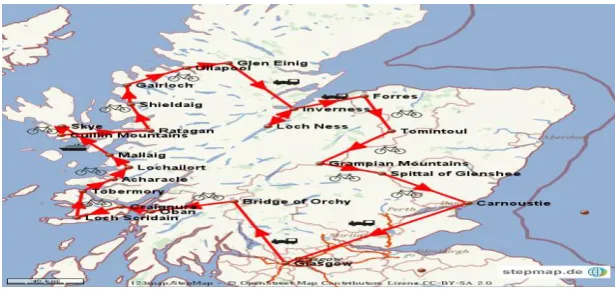
Figure 1: Solution of the traveling salesman problem: the red line is the shortest path that connects all the black
International organization of Scientific Research 18 | Page
II.
DESCRIPTION OF THE PROBLEM
The Traveling Salesman Problem is defined on a complete and directed graph G= (V, A), because we treat Asymmetric TSP (ATSP) (See section 3), the set V = {1 . . . n} is the vertex set (cities) with n is the number of cities, and is an arc set; a cost matrix dij is defined on A. The cost matrix satisfies the triangle inequality whenever , for all i, j, k.
III.
MATHEMATICAL FORMULATIONS OF TRAVELING SALESMAN PROBLEM:
A. The Danzig-Fulkerson-Johnson formulation:
The DFJ formulation and many ATSP formulations consist of an assignment problem with integrality constraint
and sub-tour elimination constraints (SECs) [1], they use a binary variable xij equal to 1 if and only if arc
,i j
belongs to the optimal solution and otherwise it would be equal to 0, S is the sub set of vertices (cities) in the sub tour. The basic model is as follows:
1
(5)
1 ( , )
Subject to
ij ij i j j n ij Min
i V i j
d x
x
1 (6) 1 ( , )ij i
n
j V i j
x
, (7) (8) 0-1 (S
V, 2
2)
ij i j S
ij
S
S
n
x
x
;1 i j, A (9)(5) represents the objective function, (6) and (7) represent the assignment constraints, (8) is the sub-tour elimination constraints (9) is a integrality constraints, This formulation becomes difficult in practice, as soon as the size of the model increases, and it is due to the exponential number of subtour elimination constraints
generated, this formulation of the TSP contains n(n-1) variables and
2
n1
n
2
constraints.B. The Miller -Tucker-Zemlin formulation:
This formulation was originally proposed by Miller and all, for a traveling salesman problem, where the number
of vertices of each route is limited [2], they use one binary variable xij and for each arc
i j, A, xij which takes 1 if the city j is visited immediately after i in the tour , otherwise it takes 0, they usesU
ivariables to define theorder in which each vertex i is visited on a tour, so the MTZ formulation of the TSP is :
1
(10)
1 ( ,
min
ij i j j ij n
ij i V i
Subject to
x
d x
1 (11) 1 ) ( , ) i n ij jj V i j
x
(12)0;1 ,
ij
x i j A
(13)
, 2..
1 ,
i j ij i j n
U
U
nx
n
(14)(15)
2..
1
U
i
n
1
i
n
(10) Represents the objective function, (11) and (12) are the assignment constraints, (13) is the integrality constraint, (14) are the sub-tour elimination constraints, (15) is the integrality constraint. This TSP formulation
C. The Desrochers-Laporte formulation:
Among the advantages of the MTZ formulation is that the sub-tour elimination constraints (14) and (15) can be incorporated into other types of problem formulations together with stronger constraints [3]. Motivated by these facts, Desrochers and Laporte have lifted sub-tour elimination constraints (14) and (15) to obtain the stronger forms:
1 1
(16)
( , )
Subject to
ij j
ij ij
i j
n
Min
i V i j
d
x
x
1
(17) 1 ( , )
ij i
n
j V i j
x
(18)
,
0;1
ij
x
i j
A
(19) (20)
+
2 , i,j = 2..
i = 2..
1
3
1
1
,
i j ji
i
ij
U
U
x
x
n
n
U
n
n
n
n
(21)
(16) is the objective function, the assignment constraints (17) and (18) ensure that each city is visited one and only once, (19)and (21) are the integrality constraints, (20) is the sub-tour elimination constraints .
IV.
RESOLUTION METHODS FOR THE TRAVELING SALESMAN PROBLEM
:In our case, for the resolution we used exact methods [8], using a linear programming solver CPLEX version 12.6.3 which by default uses the method Branch and Cut, it is an exact method for solve integer linear optimization problems, using the Branch and Bound method, and the secant plan method.
A. Resolution of MTZ and DL formulation :
For the resolution with this formulation we used an integer linear programming solver that uses the default Branch and Cut method.
B. Resolution of DFJ Formulation
For the DFJ (Danzig-Fulkerson-Johnson) formulation, taking into account the exponential number of subtour elimination of constraints (SEC) of the order of 2n, we proceed by constraint generation.
C. The generation of constraint method :
The constraint generation approach works as follows:
First of all, we solve the problem without any constraints of Elimination of sub-turns. and we solve the remaining ILP model. Then we check if the resulting whole solution contains sub-turns. Otherwise, the solution is an optimal TSP visit. And if we have sub-towers, we find all the sub-towers in the integral solution and add the corresponding SEC to the model. The resulting expanded ILP model is again resolved to optimality. Iterating this process clearly leads to an optimal TSP tour.
V.
RESULTS AND DISCUSSTION
International organization of Scientific Research 20 | Page
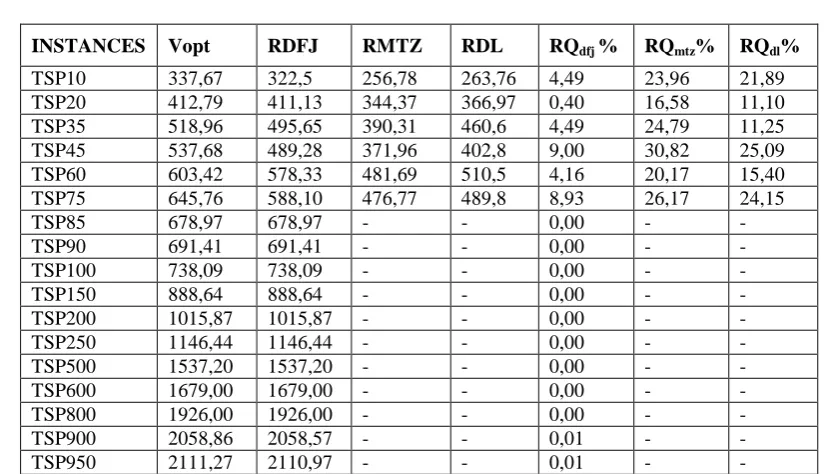
Table 1: Optimal Value (Vopt), Solution time T(s), Continuous Relaxation Value(R) , and Relaxation quality
(RQ) for the DFJ , MTZ and DL formulations.
TSP20 TSP45 TSP75 TSP90 TSP150 TSP250
0 500 1000 1500
Vo
pt
, R
Instances
Vopt Rdfj Rmtz Rdl
Figure 2.The Continuous Relaxation Value (R) of the DFJ, MTZ and DL formulations
It is apparent from the results that:
• The DFJ Relaxation value is better than the MTZ and DL Relaxation value.
• From 35 cities, the formulation MTZ and DL become very slow in calculation time, we took as limit time 30 min.
VI.
CONCLUSION
The study leads to the following conclusions:
• The MTZ formulation is seductive because it is easy to implement but it gives a low continuous relaxation. • In practice it is more interesting to use the DFJ formulation, even this requires to implement the generation of constraints.
• The DL formulation, although significantly strengthens the MTZ formulation, does not compete with the DFJ formulation.
REFERENCES
[1]. Dantzig, G.B.; Fulkerson, D.R. & Johnson, S.M. (1954). Solution of a large-scale traveling salesman problem. Operations Research, Vol. 2, pp.393–410
[2]. Miller, C.E.; Tucker, A.W. & Zemlin, R.A.(1960). Integer programming formulation of traveling salesman problems. Journal of Association for Computing Machinery, Vol. 7, pp. 326–9.
INSTANCES Vopt RDFJ RMTZ RDL RQdfj % RQmtz% RQdl%
TSP10 337,67 322,5 256,78 263,76 4,49 23,96 21,89 TSP20 412,79 411,13 344,37 366,97 0,40 16,58 11,10 TSP35 518,96 495,65 390,31 460,6 4,49 24,79 11,25 TSP45 537,68 489,28 371,96 402,8 9,00 30,82 25,09 TSP60 603,42 578,33 481,69 510,5 4,16 20,17 15,40 TSP75 645,76 588,10 476,77 489,8 8,93 26,17 24,15
TSP85 678,97 678,97 - - 0,00 - -
TSP90 691,41 691,41 - - 0,00 - -
International organization of Scientific Research 21 | Page
[3]. Martin Desrochers , Gilbert Laporte (1991) . Improvements and extensions to the Miller-Tucker-Zemlinsubtour elimination constraints . Volume 10, Issue 1, pp. 27-36
[4]. Padberg M, Sung T. An analytical comparison of different formulations of the travelling salesman problem. Mathematical Programming 1991;52:315–57
[5]. Langevin A, Soumis F, Desrosiers J. Classification of travelling salesman problem formulations.
Operations Research Letters 1990;9:127–32
[6]. Desrochers M, Laporte G. Improvements and extensions to the Miller–Tucker–Zemlin subtour elimination constraints. Operations Research Letters 1991;10:27–36
[7]. Sherali HD, Driscoll PJ. On tightening the relaxations of Miller–Tucker–Zemlin formulations for asymmetric traveling salesman problems. Operations Research 2002;50:656–69.
[8]. Ryan J. O’Neil, Karla Hoffman, Exact Methods for Solving Traveling Salesman Problems with Pickup and Delivery in Real Time, INFORMS Journal on Computing manuscript 2017-12-11.