ISSN (e): 2250-3021, ISSN (p): 2278-8719
Vol. 09, Issue 7 (July. 2019), ||S (II) || PP 08-15
Microstructural evolution of AA1070 Al alloy deformed bycold
ECAP process from route C.
Castro, G.G.P
1,a*, Mendes, R.S.
2,b, Braga, J.O.
3,c, Duarte, A.C.R.
4,d,
Silva, F.R.F.
5,e, Fontana, M.
6,f, Lins, J.F.C.
7,g1,2,3,4,5,6,7
12 Street - Vila Santa Cecília, Volta Redonda – RJ - Brazil - Zip Code: 27255-125
Abstract:
The study aimed to produce an alloy Al AA1070 with fine grains from a material with coarse particle size, by DPS applied by ECAP route C, and clarify and assess the mechanisms responsible for the microstructural evolution during this pressing process. Will be held 5 consecutive passes where the deformation accumulated is ɛ5 = 5.95. The starting material is manufactured from a hot-rolling process, and has a coarse grain microstructure with a grain size of 16 ± 18 µm. Microstructural characterization was performed with the aid of scanning electron microscopy techniques (SEM) and electron backscatter diffraction was performed. The microstructural refinement was carried reaching a fine microstructure, there was a 80% reduction reaching a in achieving a grain size of 3 microns, and an increase of the fraction of high angle boundaries from 23% to 46%. From the results obtained in this study it is concluded that the mechanisms responsible for microstructural evolution were the subdivision processes through fragmentation and rotation grains dynamic recovery and recrystallization.Keywords: Scanning electron microscopy; Pressing by equiangular channels; Aluminum alloy; Severe plastic
deformation; angle boundaries; grain size; recrystallization; dynamic recovery.--- Date of Submission: 06-07-2019 Date of acceptance: 22-07-2019 ---
I.
INTRODUCTION
Severe plastic deformation (SPD) techniques have shown to be effective in obtaining materials with different properties, highlighting Equal channel angular pressing (ECAP) technique, an efficient way to obtain microstructural refinement of crystalline materials [1, 2].
This technique involves the passage of a billet by channel with constant cross-section perpendicular to one another. In the ECAP process, a simple shear deformation is applied to the material during its passage over the intersection of the channels, which promotes microstructural changes. This mechanical forming technique presents some particular technological advantages, such as the conservation of the original dimensions and chemical properties, regardless of the number of deformation passes carried out [2-4].
The ECAP may be conducted in four fundamental directions, named routes the A, BA, BC e C. Each route favors the activation of different slip systems, which produce significant differences in the microstructure of the processed material [3]. The difference between each ECAP route is about the rotations related to the direction of load application deformation of the material after each pass. In BA route the material undergoes alternating rotations of 90° to the direction of pressing in the clockwise and counterclockwise. In BC route the material undergoes after each pass, a 90° clockwise rotation. Finally, the route C, the material undergoes a rotation of 180° between passes.For this study was chosen Aluminium alloy AA1070, initially with a coarse microstructure with grain size of the order of 16 ± 18 µm and the fraction of low angle boundaries in 77%.
Study materials little investigated, such as AA1070 Al alloy may clarify some doubts about the microstructural evolution and the effects of ECAP processing in refining the microstructure by the different routes of the process. Tolaminyad and Dehghani [4] performed microstructural characterization and evaluated some mechanical properties of this alloy processed by ECAP via route BC. It was observed in his works two types of behavior. Between the first and the fourth pass, the microstructure evolved elongated subgrains to an array of fine and equiaxed grains; the fraction of high-angle boundaries and crystallographic difference grew rapidly until the fourth pass. Between the fourth and eighth pass, the growth rate was reduced and there was no significant change in grain size.
The ECAP processing was performed in the Laboratory of Mechanical Tests at the Federal Fluminense University (EEIMVR/UFF) using the traction and compression universal machine EMIC DL-60, with a maximum load capacity of 600 kN; the material used in the die was a H13 steel-tool with two identical channels with 10x10 mm dimensions forming an angle 90 º to each other; the material of the puncher was H13 tool-steel. The curvature radius of 5mm at the intersection of the channels (Ψ≈37º) in order to facilitate the flow of the billet between the channels and reduce the press load. The deformation process occurred at a speed of 5 mm/min and after five passes accumulated a strain ɛ5 = 5.95. During processing, graphs strain-stress were generated order to evaluate the mechanical behavior of the samples in passes of deformation .
Metallographic preparation.The as-received material and deformed samples via ECAP, after each pass were cut into measures approximately 10x10x5 mm and subjected to microstructural analysis. After cutting, samples were ground with 120, 300, 400, 600, 800, 1200 grit sandpaper and then electrolytic polishing. The polishing was carried through two electrolytic cells in standard equipment, using a solution composed of 59 parts of CH4O (methanol), 35 parts of C2H4 (OH) 2 (ethylene glycol) and 6 parts of HClO4 (perchloricacid) (by volume). The Electric Potential Difference (EPD) of 8V was applied for 90 seconds at room temperature.
Scanning electron microscopy – SEM.The microstructure of the samples was observed and evaluated with the aid of a scanning electron microscope EVO MA10 Zeiss with LaB6 filament that equipment is installed in multi-user Laboratory Electron Microscopy (LMME) at the Federal Fluminense University (EEIMVR/UFF).
Electron backscatter diffraction-EBSD.The grain size measurements and fraction of high and low angle boundaries were carried out with the aid of the technique of electron backscatter diffraction (EBSD) using the system Pegasus MX4i model and EDAX brand with high-speed camera Hiraki model , integrated with SEM. The area with dimensions 60x100 µm approximately of each sample was mapped according to the morphology of this substructure elements, with a scan step (step size) of 0.3 μm and magnification of 8000X.The information generated by these scans were integrated and processed by OIM analysis 5.3 software (EDAX).
IV. RESULTS AND DISCUSSION
(a)
(b)
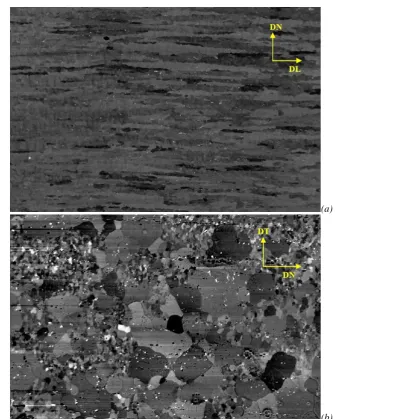
Fig. 1: Micrograph showing the microstructure of the as- received material: a) longitudinal section; b) cross-section. (SEM - electron backscattered Images 10 kV). DL Direction Longitudinal, DN - Normal and DT
Direction - Transverse Direction. [7].
The incidence of low angle boundaries and high angle was 77% and 23% , respectively. The high fraction of low angle boundaries, indicating that the material has undergone dynamic recovery during the thermomechanical process. The average grain size was 15.8 ± 17.5 micrometres obtained by linear intercept grain size method . The high standard deviation regarding the grain size, is due to the heterogeneity of the material with grain sizes were observed up to 2.5 times the average obtained. Alvi and colleagues [6] by computer simulation found that the grain size of commercially pure aluminum hot rolled can reach up to 3 times the mean value.
Microstructural Characterization after processing by ECAP.After processing by ECAP the microstructure of AA1070 alloy has changed considerably. This change was due to intense deformation to which the material is subjected during processing.
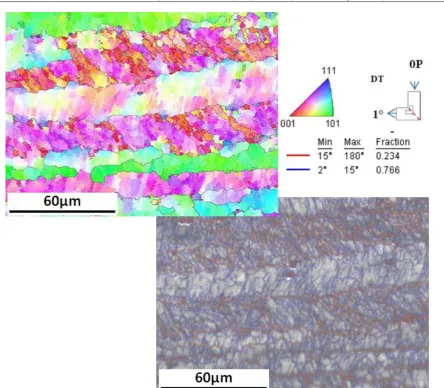
Fig. 2: a) Orientation Map after the first pass, cross section; b)The quality map with outlinedcontours. (SEM – EBSD, 20 KV) [7].
In the first pass of ECAP processing was found a severe grain refinement, about 65% of refinement, reaching 5.2 ± 5.4μm and a reduction in the fraction of low-angle boundaries to 68%. It is important to note that the first deformation pass is common to all routes applied by the ECAP. Iwahashi and his coworkers [9] to investigate the microstructural evolution of high purity aluminum during the ECAP via route C concluded that the grain boundary increases over the passes and that for high purity aluminum, an ideal considered fine microstructure can be obtained after four passes when processed via route C.
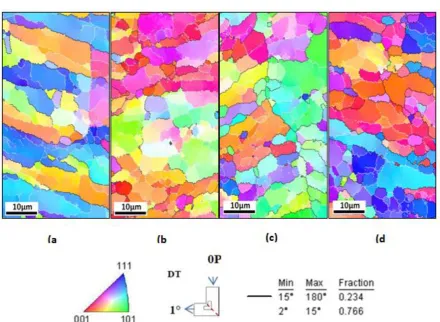
Fig. 3: Microstructural evolution, textural and nature of the contours. (A) Second Pass; (B) Third Pass; (C) Fourth Pass; (D) Fifth Pass. (SEM - EBSD, 20 kV).
Valiev and Langdon [10] suggests in his work that the main mechanisms responsible for the reduction of grain size occur from rotation and fragmentation of grains , according grain refinement model proposed by Langdon [11]. Analyzing the microstructure and comparing with the schematic illustration of grain refinement model proposed by Langdon [11] Figure 3a, similarity was observed, since the route C retain the elongated grains or subgrains due to the low angular range, η. In route C shear planes are consistently 45 ° to the direction of pressing, when viewed in cross section. The microstructure is found in accordance with the proposed Langdon [11].
Note that with the change of the grain morphology by the shear stresses present in the processing, the volume fraction of low-angle grain boundaries reached the level of approximately 50% and generated an equal proportion between grains and sub-grains in the microstructure with the application of 5˚ pass.
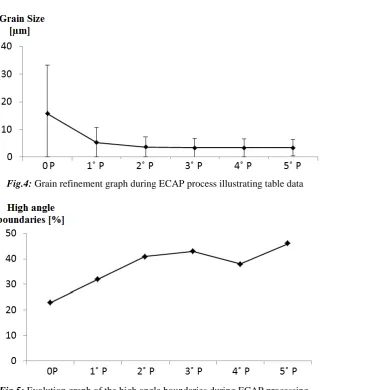
Table 2 shows the microstructural evolution promoted by 5 passes from the as received material. Figures 4 and 5 illustrate by means of graphs the data in Table 2, in which we observe respectively the stagnation of refining and development of high-angle boundaries process.
Fig.5: Evolution graph of the high angle boundaries during ECAP processing.
During the analysis of orientation maps, image quality and indexing indexes were observed strong evidence proving that the material underwent recrystallization and dynamic recovery during ECAP processing, which could explain the stagnation of microstructural refining after 3˚ Pass.
Resende [7] and Hauguem [12] studied aluminum alloys processed by ECAP presenting dynamic recrystallization of evidence through the evolution of the fraction of high-angle boundaries in the first four passes, this set of passes is classified as a first processing step ECAP [13].
V.
CONCLUSION
The microstructural refinement after processing via ECAP was performed efficiently, starting from a structure with coarser granulometry and achieving a fine microstructure. From the results obtained in this study, one can conclude that the mechanisms responsible for microstructural refinement were the subdivision processes through fragmentation and rotation of grains and dynamic recrystallization. It is also observed that the microstructural refinement process stalled after the third pass. This may be linked to the process of microstructural competition between recovery and dynamic recrystallization, since we observed evidence of this competition more often from the second pass. Soon, the ECAP process is shown to be effective only until the third pass processing for Al alloy AA1070, showing no significant changes in its microstructure beyond this pass due to the existing competition between recrystallization and dynamic recovery.
AA1070 Deformada a Frio Via Prensagem em Canais Equiangulares, dissertação de Mestrado, UFF, 2011.
[8]. Langdom, T.G., The Principles of grain refinement in equal-channel angular pressing. Materials Science and Engineering A, v. 462, p. 3-11, 2007.
[9]. Iwahashi, Y. et al. An investigation of microstructural evolution during equal-channel angular pressing. ActaMaterialia, v. 45, n. 11, p. 4733-4741, 1997.
[10]. Valiev, R. Z.; Langdom, T. G. Principles of equal-channel angular pressing as a processing tool for grain refinement. Progress in Materials Science, v. 51, n. 7, p. 881-981, 2006.
[11]. Langdom, T.G., The Principles of grain refinement in equal-channel angular pressing. Materials Science andEngineering A, v. 462, p. 3-11, 2007.
[12]. Haugen, C.G., Caracterização Microestrutural da Liga Al AA1070 Defromada via Prensagem em Canais Equiangulares a Frio Atravéz das Rotas BA e BC. Dissertação de Mestrado, UFF, 2014.
[13]. Suh, J.Y., Kim, H.S., Park, J.W., Chang, J.Y., Finite element analysis of material flow in equal channel angular pressing. ScriptaMaterialia, v. 44, p. 677-681, 2001.